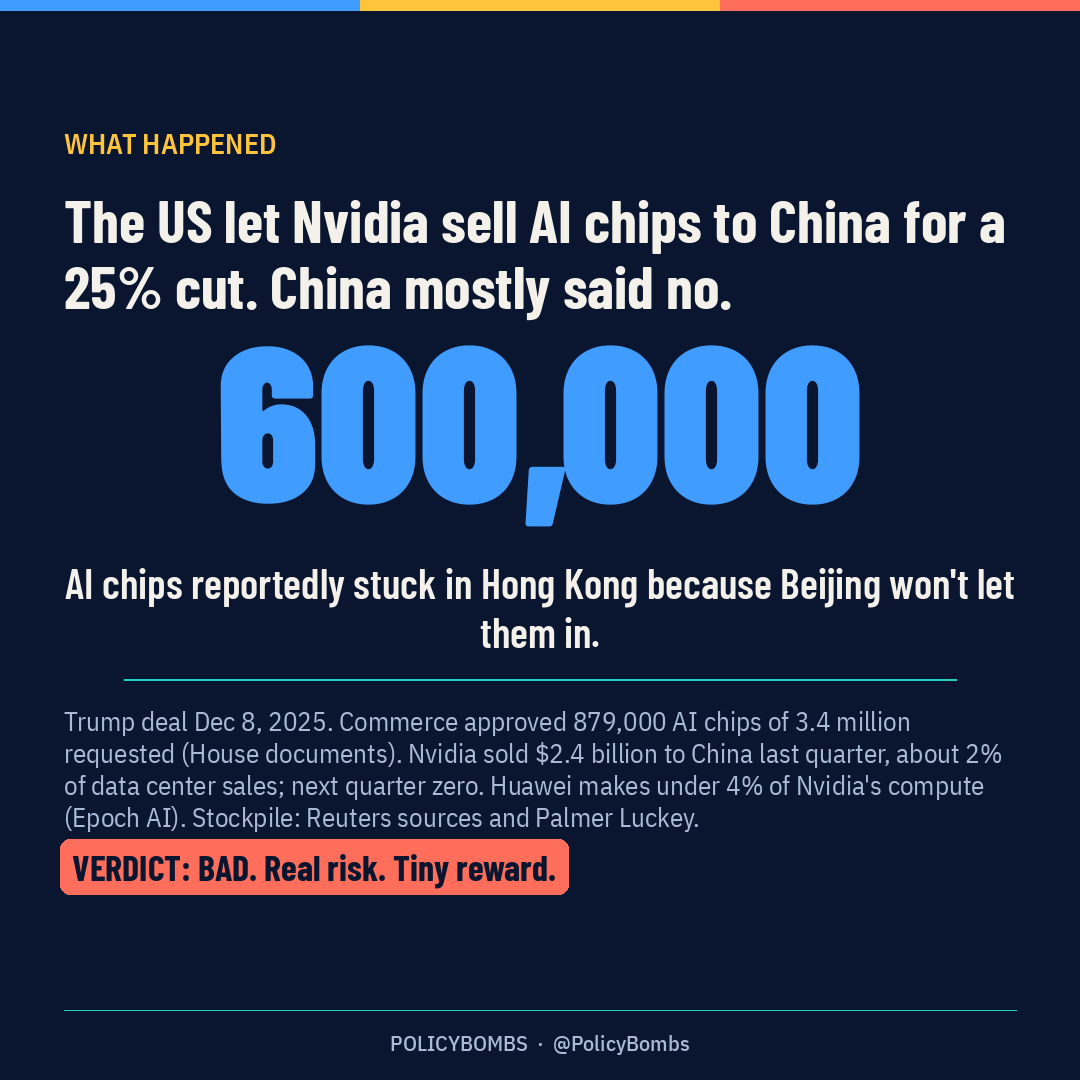
600,000. That's how many Nvidia H200 AI chips reportedly sit in Hong Kong, waiting on Beijing's import approval, per two people familiar who spoke to Reuters. Washington sold China access to the chips for a 25% cut. Then Beijing mostly said no.
The deal. On Dec 8, 2025, President Trump said Nvidia could ship H200s to "approved customers in China," with 25% paid to the United States. On Jan 15, 2026, Commerce moved those exports from presumed denial to case-by-case review. The cut is collected as a tariff when the Taiwan-made chips pass through the US for a security test.
The result. Nvidia sold $2.4 billion of licensed chips to China last quarter, about 2% of its $107.6 billion data center sales. Next quarter's guidance: zero. Nvidia says it has stopped shipping them. Treasury's take from the 25% has never been published.
The risk. Commerce approved 879,000 AI chips for Chinese firms out of 3.4 million requested through May 2026, per House Foreign Affairs documents. Some approvals went to firms the Pentagon lists as Chinese military companies. Commerce says licensing was interagency. Contested.
The best case for the deal: sell older chips and starve Huawei. Huawei makes under 4% of Nvidia's AI compute this year (Epoch AI), so the controls bite. But the plan needed Beijing to let its firms buy. It didn't. And Congress's own researchers say the 25% may be an export tax the Constitution forbids.
Verdict: BAD. Real risk. Tiny reward. The export controls underneath grade MIXED: they slow Huawei but leaked through smuggling and rented cloud compute until Nov 19, 2026.
Full analysis
Long-form analysis of US export licensing of Nvidia and AMD AI chips to China, 2025 to 2026. Content checked November 20, 2026 (America/Los_Angeles). Finding tags: Substantiated, Pending, Unverified, Contested, Unproven.
Research cutoff: November 20, 2026 (PT). Every figure below comes from a source fetched on this date. Fast-moving story: recheck before publishing.
Verdict: BAD on the 2025 to 2026 “sell for a cut” policy (H20 at 15%, then H200 at 25%). The harm was limited mainly because Beijing refused most of the chips, not because Washington’s safeguards held. The underlying export-control regime itself grades MIXED: it measurably slows China’s chipmakers but leaks through smuggling and remote access.
1. What is the policy
Jurisdiction: federal. Agencies: Commerce Department Bureau of Industry and Security (BIS), which licenses exports under the Export Control Reform Act of 2018 (ECRA); the President, who set the 25% fee through a Section 232 tariff proclamation.
Timeline (primary or wire sources):
- 2022 onward: US export controls have restricted China’s access to advanced Nvidia chips and the tools to make them (Reuters, Nov 5, 2026). Nvidia and AMD re-engineered weaker chips to stay legal in China (CNBC, Nov 19, 2026). The H20 was built for China after the 2023 rules (BBC, Aug 11, 2025).
- April 2025: The administration required licenses for the H20. Nvidia booked a $4.5 billion charge for H20 excess inventory and purchase obligations (Nvidia 10-Q, quarter ended April 27, 2025). Nvidia had first warned of up to $5.5 billion (Business Insider, July 16, 2025).
- July to August 2025: Licenses resumed. Nvidia agreed to pay the US government 15% of H20 China revenue; AMD agreed to 15% of MI308 China revenue (BBC, Aug 11, 2025).
- December 8, 2025: President Trump posted that the US “will allow NVIDIA to ship its H200 products to approved customers in China … $25% will be paid to the United States of America,” adding that Blackwell and Rubin are not part of the deal and “the same approach will apply to AMD, Intel” (Truth Social, archived by the American Presidency Project).
- January 14 to 15, 2026: Proclamation 11,002 imposed a 25% Section 232 tariff on a narrow class of chips (the White House names the H200 and AMD MI325X), with broad exemptions for US data centers, R&D, startups and other domestic uses (CRS LSB11409; White House fact sheet). BIS moved H200-class exports to China and Macau from a presumption of denial to case-by-case review, effective January 15, 2026 (Federal Register 2026-00789).
- BIS license conditions (Federal Register 2026-00789): chips must be below 21,000 TPP and 6,500 GB/s DRAM bandwidth; exporter certifies sufficient US supply and no diversion of foundry capacity; China and Macau shipments capped at 50% of the product’s US shipments; rigorous know-your-customer screening against unauthorized remote access; every shipment checked by a third-party lab in the US before export; the deal must not be barred by existing end-use and end-user controls.
- Through May 2026: BIS approved more than 879,000 AI chips to Chinese companies out of 3.4 million requested from December through May, per documents the House Foreign Affairs Committee released Nov 19, 2026 (CNBC). The Washington Post counts almost 580,000 of those as Nvidia chips (Nov 20, 2026). Reuters reported approvals for 10 Chinese firms, including Alibaba, Tencent and ByteDance (Reuters via Investing.com, Nov 18, 2026).
- Beijing’s response: China withheld approval for large-scale imports. About 600,000 H200s were reported stored in Hong Kong awaiting shipment, per two people familiar (Reuters, Nov 5, 2026). Several large Chinese internet firms each got about 10,000.
- November 11, 2026: Nvidia’s board accepted Jensen Huang’s resignation as CEO; CFO Colette Kress became interim CEO (Nvidia SEC filing; CNBC). Reporting ties the resignation to affairs, including with a former executive of Megaspeed, a Singapore firm US agencies are investigating for allegedly routing chips to China (CNBC, Nov 17, 2026). Nvidia’s board had said it had “no reason to believe that either national security or NVIDIA secrets were compromised” (Nvidia board statement, Nov 8, 2026). These are allegations; nothing here is an adjudicated finding.
- November 16 to 19, 2026: BIS issued an interim final rule requiring licenses for advanced chips sent to overseas data centers that supply significant compute to companies headquartered in China (Country Group D:5) or Macau, added license requirements for Indonesia, Malaysia, Singapore, Thailand and Brazil as diversion risks, and formally rescinded the Biden AI Diffusion Rule, which it says “has never been enforced” (Federal Register 2026-23529, effective Nov 19, 2026).
- November 17, 2026: Nvidia reported $2.4 billion of licensed Hopper data center sales to China in the quarter ended Oct 25, 2026, then said: “we are no longer shipping licensed Hopper data center products to China.” Its Q4 outlook assumes no China data center compute revenue (Nvidia Q3 FY2027 release and CFO commentary).
Status today: H200 licensing rule still on the books; Nvidia has stopped shipping; Congress is weighing three NDAA amendments (AI Overwatch Act, MATCH Act, Chip Security Act) (CNBC, Nov 17, 2026).
2. Why it exists
Stated reasons, pro-sale side:
- Jobs, taxpayers, manufacturing. Trump: the policy “will support American Jobs, strengthen U.S. Manufacturing, and benefit American Taxpayers,” and the Biden rules forced companies to build “degraded” products “nobody wanted” (Truth Social, Dec 8, 2025).
- Starve Huawei of its home market. David Sacks, White House AI czar: “you just don’t want to hand Huawei the entire Chinese market when Nvidia is capable of competing for a big slice of it with a deprecated, less capable chip” (Business Insider, July 16, 2025).
- Keep the world on the American tech stack. Jensen Huang (firsthand): Nvidia’s China share fell from “about 95 percent four years ago” to “about 50 percent”; China is a “$50 billion a year market” and home to “50 percent of the world’s AI researchers”; “we want every developer in the world to prefer the American technology stacks” (CNBC Mad Money transcript, May 28, 2025).
Stated reasons, control side:
- AI compute is the bottleneck for China’s frontier models. CNAS: “Chinese AI companies themselves cite this chip shortage as the critical bottleneck to their progress” (CNAS, Jan 16, 2026).
- Military use. Twenty security specialists wrote to the Commerce Secretary that inference chips “will enable autonomous weapons systems, intelligence surveillance platforms and rapid advances in battlefield decision-making” (BBC, Aug 11, 2025).
Honest underlying drivers:
- Trade bargaining. Reuters reports the H200 shift “followed US-China trade negotiations” (Reuters, Nov 5, 2026). Trump announced it as something he told Xi, who “responded positively.”
- Corporate lobbying. Reuters and CNBC both describe months of lobbying by Huang (Reuters via Investing.com, Nov 18, 2026; CNBC, Nov 17, 2026).
- Revenue. The 25% was collected as a tariff because ECRA bars fees for export licenses and the Constitution bars export taxes (CRS LSB11409). CRS notes some reporting treats the US security review as the mechanism “to collect [the] 25 percent fee.”
Test the slogans:
- “Benefit American Taxpayers.” Define: money actually collected by Treasury. Measure: no official collection figure has been published (searched this run; none found). Nvidia’s reported China Hopper sales were $2.4 billion in one quarter. Even if 25% applied to that full amount, the most it could be is about $600 million, and the tariff applies to import value, which can be lower than sale price. Status: UNVERIFIED and likely small against a federal budget.
- “Support American Jobs.” No agency or company has published a job count tied to China H200 sales. The chips are made in Taiwan by TSMC (Reuters, Nov 18, 2026); they enter the US for testing, then leave. Status: UNPROVEN.
- “Continued strong National Security.” Define: chips reach only vetted civilian buyers. Evidence: House documents say some approvals went to firms the Defense Department lists as “Chinese Military Companies,” and Rep. Mast says two applicants, Maginfra and New Matrix, are suspected smuggling fronts. BIS says licensing followed interagency review. Status: CONTESTED, pending the Dec 1 to 2 House interviews.
3. Realized effects
Revenue and market share (the promised upside):
- Nvidia’s China Hopper sales: $2.4 billion in Q3 FY2027, against $107.6 billion in data center revenue (about 2.2%) and $115.8 billion total revenue (Nvidia, Nov 17, 2026).
- Earlier, H200 shipments to China were under 1% of data center revenue for the quarter ending in July (CNBC, Nov 19, 2026).
- Forward guidance: zero China data center compute (Nvidia Q4 outlook).
- Bernstein’s Stacy Rasgon on the volume: “a rounding error. It’s tiny” (CNBC, Nov 19, 2026).
- Note: Nvidia’s total revenue from China-headquartered customers was $11.05 billion in the quarter, about 9.5% of revenue, which includes non-data-center products (Nvidia CFO commentary; CNBC). So China still matters to Nvidia; licensed AI data center chips are the small slice.
- Huang’s firsthand forecast tested: “a few hundred billion dollars worth of revenues to NVIDIA, probably tens of billions of dollars of taxes” over four years (May 2025). The record so far contradicts the pace: one quarter of $2.4 billion in licensed sales, then a halt. Flagged as contradicted by later data, though four years have not passed.
Did Huawei get starved? The market-share argument assumed Chinese buyers would be allowed to choose Nvidia. Beijing did not allow it at scale. Reuters (Nov 5, 2026) reports Beijing wanted firms to prioritize Chinese processors and approvals might total “fewer than 200,000 chips” (citing The Information). In 2025, Chinese authorities also cautioned firms over H20 purchases (Reuters, Aug 12, 2025, via search summary). So the strategy depended on a decision Beijing controls.
Palmer Luckey, Anduril founder (firsthand, DealBook, Nov 18, 2026): “China doesn’t want Nvidia to sell GPUs to Chinese companies … There are 600,000 H200 GPUs sitting in a port right now because China will not give them an import permit, because they want to build an internal domestic processor industry.” He also said: “I don’t think that we should be exporting chips to China.” Test: his 600,000 matches Reuters’ anonymous-source report of about 600,000 stored in Hong Kong. Not independently audited. Huang himself said in 2025 that the Chinese government prefers “indigenous technology” (CNBC transcript), which supports Luckey’s read.
Compute handed over versus China’s own output:
- CNAS estimated the 50% cap could let China acquire “almost 900,000 H200-equivalent chips, over twice what Chinese fabs are expected to produce this year,” with China’s 2026 domestic output estimated at about 390,000 H200-equivalents (CNAS, Jan 16, 2026; estimate built on SemiAnalysis and Bloomberg figures, with stated uncertainty). CNAS is a think tank; it calls the safeguards “almost entirely unenforceable.”
- Actual approvals (879,000 AI chips, all vendors) are close to that ceiling; actual deliveries are far lower because Beijing blocked them. Precise delivered volume: UNVERIFIED.
Do controls work at all? Evidence they bite:
- Epoch AI (Sept 2026): Huawei’s best chip, the Ascend 950, delivers roughly half an H100’s performance; Huawei will produce “less than 4% of Nvidia’s compute output this year”; export controls on high-bandwidth memory are the key bottleneck. Epoch is an independent research group.
- Gray-market prices: an eight-card H200 server sold for more than 6 million yuan ($900,000) in mainland China by late October 2026, about three times its price a year earlier (Reuters, one person familiar).
Evidence they leak:
- Smuggling via intermediaries (Reuters, Nov 5, 2026) and the Megaspeed investigation (CNBC).
- Remote access: until Nov 19, 2026, Chinese firms could rent the newest chips in third-country data centers; BIS closed that only this week (Federal Register 2026-23529).
Unintended consequences:
- A pay-for-license precedent. Peter Harrell (Carnegie, former Biden official): “charging a fee in exchange for relaxing national security export controls is a terrible precedent” (BBC). Deborah Elms (Hinrich Foundation): “You either have a national security problem or you don’t” (BBC).
- Legal exposure. CRS (March 23, 2026) says it is “debatable” that Section 232 authorizes the 25% tariff and that it “might be viewed as an unconstitutional tax” on exports. Two Nvidia shareholders sued in Delaware in January 2026 seeking records (CRS).
- Policy whiplash: ban (April 2025), sell for 15% (August 2025), sell for 25% (January 2026), stop shipping and tighten remote access (November 2026). Nvidia took a $4.5 billion charge in the first swing alone.
4. Good or bad for society
Verdict: BAD for the sell-for-a-cut policy.
Why:
- It traded a national security tool for a revenue share that, on available data, is small and unreported.
- It promised to starve Huawei, but Beijing, not Washington, decided whether Chinese firms could buy, and Beijing said mostly no.
- It approved large volumes (879,000 chips) with safeguards that CNAS calls unenforceable and that House documents suggest reached DoD-listed military companies. CONTESTED; BIS disputes the framing.
- It rests on a legal theory CRS calls debatable and possibly unconstitutional.
Strongest counterargument (stated fairly): If Beijing blocks most imports anyway, the security harm from the licenses was small, and banning sales outright hands Beijing a ready excuse to build its own industry while American firms forfeit a market and its developers. Sacks and Huang argue that market share and developer lock-in are long-term security assets, and Huang says China is home to half the world’s AI researchers. Luckey’s firsthand account supports the first half: China itself was the brake. But that cuts against the policy too: a strategy that only works if your rival cooperates is not a strategy, and the deliveries that did happen (about 10,000 chips each to several large firms, per Reuters) went to the companies building China’s frontier models.
National security versus revenue, R&D and market share, weighed both ways:
- R&D funding argument: Nvidia earned $65.3 billion in GAAP net income in one quarter (Nvidia, Nov 17, 2026). China H200 sales at about 2% of data center revenue are not what funds Nvidia’s R&D. Weak argument at this scale.
- Market share argument: real in principle (Huang’s 95% to 50% figure is firsthand and unrebutted in this record), but undercut by Beijing’s import controls.
- Security argument: supported by Epoch’s evidence that controls slow Huawei, and by CNAS’s compute math. Weakened by leakage (smuggling, remote rental) that the license policy did not create but also did not fix until November 2026.
Community impact: no US community-level jobs, wages or tax gains tied to these sales were found. Not assumed to be zero; UNVERIFIED.
What a good policy would include
- Congress sets the rules, not deal-by-deal bargaining. The AI Overwatch Act would codify bans on the most powerful chips to adversaries and let Congress review and block specific licenses (CNBC, Nov 17, 2026). H.R. 6875 would require a joint resolution to approve certain licenses (CRS). Cost estimate: none found. UNVERIFIED.
- Track the chips. The Chip Security Act would require location verification for export-controlled AI chips (CNBC). Cost and technical feasibility estimate: none found. UNVERIFIED.
- Close remote access. Done by the Nov 19, 2026 interim rule; watch enforcement after the 90-day license window (Federal Register 2026-23529).
- Allied alignment on chipmaking tools. The MATCH Act would block equipment sales to adversary-country firms and penalize allies that do not match (CNBC).
- No pay-for-license. Security decisions should not depend on revenue; CRS flags ECRA’s fee bar and the Export Clause.
- Transparency. Publish license approvals, denials and Treasury collections on a schedule. Today the public learned the approval count only because a House committee voted to release it (CNBC, Nov 19, 2026).
- Fund enforcement. BIS enforcement capacity was criticized by Rep. Meeks (“failed to enforce the rules”). A sourced budget figure was not gathered this run. UNVERIFIED.
Rigor checklist notes
- Eligibility (citizens vs immigrants): not applicable to this policy.
- Substitute costs and reliability: the BIS rule requires exporters to certify no delay to US customers and no diverted foundry capacity; no evidence was found either way on whether US supply was affected.
- Fiscal: Treasury collections unpublished; at most a few hundred million dollars on reported sales. Not material to the deficit.
- Integrity: House documents allege approvals to suspected smuggling fronts. Allegation, not finding.
- Nuisance, community, self-funded alternatives: not applicable.
- Funding labels: CNAS (think tank, national security focus); Epoch AI (independent research group); Bernstein (sell-side analyst); Hunterbrook (short-seller-linked media, AMD allegations not used as evidence here).
Politicians and public figures
For the sales (or for loosening):
- President Donald Trump: announced H200 sales for 25% (Dec 8, 2025).
- Commerce Secretary Howard Lutnick: per six sources to Axios, resisted curbs on suspected diverters and warned they “will start a trade war with China.” Commerce denied parts of the account (Axios, Nov 11, 2026).
- David Sacks, White House AI czar: deprive Huawei of its home market (July 2025).
- Treasury Secretary Scott Bessent: says no further restrictions on older Nvidia chips are needed now that remote access is closed (AP, Nov 20, 2026), while pressing for action on Megaspeed (Axios).
- Jensen Huang (industry, firsthand): called the earlier controls costly and argued for selling to keep developers on US technology.
Against the sales (or for tighter controls):
- Rep. John Moolenaar (R-MI), House China Select Committee chair: the scandal “really highlights the need for export controls” (CNBC, Nov 17, 2026).
- Rep. Brian Mast (R-FL), House Foreign Affairs chair: released the license data; calls two applicants “fake companies” (CNBC, Nov 19, 2026).
- Rep. Gregory Meeks (D-NY), ranking member: BIS “has failed to enforce the rules.”
- Senate Minority Leader Chuck Schumer (D-NY) and House Minority Leader Hakeem Jeffries (D-NY): back the NDAA chip amendments.
- Speaker Mike Johnson (R-LA): “developing consensus” to limit chip exports to China.
- Rep. Jake Auchincloss (D-MA), on the 15% deal: “Now the US government is financially motivated to sell AI to China?” (BBC).
- Palmer Luckey (industry, firsthand): opposes exporting chips to China.
- Elon Musk: per Axios sources, backed imposing controls on suspected diverters; separately signed a petition to reinstate Huang (Euronews). Reported, not firsthand on the H200 question.
- Marc Andreessen: no on-record statement on H200 sales found this run.
Gaps and unverified items
- Treasury collections under the 15% and 25% arrangements: not published. UNVERIFIED.
- Actual H200 units delivered into mainland China: not published. Reuters’ about 10,000 per major firm is one source. UNVERIFIED.
- 600,000 in Hong Kong: anonymous Reuters sources plus Luckey’s firsthand claim. Not audited.
- Approvals to DoD-listed military companies and suspected fronts: House committee documents and Rep. Mast; BIS disputes the framing. CONTESTED.
- Huang resignation: tied in reporting to an alleged intelligence link; Nvidia’s board said no reason to believe secrets were compromised. Allegations only.
- Jobs created: none documented. UNPROVEN.
- Cost estimates for AI Overwatch, Chip Security and MATCH Acts: not found. UNVERIFIED.
References
- Reuters (via Investing.com), “Nvidia chips pile up in Hong Kong as China withholds import approval,” Nov 5, 2026. https://www.investing.com/news/stock-market-news/exclusivenvidia-chips-pile-up-in-hong-kong-as-china-withholds-import-approval-5003223
- Reuters (via Investing.com), “Nvidia stops shipping US-approved AI chips to China,” Nov 18, 2026. https://www.investing.com/news/stock-market-news/nvidia-stops-shipping-usapproved-ai-chips-to-china-5035204
- CNBC, “Commerce approved sales of more than 879,000 AI chips to Chinese companies, Rep. Mast says,” Nov 19, 2026. https://www.cnbc.com/2026/11/19/nvidia-amd-china-chip-sales-congress.html
- Washington Post, “Officials approved the sale of 580,000 Nvidia chips to Chinese companies,” Nov 20, 2026. https://www.washingtonpost.com/technology/2026/11/20/officials-approved-sale-580000-nvidia-chips-chinese-companies/
- CNBC, “Jensen Huang scandal fuels bipartisan push to block AI chip sales to China,” Nov 17, 2026. https://www.cnbc.com/2026/11/17/congress-ai-china-jensen-huang-chips.html
- Nvidia, Q3 FY2027 results, Nov 17, 2026. https://investor.nvidia.com/news/press-release-details/2026/NVIDIA-Announces-Financial-Results-for-Third-Quarter-Fiscal-2027/
- Nvidia CFO commentary and 8-K exhibit, Q3 FY2027. https://www.sec.gov/Archives/edgar/data/1045810/000104581026000088/0001045810-26-000088.txt
- Nvidia earnings call transcript, Q3 FY2027 (Exa library). https://exa.ai/library/markets/stocks/NVDA/earnings/FY2027/Q3/transcript
- Nvidia Form 10-Q, quarter ended April 27, 2025. https://www.sec.gov/Archives/edgar/data/1045810/000104581025000116/nvda-20250427.htm
- Nvidia Board statement, Nov 8, 2026. https://nvidianews.nvidia.com/news/statement-from-nvidia-board-of-directors
- Federal Register 2026-00789, “Revision to License Review Policy for Advanced Computing Commodities,” Jan 15, 2026. https://www.federalregister.gov/documents/2026/01/15/2026-00789/revision-to-license-review-policy-for-advanced-computing-commodities
- Federal Register 2026-23529, “Addressing Remote Access to Advanced Semiconductors,” Nov 19, 2026. https://www.federalregister.gov/documents/2026/11/19/2026-23529/addressing-remote-access-to-advanced-semiconductors
- BIS press release, Nov 16, 2026. https://www.bis.gov/press-release/bis-issues-rule-addressing-remote-access-american-super-intelligence-technology
- White House fact sheet, January 2026. https://www.whitehouse.gov/fact-sheets/2026/01/fact-sheet-president-donald-j-trump-takes-action-on-certain-advanced-computing-chips-to-protect-americas-economic-and-national-security/
- Congressional Research Service, LSB11409, “Legal Authority for Export Controls and Tariffs on Semiconductor Chips Sold to China,” March 23, 2026. https://www.congress.gov/crs_external_products/LSB/PDF/LSB11409/LSB11409.1.pdf
- American Presidency Project, Truth Social posts of Dec 8, 2025. https://www.presidency.ucsb.edu/documents/truth-social-posts-december-8-2025
- CNAS, “Unpacking the H200 Export Policy,” Jan 16, 2026. https://www.cnas.org/publications/cnas-insights/cnas-insights-unpacking-the-h200-export-policy
- Epoch AI, “Will Huawei catch up to Nvidia by 2030?” Sept 2026. https://epoch.ai/publications/huaweis-roadmap-to-2031
- BBC, “Nvidia and AMD to pay 15% of China chip sales to US,” Aug 11, 2025. https://www.bbc.com/news/articles/cvgvvnx8y19o
- Business Insider, “White House AI czar says resuming Nvidia’s chip sales to China is all about capping Huawei’s growth,” July 16, 2025. https://www.businessinsider.com/white-house-ai-czar-selling-nvidia-chips-china-cap-huawei-2025-7
- CNBC, Jensen Huang Mad Money transcript, May 28, 2025. https://www.cnbc.com/2025/05/28/cnbc-transcript-nvidia-founder-president-ceo-jensen-huang-speaks-with-cnbcs-jim-cramer-on-mad-money-today.html
- TechCrunch, Palmer Luckey at DealBook, Nov 18, 2026. https://techcrunch.com/2026/11/18/palmer-luckey-thinks-china-is-thrilled-to-have-jensen-out-so-he-wants-the-ousted-nvidia-ceo-reinstated/
- Times of India, Luckey DealBook quotes, Nov 20, 2026. https://timesofindia.indiatimes.com/technology/tech-news/palmer-luckey-wants-jensen-huang-back-as-nvidia-ceo-he-was-on-the-side-of-chinese-ai-companies-but-/articleshow/136021608.cms
- Axios, “Lutnick stalled Trump’s Nvidia-China chip curbs after Oval talks,” Nov 11, 2026. https://www.axios.com/2026/11/11/trump-lutnick-nvidia-china-chip-export-controls
- Euronews, “Elon Musk joins calls to bring back Jensen Huang,” Nov 16, 2026. https://www.euronews.com/2026/11/16/elon-musk-joins-calls-to-bring-back-jensen-huang-as-allies-build-war-room-to-lobby-his-ret
- AP, “Bessent: No added restrictions needed for Nvidia exports to China,” Nov 20, 2026. https://apnews.com/article/nvidia-chip-export-restrictions-china-bessent-lutnick-88142455395552afe74caec3399a648b
- Reuters, “China cautions tech firms over Nvidia H20 AI chip purchases,” Aug 12, 2025 (read via search summary only; page blocked). https://www.reuters.com/world/china/china-cautions-tech-firms-over-nvidia-h20-ai-chip-purchases-sources-say-2025-08-12/
- Starting source (Korean-language commentary on Luckey’s remarks), X post by @USAnt_IDEA, Nov 19, 2026. https://x.com/USAnt_IDEA/status/2123436441640579406