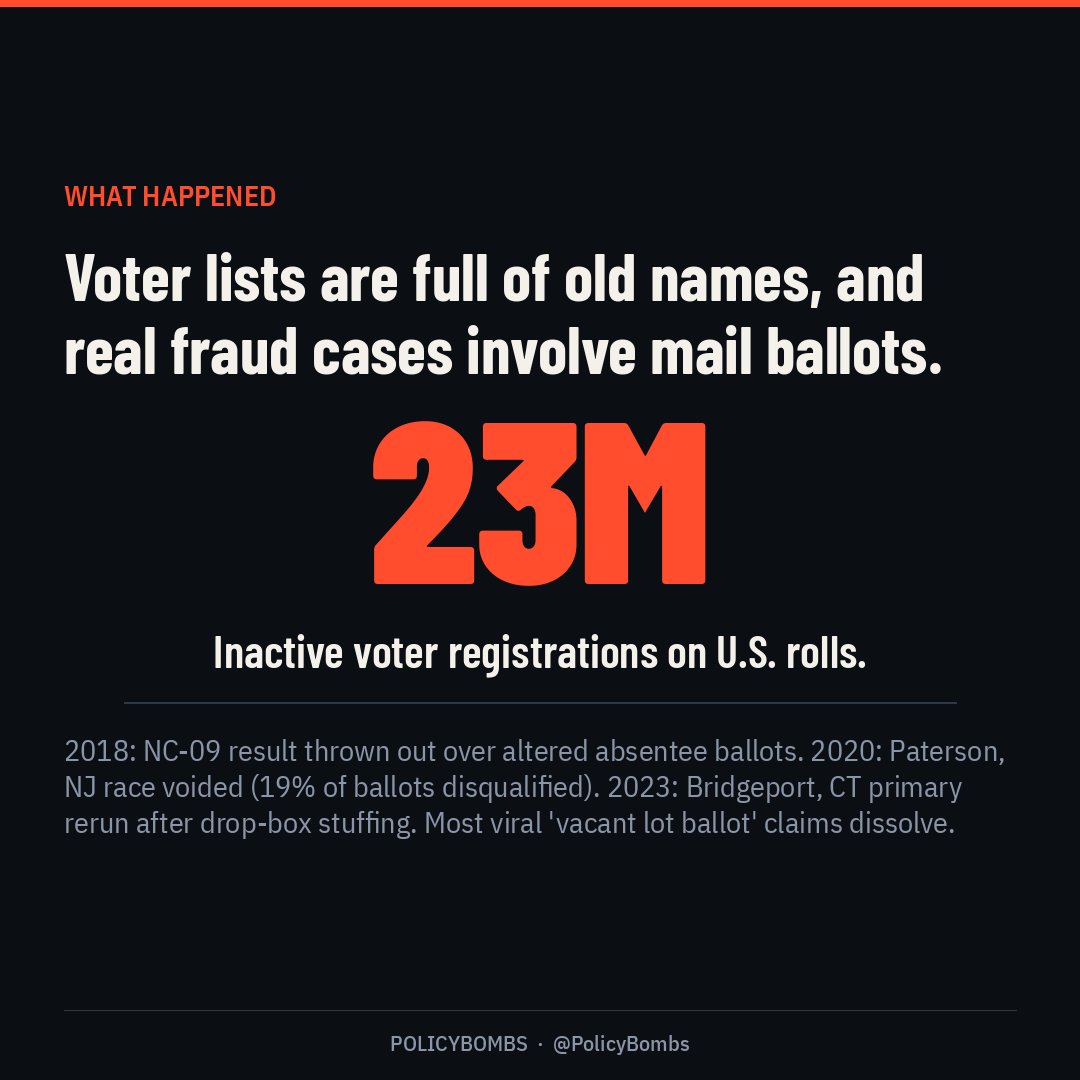
Absentee Ballots, Harvesting & Voter Rolls

23 million inactive voter registrations. And mail ballots are where proven, outcome-changing fraud keeps turning up.

2018: a GOP operative's crew altered absentee ballots and North Carolina threw out the NC-09 result. 2020: a Paterson, NJ council race voided after 19% of ballots were disqualified. 2023: Bridgeport, CT reran a mayoral primary after cameras caught drop-box stuffing. Yet most viral 'vacant lot ballot' claims dissolve on follow-up.

PRO: Mail voting serves millions and is mostly honest.

CON / COST: Loose ballot-return rules have flipped local and congressional races.

SOCIETY: Tighten carriers, ID, signature cure, drop-box cameras, list upkeep.


Full analysis

Absentee Ballot Abuse, Ballot Harvesting and Unclean Voter Rolls

Local cases, court outcomes, audit data and voter-roll anomalies, each paired with what investigators actually concluded. As of Nov 4, 2026.

Content as of Nov 4, 2026, 8:33 PM ET. Source Page: PolicyBombs canvas

Long-form deep analysis. Companion to the 10-minute quick reference (22-absentee-harvesting-voter-rolls-summary.docx).

Contents

  • 10-Minute Voter Guide
  • 1. What is the policy
  • 2. Why it exists (incentives and corruption risk)
  • 3. Realized effects
  • 4. Good or bad for society
  • Anomaly and case table
  • Who supports / who opposes
  • References

10-Minute Voter Guide

Who’s for / against: For ballot collection and mail voting: California Democrats (AB 1921, 2016; SB 1174 banning local voter ID, 2024). For tighter rules: Republicans (Georgia SB 202, Texas SB 1, Trump’s 2025 EO). Surprise: the California GOP used ballot collection in 2020, and the worst proven harvesting fraud (NC-9, 2018) was by a Republican operative.

Mail ballots are the one part of American voting where proven, outcome-changing fraud keeps turning up. In 2018 a GOP operative’s crew in rural North Carolina collected and altered absentee ballots, and the state threw out a congressional result (NC-09). In 2020 a Paterson, NJ council race was voided after 19% of ballots were disqualified. In 2023 Bridgeport, CT had to rerun a mayoral primary after cameras caught people stuffing drop boxes. These cases are local, organized by insiders, and aimed at races won by a few hundred votes, where a single operative can swing the result. Messy voter rolls are a different problem. There are 23 million inactive registrations, plus dead and moved voters who linger on the lists. That clutter creates the opportunity, but when officials follow up, most viral claims of "ballots at vacant lots" turn out to be shelters, typos, or ballots that were already voided. Actual votes cast in dead people’s names number in the single or double digits per state. Prosecutions often collapse: the Paterson cases were dismissed in 2026, and Bridgeport and Frio County, TX are still pending.

Pros of easy mail voting / third-party return

Cons

+ Access for elderly, disabled, rural, military and shift-working voters (30% of 2024 voters used mail)

+ Paper trail: every mail ballot has an envelope, signature and audit trail

+ 98.8% of returned mail ballots were counted in 2024 (EAVS)

– Ballots are filled out away from poll workers, so coercion and harvesting can’t be seen

– Proven cases have overturned real elections (NC-09, Paterson, Bridgeport)

– Dirty rolls mean ballots get mailed to people who moved or died, creating opportunity

– Prosecutions are slow and often fail, so deterrence is weak

Bottom line: Mail-ballot fraud is rare statewide but real and decisive in small local races. The best-documented abuses come from paid or partisan ballot handlers, not from phantom voters at vacant lots. Back reforms that verify the voter and record who handled the ballot (ID number on the envelope, signature cure, chain-of-custody limits on who may return ballots, cameras on drop boxes, routine list maintenance with ERIC). Be skeptical of viral address claims until a county follows up.

1. What is the policy

Item

Detail

Absentee / mail voting

Every state allows some mail voting; 8 states (plus DC) mail every voter a ballot. 2024: 66.9M mail ballots sent, 48.0M returned, 47.6M counted (EAVS).

Ballot return by third parties ("harvesting")

Rules vary widely. California AB 1921 (2016, effective 2017) lets a voter designate anyone to return their ballot, and it can’t be a paid-per-ballot arrangement. Texas SB 1 (2021) makes paid vote harvesting a felony; the 5th Circuit upheld that ban in Feb 2026. NC, AL and others limit return to family or guardians.

Voter-roll maintenance (NVRA Sec. 8)

States must make a ‘reasonable effort’ to remove dead and moved voters. A voter who doesn’t answer a confirmation notice becomes inactive and is removed only after two federal general elections without contact. No systematic removals are allowed within 90 days of a federal election. Private groups (Judicial Watch, PILF) enforce this by lawsuit. For example, Judicial Watch’s 2019 settlement with LA County and California required notices to up to 1.5M inactive registrants.

Verification tools

Signature match (most states), ID number or copy on the envelope (TX, GA, MN, OH, AL, AR, etc.), witness or notary (a few), ballot tracking, ERIC interstate data-sharing (about 24 states plus DC as of 2026, after 9 GOP-led states left in 2023), and SSA death data.

2. Why it exists (incentives and corruption risk)

Case for broad mail voting and assisted return

Case for tight limits

+ Turnout and convenience, especially for the elderly and disabled

+ Lower cost per voter in all-mail states

+ Help for voters who can’t reach a mailbox (rural, tribal lands, homebound)

– The secret ballot is lost at the kitchen table: family, caregivers or operatives can pressure the voter

– Chain of custody breaks when one person carries dozens of ballots

– Bloated rolls send live ballots to wrong addresses

Incentives to cheat: the documented schemes cluster where (1) margins are tiny, (2) one party dominates, so the primary is the real election, (3) patronage jobs or contracts depend on the result (city councils, county judges, mayors), and (4) paid canvassers are paid per ballot. Dowless was paid by the Harris campaign’s consultant. Bridgeport’s defendant was a city employee and party vice-chair. The Frio County defendants include a county judge and city officials. This is retail corruption by local insiders, not national conspiracies, and that is why local court records find it while national studies miss it.

Incentives to exaggerate: activist groups raise money from viral "bogus ballot" counts, and national politicians cite inflated numbers (e.g. Trump’s 5,000 dead Georgia voters versus the 4 investigators found). Incentives to downplay: officials are graded on smooth elections, and both parties’ local machines benefit from mail-ballot operations.

3. Realized effects

A. Proven schemes that changed or voided results

Item

Detail

Assessment

NC-09, 2018 (Bladen/Robeson counties)

Republican Mark Harris led by 905 votes. Operative McCrae Dowless’s paid workers collected, filled in and discarded absentee ballots, and Harris won 61% of Bladen mail ballots. The state board refused to certify and ordered a new election (2019). Dowless was indicted but died in April 2022 before trial. Co-defendants (Lisa Britt and others) pleaded guilty and got probation or community service.

Substantiated; result voided

Paterson NJ, May 2020 council (all-mail)

About 19% of ballots (roughly 3,190 of 16,747) were disqualified, and hundreds of ballots were found bundled in mailboxes. A judge voided the 3rd Ward result; Alex Mendez won the rerun by 9 votes. Councilmen Mendez and Michael Jackson were indicted. Mendez’s case was dismissed in April 2026 on speedy-trial grounds and an undisclosed witness immunity deal. Jackson’s case also collapsed in May 2026 after a state investigator gave the grand jury inaccurate information. Correction to earlier framing: no conviction of the councilmen.

Result voided; prosecution failed

Bridgeport CT, Sept 2023 Dem mayoral primary

Ganim beat Gomes by 251 votes (4,212 to 3,961) after winning absentees roughly 2-to-1. Surveillance video showed stacks of ballots stuffed into drop boxes. Judge William Clark voided the result and ordered a new primary (Ganim won the Jan 2024 redo). Feb 2025: five people charged, including Wanda Geter-Pataky (96 counts). As of Aug 2026 she and Alfredo Castillo rejected plea deals and chose jury trials.

Result voided; charges pending

Frio County TX, 2024 (Paxton)

Nine people were indicted, later 15 defendants including County Judge Rochelle Camacho and city officials, for paid vote harvesting. All pleaded not guilty. No convictions as of Nov 2026. A related $50M defamation suit was dismissed in May 2026.

Pending

B. Voter-roll anomalies and what follow-up found

Claim / anomaly

What follow-up found

Status

Fulton County GA (AJC 2013): over 100 people voted in 2012 while registered at demolished public-housing sites

Real roll decay: 10,000 or more addresses didn’t match. AJC found mostly ex-residents who had moved but kept old registrations. Officials began a cleanup; no fraud prosecutions reported

Anomaly real; fraud unsubstantiated

Venice CA, 2026: 26 voters ‘at a vacant lot’ (viral video, 1.3M views)

LA County: the site was a Bridge Home homeless shelter until Dec 31, 2024. State law lets homeless voters register at a shelter. 23 active records remained, subject to undeliverable-mail inactivation

Unsubstantiated (PolitiFact: False)

Clark County NV and Detroit MI: ‘voters at vacant lots’ (Crowder, 2021)

Clark County found typos by the video makers (wrong street or direction) and some clerical errors in county records. Real addresses included senior apartments

Unsubstantiated as fraud; some record errors

Wisconsin 2024: 30,084 mail-ballot requests at ‘fishy addresses’ (CommonSense Elections)

Commercial data-matching (moved, undeliverable, missing apartment number). No official finding of illegal votes published. In a separate RNC complaint, the Wisconsin Elections Commission showed the ballots flagged had already been voided when the voter went inactive or died

Unverified / mostly explained

Jeff Davis Parish LA (KPLC 2023): registrations at vacant lots and dilapidated homes

Registrar removed some names and sent 18 address-verification letters

List cleanup; no charges reported

‘Up to ~40 ballots tied to one vacant house’

Not located in local news, court or official sources this turn for any U.S. state. The closest documented items are the Venice lot (26 registrations, a shelter) and Fulton’s demolished-housing voters (over 100 across several sites). Treat it as unverified until the address, county and election are known

Unverified

C. Dead voters and duplicates: what audits found

Item

Detail

Assessment

Georgia 2020

Trump claimed 5,000 dead voters; SOS investigators found 4 ballots cast in dead people’s names, all by relatives, and referred them for prosecution.

4 substantiated

Michigan 2020 (Auditor General, 2022)

1,616 counted ballots came from people dead by Election Day (0.03% of 5.5M). Most were absentee ballots legally cast before the voter died. Clerks rejected another 3,469 such ballots. Duplicate votes were minimal.

Mostly lawful

2024 rejection data (EAVS)

11.1% of rejected mail ballots (about 36,000 nationally) were rejected because the voter had already cast another accepted ballot. The double-vote check catches these, but it shows how often attempts or mistakes happen.

Caught by system

ERIC

Since 2013 member states have been flagged on 14.6M cross-state movers and 1.46M in-state duplicate registrations (to Sept 2026). These are list-cleanup leads, not fraud findings. Kansas’s Crosscheck (closed 2019) had about 99% false positives; a study estimated about 300 legitimate registrations would be wrongly purged for every real double vote.

Data

Heritage database

387 ‘fraudulent use of absentee ballots’ cases (as of Dec 2025) out of about 1,600 total cases, spanning decades. It is a sample of proven cases, not a measure of how common fraud is.

Proven cases

D. Scale of roll clutter (EAVS 2024)

Metric

2024 value

Active registrations

211,144,275

Inactive registrations (need address confirmation before voting)

23,184,185 (about 1 in 10)

Records removed, 2022 to 2024 registration close

21,298,175

Confirmation notices sent / returned undeliverable / never answered

38.8M sent / 8.4% undeliverable / 69.7% unanswered

Mail ballots sent / returned / counted

66.9M / 48.0M (72%) / 47.6M (98.8%)

Share of jurisdictions using undeliverable mail ballots to flag voters for removal

64.8%

The national count of undeliverable domestic mail ballots (EAVS item C1c) is not stated in the EAC narrative. Advocacy figures (e.g. PILF’s roughly 1M+ for 2020) were not re-verified this turn.

E. Nursing homes and audits

Item

Detail

Assessment

Racine County WI nursing home, 2020

Sheriff Schmaling said 8 residents at Ridgewood Care Center who lacked capacity had voted, after the Elections Commission suspended visits by special voting deputies. The Racine DA declined to charge commissioners (no jurisdiction). Milwaukee and other DAs also declined, finding insufficient evidence; staff weren’t charged. Real procedural breach (law suspended without authority), but not prosecutable fraud.

No charges

Arizona (Maricopa) 2021 Cyber Ninjas review

The hand count confirmed Biden’s win. Claims of voters at vacant or ‘moved’ addresses relied on commercial data; Maricopa’s rebuttal found almost all were lawful (e.g. military, students, address-confidential voters). AP: ‘nonsensical conclusions’.

Unsubstantiated

Michigan 2020 (Senate GOP oversight report, Auditor General)

No evidence of widespread fraud. Dead-voter counts were mostly timing, not fraud.

Unsubstantiated as widespread

F. Margins: why small numbers matter

Race

Margin

Paterson 3rd Ward rerun, 2020

9 votes

Virginia HD-94, 2017

Tie, decided by drawing a name from a bowl

Bridgeport primary, 2023

251 votes (voided)

Florida presidential, 2000

537 votes

NC-09, 2018

905 votes (voided)

Arizona presidential, 2020

10,457 votes

Georgia presidential, 2020

11,779 votes

Wisconsin presidential, 2020

20,682 votes

One operative with a crew (Dowless had a few dozen ballots per worker) can exceed margins at the bottom of this table. No documented scheme has come close to the statewide presidential margins.

4. Good or bad for society

Verdict: Mail voting with loose ballot-return rules and stale rolls is a real vulnerability. It has demonstrably flipped local and congressional results, which is more than can be said for in-person impersonation or noncitizen voting. The fix is not ending mail voting, which serves millions and is mostly honest. The fix is tightening the few points where operatives intervene: who may carry ballots, ID on the envelope, signature checks with notice and cure, drop-box cameras, and steady list maintenance. Viral ‘vacant house’ claims usually dissolve on follow-up; organized local harvesting does not.

Trade-offs of tightening

Risks of tightening

+ Limits on who can return ballots plus custody logs would have flagged NC-09 and Bridgeport earlier

+ ID numbers on envelopes verify the voter more objectively than signature matching

+ Clean rolls remove the raw material for misdirected ballots

– Texas SB 1 ID rules caused about 12% of mail ballots to be rejected in the March 2022 primary before the rate fell

– Aggressive purges hit eligible voters (Crosscheck’s 99% false positives)

– Harvesting bans can criminalize innocent help to elderly or disabled voters

  1. Require ID number (last 4 of SSN or driver’s license number) on mail ballot envelopes, with a cure period.
  2. Limit ballot return to family, household or caregivers, require the returner’s name on the envelope, and ban per-ballot pay.
  3. Put cameras on drop boxes and publish the footage when results are challenged (the Bridgeport video was the key evidence).
  4. Belong to ERIC or an equivalent, run monthly SSA death matches, and process undeliverable mail before each election.
  5. Fund state election-crimes units with speedy-trial discipline; collapsed cases (Paterson) destroy deterrence.
  6. Require citizen auditors’ address lists to go to counties for follow-up before they’re published as fraud.

Anomaly and case table

Case

Type

Scale

Official conclusion

NC-09 2018

Paid harvesting/alteration

Hundreds of ballots; 905 margin

Substantiated; voided; pleas

Paterson NJ 2020

Mail ballot fraud alleged

19% disqualified

Voided; charges dismissed 2026

Bridgeport CT 2023

Drop-box stuffing

251 margin

Voided; 5 charged, pending

Frio County TX 2024

Paid harvesting

15 defendants

Pending

Georgia dead voters 2020

Impersonation

4 ballots

Substantiated (relatives)

Michigan dead voters 2020

Timing

1,616 counted

Mostly lawful

Racine nursing home 2020

Procedural breach

8 residents

No charges

Fulton demolished housing 2012

Roll decay

Over 100 voters

No charges reported

Venice CA lot 2026

Address claim

26 registrations

Shelter; false

Wisconsin 30,084 requests 2024

Commercial data claim

30,084

Unverified

‘~40 ballots at a vacant house’

Address claim

~40

Not found / unverified

Who supports / who opposes

For = expanding mail voting and ballot collection. Against = tightening absentee rules. Mixed = a proven harvesting fraud case. Each row cites a numbered source below. Checked Nov 4, 2026.

Who

Party / level

Position

Evidence

Ref

Asm. Lorena Gonzalez (D); Gov. Jerry Brown (D-CA)

Democrat

For

AB 1921 (2016) lets anyone a voter designates return their mail ballot

[1]

Gov. Gavin Newsom (D-CA); Sen. Dave Min (D)

Democrat

For

SB 1174 (2024) bars local voter-ID rules, aimed at Huntington Beach Measure A

[2]

Gov. Brian Kemp (R-GA)

Republican

Against

Signed SB 202 (2021), adding ID for absentee ballots and limiting drop boxes

[3]

Gov. Greg Abbott (R-TX)

Republican

Against

Signed SB 1 (2021), tightening mail and assistance rules

[4]

President Donald Trump

Republican

Against

EO of Mar 25, 2025 on ballot receipt deadlines and voter-list checks

[5]

McCrae Dowless (R operative), NC-9

Republican

Mixed

Absentee-ballot fraud led to a new 2019 election

[6]

Cross-party defectors: The California Republican Party set up its own unofficial ballot-collection boxes in 2020; AG Becerra (D) and SoS Padilla (D) ordered them removed [7]. Democrats Joe Manchin and Kyrsten Sinema voted with all Republicans against changing the filibuster for the Freedom to Vote Act; the rules change failed 52–48 (Jan 19, 2022) [8].

How positions shifted: Republicans led on absentee voting before 2020 (e.g., Florida, Utah). After 2020, GOP positions turned against mail voting, while Democrats expanded it.

Sources for this section:

References

[1] AP: Dowless dies before trial. apnews.com. https://apnews.com/article/2022-midterm-elections-north-carolina-general-raleigh-1f8751124b441d55be5f9317a2124e55

[2] WSOC: NC9 saga ends with two guilty pleas. wsoctv.com. https://www.wsoctv.com/news/local/with-two-guilty-pleas-nc9-election-fraud-saga-comes-an-end/HSJOA7VKRNH5JJKC3B4UV5KZD4/

[3] NorthJersey: 19% of Paterson votes disqualified. northjersey.com. https://www.northjersey.com/story/news/paterson-press/2020/05/20/paterson-nj-election-officials-disqualify-19-percent-votes-cast/5233032002/

[4] NJ Globe: Mendez charges dropped (Apr 2026). newjerseyglobe.com. https://newjerseyglobe.com/local/voter-fraud-charges-against-paterson-councilman-dropped-after-six-years/

[5] NorthJersey: case against Jackson falls apart (May 2026). northjersey.com. https://www.northjersey.com/story/news/paterson-press/2026/05/15/nj-ag-election-fraud-case-against-paterson-councilman-michael-jackson-falls-apart/90099539007/

[6] Paterson Times: rerun results. patersontimes.com. https://patersontimes.com/2020/11/20/khalique-and-mendez-win-paterson-council-seats-in-do-over-elections/

[7] AP: judge orders new Bridgeport primary. apnews.com. https://apnews.com/article/connecticut-judge-bridgeport-ganim-mayor-election-1e6d23567703c55430968ffdaa0b6369

[8] CT Division of Criminal Justice: five charged. portal.ct.gov. https://portal.ct.gov/dcj/press-releases/division-of-criminal-justice/02212025bridgeportarrests

[9] CT Mirror: Geter-Pataky opts for jury trial (Aug 2026). ctmirror.org. https://ctmirror.org/2026/08/25/wanda-jeter-pataky-bridgeport-absentee-ballot-alfredo-castillo-jury-trial/

[10] Texas AG: Frio County indictments. texasattorneygeneral.gov. https://www.texasattorneygeneral.gov/news/releases/attorney-general-ken-paxton-releases-information-indictments-and-arrests-nine-individuals-including

[11] KSAT: 15 Frio County defendants in court. ksat.com. https://www.ksat.com/news/local/2025/08/14/15-suspects-including-frio-county-judge-make-court-appearance-in-vote-harvesting-scandal/

[12] 5th Circuit: Texas paid-harvesting ban upheld. ca5.uscourts.gov. https://www.ca5.uscourts.gov/opinions/pub/24/24-50783-CV0.pdf

[13] AJC: Fulton voters registered at empty lots (2013). ajc.com. https://www.ajc.com/news/scores-fulton-voters-registered-empty-lots/qYmxU9nMncqrcyTj63RlUL/

[14] PolitiFact: Venice vacant lot was a shelter. politifact.com. https://politifact.com/factchecks/2026/jan/21/benny-johnson/california-register-to-vote-toilet-no-fraud/

[15] Lead Stories: Crowder vacant-address video errors. leadstories.com. https://leadstories.com/hoax-alert/2021/02/fact-check-louder-with-crowder-video-of-vacant-voter-addresses-is-not-proof-of-voter-fraud.html

[16] Daily Signal: 30,084 Wisconsin requests (claim). dailysignal.com. https://www.dailysignal.com/2024/10/25/wisconsin-who-requested-30084-mail-in-ballots-fishy-addresses/

[17] Wisconsin Elections Commission letter to RNC. wpr.org. https://wpr.org/wp-content/uploads/2024/09/Letter-to-RNC-9.27.24.pdf

[18] KPLC: Jeff Davis Parish irregularities. kplctv.com. https://www.kplctv.com/2023/05/04/voting-irregularities-under-investigation-jeff-davis-parish/

[19] AJC: just 4 dead voters in Georgia. ajc.com. https://www.ajc.com/politics/alleged-dead-georgia-voters-found-alive-and-well-after-2020-election/DAL3VY7NFNHL5OREMHD7QECOCA/

[20] Bridge Michigan: Auditor General on dead/duplicate voters. bridgemi.com. https://bridgemi.com/michigan-government/michigan-audit-minimal-duplicate-dead-voters-2020-presidential-vote/

[21] WISN: no charges in Racine nursing home case. wisn.com. https://www.wisn.com/article/no-charges-over-ballots-cast-at-nursing-home-2020-election/39050584

[22] AP: Arizona canvass report conclusions. apnews.com. https://apnews.com/article/elections-media-arizona-ap-fact-check-phoenix-96f95a57cd361006d3398b0902a3e0d8

[23] EAC: 2024 EAVS Comprehensive Report. eac.gov. https://www.eac.gov/sites/default/files/2025-07/2024_EAVS_Report_508.pdf

[24] EAC: 2024 EAVS Data Brief (US). eac.gov. https://www.eac.gov/sites/default/files/2026-07/2024_EAVS_Data_Brief_US.pdf

[25] ERIC statistics. ericstates.org. https://ericstates.org/statistics/

[26] Ars Technica: Crosscheck 99% false positives. arstechnica.com. https://arstechnica.com/information-technology/2017/10/researchers-warn-state-system-to-catch-voter-fraud-has-99-false-positive-rate/

[27] Judicial Watch: LA County 1.5M settlement. judicialwatch.org. https://www.judicialwatch.org/california-and-los-angeles-county-to-remove-1-5-million-inactive-voters-from-voter-rolls-settle-judicial-watch-federal-lawsuit/

[28] Heritage Election Fraud Database. heritage.org. https://electionfraud.heritage.org/

[29] Ballotpedia: absentee/mail ballot fraud. ballotpedia.org. https://ballotpedia.org/Absentee/mail-in_ballot_vote_fraud

PolicyBombs · Day 66. Follow @PolicyBombs on X.
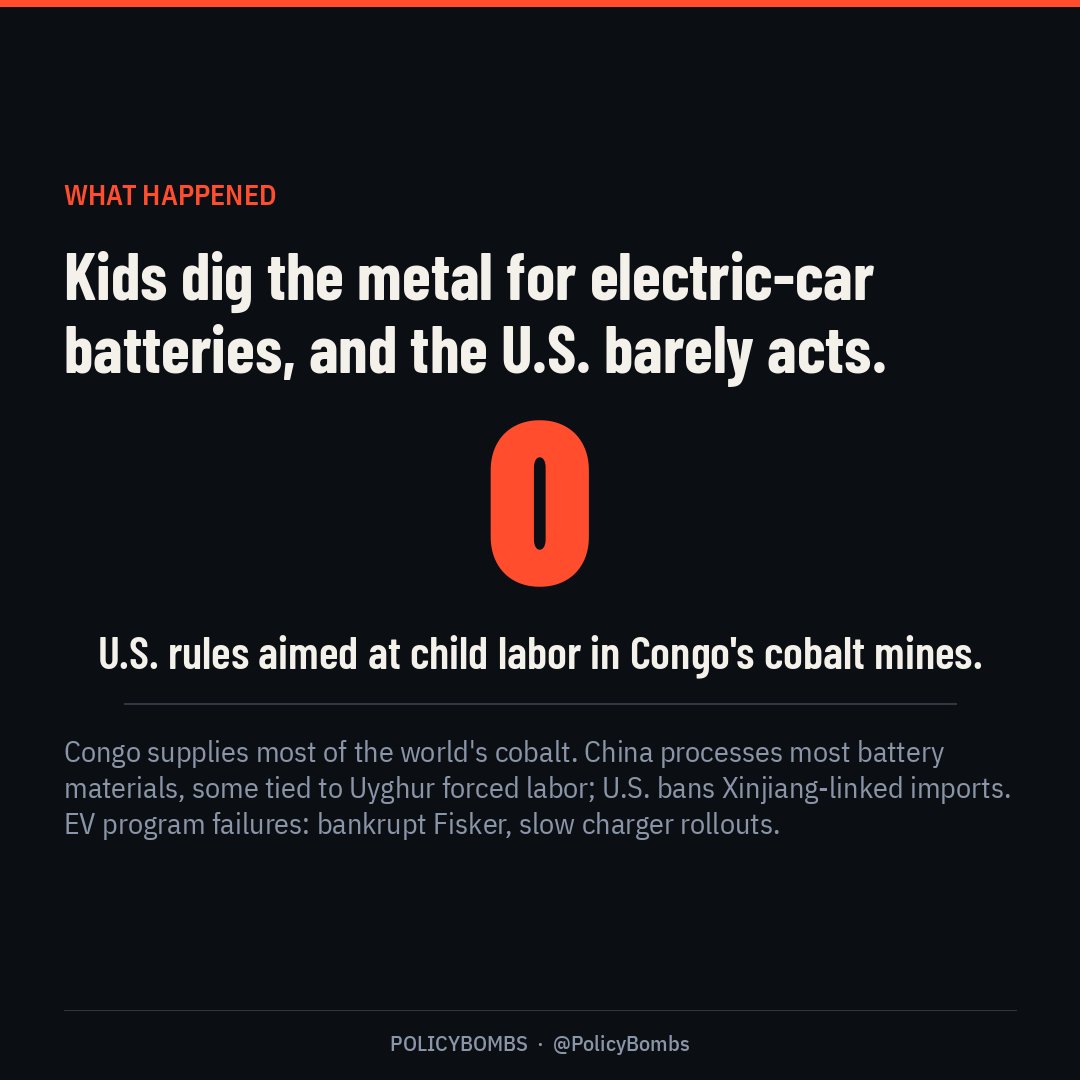
Child Labor in EV Batteries

Zero. That's how many US rules specifically target child labor in Congo's cobalt mines, the source of most of the world's cobalt.

Children have been documented working in small-scale Congo mines. China processes most battery materials, some tied to Uyghur forced labor. The US bans Xinjiang-linked imports and restricted Chinese content in EV subsidies, but stays close to silent on Congo. Taxpayer EV programs had oversight failures too, from bankrupt Fisker to slow charger rollouts.

PRO: UFLPA is good policy.

CON / COST: EVs subsidized without traceable minerals.

SOCIETY: 'Child slavery' overstates; 'clean supply chain' understates.


Full analysis

Child and Forced Labor in EV Battery Supply Chains: Policy Assessment

Cobalt mining in the DRC, Uyghur forced labor, the UFLPA, and how US EV subsidy sourcing rules addressed or ignored it. As of Nov 4, 2026.

Content as of Nov 4, 2026, 8:32 PM ET. Source Page: PolicyBombs canvas

Long-form deep analysis. Companion to the 10-minute quick reference (21-ev-battery-labor-summary.docx).

Contents

  • 10-Minute Voter Guide
  • Key facts
  • 1. What is the policy
  • 2. Why it exists
  • 3. Realized effects
  • 4. Good or bad for society
  • Local investigations and data anomalies
  • Who supports / who opposes
  • References

10-Minute Voter Guide

Who’s for / against: Bipartisan agreement against forced and child labor in supply chains (Uyghur Forced Labor Prevention Act, Rubio/Merkley). Split on EV mandates: Republicans plus 35 House Democrats voted to revoke California’s 2035 gas-car phase-out waiver (2025), and the 2025 law ended federal EV tax credits.

Most of the world’s cobalt, used in many EV batteries and phones, comes from Congo, where children have been documented working in small-scale mines. China processes most battery materials, and some suppliers are tied to Uyghur forced labor. The US bans Xinjiang-linked imports and restricted Chinese content in EV subsidies, but has no rule targeting Congo child labor. Taxpayer EV programs have also had oversight failures, from the bankrupt loan recipient Fisker to slow charger rollouts.

What policy gets right

What it misses

+ Toughest forced-labor import ban in the world (UFLPA)

+ Pushes supply chains away from China

– No due-diligence rule for cobalt child labor

– Weak oversight of EV subsidy and grant recipients

– Consumer EV credit repealed, reducing leverage

Bottom line for voters: Both ‘EVs run on child slavery’ and ‘clean supply chain’ are spin. Ask for mine-to-battery traceability and audited subsidy recipients.

Bottom line: Child labor in Congolese cobalt and state-imposed Uyghur labor in Chinese minerals processing are documented. US policy targeted China (UFLPA, FEOC rules) far more than it targeted the DRC. EV subsidies were justified on climate grounds while the supply chain carried these abuses. The 2025 law ended the consumer EV credit anyway. Child labor in cobalt is real, but most cobalt also goes into phones, laptops and refining. Cobalt-free LFP batteries now reduce the exposure.

Key facts

Item

Figure / status

Source

DRC share of world cobalt mining

About 70%+ (2023–24)

USGS Mineral Commodity Summaries

Children in southern DRC mines

About 40,000 (2014 estimate, cited by Amnesty 2016); old, not updated

UNICEF via Amnesty

Artisanal share of DRC output

Estimates range roughly 10–30%; not verified for 2026

Various (OECD, industry)

China share of cobalt refining

About 75%+

IEA

Uyghur Forced Labor Prevention Act

In force since June 21, 2022; presumption of forced labor for Xinjiang-linked goods

CBP

IRA 30D EV credit sourcing rules

Critical-mineral and battery-component thresholds; FEOC exclusions 2024–25

IRS / Treasury

30D termination

Ended for vehicles acquired after Sept 30, 2025 (OBBBA)

IRS

45X battery FEOC threshold

Non-PFE material share 60% (2026) rising to 85% (2030+)

Treasury / IRS

1. What is the policy

Item

Detail

UFLPA (2021 law)

Goods made wholly or partly in Xinjiang, or by entities on the UFLPA Entity List, are presumed made with forced labor and barred at the border unless importers prove otherwise. Lithium, aluminum, polysilicon and battery-related firms have been added to the list over time.

IRA Section 30D (2022)

The $7,500 credit was split. Half required critical minerals to be extracted or processed in the US or a free-trade partner. Half required battery components made in North America. Vehicles with batteries from a ‘foreign entity of concern’ (China and others) were excluded from 2024 (components) and 2025 (minerals). There was no explicit child-labor or DRC provision.

2025 law

OBBBA ended 30D and 25E after Sept 30, 2025. The 45X manufacturing credit continues but, for tax years beginning after July 4, 2025, denies credit for battery components with ‘material assistance’ from a prohibited foreign entity. The non-PFE share of direct material costs must reach 60% in 2026, rising to 85% from 2030 (Treasury/IRS guidance).

Other

Section 307 of the Tariff Act bars forced-labor goods (Withhold Release Orders). Dodd-Frank 1502 conflict-minerals rules cover tin, tantalum, tungsten and gold, not cobalt. EU Battery Regulation (2023) requires due diligence from 2025, later delayed.

2. Why it exists

Stated reasons: human rights, energy security, climate, and reshoring manufacturing.

Underlying drivers: the FEOC and UFLPA rules are mostly about competing with China and protecting industry. Bipartisan China hawks and domestic manufacturers and unions backed them. Human-rights framing gave them broad support. The DRC gets less attention because Chinese firms (CMOC, Huayou) own most of its large mines, so US policy addressed it indirectly. Automakers lobbied to loosen IRA sourcing timelines.

3. Realized effects

Item

Detail

Assessment

Child labor in DRC

Amnesty (2016) documented children as young as 7 in artisanal mines. Siddharth Kara’s ‘Cobalt Red’ (2023) is vivid but anecdotal. Industry and the Fair Cobalt Alliance say most battery cobalt comes from industrial mines, though artisanal ore mixes in at traders and refiners. Lawsuits against Apple, Tesla and others (Doe v. Apple) were dismissed in 2024.

Documented, scale unclear

Uyghur forced labor

Sheffield Hallam ‘Driving Force’ (Dec 2022) found 96 auto-relevant firms in the Uyghur Region, at least 38 using state labor transfers, and over 100 international automakers or suppliers with exposure, including in batteries. CBP has detained billions in goods under UFLPA, mostly solar and apparel. Several battery-material firms are on the Entity List.

Documented

Sourcing shifts

Fewer models qualified for 30D after FEOC rules. Automakers moved toward LFP (cobalt-free) and Korean, Japanese and US supply. Lower cobalt intensity reduces DRC exposure but raises dependence on Chinese LFP.

Partial

Enforcement gaps

Traceability through refiners is weak. The UFLPA presumption does not reach DRC child labor. The 30D repeal removed the main US consumer-side lever.

Weak

4. Good or bad for society

Verdict: Child and forced labor in battery supply chains is a real moral failure, and US policy treated it inconsistently. It was strict where China was the target, close to silent on DRC artisanal mining, and it subsidized EVs without requiring traceable minerals. UFLPA is good policy. A cobalt-specific due-diligence rule with audits is missing. "EVs run on child slavery" overstates the case. "Clean supply chain" understates it.

Case that current policy is adequate

Case that it fails

+ UFLPA is the world’s toughest forced-labor import ban

+ FEOC rules cut China dependence

+ LFP chemistry reduces cobalt need

– No DRC or cobalt child-labor provision

– Refiner-level mixing defeats audits

– Repeal of 30D removed leverage over automakers

  1. Extend Dodd-Frank style due diligence to cobalt and lithium.
  2. Fund formalized artisanal mining and schooling in DRC (e.g., EGC, Fair Cobalt).
  3. Publish battery passports with mine-level traceability.

Local investigations and data anomalies

Finding

Source

What investigators or courts concluded

DOE failed to obtain required financial and compliance audits for six for-profit EV grant recipients

DOE Inspector General (OAS-RA-12-11)

Control weakness confirmed

Ecotality: about $100M charger project behind schedule, about 1,000 chargers uninstalled; DOE hadn’t fully disclosed concerns before its 2013 bankruptcy

DOE IG (OAS-RA-14-01)

Oversight failure; no fraud charges noted

Fisker: $529M DOE loan guarantee; $192M disbursed; DOE recovered about $53M after bankruptcy

Center for Public Integrity; DOE

Taxpayer loss of about $139M; a business failure, not fraud

NEVI federal charger program: 384 ports built by April 2025 under a $5B program

GAO-25-106992

GAO called for improved performance management

These are older (2010s) or program-level findings. A search for audits of 2022-25 IRA subsidy recipients found none to cite yet. Verdict: unchanged. Added point: subsidy oversight has been weak, so supply-chain ethics claims about subsidized products are hard to verify.

Further reading (also listed in References):

  • DOE IG: Recent events related to Ecotality (2013) — energy.gov
  • DOE IG audit OAS-RA-12-11 — energy.gov
  • Center for Public Integrity: DOE bet on Fisker ends in bankruptcy — publicintegrity.org
  • GAO-25-106992: EV infrastructure performance management — gao.gov

Who supports / who opposes

For = the named supply-chain or EV measure. Against = revoking or blocking it. Each row cites a numbered source below. Checked Nov 4, 2026.

Who

Party / level

Position

Evidence

Ref

Sens. Marco Rubio (R-FL) & Jeff Merkley (D-OR)

Bipartisan

For

Uyghur Forced Labor Prevention Act (P.L. 117-78), signed Dec 23, 2021

[1]

House Republicans + 35 Democrats

Bipartisan

Against

H.J.Res. 88 revoking CA Advanced Clean Cars II waiver passed House (May 1, 2025); signed Jun 12, 2025

[2]

Gov. Gavin Newsom (D-CA); CARB

Democrat

For

Champions the Advanced Clean Cars II rule (100% zero-emission new-car sales by 2035), which H.J.Res. 88 revoked

[3]

Republicans; President Trump

Republican

Against

H.R. 1 (2025) ended EV purchase credits after Sept 30, 2025

[4]

Cross-party defectors: 35 House Democrats voted to revoke California’s EV waiver.

How positions shifted: Democrats’ 2022 IRA tied EV credits to ‘foreign entity of concern’ sourcing rules. Republicans repealed the credits in 2025 instead of tightening the sourcing rules. Neither party has passed cobalt-specific DRC child-labor legislation.

Not included or not fully verified: Found no federal or California bill specifically on DRC cobalt child labor that received a vote.

Sources for this section:

References

[1] DOE IG: Recent events related to Ecotality (2013). energy.gov. https://www.energy.gov/sites/default/files/2013/11/f4/OAS-RA-14-01.pdf

[2] DOE IG audit OAS-RA-12-11. energy.gov. https://www.energy.gov/ig/articles/audit-report-oas-ra-12-11

[3] Center for Public Integrity: DOE bet on Fisker ends in bankruptcy. publicintegrity.org. https://publicintegrity.org/environment/energy-department-bet-on-fisker-automotive-ends-in-bankruptcy/

[4] GAO-25-106992: EV infrastructure performance management. gao.gov. https://files.gao.gov/reports/GAO-25-106992/index.html

[5] Amnesty: This is what we die for (2016). amnesty.org. https://www.amnesty.org/en/documents/afr62/3183/2016/en/

[6] USGS Mineral Commodity Summaries: Cobalt. usgs.gov. https://www.usgs.gov/centers/national-minerals-information-center/cobalt-statistics-and-information

[7] Sheffield Hallam: Driving Force (2022). shuforcedlabour.org. https://www.shuforcedlabour.org/drivingforce/

[8] IRS: guidance on prohibited foreign entity material assistance (OBBBA). irs.gov. https://www.irs.gov/newsroom/treasury-irs-provide-guidance-for-certain-energy-tax-credits-regarding-material-assistance-provided-by-prohibited-foreign-entities-under-the-one-big-beautiful-bill

[9] CBP: UFLPA statistics. cbp.gov. https://www.cbp.gov/newsroom/stats/trade/uyghur-forced-labor-prevention-act-statistics

[10] DHS: UFLPA Entity List. dhs.gov. https://www.dhs.gov/uflpa-entity-list

[11] IRS: Clean vehicle credits. irs.gov. https://www.irs.gov/credits-deductions/credits-for-new-clean-vehicles-purchased-in-2023-or-after

[12] IEA: Global critical minerals outlook. iea.org. https://www.iea.org/reports/global-critical-minerals-outlook-2024

PolicyBombs · Day 65. Follow @PolicyBombs on X.

Inflation vs Wages

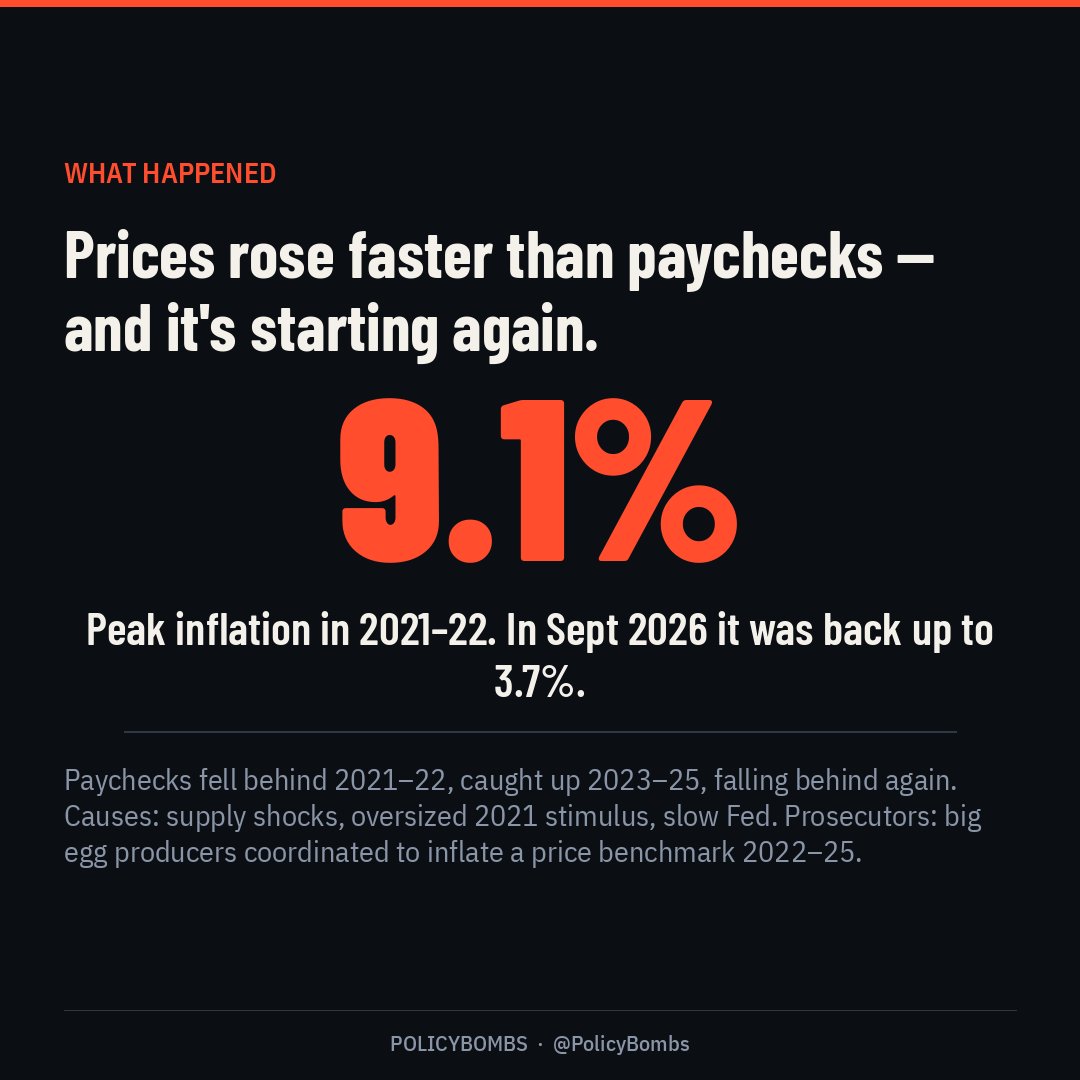
9.1%. That was peak inflation in 2021-22. And in 2026 it's rising again: 3.7% in September, mostly gasoline.

Paychecks fell behind in 2021-22, caught up in 2023-25, and are falling behind again. Causes: global supply shocks, an oversized 2021 stimulus, and a slow Fed. Prosecutors also found big egg producers coordinated to inflate a key price benchmark from 2022 to 2025.

The good: Fast, strong jobs recovery that past recoveries lacked. The cost: ARP oversized and Fed late turned a supply shock into broad inflation.

PRO: Fast, strong jobs recovery that past recoveries lacked.

CON / COST: ARP oversized and Fed late turned a supply shock into broad inflation.

SOCIETY: 2026 wage squeeze: energy plus tariff pass-through.


Full analysis

Inflation vs Wages, 2021–2026: Policy Assessment

CPI against real wages from 2021 to Sept 2026 using BLS data, and how much fiscal stimulus, Fed policy and supply shocks each explain. As of Nov 4, 2026.

Content as of Nov 4, 2026, 8:32 PM ET. Source Page: PolicyBombs canvas

Long-form deep analysis. Companion to the 10-minute quick reference (20-inflation-wages-summary.docx).

Contents

  • 10-Minute Voter Guide
  • Key facts
  • CPI inflation, December readings
  • 1. What is the policy
  • 2. Why it exists
  • 3. Realized effects
  • 4. Good or bad for society
  • Local investigations and data anomalies
  • Who supports / who opposes
  • References

10-Minute Voter Guide

Who’s for / against: For raising wages by law: most Senate Democrats (42 voted for Sanders’ 2021 $15 amendment), Gov. Newsom (CA $20 fast-food wage), and Sen. Josh Hawley (R), who co-led a $15 bill. Against: most Republicans. 8 Democratic-caucus senators voted against the $15 amendment in 2021.

Prices jumped in 2021-22 (peak 9.1%), cooled by 2024, and are rising again in 2026 (3.7% in September, mostly gasoline after the Iran war hit oil supply). Paychecks fell behind in 2021-22, caught up in 2023-25, and are falling behind again. Causes: global supply shocks, oversized 2021 stimulus, and a slow Fed. Prosecutors also found big egg producers coordinated to inflate a key price benchmark from 2022 to 2025.

Defense of 2021 policy

Criticism

+ Fast jobs recovery, no recession

+ Low-wage workers gained most by 2024

– Prices permanently higher

– Real wages falling again in 2026

– Some producers exploited the chaos to manipulate prices

Bottom line for voters: Ask how candidates will avoid stimulus that overheats the economy, keep energy supply stable, and enforce antitrust laws against price manipulation.

Bottom line: Real wages fell through 2021–22, recovered in 2023–25, and are falling again in 2026: Sept 2026 CPI 3.7% vs 3.0% wage growth. The 2021–22 surge had three causes: supply shocks, oversized fiscal stimulus in 2021, and a Fed that waited too long. The price level never comes back down, so households still feel poorer even after wages caught up.

Key facts

Item

Figure

Source

CPI peak

9.1% y/y, June 2022 (highest since 1981)

BLS

CPI, Sept 2025

3.0% y/y

BLS

CPI, Sept 2026

3.7% y/y; core 2.6%; energy +20.4%

BLS / JEC

Avg hourly earnings, Sept 2026

$37.81, up 3.0% y/y

BLS

Real avg hourly earnings, Sept 2026

Down 0.7% y/y ($11.24 in 1982–84 dollars)

BLS

Real avg weekly earnings, Sept 2026

Down 0.1% y/y (longer hours offset part)

BLS

Fed funds rate

Near 0 until Mar 2022; 5.25–5.50% peak Jul 2023 to Sept 2024

Federal Reserve

Fiscal stimulus 2020–21

About $5T, incl. $1.9T ARP (Mar 2021)

CRFB

CPI inflation, December readings

Chart data (shown as a chart on the Page)

Label

Value

2020

1.4%

2021

7%

2022

6.5%

2023

3.4%

2024

2.9%

Sept 2025

3%

Sept 2026

3.7%

CPI-U, 12-month change. Dec 2020–2024 values from BLS annual releases. The last two points are September readings.

1. What is the policy

Item

Detail

Fiscal

CARES (2020), Dec 2020 relief, and the American Rescue Plan (Mar 2021) included stimulus checks, enhanced unemployment benefits and the expanded Child Tax Credit. The Inflation Reduction Act (2022) had small near-term effects on inflation either way, per CBO.

Monetary

Zero rates plus about $120B a month of asset purchases through late 2021. The Fed called inflation ‘transitory’ into Nov 2021, then raised rates 525 basis points from Mar 2022 to Jul 2023. Cuts began in Sept 2024.

Supply and trade

Pandemic supply-chain snarls, the 2022 Russia–Ukraine energy and food shock, and 2025–26 tariffs (Yale Budget Lab and others estimate a price-level boost). The 2026 energy spike (energy +20.4% and gasoline +34.2% y/y in Sept 2026, per BLS) followed the Iran war’s disruption of oil flows through the Strait of Hormuz and strikes on Russian refineries; crude rose from below $70 to over $100 a barrel (AP, BBC).

2. Why it exists

Stated reasons: avoid a 2008-style slow recovery, protect households, and pursue a ‘hot labor market’ under the Fed’s 2020 flexible average inflation targeting framework.

Underlying drivers: political incentive to send visible checks before 2020 and after the 2021 inauguration. Economists like Larry Summers and Jason Furman warned early in 2021 that the ARP was about three times the output gap. The Fed’s new framework biased it toward waiting. Tariffs in 2025–26 were pursued for industrial and revenue goals despite expected price effects.

3. Realized effects

Item

Detail

Assessment

Real wages

Fell through 2021–22 as prices outpaced pay. Recovered 2023–25; lower-wage workers gained most, a compression documented by Autor, Dube and McGrew (2023). Turned negative again in 2026.

Round trip

Causes, quantified

Bernanke and Blanchard (2023): early inflation driven mostly by energy, food and sectoral shortages, with labor-market tightness growing later. SF Fed (2022): US fiscal support added about 3 points relative to peer countries. Inflation also rose sharply in Europe with less stimulus, which points to global shocks.

Shared blame

Labor market

Unemployment fell to 3.4% (Apr 2023) with no recession. A soft landing was achieved.

Positive

Consumer sentiment

Sentiment stayed depressed after real wages recovered, because the price level is about 20%+ higher than in 2020 and borrowing costs rose.

Negative

4. Good or bad for society

Verdict: The 2021 policy mix was bad on net for inflation. The ARP was oversized for a recovering economy and the Fed moved late, so a supply shock became broad inflation. The trade-off was a fast, strong jobs recovery that previous recoveries lacked. 2026’s renewed real-wage decline is driven by energy plus tariff pass-through, and warrants scrutiny of current trade and energy policy.

Defense of 2021 policy

Critique

+ Fastest jobs recovery in decades; no recession

+ Low-wage workers saw real gains by 2024

+ Global inflation shows most was not US policy

– US core inflation ran hotter than peers

– ‘Transitory’ delay required much higher rates later

– Price level permanently higher; savers and fixed incomes lost

  1. Size stimulus to the output gap.
  2. Fed: act on forecasts, not just realized data.
  3. Avoid tariffs and energy policy that add supply-side inflation.

Local investigations and data anomalies

Finding

Source

What investigators or courts concluded

Cal-Maine, Versova and Hickman’s coordinated bids to inflate the Urner Barry daily egg-price benchmark, June 2022 to March 2025, raising prices to retailers and consumers

DOJ Antitrust Division with state AGs (NY, CA, TX and others), 2026

Settlement: $3.3M to states, more than 53 million eggs donated, ban on competitor price communications, compliance programs. No admission of liability reported

A settlement is not a court finding of guilt, and $3.3M is small next to the price effects alleged. Verdict: unchanged. Macro causes dominate; this is a documented example of manipulation inside the inflation period.

Further reading (also listed in References):

  • DOJ: egg producers must end coordinated benchmark manipulation — justice.gov
  • NY AG: 50M+ eggs and $3.3M after uncovering price scheme (2026) — ag.ny.gov

Who supports / who opposes

For = raising the minimum wage by law. Against = opposing a mandated increase. Each row cites a numbered source below. Checked Nov 4, 2026.

Who

Party / level

Position

Evidence

Ref

Sen. Josh Hawley (R-MO) & Sen. Peter Welch (D-VT)

Bipartisan

For

Introduced S. 2013 Higher Wages for American Workers Act ($15 + inflation), Jun 10, 2025

[1]

Sen. Ron Johnson (R-WI)

Republican

Against

Said "I wouldn’t support it" about Hawley’s bill

[2]

Gov. Gavin Newsom (D-CA)

Democrat

For

Signed AB 1228 (2023), $20 fast-food minimum wage

[3]

Sen. Bernie Sanders (I-VT)

Independent

For

$15 amendment to the American Rescue Plan failed 42–58 (Mar 5, 2021); all Republicans and 8 Democratic-caucus senators voted no

[4]

Cross-party defectors: Hawley is a rare Republican co-leading a minimum-wage hike. Eight Democratic-caucus senators voted against Sanders’ $15 amendment in 2021.

How positions shifted: Inflation from 2021 to 2023 outpaced wages until mid-2023. Republicans blamed Democratic spending, and the populist right has since warmed to wage floors.

Sources for this section:

References

[1] DOJ: egg producers must end coordinated benchmark manipulation. justice.gov. https://www.justice.gov/opa/pr/justice-department-requires-egg-producers-end-coordinated-benchmark-manipulation

[2] NY AG: 50M+ eggs and $3.3M after uncovering price scheme (2026). ag.ny.gov. https://ag.ny.gov/press-release/2026/attorney-general-james-secures-more-50-million-eggs-and-33-million-after

[3] BLS Real Earnings, Sept 2026. bls.gov. https://www.bls.gov/news.release/realer.nr0.htm

[4] BLS Real Earnings Table A-1. bls.gov. https://www.bls.gov/news.release/realer.t01.htm

[5] CNBC: CPI report Sept 2026. cnbc.com. https://www.cnbc.com/2026/10/14/cpi-inflation-report-september-2026.html

[6] JEC monthly inflation update (Sept 2026). jec.senate.gov. https://www.jec.senate.gov/public/vendor/_accounts/JEC-R/inflation/Monthly%20Inflation%20Update%20(PDF).pdf

[7] BLS TED: gasoline up 34.2% over the year to Sept 2026. bls.gov. https://www.bls.gov/opub/ted/2026/prices-for-gasoline-increased-34-2-percent-over-the-year-ended-september-2026.htm

[8] AP: inflation accelerates on gasoline and energy (Oct 2026). apnews.com. https://apnews.com/article/consumer-prices-inflation-gasoline-energy-trump-c32cfa8b85ae53ceb7b1cc557d3b7400

[9] Bernanke and Blanchard: What caused the US pandemic-era inflation?. brookings.edu. https://www.brookings.edu/articles/what-caused-the-u-s-pandemic-era-inflation/

[10] SF Fed: Why is US inflation higher than in other countries?. frbsf.org. https://www.frbsf.org/research-and-insights/publications/economic-letter/2022/03/why-is-us-inflation-higher-than-in-other-countries/

[11] Autor, Dube and McGrew: The unexpected compression. nber.org. https://www.nber.org/papers/w31010

PolicyBombs · Day 64. Follow @PolicyBombs on X.

Illegal Immigration

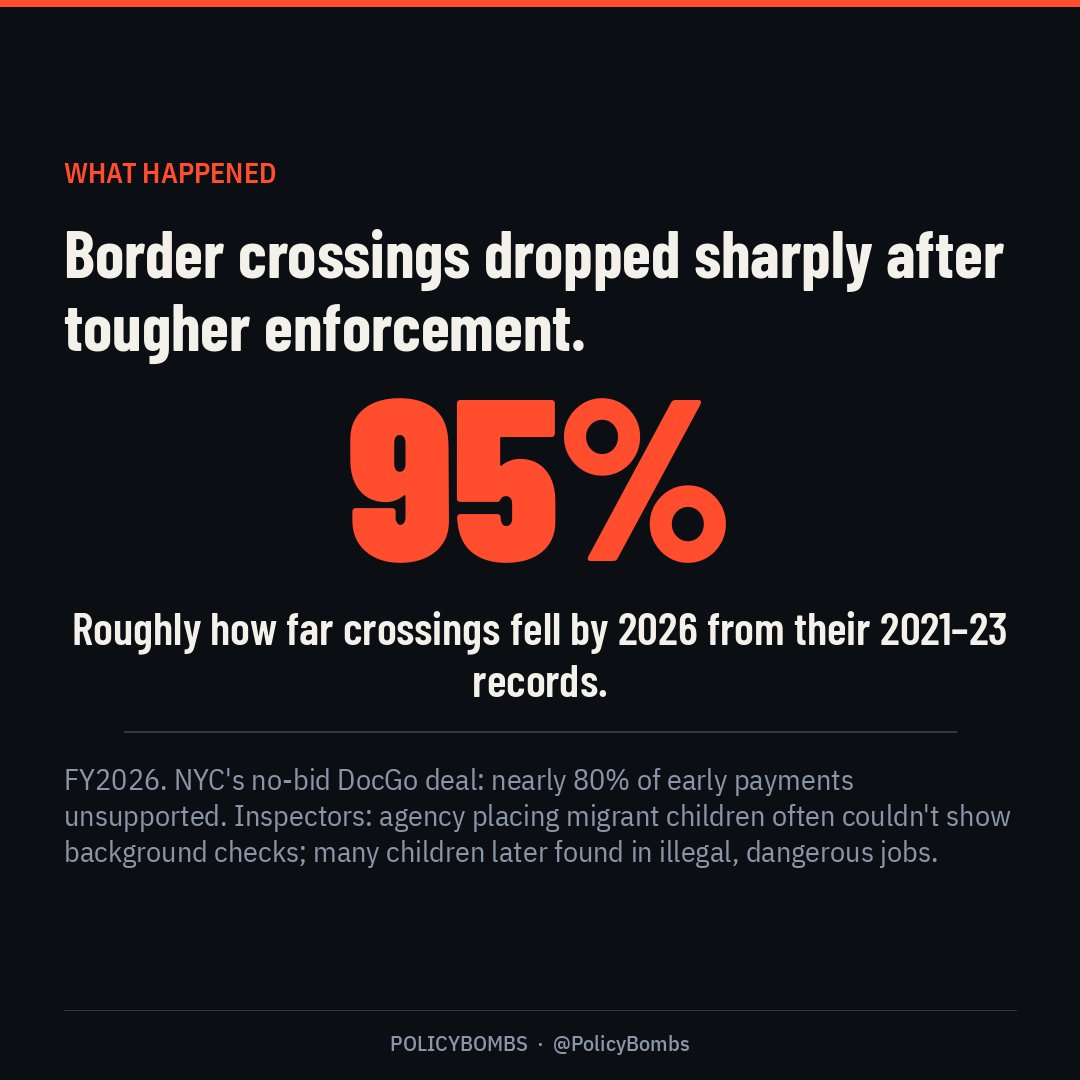
95%. That's roughly how far border crossings fell by FY2026 from their 2021-23 records, under tougher enforcement.

The surge overwhelmed cities, which handed out emergency contracts with little oversight: NYC's no-bid DocGo deal had nearly 80% of early payments unsupported. Federal inspectors found the agency placing migrant children often couldn't show required background checks, and many children were later found in illegal, dangerous jobs.

PRO: Restoring control was right; legal immigration has clear value.

CON / COST: Enforcement ignoring employers leaves exploitation in place.

SOCIETY: Mass illegal entry rewards smugglers and exploits children most.


Full analysis

Illegal Immigration: Policy Assessment

Border numbers FY2021–26, fiscal-cost studies on both sides, labor effects, and the exploitation of migrants: labor trafficking and child migrant labor. As of Nov 4, 2026.

Content as of Nov 4, 2026, 8:32 PM ET. Source Page: PolicyBombs canvas

Long-form deep analysis. Companion to the 10-minute quick reference (19-illegal-immigration-summary.docx).

Contents

  • 10-Minute Voter Guide
  • Key facts
  • Border Patrol encounters
  • 1. What is the policy
  • 2. Why it exists
  • 3. Realized effects
  • 4. Good or bad for society
  • Local investigations and data anomalies
  • Who supports / who opposes
  • References

10-Minute Voter Guide

Who’s for / against: For tougher enforcement: Republicans and Trump (Laken Riley Act, with 12 Senate and 46 House Democrats; the 2025 law’s enforcement funding). For sanctuary protections: California Democrats (SB 54). Surprise: Trump and most Republicans helped kill the 2024 bipartisan Lankford–Murphy–Sinema border bill.

Border crossings hit record highs in 2021-23 and fell about 95% by FY2026 under tougher enforcement. The surge overwhelmed cities, which handed out huge emergency contracts with little oversight: NYC’s no-bid DocGo deal had nearly 80% of early payments unsupported. Federal inspectors found the agency placing migrant children with sponsors often couldn’t show it had run required background checks, and many children were later found working illegal, dangerous jobs.

Arguments that immigration helps

Arguments about harm

+ Fills labor shortages

+ CBO: surge cuts federal deficits by $0.9T over 10 years

+ Immigrants’ children are strong contributors

– Child labor and trafficking in a shadow economy

– Emergency city contracts wasted millions

– Undermines legal immigration and rule of law

Bottom line for voters: Ask candidates how they will stop employers from using illegal labor, vet every child’s sponsor, and audit every emergency migrant contract.

Bottom line: The 2021–24 surge was a policy failure. Release-heavy processing and asylum backlogs drew record crossings. They also fed a shadow labor market where migrants, including unaccompanied children, were exploited in conditions that at the extreme amount to forced labor. Crossings fell about 95% by FY2026 under tougher enforcement. The fiscal picture is genuinely contested and depends on time horizon and education level. Low-wage undocumented labor benefits employers and consumers, while the workers carry most of the cost.

Key facts

Item

Figure

Source

Border Patrol encounters, nationwide

FY21 1.66M; FY22 2.21M; FY23 2.06M; FY24 1.58M; FY25 254K

CBP

Total CBP encounters, FY23 (record)

3.20M (incl. ports of entry, CBP One)

CBP

Southwest border apprehensions, FY26

98,708 (preliminary; DHS says lowest ever)

DHS, Oct 2026

NAS 2016 fiscal study

First generation net cost (mostly state and local, via children’s education); second generation among strongest net contributors

National Academies

FAIR 2023

$150.7B net annual cost of illegal immigration (federal, state, local)

FAIR (restrictionist)

ITEP 2024

Undocumented immigrants paid $96.7B in taxes in 2022

ITEP (progressive)

CBO July 2024

2021–26 surge lowers federal deficits $0.9T over 2024–34 (+$1.2T revenue, +$0.3T outlays); excludes discretionary (about $0.2T) and state/local costs

CBO

Unaccompanied children HHS could not reach

About 85,000 over two years (NYT, 2023, not independently verified here). DHS OIG-24-46 (Aug 2024): of 448,000+ transferred FY19–23, 32,000+ missed court; 291,000+ never served a Notice to Appear

NYT; DHS OIG

Child labor violations

Minors employed in violation up sharply since 2019 (DOL WHD)

US DOL

Border Patrol encounters

Chart data (shown as a chart on the Page)

Label

Value

FY21

1.66M

FY22

2.21M

FY23

2.06M

FY24

1.58M

FY25

254K

FY26

99K

FY21–25: nationwide Border Patrol encounters (CBP). FY26: southwest border apprehensions only, preliminary DHS figure. Not strictly comparable.

1. What is the policy

Item

Detail

2021–24

Ended Remain in Mexico and paused border wall construction. Title 42 expulsions continued until May 2023. Mass parole and release with court dates, CBP One appointments, CHNV parole (about 530,000), and expanded TPS. June 2024 asylum restrictions cut crossings.

2025–26

National emergency declaration, troops at the border, asylum shut-off at the border, Remain in Mexico restored, CBP One ended, parole and TPS revoked (litigated), mass deportation push with ICE expansion funded by the 2025 reconciliation law. Zero Border Patrol releases since May 2025 (DHS).

Unaccompanied children (UACs)

Under TVPRA 2008, UACs from non-contiguous countries go to HHS’s Office of Refugee Resettlement (ORR) and are released to sponsors. Record numbers in FY21–23 (about 130,000 in FY22). ORR follow-up was a single safety call after 30 days.

2. Why it exists

Stated reasons: humanitarian protection and asylum law (left); sovereignty, rule of law and public safety (right).

Underlying drivers: employers in agriculture, meatpacking, construction and hospitality depend on undocumented labor, and E-Verify is still not mandatory nationally. Both parties have blocked fixes: the 2013 Gang of Eight bill and the 2024 Senate border bill. Democratic coalitions include immigrant-advocacy groups, and the GOP campaigns on the border. Cartels earn billions from smuggling fees. Asylum backlogs (over 3M immigration court cases by 2024) let people work for years before rulings.

3. Realized effects

Item

Detail

Assessment

Fiscal

Results depend on the scope chosen. FAIR counts US-citizen children as costs and assumes low taxes. ITEP and Cato emphasize taxes paid and low per-capita benefit use. CBO counts federal gains from the surge but notes state and local costs. NAS (the most neutral) finds low-education first-generation immigrants are net costs over their lifetimes, while their children are net contributors.

Contested

City costs

NYC spent several billion dollars on the shelter system for migrants (city budget estimates over $4B a year at peak). Denver and Chicago faced similar strains.

High local cost

Labor market

Most studies (Card; NAS 2016) find small wage effects overall, with negative effects concentrated on prior immigrants and workers without a high school diploma. Borjas finds larger effects. CBO credited the surge with raising labor force and GDP growth.

Small, uneven

Exploitation and forced labor

NYT (Hannah Dreier, Feb 2023) documented migrant children working overnight shifts in slaughterhouse sanitation (Packers Sanitation paid $1,544,076 in DOL penalties for 102 minors aged 13–17 at 13 plants in 8 states, Feb 2023), auto-parts plants and food processing. Debt bondage to smugglers and sponsors was documented. DHS OIG and HHS OIG found ORR failed to track children and vet sponsors. Labor trafficking cases (e.g., Operation Blooming Onion, GA 2021) involved H-2A and undocumented workers held in slavery-like conditions.

Serious

The ‘slavery’ framing: labor trafficking and debt bondage meet the legal definition of forced labor under the TVPA in prosecuted cases. The scale is not measured reliably; no credible national count exists. Using the word for all undocumented work overstates it. For the documented child and trafficking cases, it is accurate.

4. Good or bad for society

Verdict: Large-scale illegal immigration is bad for society. It rewards smugglers, exploits migrants (children most of all), overwhelms cities and courts, and erodes support for legal immigration, which has clear economic value. Restoring control was right. Enforcement that ignores employers and offers no legal channels leaves the exploitation in place.

Case that it benefits the US

Case that it harms

+ Fills labor shortages; CBO projects lower deficits

+ Undocumented workers pay tens of billions in taxes

+ Children of immigrants are strong net contributors

– Exploitation, trafficking and child labor are built into a shadow labor market

– Local fiscal and service strain

– Undermines rule of law and legal immigration’s legitimacy

  1. Mandatory E-Verify with employer penalties.
  2. Fund asylum adjudication to decide cases in months.
  3. ORR: vetting, post-release services, and tracking every child.
  4. Expand legal work visas for sectors that rely on illegal labor.

Local investigations and data anomalies

Finding

Source

What investigators or courts concluded

NYC’s $432M no-bid emergency contract with DocGo, a COVID-testing firm with no housing experience: $11M of $13.8M in the first two months unsupported or unallowable; 9,874 empty hotel-room nights paid; $2M+ in unauthorized security hours; 33 of 41 subcontractors had no agreement on file

NYC Comptroller audit, 2024

Recommended recoupment; HPD agreed to review invoices, but the administration signaled it would not recoup. Contract not renewed after May 2024

ORR sponsor vetting, spring 2021: 16% of case files lacked documentation of required safety checks; 19% never updated with pending FBI or child-abuse registry results; 35% had illegible sponsor IDs; 22% of follow-up calls late

HHS OIG OEI-07-21-00250, Feb 2024

ACF agreed to all 6 recommendations; ORR added universal fingerprinting and stricter ID rules in 2025

Same address used for multiple sponsorships is a known red flag

HHS OIG (same report)

OIG noted missed address checks could hide vacant homes or repeat-sponsor addresses; prevalence not quantified

448,000+ children transferred FY2019-23; 32,000+ missed court; 291,000+ never got a court date

DHS OIG-24-46, Aug 2024

ICE could not monitor children; heightened trafficking risk

Packers Sanitation: 102 children aged 13-17 cleaning slaughterhouses overnight at 13 plants

US DOL WHD, Feb 2023

$1,544,076 in civil penalties

Verdict: unchanged, and strengthened. The local audit record shows waste in emergency contracting and weak child-sponsor vetting during the surge. Both are institutional failures, separate from the immigration-policy debate itself.

Further reading (also listed in References):

Who supports / who opposes

For = tougher enforcement. Against = sanctuary limits on cooperation. Each row cites a numbered source below. Checked Nov 4, 2026.

Who

Party / level

Position

Evidence

Ref

Sen. Katie Britt (R-AL) + Republicans; 12 Senate & 46 House Democrats

Bipartisan

For

Laken Riley Act (S. 5) signed Jan 29, 2025; Senate 64–35, House 263–156

[1]

Sens. James Lankford (R-OK), Chris Murphy (D-CT), Kyrsten Sinema (I-AZ)

Bipartisan

For

Negotiated 2024 border deal; failed cloture 49–50 (Feb 7, 2024) after Trump opposed it

[2]

Sen. Kevin de León (D); Gov. Jerry Brown (D-CA)

Democrat

Against

SB 54 (2017) California Values Act limits state/local help to ICE

[3]

Republicans; President Trump

Republican

For

H.R. 1 (2025) funds ~$170B for border/ICE enforcement

[4]

Gov. Pete Wilson (R-CA)

Republican

For (qualified)

Backed Prop 187 (1994), denying services to undocumented; later struck down

[5]

Cross-party defectors: Democrats split on the Laken Riley Act. Republicans split on the 2024 border deal, which Lankford co-wrote.

How positions shifted: The Senate passed comprehensive reform (S. 744) 68–32 in 2013 with 14 Republicans. That bipartisan path collapsed, and since 2016 the GOP has moved to enforcement-only. California went from Prop 187 (1994) to sanctuary-state status (2017).

Sources for this section:

References

[1] NYC Comptroller: Audit of HPD oversight of DocGo contract. comptroller.nyc.gov. https://comptroller.nyc.gov/reports/audit-of-the-department-of-housing-preservation-and-developments-oversight-of-its-contract-with-rapid-reliable-testing-ny-llc-aka-docgo/

[2] HHS OIG: Gaps in sponsor screening and followup (Feb 2024). oig.hhs.gov. https://oig.hhs.gov/reports/all/2024/gaps-in-sponsor-screening-and-followup-raise-safety-concerns-for-unaccompanied-children/

[3] DHS OIG-24-46 on unaccompanied children. oversight.gov. https://www.oversight.gov/reports/audit/management-alert-ice-cannot-monitor-all-unaccompanied-migrant-children-released-dhs

[4] CBP enforcement statistics FY2025. cbp.gov. https://www.cbp.gov/newsroom/stats/cbp-enforcement-statistics-fy2025

[5] DHS: FY2026 lowest border crossings (Oct 2026). dhs.gov. https://www.dhs.gov/news/2026/10/16/under-president-trump-and-secretary-mullin-dhs-announces-lowest-fiscal-year-border

[6] NAS 2016: Economic and fiscal consequences of immigration. nap.edu. https://nap.nationalacademies.org/catalog/23550/the-economic-and-fiscal-consequences-of-immigration

[7] FAIR: Fiscal burden of illegal immigration (2023). fairus.org. https://www.fairus.org/issue/publications-resources/fiscal-burden-illegal-immigration-united-states-taxpayers-2023

[8] ITEP: Tax payments by undocumented immigrants (2024). itep.org. https://itep.org/undocumented-immigrants-taxes-2024/

[9] Cato: immigration fiscal research. cato.org. https://www.cato.org/research/immigration

[10] CBO: Effects of the immigration surge on the budget (2024). cbo.gov. https://www.cbo.gov/publication/60569

[11] NYT: Alone and exploited, migrant children work brutal jobs (2023). nytimes.com. https://www.nytimes.com/2023/02/25/us/unaccompanied-migrant-child-workers-exploitation.html

[12] DHS OIG-24-46: ICE cannot monitor unaccompanied children. oig.dhs.gov. https://www.oig.dhs.gov/sites/default/files/assets/2024-08/OIG-24-46-Aug24.pdf

[13] DOL: Packers Sanitation child labor penalty. dol.gov. https://www.dol.gov/newsroom/releases/whd/whd20230217-1

PolicyBombs · Day 63. Follow @PolicyBombs on X.

Trans Athletes in Women’s Sports

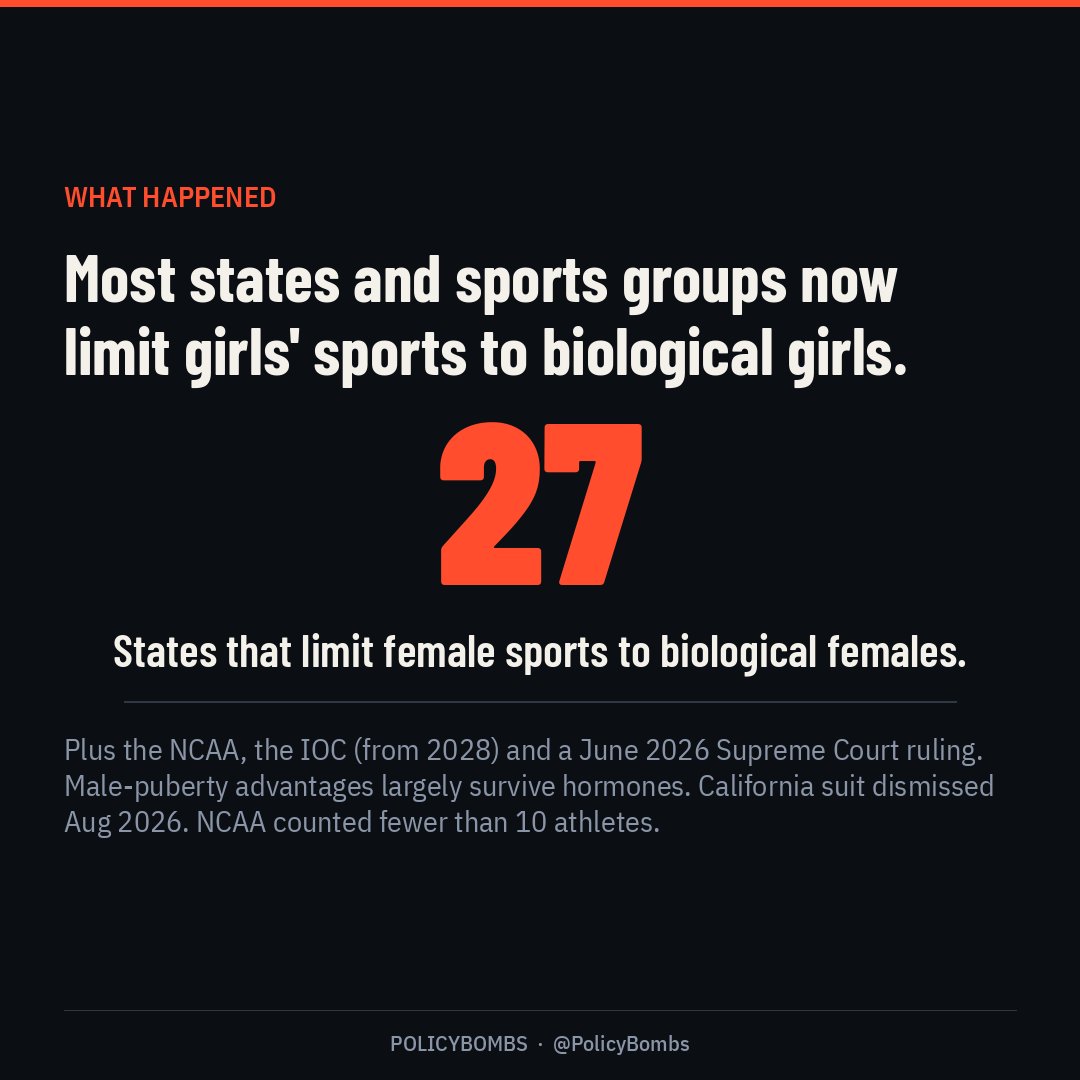
27 states, the NCAA, the IOC (from 2028) and a June 2026 Supreme Court ruling now allow or require female sports limited to biological females.

Studies show male-puberty advantages in speed and strength largely survive hormone treatment. California still allows trans girls on girls' teams; a federal suit to stop it was dismissed in Aug 2026. Very few athletes are involved: the NCAA counted fewer than 10.

The good: Sex-based eligibility for post-puberty female sports fits Title IX. The cost: Bans on young kids and invasive enforcement go beyond the evidence.

PRO: Sex-based eligibility for post-puberty female sports fits Title IX.

CON / COST: Bans on young kids and invasive enforcement go beyond the evidence.

SOCIETY: Open categories and youth inclusion are a reasonable compromise.


Full analysis

Transgender Athletes in Women’s Sports: Policy Assessment

Title IX rule changes, state bans, the Feb 2025 executive order, NCAA policy, the June 2026 Supreme Court ruling, the physiology evidence and California’s CIF cases. As of Nov 4, 2026.

Content as of Nov 4, 2026, 8:32 PM ET. Source Page: PolicyBombs canvas

Long-form deep analysis. Companion to the 10-minute quick reference (18-trans-athletes-summary.docx).

Contents

  • 10-Minute Voter Guide
  • Key facts
  • 1. What is the policy
  • 2. Why it exists
  • 3. Realized effects
  • 4. Good or bad for society
  • Local investigations and data anomalies
  • Who supports / who opposes
  • References

10-Minute Voter Guide

Who’s for / against: For restricting trans girls and women in female sports: Republicans (H.R. 28 passed the House in Jan 2025, plus Trump’s Feb 2025 EO), joined by 2 House Democrats and, rhetorically, Gov. Newsom (‘deeply unfair’). Against restrictions: most Democrats; the Senate bill failed 51–45.

Twenty-seven states, the NCAA, the IOC (from 2028) and a June 2026 Supreme Court ruling now allow or require girls’ and women’s sports to be limited to biological females. California still allows trans girls on girls’ teams; a federal suit to stop it was dismissed in Aug 2026. Studies show male-puberty advantages in speed and strength largely survive hormone treatment. Very few athletes are involved: the NCAA counted fewer than 10.

Arguments for sex-based teams

Arguments against

+ Physical advantage persists after hormones

+ Protects girls’ spots, scholarships and records

+ Most Americans agree (about 69%)

– Very few athletes affected

– Excludes a vulnerable group

– Enforcement can lead to invasive checks on any girl

Bottom line for voters: Sex-based rules for competitive teams after puberty are backed by the evidence. Watch for overreach into young kids’ and recreational sports.

Bottom line: For competitive female sports after puberty, sex-based eligibility is justified by the physiology evidence. Testosterone suppression reduces male advantages but does not erase them. The number of athletes affected is very small, so the policy fight is far bigger than the on-field problem. Fairness in elite and scholarship competition is a strong argument. Blanket bans that reach recreational and pre-puberty play are harder to justify.

Key facts

Policy

Date

Status (Nov 2026)

Key point

Biden Title IX rule (gender identity)

Apr 2024

Vacated nationwide Jan 9, 2025 (E.D. Ky.)

Athletics rule never finalized

Executive Order 14201, ‘Keeping Men Out of Women’s Sports’

Feb 5, 2025

In force

Title IX enforcement and funding threats

NCAA participation policy

Feb 6, 2025

In force

Women’s competition limited to athletes assigned female at birth

State laws

2020–26

27 states (per SCOTUS opinion)

Idaho first (2020)

West Virginia v. B.P.J. / Little v. Hecox

June 30, 2026

Bans upheld

Title IX and Equal Protection allow sex-based teams; states may, not must, exclude

US v. California Dept of Education / CIF

2025–26

DOJ suit dismissed Aug 31, 2026 (C.D. Cal.)

Spending Clause: no clear notice; CA inclusive policy remains

IOC Protection of the Female Category

Mar 26, 2026

Applies from LA28

One-time SRY gene screen; trans women eligible in male or open categories

NCAA count of transgender athletes

Dec 2024

Testimony

Fewer than 10 among about 510,000 NCAA athletes (Charlie Baker)

1. What is the policy

Item

Detail

Federal

The Biden 2024 rule defined sex discrimination to include gender identity but left athletics to a separate rule that was withdrawn in Dec 2024. Courts vacated the main rule. EO 14201 directs agencies to treat sex as biological sex under Title IX. The Education Department opened investigations (e.g., Maine, California, UPenn; Penn settled July 2025).

Supreme Court (June 30, 2026)

Held that Title IX permits sex-separated teams defined by biological sex and that the Idaho and West Virginia laws are constitutional. SCOTUSblog reports the Title IX holding was unanimous and the Equal Protection ruling divided the Court. Scope is limited to sports.

NCAA and Olympics

NCAA changed policy the day after the EO. World Athletics (2023) and World Aquatics (2022) bar male-puberty athletes from female events. On Mar 26, 2026 the IOC adopted a policy limiting the female category at its events, from LA28, to athletes who pass a one-time SRY gene screen, with narrow DSD exceptions; it is not retroactive and does not cover grassroots sport.

California

State law (AB 1266, 2013) lets students play on teams matching gender identity. In 2025 CIF changed state-meet rules so a displaced girl would also medal. The Education Department found CA in violation, and DOJ sued in July 2025. On Aug 31, 2026 Judge Cynthia Valenzuela dismissed the suit: California lacked clear notice that federal funds required sex-based eligibility, so the Spending Clause barred enforcement. The ruling did not decide whether Title IX permits trans girls on girls’ teams.

2. Why it exists

Stated reasons for bans: fairness, safety and scholarships for women and girls (Title IX’s purpose). Stated reasons for inclusion: anti-discrimination, mental health and belonging for trans youth.

Underlying drivers: polling (Gallup 2023–25 shows about 69% of Americans favor birth-sex teams) made this a winning GOP issue. ADF litigated and supplied model bills. Democrats faced pressure from LGBTQ advocacy groups, and some Democrats have since broken ranks (e.g., Gov. Newsom calling it ‘deeply unfair’ in March 2025). The sheer number of laws reflects political salience more than case volume.

3. Realized effects

Item

Detail

Assessment

Physiology

Male puberty gives about 10–12% advantage in running and swimming and larger gaps in strength and power (Hilton and Lundberg 2021 review). After 12 months of suppression, strength and muscle mass drop only about 5%. Roberts et al. 2021 (US Air Force fitness tests): push-up and sit-up advantages disappeared after 2 years of hormones, but trans women remained about 12% faster than cis women on the 1.5-mile run after 2 years.

Advantage persists

Counter-evidence

IOC-funded Hamilton et al. 2024 found trans women had lower jump performance and lung function relative to body size than cis women; small, cross-sectional study. Data for pre-puberty transition is sparse.

Limited

Scale

Very few cases: under 10 in NCAA; a handful of high-profile high school cases (CT Soule case, AB Hernandez in CA, Lia Thomas 2022 NCAA title).

Small numbers

Trans youth

Exclusion is associated with lower sports participation, and surveys (Trevor Project) link it to worse well-being. Causal evidence is weak.

Real cost

4. Good or bad for society

Verdict: Sex-based eligibility for post-puberty competitive female sports is good policy and fits Title IX’s purpose. The evidence shows retained advantage that hormone therapy does not remove. Bans covering young children and recreational play, and invasive eligibility enforcement, go further than the evidence supports. Open categories, and inclusion at the youth and intramural level, are a reasonable compromise.

Strongest case for sex-based teams

Strongest case for inclusion

+ Male puberty advantage largely survives suppression

+ Female category exists to correct for that gap

+ Scholarships, records and safety in contact sports

– Tiny number of athletes; bans are disproportionate

– Exclusion harms a vulnerable group

– Enforcement can lead to sex-verification of any girl who looks ‘masculine’

  1. Sex-based eligibility for post-puberty competitive events.
  2. Open or mixed categories where feasible.
  3. No invasive verification; rely on records and existing documents.

Local investigations and data anomalies

Finding

Source

What investigators or courts concluded

USDA froze Maine child-nutrition funds over trans-athlete policy

US District Court, D. Maine, Apr 2025

Ordered unfrozen: USDA likely skipped required Title IX procedures. Settled May 2, 2025; merits not decided

DOJ suit against California Dept of Education and CIF

C.D. Cal., Aug 31, 2026

Dismissed on Spending Clause notice grounds; Title IX merits not decided

Fraud or corruption angle

Search of audits and court records

None found. This is a rights and fairness dispute, not a spending one

The federal funding-threat tactic has twice lost in court on procedure, not on substance. Verdict: unchanged.

Further reading (also listed in References):

  • AP: Trump administration settles with Maine over funding freeze — apnews.com
  • CRS: Transgender athletes and Title IX investigations and litigation — congress.gov

Who supports / who opposes

For = restricting female sports to biological females. Against = allowing participation by gender identity. Each row cites a numbered source below. Checked Nov 4, 2026.

Who

Party / level

Position

Evidence

Ref

Rep. Greg Steube (R-FL) + House Republicans

Republican

For

Protection of Women and Girls in Sports Act (H.R. 28) passed House 218–206 (Jan 14, 2025)

[1]

Reps. Henry Cuellar (D-TX), Vicente Gonzalez (D-TX)

Democrat (defectors)

For

Voted yes on H.R. 28

[1]

Senate Democrats

Democrat

Against

Blocked cloture on S. 9, 51–45 (Mar 3, 2025)

[2]

President Donald Trump

Republican

For

EO 14201 "Keeping Men Out of Women’s Sports" (Feb 5, 2025)

[3]

Gov. Gavin Newsom (D-CA)

Democrat (defector)

For (qualified)

Called trans athletes in women’s sports "deeply unfair" (podcast, Mar 2025); has not changed CA law

[4]

Gov. Jerry Brown (D-CA); Asm. Tom Ammiano (D)

Democrat

Against

AB 1266 (2013) lets CA students play on teams matching gender identity

[5]

Cross-party defectors: Two House Democrats voted for H.R. 28. Newsom broke with his party rhetorically.

How positions shifted: Democrats were almost unanimous against restrictions through 2024. After the 2024 election, some, like Newsom, voiced concern, though few votes changed.

Not included or not fully verified: Left out Rep. Seth Moulton’s reported Nov 2024 remarks because no link was opened this turn.

Sources for this section:

References

[1] AP: Trump administration settles with Maine over funding freeze. apnews.com. https://apnews.com/article/trump-maine-usda-transgender-sports-cf1754471bcc8a6418f3308a6aed8fc5

[2] CRS: Transgender athletes and Title IX investigations and litigation. congress.gov. https://www.congress.gov/crs-product/LSB11322

[3] West Virginia v. B.P.J. opinion (June 30, 2026). supremecourt.gov. https://www.supremecourt.gov/opinions/25pdf/24-43%5F2b35.pdf

[4] SCOTUSblog: ruling analysis. scotusblog.com. https://www.scotusblog.com/2026/06/court-rules-that-states-can-exclude-transgender-athletes-from-girls-and-womens-sports-teams/

[5] ACLU: what the BPJ and Hecox decision means. aclu.org. https://www.aclu.org/news/lgbtq-rights/your-questions-answered-what-you-need-to-know-about-the-bpj-and-hecox-supreme-court-decision

[6] EO 14201, Keeping Men Out of Women’s Sports. federalregister.gov. https://www.federalregister.gov/documents/2025/02/11/2025-02513/keeping-men-out-of-womens-sports

[7] NCAA: transgender participation policy change (Feb 6, 2025). ncaa.org. https://www.ncaa.org/news/media-center-ncaa-announces-transgender-student-athlete-participation-policy-change/

[8] IOC: Policy on the protection of the female category (Mar 2026). olympics.com. https://www.olympics.com/ioc/news/international-olympic-committee-announces-new-policy-on-the-protection-of-the-female-women-s-category-in-olympic-sport

[9] LA Times: judge dismisses DOJ suit over CA trans athlete policy. latimes.com. https://www.latimes.com/california/story/2026-09-01/judge-dismisses-doj-lawsuit-california-transgender-athlete-policies

[10] Hilton and Lundberg 2021, Sports Medicine. springer.com. https://link.springer.com/article/10.1007/s40279-020-01389-3

[11] Roberts et al. 2021, BJSM. bjsm.bmj.com. https://pubmed.ncbi.nlm.nih.gov/33288617/

[12] Gallup: views on transgender athletes. gallup.com. https://news.gallup.com/poll/507023/views-transgender-athletes.aspx

PolicyBombs · Day 62. Follow @PolicyBombs on X.

COVID School Closures

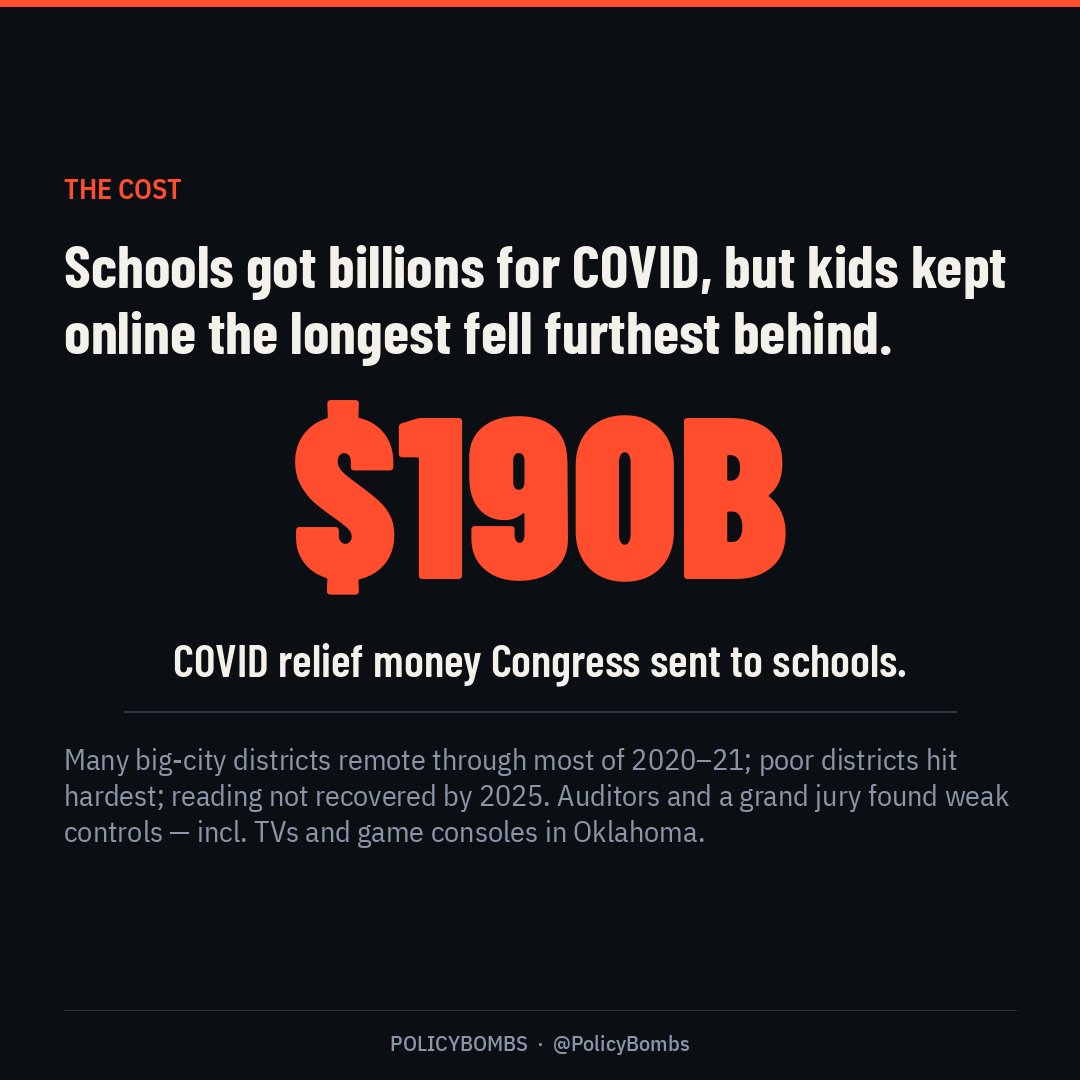
$190 billion. That's what Congress sent schools in COVID relief. Test scores still fell most where schools stayed remote longest.

Many big-city districts stayed remote through most of 2020-21. Poor districts were hit hardest, and reading still hadn't recovered by 2025. State auditors and a grand jury later found some relief money spent with weak controls, including on TVs and game consoles in Oklahoma.

The good: The fair defense covers spring 2020 only. The cost: Large, lasting learning, earnings and equity costs; small child health benefit.

PRO: The fair defense covers spring 2020 only.

CON / COST: Large, lasting learning, earnings and equity costs; small child health benefit.

SOCIETY: Union pressure and partisanship, not just evidence, kept districts closed.


Full analysis

COVID School Closures: Policy Assessment

How long US schools stayed remote, what NAEP and the Education Recovery Scorecard show, the union role in CDC guidance, and a verdict. As of Nov 4, 2026.

Content as of Nov 4, 2026, 8:32 PM ET. Source Page: PolicyBombs canvas

Long-form deep analysis. Companion to the 10-minute quick reference (17-school-closures-summary.docx).

Contents

  • 10-Minute Voter Guide
  • Key facts
  • 1. What is the policy
  • 2. Why it exists
  • 3. Realized effects
  • 4. Good or bad for society
  • Local investigations and data anomalies
  • Who supports / who opposes
  • References

10-Minute Voter Guide

Who’s for / against: For fast reopening in 2020: President Trump and Gov. DeSantis (R). For longer closures: teachers’ unions (AFT’s Randi Weingarten) and many big-city districts that stayed remote into 2021. San Francisco Democrats recalled 3 school-board members in 2022, with Mayor Breed’s support.

Many big-city districts kept schools remote through most of 2020-21. Test scores fell the most in places that stayed remote longest, especially in poor districts, and reading still hadn’t recovered by 2025. Congress sent about $190 billion in school relief (ESSER). State auditors and a grand jury later found some of it was spent with weak controls, including on TVs and game consoles in Oklahoma.

Arguments for the closures

Arguments against

+ Early 2020 was genuinely uncertain

+ Protected high-risk staff and families before vaccines

– Children were at very low risk; Europe reopened sooner

– Largest learning losses on record, hitting poor kids hardest

– Relief money was partly wasted with weak oversight

Bottom line for voters: Back officials who commit to keeping schools open in emergencies and to publishing how every relief dollar was spent.

Bottom line: Closing schools in spring 2020 was defensible given what was known then. Keeping many districts remote through 2020–21, after evidence showed in-person school was low-risk, was a serious policy failure. The heaviest costs fell on poor and minority students. Teachers’ union influence on federal guidance is documented. Scores were already sliding before COVID, and reading had not fully recovered as of 2025.

Key facts

Item

Finding

Source

NAEP 2022 math

Grade 4 down 5 points, grade 8 down 8, the largest drop on record

NCES

NAEP 2024

Reading down 2 more points in grades 4 and 8; grade 4 math up slightly; grade 8 math flat

NCES (Jan 2025)

Remote vs in-person

Districts remote longer lost more, especially high-poverty ones

Education Recovery Scorecard (Harvard/Stanford)

2026 Scorecard

Declines started about 2013; math rebounding since 2022; reading turned only in 2025; U-shaped recovery

Harvard CEPR, May 2026

CDC Feb 2021 guidance

CDC shared a draft with AFT and accepted AFT edits (GOP majority finding); AFT and committee Democrats say CDC consulted widely and AFT sought safe reopening

House Select Subcommittee final report, Dec 2024

ESSER relief

About $190B across three laws

US Dept of Education

Chronic absenteeism

About doubled from about 15% pre-pandemic to about 28% in 2022; still elevated

AEI / Return to Learn tracker; approximate

1. What is the policy

Item

Detail

Spring 2020

Nearly all US public schools closed by late March 2020 under state orders.

2020–21 school year

Districts and states chose locally. Many Southern and rural districts and private and Catholic schools reopened in fall 2020. Many large urban districts (LA, Chicago, SF, Seattle, Washington DC) stayed fully or mostly remote into spring 2021, some for over a year. Chicago’s union held a strike vote in Jan 2022 and closed schools for several days.

Federal guidance

CDC Feb 12, 2021 Operational Strategy tied reopening to community transmission tiers and six-foot distancing. Revised to three feet in March 2021.

Status

No closures in force. ESSER funds expired Sept 2024 (liquidation into 2026). States are now adopting high-dosage tutoring and science-of-reading laws.

2. Why it exists

Stated reasons: protect students, staff and families from COVID; uncertainty in early 2020; ventilation and staffing concerns.

Underlying drivers: teachers’ unions (AFT, NEA, and big-city locals in Chicago and LA) used reopening as leverage for safety demands and sometimes broader political demands. Democratic officials in union-aligned cities deferred to them. Brookings and other studies found reopening correlated more with local partisanship and union strength than with COVID case rates. Some parents in high-risk communities also wanted to stay remote. Liability fears pushed administrators toward caution.

3. Realized effects

Item

Detail

Assessment

Learning loss

Scorecard research (Kane, Reardon et al.) finds remote time explains a meaningful share of district-level losses, with the highest-poverty remote districts losing the most. Losses are measurable in later earnings estimates.

Large

Inequality

Gaps widened between high- and low-poverty districts and between high and low achievers. NAEP 2024 lowest-percentile students fell furthest.

Widened

Health benefit

Studies of in-person schooling with mitigation found limited added transmission in 2020–21. European schools reopened in spring 2020 without major surges attributed to schools. The marginal health benefit of extended closure appears small.

Small

Recovery

2026 Scorecard: math is rebounding, aided by federal relief in high-poverty districts. Middle-income districts lag. Reading only started turning in 2025, and the decline predates COVID (since about 2013, linked by some to smartphones and reading curricula).

Partial

Mental health and absenteeism

Chronic absenteeism nearly doubled and has stayed elevated. Youth mental-health crises rose, though causation is shared with social media trends.

Persistent

4. Good or bad for society

Verdict: Extended closures were bad for society. The learning, earnings and equity costs were large and lasting, and the health benefit for children was small. Union pressure and partisanship, not just evidence, kept many urban districts closed. The fair defense covers spring 2020 only.

Case for closures

Case against extended closures

+ Early 2020 uncertainty and no vaccines

+ Protect older teachers and multigenerational households

+ Ventilation and staffing were not ready

– Children faced very low COVID risk; Europe reopened safely

– Lost learning is worth trillions in lifetime earnings (Hanushek estimates)

– Harm was concentrated on poor and minority students

  1. Future pandemic plans: schools last to close, first to open.
  2. Make reopening decisions evidence-tiered and transparent, not negotiated.
  3. Sustain tutoring and phonics-based reading reform.

Local investigations and data anomalies

Finding

Source

What investigators or courts concluded

Oklahoma ‘Bridge the Gap’ (GEER funds via ClassWallet): about $1.7M spent on non-educational items (Xbox consoles, TVs, appliances, furniture, Christmas trees); state declined available purchase controls

Oklahoma State Auditor Cindy Byrd (2022)

Mismanagement confirmed

Same program

Oklahoma Multi-County Grand Jury, Oct 2024

Found pervasive mismanagement and waste but returned no indictments

State lawsuit against ClassWallet

Oklahoma AG Drummond, Jan 2026

Case dismissed; AG called it baseless

West Virginia: 37 of 54 county districts noncompliant with ESSER rules, including improper purchases

WV Legislative Auditor (PERD), Nov 2023

Misspending and weak documentation; recoveries not verified here

Tulsa Public Schools: $4.9M in reimbursements with inadequate invoices; $110,801 unallowable

Oklahoma State Auditor

Unsupported and unallowable costs

Des Moines schools’ ESSER use

US Dept of Education OIG

Federal OIG audit of district spending; see report for findings

Pattern: emergency education money moved faster than controls, and auditors repeatedly found unsupported or off-purpose spending. Grand juries and courts did not find criminal intent in the Oklahoma case. Verdict on closures: unchanged. New: relief spending oversight was weak and deserves its own accountability.

Further reading (also listed in References):

  • Oklahoma AG: Multi-County Grand Jury on GEER education funds (Oct 2024) — oklahoma.gov
  • Oklahoma AG: ClassWallet case dismissed (Jan 2026) — oklahoma.gov
  • WV Legislative Auditor: ESSER review (Nov 2023) — wvlegislature.gov
  • Oklahoma State Auditor: Tulsa Public Schools audit — sai.ok.gov
  • ED OIG: Des Moines ESSER use — oig.ed.gov

Who supports / who opposes

For = in-person reopening in 2020–21. Against = prolonged closures. Each row cites a numbered source below. Checked Nov 4, 2026.

Who

Party / level

Position

Evidence

Ref

President Donald Trump

Republican

For (qualified)

Jul 8, 2020 tweet: schools should open; "May cut off funding if not open!"

[1]

Gov. Ron DeSantis (R-FL); Ed. Commissioner Richard Corcoran

Republican

For (qualified)

Emergency Order DOE 2020-EO-06 required brick-and-mortar schools to reopen (Jul 6, 2020, for August reopening)

[2]

AFT President Randi Weingarten

Union (D-aligned)

Against (qualified)

AFT suggested language adopted in CDC Feb 2021 reopening guidance; testified to House panel (2023)

[3]

SF voters; Mayor London Breed (D)

Democrat (local)

For (qualified)

Recalled board members Collins, López, Moliga (Feb 2022) amid parent anger over slow reopening

[4]

Cross-party defectors: San Francisco’s recall was driven by Democratic parents and backed by a Democratic mayor.

How positions shifted: By 2022–24 most Democrats, including Biden, acknowledged the learning losses from long closures. The House select subcommittee’s final report (Dec 2024) criticized CDC/AFT coordination.

Not included or not fully verified: The AFT–CDC language detail comes from House select subcommittee findings, not re-opened this turn.

Sources for this section:

References

[1] Oklahoma AG: Multi-County Grand Jury on GEER education funds (Oct 2024). oklahoma.gov. https://oklahoma.gov/oag/news/newsroom/2024/october/multi-county-grand-jury-finds-pervasive-mismanagement-waste-in-governors-pandemic-relief-funds-for-education.html

[2] Oklahoma AG: ClassWallet case dismissed (Jan 2026). oklahoma.gov. https://oklahoma.gov/oag/news/newsroom/2026/january/drummond-lauds-dismissal-of-baseless-classwallet-case.html

[3] WV Legislative Auditor: ESSER review (Nov 2023). wvlegislature.gov. https://www.wvlegislature.gov/legisdocs/reports/perd/DOE.ESSER_NOVEMBER_2023.pdf

[4] Oklahoma State Auditor: Tulsa Public Schools audit. sai.ok.gov. https://www.sai.ok.gov/Search%20Reports/database/TPS%20Audit%20Report%20web%20final.pdf

[5] ED OIG: Des Moines ESSER use. oig.ed.gov. https://oig.ed.gov/reports/other/des-moines-independent-community-school-districts-use-elementary-and-secondary-school

[6] Education Recovery Scorecard, May 2026 report. educationscorecard.org. https://educationscorecard.org/wp-content/uploads/2026/05/Education_Scorecard_May_2026_Report.pdf

[7] Harvard GSE: U-shaped recovery. gse.harvard.edu. https://www.gse.harvard.edu/ideas/news/26/05/new-education-scorecard-finds-u-shaped-recovery

[8] NAEP: Nation’s Report Card. nationsreportcard.gov. https://www.nationsreportcard.gov/

[9] Chalkbeat: Tom Kane on recovery (May 2026). chalkbeat.org. https://www.chalkbeat.org/2026/05/21/tom-kane-on-test-scores-and-learning-loss-recovery/

[10] Return to Learn tracker (AEI). returntolearntracker.net. https://www.returntolearntracker.net/

[11] House Select Subcommittee final report (Dec 4, 2024), AFT/CDC chapter pp. 415–437. oversight.house.gov. https://oversight.house.gov/wp-content/uploads/2024/12/12.04.2024-SSCP-FINAL-REPORT.pdf

[12] AFT rebuttal: The Select Subcommittee’s revisionist history. aft.org. https://www.aft.org/sites/default/files/media/documents/2024/TheSelectSubcommitteesRevisionistHistoryofSchoolClosures.pdf

PolicyBombs · Day 61. Follow @PolicyBombs on X.

Open Presidential Debates

15%. That's the polling bar to get on the presidential debate stage. No third-party candidate has cleared it since 1992.

Presidential debates are run by a private nonprofit created by the Republican and Democratic parties and paid for by corporate sponsors. In 2024 the two campaigns skipped the commission entirely and cut deals with TV networks directly.

The good: Lowering the bar would cost little and improve legitimacy. The cost: A duopoly-run, self-fulfilling threshold shrinks voter choice.

PRO: Lowering the bar would cost little and improve legitimacy.

CON / COST: A duopoly-run, self-fulfilling threshold shrinks voter choice.

SOCIETY: Campaigns setting their own terms is worse still.


Full analysis

Open Presidential Debates: Policy Assessment

Who controls general-election debate access, how the 15% rule works, what happened in 2024, and whether third-party candidates should get in. As of Nov 4, 2026.

Content as of Nov 4, 2026, 8:33 PM ET. Source Page: PolicyBombs canvas

Long-form deep analysis. Companion to the 10-minute quick reference (16-open-debates-summary.docx).

Contents

  • 10-Minute Voter Guide
  • Key facts
  • 1. What is the policy
  • 2. Why it exists
  • 3. Realized effects
  • 4. Good or bad for society
  • Local investigations and data anomalies
  • Who supports / who opposes
  • References

10-Minute Voter Guide

Who’s for / against: For keeping the current 15% gate: the CPD (founded by the RNC and DNC) and, in 2024, both the Biden and Trump campaigns. For opening debates: third-party candidates (RFK Jr., Jill Stein, Gary Johnson) and Level the Playing Field. The RNC voted to quit the CPD in 2022.

Presidential debates are run by a private nonprofit created by the Republican and Democratic parties and paid for by corporate sponsors. To get on stage, a candidate needs 15% in national polls, a bar no third-party candidate has cleared since 1992. In 2024 the two campaigns skipped the commission and cut deals with TV networks directly.

Arguments for the current rules

Arguments against

+ Keeps the stage to people who could win

+ Rules are announced in advance

– Built by the two parties to exclude rivals

– Corporate sponsors with policy interests fund it

– You can’t reach 15% without debate exposure

Bottom line for voters: The system protects incumbents of both parties. Support a lower, transparent entry bar run by an independent sponsor.

Bottom line: Debate access is a private arrangement run by and for the two major parties. The 15% polling threshold has kept every third-party candidate out since 1996. In 2024 the two campaigns bypassed even the bipartisan commission and negotiated directly with networks. A lower, transparent threshold would serve voters better than the current setup.

Key facts

Item

Detail

Status (Nov 2026)

Commission on Presidential Debates (CPD)

Private nonprofit founded 1987 by the RNC and DNC chairs

Exists; says it will return in 2028

CPD criteria (since 2000)

Constitutional eligibility; ballot access for 270 electoral votes; 15% average in 5 national polls

Unchanged

Last third-party candidate on stage

Ross Perot, 1992 (19% vote)

None since

2024 arrangement

Biden and Trump camps agreed directly: CNN (June 27) and ABC (Sept 10); CBS VP debate (Oct 1)

Used 15% rule; RFK Jr. excluded

Level the Playing Field v. FEC

Challenged the 15% rule

Lost (D.C. Cir. 2020)

2028 arrangements

No sponsor, dates, format or party commitments announced

CPD says it will return; checked Nov 2026

1. What is the policy

Item

Detail

CPD rules

FEC regulation (11 CFR 110.13) lets nonprofits stage debates if they use ‘pre-established objective criteria.’ The CPD set 15% in 2000 after Perot’s 1996 exclusion. Ballot access for 270 electoral votes is also required.

2024

In May 2024 both campaigns announced they would skip the CPD. Biden’s team cited CPD scheduling (debates after early voting). Trump agreed to CNN and ABC. The networks adopted the 15% rule plus 270-vote ballot access by deadline; RFK Jr. did not qualify. A second Trump–Harris debate never happened.

Status

The CPD remains, but its role is uncertain. The RNC voted in 2022 to withdraw from CPD debates. Primary debates are run by the parties themselves.

2. Why it exists

Stated reasons: keep stages to viable candidates, ensure orderly formats, give voters a serious choice between plausible winners.

Underlying drivers: the commission was created by the two parties, and its co-chairs have been party insiders. Both parties gain by keeping out spoilers (Perot, Nader, Johnson). Corporate sponsors underwrite the events. Campaigns now negotiate terms directly to gain format advantages, such as muted mics and no audience in CNN 2024. A catch-22: candidates can’t reach 15% without the exposure a debate gives.

3. Realized effects

Item

Detail

Assessment

Exclusion

Gary Johnson polled in the high single digits to about 10% in 2016 and was excluded. RFK Jr. hit low-to-mid teens in some 2023–24 polls but fell short of a 15% average. Polls in 1992 had Perot below 15% before his debates.

Effective gatekeeping

Viewership

Debates remain the largest civic audiences: 2024 ABC debate about 67M viewers (Nielsen), CNN about 51M.

High stakes

Impact

The June 2024 debate led to Biden’s withdrawal on July 21, 2024, showing debates can change races.

Decisive

Legal

Courts have deferred to the FEC; challenges argued the rule is a bipartisan in-kind contribution. They lost on deference grounds, not on evidence of fairness.

Stuck

4. Good or bad for society

Verdict: Bad as structured. A duopoly-run gate with a self-fulfilling 15% threshold reduces voter choice and accountability. Lowering the bar (e.g., ballot access for 270 votes plus 5% polling, or a stage for any candidate who could mathematically win) would cost little and improve legitimacy. The 2024 practice of campaigns setting terms directly is worse still.

Case for the 15% rule

Case for opening debates

+ Keeps focus on candidates who can win

+ Limits fringe or novelty candidates

+ Objective and pre-announced

– Polls are noisy and depend on name recognition

– Perot’s 1992 run shows outsiders can be viable

– Large shares of voters say they want more choices (Gallup support for a third party is often above 50%)

  1. Set entry at 270-vote ballot access plus 5% average or a mathematical path.
  2. Make the sponsor independent, with no party-appointed board.
  3. Fix the debate calendar before early voting starts.

Local investigations and data anomalies

Finding

Source

What investigators or courts concluded

CPD is funded largely by corporate sponsors (e.g., Anheuser-Busch, $550,000 in 2000 and a sponsor every cycle since 1996)

Center for Public Integrity investigation; CPD Form 990s

Legal under FEC rules; sponsors gain access but no quid pro quo has been proven

Complaints that the 15% rule is an illegal corporate contribution to the two parties

FEC MURs; Level the Playing Field v. FEC

FEC dismissed; D.C. Circuit upheld the dismissal (2020)

Co-chairs are former party chairs; Frank Fahrenkopf receives no salary per 990s

CPD 990s (ProPublica)

No self-dealing found in filings

No ‘dark money’ in the legal sense was found: CPD’s donors appear on its filings and in reporting. The structural conflict is in plain sight, not hidden. Verdict: unchanged.

Further reading (also listed in References):

Who supports / who opposes

For = opening debates to third parties. Against = current gatekeeping. Mixed = bypassing the CPD while keeping the 15% bar. Each row cites a numbered source below. Checked Nov 4, 2026.

Who

Party / level

Position

Evidence

Ref

Republican National Committee

Republican

Mixed

Voted unanimously (Apr 2022) to withdraw from CPD debates

[1]

Biden and Trump campaigns

Both

Mixed

Bypassed CPD in 2024 and negotiated network debates using a 15% threshold

[2]

Robert F. Kennedy Jr. (independent, 2024)

Independent

For

Filed FEC complaint against CNN’s debate criteria (2024)

[3]

Level the Playing Field; Gary Johnson & Jill Stein (2016 suit)

Third parties

For

Sued over the 15% rule; lost (D.C. Cir. 2020)

[4]

Cross-party defectors: The RNC quit the CPD it co-founded, but over alleged bias, not to open debates to third parties.

How positions shifted: Both major parties have backed tighter control. The 2024 deals moved debates from a bipartisan commission to direct campaign-network negotiations.

Not included or not fully verified: Could not source any sitting member of Congress’s bill to lower the 15% threshold; none found.

Sources for this section:

References

[1] Center for Public Integrity: The buying of the presidential debates. publicintegrity.org. https://www.publicintegrity.org/politics/the-buying-of-the-presidential-debates/

[2] ProPublica Nonprofit Explorer: CPD 990s. propublica.org. https://projects.propublica.org/nonprofits/organizations/521500977

[3] FEC MUR file on CPD criteria. fec.gov. https://www.fec.gov/files/legal/murs/current/118231.pdf

[4] CPD: Overview and candidate criteria. debates.org. https://www.debates.org/about-cpd/overview/

[5] Semafor: Why Biden and Trump ditched the CPD. semafor.com. https://www.semafor.com/article/05/17/2024/why-biden-and-trump-ditched-the-commission-on-presidential-debates

[6] Ballotpedia: Commission on Presidential Debates. ballotpedia.org. https://www.ballotpedia.org/Commission_on_Presidential_Debates

[7] 11 CFR 110.13 (FEC debate staging). ecfr.gov. https://www.ecfr.gov/current/title-11/chapter-I/subchapter-A/part-110/section-110.13

[8] Citizens’ Debate Commission: reform proposals. citizensdebates.org. https://citizensdebates.org/debate-reform-today/

[9] The Hill: CPD chair says ‘we’ll be back in 2028’. thehill.com. https://thehill.com/newsletters/evening-report/4742020-evening-report-debates-chairman-rips-cnn-format/

PolicyBombs · Day 60. Follow @PolicyBombs on X.

Federal Deficit Spending

$1 trillion+. That's what the federal government now pays in interest on its debt each year.

It borrows about $1.9 trillion a year, and debt will pass its World War II record by 2030. Both parties added to it: COVID relief under both, and the 2025 tax law. Government auditors estimate $233 to $521 billion a year lost to fraud, plus $186 billion in improper payments in FY2025.

The good: Emergency deficits like 2020 can be justified. The cost: Permanent ~6% of GDP deficits shift costs to future taxpayers.

PRO: Emergency deficits like 2020 can be justified.

CON / COST: Permanent ~6% of GDP deficits shift costs to future taxpayers.

SOCIETY: Interest is crowding out other spending.


Full analysis

Federal Deficit Spending: Policy Assessment

Debt path, CBO’s Feb 2026 projections, interest costs, COVID spending and the 2025 tax law, with a verdict. As of Nov 4, 2026.

Content as of Nov 4, 2026, 8:33 PM ET. Source Page: PolicyBombs canvas

Long-form deep analysis. Companion to the 10-minute quick reference (15-deficit-spending-summary.docx).

Contents

  • 10-Minute Voter Guide
  • Key facts
  • Debt trajectory
  • 1. What is the policy
  • 2. Why it exists
  • 3. Realized effects
  • 4. Good or bad for society
  • Local investigations and data anomalies
  • Who supports / who opposes
  • References

10-Minute Voter Guide

Who’s for / against: Both parties add to deficits. Democrats passed the 2021 American Rescue Plan alone, and Republicans passed the 2025 tax-and-spending law alone (CBO estimates it adds ~$3.4T over 10 years). Deficit hawks who broke ranks: Sen. Rand Paul and Rep. Thomas Massie (R). The 2023 Fiscal Responsibility Act passed with bipartisan votes.

The federal government borrows about $1.9 trillion a year, and interest on the debt now tops $1 trillion. Debt will pass its World War II record by 2030. Both parties added to it: COVID relief under both, and the 2025 tax law. On top of that, the government’s own auditors say it loses an estimated $233 to $521 billion a year to fraud, plus $186 billion in improper payments in FY2025.

Arguments that deficits are OK

Arguments that they are dangerous

+ Emergency borrowing in 2020 prevented deeper damage

+ The US borrows in its own currency

– Interest crowds out everything else

– Fraud losses rival the defense budget at the high end

– Social Security trust fund runs dry in 2032

Bottom line for voters: Ask candidates for a specific plan to cut the deficit and a specific plan to cut fraud and improper payments. ‘Waste’ with no program named is not a plan.

Bottom line: Running deficits near 6% of GDP in a full-employment economy is bad policy, and both parties caused it. The deficit is now driven by interest costs rather than new programs. Debt is projected to pass its 1946 record by 2030. The 2025 tax law made the gap wider. Tariff revenue offset part of it, but that offset is legally and politically uncertain.

Key facts

Metric

Value

Source

FY2026 deficit (projected)

$1.9T, 5.8% of GDP

CBO Feb 2026

FY2036 deficit (projected)

$3.1T, 6.7% of GDP

CBO Feb 2026

50-year average deficit

3.8% of GDP

CBO

Debt held by public

99% (2025), 101% (2026), 120% (2036), 175% (2056)

CBO

Net interest

$970B (2025), over $1.0T (2026), $2.1T (2036), 3.3% to 4.6% of GDP

CBO

2026–35 deficits vs Jan 2025 baseline

+$1.4T total: +$3.4T OBBBA-driven, +$0.7T interest, minus $2.7T mostly tariffs

CBO via Fiscal Lab

Social Security OASI trust fund

Exhausted 2032

CBO

COVID relief laws 2020–21

About $5T (CARES, Dec 2020 act, ARP)

CRFB tracker; approximate

Debt trajectory

Chart data (shown as a chart on the Page)

Label

Value

2025

99% of GDP

2026

101% of GDP

2030

108% of GDP

2036

120% of GDP

2056

175% of GDP

Note at 2030: Passes 1946 record (106%)

Debt held by the public, CBO current-law projections (Feb 2026). Points are unevenly spaced in time.

1. What is the policy

Item

Detail

Structural deficit

Revenues around 17% of GDP and outlays around 23%. The gap comes from Social Security, Medicare and Medicaid growth, defense, and now interest. The primary deficit is 2.6% of GDP in 2026, falling to 2.1% by 2036. Total deficits rise anyway because of interest.

COVID spending (2020–21)

CARES Act ($2.2T), Dec 2020 relief ($0.9T) and the American Rescue Plan ($1.9T). The FY2020 deficit was about $3.1T, the largest on record.

One Big Beautiful Bill Act (July 4, 2025)

Made the 2017 TCJA individual cuts permanent and added tax breaks on tips, overtime and seniors. It cut Medicaid and SNAP (through work requirements), ended EV credits, and raised border and defense funding. CBO (2025) estimated about $3.4T in added deficits over 10 years before interest.

Tariffs (2025–26)

Customs revenue jumped. CBO credits about $2.7T in lower deficits, mainly from tariffs. But on Feb 20, 2026 the Supreme Court held 6–3 in Learning Resources v. Trump that IEEPA does not authorize tariffs. CBO’s baseline reflects trade policy as of Nov 20, 2025, so part of the tariff offset is now legally void unless replaced under other statutes (e.g., Sections 232, 301, 122). The size of the remaining offset is not verified here.

2. Why it exists

Stated reasons: emergency stabilization (2008, 2020), growth from tax cuts, national defense, and protecting seniors’ benefits.

Underlying drivers: voters reward tax cuts and benefits and punish the costs. Neither party will touch Social Security or Medicare, the largest drivers. The GOP prioritizes tax cuts and Democrats prioritize spending, and bipartisan deals stack both. Low rates in 2010–21 made borrowing look free. Lobbying for tax expenditures and defense procurement adds to the gap. The bond market has not yet forced discipline.

3. Realized effects

Item

Detail

Assessment

Interest costs

Net interest went over $1T in 2026, exceeding defense spending. It is projected to be nearly a fifth of spending by 2036.

Worsening

Inflation

Studies (SF Fed, Jordà et al. 2022) estimate US fiscal support added roughly 2.5–3 points to 2021 core inflation. Others (Bernanke and Blanchard 2023) put more weight on energy and supply shocks.

Contributor

COVID payoff

Fast recovery and child poverty at a record low in 2021 (SPM), but also large fraud. GAO and SBA OIG estimate $200B+ in potentially fraudulent PPP and EIDL loans; that is the SBA IG figure.

Mixed

Credit rating

Moody’s downgraded the US from Aaa in May 2025, so all three major agencies now rate below AAA.

Negative

Crowding out

CBO estimates higher debt lowers private investment and future income. This is a slow erosion, not a sudden crisis.

Long-run cost

4. Good or bad for society

Verdict: Bad. Deficits during emergencies like 2020 can be justified, though the 2021 ARP was oversized for a recovering economy. Permanent deficits near 6% of GDP at low unemployment shift costs to future taxpayers, and interest is crowding out other spending. The 2025 tax law worsened the structural gap.

Case that deficits are fine

Case that they are dangerous

+ The US borrows in its own reserve currency; Japan carries far higher debt

+ Stabilizers and emergency spending cut recession damage

+ Primary deficit is projected to shrink

– Interest grows faster than the economy when rates are above growth

– Leaves little fiscal room for the next crisis

– Trust fund exhaustion in 2032 forces automatic benefit cuts

  1. Adopt a debt-stabilization target (e.g., primary surplus by 2035).
  2. Fix Social Security on a bipartisan commission timeline before 2032.
  3. Pay for extensions; trim tax expenditures.

Local investigations and data anomalies

Finding

Source

What investigators or courts concluded

Federal fraud losses $233B-$521B a year (FY2018-22), 3-7% of obligations

GAO-24-105833

First government-wide estimate; includes pandemic years; not predictive

Improper payments $186B in FY2025 (up $24B); about $3T since 2003; TANF not even measured

GAO-26-108694

Totals understate the problem because some risky programs don’t report

Feeding Our Future (MN): claimed 91 million meals; about $250M in child-nutrition funds stolen; sponsor grew from $3.4M (2019) to nearly $200M (2021)

US District Court, D. Minn.; DOJ

70 charged; Aimee Bock convicted on all counts (Mar 2025), sentenced to 500 months and $243M restitution (May 2026); a juror-bribery attempt was charged separately

PPP and EIDL potentially fraudulent loans $200B+

SBA OIG

Estimate, not adjudicated total

The anomaly pattern: a sponsor’s funding jumped 58-fold in two years while the state agency flagged it but kept paying. That is the clearest local sign of control failure under emergency waivers. Verdict: unchanged (bad), with an added finding. Fraud and improper payments are a significant, measurable share of the deficit problem and get little attention in deficit debates.

Further reading (also listed in References):

  • GAO: federal fraud loss estimate (2024) — gao.gov
  • GAO-26-108694: improper payments $186B in FY2025 — gao.gov
  • DOJ: Feeding Our Future ringleader sentenced to 500 months — justice.gov
  • MPR News: Bock sentencing (May 2026) — mprnews.org

Who supports / who opposes

For = voted for the deficit-increasing law. Against = voted no on deficit grounds. Mixed = bipartisan restraint deal. Each row cites a numbered source below. Checked Nov 4, 2026.

Who

Party / level

Position

Evidence

Ref

Speaker Kevin McCarthy (R) & President Biden (D)

Bipartisan

Mixed

Fiscal Responsibility Act of 2023 (H.R. 3746) passed House 314–117 and Senate 63–36; 71 R and 46 D voted no in the House

[1]

Democrats; President Biden

Democrat

For

American Rescue Plan (H.R. 1319, 2021), $1.9T, passed with no Republican votes

[2]

Republicans; President Trump

Republican

For

H.R. 1 (2025); CBO estimate ~$3.4T added to deficits over 2025–2034

[3]

Rep. Thomas Massie (R-KY); Sen. Rand Paul (R-KY)

Republican (defectors)

Against

Voted no on H.R. 1 (2025), citing deficits

[3]

Cross-party defectors: Massie and Paul voted against their own party’s 2025 bill on deficit grounds. Dozens of Democrats and Republicans voted against the 2023 debt-limit deal.

How positions shifted: Republicans emphasized deficits under Obama and Biden, then passed deficit-increasing tax laws in 2017 and 2025. Democrats now cite CBO deficit scores against Republican bills.

Sources for this section:

References

[1] GAO: federal fraud loss estimate (2024). gao.gov. https://www.gao.gov/products/gao-24-105833

[2] GAO-26-108694: improper payments $186B in FY2025. gao.gov. https://www.gao.gov/assets/gao-26-108694.pdf

[3] DOJ: Feeding Our Future ringleader sentenced to 500 months. justice.gov. https://www.justice.gov/opa/pr/feeding-our-future-ringleader-sentenced-500-months

[4] MPR News: Bock sentencing (May 2026). mprnews.org. https://www.mprnews.org/story/2026/05/21/aimee-bock-feeding-our-future-fraud-sentencing

[5] CBO: Budget and Economic Outlook 2026–2036. cbo.gov. https://www.cbo.gov/publication/62105

[6] CBO Director’s statement (Feb 2026). cbo.gov. https://www.cbo.gov/publication/62050

[7] Fiscal Lab: Feb 2026 CBO outlook breakdown. fiscallab.org. https://fiscallab.org/guides/cbo-budget-outlook-2026/

[8] Learning Resources v. Trump opinion (Feb 20, 2026). supremecourt.gov. https://www.supremecourt.gov/opinions/25pdf/24-1287%5F4gcj.pdf

[9] CRS: Supreme Court rules against IEEPA tariffs. congress.gov. https://www.congress.gov/crs-product/LSB11398

[10] CRFB COVID Money Tracker. covidmoneytracker.org. https://www.covidmoneytracker.org/

[11] SF Fed: Why is US inflation higher than in other countries?. frbsf.org. https://www.frbsf.org/research-and-insights/publications/economic-letter/2022/03/why-is-us-inflation-higher-than-in-other-countries/

[12] SBA OIG: COVID-19 pandemic EIDL and PPP loan fraud landscape. sba.gov. https://www.sba.gov/document/report-23-09-covid-19-pandemic-eidl-ppp-loan-fraud-landscape

PolicyBombs · Day 59. Follow @PolicyBombs on X.

Red vs Blue States

$24 billion. California's own auditor couldn't show whether that much homelessness spending worked.

People are steadily moving from California, New York and Illinois to Texas and Florida, mostly because of housing costs. Blue states are richer and spend more. Crime does not split cleanly by party. Red states have their own accountability problems, but the main ones checked were cleared in court or by auditors.

The good: Red states win on affordability and growth. The cost: Red states lose on health coverage and some public-health outcomes.

PRO: Red states win on affordability and growth.

CON / COST: Red states lose on health coverage and some public-health outcomes.

SOCIETY: Blue-state housing policy is clearly bad; 'Democrats ruin states' overreaches.


Full analysis

Democratic vs Republican Governance: CA, IL, NY vs TX, FL

Tests the claim that Democratic policy harms cities and states, comparing one-party blue and red states on migration, cost, housing, crime, taxes and budgets with confounders stated. As of Nov 4, 2026.

Content as of Nov 4, 2026, 8:33 PM ET. Source Page: PolicyBombs canvas

Long-form deep analysis. Companion to the 10-minute quick reference (14-red-vs-blue-states-summary.docx).

Contents

  • 10-Minute Voter Guide
  • Key facts
  • Net domestic migration, July 2024 to June 2025
  • Crime rates, 2024
  • 1. What is the policy
  • 2. Why it exists
  • 3. Realized effects
  • 4. Good or bad for society
  • Local investigations and data anomalies
  • Who supports / who opposes
  • References

10-Minute Voter Guide

Who’s for / against: Blue-state model champions: Gov. Newsom (D-CA), who also led Prop 50 redistricting in response to Texas. Red-state model champions: Govs. DeSantis (R-FL) and Abbott (R-TX), who signed the 2025 mid-decade Texas map. The two models clashed on Fox in the Nov 2023 Newsom–DeSantis debate.

People are steadily moving from California, New York and Illinois to Texas and Florida, mostly because of housing costs. Blue states are richer and spend more, but California’s own auditor found the state couldn’t show whether $24 billion in homelessness spending worked. Crime does not split cleanly by party. Red states have their own accountability problems, but the main ones checked here were cleared in court or by auditors.

Blue-state model: strengths

Blue-state model: weaknesses

+ Higher wages and productivity

+ Broader health coverage

+ Lower murder rate in NY

– Very high housing costs from building restrictions

– Big spending without tracked results (CA homelessness audit)

– Worst pension debt (IL)

Bottom line for voters: Ask any candidate how many homes their policies will let get built, and whether they will publish results for every major spending program.

Bottom line: The strongest evidence against blue-state governance is about housing and cost. Land-use restrictions in CA and NY made homes scarce and expensive, and that drives the steady domestic out-migration. Crime does not divide cleanly by party. Several red states have higher murder rates. The blue states also stay richer and more productive. Democrats’ clearest self-inflicted failure is blocking housing, not the general idea of "Democratic policy."

Key facts

Measure

CA

NY

IL

TX

FL

Top state income tax rate

13.3% (+1.1% SDI on wages)

10.9%

4.95% flat

0%

0%

Domestic migration, 2020–24 direction (Census)

Net loss

Net loss

Net loss

Net gain

Net gain

Housing cost vs US

Among highest

High (NYC metro)

Near average

Near/below average; rising

Above average; insurance surge

Population trend, 2024–25

Slight growth via immigration

Slight growth via immigration

Flat

Fast growth

Fast growth

Party control (2026)

D trifecta

D trifecta

D trifecta

R trifecta

R trifecta

Net domestic migration, July 2024 to June 2025

Chart data (shown as a chart on the Page)

Label

Value

California

−229,077

New York

−137,586

Illinois

−40,017

Florida

+22,517

Texas

+67,299

Census Vintage 2025 estimates (movers between states only; excludes international migration). Florida’s inflow has slowed sharply from its 2022 peak.

Crime rates, 2024

State

Party

Violent crime per 100K

Murder per 100K

California

D

486.0

4.5

Texas

R

389.4

5.2

New York

D

380.2

2.7

Illinois

D

289.2

5.8

Florida

R

267.1

3.9

FBI 2024 reported offenses, as compiled by secondary tables (OpenCrime, Exiled Policy); spot-check against the FBI Crime Data Explorer before quoting. Florida’s reporting coverage to the FBI has been incomplete in some recent years. Party split: California has the highest violent-crime rate, while New York has the lowest murder rate of the five.

1. What is the policy

Item

Detail

Blue model (CA, NY, IL)

Progressive income taxes, higher minimum wages (CA $16.50 in 2025; fast-food $20), expansive Medicaid and social programs, strict environmental review (CEQA), rent regulation (NYC), strong public-sector unions with large pension obligations (IL most underfunded), and restrictive local zoning.

Red model (TX, FL)

No income tax, higher property taxes (TX) or sales and tourism taxes (FL), lighter permitting and land-use rules, right-to-work, fewer social programs (neither expanded Medicaid), and state preemption of blue cities (e.g., TX HB 2127, 2023).

Cities

Most large cities in both red and blue states are run by Democrats (Houston, Dallas, Austin, Miami-Dade until 2022). So city-level comparisons by party usually compare blue cities to other blue cities.

2. Why it exists

Blue-state drivers: urban and coastal coalitions, public-sector unions, environmental groups, and incumbent homeowners. Homeowners use zoning and CEQA to protect home values, a bipartisan local behavior that blue metros practice most. High-income tax bases (tech, finance) make progressive taxes feasible, but they also make revenue volatile.

Red-state drivers: business lobbies, growth coalitions, oil and gas revenue (TX), retirees and tourism (FL), and competition for movers by marketing low taxes.

3. Realized effects

Item

Detail

Assessment

Migration

Census shows sustained net domestic out-migration from CA, NY and IL and inflow to TX and FL since at least 2010, accelerated in 2020–22. IRS migration data shows leavers skew middle-income, consistent with housing costs as the main push.

Blue negative

Housing

CA and NY permit far fewer homes per capita than TX and FL. Research (Glaeser and Gyourko; Hsieh and Moretti) ties high coastal prices mainly to supply restrictions. CA’s 2023–25 YIMBY laws (SB 9, SB 35, 2025 CEQA reform) are recent.

Blue negative

Crime

FBI data: violent-crime and murder rates do not divide by party. Third Way (2023) found higher per-capita murder rates in states Trump won. Big-city crime fell in both red and blue areas in 2023–25. City-level spikes (SF property crime, Chicago homicide) are real but local.

No clean split

Fiscal health

IL has the worst pension funding (43.3% funded in 2023, lowest in the US per Pew) and history of credit downgrades, though it was upgraded 2021–24. CA has volatile capital-gains revenue and recurring deficits. TX and FL hold large rainy-day funds. Blue states send more money to Washington than they get back.

Mixed

Prosperity

CA and NY have higher GDP per capita and median wages, but after housing costs their poverty rates (Census Supplemental Poverty Measure) rank among the highest; CA’s is the highest. FL lacks Medicaid expansion and has a larger uninsured share; TX has the highest uninsured rate in the US.

Trade-off

Confounders: climate and retiree preferences (FL), energy booms (TX), coastal agglomeration (CA, NY), remote work after 2020, and the 2017 SALT cap, which raised effective taxes for high earners in blue states. Partisan control is not randomly assigned, so the evidence is correlational.

4. Good or bad for society

Verdict: Blue-state housing and permitting policy is clearly bad. It is the strongest support for the claim and explains much of the cost-of-living gap and out-migration. On crime, overall prosperity and safety nets, the evidence does not support a blanket "Democratic policies ruin states" claim. Red states win on affordability and growth, and lose on health coverage and some public-health outcomes.

Case for the claim

Case against

+ Decade-plus of residents voting with their feet

+ Housing scarcity created by policy, plus very high cost of living

+ IL pension debt; CA homelessness (largest in US) despite large spending

– Blue states remain the most productive economies; growth is not the same as welfare

– Crime and murder are not higher in blue states overall

– Red-state growth partly reflects cheap land and climate, not only policy

  1. Blue states: legalize housing (by-right permitting, CEQA limits).
  2. Red states: invest in health coverage and infrastructure for growth.
  3. Judge outcomes by specific policies, not party labels.

Local investigations and data anomalies

Finding

Source

What investigators or courts concluded

CA allocated about $24B to homelessness and housing (FY2018-19 to 2022-23) but stopped tracking statewide spending after FY2020-21; 3 of 5 programs reviewed lacked outcome data to judge

California State Auditor 2023-102.1, Apr 2024

Only Homekey and CalWORKs Housing Support appeared cost-effective; no fraud finding, but an accountability failure

Illinois pensions 43.3% funded (2023), lowest in US

Pew

Structural underfunding, not fraud

Texas Operation Lone Star: $11B+ border spending, much via emergency no-bid contracts (Texas Observer, Houston Chronicle)

Texas State Auditor 27-005, Oct 2026

Sampled $282M in payments on 3 contracts were accurate and supported; one routine janitorial contract improperly treated as emergency

Florida: $10M from a Medicaid settlement routed to the Hope Florida Foundation, then to political committees

Leon County grand jury, 2025

Grand jury said the money was misappropriated but indicted no one; 1st DCA ordered the report expunged in Oct 2026, ruling the funds were not public money

Verdict: unchanged, and sharpened. The strongest documented accountability failure is California’s untracked homelessness spending. Red-state anomalies were real enough to investigate, but auditors or courts cleared them on the record.

Further reading (also listed in References):

  • CA State Auditor: Homelessness in California (2024) — auditor.ca.gov
  • Texas SAO: Contracting at Texas Military Department (Oct 2026) — sao.texas.gov
  • WFLA: court orders Hope Florida grand jury report expunged — wfla.com

Who supports / who opposes

For = championing their own state model or map. Each row cites a numbered source below. Checked Nov 4, 2026.

Who

Party / level

Position

Evidence

Ref

Gov. Gavin Newsom (D-CA)

Democrat

For

Championed Prop 50 (Nov 4, 2025) for temporary legislature-drawn maps to counter Texas; passed 64%

[1]

Gov. Greg Abbott (R-TX)

Republican

For

Signed HB 4 (2025 special session), a mid-decade congressional map aimed at +5 GOP seats

[2]

Newsom vs. Gov. Ron DeSantis (R-FL)

Both

Mixed

Debated state models on Fox News (Nov 30, 2023)

[3]

Cross-party defectors: Prop 50 was opposed by former Gov. Arnold Schwarzenegger (R), who backed independent redistricting.

How positions shifted: Both parties used to back independent redistricting commissions in some form (CA voters created one in 2008 and 2010). In 2025 both turned to mid-decade partisan maps.

Not included or not fully verified: This is a comparison topic, so there is no single bill. Rows cover the leaders of each model. The Schwarzenegger opposition to Prop 50 was not re-opened this turn.

Sources for this section:

References

[1] CA State Auditor: Homelessness in California (2024). auditor.ca.gov. https://www.auditor.ca.gov/reports/2023-102-1/

[2] Texas SAO: Contracting at Texas Military Department (Oct 2026). sao.texas.gov. https://sao.texas.gov/Reports/Main/27-005.pdf

[3] WFLA: court orders Hope Florida grand jury report expunged. wfla.com. https://www.wfla.com/news/florida/court-orders-full-expungement-of-hope-florida-grand-jury-report/

[4] Census state population estimates and components of change. census.gov. https://www.census.gov/programs-surveys/popest.html

[5] IRS SOI migration data. irs.gov. https://www.irs.gov/statistics/soi-tax-stats-migration-data

[6] Census Supplemental Poverty Measure. census.gov. https://www.census.gov/topics/income-poverty/supplemental-poverty-measure.html

[7] FBI Crime Data Explorer. cde.ucr.cjis.gov. https://cde.ucr.cjis.gov/

[8] Third Way: The Red State Murder Problem. thirdway.org. https://www.thirdway.org/report/the-red-state-murder-problem

[9] Tax Foundation: state individual income tax rates. taxfoundation.org. https://taxfoundation.org/data/all/state/state-income-tax-rates/

[10] Hsieh and Moretti: Housing constraints and spatial misallocation. aeaweb.org. https://www.aeaweb.org/articles?id=10.1257/mac.20170388

[11] Pew: State pension funding levels (Oct 2025; IL lowest at 43.3%). pew.org. https://www.pew.org/en/research-and-analysis/articles/2025/10/29/state-pension-funding-levels-stayed-stable-despite-volatility

[12] Census Vintage 2025 state components of change (CSV). census.gov. https://www2.census.gov/programs-surveys/popest/datasets/2020-2025/state/totals/NST-EST2025-ALLDATA.csv

[13] OpenCrime: state crime rates (FBI 2024 compiled). opencrime.us. https://www.opencrime.us/states

PolicyBombs · Day 58. Follow @PolicyBombs on X.

Free Speech

Zero. That's how many laws have banned free speech. The real threat is quieter: government pressure on private companies.

The Biden administration pressed platforms over COVID and election posts and funded groups that rated news sites. California passed AI-deepfake election laws a federal judge struck down. The Trump FCC has used broadcast licenses and merger approvals against TV networks. Courts have blocked most direct restrictions.

PRO: Courts have blocked most direct restrictions.

CON / COST: Jawboning, speech codes and FCC threats chill speech without a law.

SOCIETY: Both parties are eroding norms; neither has a clean record.


Full analysis

"Eliminating Free Speech": Claim and Policy Assessment

Tests the claim against concrete policies: government jawboning of platforms, campus speech codes, California deepfake laws, and 2025–26 FCC pressure on broadcasters. As of Nov 4, 2026.

Content as of Nov 4, 2026, 8:33 PM ET. Source Page: PolicyBombs canvas

Long-form deep analysis. Companion to the 10-minute quick reference (13-free-speech-summary.docx).

Contents

  • 10-Minute Voter Guide
  • Key facts
  • 1. What is the policy
  • 2. Why it exists
  • 3. Realized effects
  • 4. Good or bad for society
  • Local investigations and data anomalies
  • Who supports / who opposes
  • References

10-Minute Voter Guide

Who’s for / against: Against government pressure on platforms: Missouri AG Eric Schmitt (R, Murthy v. Missouri), Florida and Texas GOP (platform laws). Against FCC pressure on ABC over Kimmel: Sen. Ted Cruz (R). California’s 2024 election-deepfake laws, signed by Newsom (D), were challenged in court by X Corp. and others.

Nobody passed a law banning free speech. The real issue is government using indirect pressure on private companies to suppress speech it dislikes. The Biden administration pressed social media platforms over COVID and election posts and funded groups that rated news sites. California passed AI-deepfake election laws that a federal judge struck down. The Trump FCC has used broadcast licenses and merger approvals against TV networks. Courts have blocked most direct restrictions.

Arguments for government action

Arguments against

+ Health misinformation and fake AI ads can cause real harm

+ Government is allowed to speak and share information

+ Broadcasters use public airwaves

– Informal pressure avoids courts and voters

– Both parties used it against their critics

– Taxpayer-funded ‘disinformation’ raters had little oversight

Bottom line for voters: Judge candidates by whether they would restrain their own side’s use of pressure on platforms, broadcasters and universities, not just the other side’s.

Bottom line: No party is "eliminating" free speech, and courts have struck down or blocked most of the direct restrictions. Both parties have used government leverage against speech they dislike. The Biden administration pressed platforms over COVID and election content from 2020 to 2022. The Trump administration’s FCC used broadcast licenses and merger reviews against networks in 2025–26. California passed deepfake laws a federal court struck down. The threat is real and bipartisan. It comes as indirect pressure, not outright bans.

Key facts

Policy / event

Year

Status (Nov 2026)

Key point

White House, CDC and FBI contacts with platforms (Murthy v. Missouri)

2020–22

SCOTUS 6–3: no standing (June 2024)

Merits never decided; 5th Cir. had found coercion

NRA v. Vullo

2024

SCOTUS 9–0 for NRA

Government can’t coerce third parties to punish speech

Twitter Files (internal docs released by Musk)

Dec 2022–23

Released

Showed frequent government flagging; formal coercion disputed

CA AB 2839 (election deepfakes) and AB 2655 (platform takedown)

2024

Struck down (Kohls v. Bonta, E.D. Cal.)

2839 failed First Amendment review; 2655 preempted by Section 230

Campus speech (FIRE)

2024–26

Ongoing

Most rated colleges hold at least one restrictive policy; ‘yellow light’ is the most common rating

FCC: Kimmel suspension after Carr remarks

Sept 2025

Show returned after about a week

Chair publicly threatened ABC affiliates

FCC: early license reviews of 8 ABC stations; poll-reporting warnings

2026

Pending

Commissioner Gomez dissents; no decision reported

1. What is the policy

Item

Detail

Jawboning (2020–22)

White House, Surgeon General, CDC, FBI and CISA flagged posts and pressed Meta, YouTube and Twitter on COVID misinformation and election content. The 5th Circuit (2023) found coercion and significant encouragement. The Supreme Court reversed on standing in Murthy v. Missouri (June 26, 2024) without ruling on the merits.

Campus speech codes

Bias-response teams, harassment definitions broader than the Davis standard, and free-speech zones. FIRE rates policies red, yellow or green, and publishes an annual College Free Speech Rankings survey. Since 2023, protests over Gaza produced new time-place-manner rules. Federal pressure (Title VI investigations, funding freezes at Harvard and Columbia in 2025) pushed from the other side.

California AB 2839 / AB 2655 (2024)

AB 2839 let anyone sue over materially deceptive election deepfakes. AB 2655 required large platforms to remove or label them. The court enjoined AB 2839 in Oct 2024 after the Kohls (Mr Reagan) parody suit. Judge John Mendez (E.D. Cal.) entered a final judgment and permanent injunction against AB 2655 on Aug 20, 2025 (preempted by Section 230). On Aug 29, 2025 he struck AB 2839 on First Amendment grounds (content- and viewpoint-based, not narrowly tailored).

FCC under Chair Brendan Carr (2025–26)

Reopened news-distortion complaints against ABC, CBS and NBC. Used merger review (Skydance–Paramount closed July 2025 after CBS settled with Trump for $16M and made commitments). Sept 2025: Carr’s remarks preceded Nexstar and Sinclair pulling Jimmy Kimmel; ABC suspended him and then reinstated him. Oct 2026: early license-renewal reviews of 8 ABC stations, plus warnings about airing ‘fabricated’ election polls.

2. Why it exists

Stated reasons: public health (COVID), election integrity, foreign influence, campus harassment and inclusion, fake AI political ads, and broadcaster ‘public interest’ obligations.

Underlying drivers: each party in power uses whatever lever it has against speech that hurts it. Democrats leaned on platforms, where their allies had influence. Republicans have leaned on licensed broadcasters, where the FCC has leverage, and on universities through federal funding. Platforms faced an advertiser and regulatory risk and often wanted cover for moderation choices. Campus administrators respond to liability and reputation incentives. California legislators were acting after a deepfake of Kamala Harris that Elon Musk shared in July 2024.

3. Realized effects

Item

Detail

Assessment

Courts as backstop

Vullo (9–0), Moody v. NetChoice (2024, platform moderation is protected editorial judgment) and Kohls v. Bonta all limited government. Murthy left jawboning lines unclear.

Mostly protective

Platform moderation

Pressure on platforms mostly ended after 2023: X ended most moderation, and Meta ended US third-party fact-checking in Jan 2025. Meta’s Zuckerberg told the House Judiciary Committee (Aug 2024) that the administration had pressured Meta and that he regretted giving in.

Campus climate

FIRE/College Pulse surveys show large shares of students self-censor and many find shouting down speakers acceptable. These are self-reported attitudes, not measures of actual sanctions.

Broadcast chilling

Settlements (ABC $15M Dec 2024, CBS/Paramount $16M July 2025) and the Kimmel episode show real leverage. No license has been revoked as of the cited reporting.

Warning

4. Good or bad for society

Verdict: Jawboning, campus speech codes, deepfake bans and FCC license threats are all bad for society. Each lets the party in power chill speech without passing a law that would survive court review. The "eliminating free speech" framing overstates it. The fair criticism is that both parties are eroding norms. Neither left nor right holds a clean record.

Strongest case for intervention

Strongest case against

+ Real harms: viral health misinformation, deceptive deepfakes, targeted harassment

+ Government can share information and speak itself

+ Broadcasters use public spectrum under public-interest duties

– Who decides what counts as misinformation? Some flagged claims, such as lab-leak, were later treated as plausible

– Informal pressure escapes judicial review and accountability

– Regulatory leverage (licenses, mergers, grants) turns into partisan punishment

  1. Require public logs of every government request to platforms to remove content.
  2. Limit FCC news-distortion enforcement to deliberate falsification with evidence, per long-standing precedent.
  3. Campuses: adopt the Chicago principles and the Davis harassment standard.

Local investigations and data anomalies

Finding

Source

What investigators or courts concluded

State Department Global Engagement Center (GEC) grant program had inadequate risk assessments, monitoring plans and reviews of recipients

State Dept OIG audit, April 2020

Significant grant-management deficiencies; did not find misuse of specific awards

GEC gave a $100,000 grant (2021) to the Global Disinformation Index, which rated US news sites for advertisers

Texas and Daily Wire/Federalist v. State Dept (filed Dec 2023)

Court let the suit proceed (May 2024); final ruling not verified here. GEC closed Dec 2024 when Congress let its authorization lapse

California AB 2839 and AB 2655

Kohls v. Bonta, E.D. Cal. court record

Both struck down (Aug 20 and 29, 2025)

FCC early license reviews of 8 ABC stations

FCC record; Commissioner Gomez dissent

Pending; no license decision

Verdict: unchanged. The grant-audit record supports the concern that federally funded ‘disinformation’ work had weak oversight, though no audit found illegal use of funds.

Further reading (also listed in References):

  • State OIG: Audit of GEC federal assistance award management (2020) — oversight.gov
  • Reuters: Texas suit over State Dept-funded tech can proceed (2024) — reuters.com

Who supports / who opposes

For = the named action affecting speech. Against = opposing it as a free-speech threat. Each row cites a numbered source below. Checked Nov 4, 2026.

Who

Party / level

Position

Evidence

Ref

Missouri AG (now Sen.) Eric Schmitt (R)

Republican

Against

Sued Biden administration over social-media "jawboning" (Murthy v. Missouri, 2024: dismissed for standing)

[1]

Gov. Ron DeSantis (R-FL); Gov. Greg Abbott (R-TX)

Republican

For

Signed laws limiting platform moderation; Supreme Court vacated & remanded (Moody v. NetChoice, 2024)

[2]

Sen. Ted Cruz (R-TX)

Republican (defector)

Against

Called FCC Chair Brendan Carr’s threats over Jimmy Kimmel "dangerous as hell" (Sep 19, 2025)

[3]

FCC Chair Brendan Carr (Trump appointee)

Republican

For

Carr urged ABC to "take action" on Kimmel: "We can do this the easy way or the hard way" (Sep 2025)

[3]

Gov. Gavin Newsom (D-CA)

Democrat

For

Signed AB 2655/AB 2839 (2024) on election deepfakes; challenged in court by X Corp. and others

[4]

Cross-party defectors: Cruz broke with the Trump administration over the FCC’s pressure on ABC.

How positions shifted: In 2020–23 Republicans attacked government pressure on platforms (the Biden-era ‘jawboning’ cases). In 2025 they used the FCC to pressure broadcasters, and some Democrats turned to free-speech arguments.

Not included or not fully verified: Court outcomes in the AB 2655/2839 lawsuits were not re-checked this turn, so they are omitted.

Sources for this section:

References

[1] State OIG: Audit of GEC federal assistance award management (2020). oversight.gov. https://www.oversight.gov/sites/default/files/documents/reports/2023-07/Final-Report-Audit-GEC-20-April-2020-51523Redacted.pdf

[2] Reuters: Texas suit over State Dept-funded tech can proceed (2024). reuters.com. https://www.reuters.com/legal/government/texas-lawsuit-claiming-us-helped-censor-conservative-news-can-proceed-2024-05-08/

[3] Murthy v. Missouri opinion (2024). supremecourt.gov. https://www.supremecourt.gov/opinions/23pdf/23-411_3dq3.pdf

[4] NRA v. Vullo opinion (2024). supremecourt.gov. https://www.supremecourt.gov/opinions/23pdf/22-842_6kg7.pdf

[5] Moody v. NetChoice (2024). supremecourt.gov. https://www.supremecourt.gov/opinions/23pdf/22-277_d18f.pdf

[6] FIRE: Spotlight on speech codes. thefire.org. https://www.thefire.org/research-learn/spotlight-speech-codes-2025

[7] FIRE: College Free Speech Rankings. thefire.org. https://www.thefire.org/college-free-speech-rankings

[8] Politico: ABC license fight (Oct 2026). politico.com. https://www.politico.com/news/2026/10/06/abcs-license-fight-threatens-to-reshape-trump-coverage-01109399

[9] NewscastStudio: Carr and Gomez split over poll warnings (Oct 2026). newscaststudio.com. https://www.newscaststudio.com/2026/10/29/carr-gomez-split-over-fcc-warning-to-broadcasters-on-election-polls/

[10] Kohls v. Bonta: final judgment on AB 2655 (Aug 2025). courtlistener.com. https://storage.courtlistener.com/recap/gov.uscourts.caed.453046/gov.uscourts.caed.453046.98.0.pdf

[11] Volokh/Reason: AB 2839 ruling (Aug 29, 2025). reason.com. https://reason.com/volokh/2025/08/29/california-law-restricting-materially-deceptive-election-related-deepfakes-violates-first-amendment/

PolicyBombs · Day 57. Follow @PolicyBombs on X.