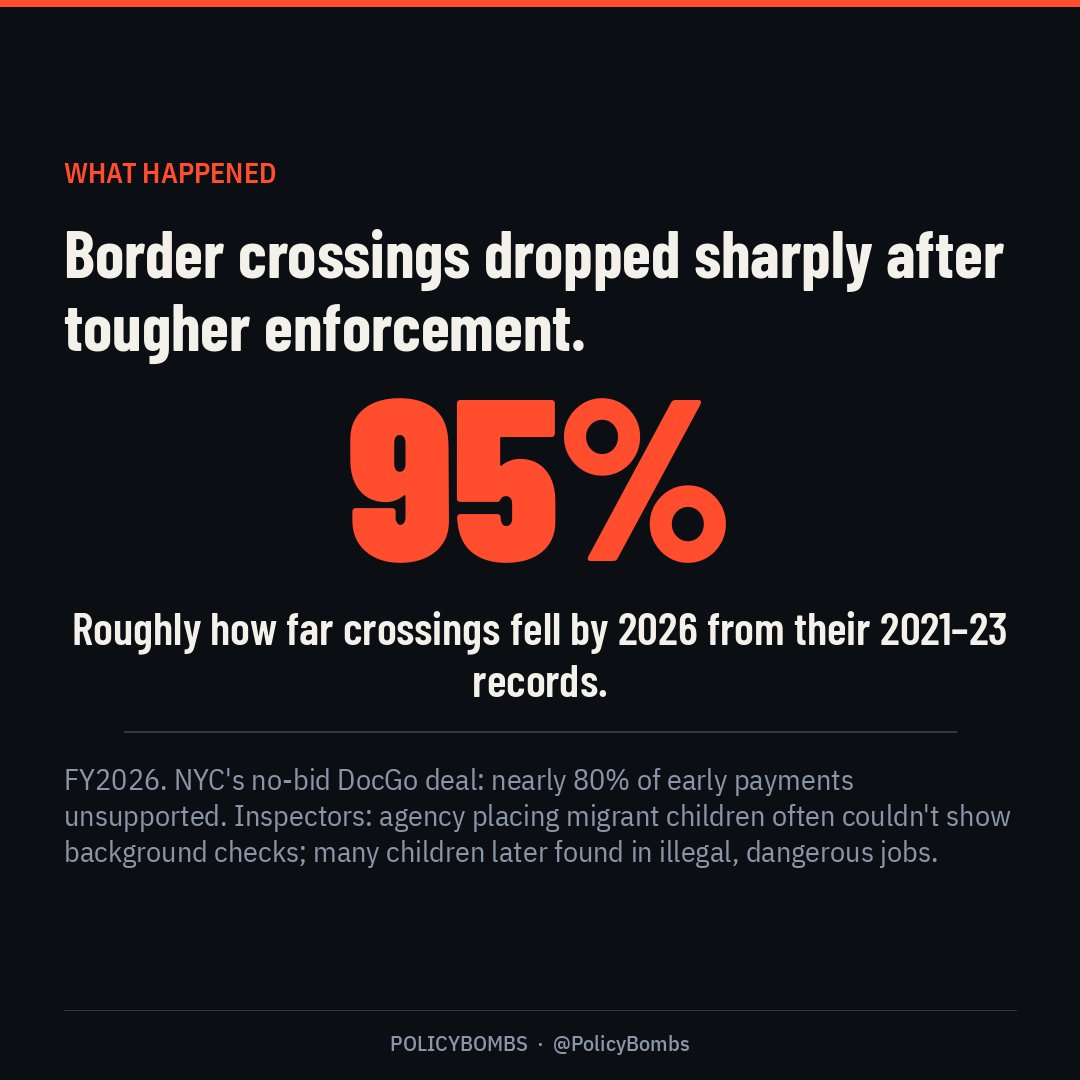
95%. That's roughly how far border crossings fell by FY2026 from their 2021-23 records, under tougher enforcement.
The surge overwhelmed cities, which handed out emergency contracts with little oversight: NYC's no-bid DocGo deal had nearly 80% of early payments unsupported. Federal inspectors found the agency placing migrant children often couldn't show required background checks, and many children were later found in illegal, dangerous jobs.
PRO: Restoring control was right; legal immigration has clear value.
CON / COST: Enforcement ignoring employers leaves exploitation in place.
SOCIETY: Mass illegal entry rewards smugglers and exploits children most.
Full analysis
Illegal Immigration: Policy Assessment
Border numbers FY2021–26, fiscal-cost studies on both sides, labor effects, and the exploitation of migrants: labor trafficking and child migrant labor. As of Nov 4, 2026.
Content as of Nov 4, 2026, 8:32 PM ET. Source Page: PolicyBombs canvas
Long-form deep analysis. Companion to the 10-minute quick reference (19-illegal-immigration-summary.docx).
Contents
- 10-Minute Voter Guide
- Key facts
- Border Patrol encounters
- 1. What is the policy
- 2. Why it exists
- 3. Realized effects
- 4. Good or bad for society
- Local investigations and data anomalies
- Who supports / who opposes
- References
10-Minute Voter Guide
Who’s for / against: For tougher enforcement: Republicans and Trump (Laken Riley Act, with 12 Senate and 46 House Democrats; the 2025 law’s enforcement funding). For sanctuary protections: California Democrats (SB 54). Surprise: Trump and most Republicans helped kill the 2024 bipartisan Lankford–Murphy–Sinema border bill.
Border crossings hit record highs in 2021-23 and fell about 95% by FY2026 under tougher enforcement. The surge overwhelmed cities, which handed out huge emergency contracts with little oversight: NYC’s no-bid DocGo deal had nearly 80% of early payments unsupported. Federal inspectors found the agency placing migrant children with sponsors often couldn’t show it had run required background checks, and many children were later found working illegal, dangerous jobs.
Arguments that immigration helps | Arguments about harm |
+ Fills labor shortages + CBO: surge cuts federal deficits by $0.9T over 10 years + Immigrants’ children are strong contributors | – Child labor and trafficking in a shadow economy – Emergency city contracts wasted millions – Undermines legal immigration and rule of law |
Bottom line for voters: Ask candidates how they will stop employers from using illegal labor, vet every child’s sponsor, and audit every emergency migrant contract. |
Bottom line: The 2021–24 surge was a policy failure. Release-heavy processing and asylum backlogs drew record crossings. They also fed a shadow labor market where migrants, including unaccompanied children, were exploited in conditions that at the extreme amount to forced labor. Crossings fell about 95% by FY2026 under tougher enforcement. The fiscal picture is genuinely contested and depends on time horizon and education level. Low-wage undocumented labor benefits employers and consumers, while the workers carry most of the cost. |
Key facts
Item | Figure | Source |
|---|---|---|
Border Patrol encounters, nationwide | FY21 1.66M; FY22 2.21M; FY23 2.06M; FY24 1.58M; FY25 254K | CBP |
Total CBP encounters, FY23 (record) | 3.20M (incl. ports of entry, CBP One) | CBP |
Southwest border apprehensions, FY26 | 98,708 (preliminary; DHS says lowest ever) | DHS, Oct 2026 |
NAS 2016 fiscal study | First generation net cost (mostly state and local, via children’s education); second generation among strongest net contributors | National Academies |
FAIR 2023 | $150.7B net annual cost of illegal immigration (federal, state, local) | FAIR (restrictionist) |
ITEP 2024 | Undocumented immigrants paid $96.7B in taxes in 2022 | ITEP (progressive) |
CBO July 2024 | 2021–26 surge lowers federal deficits $0.9T over 2024–34 (+$1.2T revenue, +$0.3T outlays); excludes discretionary (about $0.2T) and state/local costs | CBO |
Unaccompanied children HHS could not reach | About 85,000 over two years (NYT, 2023, not independently verified here). DHS OIG-24-46 (Aug 2024): of 448,000+ transferred FY19–23, 32,000+ missed court; 291,000+ never served a Notice to Appear | NYT; DHS OIG |
Child labor violations | Minors employed in violation up sharply since 2019 (DOL WHD) | US DOL |
Border Patrol encounters
Chart data (shown as a chart on the Page)
Label | Value |
|---|---|
FY21 | 1.66M |
FY22 | 2.21M |
FY23 | 2.06M |
FY24 | 1.58M |
FY25 | 254K |
FY26 | 99K |
FY21–25: nationwide Border Patrol encounters (CBP). FY26: southwest border apprehensions only, preliminary DHS figure. Not strictly comparable.
1. What is the policy
Item | Detail |
|---|---|
2021–24 | Ended Remain in Mexico and paused border wall construction. Title 42 expulsions continued until May 2023. Mass parole and release with court dates, CBP One appointments, CHNV parole (about 530,000), and expanded TPS. June 2024 asylum restrictions cut crossings. |
2025–26 | National emergency declaration, troops at the border, asylum shut-off at the border, Remain in Mexico restored, CBP One ended, parole and TPS revoked (litigated), mass deportation push with ICE expansion funded by the 2025 reconciliation law. Zero Border Patrol releases since May 2025 (DHS). |
Unaccompanied children (UACs) | Under TVPRA 2008, UACs from non-contiguous countries go to HHS’s Office of Refugee Resettlement (ORR) and are released to sponsors. Record numbers in FY21–23 (about 130,000 in FY22). ORR follow-up was a single safety call after 30 days. |
2. Why it exists
Stated reasons: humanitarian protection and asylum law (left); sovereignty, rule of law and public safety (right).
Underlying drivers: employers in agriculture, meatpacking, construction and hospitality depend on undocumented labor, and E-Verify is still not mandatory nationally. Both parties have blocked fixes: the 2013 Gang of Eight bill and the 2024 Senate border bill. Democratic coalitions include immigrant-advocacy groups, and the GOP campaigns on the border. Cartels earn billions from smuggling fees. Asylum backlogs (over 3M immigration court cases by 2024) let people work for years before rulings.
3. Realized effects
Item | Detail | Assessment |
|---|---|---|
Fiscal | Results depend on the scope chosen. FAIR counts US-citizen children as costs and assumes low taxes. ITEP and Cato emphasize taxes paid and low per-capita benefit use. CBO counts federal gains from the surge but notes state and local costs. NAS (the most neutral) finds low-education first-generation immigrants are net costs over their lifetimes, while their children are net contributors. | Contested |
City costs | NYC spent several billion dollars on the shelter system for migrants (city budget estimates over $4B a year at peak). Denver and Chicago faced similar strains. | High local cost |
Labor market | Most studies (Card; NAS 2016) find small wage effects overall, with negative effects concentrated on prior immigrants and workers without a high school diploma. Borjas finds larger effects. CBO credited the surge with raising labor force and GDP growth. | Small, uneven |
Exploitation and forced labor | NYT (Hannah Dreier, Feb 2023) documented migrant children working overnight shifts in slaughterhouse sanitation (Packers Sanitation paid $1,544,076 in DOL penalties for 102 minors aged 13–17 at 13 plants in 8 states, Feb 2023), auto-parts plants and food processing. Debt bondage to smugglers and sponsors was documented. DHS OIG and HHS OIG found ORR failed to track children and vet sponsors. Labor trafficking cases (e.g., Operation Blooming Onion, GA 2021) involved H-2A and undocumented workers held in slavery-like conditions. | Serious |
The ‘slavery’ framing: labor trafficking and debt bondage meet the legal definition of forced labor under the TVPA in prosecuted cases. The scale is not measured reliably; no credible national count exists. Using the word for all undocumented work overstates it. For the documented child and trafficking cases, it is accurate.
4. Good or bad for society
Verdict: Large-scale illegal immigration is bad for society. It rewards smugglers, exploits migrants (children most of all), overwhelms cities and courts, and erodes support for legal immigration, which has clear economic value. Restoring control was right. Enforcement that ignores employers and offers no legal channels leaves the exploitation in place. |
Case that it benefits the US | Case that it harms |
+ Fills labor shortages; CBO projects lower deficits + Undocumented workers pay tens of billions in taxes + Children of immigrants are strong net contributors | – Exploitation, trafficking and child labor are built into a shadow labor market – Local fiscal and service strain – Undermines rule of law and legal immigration’s legitimacy |
- Mandatory E-Verify with employer penalties.
- Fund asylum adjudication to decide cases in months.
- ORR: vetting, post-release services, and tracking every child.
- Expand legal work visas for sectors that rely on illegal labor.
Local investigations and data anomalies
Finding | Source | What investigators or courts concluded |
|---|---|---|
NYC’s $432M no-bid emergency contract with DocGo, a COVID-testing firm with no housing experience: $11M of $13.8M in the first two months unsupported or unallowable; 9,874 empty hotel-room nights paid; $2M+ in unauthorized security hours; 33 of 41 subcontractors had no agreement on file | NYC Comptroller audit, 2024 | Recommended recoupment; HPD agreed to review invoices, but the administration signaled it would not recoup. Contract not renewed after May 2024 |
ORR sponsor vetting, spring 2021: 16% of case files lacked documentation of required safety checks; 19% never updated with pending FBI or child-abuse registry results; 35% had illegible sponsor IDs; 22% of follow-up calls late | HHS OIG OEI-07-21-00250, Feb 2024 | ACF agreed to all 6 recommendations; ORR added universal fingerprinting and stricter ID rules in 2025 |
Same address used for multiple sponsorships is a known red flag | HHS OIG (same report) | OIG noted missed address checks could hide vacant homes or repeat-sponsor addresses; prevalence not quantified |
448,000+ children transferred FY2019-23; 32,000+ missed court; 291,000+ never got a court date | DHS OIG-24-46, Aug 2024 | ICE could not monitor children; heightened trafficking risk |
Packers Sanitation: 102 children aged 13-17 cleaning slaughterhouses overnight at 13 plants | US DOL WHD, Feb 2023 | $1,544,076 in civil penalties |
Verdict: unchanged, and strengthened. The local audit record shows waste in emergency contracting and weak child-sponsor vetting during the surge. Both are institutional failures, separate from the immigration-policy debate itself.
Further reading (also listed in References):
- NYC Comptroller: Audit of HPD oversight of DocGo contract — comptroller.nyc.gov
- HHS OIG: Gaps in sponsor screening and followup (Feb 2024) — oig.hhs.gov
- DHS OIG-24-46 on unaccompanied children — oversight.gov
Who supports / who opposes
For = tougher enforcement. Against = sanctuary limits on cooperation. Each row cites a numbered source below. Checked Nov 4, 2026.
Who | Party / level | Position | Evidence | Ref |
Sen. Katie Britt (R-AL) + Republicans; 12 Senate & 46 House Democrats | Bipartisan | For | Laken Riley Act (S. 5) signed Jan 29, 2025; Senate 64–35, House 263–156 | [1] |
Sens. James Lankford (R-OK), Chris Murphy (D-CT), Kyrsten Sinema (I-AZ) | Bipartisan | For | Negotiated 2024 border deal; failed cloture 49–50 (Feb 7, 2024) after Trump opposed it | [2] |
Sen. Kevin de León (D); Gov. Jerry Brown (D-CA) | Democrat | Against | SB 54 (2017) California Values Act limits state/local help to ICE | [3] |
Republicans; President Trump | Republican | For | H.R. 1 (2025) funds ~$170B for border/ICE enforcement | [4] |
Gov. Pete Wilson (R-CA) | Republican | For (qualified) | Backed Prop 187 (1994), denying services to undocumented; later struck down | [5] |
Cross-party defectors: Democrats split on the Laken Riley Act. Republicans split on the 2024 border deal, which Lankford co-wrote.
How positions shifted: The Senate passed comprehensive reform (S. 744) 68–32 in 2013 with 14 Republicans. That bipartisan path collapsed, and since 2016 the GOP has moved to enforcement-only. California went from Prop 187 (1994) to sanctuary-state status (2017).
Sources for this section:
- [1] Congress.gov: S. 5 Laken Riley Act (congress.gov) https://www.congress.gov/bill/119th-congress/senate-bill/5
- [2] Senate: Roll call on emergency supplemental/border (Feb 7, 2024) (senate.gov) https://www.senate.gov/legislative/LIS/roll_call_votes/vote1182/vote_118_2_00039.htm
- [3] CA Legislature: SB 54 (2017) (leginfo.legislature.ca.gov) https://leginfo.legislature.ca.gov/faces/billNavClient.xhtml?bill_id=201720180SB54
- [4] Congress.gov: H.R. 1 One Big Beautiful Bill Act (119th) (congress.gov) https://www.congress.gov/bill/119th-congress/house-bill/1
- [5] Ballotpedia: California Prop 187 (1994) (ballotpedia.org) https://ballotpedia.org/California_Proposition_187,_Prohibit_Persons_in_Violation_of_Immigration_Law_from_Using_Public_Healthcare,_Schools,_and_Social_Services_Initiative_(1994)
References
[1] NYC Comptroller: Audit of HPD oversight of DocGo contract. comptroller.nyc.gov. https://comptroller.nyc.gov/reports/audit-of-the-department-of-housing-preservation-and-developments-oversight-of-its-contract-with-rapid-reliable-testing-ny-llc-aka-docgo/
[2] HHS OIG: Gaps in sponsor screening and followup (Feb 2024). oig.hhs.gov. https://oig.hhs.gov/reports/all/2024/gaps-in-sponsor-screening-and-followup-raise-safety-concerns-for-unaccompanied-children/
[3] DHS OIG-24-46 on unaccompanied children. oversight.gov. https://www.oversight.gov/reports/audit/management-alert-ice-cannot-monitor-all-unaccompanied-migrant-children-released-dhs
[4] CBP enforcement statistics FY2025. cbp.gov. https://www.cbp.gov/newsroom/stats/cbp-enforcement-statistics-fy2025
[5] DHS: FY2026 lowest border crossings (Oct 2026). dhs.gov. https://www.dhs.gov/news/2026/10/16/under-president-trump-and-secretary-mullin-dhs-announces-lowest-fiscal-year-border
[6] NAS 2016: Economic and fiscal consequences of immigration. nap.edu. https://nap.nationalacademies.org/catalog/23550/the-economic-and-fiscal-consequences-of-immigration
[7] FAIR: Fiscal burden of illegal immigration (2023). fairus.org. https://www.fairus.org/issue/publications-resources/fiscal-burden-illegal-immigration-united-states-taxpayers-2023
[8] ITEP: Tax payments by undocumented immigrants (2024). itep.org. https://itep.org/undocumented-immigrants-taxes-2024/
[9] Cato: immigration fiscal research. cato.org. https://www.cato.org/research/immigration
[10] CBO: Effects of the immigration surge on the budget (2024). cbo.gov. https://www.cbo.gov/publication/60569
[11] NYT: Alone and exploited, migrant children work brutal jobs (2023). nytimes.com. https://www.nytimes.com/2023/02/25/us/unaccompanied-migrant-child-workers-exploitation.html
[12] DHS OIG-24-46: ICE cannot monitor unaccompanied children. oig.dhs.gov. https://www.oig.dhs.gov/sites/default/files/assets/2024-08/OIG-24-46-Aug24.pdf
[13] DOL: Packers Sanitation child labor penalty. dol.gov. https://www.dol.gov/newsroom/releases/whd/whd20230217-1
PolicyBombs · Day 63. Follow @PolicyBombs on X.