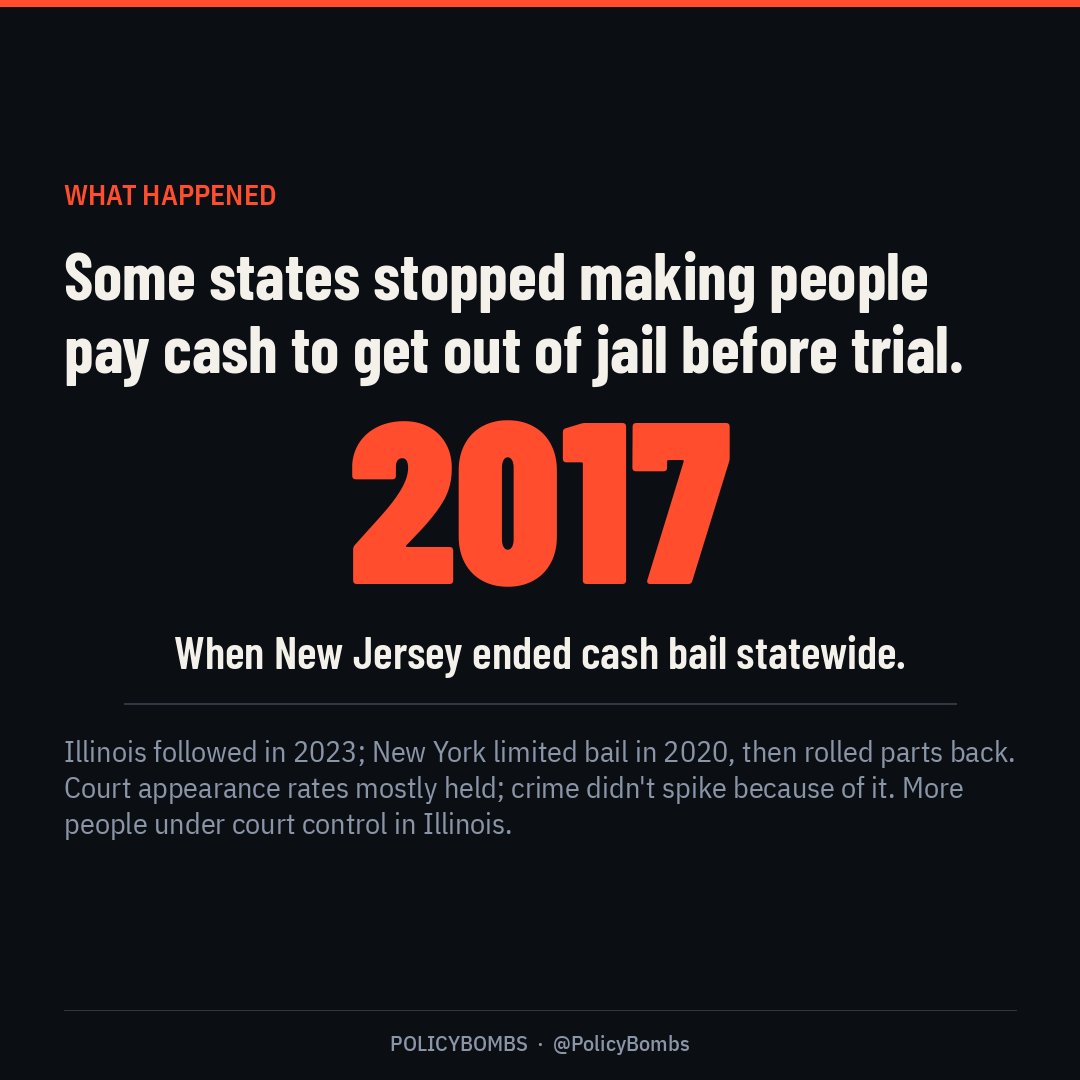
2017. That's when New Jersey ended cash bail statewide. Illinois followed in 2023; New York limited bail in 2020 and then rolled parts back.
Cashless bail means judges decide release with conditions or detention for danger or flight risk, not a dollar amount. Data so far: court appearance rates mostly held and crime did not spike because of it. But the number of people under some form of court control actually went up in Illinois.
PRO: Money bail sorts by wealth, not risk.
CON / COST: Removing judicial discretion over dangerous repeat offenders (NY 2020) backfired.
SOCIETY: Net good when designed like New Jersey.
Full analysis
No-Bail / Cashless Bail: Policy Assessment
Illinois, New Jersey, New York and California: what changed, why, what the appearance and rearrest data show, and a verdict. As of Nov 4, 2026.
Content as of Nov 4, 2026, 8:33 PM ET. Source Page: PolicyBombs canvas
Long-form deep analysis. Companion to the 10-minute quick reference (12-no-bail-summary.docx).
Contents
- 10-Minute Voter Guide
- Key facts
- 1. What is the policy
- 2. Why it exists
- 3. Realized effects
- 4. Good or bad for society
- Local investigations and data anomalies
- Who supports / who opposes
- References
10-Minute Voter Guide
Who’s for / against: For ending cash bail: Gov. JB Pritzker (D-IL, SAFE-T Act), Gov. Jerry Brown (D-CA, SB 10). Against: Republicans, President Trump (Aug 2025 EO), the bail industry, and California voters (Prop 25, 2020). Some civil-rights groups also opposed SB 10’s risk algorithms.
Cashless bail means judges no longer set a dollar amount to get out of jail before trial. Instead they decide whether to release someone with conditions or hold them because they are dangerous or likely to flee. Illinois (2023) and New Jersey (2017) did it statewide; New York limited bail in 2020 and then rolled parts back. Data so far: court appearance rates mostly held, crime did not spike because of it, but the number of people under some form of court control actually went up in Illinois.
Pros | Cons |
+ Poor people no longer sit in jail just because they can’t pay + Dangerous people can be held outright instead of buying their way out + New Jersey’s results are good and well documented | – Some repeat offenders reoffended more under New York’s first version – Felony no-show rates rose in Illinois – State courts have been slow to publish the monitoring data the law requires |
Bottom line for voters: Support versions that let judges hold dangerous people after a hearing and that publish their data. Be skeptical of versions that tie judges’ hands or that never report results. |
Bottom line: Getting rid of money bail has not caused the crime waves opponents predicted, and court appearance rates mostly held steady. The design is what matters. New Jersey paired abolition with risk assessment and real detention hearings, and it worked. New York’s first version barred judges from weighing dangerousness and had to be rolled back three times. Bail reform done carefully is good policy. Releasing people across the board without letting judges assess risk is bad policy. |
Key facts
Jurisdiction | Start | Status (Nov 2026) | Key number |
|---|---|---|---|
New Jersey Criminal Justice Reform Act | Jan 2017 | In force | Pretrial jail pop. down about 40%+ by 2018 vs 2015 (NJ Courts); NIJ/MDRC found no rise in rearrest or FTA |
New York bail reform | Jan 2020 | In force, amended 2020, 2022, 2023 | Data Collaborative for Justice: bail elimination linked to lower rearrest for most groups; higher for some repeat-offense groups |
Illinois Pretrial Fairness Act (SAFE-T Act) | Sept 18, 2023 | In force | FTA warrant rate 13.6% before vs 12.5% after (Loyola, 22 counties) |
Illinois, Cook County | 2023–25 | In force | 87% of released people appeared; 84% had no new charge while released (Aug 2025 data) |
California, In re Humphrey | Mar 2021 | Binding case law | Courts must consider ability to pay; Prop 25 (statewide abolition) rejected by voters 56–44 in Nov 2020 |
Federal pressure: EO ‘Taking Steps to End Cashless Bail’ | Aug 25, 2025 | Signed; no funding cut or lawsuit reported as of search | Directs DOJ to list jurisdictions and federal funds that could be suspended; Illinois law remains in force |
1. What is the policy
Item | Detail |
|---|---|
New Jersey (2017) | Constitutional amendment (2014) plus statute. Money bail almost entirely replaced by a Public Safety Assessment risk score, release conditions, and a hearing where prosecutors can seek detention without bail. Speedy-trial deadlines. |
New York (2019 law, effective Jan 2020) | Mandatory release for most misdemeanors and nonviolent felonies. Judges could not consider dangerousness, which is unusual nationally. Amended April 2020 (more bail-eligible offenses), 2022 (repeat offenses, gun charges), and 2023 (dropped the ‘least restrictive’ standard for serious charges). |
Illinois Pretrial Fairness Act (part of the 2021 SAFE-T Act) | Ended cash bail statewide on Sept 18, 2023, after the IL Supreme Court upheld it in Rowe v. Raoul (July 2023). Prosecutors can file for detention on listed offenses and must show by clear and convincing evidence that the person is dangerous or a willful flight risk. |
California (In re Humphrey, 2021) | CA Supreme Court: judges must consider ability to pay and may detain only when no other condition will protect public safety or ensure appearance. SB 10 (2018) abolished cash bail, but voters repealed it via Prop 25 in 2020. Practice still varies by county. |
2. Why it exists
Stated case for reform | Stated case against |
+ Wealth, not risk, decided who sat in jail before trial + Even a few days in jail cost jobs and housing, and pressure innocent people to plead guilty + Cases like Kalief Browder (NYC, 3 years at Rikers without trial) made the problem visible + Jail costs for counties | – Bail creates an incentive to show up to court – Repeat offenders get released quickly – Victims and police lose trust – Judges should be able to weigh dangerousness |
Underlying drivers: there was a bipartisan reform movement in the 2010s (Koch-funded groups as well as the ACLU and Arnold Ventures, which funded the PSA risk tool). The commercial bail bond industry spent heavily against reform. In CA it funded the referendum that put SB 10 on the ballot. Prosecutors and police unions opposed the measures. Progressive DAs and legislative majorities in one-party states passed the strongest versions. Republicans have used reform as a midterm crime issue (NY 2022), which pushed the NY rollbacks.
3. Realized effects
Item | Detail | Assessment |
|---|---|---|
New Jersey | NJ Judiciary reports and an NIJ/MDRC evaluation found pretrial jail population fell sharply. There was no statistically significant change in failure to appear, and no rise in new criminal activity two years out. This is the best-documented success. | Positive |
New York | Data Collaborative for Justice (John Jay) found that eliminating bail reduced rearrest overall. Rearrests rose for people with recent prior arrests charged with certain offenses, which is the group the amendments targeted. Statewide crime rose in 2020–22, as it did in states without reform, so it is hard to pin on bail. | Mixed |
Illinois | Loyola CCJ (state-commissioned): no dramatic change in FTA; felony FTA rose (non-detainable felonies 13.1% to 16.1%). Jail populations fell 14–25% early, then rebounded in Cook, Lake and Kane by July 2025. People under some pretrial control rose 17%. Crime fell 2024–25, matching national trends. | Neutral to positive |
California | Humphrey has been unevenly applied. Studies are limited (PPIC tracked arrest/booking data). No clear statewide effect can be attributed to it. | Unclear |
Caveat: advocacy groups on both sides cherry-pick individual crimes or single-county numbers. FTA definitions differ (warrant vs any missed hearing), so cross-state comparisons are weak. 2020–22 crime trends were national and swamp any bail signal.
4. Good or bad for society
Verdict: Net good when designed like New Jersey: risk-based detention hearings, supervision, and speedy trials. Bad when it removes judicial discretion over dangerous repeat offenders, as New York’s 2020 law did. Money bail itself is a bad tool, because it sorts by wealth, not risk. |
Strongest case FOR | Strongest case AGAINST |
+ NJ shows large jail reductions without measurable rises in FTA or rearrest + Ends wealth-based detention and coerced pleas + Lets dangerous people be held outright instead of bonding out with money | – Specific subgroups (recent repeat arrestees) did reoffend more in NY – IL shows rising felony FTA and growth in supervision and revocations, so it shifts control rather than ending it – Requires court and pretrial-services capacity many counties lack |
- Keep money out of release decisions; let judges hold people based on risk, with a hearing.
- Publish standardized FTA and rearrest data by charge type every quarter.
- Fund court reminders (texts measurably cut FTA) and speedy trials.
Local investigations and data anomalies
Finding | Source | What investigators concluded |
|---|---|---|
Cook County electronic monitoring: no meaningful difference in violent rearrest between people on EM and those released without it; violent rearrest under 1% in the studied group | Chicago Appleseed review of Circuit Court of Cook County data, Aug 2025 (reform-leaning) | EM adds cost and control without clear safety gain; the Sheriff’s EM program is being absorbed into the court’s |
PFA’s required 60-day reviews of detention largely ineffective | Same report | Process requirement not working as written |
State courts slow to publish SAFE-T Act electronic monitoring data | Better Government Association, Mar 2025 (local investigative) | Data the law mandates was lagging; independent verification is harder |
Total people under pretrial control up 17%; rural pretrial supervision up 138% | Loyola CCJ, July 2025 (state-commissioned) | Reform shifted control from jail to supervision rather than reducing it |
Cook, Lake and Kane pretrial jail populations above pre-PFA levels by July 2025 | Loyola CCJ | Early jail drop reversed in the biggest counties, partly from release-violation detentions |
No fraud or corruption finding tied to bail reform turned up. The bail bond industry it replaced had a long record of local corruption cases, which this review did not re-examine. Verdict: unchanged. The local data reinforces that design and transparency matter, and adds a new concern: reform can grow supervision rather than shrink it.
Further reading (also listed in References):
- Chicago Appleseed: PFA and electronic monitoring in Cook County (2025) — chicagoappleseed.org
- BGA: State courts lag on EM data required by SAFE-T Act — bettergov.org
- Circuit Court of Cook County: pretrial research and statistics — cookcountycourtil.gov
Who supports / who opposes
For = ending or limiting cash bail. Against = keeping cash bail. Each row cites a numbered source below. Checked Nov 4, 2026.
Who | Party / level | Position | Evidence | Ref |
Gov. JB Pritzker (D-IL) | Democrat | For | Signed SAFE-T Act (HB 3653, 2021); cash bail ended Sept 18, 2023 | [1] |
Gov. Jerry Brown (D-CA); Sen. Bob Hertzberg (D) | Democrat | For | Signed SB 10 (2018) ending cash bail | [2] |
California voters | Ballot | Against | Rejected SB 10 via Prop 25 (Nov 2020), ~56% no | [2] |
President Donald Trump | Republican | Against | EO 14342 "Taking Steps to End Cashless Bail" (Aug 25, 2025) targets federal grants to cashless-bail jurisdictions | [3] |
Illinois Republicans | Republican | Against | Voted against SAFE-T Act; state’s attorneys sued (lost 2023) | [1] |
Cross-party defectors: The ACLU of California withdrew support for SB 10 over risk-assessment tools, so it ended up opposed by the bail industry and some reformers at once.
How positions shifted: New York’s 2019 bail reform was rolled back in 2020 under Gov. Cuomo (D), then again in 2022 and 2023 at Gov. Hochul’s (D) urging. Democrats have moved toward judicial discretion.
Not included or not fully verified: Did not cite a specific Hochul statement link; the rollbacks are documented in NY budget bills, which were not opened this turn.
Sources for this section:
- [1] Illinois General Assembly: HB 3653 (101st) (ilga.gov) https://www.ilga.gov/legislation/BillStatus.asp?DocNum=3653&GAID=15&GA=101&DocTypeID=HB&SessionID=108
- [2] Ballotpedia: California Prop 25 (2020) (ballotpedia.org) https://ballotpedia.org/California_Proposition_25,_Replace_Cash_Bail_with_Risk_Assessments_Referendum_(2020)
- [3] White House: Taking Steps to End Cashless Bail (whitehouse.gov) https://www.whitehouse.gov/presidential-actions/2025/08/taking-steps-to-end-cashless-bail-to-protect-americans/
References
[1] Chicago Appleseed: PFA and electronic monitoring in Cook County (2025). chicagoappleseed.org. https://www.chicagoappleseed.org/2025/08/05/new-report-the-impact-of-the-pretrial-fairness-act-on-electronic-monitoring/
[2] BGA: State courts lag on EM data required by SAFE-T Act. bettergov.org. https://www.bettergov.org/2025/03/26/state-courts-lag-on-electronic-monitoring-data-required-by-safe-t-act/
[3] Circuit Court of Cook County: pretrial research and statistics. cookcountycourtil.gov. https://www.cookcountycourtil.gov/department/adult-probation/adult-probation-department-research-statistics/pretrial-curfew
[4] Loyola CCJ: The First Year of the Pretrial Fairness Act. loyolaccj.org. https://pfa-1yr.loyolaccj.org/
[5] Loyola CCJ: Pretrial detention and supervision under the PFA (2025). loyolaccj.org. https://loyolaccj.org/blog/pretrial-detention-and-supervision-under-the-pfa
[6] NPR Illinois: Cook County pretrial data (Aug 2025). nprillinois.org. https://www.nprillinois.org/illinois/2025-08-26/trump-threatens-illinois-federal-funding-for-eliminating-cash-bail
[7] NJ Courts: Criminal Justice Reform reports. njcourts.gov. https://www.njcourts.gov/public/concerns/criminal-justice-reform
[8] MDRC: Evaluation of New Jersey’s bail reform. mdrc.org. https://www.mdrc.org/work/projects/evaluation-new-jerseys-bail-reform
[9] Data Collaborative for Justice: NY bail reform and recidivism. datacollaborativeforjustice.org. https://datacollaborativeforjustice.org/work/bail/
[10] In re Humphrey opinion (CA Supreme Court, Mar 25, 2021). courts.ca.gov. https://www4.courts.ca.gov/opinions/archive/S247278.PDF
[11] White House fact sheet: EO on cashless bail (Aug 2025). whitehouse.gov. https://www.whitehouse.gov/fact-sheets/2025/08/fact-sheet-president-donald-j-trump-takes-steps-to-end-cashless-bail-to-protect-americans/
[12] Coalition to End Money Bond: one-year review (advocacy). endmoneybond.org. https://endmoneybond.org/one-year-after-implementation-this-is-what-we-know-about-the-pretrial-fairness-act/
PolicyBombs · Day 56. Follow @PolicyBombs on X.