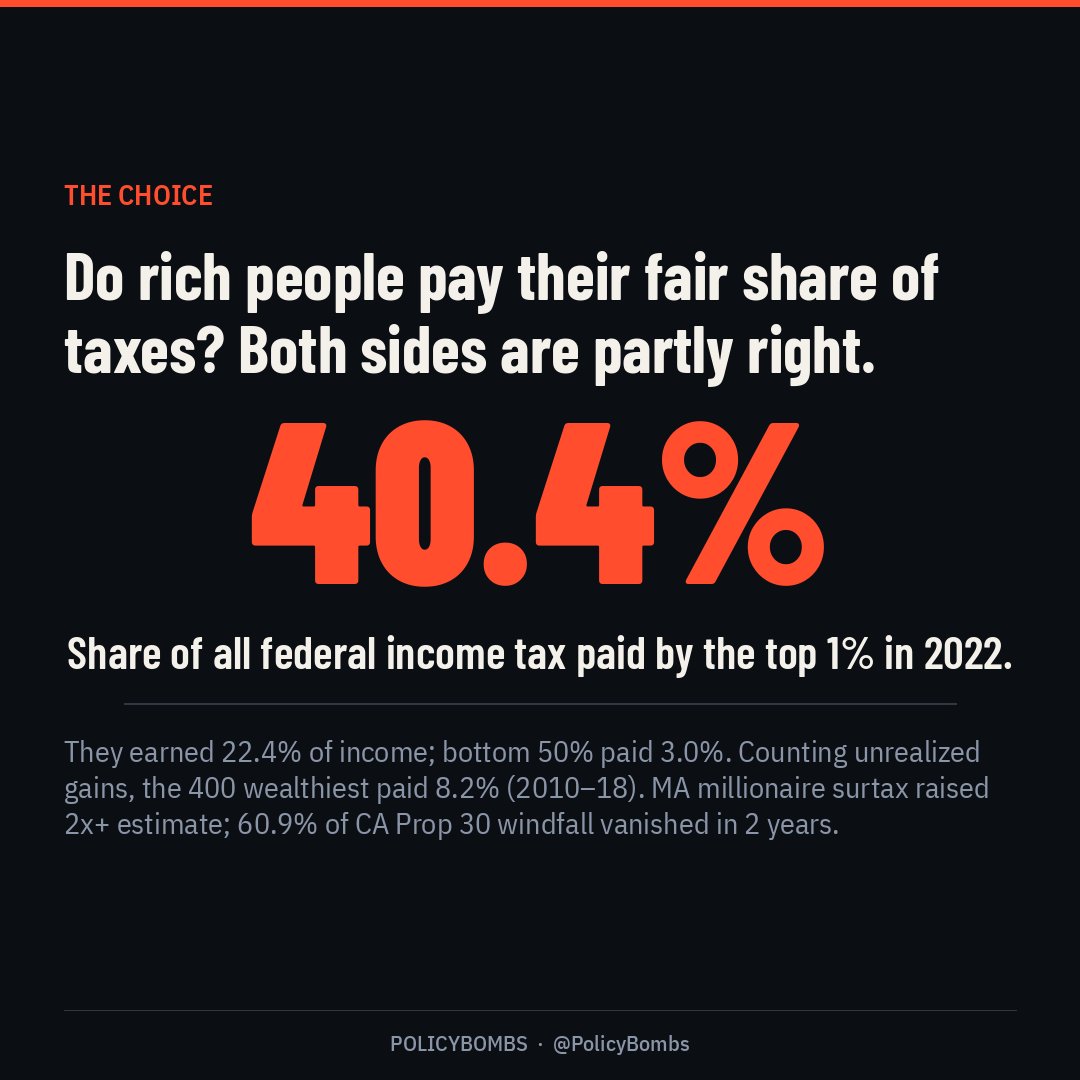
40.4%. That's the top 1%'s share of federal income tax in 2022, on 22.4% of income. The bottom 50% paid 3.0%.
But count unrealized gains as income and the 400 wealthiest families paid just 8.2% (2010–2018). Both claims are partly true. Massachusetts' millionaire surtax raised more than double its estimate, while 60.9% of California's expected Prop 30 windfall vanished to taxpayer responses within 2 years. Carried interest survived both 2017 and 2025 bills.
PRO: Closing step-up at death and unrealized-gains gaps hits the real hole.
CON / COST: Wealth-tax revenue swings with markets; top earners shrink reported income.
SOCIETY: Targeted loophole closing beats broad new wealth taxes.
Full analysis
"Rich Pay Their Fair Share": Policy Assessment
Tests the claim against CBO and IRS data, then grades the main proposals: the billionaire minimum tax, CA Props 30/55/40, and the Massachusetts millionaire tax. As of Nov 4, 2026.
Content as of Nov 4, 2026, 8:31 PM ET. Source Page: PolicyBombs canvas
Long-form deep analysis. Companion to the 10-minute quick reference (02-rich-pay-fair-share-summary.docx).
10-Minute Voter Guide
Who’s for / against: For higher taxes on the rich: Sen. Bernie Sanders, Sen. Elizabeth Warren, most Democrats, SEIU-UHW (CA Prop 40). Against: Republicans (2017 TCJA and 2025 One Big Beautiful Bill passed with zero Democratic votes) and, on California’s billionaire tax, Gov. Newsom (D).
The top 1% already pays about 40% of federal income tax (IRS) and 26% of all federal taxes (CBO). But the very wealthy hold most of their gains as unrealized assets that are taxed lightly or never. State millionaire taxes raise real money, Massachusetts nearly $3B a year, but top earners shrink their reported income (California Prop 30). Business lobbies kept special carve-outs alive in 2025.
Pros of taxing the rich more | Cons |
+ Closes the step-up-at-death and unrealized-gains gap + Massachusetts surtax brought in more than double its estimate + Funds schools and transit without middle-class increases | – Revenue swings with the stock market – 60.9% of California’s expected Prop 30 windfall lost to taxpayer responses within 2 years – Earmarked money mainly benefits the interest groups that funded the campaign |
Bottom line: Close specific loopholes (step-up at death, carried interest, the pass-through deduction) rather than vote for broad new wealth taxes.
Contents
- 10-Minute Voter Guide
- Key facts
- 1. What is the policy
- 2. Why it exists
- 3. Realized effects
- Follow the money: carve-outs and campaign finance
- 4. Good or bad for society
- Who supports / who opposes
- References
Bottom line: On income taxes, the US federal system is already steeply progressive: the top 1% pays a higher average rate and a far larger share than any other group. The real gap is unrealized gains on very large fortunes, which are lightly taxed until sale and can escape tax entirely at death. Narrow fixes to that gap are defensible. Broad state surcharges bring in a lot of money but make revenue volatile and push some earners to leave. |
Key facts
Item | Figure | Source |
|---|---|---|
Top 1% average federal tax rate, 2023 (all federal taxes) | 26.0% (31.5% in 2022); top 1% paid 26% of all federal taxes | CBO, Distribution of Household Income 2023 (Sept 24, 2026) |
Top 1% share of federal individual income tax, tax year 2022 | 40.4% of tax on 22.4% of AGI; average rate 26.1%. Bottom 50% paid 3.0% | IRS SOI percentile tables (via Tax Foundation) |
400 wealthiest families’ federal income tax rate when unrealized gains count as income, 2010–2018 | 8.2% | White House CEA/OMB, 2021 (estimate) |
Billionaire Minimum Income Tax (25% on income incl. unrealized gains, over $100M wealth) | Never enacted | Biden budgets FY2023–FY2025 |
CA Prop 30 (2012), extended by Prop 55 (2016): top marginal rate 13.3% | In force through 2030 | CA Legislative Analyst’s Office |
CA Prop 40 (2026): one-time 5% tax on wealth over $1B | Rejected 55.6% No (early, uncertified count) | CA results, Nov 4, 2026 |
MA 4% surtax on income over $1M (Fair Share, 2022) | FY24 $2.4B; FY25 $2.99B against a $1.3B benchmark | MA DOR certifications |
Federal 2025 reconciliation law (OBBBA) | Made the TCJA individual rates permanent; top rate stays 37% | Public Law 119-21 |
1. What is the policy
"Fair share" is a slogan, not a single law. This page tests it against four concrete measures.
Item | Detail |
|---|---|
Federal income and payroll tax | Seven brackets from 10% to 37%. Long-term capital gains and qualified dividends are taxed at 0/15/20% plus the 3.8% NIIT. Gains are taxed only when an asset is sold, and step-up in basis at death erases the gain for heirs. Making the TCJA rates permanent in July 2025 kept this structure. |
Billionaire Minimum Income Tax (proposal) | Households with more than $100M in wealth would pay at least 25% on income that includes unrealized gains, payable in installments. Proposed in Biden’s FY2023–FY2025 budgets. It never got a floor vote and is dormant under the current Congress. |
California Props 30 and 55 | Prop 30 (2012) added 1–3 points to income over $250K, $300K, and $500K (single filers). Prop 55 (2016) extended these through 2030. With the 1% mental-health surcharge (Prop 63), the top rate is 13.3%, the highest of any state. |
California Prop 40 (Nov 2026) | A one-time 5% tax on net worth over $1B, mostly earmarked for health care. Early returns show it losing about 56–44. |
Massachusetts Fair Share Amendment | Approved by voters in Nov 2022, 52–48. Adds a 4% surtax on taxable income above $1M (indexed: $1,083,150 for 2025). Revenue is constitutionally earmarked for education and transportation. In effect since tax year 2023. |
2. Why it exists
Stated reasons | Underlying drivers |
+ Top income and wealth shares rose sharply after 1980 + Wealth held as unrealized gains goes untaxed for decades ("buy, borrow, die") + Pay for schools, transit, and health care without taxing the middle class + Fairness: billionaires can show lower effective rates than workers on some measures | – Polls well: taxing the top 1% consistently gets majority support – Public-sector unions and education lobbies backed Prop 30/55 and Fair Share because the money is earmarked for them – Lets legislators expand spending without broad tax increases – Opponents’ money also comes from the people who would be taxed (Prop 40 opposition was funded largely by tech wealth) |
The fight over the facts mostly comes down to definitions. Using CBO’s income measure, the rich pay much higher average rates. If unrealized gains count as income (the CEA and ProPublica approach), the very top pays lower rates than many professionals. Both are true, under different definitions.
3. Realized effects
Federal progressivity
CBO finds federal taxes progressive in every year it tracks. In its Sept 2026 report, the top 1%’s average rate was 26.0% in 2023, down from 31.5% in 2022. The drop came mostly from a 9% fall in top-1% income, driven by lower realized capital gains. The top 1% paid 26% of all federal taxes, and the top 20% paid 70%. After refundable credits, the bottom quintile’s federal income tax rate is negative.
Saez and Zucman (2019) estimated that the 400 richest pay a lower total rate than the bottom half once state, local, and corporate taxes are included. Auten and Splinter and others dispute their assumptions about how corporate taxes and income are allocated. Treat the Saez–Zucman headline as contested.
State millionaire taxes
Item | Detail | Assessment |
|---|---|---|
Massachusetts | Brought in $2.4B in FY24 and $2.99B in FY25, more than twice the $1.3B budget benchmark. Spending has gone to free community college, school meals, and the MBTA. Critics point to high-income out-migration in IRS data and to swings: the surtax is concentrated in capital gains. A causal estimate of migration is not yet settled. | Revenue beat estimates |
California Prop 30 | Rauh and Shyu (AEJ: Policy, 2024) find top earners left at higher rates and remaining ones reported less income. Behavioral responses eroded 45.2% of the expected windfall in the first year and 60.9% within two years. Most of the loss came from stayers reporting less income; out-migration was 9.5% of it. The rest was still a large revenue gain. California’s dependence on the top 1% (about half of personal income tax by LAO accounts) makes boom-bust deficits worse, for example 2023–24. | Revenue gain, partly offset |
Wealth taxes abroad | Most OECD countries that had annual wealth taxes repealed them (12 in 1990, about 4 by 2017, per OECD), citing high administrative cost, capital flight, and low yield. | Mostly repealed |
Follow the money: carve-outs and campaign finance
Finding | What the record shows | Source |
|---|---|---|
MA Question 1 (2022) campaign money | Yes side spent $27.9M; the Massachusetts Teachers Association ($13.3M) and NEA ($7.2M) gave about $20.5M of it. Opponents spent $14.5M. The surtax is constitutionally earmarked for education and transportation. | MA OCPF ballot question report |
Pass-through deduction (Sec. 199A) | Created in 2017 after pass-through business lobbying; the 2025 law made it permanent at 20%, widened phase-ins, added a $400 minimum. Benefits are concentrated at high incomes (JCT distribution tables). | IRS; KPMG on OBBBA; JCT |
Carried interest | Survived the 2017 and 2025 bills despite campaign promises from both parties to close it; private-equity lobbying is documented in lobbying disclosures. | Senate LDA filings; CNN on 2025 lobbying wins |
Rich-side campaign money | CA Prop 40 (2026) opposition was largely funded by tech wealth (reported); exact totals not verified here, so check Cal-Access. | Cal-Access (verify) |
No court or auditor has found fraud in these tax measures. The pattern is legal capture: each side’s donors write or protect provisions that benefit them. What changed: the verdict now adds that targeted repeal of carve-outs beats new broad taxes, and that earmarks should get independent audits of whether they actually add new funding.
4. Good or bad for society
Verdict: The claim that the rich pay little federal income tax is false on standard data. The claim that the wealthiest avoid tax on most of their economic gains is true. Ending step-up in basis, or a minimum tax on realized gains, fixes the real gap at low distortion. One-time and annual wealth taxes, and stacking state surcharges past about 13%, carry costs from migration and volatility that their backers understate. |
Strongest case for higher top taxes | Strongest case against |
+ Deficits are large, and the top has the most capacity to pay + Massachusetts shows a surtax can raise billions without the predicted collapse + Step-up in basis is a pure loophole that serves no efficiency goal + Concentrated wealth turns into political power | – Top 1% already pays 40% of income tax; the base is narrow and volatile – Mobile earners leave high-tax states (California Prop 30 evidence) – Taxing unrealized gains raises valuation, liquidity and constitutional problems (Moore v. US, 2024, left this open) – Earmarked revenue often replaces existing funding rather than adding to it |
Who supports / who opposes
For = higher taxes on top earners or wealth. Against = lower or permanent tax cuts at the top. Each row cites a numbered source below. Checked Nov 4, 2026.
Who | Party / level | Position | Evidence | Ref |
Sen. Elizabeth Warren (D-MA) | Democrat | For | Sponsored the Ultra-Millionaire Tax Act (annual 2% tax on net worth above $50M) | [1] |
Sen. Bernie Sanders (I-VT) | Independent (caucuses D) | For | Rallied in California for Prop 40, the one-time 5% billionaire tax (2026) | [2] |
SEIU-UHW; Lorena Gonzalez (CA Labor Federation) | CA labor | For | Put Prop 40 on the Nov 2026 ballot; trailing ~55% no in early returns (Nov 4, 2026) | [3] |
Gov. Gavin Newsom (D-CA) | Democrat (defector) | Against | Opposed Prop 40 and endorsed Prop 42 (ban on wealth taxes); says he backs a national minimum tax instead | [3] |
House & Senate Republicans; President Trump | Republican | Against | One Big Beautiful Bill Act (H.R. 1, signed Jul 4, 2025) made the 2017 income-tax cuts permanent; passed House 218–214 and Senate 51–50 with no Democratic votes | [4] |
Reps. Thomas Massie (R-KY), Brian Fitzpatrick (R-PA); Sens. Rand Paul, Thom Tillis, Susan Collins | Republican (defectors) | Against | Voted no on final passage of H.R. 1 (2025), for differing reasons (deficit, Medicaid) | [4] |
Democratic Party | Platform | For | 2024 platform: make billionaires and corporations "pay their fair share", raise top rates on income over $400K | [5] |
Cross-party defectors: Newsom and much of California’s Democratic establishment (CTA, Planned Parenthood CA) opposed the state billionaire tax while Sanders campaigned for it. Massie and Fitzpatrick broke with Republicans on the 2025 tax bill.
How positions shifted: Republicans voted unanimously for the 2017 and 2025 tax laws; Democrats unanimously against. Within the Democratic Party the split is now over state-level wealth taxes, not federal rates.
Not included or not fully verified: Final Prop 40 result was not certified as of Nov 4, 2026.
Sources for this section:
- [1] Congress.gov: S.510 Ultra-Millionaire Tax Act (118th) (congress.gov) https://www.congress.gov/bill/118th-congress/senate-bill/510
- [2] PBS/AP: California voters consider tax on billionaires (pbs.org) https://www.pbs.org/newshour/politics/california-voters-consider-proposition-to-tax-billionaires-wealth
- [3] CalMatters: Prop 40 billionaire tax appears headed for defeat (calmatters.org) https://calmatters.org/health/2026/11/california-election-2026-prop-40-41-42/
- [4] Congress.gov: H.R. 1 One Big Beautiful Bill Act (119th) (congress.gov) https://www.congress.gov/bill/119th-congress/house-bill/1
- [5] 2024 Democratic Party Platform (presidency.ucsb.edu) https://www.presidency.ucsb.edu/documents/2024-democratic-party-platform
References
[1] CBO: Distribution of Household Income, 2022. cbo.gov. https://www.cbo.gov/publication/62300
[2] Tax Foundation: Latest federal income tax data (TY2022). taxfoundation.org. https://taxfoundation.org/data/all/federal/latest-federal-income-tax-data-2025/
[3] IRS SOI tables by income percentile. irs.gov. https://www.irs.gov/statistics/soi-tax-stats-individual-statistical-tables-by-tax-rate-and-income-percentile
[4] CBO income distribution topic page. cbo.gov. https://www.cbo.gov/topics/income-distribution
[5] IRS SOI individual income tax statistics. irs.gov. https://www.irs.gov/statistics/soi-tax-stats-individual-income-tax-statistics
[6] CEA: What is the average federal individual income tax rate on the wealthiest Americans? (2021). whitehouse.gov archive. https://bidenwhitehouse.archives.gov/cea/written-materials/2021/09/23/what-is-the-average-federal-individual-income-tax-rate-on-the-wealthiest-americans/
[7] MA DOR surtax certifications. mass.gov. https://www.mass.gov/lists/massachusetts-dor-certification-of-surtax-and-capital-gains-tax
[8] MA Fair Share impact report. mass.gov. https://www.mass.gov/info-details/delivering-on-fair-share-impact-report
[9] Rauh & Shyu, Behavioral responses to state income taxation of high earners. aeaweb.org. https://www.aeaweb.org/articles?id=10.1257/pol.20200500
[10] CA Prop 40 (2026) guide. sos.ca.gov. https://quickguidetoprops.sos.ca.gov/propositions/2026-11-03/40
[11] MA OCPF: 2022 ballot question spending report. ocpf.us. https://ocpf2.blob.core.windows.net/pdf/studies/bq2022.pdf
[12] KPMG: pass-through provisions in OBBBA. kpmg.com. https://kpmg.com/kpmg-us/content/dam/kpmg/taxnewsflash/pdf/2025/05/kpmg-report-passthroughs-one-big-beautiful-bill-may-16-2025.pdf
[13] CNN: How business lobbyists scored wins in the 2025 bill. cnn.com. https://www.cnn.com/2025/07/18/politics/business-lobbyists-trump-agenda-bill
[14] OECD: The role and design of net wealth taxes (2018). oecd.org. https://www.oecd.org/tax/the-role-and-design-of-net-wealth-taxes-in-the-oecd-9789264290303-en.htm
PolicyBombs · Day 46. Follow @PolicyBombs on X.