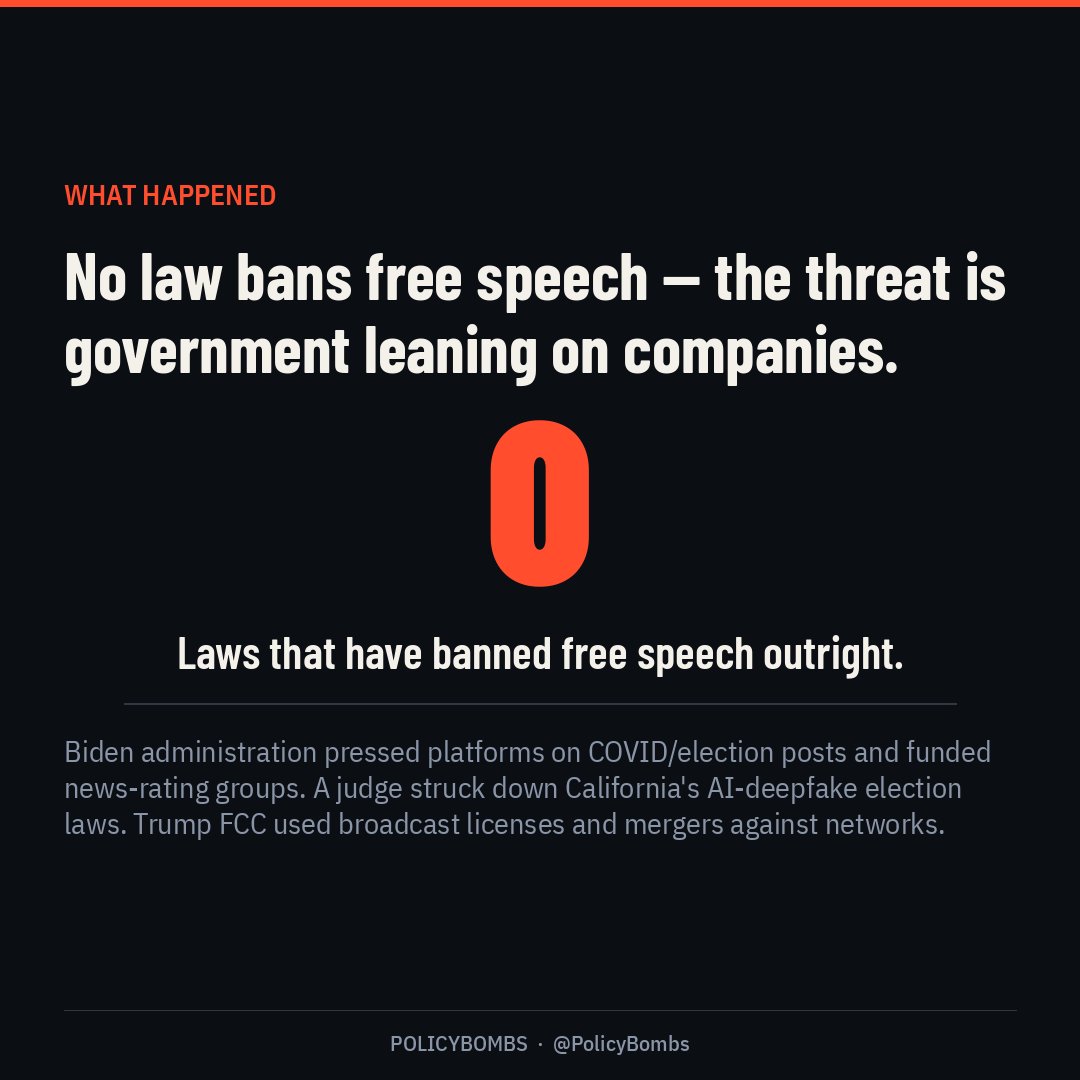
Zero. That's how many laws have banned free speech. The real threat is quieter: government pressure on private companies.
The Biden administration pressed platforms over COVID and election posts and funded groups that rated news sites. California passed AI-deepfake election laws a federal judge struck down. The Trump FCC has used broadcast licenses and merger approvals against TV networks. Courts have blocked most direct restrictions.
PRO: Courts have blocked most direct restrictions.
CON / COST: Jawboning, speech codes and FCC threats chill speech without a law.
SOCIETY: Both parties are eroding norms; neither has a clean record.
Full analysis
"Eliminating Free Speech": Claim and Policy Assessment
Tests the claim against concrete policies: government jawboning of platforms, campus speech codes, California deepfake laws, and 2025–26 FCC pressure on broadcasters. As of Nov 4, 2026.
Content as of Nov 4, 2026, 8:33 PM ET. Source Page: PolicyBombs canvas
Long-form deep analysis. Companion to the 10-minute quick reference (13-free-speech-summary.docx).
Contents
- 10-Minute Voter Guide
- Key facts
- 1. What is the policy
- 2. Why it exists
- 3. Realized effects
- 4. Good or bad for society
- Local investigations and data anomalies
- Who supports / who opposes
- References
10-Minute Voter Guide
Who’s for / against: Against government pressure on platforms: Missouri AG Eric Schmitt (R, Murthy v. Missouri), Florida and Texas GOP (platform laws). Against FCC pressure on ABC over Kimmel: Sen. Ted Cruz (R). California’s 2024 election-deepfake laws, signed by Newsom (D), were challenged in court by X Corp. and others.
Nobody passed a law banning free speech. The real issue is government using indirect pressure on private companies to suppress speech it dislikes. The Biden administration pressed social media platforms over COVID and election posts and funded groups that rated news sites. California passed AI-deepfake election laws that a federal judge struck down. The Trump FCC has used broadcast licenses and merger approvals against TV networks. Courts have blocked most direct restrictions.
Arguments for government action | Arguments against |
+ Health misinformation and fake AI ads can cause real harm + Government is allowed to speak and share information + Broadcasters use public airwaves | – Informal pressure avoids courts and voters – Both parties used it against their critics – Taxpayer-funded ‘disinformation’ raters had little oversight |
Bottom line for voters: Judge candidates by whether they would restrain their own side’s use of pressure on platforms, broadcasters and universities, not just the other side’s. |
Bottom line: No party is "eliminating" free speech, and courts have struck down or blocked most of the direct restrictions. Both parties have used government leverage against speech they dislike. The Biden administration pressed platforms over COVID and election content from 2020 to 2022. The Trump administration’s FCC used broadcast licenses and merger reviews against networks in 2025–26. California passed deepfake laws a federal court struck down. The threat is real and bipartisan. It comes as indirect pressure, not outright bans. |
Key facts
Policy / event | Year | Status (Nov 2026) | Key point |
|---|---|---|---|
White House, CDC and FBI contacts with platforms (Murthy v. Missouri) | 2020–22 | SCOTUS 6–3: no standing (June 2024) | Merits never decided; 5th Cir. had found coercion |
NRA v. Vullo | 2024 | SCOTUS 9–0 for NRA | Government can’t coerce third parties to punish speech |
Twitter Files (internal docs released by Musk) | Dec 2022–23 | Released | Showed frequent government flagging; formal coercion disputed |
CA AB 2839 (election deepfakes) and AB 2655 (platform takedown) | 2024 | Struck down (Kohls v. Bonta, E.D. Cal.) | 2839 failed First Amendment review; 2655 preempted by Section 230 |
Campus speech (FIRE) | 2024–26 | Ongoing | Most rated colleges hold at least one restrictive policy; ‘yellow light’ is the most common rating |
FCC: Kimmel suspension after Carr remarks | Sept 2025 | Show returned after about a week | Chair publicly threatened ABC affiliates |
FCC: early license reviews of 8 ABC stations; poll-reporting warnings | 2026 | Pending | Commissioner Gomez dissents; no decision reported |
1. What is the policy
Item | Detail |
|---|---|
Jawboning (2020–22) | White House, Surgeon General, CDC, FBI and CISA flagged posts and pressed Meta, YouTube and Twitter on COVID misinformation and election content. The 5th Circuit (2023) found coercion and significant encouragement. The Supreme Court reversed on standing in Murthy v. Missouri (June 26, 2024) without ruling on the merits. |
Campus speech codes | Bias-response teams, harassment definitions broader than the Davis standard, and free-speech zones. FIRE rates policies red, yellow or green, and publishes an annual College Free Speech Rankings survey. Since 2023, protests over Gaza produced new time-place-manner rules. Federal pressure (Title VI investigations, funding freezes at Harvard and Columbia in 2025) pushed from the other side. |
California AB 2839 / AB 2655 (2024) | AB 2839 let anyone sue over materially deceptive election deepfakes. AB 2655 required large platforms to remove or label them. The court enjoined AB 2839 in Oct 2024 after the Kohls (Mr Reagan) parody suit. Judge John Mendez (E.D. Cal.) entered a final judgment and permanent injunction against AB 2655 on Aug 20, 2025 (preempted by Section 230). On Aug 29, 2025 he struck AB 2839 on First Amendment grounds (content- and viewpoint-based, not narrowly tailored). |
FCC under Chair Brendan Carr (2025–26) | Reopened news-distortion complaints against ABC, CBS and NBC. Used merger review (Skydance–Paramount closed July 2025 after CBS settled with Trump for $16M and made commitments). Sept 2025: Carr’s remarks preceded Nexstar and Sinclair pulling Jimmy Kimmel; ABC suspended him and then reinstated him. Oct 2026: early license-renewal reviews of 8 ABC stations, plus warnings about airing ‘fabricated’ election polls. |
2. Why it exists
Stated reasons: public health (COVID), election integrity, foreign influence, campus harassment and inclusion, fake AI political ads, and broadcaster ‘public interest’ obligations.
Underlying drivers: each party in power uses whatever lever it has against speech that hurts it. Democrats leaned on platforms, where their allies had influence. Republicans have leaned on licensed broadcasters, where the FCC has leverage, and on universities through federal funding. Platforms faced an advertiser and regulatory risk and often wanted cover for moderation choices. Campus administrators respond to liability and reputation incentives. California legislators were acting after a deepfake of Kamala Harris that Elon Musk shared in July 2024.
3. Realized effects
Item | Detail | Assessment |
|---|---|---|
Courts as backstop | Vullo (9–0), Moody v. NetChoice (2024, platform moderation is protected editorial judgment) and Kohls v. Bonta all limited government. Murthy left jawboning lines unclear. | Mostly protective |
Platform moderation | Pressure on platforms mostly ended after 2023: X ended most moderation, and Meta ended US third-party fact-checking in Jan 2025. Meta’s Zuckerberg told the House Judiciary Committee (Aug 2024) that the administration had pressured Meta and that he regretted giving in. | |
Campus climate | FIRE/College Pulse surveys show large shares of students self-censor and many find shouting down speakers acceptable. These are self-reported attitudes, not measures of actual sanctions. | |
Broadcast chilling | Settlements (ABC $15M Dec 2024, CBS/Paramount $16M July 2025) and the Kimmel episode show real leverage. No license has been revoked as of the cited reporting. | Warning |
4. Good or bad for society
Verdict: Jawboning, campus speech codes, deepfake bans and FCC license threats are all bad for society. Each lets the party in power chill speech without passing a law that would survive court review. The "eliminating free speech" framing overstates it. The fair criticism is that both parties are eroding norms. Neither left nor right holds a clean record. |
Strongest case for intervention | Strongest case against |
+ Real harms: viral health misinformation, deceptive deepfakes, targeted harassment + Government can share information and speak itself + Broadcasters use public spectrum under public-interest duties | – Who decides what counts as misinformation? Some flagged claims, such as lab-leak, were later treated as plausible – Informal pressure escapes judicial review and accountability – Regulatory leverage (licenses, mergers, grants) turns into partisan punishment |
- Require public logs of every government request to platforms to remove content.
- Limit FCC news-distortion enforcement to deliberate falsification with evidence, per long-standing precedent.
- Campuses: adopt the Chicago principles and the Davis harassment standard.
Local investigations and data anomalies
Finding | Source | What investigators or courts concluded |
|---|---|---|
State Department Global Engagement Center (GEC) grant program had inadequate risk assessments, monitoring plans and reviews of recipients | State Dept OIG audit, April 2020 | Significant grant-management deficiencies; did not find misuse of specific awards |
GEC gave a $100,000 grant (2021) to the Global Disinformation Index, which rated US news sites for advertisers | Texas and Daily Wire/Federalist v. State Dept (filed Dec 2023) | Court let the suit proceed (May 2024); final ruling not verified here. GEC closed Dec 2024 when Congress let its authorization lapse |
California AB 2839 and AB 2655 | Kohls v. Bonta, E.D. Cal. court record | Both struck down (Aug 20 and 29, 2025) |
FCC early license reviews of 8 ABC stations | FCC record; Commissioner Gomez dissent | Pending; no license decision |
Verdict: unchanged. The grant-audit record supports the concern that federally funded ‘disinformation’ work had weak oversight, though no audit found illegal use of funds.
Further reading (also listed in References):
- State OIG: Audit of GEC federal assistance award management (2020) — oversight.gov
- Reuters: Texas suit over State Dept-funded tech can proceed (2024) — reuters.com
Who supports / who opposes
For = the named action affecting speech. Against = opposing it as a free-speech threat. Each row cites a numbered source below. Checked Nov 4, 2026.
Who | Party / level | Position | Evidence | Ref |
Missouri AG (now Sen.) Eric Schmitt (R) | Republican | Against | Sued Biden administration over social-media "jawboning" (Murthy v. Missouri, 2024: dismissed for standing) | [1] |
Gov. Ron DeSantis (R-FL); Gov. Greg Abbott (R-TX) | Republican | For | Signed laws limiting platform moderation; Supreme Court vacated & remanded (Moody v. NetChoice, 2024) | [2] |
Sen. Ted Cruz (R-TX) | Republican (defector) | Against | Called FCC Chair Brendan Carr’s threats over Jimmy Kimmel "dangerous as hell" (Sep 19, 2025) | [3] |
FCC Chair Brendan Carr (Trump appointee) | Republican | For | Carr urged ABC to "take action" on Kimmel: "We can do this the easy way or the hard way" (Sep 2025) | [3] |
Gov. Gavin Newsom (D-CA) | Democrat | For | Signed AB 2655/AB 2839 (2024) on election deepfakes; challenged in court by X Corp. and others | [4] |
Cross-party defectors: Cruz broke with the Trump administration over the FCC’s pressure on ABC.
How positions shifted: In 2020–23 Republicans attacked government pressure on platforms (the Biden-era ‘jawboning’ cases). In 2025 they used the FCC to pressure broadcasters, and some Democrats turned to free-speech arguments.
Not included or not fully verified: Court outcomes in the AB 2655/2839 lawsuits were not re-checked this turn, so they are omitted.
Sources for this section:
- [1] Supreme Court: Murthy v. Missouri (2024) (supremecourt.gov) https://www.supremecourt.gov/opinions/23pdf/23-411_3dq3.pdf
- [2] Supreme Court: Moody v. NetChoice (2024) (supremecourt.gov) https://www.supremecourt.gov/opinions/23pdf/22-277_d18f.pdf
- [3] NBC News: Ted Cruz rips FCC’s Kimmel threat (nbcnews.com) https://www.nbcnews.com/politics/congress/ted-cruz-fcc-brendan-carr-jimmy-kimmel-threat-free-speech-rcna232496
- [4] CA Legislature: AB 2655 (2024) (leginfo.legislature.ca.gov) https://leginfo.legislature.ca.gov/faces/billNavClient.xhtml?bill_id=202320240AB2655
References
[1] State OIG: Audit of GEC federal assistance award management (2020). oversight.gov. https://www.oversight.gov/sites/default/files/documents/reports/2023-07/Final-Report-Audit-GEC-20-April-2020-51523Redacted.pdf
[2] Reuters: Texas suit over State Dept-funded tech can proceed (2024). reuters.com. https://www.reuters.com/legal/government/texas-lawsuit-claiming-us-helped-censor-conservative-news-can-proceed-2024-05-08/
[3] Murthy v. Missouri opinion (2024). supremecourt.gov. https://www.supremecourt.gov/opinions/23pdf/23-411_3dq3.pdf
[4] NRA v. Vullo opinion (2024). supremecourt.gov. https://www.supremecourt.gov/opinions/23pdf/22-842_6kg7.pdf
[5] Moody v. NetChoice (2024). supremecourt.gov. https://www.supremecourt.gov/opinions/23pdf/22-277_d18f.pdf
[6] FIRE: Spotlight on speech codes. thefire.org. https://www.thefire.org/research-learn/spotlight-speech-codes-2025
[7] FIRE: College Free Speech Rankings. thefire.org. https://www.thefire.org/college-free-speech-rankings
[8] Politico: ABC license fight (Oct 2026). politico.com. https://www.politico.com/news/2026/10/06/abcs-license-fight-threatens-to-reshape-trump-coverage-01109399
[9] NewscastStudio: Carr and Gomez split over poll warnings (Oct 2026). newscaststudio.com. https://www.newscaststudio.com/2026/10/29/carr-gomez-split-over-fcc-warning-to-broadcasters-on-election-polls/
[10] Kohls v. Bonta: final judgment on AB 2655 (Aug 2025). courtlistener.com. https://storage.courtlistener.com/recap/gov.uscourts.caed.453046/gov.uscourts.caed.453046.98.0.pdf
[11] Volokh/Reason: AB 2839 ruling (Aug 29, 2025). reason.com. https://reason.com/volokh/2025/08/29/california-law-restricting-materially-deceptive-election-related-deepfakes-violates-first-amendment/
PolicyBombs · Day 57. Follow @PolicyBombs on X.