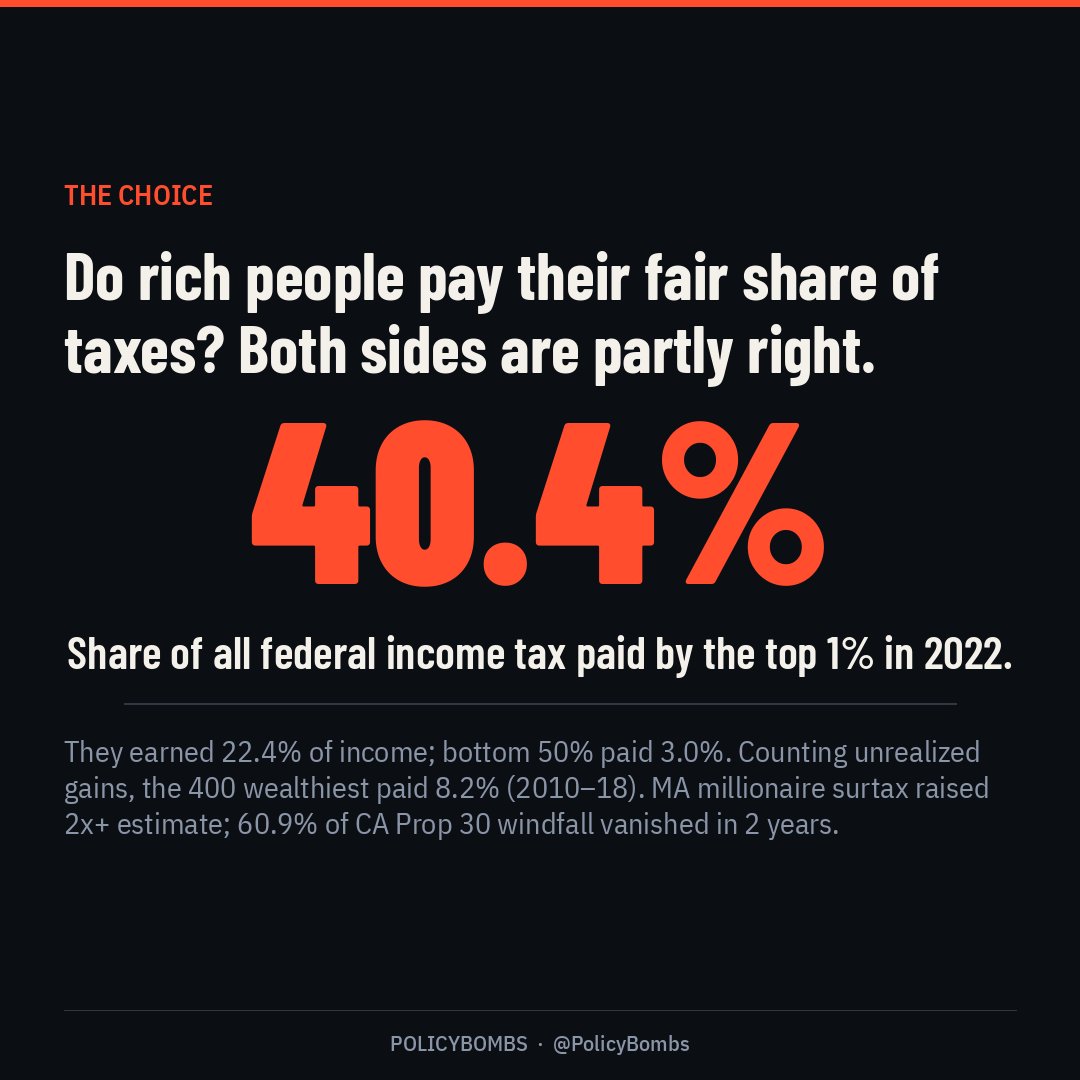
Do the Rich Pay Their Fair Share?

40.4%. That's the top 1%'s share of federal income tax in 2022, on 22.4% of income. The bottom 50% paid 3.0%.

But count unrealized gains as income and the 400 wealthiest families paid just 8.2% (2010–2018). Both claims are partly true. Massachusetts' millionaire surtax raised more than double its estimate, while 60.9% of California's expected Prop 30 windfall vanished to taxpayer responses within 2 years. Carried interest survived both 2017 and 2025 bills.

PRO: Closing step-up at death and unrealized-gains gaps hits the real hole.

CON / COST: Wealth-tax revenue swings with markets; top earners shrink reported income.

SOCIETY: Targeted loophole closing beats broad new wealth taxes.


Full analysis

"Rich Pay Their Fair Share": Policy Assessment

Tests the claim against CBO and IRS data, then grades the main proposals: the billionaire minimum tax, CA Props 30/55/40, and the Massachusetts millionaire tax. As of Nov 4, 2026.

Content as of Nov 4, 2026, 8:31 PM ET. Source Page: PolicyBombs canvas

Long-form deep analysis. Companion to the 10-minute quick reference (02-rich-pay-fair-share-summary.docx).

10-Minute Voter Guide

Who’s for / against: For higher taxes on the rich: Sen. Bernie Sanders, Sen. Elizabeth Warren, most Democrats, SEIU-UHW (CA Prop 40). Against: Republicans (2017 TCJA and 2025 One Big Beautiful Bill passed with zero Democratic votes) and, on California’s billionaire tax, Gov. Newsom (D).

The top 1% already pays about 40% of federal income tax (IRS) and 26% of all federal taxes (CBO). But the very wealthy hold most of their gains as unrealized assets that are taxed lightly or never. State millionaire taxes raise real money, Massachusetts nearly $3B a year, but top earners shrink their reported income (California Prop 30). Business lobbies kept special carve-outs alive in 2025.

Pros of taxing the rich more

Cons

+ Closes the step-up-at-death and unrealized-gains gap

+ Massachusetts surtax brought in more than double its estimate

+ Funds schools and transit without middle-class increases

– Revenue swings with the stock market

– 60.9% of California’s expected Prop 30 windfall lost to taxpayer responses within 2 years

– Earmarked money mainly benefits the interest groups that funded the campaign

Bottom line: Close specific loopholes (step-up at death, carried interest, the pass-through deduction) rather than vote for broad new wealth taxes.

Contents

  • 10-Minute Voter Guide
  • Key facts
  • 1. What is the policy
  • 2. Why it exists
  • 3. Realized effects
  • Follow the money: carve-outs and campaign finance
  • 4. Good or bad for society
  • Who supports / who opposes
  • References

Bottom line: On income taxes, the US federal system is already steeply progressive: the top 1% pays a higher average rate and a far larger share than any other group. The real gap is unrealized gains on very large fortunes, which are lightly taxed until sale and can escape tax entirely at death. Narrow fixes to that gap are defensible. Broad state surcharges bring in a lot of money but make revenue volatile and push some earners to leave.

Key facts

Item

Figure

Source

Top 1% average federal tax rate, 2023 (all federal taxes)

26.0% (31.5% in 2022); top 1% paid 26% of all federal taxes

CBO, Distribution of Household Income 2023 (Sept 24, 2026)

Top 1% share of federal individual income tax, tax year 2022

40.4% of tax on 22.4% of AGI; average rate 26.1%. Bottom 50% paid 3.0%

IRS SOI percentile tables (via Tax Foundation)

400 wealthiest families’ federal income tax rate when unrealized gains count as income, 2010–2018

8.2%

White House CEA/OMB, 2021 (estimate)

Billionaire Minimum Income Tax (25% on income incl. unrealized gains, over $100M wealth)

Never enacted

Biden budgets FY2023–FY2025

CA Prop 30 (2012), extended by Prop 55 (2016): top marginal rate 13.3%

In force through 2030

CA Legislative Analyst’s Office

CA Prop 40 (2026): one-time 5% tax on wealth over $1B

Rejected 55.6% No (early, uncertified count)

CA results, Nov 4, 2026

MA 4% surtax on income over $1M (Fair Share, 2022)

FY24 $2.4B; FY25 $2.99B against a $1.3B benchmark

MA DOR certifications

Federal 2025 reconciliation law (OBBBA)

Made the TCJA individual rates permanent; top rate stays 37%

Public Law 119-21

1. What is the policy

"Fair share" is a slogan, not a single law. This page tests it against four concrete measures.

Item

Detail

Federal income and payroll tax

Seven brackets from 10% to 37%. Long-term capital gains and qualified dividends are taxed at 0/15/20% plus the 3.8% NIIT. Gains are taxed only when an asset is sold, and step-up in basis at death erases the gain for heirs. Making the TCJA rates permanent in July 2025 kept this structure.

Billionaire Minimum Income Tax (proposal)

Households with more than $100M in wealth would pay at least 25% on income that includes unrealized gains, payable in installments. Proposed in Biden’s FY2023–FY2025 budgets. It never got a floor vote and is dormant under the current Congress.

California Props 30 and 55

Prop 30 (2012) added 1–3 points to income over $250K, $300K, and $500K (single filers). Prop 55 (2016) extended these through 2030. With the 1% mental-health surcharge (Prop 63), the top rate is 13.3%, the highest of any state.

California Prop 40 (Nov 2026)

A one-time 5% tax on net worth over $1B, mostly earmarked for health care. Early returns show it losing about 56–44.

Massachusetts Fair Share Amendment

Approved by voters in Nov 2022, 52–48. Adds a 4% surtax on taxable income above $1M (indexed: $1,083,150 for 2025). Revenue is constitutionally earmarked for education and transportation. In effect since tax year 2023.

2. Why it exists

Stated reasons

Underlying drivers

+ Top income and wealth shares rose sharply after 1980

+ Wealth held as unrealized gains goes untaxed for decades ("buy, borrow, die")

+ Pay for schools, transit, and health care without taxing the middle class

+ Fairness: billionaires can show lower effective rates than workers on some measures

– Polls well: taxing the top 1% consistently gets majority support

– Public-sector unions and education lobbies backed Prop 30/55 and Fair Share because the money is earmarked for them

– Lets legislators expand spending without broad tax increases

– Opponents’ money also comes from the people who would be taxed (Prop 40 opposition was funded largely by tech wealth)

The fight over the facts mostly comes down to definitions. Using CBO’s income measure, the rich pay much higher average rates. If unrealized gains count as income (the CEA and ProPublica approach), the very top pays lower rates than many professionals. Both are true, under different definitions.

3. Realized effects

Federal progressivity

CBO finds federal taxes progressive in every year it tracks. In its Sept 2026 report, the top 1%’s average rate was 26.0% in 2023, down from 31.5% in 2022. The drop came mostly from a 9% fall in top-1% income, driven by lower realized capital gains. The top 1% paid 26% of all federal taxes, and the top 20% paid 70%. After refundable credits, the bottom quintile’s federal income tax rate is negative.

Saez and Zucman (2019) estimated that the 400 richest pay a lower total rate than the bottom half once state, local, and corporate taxes are included. Auten and Splinter and others dispute their assumptions about how corporate taxes and income are allocated. Treat the Saez–Zucman headline as contested.

State millionaire taxes

Item

Detail

Assessment

Massachusetts

Brought in $2.4B in FY24 and $2.99B in FY25, more than twice the $1.3B budget benchmark. Spending has gone to free community college, school meals, and the MBTA. Critics point to high-income out-migration in IRS data and to swings: the surtax is concentrated in capital gains. A causal estimate of migration is not yet settled.

Revenue beat estimates

California Prop 30

Rauh and Shyu (AEJ: Policy, 2024) find top earners left at higher rates and remaining ones reported less income. Behavioral responses eroded 45.2% of the expected windfall in the first year and 60.9% within two years. Most of the loss came from stayers reporting less income; out-migration was 9.5% of it. The rest was still a large revenue gain. California’s dependence on the top 1% (about half of personal income tax by LAO accounts) makes boom-bust deficits worse, for example 2023–24.

Revenue gain, partly offset

Wealth taxes abroad

Most OECD countries that had annual wealth taxes repealed them (12 in 1990, about 4 by 2017, per OECD), citing high administrative cost, capital flight, and low yield.

Mostly repealed

Follow the money: carve-outs and campaign finance

Finding

What the record shows

Source

MA Question 1 (2022) campaign money

Yes side spent $27.9M; the Massachusetts Teachers Association ($13.3M) and NEA ($7.2M) gave about $20.5M of it. Opponents spent $14.5M. The surtax is constitutionally earmarked for education and transportation.

MA OCPF ballot question report

Pass-through deduction (Sec. 199A)

Created in 2017 after pass-through business lobbying; the 2025 law made it permanent at 20%, widened phase-ins, added a $400 minimum. Benefits are concentrated at high incomes (JCT distribution tables).

IRS; KPMG on OBBBA; JCT

Carried interest

Survived the 2017 and 2025 bills despite campaign promises from both parties to close it; private-equity lobbying is documented in lobbying disclosures.

Senate LDA filings; CNN on 2025 lobbying wins

Rich-side campaign money

CA Prop 40 (2026) opposition was largely funded by tech wealth (reported); exact totals not verified here, so check Cal-Access.

Cal-Access (verify)

No court or auditor has found fraud in these tax measures. The pattern is legal capture: each side’s donors write or protect provisions that benefit them. What changed: the verdict now adds that targeted repeal of carve-outs beats new broad taxes, and that earmarks should get independent audits of whether they actually add new funding.

4. Good or bad for society

Verdict: The claim that the rich pay little federal income tax is false on standard data. The claim that the wealthiest avoid tax on most of their economic gains is true. Ending step-up in basis, or a minimum tax on realized gains, fixes the real gap at low distortion. One-time and annual wealth taxes, and stacking state surcharges past about 13%, carry costs from migration and volatility that their backers understate.

Strongest case for higher top taxes

Strongest case against

+ Deficits are large, and the top has the most capacity to pay

+ Massachusetts shows a surtax can raise billions without the predicted collapse

+ Step-up in basis is a pure loophole that serves no efficiency goal

+ Concentrated wealth turns into political power

– Top 1% already pays 40% of income tax; the base is narrow and volatile

– Mobile earners leave high-tax states (California Prop 30 evidence)

– Taxing unrealized gains raises valuation, liquidity and constitutional problems (Moore v. US, 2024, left this open)

– Earmarked revenue often replaces existing funding rather than adding to it

Who supports / who opposes

For = higher taxes on top earners or wealth. Against = lower or permanent tax cuts at the top. Each row cites a numbered source below. Checked Nov 4, 2026.

Who

Party / level

Position

Evidence

Ref

Sen. Elizabeth Warren (D-MA)

Democrat

For

Sponsored the Ultra-Millionaire Tax Act (annual 2% tax on net worth above $50M)

[1]

Sen. Bernie Sanders (I-VT)

Independent (caucuses D)

For

Rallied in California for Prop 40, the one-time 5% billionaire tax (2026)

[2]

SEIU-UHW; Lorena Gonzalez (CA Labor Federation)

CA labor

For

Put Prop 40 on the Nov 2026 ballot; trailing ~55% no in early returns (Nov 4, 2026)

[3]

Gov. Gavin Newsom (D-CA)

Democrat (defector)

Against

Opposed Prop 40 and endorsed Prop 42 (ban on wealth taxes); says he backs a national minimum tax instead

[3]

House & Senate Republicans; President Trump

Republican

Against

One Big Beautiful Bill Act (H.R. 1, signed Jul 4, 2025) made the 2017 income-tax cuts permanent; passed House 218–214 and Senate 51–50 with no Democratic votes

[4]

Reps. Thomas Massie (R-KY), Brian Fitzpatrick (R-PA); Sens. Rand Paul, Thom Tillis, Susan Collins

Republican (defectors)

Against

Voted no on final passage of H.R. 1 (2025), for differing reasons (deficit, Medicaid)

[4]

Democratic Party

Platform

For

2024 platform: make billionaires and corporations "pay their fair share", raise top rates on income over $400K

[5]

Cross-party defectors: Newsom and much of California’s Democratic establishment (CTA, Planned Parenthood CA) opposed the state billionaire tax while Sanders campaigned for it. Massie and Fitzpatrick broke with Republicans on the 2025 tax bill.

How positions shifted: Republicans voted unanimously for the 2017 and 2025 tax laws; Democrats unanimously against. Within the Democratic Party the split is now over state-level wealth taxes, not federal rates.

Not included or not fully verified: Final Prop 40 result was not certified as of Nov 4, 2026.

Sources for this section:

References

[1] CBO: Distribution of Household Income, 2022. cbo.gov. https://www.cbo.gov/publication/62300

[2] Tax Foundation: Latest federal income tax data (TY2022). taxfoundation.org. https://taxfoundation.org/data/all/federal/latest-federal-income-tax-data-2025/

[3] IRS SOI tables by income percentile. irs.gov. https://www.irs.gov/statistics/soi-tax-stats-individual-statistical-tables-by-tax-rate-and-income-percentile

[4] CBO income distribution topic page. cbo.gov. https://www.cbo.gov/topics/income-distribution

[5] IRS SOI individual income tax statistics. irs.gov. https://www.irs.gov/statistics/soi-tax-stats-individual-income-tax-statistics

[6] CEA: What is the average federal individual income tax rate on the wealthiest Americans? (2021). whitehouse.gov archive. https://bidenwhitehouse.archives.gov/cea/written-materials/2021/09/23/what-is-the-average-federal-individual-income-tax-rate-on-the-wealthiest-americans/

[7] MA DOR surtax certifications. mass.gov. https://www.mass.gov/lists/massachusetts-dor-certification-of-surtax-and-capital-gains-tax

[8] MA Fair Share impact report. mass.gov. https://www.mass.gov/info-details/delivering-on-fair-share-impact-report

[9] Rauh & Shyu, Behavioral responses to state income taxation of high earners. aeaweb.org. https://www.aeaweb.org/articles?id=10.1257/pol.20200500

[10] CA Prop 40 (2026) guide. sos.ca.gov. https://quickguidetoprops.sos.ca.gov/propositions/2026-11-03/40

[11] MA OCPF: 2022 ballot question spending report. ocpf.us. https://ocpf2.blob.core.windows.net/pdf/studies/bq2022.pdf

[12] KPMG: pass-through provisions in OBBBA. kpmg.com. https://kpmg.com/kpmg-us/content/dam/kpmg/taxnewsflash/pdf/2025/05/kpmg-report-passthroughs-one-big-beautiful-bill-may-16-2025.pdf

[13] CNN: How business lobbyists scored wins in the 2025 bill. cnn.com. https://www.cnn.com/2025/07/18/politics/business-lobbyists-trump-agenda-bill

[14] OECD: The role and design of net wealth taxes (2018). oecd.org. https://www.oecd.org/tax/the-role-and-design-of-net-wealth-taxes-in-the-oecd-9789264290303-en.htm

PolicyBombs · Day 46. Follow @PolicyBombs on X.
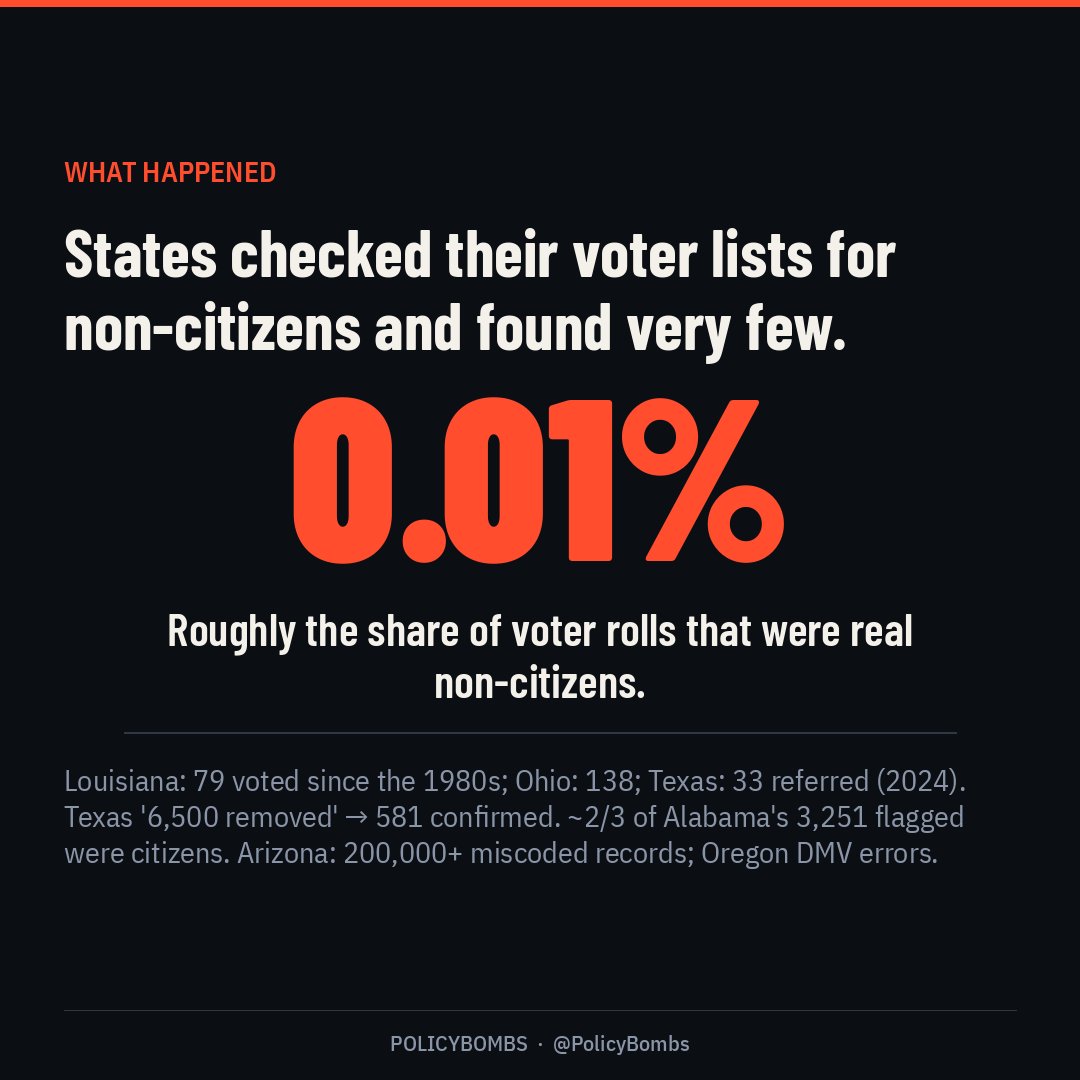
Non-Citizen Voting

0.01%. That's roughly how much of state voter rolls turned out to be real noncitizen registrants when states actually checked.

Louisiana found 79 who voted since the 1980s, Ohio 138, Texas 33 referred from 2024. Real, but tiny. And the headline numbers collapsed: Texas's '6,500 removed' was 581 confirmed. About two-thirds of Alabama's 3,251 'noncitizens' were citizens. The real weak spot? Government data plumbing, like Oregon's DMV errors and Arizona's 200,000+ miscoded records.

PRO: Routine SAVE/DMV checks catch real cases and agency errors.

CON / COST: Initial flags are mostly wrong; Kansas proof rules blocked 31,089 citizens.

SOCIETY: Local noncitizen voting weakens citizenship and trust; blanket purges hit citizens.


Full analysis

Non-Citizen Voting in the U.S.: Policy Assessment

What the laws are, why they exist, what local audits and state referrals actually found, and a verdict. Revised Nov 4, 2026 to a local-evidence standard.

Content as of Nov 4, 2026, 8:34 PM ET. Source Page: PolicyBombs canvas

Long-form deep analysis. Companion to the 10-minute quick reference (01-non-citizen-voting-summary.docx).

Contents

  • 10-Minute Voter Guide
  • What changed in this revision
  • Key facts
  • 1. What is the policy
  • 2. Why it exists
  • 3. Realized effects
  • 4. Good or bad for society
  • Anomaly and case table
  • Who supports / who opposes
  • References

10-Minute Voter Guide

Who’s for / against: For local noncitizen voting: DC Council (D), SF and Oakland voters, NYC Council (D). For citizenship-proof rules: House Republicans (SAVE Act) plus 4 House Democrats, the 2024 GOP platform, and Trump’s March 2025 executive order. Most Democrats oppose the SAVE Act as voter suppression.

Some cities (San Francisco, DC, about 11 Maryland towns) let noncitizens vote in local races. Voting in state or federal races is a crime for noncitizens. Since 2024, states have run their rolls through DMV and federal immigration (SAVE) data and found real noncitizens registered, and some who voted: Louisiana 79 who voted at least once since the 1980s, Ohio 138, Georgia 9, Oregon up to 9 (registered by a DMV error), Texas 33 referred from 2024 using SAVE. That is about 0.01% of rolls, far fewer than the big numbers politicians announced. Texas’s ‘6,500 removed’ was really 581 confirmed. About two-thirds of Alabama’s 3,251 ‘noncitizens’ were citizens. Virginia’s purges swept in citizens who checked the wrong DMV box. The real weak spot is government data plumbing (Oregon’s DMV, Arizona’s 200,000-plus records coded with citizenship proof they never gave), not mass fraud.

Pros of stricter citizenship checks

Cons

+ Every state that checked found some real noncitizen registrants; a few hundred votes can decide local races

+ The revamped SAVE database (2025) can confirm status in bulk for free

+ Exposes agency errors (Oregon, Arizona) that attestation never caught

– Initial flags are mostly wrong: AL two-thirds citizens; TX 6,500 shrank to 581; Idaho 678 to 36

– Pre-election purges were blocked or settled under NVRA’s 90-day rule (VA, AL)

– Documentary-proof mandates block far more citizens than they catch noncitizens (Kansas: 31,089)

Bottom line: Noncitizen voting is real, documented in every state that looked, and almost always tiny (about 0.01% of rolls), often traced to agency mistakes or confused immigrants rather than organized fraud. Support routine SAVE and DMV checks done individually with notice. Distrust headline purge numbers until follow-up confirms them. Local noncitizen voting remains a weak policy.

What changed in this revision

  1. Added 2024–2026 state and county findings: Virginia, Texas, Alabama, Oregon, Arizona, Louisiana, Utah and Idaho, each with its follow-up result.
  2. New evidence moves the verdict slightly: the problem is no longer ‘close to zero’ but ‘small and real’, with confirmed votes in several states. Government data errors are now a documented cause. Routine verification is a stronger recommendation than before; the verdict against blanket documentary-proof mandates stands.
  3. Added a corruption and incentive lens: officials on both sides inflated (TX, AL) or ignored (OR, AZ) the problem.

Key facts

Policy

Year

Status (Nov 2026)

Key number

SF Prop N: noncitizen parents vote for school board

2016

In force; upheld on appeal Aug 2023

235 noncitizens voted in the 2022 recall; about 44,000 eligible (city estimate)

NYC Local Law 11: about 800,000 green-card holders and work-authorized residents vote in city races

2022

Void; NY Court of Appeals 6–1, Mar 20, 2025

Never used in an election

Takoma Park, MD: all residents vote in city elections

1992

In force (about 11 MD towns)

347 registered, 72 voted (2017)

DC Local Resident Voting Rights Act

2022

In force; House repeal bill passed, stalled in Senate

House repeal vote 266–148 (June 10, 2025)

18 U.S.C. 611 (added by IIRIRA)

1996

Federal law

Up to 1 year in prison for voting in a federal race

State constitutional bans on noncitizen voting

2018–2024

8 of 8 passed in 2024

Ohio 2022 and Louisiana 2022 passed by wide margins

SAVE / SAVE America Act: proof of citizenship to register

2024–2026

Passed House; failed in Senate 48–50 (June 4, 2026)

House 218–213 (Feb 2026)

Georgia citizenship audits

2022, 2024

Done

2022: 1,634 attempted, 0 registered. 2024: 20 on 8.2M rolls, 9 voted

Ohio referrals

2024

Referred to the state attorney general

597 referred (138 voted, 459 registered only)

1. What is the policy

Item

Detail

Federal ban

18 U.S.C. 611, added by IIRIRA in 1996, makes it a crime for a noncitizen to vote in a federal election (fine, up to 1 year). There is an exception for local elections that allow noncitizens to vote, plus a reasonable-belief defense added in 2000. 18 U.S.C. 1015(f) and 8 U.S.C. 1182/1227 add false-claim penalties and grounds for deportation.

San Francisco Prop N (2016)

Charter amendment. Noncitizen parents, guardians and caregivers of SF children can vote for the Board of Education, regardless of immigration status. They must register separately for each election. The Board of Supervisors made it permanent in 2021. Superior Court struck it down in July 2022 (Lacy v. SF). The 1st District Court of Appeal reversed in August 2023, citing charter-city home rule.

NYC Local Law 11 (2022)

Lawful permanent residents and work-authorized noncitizens with 30 days of residency could vote for mayor, comptroller, public advocate, borough president and council. It took effect Jan 9, 2022 without a mayoral signature. Struck down by Supreme Court, Richmond County (2022), Appellate Division (2024) and the Court of Appeals (Fossella v. Adams, Mar 20, 2025, 6–1). Article II §1 of the state constitution limits voting to citizens.

Maryland municipalities

State law lets towns set their own electorate. Takoma Park has allowed it since 1992 (first election 1993). About 11 towns do now, including Hyattsville, Mount Rainier and Riverdale Park. Also allowed in a few Vermont towns, such as Winooski and Montpelier.

District of Columbia (2022)

The Local Resident Voting Rights Amendment Act lets noncitizens who have lived in DC 30 days, including undocumented people and diplomats, vote in local elections. It took effect Feb 23, 2023, after Congress’s review period ran out (the House voted to disapprove; the Senate didn’t act). H.R. 884 (repeal) passed the House 266–148 with 56 Democrats on June 10, 2025. It has been in a Senate committee since.

State constitutional amendments

Amendments changing "every citizen" to "only citizens": North Dakota (2018); Alabama, Colorado and Florida (2020); Ohio (Issue 2) and Louisiana (2022). In 2024: Idaho, Iowa, Kentucky, Missouri, North Carolina, Oklahoma, South Carolina and Wisconsin. All passed.

SAVE Act / SAVE America Act

Would amend the NVRA to require documents proving citizenship (passport, birth certificate plus ID, etc.) to register for federal elections. The 2026 version adds photo ID and sends voter rolls to DHS. It passed the House in 2024, 2025 and Feb 2026 (218–213). It failed as a Senate amendment 48–50 on June 4, 2026. Courts have blocked executive-order versions.

2. Why it exists

Stated case for local noncitizen voting

Stated case for bans and proof of citizenship

+ No taxation without representation: residents pay local taxes and use local schools

+ Parents should have a say over their children’s schools (SF)

+ Integration and civic habit before naturalization

+ There is historical precedent: about 40 states or territories let noncitizens vote at some point before 1926

– Citizenship is what defines the political community

– Separate rolls cause confusion and can lead to accidental illegal federal voting

– Lowers the incentive to naturalize

– Attestation alone, without verification, invites fraud and undermines trust

Underlying drivers on the left: progressive city councils and immigrant-rights groups (NYC: Our City, Our Vote; SF: Chinese Progressive Association) want to grow constituencies that lean their way and to signal values. Few noncitizens actually use the right, which suggests symbolism matters as much as representation.

Underlying drivers on the right: the ballot amendments and the SAVE Act ban things that are mostly already illegal (only local law allowed noncitizen voting anywhere). They are partly turnout tools: they put the immigration issue on the ballot and set up a narrative of stolen elections. Proof-of-citizenship requirements also burden eligible citizens who lack documents. Those citizens skew poorer and younger, and the parties disagree about who they vote for.

Some Democrats cross over (56 House Democrats on the DC repeal, and wide margins in blue-leaning electorates on amendments). Noncitizen voting is unpopular with the public, so the right gains more politically by forcing votes on it.

3. Realized effects

Legal local voting: low uptake

Item

Detail

San Francisco

235 noncitizens voted in the high-profile 2022 school board recall, out of about 44,000 estimated eligible (SF Examiner, citing city figures). The Department of Elections has not published a separate noncitizen count for Nov 2024; noncitizen ballots were merged into the certified totals. Fear of immigration enforcement is the reason most often given.

Takoma Park

347 noncitizens registered and 72 voted in 2017 (about 20%). The city stopped reporting the figure separately after that.

Hyattsville

About 230 city-only registrants and roughly 40 voters (Washington Times, 2024).

NYC

Zero; the law was enjoined before any election.

Illegal voting in state and federal elections: rare

Study / audit

Finding

Source lean

Georgia audit 2022

1,634 noncitizens tried to register over 25 years; none got on the rolls

GOP Secretary of State

Georgia audit 2024

20 noncitizens among 8.2M registrants; 9 had voted

GOP Secretary of State

Ohio referrals 2024

597 apparent noncitizens referred: 138 voted, 459 only registered (about 8M registered voters)

GOP Secretary of State

Michigan 2024

15 potential noncitizen votes among more than 5.7M ballots

Dem Secretary of State

Brennan Center 2017

About 30 suspected noncitizen votes referred among 23.5M in 42 jurisdictions (2016), or 0.0001%. 40 of 42 jurisdictions reported zero. Officials self-reported, and NYC declined to participate

Progressive

Heritage fraud database

1,619 total fraud cases. 89 are noncitizen voting cases since 2000 (16 involving undocumented immigrants), per an American Immigration Council count. Brennan’s 2017 review of the then-database counted 41

Conservative

Richman, Chattha & Earnest 2014 (Electoral Studies, CCES data)

Estimated 6.4% of noncitizens voted in 2008 and 2.2% in 2010

Academic; disputed

Ansolabehere et al. 2015

Ansolabehere, Luks & Schaffner 2015: even a 0.1% citizenship-misclassification rate produces the apparent voters. Among panel respondents who consistently said they were noncitizens, none was a validated voter, so the best estimate is about zero. Richman’s own 2023 Arizona expert report found 1,934 records of possible noncitizens on 4M rolls (0.04%), per Brennan

Academic rebuttal

Caveat: audits only find people who show up in DHS/SAVE or DMV data, so the true count could be somewhat higher. Even so, every audit lands on rates of about 0.01% or lower. That is far below the margin in nearly every race, and some of the cases are confused green-card holders, not deliberate fraud.

Local and state findings, 2024–2026 (verified this revision)

State / county

Headline claim

What follow-up found

Status

Virginia (EO 35, Aug 2024)

About 1,600 removed Aug–Oct 2024; 6,303 ‘noncitizens’ removed July 2022–July 2024

Washington Post and state officials: many were citizens who checked the wrong DMV box. Radio IQ reviewed 650+ election-crime cases over 20 years and found no noncitizen voting convictions. Fairfax referred about 800 people; its prosecutor said failing to answer a letter isn’t a crime. SCOTUS allowed the purge (Oct 30, 2024); an Apr 2026 settlement bars it within 90 days of federal elections

Mostly unsubstantiated as illegal voting

Texas (Aug 2024)

6,500 noncitizens removed; 1,930 with voting history sent to AG

SOS report: 581 confirmed noncitizens over 3 years; the rest didn’t answer notices. Reporters found citizens on the list. The 1,930 narrowed to about 100-plus investigations. June 2025: SOS referred 33 SAVE-flagged noncitizens who voted in Nov 2024

Inflated; 33 referrals pending

Alabama (Aug 2024)

3,251 noncitizen ID holders made inactive

At least 2,074 were eligible citizens (state’s own sworn filing); 106 asked to be removed. Judge Manasco (Trump appointee) enjoined it. DOJ dropped its suit in 2025

Mostly false positives

Oregon (Sept–Oct 2024)

DMV registered 1,259 people without proof of citizenship (plus 123 more found Oct 2024; American Samoans coded as citizens since 2016)

10 had voted; 1 confirmed citizen, so up to 9 potentially ineligible votes since 2021. Officials say no race was affected. After-action report blames systemic DMV error

Substantiated agency error

Arizona (2024–2025)

About 218,000 voters coded as having shown citizenship proof due to an MVD flaw on pre-1996 licenses

Court let them vote full ballots in 2024. List fell to about 200,000 as documents were found. Most are believed to be longtime citizens

Agency error; citizenship mostly presumed

Louisiana (Sept 2025, SAVE)

390 noncitizens registered, 79 voted at least once since the 1980s

About 0.01% of 2.9M rolls. SOS: ‘not a systemic problem’; due process pending

Preliminary; referrals

Utah (2025)

Full-roll citizenship check

27 confirmed noncitizens removed; 25 probable; 5,007 unconfirmed (mostly old registrations). No confirmed illegal votes reported

Small

Idaho (2024–2025)

678 potential noncitizens flagged by DMV

SAVE confirmed 638 as citizens; 34 removed and referred; none voted in 2024. About 15 referred to the U.S. Attorney; 12 more flagged in 2025

Small; pending

Georgia, Ohio, Michigan (2022–2024)

See table above

GA 9 voted; OH 138 voted; MI 15 potential

Referred

Pattern: every headline number shrank by 70–99% on follow-up, yet none shrank to zero. Confirmed noncitizen votes, summed across the states above, are in the low hundreds over many years against more than 30M registrants. That is below nearly every statewide margin, but within range of close local races (e.g. Paterson’s 9-vote rerun, Virginia HD-94’s 2017 tie).

Litigation scorecard

Item

Detail

Assessment

California (charter city)

Lacy v. SF, 2023: allowed under home rule

Upheld

New York

Fossella v. Adams, 2025: violates Art. II §1 and needed a referendum

Struck

Maryland

State law lets towns set their own electorate; no appellate ruling has struck it down

In force

Kansas proof of citizenship

Fish v. Kobach (D. Kan. 2018): 31,089 applicants blocked (14,770 suspended, 16,319 canceled). Affirmed as Fish v. Schwab (10th Cir. 2020), which found the evidence of noncitizen registration ‘scant’

Struck

Federal proof-of-citizenship EO

Blocked: courts say elections are for states and Congress

Blocked

4. Good or bad for society

Verdict: Letting noncitizens vote locally is a net negative: its benefits are small, while it weakens the meaning of citizenship and damages trust in elections. Illegal noncitizen voting is small but real. 2024–2026 state checks confirmed votes in LA, OH, GA, OR and TX, and showed agency errors (Oregon, Arizona) are a real cause. Revised: routine SAVE and DMV verification is now clearly worth doing, done case by case and outside the 90-day window. Blanket documentary-proof mandates still block far more citizens than noncitizens, as the Alabama and Texas false positives show. Distrust headline purge numbers from either side.

Strongest case FOR local noncitizen voting

Strongest case AGAINST

+ Taxpaying residents and school parents get a voice over services they fund and use

+ Low risk: separate ballots, and 30 years in Takoma Park without scandal

+ Local democracy: SF voters chose it themselves, and the courts there upheld it

– Very low uptake (under 1% of eligible in SF) means the representation benefit is mostly symbolic

– Separate rolls create real legal risk for immigrants (the N-400 voting question, deportation if they vote in the wrong race)

– Weakens the incentive to naturalize, and the public doesn’t accept it, which feeds distrust and backlash

Strongest case FOR SAVE-style proof

Strongest case AGAINST

+ Attestation alone is a weak check, and audits keep finding a few cases

+ Public confidence: a large share of voters believe it is a problem

+ Simple rule: you verify before you register

– Millions of eligible citizens lack ready access to the documents (NPR, citing research)

– Kansas’s 2013 proof-of-citizenship law blocked 31,089 registration applicants; it was struck down in Fish v. Kobach / Fish v. Schwab (10th Cir. 2020)

– Already illegal; deterrence (prison plus deportation) is strong, and the cases are microscopic

  1. Better approach: run routine checks of voter rolls against the SAVE database and DMV data to catch the cases audits find, with notice and a chance to respond so citizens aren’t wrongly removed.
  2. Keep 18 U.S.C. 611 as it is, and prosecute the deliberate cases.
  3. Cities wanting immigrant voice: fund naturalization drives, not separate electorates.

Anomaly and case table

Jurisdiction

Flagged

Confirmed / voted

Conclusion

Texas 2024

6,500 / 1,930

581 confirmed; 33 referred (2025)

Inflated

Alabama 2024

3,251

2,074+ citizens

Mostly false

Virginia 2024

About 1,600 (6,303 earlier)

0 convictions in 20 years of records

Unsubstantiated

Oregon 2024

1,259 + 123

Up to 9 voted

Agency error

Arizona 2024

About 218,000

Mostly presumed citizens

Agency error

Louisiana 2025

390

79 voted (since 1980s)

Preliminary

Ohio 2024

597

138 voted

Referred

Georgia 2024

20

9 voted

Referred

Idaho 2024

678

34 removed; 0 voted 2024

Referred

Utah 2025

10,718 unconfirmed

27 confirmed noncitizens

Removed

Who supports / who opposes

For = allow noncitizens to vote locally / oppose proof-of-citizenship mandates. Against = citizenship-only voting and proof requirements. Each row cites a numbered source below. Checked Nov 4, 2026.

Who

Party / level

Position

Evidence

Ref

DC Council (Brianne Nadeau, D, lead sponsor)

Democrat / DC

For

Passed the Local Resident Voting Rights Amendment Act (B24-0300), letting noncitizen residents vote in DC local elections

[1]

San Francisco & Oakland voters

CA local

For

SF Prop N (2016) and Oakland Measure S (2022) let noncitizen parents vote in school-board races

[2]

Rep. Chip Roy (R-TX) and 216 House Republicans

Republican

Against

Sponsored the SAVE Act (H.R. 22), requiring documentary proof of citizenship to register; passed House 220–208 on Apr 10, 2025

[3]

Reps. Ed Case (HI), Henry Cuellar (TX), Jared Golden (ME), Marie Gluesenkamp Perez (WA)

Democrat (defectors)

Against

Voted yes on the SAVE Act, roll call 102

[3]

208 House Democrats; Senate Minority Leader Chuck Schumer (D-NY)

Democrat

For (qualified)

Voted no on SAVE Act; Schumer called it "noxious" and vowed to block it in the Senate (opposes the citizenship-proof bill, not a vote for noncitizen voting)

[4]

President Donald Trump

Republican

Against

EO "Preserving and Protecting the Integrity of American Elections" (Mar 25, 2025) demands proof of citizenship on the federal form; parts blocked in court

[5]

Republican Party

Platform

Against

2024 platform calls to secure elections and ban noncitizen voting

[6]

Voters in 8 states (ID, IA, KY, MO, NC, OK, SC, WI)

Ballot measures

Against

Approved 2024 constitutional amendments saying only citizens may vote

[7]

Cross-party defectors: Four House Democrats crossed to back the SAVE Act in 2025. Many Democrats who oppose the SAVE Act also oppose noncitizen voting itself; their objection is about the paperwork burden on citizens.

How positions shifted: Noncitizen voting was common in many states into the 1920s; it became a partisan flashpoint after the 2016–2022 local measures. Republicans moved from opposing it to making proof-of-citizenship registration a top priority after 2024.

Not included or not fully verified: Could not source California statewide officials’ (e.g., Newsom’s) on-record position on local noncitizen voting; omitted.

Sources for this section:

References

[1] Fossella v. Adams decision (NY Court of Appeals, 2025). nycourts.gov. http://www.nycourts.gov/reporter/3dseries/2025/2025_01668.htm

[2] Lacy v. City and County of San Francisco (2023). justia.com. https://law.justia.com/cases/california/court-of-appeal/2023/a165899.html

[3] SF City Attorney: appeal court upholds program. sf.gov. https://www.sf.gov/news-appeal-court-upholds-san-franciscos-noncitizen-voting-program

[4] SF noncitizen turnout (235 in 2022 recall; 44,000 eligible). sfexaminer.com. https://www.sfexaminer.com/news/politics/sf-school-board-election-noncitizen-turnout-not-yet-clear/article_7d73cb42-a6c8-11ef-8f10-277b3a6993be.html

[5] SF Nov 2024 NCV outreach plan. sf.gov. https://www.sf.gov/sites/default/files/2024-07/November%202024%20NCV%20Outreach%20Plan.pdf

[6] Takoma Park: 30 years of non-citizen voting. takomaparkmd.gov. https://documents.takomaparkmd.gov/news/newsletter/2023/TPN_1023_FINAL.pdf

[7] PolitiFact on Takoma Park. politifact.com. https://politifact.com/article/2024/oct/21/a-maryland-city-has-let-noncitizens-vote-in-local/

[8] Washington Times: noncitizen turnout struggles. washingtontimes.com. https://www.washingtontimes.com/news/2024/jan/1/if-you-build-it-will-they-vote-cities-with-nonciti/

[9] H.R. 884 (DC repeal). congress.gov. https://www.congress.gov/bill/119th-congress/house-bill/884

[10] House roll call 163 (2025). clerk.house.gov. https://clerk.house.gov/Votes/2025163

[11] 18 U.S.C. 611. law.cornell.edu. https://www.law.cornell.edu/uscode/text/18/611

[12] NPR: SAVE Act fails in Senate (June 2026). npr.org. https://www.npr.org/2026/06/04/nx-s1-5751145/save-act-senate-vote-trump

[13] Reuters: what’s in the SAVE America Act. reuters.com. https://www.reuters.com/legal/government/what-is-trumps-bill-that-requires-proof-citizenship-vote-2026-03-17/

[14] Georgia SOS: 2022 audit referrals (1,634). sos.ga.gov. https://sos.ga.gov/news/secretary-raffensperger-refers-1600-noncitizen-registrants-local-das-gbi-state-election-board

[15] Ohio SOS: Aug 2024 referrals. ohiosos.gov. https://www.ohiosos.gov/office/media-center/categories/press-releases/2024-08-21

[16] AP: Ohio finds 597 noncitizens. apnews.com. https://apnews.com/article/ohio-voters-citizenship-referrals-42799a379bdda8bca7201d6c42f99c65

[17] Brennan Center: Noncitizen Voting, The Missing Millions. brennancenter.org. https://www.brennancenter.org/our-work/research-reports/noncitizen-voting-missing-millions

[18] Brennan Center: Noncitizen Voting is Vanishingly Rare. brennancenter.org. https://www.brennancenter.org/our-work/research-reports/noncitizen-voting-vanishingly-rare

[19] Brennan Center analysis of Heritage database (2017). brennancenter.org. https://www.brennancenter.org/sites/default/files/publications/HeritageAnalysis_Final.pdf

[20] American Immigration Council: Heritage’s own data (89 cases). americanimmigrationcouncil.org. https://www.americanimmigrationcouncil.org/blog/myths-about-noncitizen-voting-heritage-foundation-data/

[21] Richman, Chattha & Earnest (2014), Do Non-Citizens Vote in U.S. Elections?. odu.edu. https://digitalcommons.odu.edu/politicalscience_geography_pubs/11/

[22] Fish v. Schwab (10th Cir. 2020). justia.com. https://law.justia.com/cases/federal/appellate-courts/ca10/18-3133/18-3133-2020-04-29.html

[23] Ballotpedia: citizenship requirement ballot measures. ballotpedia.org. https://ballotpedia.org/History_of_citizenship_requirements_and_noncitizen_voting_ballot_measures

[24] SF certifies Nov 5, 2024 election. sf.gov. https://www.sf.gov/news–san-francisco-department-elections-certifies-november-5-2024-consolidated-general-election

[25] Heritage Election Fraud Database. heritage.org. https://electionfraud.heritage.org/

[26] Ansolabehere, Luks & Schaffner (2015), The perils of cherry picking low frequency events. stanford.edu. https://web.stanford.edu/group/bps/cgi-bin/wordpress/wp-content/uploads/2015/04/The-Perils-of-cherry-picking-low-frequency-events-in-surveys.pdf

[27] LegalClarity: SAVE Act status and state audit figures. legalclarity.org. https://legalclarity.org/will-the-save-act-pass-the-senate-votes-opposition-and-status/

[28] FFXnow: Fairfax referrals and VA purge. ffxnow.com. https://www.ffxnow.com/2024/10/15/fairfax-refers-possible-non-citizen-voters-for-prosecution-as-virginia-faces-lawsuits/

[29] Radio IQ: VA court records show no noncitizen convictions. wvtf.org. https://www.wvtf.org/news/2024-10-30/understanding-virginias-noncitizen-registered-voters

[30] Democracy Docket: VA purge case and 2026 settlement. democracydocket.com. https://www.democracydocket.com/cases/virginia-noncitizen-voter-purge-program-challenge/

[31] Texas Tribune/ProPublica/Votebeat: 6,500 inflated. texastribune.org. https://www.texastribune.org/2024/10/15/texas-noncitizen-voter-roll-removal-included-americans/

[32] Texas Tribune: 33 SAVE referrals (2025). texastribune.org. https://www.texastribune.org/2025/06/05/texas-secretary-state-noncitizen-voters-investigation/

[33] AP: judge halts Alabama purge. apnews.com. https://apnews.com/article/alabama-voter-purge-allen-secretary-state-judge-6cec74a5bc2afef14beae6827d4cf971

[34] DOJ dismisses Alabama suit (2025). justice.gov. https://www.justice.gov/opa/pr/us-department-justice-dismisses-biden-era-lawsuit-against-alabama-order-have-more-secure

[35] Oregon SOS: 9 potentially ineligible voters. oregon.gov. https://apps.oregon.gov/oregon-newsroom/OR/SOS/Posts/Post/dmv-potential-ineligible-voters-improper-registration-records

[36] Oregon DMV After-Action Report. oregon.gov. https://www.oregon.gov/odot/DMV/docs/After-Action-Report.pdf

[37] AP: Arizona unconfirmed-citizenship voters double. apnews.com. https://apnews.com/article/voting-arizona-fontes-citizenship-ballot-election-f7b9aee24c58ee8a65d437c15c2d77a7

[38] Louisiana Illuminator: 390 found, 79 voted. lailluminator.com. https://lailluminator.com/2025/09/04/louisiana-election-investigation-finds-79-noncitizens-have-voted-since-1980s/

[39] Utah Lt. Governor: citizenship review summary. utah.gov. https://ltgovernor.utah.gov/wp-content/uploads/CITIZENSHIP-FULL-SUMMARY-2.pdf

[40] Idaho SOS McGrane: legislative report. idaho.gov. https://legislature.idaho.gov/wp-content/uploads/sessioninfo/2025/standingcommittees/250317_ssta_0800AM-Minutes_Attachment_1.pdf

[41] NPR: noncitizen voting claims vs results (2025). npr.org. https://thin.npr.org/2025/07/30/nx-s1-5462836/noncitizen-voting-trump-ceir-review

PolicyBombs · Day 45. Follow @PolicyBombs on X.

January 6 Committee Records: Handling, Sealing, and Claimed Losses

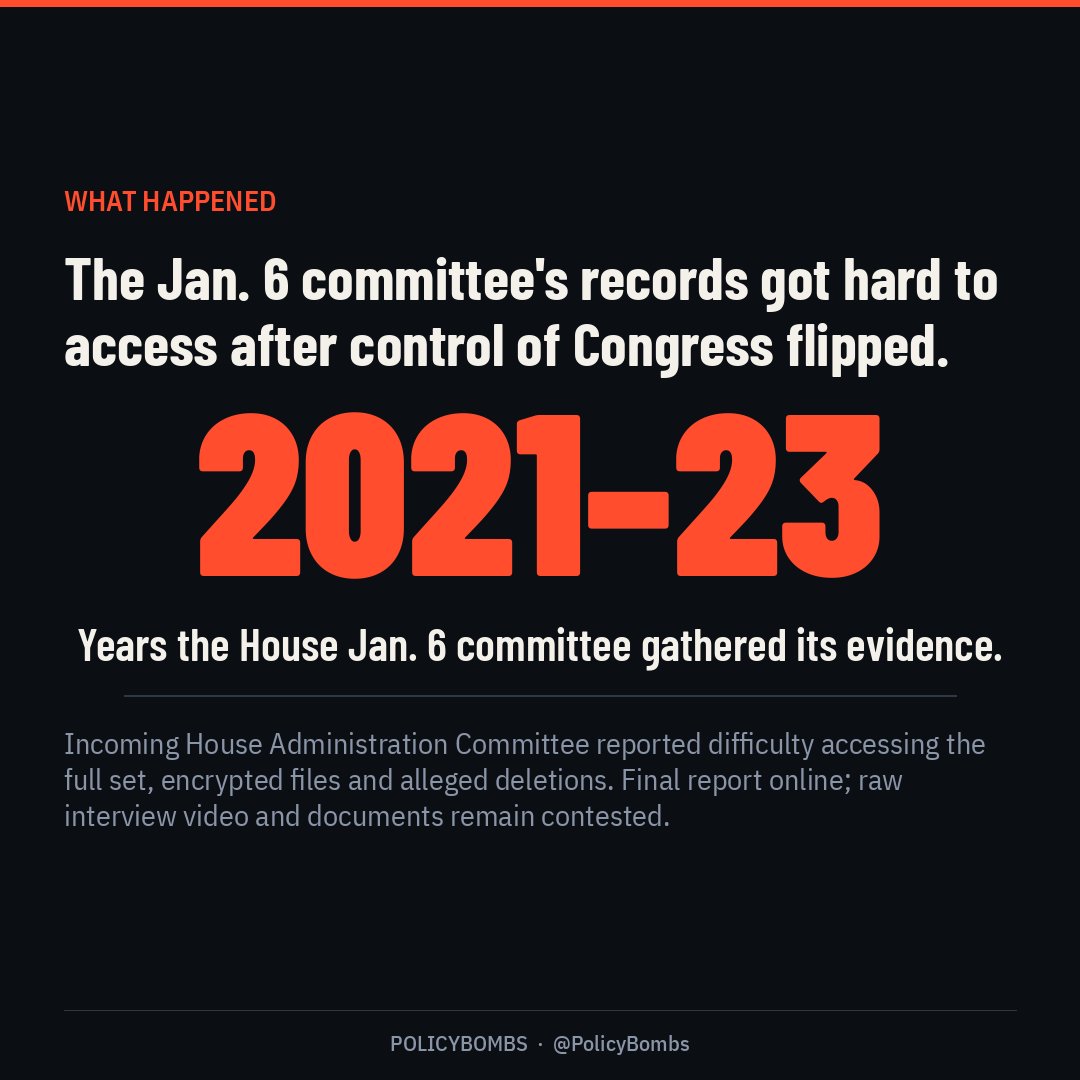
2021–2023: the House Jan 6 Select Committee collected a vast digital record. When the majority flipped, the incoming House Administration Committee reported difficulty accessing the full set, encrypted files and alleged deletions. The final report is online, but access to raw interview video and documents remains contested. History requires durable, auditable records, whoever runs the committee.

PRO: Final report and many transcripts published; witness privacy is real.

CON / COST: Encrypted or inaccessible archive; evidence shouldn't vanish when power flips.

SOCIETY: BAD


Full analysis

January 6 Committee Records: Handling, Sealing, and Claimed Losses

Handling, archiving, sealing, encryption, and claimed deletion or loss of documents and materials by the House Select Committee investigating January 6 — plus successor access fights. As of Nov 5, 2026.

Content as of Nov 5, 2026, 6:22 AM ET. Source Page: PolicyBombs canvas

Long-form deep analysis. Companion to the 10-minute quick reference (44-january-6-committee-records-summary.docx).

Contents

  • 10-Minute Lazy Voter Guide
  • 1. What happened
  • 2. Why it exists
  • 3. Realized effects
  • Archive and encryption fight
  • Who supports / who opposes
  • 4. Good or bad for society
  • References
  • Gaps / unverified

10-Minute Lazy Voter Guide

Who’s for / against: Committee Democrats / allies: argued they archived what statute required and protected witnesses. Critics (House Admin majority after 2023, some Republicans): alleged mass deletion, encrypted drives, incomplete transfer to National Archives / successor committees.

Committee defense

Critique

+ Final report and many transcripts published

+ Some materials transferred to Archives

+ Witness privacy / security concerns real

– Encrypted or inaccessible digital materials reported by successors

– Staff alleged destruction of records outside normal archiving

– Select committees should not vanish evidence when majority flips

Verdict for voters: Process failure at minimum. Historic investigation materials belong in durable public archives — not disappearing hard drives. Demand full inventory and decryption under House rules / NARA.

1. What happened

Item

Detail

Assessment

Select Committee 2021–2023

Investigated Jan 6; issued final report; held hearings; collected vast digital record.

Substantiated

End-of-Congress transfer fight

Incoming House majority (Admin Committee) reported difficulty accessing full set; encrypted files; alleged deletions.

Substantiated dispute

Public report vs raw archive

Final report online; raw interview video/docs access remains contested.

Substantiated

2. Why it exists

Stated: protect sensitive materials; comply with House archiving; prevent misuse against witnesses.

Underlying: Partisan control of narrative after majority change. Corruption hypothesis: selective preservation — keep what supports the report, obscure what complicates it. Evidence standard: House Administration findings, NARA correspondence, committee minority/majority letters — not unverified viral claims of ‘all evidence destroyed.’

3. Realized effects

Outcome

Detail

Tag

Published final report

Public PDF / site

Substantiated

Access disputes

Encrypted drives / incomplete handoff claims

Substantiated as dispute

Transcript releases

Partial transcript dumps over time

Substantiated

Public trust

Both sides accuse bad faith

Substantiated

Archive and encryption fight

After Republicans took the House in 2023, House Administration and oversight figures said large volumes of digital committee records were encrypted or not transferred in usable form. Committee alumni disputed characterizations of ‘destruction,’ pointing to Archives deposits and published work product. Voters should demand a public chain-of-custody inventory — file counts, hash lists, encryption keys under House custody — rather than dueling press releases.

Who supports / who opposes

Who

Party / level

Position

Evidence

Ref

Jan 6 Select Committee majority

Democrat-led

Defended archiving practices

Statements; final report process

[1]

House Administration (118th)

Republican

Alleged incomplete / encrypted records

Letters / hearings

[2]

NARA

Agency

Receives congressional deposits under rules

Archives practice

[3]

Transparency advocates

Civil

Want full raw archive public

FOIA / advocacy

[4]

Further reading (also listed in References):

4. Good or bad for society

Direct judgment: Opaque handoffs are bad whether your team ran the committee or inherited it. History requires durable, auditable records. Encrypting the archive against the next Congress looks like power protection, not scholarship.

  1. Mandatory public inventory of all Select Committee digital assets
  2. Keys escrowed to House Clerk / NARA
  3. Uniform archiving statute for future select committees

References

[1] [1] Jan 6 Committee final report. govinfo.gov. https://www.govinfo.gov/collection/january-6th-committee-final-report

[2] [2] House Administration Committee. cha.house.gov. https://cha.house.gov/

[3] [3] National Archives. archives.gov. https://www.archives.gov/

[4] [4] Congress.gov Jan 6 materials. congress.gov. https://www.congress.gov/

Gaps / unverified

Item

Detail

Assessment

Exact byte-level deletion proof

Allegations vs denials; need forensic inventory.

Pending

Full decrypted corpus online

Not complete as of this page.

Unverified

PolicyBombs · Day 44. Follow @PolicyBombs on X.

COVID Origins / Fauci: Lab-Leak Messaging and Public Health Authority

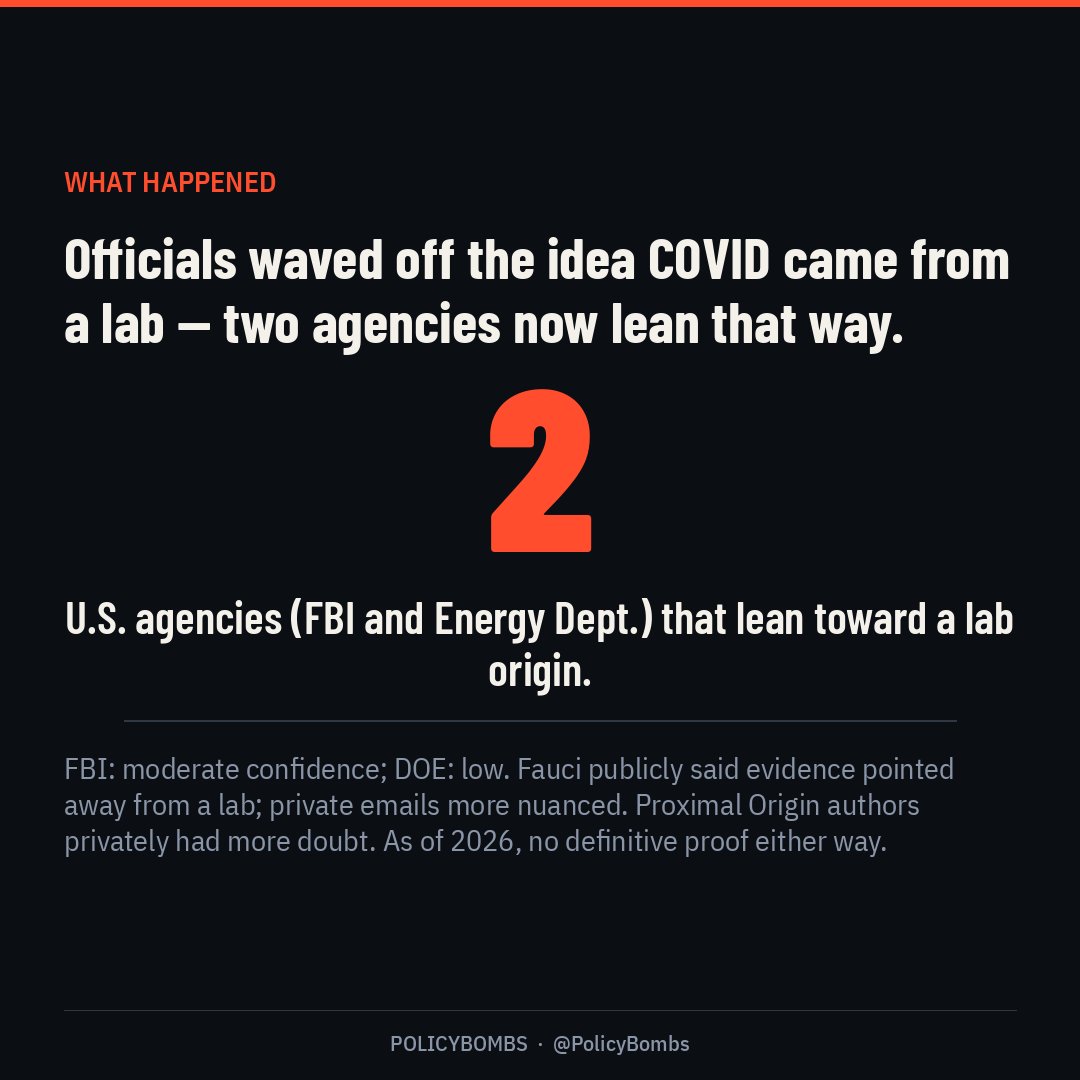
The FBI and the Energy Department both came to lean toward a lab origin for COVID, the FBI with moderate confidence and DOE with low. Early on, Fauci said publicly that the evidence pointed away from a lab, though his private emails were more nuanced. The Proximal Origin paper dismissed a lab construct while its authors privately had more doubt. As of 2026, there's no definitive proof either way.

PRO: Avoid stigma; natural spillover remains plausible; lab claim needed evidence.

CON / COST: Conflicted officials dismissing lab leak chilled inquiry for years.

SOCIETY: BAD


Full analysis

COVID Origins / Fauci: Lab-Leak Messaging and Public Health Authority

Public health messaging that downplayed or dismissed the lab-leak hypothesis; Fauci and WHO statements; later FBI/DOE assessments and congressional oversight. As of Nov 5, 2026.

Content as of Nov 5, 2026, 6:22 AM ET. Source Page: PolicyBombs canvas

Long-form deep analysis. Companion to the 10-minute quick reference (43-covid-origins-fauci-summary.docx).

Contents

  • 10-Minute Lazy Voter Guide
  • 1. What happened
  • 2. Why it exists
  • 3. Realized effects
  • Agency assessments
  • Who supports / who opposes
  • 4. Good or bad for society
  • References
  • Gaps / unverified

10-Minute Lazy Voter Guide

Who’s for / against: Early dismissal of lab leak: many public-health voices including Fauci-era NIH framing, Proximal Origin authors, WHO early messaging. Lab-leak scrutiny: FBI (moderate confidence), DOE (low confidence), Senate/House COVID origins probes, some journalists.

Official early case

Critique

+ Wanted to avoid anti-Asian stigma / geopolitics

+ Natural spillover remains plausible

+ Lab claim needed evidence

– Emails show scientists privately worried about engineered features while publicly dismissing

– Gain-of-function / EcoHealth funding conflicts

– Suppression chilled inquiry for years

Verdict for voters: Process failure. Whether lab or market, early certainty against lab leak — paired with conflicts of interest — damaged science credibility. Follow evidence; fund independent origins investigation.

1. What happened

Item

Detail

Assessment

Proximal Origin (Nature Medicine 2020)

Paper argued SARS-CoV-2 not lab construct; authors’ private Slack/emails later showed more doubt.

Substantiated

Fauci public stance

Publicly said evidence pointed away from lab; private emails more nuanced; testified before Congress repeatedly.

Substantiated

Later IC assessments

FBI favored lab origin (moderate confidence); DOE lean lab (low); others undecided or natural.

Substantiated

2. Why it exists

Stated: follow science; fight conspiracy theories; protect international collaboration.

Underlying: Career and institutional risk if US-funded research at Wuhan Institute of Virology was implicated. Corruption hypothesis: conflicted gatekeepers shaped narrative to shield funding networks (EcoHealth/NIH). Evidence: FOIA emails (e.g., Feb 2020 calls), House Select Subcommittee on the Coronavirus Pandemic reports, FOIA on grant documents — not a claim of lab certainty.

3. Realized effects

Outcome

Detail

Tag

Chilled research

Lab-leak discussion labeled misinformation on platforms

Substantiated

Trust damage

Public confidence in CDC/NIH/WHO fell

Substantiated

Congressional probes

House COVID origins reports; EcoHealth debarment steps

Substantiated

Origin still open

No definitive public smoking-gun either way as of 2026

Substantiated

Agency assessments

ODNI 2021/2023 summaries: IC divided. FBI — lab, moderate confidence. DOE — lab, low confidence. Four elements and National Intelligence Council — natural, low confidence. CIA undecided in earlier releases. Treat as intelligence judgments, not courtroom proof.

Who supports / who opposes

Who

Party / level

Position

Evidence

Ref

Anthony Fauci / NIH era

Public health

Early public skepticism of lab leak

Interviews; congressional testimony

[1]

House COVID subcommittee (majority)

Republican

Pressed lab-leak / EcoHealth failures

Reports 2023–24

[2]

FBI / DOE assessments

IC

Leaned lab origin (varying confidence)

ODNI releases

[3]

WHO

Intl

Early China-cooperative framing; later called for more data

WHO statements

[4]

Further reading (also listed in References):

4. Good or bad for society

Direct judgment: Bad process. Science requires open hypothesis testing. Conflicted officials dismissing lab leak while related grants existed was a conflict of interest problem regardless of which origin is true.

  1. Independent origins commission with subpoena power
  2. Sunshine on all US pathogen-research grants abroad
  3. Never again equate dissent with ‘misinformation’ by fiat

References

[1] [1] House COVID origins materials. coronavirus.house.gov. https://coronavirus.house.gov/

[2] [2] ODNI COVID origins assessment. dni.gov. https://www.dni.gov/index.php/newsroom/reports-publications

[3] [3] Proximal Origin paper. nature.com. https://www.nature.com/articles/s41591-020-0820-9

[4] [4] Senate HELP / oversight hearings. help.senate.gov. https://www.help.senate.gov/

[5] ODNI reports. dni.gov. https://www.dni.gov/

Gaps / unverified

Item

Detail

Assessment

WIV databases / Chinese records

Still not fully shared.

Pending

Definitive origin proof

Public record incomplete either way.

Unverified

PolicyBombs · Day 43. Follow @PolicyBombs on X.

San Francisco APEC Cleanup: Temporary Homeless Removal for Xi Visit

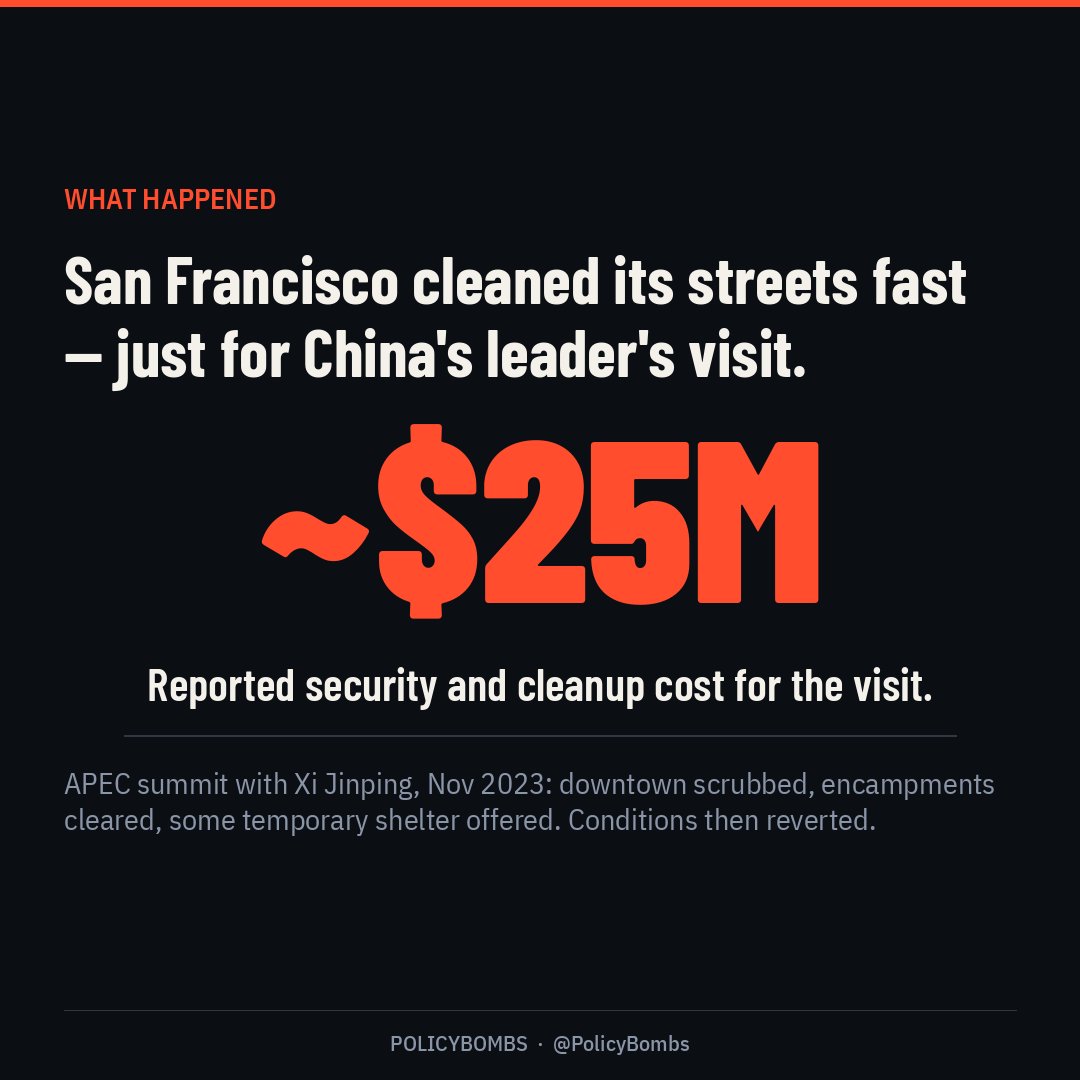
~$25 million: the reported security and cleanup spend when San Francisco hosted APEC and Xi Jinping in Nov 2023. Downtown corridors were scrubbed, encampments were cleared and some temporary shelter was offered. Then conditions reverted. If a city can clean for an authoritarian guest in days, its year-round squalor is a choice. Residents deserve that capacity too.

PRO: Diplomacy and security need clear corridors; APEC brings economic value.

CON / COST: Potemkin city for Xi; displaced without lasting housing.

SOCIETY: BAD


Full analysis

San Francisco APEC Cleanup: Temporary Homeless Removal for Xi Visit

Temporary street cleaning and homeless displacement in San Francisco ahead of the November 2023 APEC summit and Xi Jinping visit — while ordinary conditions for residents persisted before and after. As of Nov 5, 2026.

Content as of Nov 5, 2026, 6:21 AM ET. Source Page: PolicyBombs canvas

Long-form deep analysis. Companion to the 10-minute quick reference (42-sf-apec-cleanup-summary.docx).

Contents

  • 10-Minute Lazy Voter Guide
  • 1. What happened
  • 2. Why it exists
  • 3. Realized effects
  • Money and methods
  • Who supports / who opposes
  • 4. Good or bad for society
  • References
  • Gaps / unverified

10-Minute Lazy Voter Guide

Who’s for / against: City/state/federal hosts: Mayor Breed, Newsom administration, White House APEC planners. Critics: homeless advocates (displacement without lasting housing); taxpayers asking why VIP streets get cleaned when locals cannot.

Host case

Critique

+ Diplomacy and security require clear corridors

+ Temporary shelter offers and outreach occurred

+ APEC brings economic/diplomatic value

– Admits capacity existed to clear streets — reserved for Xi, not residents

– Optics of Potemkin city for authoritarian guest

– Conditions reverted after summit

Verdict for voters: Bad governance signal. If SF can clean for Xi in days, the year-round squalor was a choice. Prioritize residents over summit optics.

1. What happened

Item

Detail

Assessment

APEC Nov 2023

San Francisco hosted APEC; Xi Jinping visited; downtown corridors heavily cleaned and secured.

Substantiated

Homeless displacement

Encampments cleared from summit zones; some offers of temporary shelter; critics called it sweeps.

Substantiated

Cost

City/state security and cleanup spending reported in tens of millions range (~$25M+ cited in contemporaneous reporting for SF security/cleanup related).

Substantiated (order of magnitude)

2. Why it exists

Stated: security for world leaders; showcase US city; diplomatic hospitality.

Underlying: Avoid international embarrassment; manage China summit optics. Corruption hypothesis: selective enforcement — same tools denied to neighborhoods year-round suddenly available for VIPs. Evidence is capability asymmetry, not a secret bribe.

3. Realized effects

Outcome

Detail

Tag

Temporary clear corridors

Tenderloin/downtown zones cleaned for cameras

Substantiated

Post-summit reversion

Encampments and open-air drug markets returned in many areas

Substantiated pattern

Political backlash

National commentary on hypocrisy

Substantiated

Xi meeting

Biden-Xi bilateral proceeded amid cleaned streets

Substantiated

Money and methods

Contemporaneous reporting (SF Chronicle, AP, CBS) described multi-million-dollar security and cleanup operations, National Guard/police surge, and hotel/shelter placements for some unhoused people near venues. Exact line-item totals vary by source; treat ~$25M figures as journalism pending city audit confirmation.

Who supports / who opposes

Who

Party / level

Position

Evidence

Ref

Mayor London Breed

Democrat / SF

Defended cleanup for APEC

Public statements Nov 2023

[1]

Gov. Gavin Newsom

Democrat / CA

State role in security/hospitality

APEC hosting role

[2]

Homeless advocates

Civil

Opposed sweeps without permanent housing

Protests / statements

[3]

Taxpayers / national critics

Cross-party

Asked why Xi gets streets locals do not

Op-eds / hearings commentary

[4]

Further reading (also listed in References):

4. Good or bad for society

Direct judgment: Reveals priorities. Cleaning for an authoritarian guest while residents live with open drug markets is a civic failure. Keep the APEC capacity — apply it year-round.

  1. Publish full APEC cleanup spend vs annual street-outreach budgets
  2. Same clearance standards for residential blocks as for summit corridors
  3. Shelter + treatment with enforcement, not optics-only sweeps

References

[1] [1] SF Chronicle APEC prep. sfchronicle.com. https://www.sfchronicle.com/

[2] [2] AP: SF cleanup for APEC. apnews.com. https://apnews.com/article/apec-san-francisco-homeless-xi-jinping-biden-2023

[3] [3] CBS: clearing homeless for Xi. cbsnews.com. https://www.cbsnews.com/news/san-francisco-homeless-apec-summit-xi-jinping/

[4] [4] City of SF APEC materials. sf.gov. https://sf.gov/

[5] AP APEC SF coverage. apnews.com. https://apnews.com/

Gaps / unverified

Item

Detail

Assessment

Exact audited dollar total

Media ~$25M; confirm via SF Controller / state audit.

Pending

Permanent housing outcomes for displaced

Follow-up data incomplete.

Unverified

PolicyBombs · Day 42. Follow @PolicyBombs on X.

Facebook Censorship: Meta and Biden Admin COVID Coordination

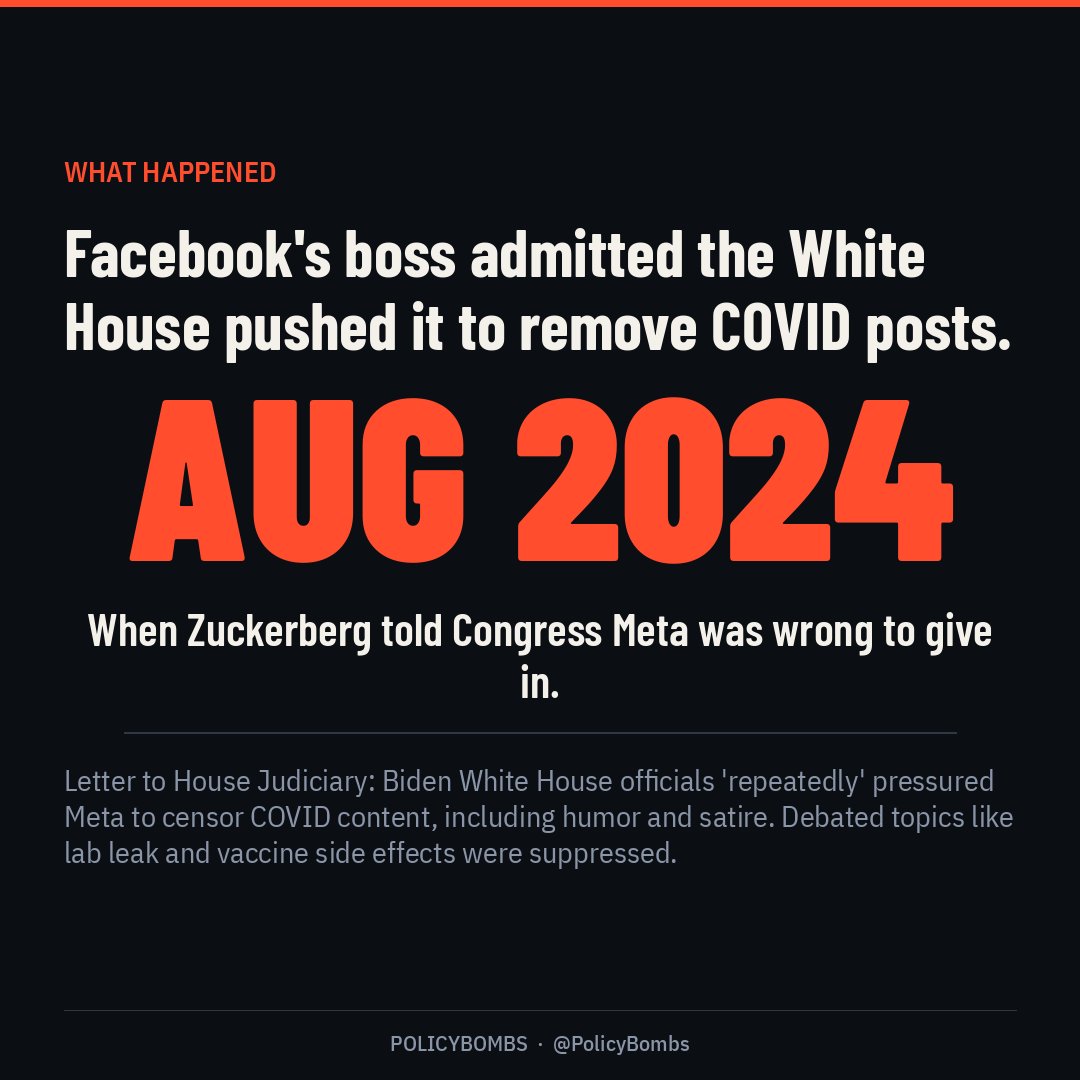
August 2024: Mark Zuckerberg told House Judiciary that Biden White House officials "repeatedly" pressured Meta to censor COVID content, including humor and satire, and said Meta was wrong to give in. Debated topics like the lab leak and vaccine side effects were often suppressed. Emergencies don't repeal the First Amendment by email. Platforms should publish government takedown requests.

PRO: Fighting harmful false cures during an emergency; platforms moderate under TOS anyway.

CON / COST: Jawboning raises First Amendment concerns; vindicated topics throttled.

SOCIETY: BAD


Full analysis

Facebook Censorship: Meta and Biden Admin COVID Coordination

Meta/Zuckerberg admissions that Biden administration officials pressured Facebook to suppress COVID content, plus broader content-moderation controversies. As of Nov 5, 2026.

Content as of Nov 5, 2026, 6:21 AM ET. Source Page: PolicyBombs canvas

Long-form deep analysis. Companion to the 10-minute quick reference (41-facebook-censorship-summary.docx).

Contents

  • 10-Minute Lazy Voter Guide
  • 1. What happened
  • 2. Why it exists
  • 3. Realized effects
  • Zuckerberg record
  • Who supports / who opposes
  • 4. Good or bad for society
  • References
  • Gaps / unverified

10-Minute Lazy Voter Guide

Who’s for / against: Pressure for suppression: Biden WH COVID team / Surgeon General messaging. Critics: House Judiciary weaponization/censorship inquiries; free-speech advocates; Zuckerberg later expressed regret on COVID pressure.

Admin / platform case at the time

Critique

+ Claimed fighting deadly misinformation during emergency

+ Platforms already moderated under TOS

+ Some false cures/treatments were harmful

– Zuckerberg letter: White House repeatedly pressured Meta

– True or debated content (lab leak, vaccine side effects) often suppressed

– Jawboning raises First Amendment concerns

Verdict for voters: Bad. Government pressure on private platforms to throttle speech — especially later-vindicated topics — is corruption of the information commons. Platforms should resist; Congress should police jawboning.

1. What happened

Item

Detail

Assessment

Zuckerberg Aug 2024 letter

Told House Judiciary WH officials ‘repeatedly’ pressured Meta to censor COVID content including humor/satire; Meta was wrong to give in.

Substantiated

Murthy v. Missouri / related

Supreme Court and lower courts addressed government-platform contacts; standing limited some remedies.

Substantiated

Twitter Files / Meta parallels

Document dumps showed government and NGO flagging pipelines.

Substantiated

2. Why it exists

Stated: reduce deaths from false COVID info; protect public health.

Underlying: Political risk management — dissent threatened official narrative and midterm optics. Corruption hypothesis: using informal pressure to achieve speech outcomes that would fail a statute or court order. Evidence: Zuckerberg’s own letter to Judiciary; contemporaneous WH tweets/statements calling for platforms to ‘do more.’

3. Realized effects

Outcome

Detail

Tag

Suppressed topics

Lab-leak discussion, vaccine injury anecdotes, school-closure dissent often demoted

Substantiated pattern

Zuckerberg regret

Public letter: WH pressure, Meta erred

Substantiated

Court docket

Murthy; discovery of emails

Substantiated

Trust collapse

Polling showed sharp drop in trust of institutions/tech

Substantiated

Zuckerberg record

"White House officials repeatedly pressured our teams for months to censor certain COVID-19 content, including humor and satire. I believe the government pressure was wrong, and I regret that we were not more outspoken about it."

— Mark Zuckerberg, letter to House Judiciary (Aug 2024)

Primary source for voters: the company’s CEO, not a partisan media paraphrase.

Who supports / who opposes

Who

Party / level

Position

Evidence

Ref

Biden WH COVID team

Democrat admin

Pressed platforms hard

Zuckerberg letter; contemporaneous statements

[1]

Mark Zuckerberg / Meta

Platform

Later admitted error under pressure

Aug 2024 Judiciary letter

[1]

House Judiciary majority

Republican

Investigated as censorship

Weaponization / censorship reports

[2]

Free-speech NGOs

Civil

Against jawboning

Amicus / commentary

[3]

Further reading (also listed in References):

4. Good or bad for society

Direct judgment: Bad for free speech and epistemic integrity. Emergencies do not repeal the First Amendment by email. Platforms should publish government takedown requests in real time.

  1. Sunshine: log every government content demand
  2. End informal ‘do more’ campaigns without statute
  3. Restore lab-leak / dissent archives for research

References

[1] [1] Zuckerberg letter coverage / text. judiciary.house.gov. https://judiciary.house.gov/media/press-releases/chairman-jordan-releases-letter-mark-zuckerberg-admitting-white-house-pressure

[2] [2] House Judiciary censorship work. judiciary.house.gov. https://judiciary.house.gov/

[3] [3] Murthy v. Missouri (SCOTUS). supremecourt.gov. https://www.supremecourt.gov/opinions/23pdf/23-411_3dq3.pdf

[4] Meta transparency / COVID policies (archival). about.fb.com. https://about.fb.com/news/

Gaps / unverified

Item

Detail

Assessment

Full WH-Meta email dump

Partial discovery; more may exist under FOIA.

Pending

Exact post counts removed solely due to WH

Meta has not published a complete tally.

Unverified

PolicyBombs · Day 41. Follow @PolicyBombs on X.

Gaza Hostages: US Policy After October 7

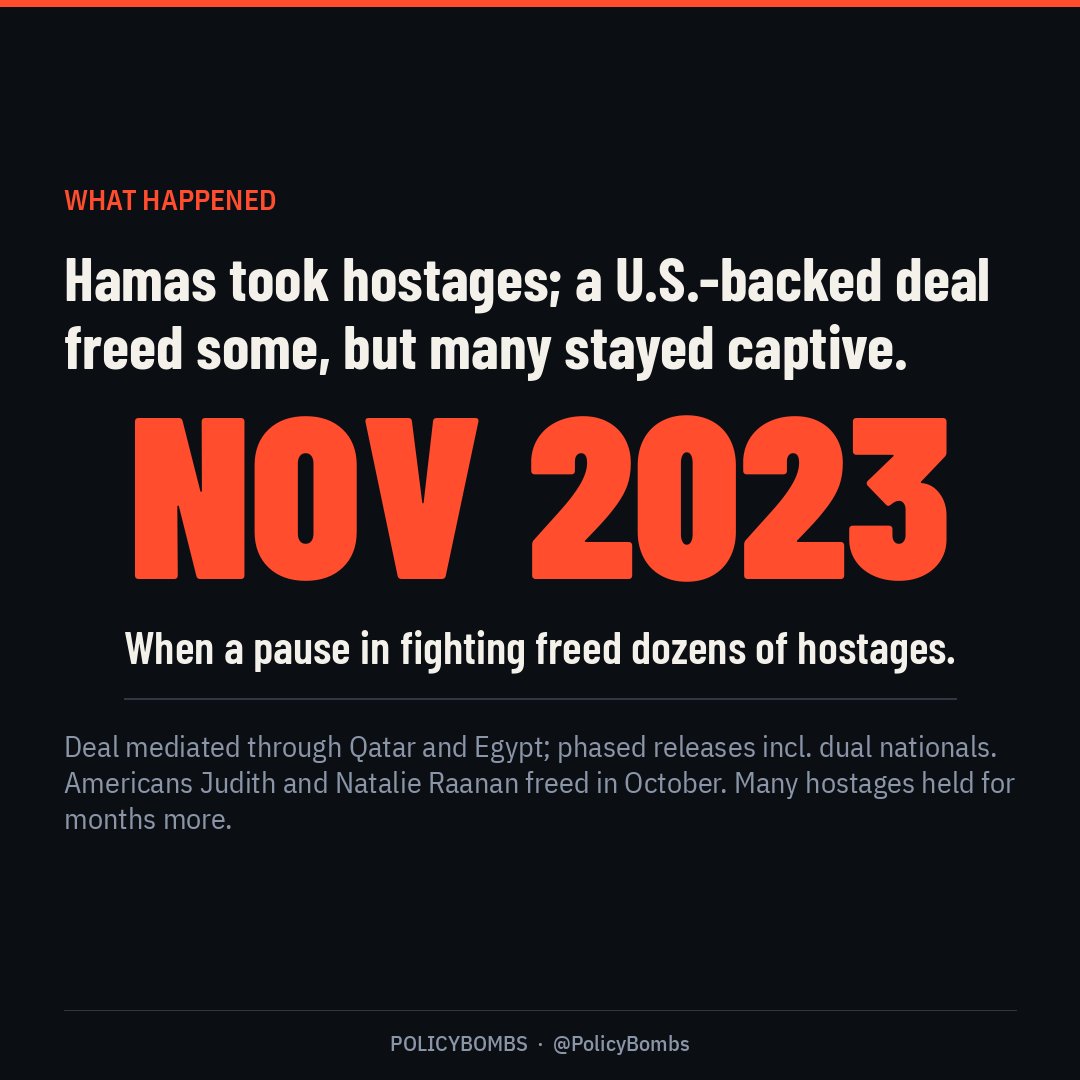
November 2023: a U.S.-backed deal mediated through Qatar and Egypt paused fighting and freed dozens of hostages, including dual nationals, in phased releases. In October, Americans Judith and Natalie Raanan had come home. But many hostages stayed in captivity for months, and families demanded more urgency. A superpower that can't make hostage-taking unprofitable invites more of it.

PRO: Real statecraft through Qatar/Egypt channels; early U.S. releases.

CON / COST: Many left for extended periods; Iran/proxy leverage questions.

SOCIETY: MIXED


Full analysis

Gaza Hostages: US Policy After October 7

US diplomatic posture on American and Israeli hostages held by Hamas — Qatar/Egypt mediation, Nov 2023 pause deal, ongoing cases, and critiques of priority/urgency. As of Nov 5, 2026.

Content as of Nov 5, 2026, 6:21 AM ET. Source Page: PolicyBombs canvas

Long-form deep analysis. Companion to the 10-minute quick reference (40-gaza-hostages-summary.docx).

Contents

  • 10-Minute Lazy Voter Guide
  • 1. What is the policy
  • 2. Why it exists
  • 3. Realized effects
  • Negotiation record
  • Who supports / who opposes
  • 4. Good or bad for society
  • References
  • Gaps / unverified

10-Minute Lazy Voter Guide

Who’s for / against: Supported active mediation: Biden WH, many Democrats and Republicans wanting hostages home. Critics (esp. after delays): some Republicans arguing insufficient pressure on Qatar/Iran/Hamas; hostage families demanding more urgency.

Administration case

Critique

+ Helped secure early US releases (e.g., Raanans) and Nov 2023 multi-hostage deal

+ Used Qatar/Egypt channels when direct talks impossible

+ Public presidential engagement raised profile

– Many hostages remained for extended periods

– Perception that campus/domestic politics competed with hostage priority

– Iran/proxy leverage questions (see Iran funding page)

Verdict for voters: Mixed. Getting some Americans out was real statecraft; leaving families in limbo for months/years is a failure metric. Hostage recovery should outrank almost every other Gaza talking point.

1. What is the policy

Item

Detail

Assessment

Mediation architecture

US worked through Qatar and Egypt with Israel; Blinken/Sullivan/Burns/McGurk roles reported.

Substantiated

Nov 2023 deal

Temporary fighting pause; hostages for Palestinian prisoners; Biden hailed release.

Substantiated

Ongoing pressure

Continued diplomacy for remaining hostages across 2024–26 phases

Substantiated

2. Why it exists

Stated: bring Americans/Israelis home; support ally; humanitarian law.

Underlying: Domestic politics of US citizens held; alliance management with Israel; Qatar’s Hamas ties as distasteful but useful channel. Corruption: Hamas monetizes hostages — the crime is theirs. US failure modes are urgency and leverage, not paying Hamas a US Treasury check for Oct 7.

3. Realized effects

Outcome

Detail

Tag

Early US releases

Judith & Natalie Raanan freed late Oct 2023 via mediation

Substantiated

Nov 2023 package

Dozens of hostages incl. dual nationals in phased releases

Substantiated

Remaining captivity

Others held far longer; deaths reported among hostages

Substantiated grim fact

Domestic politics

Hostage families lobbied WH continuously

Substantiated

Negotiation record

Reuters/Axios reporting describes intensive US shaping of the November pause deal. Biden statements framed releases as proof of diplomacy. Critics note Hamas still held leverage afterward — temporary pauses can incentivize more kidnapping if not paired with lasting cost imposition.

Who supports / who opposes

Who

Party / level

Position

Evidence

Ref

Pres. Biden

Democrat

For mediated deals

Nov 21, 2023 hostage release statement

[1]

Hostage families

Civil

For maximum urgency

Public campaigns

[2]

Israeli governments

Ally

Negotiated via US/Qatar with own red lines

Deal terms

[3]

Congressional hawks

Often Republican

More pressure on Qatar/Iran

Hearings/letters

[4]

Further reading (also listed in References):

4. Good or bad for society

Direct judgment: Necessary work, incomplete success. A superpower that cannot make hostage-taking unprofitable invites repetition. Celebrate releases; audit delays; keep Iran/proxy sanctions tight.

  1. Dedicated hostage envoy with daily public metrics
  2. Cost-impose on facilitators (finance/travel)
  3. No campus apologetics while Americans are caged

References

[1] [1] Biden hostage release statement. archives.gov. https://bidenwhitehouse.archives.gov/briefing-room/statements-releases/2023/11/21/statement-from-president-joe-biden-on-the-hostage-release-in-gaza/

[2] [2] Reuters secret negotiations. reuters.com. https://www.reuters.com/world/middle-east/secret-negotiations-that-led-gaza-hostages-deal-2023-11-22/

[3] [3] Axios: Biden shaped talks. axios.com. https://www.axios.com/2023/11/23/biden-israel-hamas-hostage-deal

[4] [4] NYT: US hostages freed. nytimes.com. https://www.nytimes.com/2023/10/21/world/middleeast/us-hostages-release-israel-hamas-qatar-raanan.html

Gaps / unverified

Item

Detail

Assessment

Classified negotiating transcripts

Not public.

Pending

Claim US blocked deals to help Netanyahu/Hamas variously

Partisan narratives; verify against timelines.

Contested

PolicyBombs · Day 40. Follow @PolicyBombs on X.

51 Intelligence Officials Letter: Laptop as Russian Disinformation

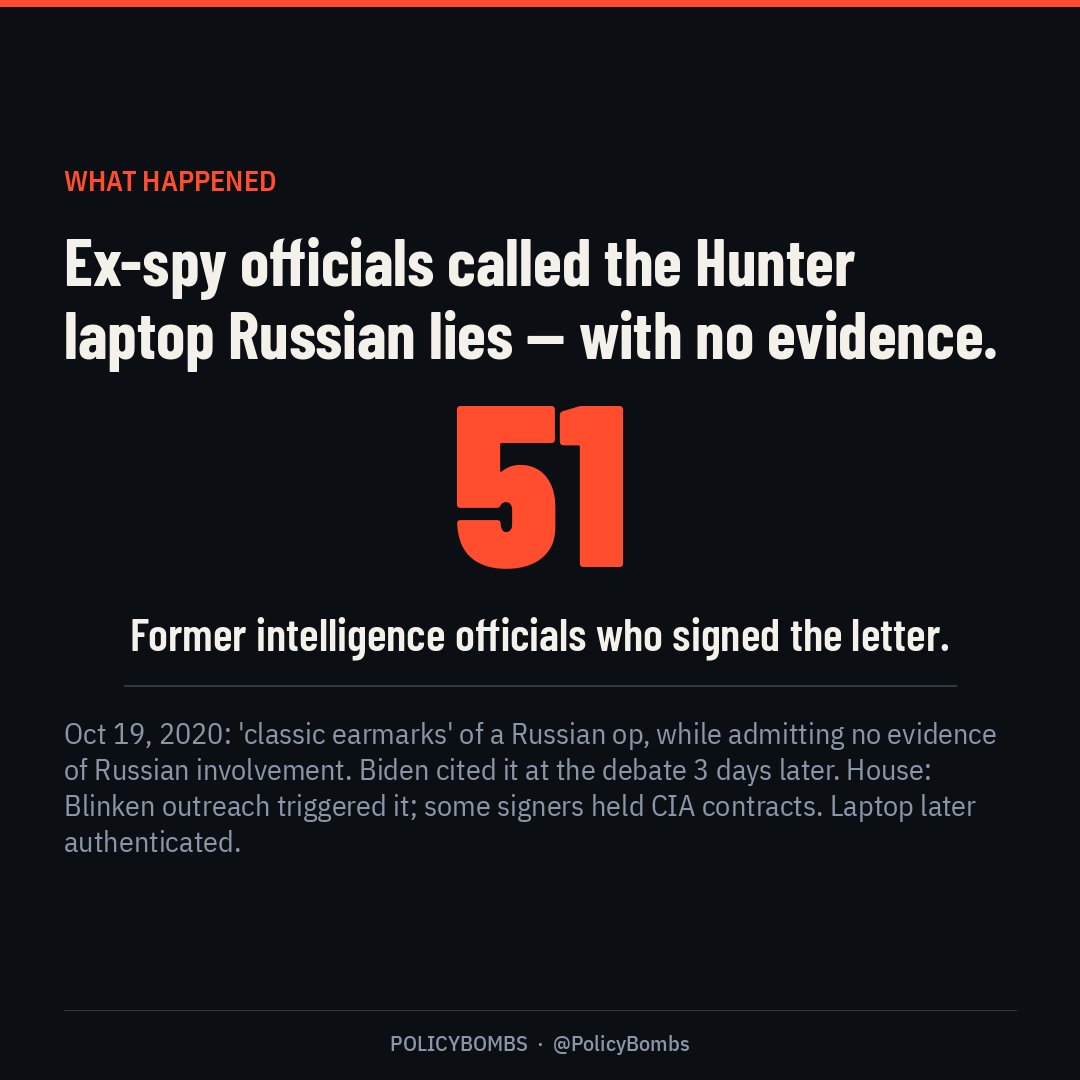
51 former intelligence officials signed an Oct 19, 2020 letter saying Hunter Biden's emails had the "classic earmarks" of a Russian info op. The same letter admitted there was no evidence of Russian involvement. Three days later Biden cited it at the debate. House reports found Blinken's outreach triggered the effort, and some signers held CIA contracts. The laptop was later authenticated.

PRO: Russia had run hack-and-leak before; former officials may speak as citizens.

CON / COST: Caveats died, headline stuck; IC's nonpartisan brand damaged.

SOCIETY: BAD


Full analysis

51 Intelligence Officials Letter: Laptop as Russian Disinformation

Oct 19, 2020 statement by 51 former intel officials; House findings that Blinken outreach triggered Morell; debate talking point; CIA contractor status; laptop later authenticated. Focused letter page (overlaps laptop/intel pages). As of Nov 5, 2026.

Content as of Nov 5, 2026, 6:20 AM ET. Source Page: PolicyBombs canvas

Long-form deep analysis. Companion to the 10-minute quick reference (39-51-intel-officials-letter-summary.docx).

Contents

  • 10-Minute Lazy Voter Guide
  • 1. What is the policy
  • 2. Why it exists
  • 3. Realized effects
  • House investigation findings
  • Who supports / who opposes
  • 4. Good or bad for society
  • References
  • Gaps / unverified

10-Minute Lazy Voter Guide

Who’s for / against: Organizers/signatories framed caution on Russian ops. House Intel/Judiciary: political operation to help Biden. Reality check: letter admitted no evidence of Russian involvement; laptop authenticated.

Signatory defenses

Critique

+ Russia had run hack-and-leak before

+ Letter said they did not know if emails were genuine

+ Former officials may speak as citizens

– Headline laundering: ‘Russian disinfo’ stuck; caveats died

– House: Blinken call triggered Morell; goal was debate talking point

– Some signatories were active CIA contractors (committee finding)

Verdict for voters: Bad. National-security credentials were weaponized for a campaign. The letter’s careful caveats were politically useless by design once Politico headlined "Russian disinfo."

1. What is the policy

Not a government policy — a coordinated public statement:

Item

Detail

Assessment

Oct 19, 2020 letter

51 former officials: Hunter Biden emails had ‘classic earmarks’ of Russian info op; no evidence of Russian involvement stated.

Substantiated

Debate use

Biden cited ~50 intel folks at Oct 22 debate.

Substantiated

Later authentication

Laptop used as evidence; media forensic work

Substantiated

2. Why it exists

Stated: warn about possible Russian operation.

Underlying (House record): help Biden rebut Trump at debate; campaign outreach initiated process. Manipulation of intel prestige — soft election interference by domestic elites.

3. Realized effects

"We do not know if the emails are genuine… and we do not have evidence of Russian involvement."

— 51 officials letter caveat

Effect

Detail

Tag

Media frame

Politico: ‘Hunter Biden story is Russian disinfo…’

Substantiated

Voter information

Suppressed seriousness of laptop reporting pre-election

Substantiated impact theme

Credibility collapse

After authentication, trust in ex-intel statements fell

Substantiated

House investigation findings

Finding

Source

Tag

Blinken outreach triggered Morell’s effort

House interim report May 2023; Morell testimony

Substantiated (committee)

Emails: want talking point for VP

Same

Substantiated

Ricchetti thank-you after debate

Same

Substantiated

Morell/Buckley on CIA contracts when signing

2024 joint interim report

Substantiated (committee)

Haspel awareness alleged pre-publication

2024 report

Committee claim

Who supports / who opposes

Who

Party / level

Position

Evidence

Ref

Michael Morell et al. (51)

Ex-intel

Signed letter

Oct 19, 2020 statement

[1]

Antony Blinken (then campaign)

Democrat

Outreach that triggered drafting

House report / testimony

[2]

House Intel/Judiciary GOP

Republican

Against as political op

Interim reports 2023–24

[3]

Joe Biden (debate)

Democrat

Cited letter

Oct 22, 2020 debate

[4]

Further reading (also listed in References):

4. Good or bad for society

Direct judgment: Bad. Free speech protects the letter; honor does not. Using "intel official" as a campaign costume damaged both elections and the IC’s residual nonpartisan brand.

  1. Cooling-off: no political letters while on IC contract
  2. Media: print caveats in headlines
  3. Voters: discount anonymous/ex-official pile-ons

References

[1] [1] House IC 51 interim report. intelligence.house.gov. https://intelligence.house.gov/UploadedFiles/IC_51_Interim_Report.pdf

[2] [2] CIA contractors report PDF. intelligence.house.gov. https://intelligence.house.gov/uploadedfiles/the_intelligence_community_51-_how_cia_contractors_colluded_with_the_biden_campaign_to_mislead_american_voters.pdf

[3] [3] House Intel release Jun 2024. intelligence.house.gov. https://intelligence.house.gov/2024/06/25/new-information-shows-cia-contractors-colluded-with-the-biden-campaign-to-discredit-hunter-biden-laptop-story/

[4] [4] CBS on House findings. cbsnews.com. https://www.cbsnews.com/news/republicans-hunter-biden-laptop-former-intelligence-officials/

[5] Judiciary press release. judiciary.house.gov. https://judiciary.house.gov/media/press-releases/new-information-shows-cia-contractors-colluded-biden-campaign-discredit-hunter

Gaps / unverified

Item

Detail

Assessment

Criminal conspiracy conviction of signatories

None; speech.

Cleared as crime

Exact vote swing from letter

Unmeasured precisely.

Unverified magnitude

PolicyBombs · Day 39. Follow @PolicyBombs on X.

Chinese Spy Balloon: Transit Before Shootdown

8 days: a Chinese surveillance balloon entered U.S. airspace near the Aleutians on Jan 28, 2023, crossed into Canada, re-entered over Idaho, and drifted across Montana near Malmstrom's nuclear missile fields. An F-22 shot it down off South Carolina on Feb 4. Commanders waited for water to avoid debris risk, and no Americans were hurt. But a rival spent a week over the homeland.

PRO: Debris risk over land was real; intel collected while tracking; recovery succeeded.

CON / COST: Multi-day sovereignty violation; deterrence signal of tolerance.

SOCIETY: MIXED


Full analysis

Chinese Spy Balloon: Transit Before Shootdown

Jan 28–Feb 4, 2023 PRC high-altitude surveillance balloon crossed US/Canadian airspace; Biden authorized takedown when debris risk allowed; F-22 shot it down off South Carolina. Deterrence judgment. As of Nov 5, 2026.

Content as of Nov 5, 2026, 6:20 AM ET. Source Page: PolicyBombs canvas

Long-form deep analysis. Companion to the 10-minute quick reference (38-chinese-spy-balloon-summary.docx).

Contents

  • 10-Minute Lazy Voter Guide
  • 1. What is the policy
  • 2. Why it exists
  • 3. Realized effects
  • Timeline
  • Who supports / who opposes
  • 4. Good or bad for society
  • References
  • Gaps / unverified

10-Minute Lazy Voter Guide

Who’s for / against: Defended wait-for-water shootdown: Biden, Pentagon (civilian debris risk). Criticized delay: Republicans arguing earlier shootdown over sparsely populated areas; China called it a weather balloon.

Wait arguments

Shoot sooner arguments

+ Military assessed undue debris risk over land

+ Intelligence collection on the balloon while tracking

+ Successful recovery in shallow water (~47 ft)

– Multi-day sovereignty violation including near nuclear missile fields (Montana)

– Public discovery forced crisis after days of tracking

– Deterrence signal of tolerance for PRC ISR

Verdict for voters: Operational caution on debris was real; strategic optics were weak. Letting a known surveillance balloon leisurely cross the continent looked like hesitation. Shoot sooner over empty land next time if debris models allow — sovereignty first.

1. What is the policy

Item

Detail

Assessment

Detection & track

Entered US ADIZ near Aleutians Jan 28, 2023; tracked across Alaska, Canada, CONUS.

Substantiated

Presidential authorization

Biden authorized takedown when mission could avoid undue civilian risk; commanders waited for water.

Substantiated

Shootdown

Feb 4, 2:39 p.m. ET — F-22 AIM-9X; ~6 nm off SC coast.

Substantiated

2. Why it exists

Stated reasons (US): protect civilians from debris; gather intel; avoid escalation over land.

Stated reasons (China): claimed civilian weather balloon off course — US rejected as lacking credibility.

Underlying: PRC strategic ISR probing; US risk-averse ROE culture; political fear of domestic casualties. Corruption: none required — great-power probing + bureaucratic caution.

3. Realized effects

Item

Fact

Tag

Sovereignty breach duration

Days over US/Canada

Substantiated

Prior brief transits

Pentagon: ≥3 under prior admin; shorter

Substantiated (DoD claim)

Recovery

Navy/USCG; intel value sought

Substantiated

Diplomacy

Blinken China trip delayed; relations worsened

Substantiated

Timeline

Date

Event

Jan 28

Enters US airspace near Aleutians

Jan 30

Enters Canada

Jan 31

Re-enters US over northern Idaho

Feb 1–3

Crosses Montana (near Malmstrom), Plains states; Biden authorizes when safe

Feb 4

Shot down off South Carolina

Who supports / who opposes

Who

Party / level

Position

Evidence

Ref

Pres. Biden / SecDef Austin

Democrat

For water shootdown plan

DoD statements Feb 4

[1]

House/Senate Republicans

Republican

Criticized delay

Oversight comments

[2]

PRC Foreign Ministry

China

Weather balloon claim

Public statements

[3]

NORTHCOM / USAF

Military

Executed mission

F-22 engagement

[4]

Further reading (also listed in References):

4. Good or bad for society

Direct judgment: Mixed tactically, weak strategically. No Americans died — good. A peer rival mapping the homeland for a week — bad. Update ROE playbooks for high-altitude ISR now.

  1. Pre-planned sparse-land engagement zones
  2. Faster public acknowledgment
  3. Cost-impose on PRC balloon fleet

References

[1] [1] DoD shootdown news. war.gov. https://www.war.gov/News/News-Stories/Article/article/3288543/f-22-safely-shoots-down-chinese-spy-balloon-off-south-carolina-coast/

[2] [2] Politico timeline. politico.com. https://www.politico.com/news/2023/02/05/timeline-a-chinese-spy-balloons-7-day-trip-across-the-united-states-00081222

[3] [3] Reuters shootdown. reuters.com. https://www.reuters.com/world/us/biden-says-us-is-going-take-care-of-chinese-balloon-2023-02-04/

[4] [4] DoD background briefing transcript. defense.gov. https://www.defense.gov/News/Transcripts/Transcript/Article/3288618/senior-defense-official-and-senior-military-official-hold-an-off-camera-on-back/

[5] WaPo timeline. washingtonpost.com. https://www.washingtonpost.com/national-security/2023/02/05/chinese-surveillance-balloon-timeline/

Gaps / unverified

Item

Detail

Assessment

Full intel haul from debris

Classified details incomplete publicly.

Pending

Intentional nuclear-silo targeting proof

Path near Malmstrom noted; intent assessment IC-side.

Assessed not proven in open source

PolicyBombs · Day 38. Follow @PolicyBombs on X.

Gender Affirmation Culture: Self-ID Over Biological Sex

2024: the UK's Cass Review final report found youth gender medicine had outrun its evidence, and European health systems began restricting it. In the U.S., the affirmative-care model (social transition to blockers, hormones and surgery) stayed favored by WPATH-influenced clinics. Self-ID norms spread into pronoun mandates and single-sex spaces, and Biden's 2024 Title IX expansion was vacated.

PRO: Reduce distress for dysphoric people; anti-bullying; adult autonomy.

CON / COST: Self-ID erases sex-based rights; compelled speech; weak evidence for minors.

SOCIETY: BAD


Full analysis

Gender Affirmation Culture: Self-ID Over Biological Sex

Institutional celebration of self-identified gender over sex in medicine, schools, corporations, and law — Cass Review evidence caution, Title IX fights, and social judgment. Complements school/sports/inmate pages. As of Nov 5, 2026.

Content as of Nov 5, 2026, 6:20 AM ET. Source Page: PolicyBombs canvas

Long-form deep analysis. Companion to the 10-minute quick reference (37-gender-affirmation-summary.docx).

Contents

  • 10-Minute Lazy Voter Guide
  • 1. What is the policy
  • 2. Why it exists
  • 3. Realized effects
  • Evidence and pushback
  • Who supports / who opposes
  • 4. Good or bad for society
  • References
  • Gaps / unverified

10-Minute Lazy Voter Guide

Who’s for / against: For affirmation/self-ID: LGBTQ medical associations (US), progressive Democrats, corporate DEI. Against/cautious: Cass Review (UK), European health systems restricting youth medicalization, women’s-rights feminists, many Republicans.

Affirmation arguments

Sex-realist arguments

+ Reduce distress for gender-dysphoric people

+ Social inclusion and anti-bullying

+ Adult bodily autonomy for consenting adults

– Self-ID erases sex-based rights in sports, prisons, shelters

– Youth medical pathways outran evidence (Cass)

– Institutional compulsion of speech/belief

Verdict for voters: Bad as a totalizing ideology. Compassion for dysphoria ≠ rewriting biology in law. Celebrate adults’ peaceful lives; stop compelling society to deny sex or medicalize minors on weak evidence.

1. What is the policy

Item

Detail

Assessment

Self-ID norms

Pronoun mandates, sex-marker changes, identity-based access to single-sex spaces.

Substantiated pattern

Affirmative care model (US)

Social transition → blockers/hormones/surgery pathway favored by WPATH-influenced clinics.

Substantiated

Corporate/government celebration

Pride campaigns, DEI trainings treating dissent as harm.

Substantiated pattern

2. Why it exists

Stated reasons: civil rights expansion; suicide prevention; authenticity.

Underlying drivers: Activist capture of medical guilds and HR; social-media contagion hypotheses; political branding. Corruption: clinic/pharma revenue in transition medicine is a real incentive — still need patient-level proof of abuse case-by-case. Cass shows evidence standards failed.

3. Realized effects

Domain

Effect

Tag

Youth medicine (UK)

Cass: weak evidence for puberty blockers’ benefits; NHS pathway overhaul

Substantiated

US culture war

Rapid institutional adoption then partial legal rollback (Title IX, sports)

Substantiated

Women’s categories

Displacement/privacy conflicts in sports and prisons

Substantiated cases

Speech

Compelled pronouns; professional discipline threats

Substantiated pattern

Evidence and pushback

The Cass Review found the evidence base for youth gender medicalization remarkably weak and recommended holistic care over routine medicalization. Several European systems restricted blockers. US institutions were slower to course-correct — a capture lag.

Who supports / who opposes

Who

Party / level

Position

Evidence

Ref

Biden admin (Title IX 2024)

Democrat

For gender-identity expansions

2024 rule (vacated)

[1]

Cass Review / NHS England

UK clinical

Against weak-evidence youth medicalization

Final report 2024

[2]

Women’s sports advocates

Cross-partisan

Against self-ID in female categories

Litigation/state laws

[3]

LGBTQ advocacy orgs

Advocacy

For affirmation model

Policy platforms

[4]

Further reading (also listed in References):

4. Good or bad for society

Direct judgment: Bad when it overrides sex-based rights and evidence-based medicine. Good when it reduces bullying without erasing reality. Society needs truth about sex plus tolerance for nonconforming adults — not compelled belief.

  1. Sex-based rules for sports, prisons, shelters
  2. Cass-aligned caution for minors
  3. No compelled speech

References

[1] [1] ED Title IX regulations status. ed.gov. https://www.ed.gov/about/ed-offices/ocr/regulations-enforced-by-the-office-for-civil-rights

[2] [2] BMJ on Cass and US. bmj.com. https://www.bmj.com/content/385/bmj.q1141.full

[3] [3] Title IX sports legal update. huschblackwell.com. https://www.huschblackwell.com/newsandinsights/supreme-court-holds-that-title-ix-and-the-equal-protection-clause-permit-biological-sex-based-restrictions-on-womens-sports-participation

[4] [4] Cass final review PDF host. cass.independent-review.uk. https://cass.independent-review.uk/

Gaps / unverified

Item

Detail

Assessment

US national youth transition regret rate

Data incomplete; clinics under-follow.

Pending

Social contagion magnitude

Hypotheses debated.

Contested

PolicyBombs · Day 37. Follow @PolicyBombs on X.