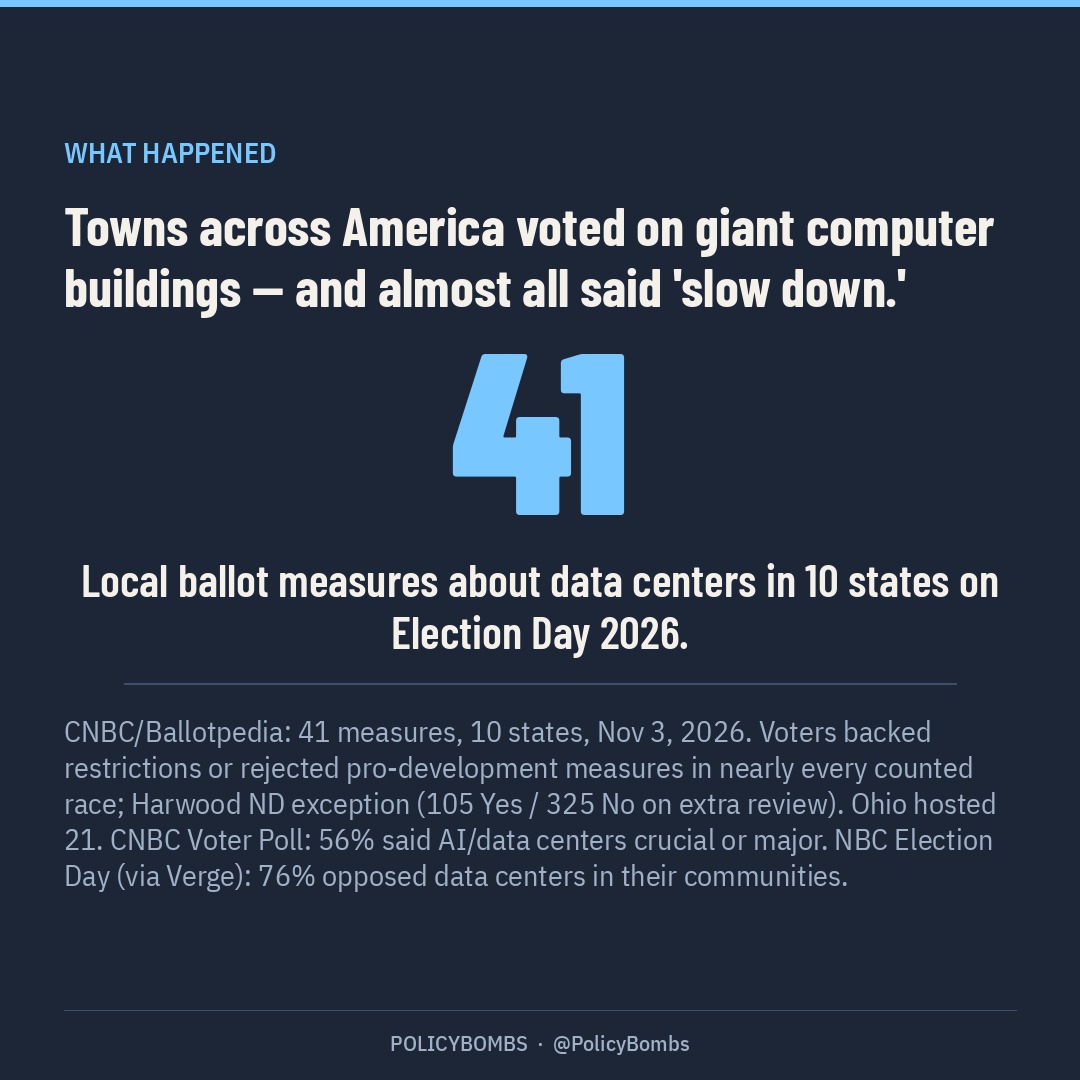
41. Local ballot measures on data centers across 10 states — and voters sided against them in nearly every counted race.
Nov 3, 2026: towns from Maine to California put AI's power plants on the ballot. CNBC/Ballotpedia: 41 measures in 10 states. Ohio alone had 21.
Results: restrictions won almost everywhere. Bans, MW caps, 180-day freezes. The rare exception: Harwood, North Dakota, rejected extra industrial review (105–325).
This wasn't a fringe issue. CNBC's voter poll: 56% said AI/data centers were a crucial or major factor. NBC Election Day: 76% opposed data centers in their own communities.
PRO: Voters who live with the noise, water draw and secrecy got a direct say — and used it.
CON / COST: 41 uncoordinated local bans are a slow, patchy way to run national AI infrastructure policy.
SOCIETY: MIXED — democratic local control over land and water is legitimate; a patchwork of bans is a real tax on national AI capacity.
Full analysis
Data-Center Ballot Measures 2026: ~41 Local Fights, Voters Chose Restrictions
About 41 local data-center ballot measures in 10 states went to voters in the 2026 midterms; with results in, voters backed restrictions or rejected pro-development measures in nearly every counted race — Harwood, North Dakota the notable exception. As of Nov 5, 2026, 11:40 PM ET.
Content as of Nov 5, 2026, 11:40 PM ET. Source: primary reporting + Ballotpedia / campaign statements fetched this run
Long-form deep analysis. Companion to the 10-minute quick reference (69-data-center-ballot-measures-2026-summary.docx).
Contents
- 10-Minute Lazy Voter Guide
- 1. What is the policy
- 2. Why it exists
- 3. Realized effects
- Local investigations and anomalies
- Who supports / who opposes
- 4. Good or bad for society
- References
- Gaps / unverified
10-Minute Lazy Voter Guide
On Election Day 2026, dozens of towns and cities asked voters: should we ban, pause, or tightly limit giant computer buildings (data centers)? In almost every place that counted quickly, voters said yes to limits — or no to welcoming them. One small North Dakota town, Harwood, voted the other way.
Verdict: MIXED — MIXED — democratic local control over land and water is legitimate; a patchwork of bans is a real tax on national AI capacity. |
Figure | Meaning | Tag |
|---|---|---|
41 | Local data-center-related ballot measures in 10 states on the Nov 3, 2026 ballot (CNBC citing Ballotpedia; Ballotpedia News pre-election) | Substantiated |
Harwood, ND | Lone widely cited exception: voters rejected added industrial/data-center review requirements — 105 Yes (24%) / 325 No (76%) (Ballotpedia / CNBC) | Substantiated |
56% | Voters who said AI/data centers were a crucial or major factor in their decision (CNBC Voter Poll) | Substantiated |
76% | Election Day poll share opposing data centers in their communities (NBC via The Verge) | Substantiated |
10 | States with data-center-related local measures (Ballotpedia News) | Substantiated |
1. What is the policy
A wave of municipal and county ballot questions on Nov 3, 2026 restricting data-center development via bans, MW caps, temporary moratoriums, or rejecting pro-development advisories. CNBC/Ballotpedia News: 41 measures in 10 states. Examples: Alhambra CA Measure DB prohibit (82% Yes); Edgewater FL prohibit new centers (77%); Bloomington IL advisory moratorium (78%); Emporia KS high-impact ban (60%); Wells ME 180-day moratorium (82%); Ohio MW caps and referenda (state hosted 21 measures). Harwood ND rejected extra industrial review. Post-election Ballotpedia pages reported additional decided measures with the same directional pattern (near-universal restriction support).
2. Why it exists
Stated reasons: Protect local water, power rates, farmland, property values and quality of life; stop being ‘sold out’ to hyperscalers.
Underlying drivers (evidence-based assessment): Visible construction + higher bills + drought fear + anti-billionaire politics after heavy Silicon Valley/GOP donor spending (CNBC: crypto/AI/gambling interests >$377M; Musk ≥$474M cycle spending). Data centers became a stand-in for AI-era inequality.
3. Realized effects
Near-sweep for restriction side on counted measures (CNBC Nov 4–5). Reinforced gubernatorial/Senate messaging in TX, OH, GA, WI, etc. Sanders: ‘National data center moratorium now.’ Market: contributed to Nov 5 AI/infra selloff narrative. Industry must now negotiate town-by-town.
Local investigations and anomalies
Final certified count may exceed 41 as late ballots/post-election listings finalize (Ballotpedia updated tallies Nov 4+). Some measures advisory only. Verge cited 45 measures / Redbud Consulting 33 restricting as of Wednesday morning — count Contested at the margin; direction Substantiated. … Full gaps listed below.
Who supports / who opposes
Supports: Local majorities; Sanders; Casar (‘AI earthquake’); municipal organizers; Americans for Responsible Innovation.
Opposes: Developers; Data Center Coalition; some local economic-development officials; Harwood ND majority.
Further reading (also listed in References):
- [1] CNBC: Voters rebuff data centers in every ballot measure except one (Nov 4, 2026)
- [2] Ballotpedia: Data center-related ballot measures, 2026
- [3] Ballotpedia News: Voters in ten states will vote on 41 measures (Nov 3, 2026)
- [4] Ballotpedia: Harwood ND Industrial Development Review Initiative
- [5] The Verge: Data centers lost the midterms — NBC 76% oppose
4. Good or bad for society
Good: ends the fiction that megawatt campuses are just another warehouse. Bad: U.S. industrial policy by zoning referendum is slow, uneven and easy to capture by whichever side shows up. Better path: statewide ratepayer/water standards + local siting voice — not 41 incompatible ordinances.
Local voters have every right to police noise, water, land use and secretive PILOT deals in their backyard — and they just did, almost uniformly. That is democratic accountability, not ‘Luddism.’ The social cost is a fragmented permitting map that makes U.S. AI capacity slower and pricier precisely when China is not holding town-hall moratoriums. Net: MIXED — healthy local veto power; unhealthy if the only national energy policy is 41 uncoordinated municipal bans.
References
[1] CNBC: Voters rebuff data centers in every ballot measure except one (Nov 4, 2026). https://www.cnbc.com/2026/11/04/data-center-ballot-measures-2026-midterm.html
[2] Ballotpedia: Data center-related ballot measures, 2026. https://ballotpedia.org/Data_center-related_ballot_measures,_2026
[3] Ballotpedia News: Voters in ten states will vote on 41 measures (Nov 3, 2026). https://news.ballotpedia.org/2026/11/03/voters-in-ten-states-will-vote-on-data-center-related-ballot-measures-november-3/
[4] Ballotpedia: Harwood ND Industrial Development Review Initiative. https://ballotpedia.org/Harwood,_North_Dakota,_Industrial_Development_Review_Requirements_Initiative_(November_2026)
[5] The Verge: Data centers lost the midterms — NBC 76% oppose. https://www.theverge.com/policy/1026365/data-centers-midterms-results
[6] Guardian: Voters approved nearly every datacenter moratorium. https://www.theguardian.com/us-news/2026/nov/04/datacenters-midterm-elections
[7] Axios: AI earthquake / ~two dozen restriction proposals passing on initial returns. https://www.axios.com/2026/11/04/ai-data-center-election-slowdown
Gaps / unverified
Final certified count may exceed 41 as late ballots/post-election listings finalize (Ballotpedia updated tallies Nov 4+). Some measures advisory only. Verge cited 45 measures / Redbud Consulting 33 restricting as of Wednesday morning — count Contested at the margin; direction Substantiated.
PolicyBombs. Follow @PolicyBombs on X.