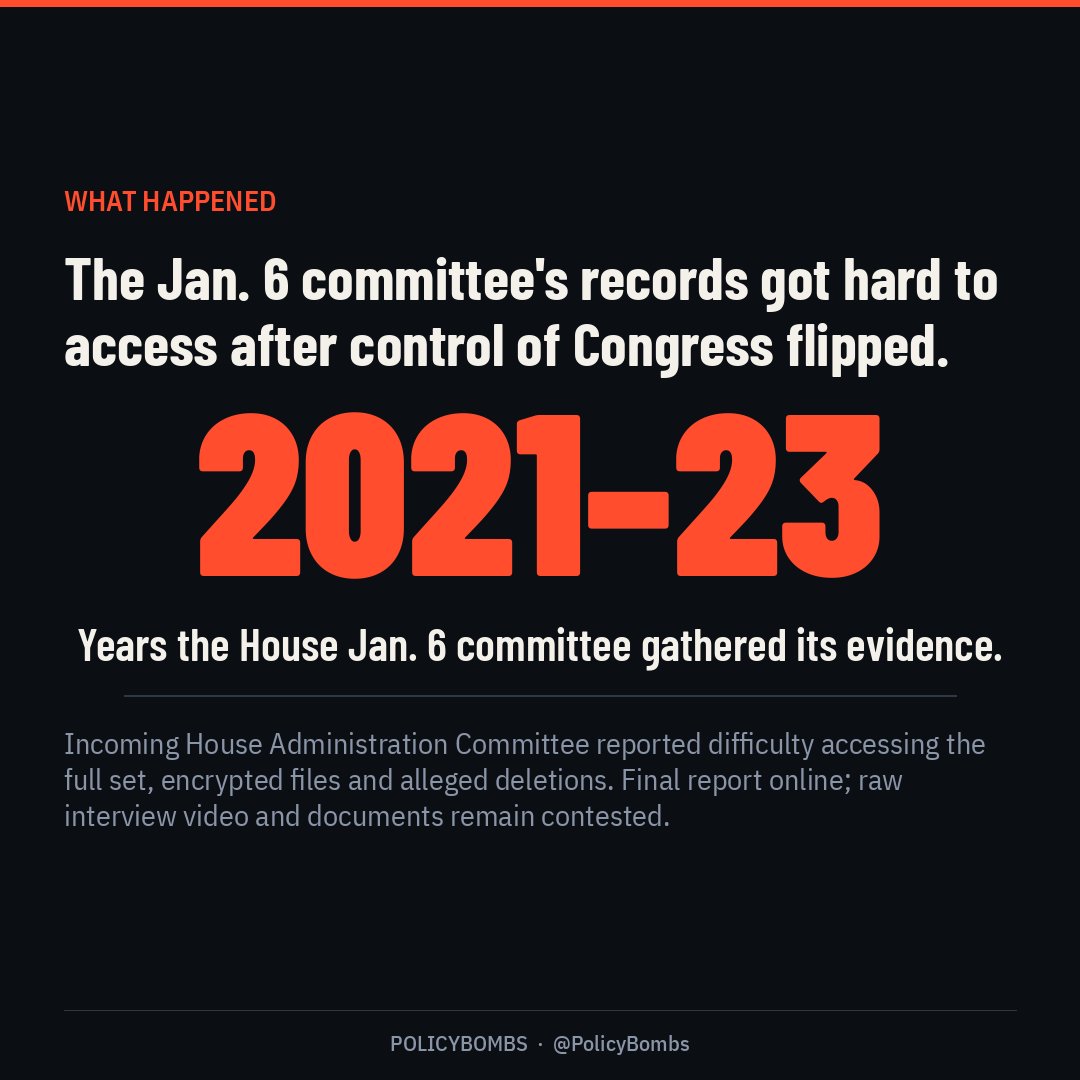
2021–2023: the House Jan 6 Select Committee collected a vast digital record. When the majority flipped, the incoming House Administration Committee reported difficulty accessing the full set, encrypted files and alleged deletions. The final report is online, but access to raw interview video and documents remains contested. History requires durable, auditable records, whoever runs the committee.
PRO: Final report and many transcripts published; witness privacy is real.
CON / COST: Encrypted or inaccessible archive; evidence shouldn't vanish when power flips.
SOCIETY: BAD
Full analysis
January 6 Committee Records: Handling, Sealing, and Claimed Losses
Handling, archiving, sealing, encryption, and claimed deletion or loss of documents and materials by the House Select Committee investigating January 6 — plus successor access fights. As of Nov 5, 2026.
Content as of Nov 5, 2026, 6:22 AM ET. Source Page: PolicyBombs canvas
Long-form deep analysis. Companion to the 10-minute quick reference (44-january-6-committee-records-summary.docx).
Contents
- 10-Minute Lazy Voter Guide
- 1. What happened
- 2. Why it exists
- 3. Realized effects
- Archive and encryption fight
- Who supports / who opposes
- 4. Good or bad for society
- References
- Gaps / unverified
10-Minute Lazy Voter Guide
Who’s for / against: Committee Democrats / allies: argued they archived what statute required and protected witnesses. Critics (House Admin majority after 2023, some Republicans): alleged mass deletion, encrypted drives, incomplete transfer to National Archives / successor committees. |
Committee defense | Critique |
+ Final report and many transcripts published + Some materials transferred to Archives + Witness privacy / security concerns real | – Encrypted or inaccessible digital materials reported by successors – Staff alleged destruction of records outside normal archiving – Select committees should not vanish evidence when majority flips |
Verdict for voters: Process failure at minimum. Historic investigation materials belong in durable public archives — not disappearing hard drives. Demand full inventory and decryption under House rules / NARA. |
1. What happened
Item | Detail | Assessment |
|---|---|---|
Select Committee 2021–2023 | Investigated Jan 6; issued final report; held hearings; collected vast digital record. | Substantiated |
End-of-Congress transfer fight | Incoming House majority (Admin Committee) reported difficulty accessing full set; encrypted files; alleged deletions. | Substantiated dispute |
Public report vs raw archive | Final report online; raw interview video/docs access remains contested. | Substantiated |
2. Why it exists
Stated: protect sensitive materials; comply with House archiving; prevent misuse against witnesses.
Underlying: Partisan control of narrative after majority change. Corruption hypothesis: selective preservation — keep what supports the report, obscure what complicates it. Evidence standard: House Administration findings, NARA correspondence, committee minority/majority letters — not unverified viral claims of ‘all evidence destroyed.’
3. Realized effects
Outcome | Detail | Tag |
|---|---|---|
Published final report | Public PDF / site | Substantiated |
Access disputes | Encrypted drives / incomplete handoff claims | Substantiated as dispute |
Transcript releases | Partial transcript dumps over time | Substantiated |
Public trust | Both sides accuse bad faith | Substantiated |
Archive and encryption fight
After Republicans took the House in 2023, House Administration and oversight figures said large volumes of digital committee records were encrypted or not transferred in usable form. Committee alumni disputed characterizations of ‘destruction,’ pointing to Archives deposits and published work product. Voters should demand a public chain-of-custody inventory — file counts, hash lists, encryption keys under House custody — rather than dueling press releases.
Who supports / who opposes
Who | Party / level | Position | Evidence | Ref |
|---|---|---|---|---|
Jan 6 Select Committee majority | Democrat-led | Defended archiving practices | Statements; final report process | [1] |
House Administration (118th) | Republican | Alleged incomplete / encrypted records | Letters / hearings | [2] |
NARA | Agency | Receives congressional deposits under rules | Archives practice | [3] |
Transparency advocates | Civil | Want full raw archive public | FOIA / advocacy | [4] |
Further reading (also listed in References):
- [1] Jan 6 Committee final report — govinfo.gov
- [2] House Administration Committee — cha.house.gov
- [3] National Archives — archives.gov
- [4] Congress.gov Jan 6 materials — congress.gov
4. Good or bad for society
Direct judgment: Opaque handoffs are bad whether your team ran the committee or inherited it. History requires durable, auditable records. Encrypting the archive against the next Congress looks like power protection, not scholarship. |
- Mandatory public inventory of all Select Committee digital assets
- Keys escrowed to House Clerk / NARA
- Uniform archiving statute for future select committees
References
[1] [1] Jan 6 Committee final report. govinfo.gov. https://www.govinfo.gov/collection/january-6th-committee-final-report
[2] [2] House Administration Committee. cha.house.gov. https://cha.house.gov/
[3] [3] National Archives. archives.gov. https://www.archives.gov/
[4] [4] Congress.gov Jan 6 materials. congress.gov. https://www.congress.gov/
Gaps / unverified
Item | Detail | Assessment |
|---|---|---|
Exact byte-level deletion proof | Allegations vs denials; need forensic inventory. | Pending |
Full decrypted corpus online | Not complete as of this page. | Unverified |
PolicyBombs · Day 44. Follow @PolicyBombs on X.