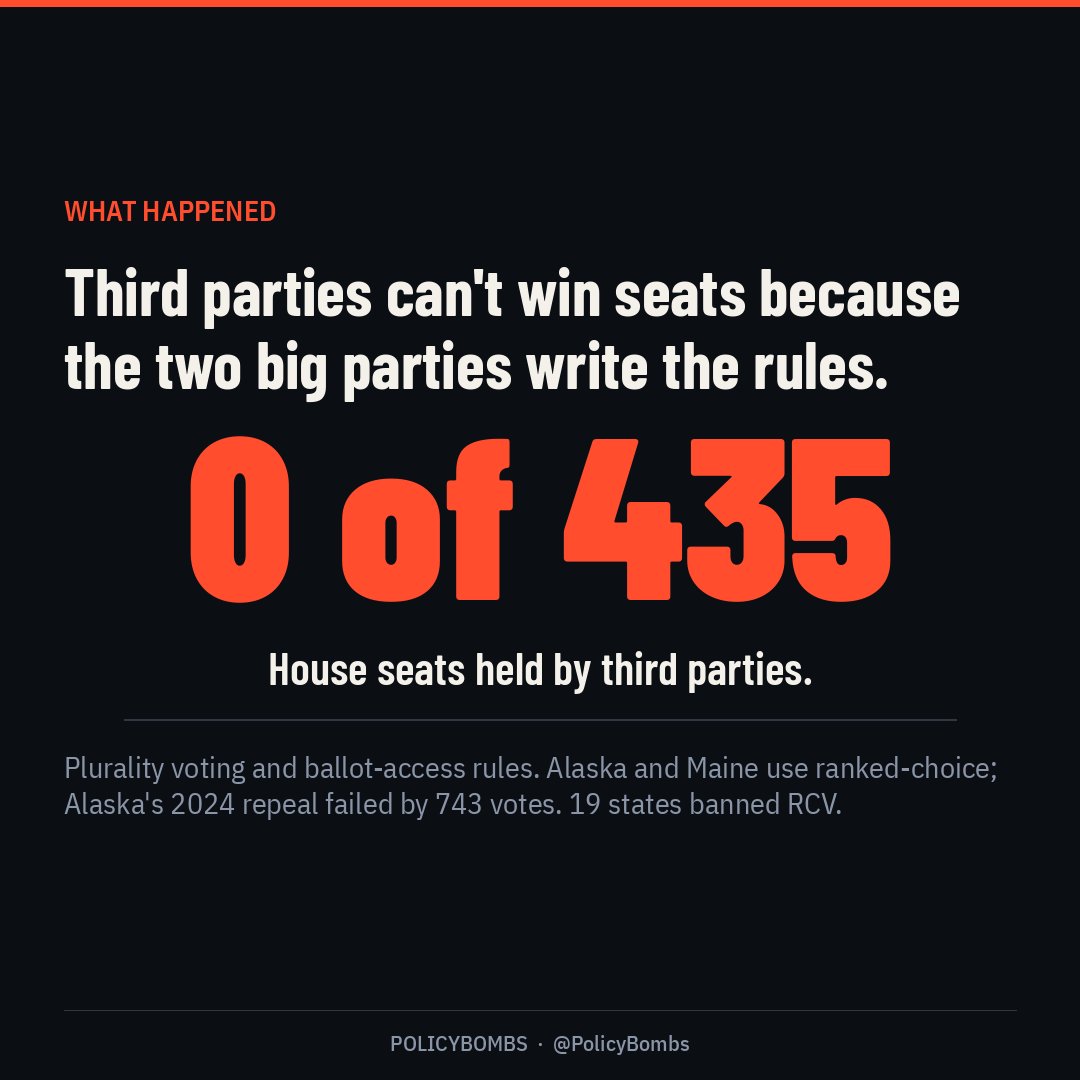
0 of 435. That's how many House seats third parties hold. The rules are written by the two parties that benefit.
Plurality voting and ballot-access rules make third parties nearly impossible. Alaska and Maine use ranked-choice voting, and Alaska's 2024 repeal failed by just 743 votes. Meanwhile 19 states have banned RCV. Both sides of these fights are funded by a few big donors, and Alaska's regulator cited a campaign for hiding its donors.
PRO: RCV and open primaries elect more crossover winners; no spoiler effect.
CON / COST: Slower counts, exhausted ballots, and no viable third parties yet.
SOCIETY: Lock-in suppresses competition; RCV and fair ballot access are modest real fixes.
Full analysis
The Two-Party System: Policy Assessment
The rules that lock in two parties (first-past-the-post, ballot access, sore-loser laws) and the reforms tested in Alaska, Maine and California. As of Nov 4, 2026.
Content as of Nov 4, 2026, 8:32 PM ET. Source Page: PolicyBombs canvas
Long-form deep analysis. Companion to the 10-minute quick reference (06-two-party-summary.docx).
10-Minute Voter Guide
Who’s for / against: For reforms that weaken the two-party grip (top-two, RCV, open primaries): Sen. Lisa Murkowski (R), Gov. Jared Polis (D), Arnold Schwarzenegger (R, CA Prop 14). Against: both major state parties in CA and CO, and GOP legislatures that banned RCV (e.g., Florida).
Plurality voting and ballot-access rules written by the two major parties make third parties nearly impossible. Alaska and Maine use ranked-choice voting, and Alaska voters have refused twice to repeal it. Meanwhile 19 states have banned it. Both sides of these fights are funded by a few big donors, and Alaska’s regulator has cited a campaign for hiding its donors.
Pros of RCV and open primaries | Cons |
+ More crossover and moderate winners (Murkowski, Peltola) + No spoiler effect + Voters in Alaska kept it twice | – Slower counts and confusing results – Ballots that don’t rank finalists drop out of the count – Has not created viable third parties |
Bottom line: Ranked-choice voting and fair ballot access are modest, real improvements. Ask who funds each side.
Contents
- 10-Minute Voter Guide
- Key facts
- 1. What is the policy
- 2. Why it exists
- 3. Realized effects
- Money and enforcement record
- 4. Good or bad for society
- Who supports / who opposes
- References
Bottom line: Two parties aren’t written into the Constitution. They come from single-member, plurality (first-past-the-post) elections, reinforced by ballot-access and sore-loser laws that the two parties themselves write. Ranked-choice and top-two reforms have changed things at the margin (a few moderates and crossover winners) but have not produced viable third parties. Only proportional representation would. |
Key facts
Item | Detail | Status (Nov 2026) |
|---|---|---|
First-past-the-post | Plurality winner in single-member districts; Duverger’s law predicts two parties | Used for nearly all US offices |
Maine RCV | Approved 2016; used in primaries and federal general elections since 2018 | In force |
Alaska top-4 primary plus RCV (Measure 2, 2020) | Passed with 50.55%; first used in 2022 | Repeal failed 2024 by 743 votes; 2026 repeal trailing 48.1–51.9 (uncertified) |
California top-two (Prop 14, 2010) | All candidates in one primary; top two advance regardless of party | In force |
State RCV bans | AL, AR, FL, ID, IN, IA, KS, KY, LA, MS, MO, MT, ND, OH, OK, SD, TN, WV, WY | 19 states (NCSL/Ballotpedia, Nov 2026) |
Sore-loser laws | A candidate who loses a primary can’t run as an independent | Most states (about 45; count not verified) |
Third-party share of House seats | 0 of 435 seats held by a third party | Long-run norm |
1. What is the policy
Item | Detail |
|---|---|
Electoral formula | A 1967 federal law (2 U.S.C. 2c) requires single-member House districts, which rules out multi-member proportional representation without new legislation. States choose plurality, RCV, or runoff. |
Ballot access | Each state sets the petition signatures and vote thresholds a party needs to keep its ballot line. Major parties qualify automatically. Minor parties must petition, sometimes needing tens of thousands of signatures, and face challenges in court (e.g. Democratic suits against Greens and RFK Jr. in 2024; GOP suits against No Labels and others). |
Debate access | The Commission on Presidential Debates’ 15% polling threshold, set by a commission the two parties created. |
Reforms | Maine: RCV. Alaska: nonpartisan top-4 primary, RCV general election, and dark-money disclosure. California and Washington: top-two primaries. |
2. Why it exists
Stated reasons | Underlying drivers |
+ Stable majorities and clear accountability + Ballot thresholds keep frivolous candidates off long ballots + Sore-loser laws protect the meaning of primaries + RCV opponents: it’s confusing and slow, and ballots get exhausted | – Incumbent parties write the election laws: a duopoly protecting itself – Spoiler fear helps each party discipline its own flank – RCV bans followed Peltola’s 2022 win and Murkowski’s survival: parties lose control – The Alaska 2026 repeal was backed largely by GOP donors, including Musk-linked money (reported) |
3. Realized effects
Item | Detail | Assessment |
|---|---|---|
Alaska | Murkowski won in 2022 despite being censured by the state GOP. Democrat Mary Peltola won the at-large seat in 2022 over Palin and Begich. Critics note confusing outcomes and long counts. Voters kept the system twice. | More moderate/crossover winners |
Maine | In 2018 Jared Golden won ME-2 after trailing in first choices, the first federal RCV comeback. Turnout and voter understanding surveys are broadly positive. No third party has become viable. | Works, limited impact |
California top-two | Studies are mixed: small moderating effects in some legislative races, many same-party general elections, and minor parties nearly vanished from the general-election ballot. Legislative polarization has not clearly fallen. | Mixed |
Third parties | Ballot-access costs and spoiler fear keep third-party presidential vote shares low except in rare years (Perot got 18.9% in 1992 and won 0 electoral votes). | Locked out |
Money and enforcement record
Finding | What regulators or records show | Source |
|---|---|---|
‘No on 2’ ads, Alaska 2020 | The Alaska Public Offices Commission found the main opposition campaign violated disclosure law by airing ads with outdated top-donor information. It ordered the ads fixed or pulled and referred the case for possible fines. | APOC via Alaska Public Media, Oct 2020 |
2020 Measure 2 money | Most yes-side money came from outside groups; Alaska Republicans funded the opposition. | Anchorage Daily News, Sept 2020 |
2026 repeal money | Repeal side raised about $2.6M, mostly via a Musk-funded group; opponents raised $10.4M. | IVN, citing Alaska Public Media |
Ballot-access litigation | Major parties routinely sue to remove minor-party and independent candidates (e.g. 2024 challenges to Greens, Cornel West, RFK Jr.). Outcomes varied by state. | State court records (summary) |
What changed: nothing in the verdict. The record adds evidence that both reform and repeal campaigns depend on concentrated outside money, and that disclosure enforcement matters.
4. Good or bad for society
Verdict: The two-party lock-in is mostly bad. It suppresses competition, forces lesser-evil voting, and lets primaries driven by polarized bases pick most officeholders. Primary reform plus RCV is a modest, evidence-backed improvement worth keeping. Fair ballot access is cheap and clearly good. A real multi-party system would require proportional representation for the House, which neither party wants. |
Strongest case for the two-party system | Strongest case against |
+ Coalitions form inside parties before elections, so governments are stable + Clear accountability: voters know whom to blame + Multi-party systems can fragment (Israel, Italy) | – Low primary turnout lets about 10% of voters effectively pick most winners – Spoiler logic punishes sincere votes – Parties write the rules to exclude challengers |
Who supports / who opposes
For = reforms that open elections beyond the two parties (top-two, RCV, open primaries). Against = keeping party-controlled primaries. Each row cites a numbered source below. Checked Nov 4, 2026.
Who | Party / level | Position | Evidence | Ref |
Gov. Arnold Schwarzenegger (R-CA); Sen. Abel Maldonado (R) | Republican | For | Backed Prop 14 (2010), creating California’s top-two primary; passed 53.7% | [1] |
California Democratic and Republican parties | Both parties | Against | Both opposed Prop 14 | [1] |
Gov. Jared Polis (D-CO) | Democrat | For | Backed Colorado Prop 131 (2024) for all-candidate primaries + RCV; it failed | [2] |
Colorado Democratic & Republican parties | Both parties | Against | Opposed Prop 131 | [2] |
Alaska voters; Sen. Lisa Murkowski (R-AK) won under the system | Ballot measure | For | Measure 2 (2020) top-four + RCV; repeal failed narrowly in 2024 | [3] |
Gov. Ron DeSantis (R-FL) and states incl. TN, ID, MT, SD | Republican | Against | Signed laws banning ranked-choice voting (FL SB 524, 2022) | [4] |
Cross-party defectors: Party organizations on both sides oppose these reforms, while some governors (Polis, Schwarzenegger) break from their own parties to back them.
How positions shifted: Republican legislatures moved from indifference to outright RCV bans after RCV results in Alaska (2022) and Maine (2018). Democratic party organizations remain split.
Not included or not fully verified: Could not source a recent Newsom veto or signature on local RCV bills; omitted.
Sources for this section:
- [1] Ballotpedia: California Prop 14 (2010) (ballotpedia.org) https://ballotpedia.org/California_Proposition_14,_Top-Two_Primaries_Amendment_(June_2010)
- [2] Ballotpedia: Colorado Prop 131 (2024) (ballotpedia.org) https://ballotpedia.org/Colorado_Proposition_131,_Top-Four_Ranked-Choice_Voting_Initiative_(2024)
- [3] Ballotpedia: Alaska Measure 2 (2024) repeal (ballotpedia.org) https://ballotpedia.org/Alaska_Ballot_Measure_2,_Repeal_Top-Four_Ranked-Choice_Voting_Initiative_(2024)
- [4] Ballotpedia: Ranked-choice voting bans (ballotpedia.org) https://ballotpedia.org/Ranked-choice_voting_(RCV)
References
[1] Alaska Public Media: RCV repeal trailing (Nov 2026). alaskapublic.org. https://alaskapublic.org/news/politics/elections/2026-11-03/early-results-show-alaskans-rejecting-ranked-choice-voting-repeal
[2] Alaska Division of Elections results. elections.alaska.gov. https://www.elections.alaska.gov/election-results/e/
[3] NCSL: Ranked choice voting. ncsl.org. https://www.ncsl.org/elections-and-campaigns/ranked-choice-voting
[4] Maine RCV information. maine.gov. https://www.maine.gov/sos/cec/elec/upcoming/rankedchoicefaq.html
[5] Ballotpedia: ballot access requirements. ballotpedia.org. https://ballotpedia.org/Ballot_access_requirements_for_political_candidates_in_the_United_States
[6] Ballotpedia: California Prop 14 (2010). ballotpedia.org. https://ballotpedia.org/California_Proposition_14,_Top-Two_Primaries_Act_(June_2010)
[7] PPIC: California’s top-two primary. ppic.org. https://www.ppic.org/publication/californias-top-two-primary-a-successful-reform/
PolicyBombs · Day 50. Follow @PolicyBombs on X.