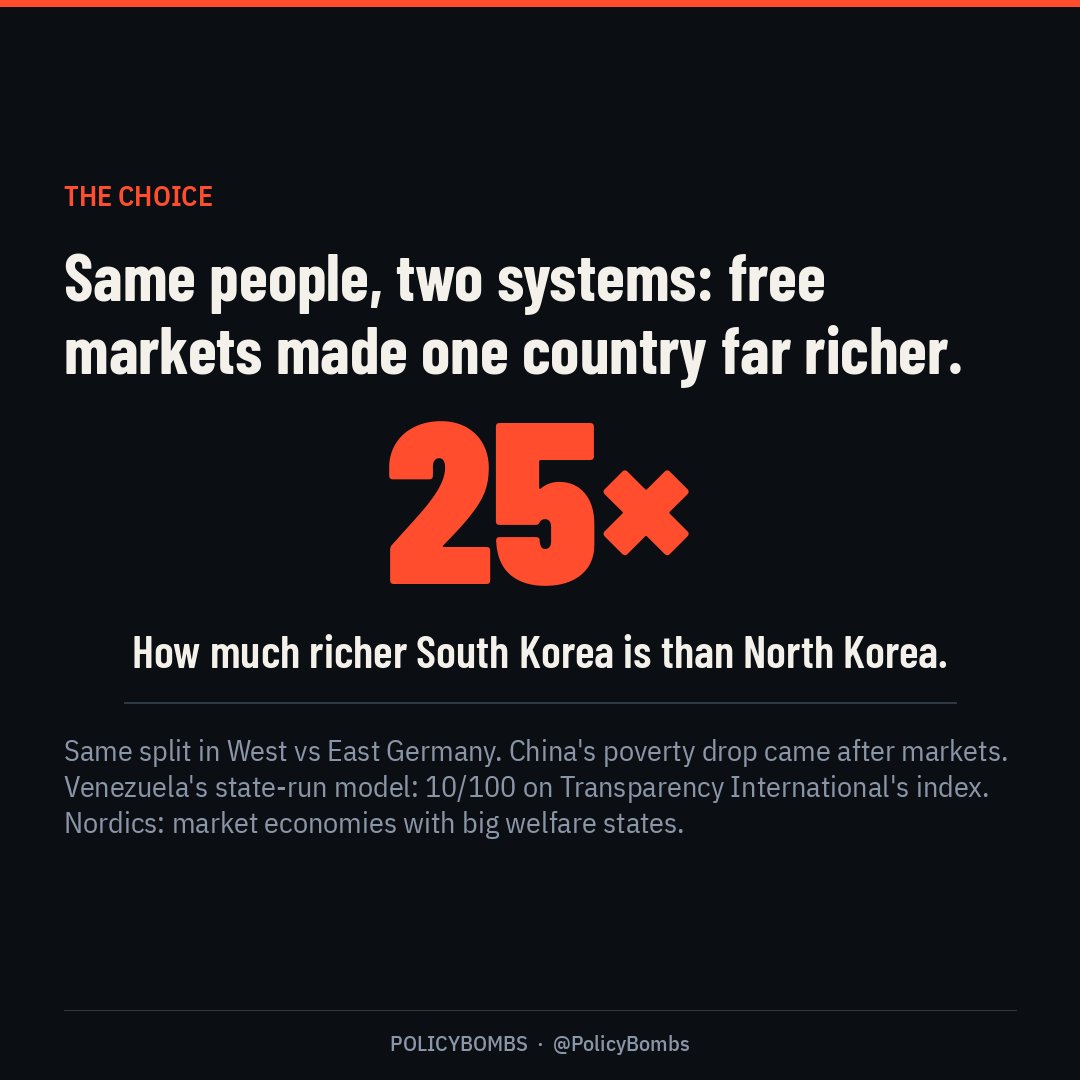
25 times. That's roughly how much richer South Korea is than North Korea. Same people, different systems.
Every country split between a planned economy and a market one shows the same result: the market side became richer, longer-lived, and freer. West vs East Germany too. China's huge drop in poverty came after it adopted markets. Venezuela's state-run model brought collapse, scoring 10/100 on Transparency International's index. The Nordics? Market economies with big welfare states.
PRO: Markets produced nearly all large poverty reductions since 1980.
CON / COST: Inequality, financial crises and pollution are real.
SOCIETY: Fix problems with welfare states and regulation, not by abolishing prices.
Full analysis
Marxism vs Capitalism: The Head-to-Head Evidence
Tests both ‘Marxism is best’ and ‘capitalism is bad’ against natural experiments: the two Germanys, the two Koreas, the USSR, China before and after 1978, Venezuela, and the Nordic model. As of Nov 4, 2026.
Content as of Nov 4, 2026, 8:32 PM ET. Source Page: PolicyBombs canvas
Long-form deep analysis. Companion to the 10-minute quick reference (08-marxism-vs-capitalism-summary.docx).
10-Minute Voter Guide
Who’s for / against: No major party backs Marxism. Self-described democratic socialists include Sen. Sanders, Rep. Ocasio-Cortez, and NYC Mayor Zohran Mamdani (DSA). The House denounced socialism 328–86 in 2023, with 109 Democrats voting yes.
Every country split between a planned economy and a market one shows the same result: the market side became richer, longer-lived, and freer. Examples are South Korea against North Korea (about 25 times richer) and West against East Germany. China’s huge drop in poverty came after it adopted markets. Venezuela’s state-run model brought collapse and some of the world’s worst corruption, scoring 10/100 on Transparency International’s index. The Nordic countries are market economies with big welfare states.
Socialist critique: valid points | Against Marxist systems |
+ Inequality and financial crises are real + Climate change is a huge market failure + Welfare states reduce poverty | – Lost every head-to-head comparison – Concentrated power breeds corruption (Venezuela 180th of 182) – Famines and repression with millions of deaths |
Bottom line: Regulated capitalism with a safety net beats central planning on every measure.
Contents
- 10-Minute Voter Guide
- Key facts
- 1. What is the policy
- 2. Why it exists
- 3. Realized effects
- Corruption record
- 4. Good or bad for society
- Who supports / who opposes
- References
Bottom line: Every clean natural experiment points the same way. Where a population was split and one side got central planning while the other got markets, the market side became far richer, longer-lived, and freer. The best-performing societies on welfare, the Nordics, are market capitalist economies with large welfare states, not Marxist ones. "Capitalism is bad" holds only for specific failures (inequality, crises, externalities), which regulated capitalism handles better than any planned alternative has. |
Key facts
Comparison | Planned / Marxist side | Market side | Note |
|---|---|---|---|
Korea: GDP per person | About $1,261 per-capita GNI, 2024 (North, Bank of Korea est.) | About $33,000 (South, World Bank) | Same people and culture; split 1945 |
Korea: life expectancy | About 73 (UN est.) | About 83 | Famine of the 1990s in the North |
Korea: Freedom House score | 3/100 | 83/100 | 2024–25 editions (verify yearly) |
Germany at reunification (1990) | East productivity about one-third of the West’s (commonly cited) | West | Same nation, split 1949 |
Germany: emigration | About 3M+ fled East before the 1961 Wall | Net receiver | Wall built to stop exodus |
China: extreme poverty | Mass famine 1959–61 (15–45M deaths, estimates vary) | 88% (1981) to under 1% (2019), World Bank $2.15 line | After market reforms in 1978 |
Venezuela 2013–2021 | Real GDP fell more than 75% (IMF); 6.98M emigrants in Latin America and the Caribbean alone, Aug 2026 (R4V) | Oil-socialist model | Not pure Marxism; nationalizations plus price controls |
Nordics | Not Marxist | High Economic Freedom ranks plus high taxes | Danish PM, 2015: "Denmark is a market economy" |
1. What is the policy
Item | Detail |
|---|---|
Marxism-Leninism in practice | State ownership of the means of production, central planning, a one-party state, and collectivized agriculture. USSR 1917–1991, Eastern Bloc, North Korea, Mao’s China, Cuba. |
Market capitalism | Private ownership, price signals, and competition, with widely varying welfare and regulation: US (lighter), Nordics (heavy redistribution), South Korea (state-guided industrialization). |
Hybrids | China since 1978 (markets under a Leninist party), Vietnam’s Doi Moi (1986), and Venezuela’s chavismo (elected, nationalizing, price controls). |
2. Why it exists
Stated case for Marxism / against capitalism | Underlying drivers |
+ Capitalism exploits labor and concentrates wealth + Boom-bust crises (1929, 2008) + Environmental and social costs are unpriced + Planning can mobilize resources fast (Soviet industrialization) | – Marxist parties seized power by revolution, then used planning to centralize control – Planned economies lack price signals and incentives (Hayek’s knowledge problem; Kornai’s soft budget constraint) – Elites in planned states captured the privileges (the nomenklatura) – Western critics often compare actual capitalism with an idealized socialism |
3. Realized effects
Item | Detail | Assessment |
|---|---|---|
USSR | Fast growth from industrialization from the 1930s to the 1960s (contested estimates), then stagnation from the 1970s. Famines (1932–33 Holodomor), the Gulag, chronic shortages, and collapse in 1991. | Failed |
East vs West Germany | The West’s ‘social market economy’ outgrew the East. The East needed a wall to keep people in. Reunification costs ran past €1.5 trillion (estimates vary). | Market wins |
North vs South Korea | The North was richer in the 1950s–60s (industrial base inherited from Japan). The South overtook it by the mid-1970s and is now roughly 25x richer per person. | Market wins |
China pre/post 1978 | Maoist planning brought the Great Leap famine and stagnant output per person. Deng’s market reforms (household responsibility, special economic zones, private firms) produced history’s largest poverty reduction. That was a move toward capitalism, under authoritarian rule. | Markets drove gains |
Venezuela | Price controls, expropriations, and oil dependence led to hyperinflation and the largest peacetime economic collapse outside war in modern Latin America (IMF data). Roughly a fifth to a quarter of the population has left (R4V counts 6.98M in Latin America and the Caribbean alone). | Failed |
Nordic model | Top life expectancy, low poverty, and high happiness, built on free trade, private firms, flexible labor markets (Danish flexicurity), and high taxes. Sweden’s 1970s–80s turn toward more state control ended in a 1990s crisis and pro-market reforms. | Regulated capitalism |
Corruption record
Finding | What investigators or courts concluded | Source |
|---|---|---|
Venezuela, Corruption Perceptions Index 2025 | 10/100, ranked 180th of 182 | Transparency International |
CLAP food boxes and PDVSA oil (Alex Saab) | Charged in Miami with laundering proceeds of corrupt food-import contracts and PDVSA oil sales through shell companies and false invoices. These are charges, not a conviction. | DOJ; Miami Herald |
Soviet bloc | Nomenklatura privileges and the black economy are documented in post-1991 archives. Estimates of their scale vary. | Academic histories (summary) |
What changed: nothing in the verdict. The record adds that state control of the economy concentrated both power and money that could be stolen, and that the corruption in Venezuela was prosecuted abroad, not at home.
4. Good or bad for society
Verdict: "Marxism is best" fails every comparison available: growth, poverty, life expectancy, and freedom. "Capitalism is bad" is an overreach. Markets have produced nearly all of the large reductions in global poverty since 1980. Inequality, financial crises, and pollution are real problems that welfare states and regulation address, without abandoning private ownership and prices. |
Strongest arguments for the socialist critique | Strongest arguments against |
+ The 2008 crisis and rising inequality show markets misallocate risk + Soviet literacy, health care, and industrialization gains were real + Climate change is a market failure on a huge scale | – Every split-country experiment favors markets by large margins – One-party planning concentrated power and produced famines with millions of deaths – The models the left admires (Nordics) are capitalist |
Who supports / who opposes
For = democratic socialism (no major figure backs Marxism outright). Against = denouncing socialism. Each row cites a numbered source below. Checked Nov 4, 2026.
Who | Party / level | Position | Evidence | Ref |
Rep. María Elvira Salazar (R-FL) + all voting Republicans | Republican | Against | Sponsored H.Con.Res. 9 "Denouncing the horrors of socialism"; passed 328–86–14 (Feb 2, 2023) | [1] |
109 House Democrats | Democrat | Against | Voted yes on H.Con.Res. 9 | [1] |
86 House Democrats (incl. Ocasio-Cortez, Tlaib) | Democrat | For (qualified) | Voted no on H.Con.Res. 9 (democratic socialists, not Marxist) | [1] |
Sen. Bernie Sanders (I-VT) | Independent | For (qualified) | Self-described democratic socialist; June 2019 George Washington University speech defining it | [2] |
NYC Mayor Zohran Mamdani (D, DSA member) | Democrat / DSA | For (qualified) | Elected Nov 4, 2025 (50.8%) as a self-described democratic socialist | [3] |
President Donald Trump | Republican | Against | 2019 State of the Union: "America will never be a socialist country" | [4] |
Cross-party defectors: Democrats split almost evenly on the 2023 anti-socialism resolution.
How positions shifted: Democratic socialism has gone from fringe to winning offices since 2016, from Sanders’ runs to the ‘Squad’ to Mamdani. Republicans have made anti-socialism a central message.
Not included or not fully verified: No politician on record supporting Marxism as such; the ‘For (qualified)’ rows are democratic socialists.
Sources for this section:
- [1] Congress.gov: H.Con.Res. 9 (118th) (congress.gov) https://www.congress.gov/bill/118th-congress/house-concurrent-resolution/9
- [2] Vox: Transcript of Sanders democratic socialism speech (Jun 12, 2019) (vox.com) https://www.vox.com/2019/6/12/18663217/bernie-sanders-democratic-socialism-speech-transcript
- [3] AP race call: Mamdani elected NYC mayor (apnews.com) https://apnews.com/article/new-york-city-mayor-election-mamdani-cuomo-sliwa-070d5b6e5544cfe6809ade6fa8b8b74a
- [4] Trump 2019 State of the Union (trumpwhitehouse.archives.gov) https://trumpwhitehouse.archives.gov/briefings-statements/remarks-president-trump-state-union-address-2/
References
[1] World Bank: Poverty and Inequality Platform. worldbank.org. https://pip.worldbank.org/
[2] World Bank: GDP per capita, Korea. data.worldbank.org. https://data.worldbank.org/indicator/NY.GDP.PCAP.CD?locations=KR
[3] Bank of Korea: North Korea GDP estimates. bok.or.kr. https://www.bok.or.kr/eng/main/main.do
[4] Freedom House: Freedom in the World. freedomhouse.org. https://freedomhouse.org/report/freedom-world
[5] UN World Population Prospects (life expectancy). population.un.org. https://population.un.org/wpp/
[6] R4V: Venezuelan refugees and migrants. r4v.info. https://www.r4v.info/en/refugeeandmigrants
[7] Transparency International: Venezuela. transparency.org. https://www.transparency.org/en/countries/venezuela
[8] DOJ: Alex Saab money laundering charges. justice.gov. https://www.justice.gov/opa/pr/maduro-regime-ally-alex-saab-arrested-money-laundering-charges-involving-venezuelan-food
[9] Heritage Index of Economic Freedom. heritage.org. https://www.heritage.org/index/
[10] Our World in Data: life expectancy. ourworldindata.org. https://ourworldindata.org/life-expectancy
PolicyBombs · Day 52. Follow @PolicyBombs on X.