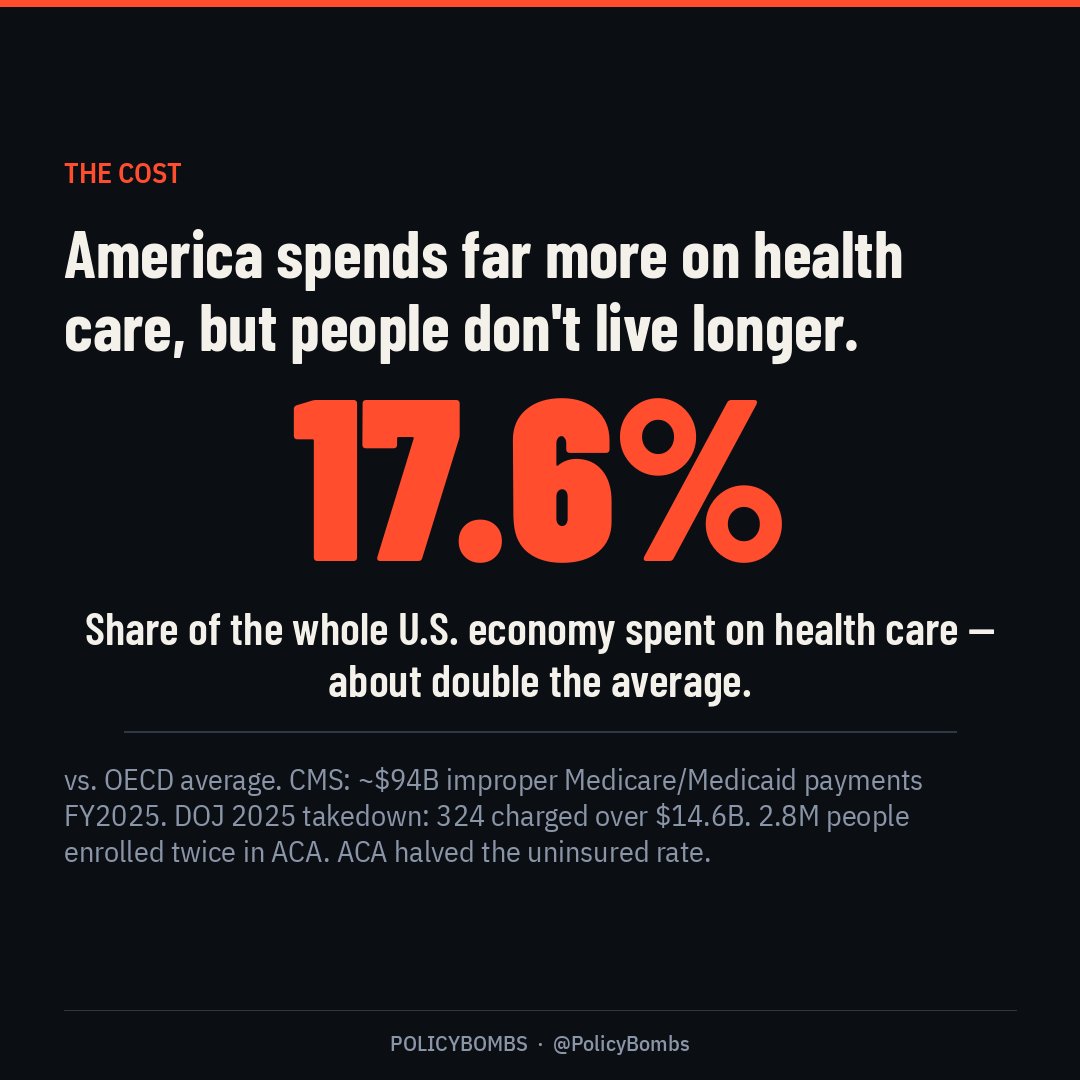
17.6% of GDP. That's what the US spends on health care, roughly double the OECD average, and Americans still live shorter lives.
The main driver is high prices. CMS estimated about $94B in improper Medicare and Medicaid payments in FY2025, and DOJ's 2025 takedown charged 324 people over $14.6B in alleged fraud. ACA subsidies drew broker schemes, and 2.8M people were enrolled twice. Yet the ACA cut the uninsured rate in half, and the 2025 cuts will reverse part of that.
PRO: ACA was a net good on coverage and mortality.
CON / COST: Subsidies fueled broker fraud; 2025 cuts drop more eligible than fraudulent (CBO: 10M more uninsured).
SOCIETY: Real fix is price discipline plus means-tested coverage.
Full analysis
US Healthcare System: Policy Assessment
The ACA, US costs against outcomes in other OECD countries, and the fiscal path of Medicare and Medicaid, including the 2025 law and the 2026 expiry of enhanced subsidies. As of Nov 4, 2026.
Content as of Nov 4, 2026, 8:33 PM ET. Source Page: PolicyBombs canvas
Long-form deep analysis. Companion to the 10-minute quick reference (09-healthcare-summary.docx).
10-Minute Voter Guide
Who’s for / against: For single-payer: Sen. Sanders, Rep. Pramila Jayapal, and CA Asm. Ash Kalra (CalCare). For the ACA: Democrats (passed with zero GOP votes). Against ACA repeal: Sens. McCain, Collins, and Murkowski (R), whose votes defeated the 2017 repeal. Republicans’ 2025 law added Medicaid work requirements.
The US spends about 17.6% of GDP on health care, roughly double the OECD average, and Americans live shorter lives. The main driver is high prices. CMS estimated about $94B in improper payments in Medicare and Medicaid in FY2025, and DOJ’s 2025 takedown charged 324 people over $14.6B in alleged fraud. ACA subsidies attracted broker schemes, including a $233M fraud conviction, and 2.8M people were enrolled twice. The ACA cut the uninsured rate in half. The 2025 cuts will reverse part of that.
Pros of expanding public coverage | Cons |
+ Medicaid expansion linked to lower death rates + Uninsured rate fell from about 16% to 8% + Medical debt protection | – About $94B a year in improper payments (CMS FY2025) – Brokers enrolled people without their consent for subsidies – Medicare hospital fund runs out in 2033 |
Bottom line: Support candidates who pair coverage with hard anti-fraud verification and price limits. Distrust both cut-only and spend-only plans.
Contents
- 10-Minute Voter Guide
- Key facts
- 1. What is the policy
- 2. Why it exists
- 3. Realized effects
- Fraud, waste and abuse findings
- 4. Good or bad for society
- Who supports / who opposes
- References
Bottom line: The US spends about twice the OECD average per person and gets shorter lives. The main reason is higher prices (hospitals, physicians, drugs, administration), not more care. The ACA cut the uninsured rate sharply but didn’t control prices. The 2025 rollbacks are reversing some of its coverage gains. Medicare’s hospital fund runs dry in 2033. |
Key facts
Item | Figure | Source |
|---|---|---|
US health spending, 2023 | $4.9T; 17.6% of GDP | CMS National Health Expenditure data |
OECD average health spending | About 9% of GDP | OECD Health Statistics |
US life expectancy, 2023 | 78.4 years (OECD peers mostly 81–84) | CDC NCHS |
ACA Marketplace effectuated enrollment | 22.3M (2025) to about 17.5M projected 2026 | KFF |
Enhanced premium tax credits | Expired Dec 31, 2025 | ARPA/IRA sunset |
Average net Marketplace premium payment | $113 to $178 a month (+58%), 2026 | KFF |
Medicare HI trust fund depletion | 2033 (2026 Trustees) | Medicare Trustees, June 2026 |
Medicare enrollment / spending, 2025 | 69.3M; about $1.2T | Medicare Trustees |
2025 reconciliation law Medicaid changes (work requirements etc.) | 10M more uninsured in 2034 (7.5M Medicaid/CHIP, 2.4M Marketplace); about 15M including subsidy expiry | CBO, Aug 2025 |
1. What is the policy
Item | Detail |
|---|---|
Affordable Care Act (2010) | Medicaid expansion to 138% FPL (optional after NFIB v. Sebelius; 40 states plus DC have expanded), subsidized Marketplaces, guaranteed issue and community rating, and an individual mandate (penalty zeroed in 2019). |
Medicare | Federal coverage for 65+ and disabled people. Part A is funded by payroll tax. Parts B and D are about 75% general revenue. Medicare Advantage now covers about 51% of enrollees. The IRA (2022) introduced drug price negotiation, starting in 2026. |
Medicaid | Joint federal-state coverage for low-income people. The 2025 law (OBBBA) adds work requirements for expansion adults (from 2027), more frequent eligibility checks, limits on provider taxes, and cost-sharing. |
Employer coverage | About half of Americans, subsidized by the tax exclusion for employer premiums, the largest tax expenditure in the code. |
2. Why it exists
Stated reasons | Underlying drivers |
+ Cover the uninsured and people with preexisting conditions + Cost control (ACA ‘bending the curve’; GOP: entitlement reform) + Medicare: seniors’ security since 1965 + 2025 cuts: fiscal savings and ‘able-bodied’ work norms | – Hospitals, insurers, pharma and physician groups shaped the ACA in exchange for support (2009 industry deals) – Price regulation is blocked by provider lobbies; health care is among the top lobbying sectors – Medicare Advantage overpayment from coding intensity, estimated at tens of billions a year by MedPAC – 2025 Medicaid cuts helped offset the cost of the tax cuts in the same bill |
3. Realized effects
Item | Detail | Assessment |
|---|---|---|
Coverage | The uninsured rate fell from about 16% (2010) to about 8% (2023, Census). Medicaid expansion is linked to lower mortality in several quasi-experimental studies (e.g. Miller, Johnson and Wherry, QJE 2021). | Big gain |
Costs | Spending growth slowed in the 2010s but share of GDP stayed near 17–18%. Anderson et al., ‘It’s the prices, stupid’ (2003, updated 2019): US use of care is near OECD levels, and prices drive the gap. | Not controlled |
Outcomes | The US is strong on cancer survival and specialty care. It’s weak on life expectancy, maternal mortality, and avoidable deaths. Part of the life-expectancy gap is guns, drugs and car crashes, not medical care alone. | Poor value |
2026 reversal | Enhanced subsidies expired, and Marketplace enrollment is dropping. 2.2M fewer by Feb 2026 (CBPP), with deductibles at a record $3,786 (KFF). | Coverage falling |
Fiscal | Medicare and Medicaid are the main drivers of long-term federal deficits in CBO projections. HI turns to deficit in 2027. | Unsustainable |
Fraud, waste and abuse findings
Finding | What investigators concluded | Source |
|---|---|---|
Medicare fee-for-service improper payments, FY2025 | 6.55%, $28.83B. Improper means not properly paid or documented; it is not all fraud. | CMS FY2025 fact sheet |
Medicare Advantage (Part C), FY2025 | 6.09%, $23.67B, mostly diagnoses that plans’ records failed to support (upcoding risk) | CMS |
Medicaid, FY2025 | 6.12%, $37.39B; 77% was insufficient documentation, which CMS says is generally not a sign of fraud | CMS |
ACA advance premium tax credit (APTC) improper rate | 0.89%, $657M (benefit year 2023). This measures payment errors, not identity fraud. | CMS |
2025 National Health Care Fraud Takedown | 324 defendants, including 96 licensed professionals; $14.6B intended loss alleged | HHS-OIG / DOJ |
Duplicate enrollment, 2024 | Each month, 1.2M people were in Medicaid in two or more states and 1.6M in both Medicaid and subsidized ACA plans | CMS press release |
Broker enrollment fraud | Cory Lloyd and Steven Strong convicted (Nov 2025) for ACA enrollments without consent: $233M sought, at least $180M paid. CMS cut off subsidies for about 1.5M ineligible or unauthorized enrollees in 2025. | DOJ; Paragon citing CMS |
Phantom enrollees | 35% of 2024 enrollees (about 11.7M) filed no claims. Paragon estimates 6.4M improper enrollees and $27B in 2025. Paragon is a market-oriented think tank; zero claims alone don’t prove fraud. | Paragon Health Institute (contested) |
Minnesota Housing Stabilization Services (Medicaid) | Program shut down after widespread fraud; 8 charged (Sept 2025), with guilty pleas following | MPR News; KARE 11 |
What changed: the verdict now treats fraud and improper payments as a first-order problem. At about $94B a year, they are comparable to the savings in the 2025 cuts. Enhanced ACA subsidies with zero-premium plans plus enrollment through broker sites with no verification created a measurable fraud channel. Requiring verification is justified; cutting coverage wholesale is a blunter tool than the evidence supports.
4. Good or bad for society
Verdict: The US system is bad value: world-leading spending, middling results, and a price problem that both parties avoid because providers fight back. The ACA was a net good on coverage and mortality. Revised: the enhanced subsidies did fuel real broker fraud, so verification reforms are justified. But letting the subsidies lapse entirely, plus the 2025 Medicaid cuts, removes far more eligible people than fraudulent ones (CBO: 10M more uninsured). The fix that would work is price discipline (site-neutral payment, all-payer or reference pricing, MA coding reform) plus means-tested coverage. |
Strongest defense of the US system | Strongest critique |
+ Innovation: most new drugs and devices are developed and launched in the US + Short waits for specialists and elective surgery compared with Canada and the UK + Consumer choice, and high quality at the top end | – About twice the OECD cost per person, for shorter lives – Medical debt and coverage gaps that peer countries don’t have – Lobbying keeps prices high, a textbook case of capture |
Who supports / who opposes
For = expanding government-run or government-financed coverage. Against = repeal or cuts. Each row cites a numbered source below. Checked Nov 4, 2026.
Who | Party / level | Position | Evidence | Ref |
Sen. Bernie Sanders (I-VT); Rep. Pramila Jayapal (D-WA) | Democrat/Ind. | For | Lead sponsors of the Medicare for All Act | [1] |
Asm. Ash Kalra (D-CA) | Democrat | For | Authored AB 1400 (CalCare single-payer); pulled without floor vote Jan 2022 | [2] |
Gov. Gavin Newsom (D-CA) | Democrat | For | Signed SB 770 (2023) to pursue federal waiver toward unified financing; 2018 campaign backed single-payer | [3] |
House Democrats (219) | Democrat | For | Passed ACA 219–212 (Mar 21, 2010); 34 Democrats and all Republicans voted no | [4] |
Sens. John McCain, Susan Collins, Lisa Murkowski (R) | Republican (defectors) | For (qualified) | Voted no on 2017 "skinny repeal," which failed 49–51 | [5] |
Republicans; President Trump | Republican | Against | H.R. 1 (2025) added Medicaid work requirements and cuts; no Democrat voted yes | [6] |
Cross-party defectors: Three Republicans saved the ACA in 2017; 34 Democrats voted against it in 2010.
How positions shifted: Republicans moved from ‘repeal and replace’ (2017) to trimming Medicaid (2025). California Democrats campaigned on single-payer but have not passed it.
Sources for this section:
- [1] Congress.gov: H.R. 3421 Medicare for All Act (118th) (congress.gov) https://www.congress.gov/bill/118th-congress/house-bill/3421
- [2] CA Legislature: AB 1400 (2021) (leginfo.legislature.ca.gov) https://leginfo.legislature.ca.gov/faces/billNavClient.xhtml?bill_id=202120220AB1400
- [3] CA Legislature: SB 770 (2023) (leginfo.legislature.ca.gov) https://leginfo.legislature.ca.gov/faces/billNavClient.xhtml?bill_id=202320240SB770
- [4] House Clerk: Roll Call 165 (Mar 21, 2010) (clerk.house.gov) https://clerk.house.gov/evs/2010/roll165.xml
- [5] Senate: Roll call vote 115th Congress, 1st session, vote 179 (senate.gov) https://www.senate.gov/legislative/LIS/roll_call_votes/vote1151/vote_115_1_00179.htm
- [6] Congress.gov: H.R. 1 One Big Beautiful Bill Act (119th) (congress.gov) https://www.congress.gov/bill/119th-congress/house-bill/1
References
[1] 2026 Medicare Trustees Report. cms.gov. https://www.cms.gov/oact/tr/2026
[2] CMS National Health Expenditure data. cms.gov. https://www.cms.gov/data-research/statistics-trends-and-reports/national-health-expenditure-data
[3] KFF: 2026 Marketplace enrollment and premiums. kff.org. https://www.kff.org/affordable-care-act/what-we-know-so-far-about-2026-aca-marketplace-enrollment-premiums-and-deductibles/
[4] CBPP: Health coverage tracker. cbpp.org. https://www.cbpp.org/research/health/health-coverage-tracker-millions-of-people-are-losing-coverage-following-2025
[5] CMS FY2025 improper payments fact sheet. cms.gov. https://www.cms.gov/newsroom/fact-sheets/fiscal-year-2025-improper-payments-fact-sheet
[6] HHS-OIG: 2025 National Health Care Fraud Takedown. oig.hhs.gov. https://oig.hhs.gov/newsroom/media-materials/2025-national-health-care-fraud-takedown/
[7] CMS: 2.8M duplicate enrollments. cms.gov. https://www.cms.gov/newsroom/press-releases/cms-finds-2-8-million-americans-potentially-enrolled-two-or-more-medicaid-aca-exchange-plans
[8] DOJ: $233M ACA enrollment fraud conviction. justice.gov. https://www.justice.gov/opa/pr/president-insurance-brokerage-firm-and-ceo-marketing-company-convicted-233m-affordable-care
[9] Paragon: The Greater Obamacare Enrollment Fraud. paragoninstitute.org. https://paragoninstitute.org/private-health/the-greater-obamacare-enrollment-fraud/
[10] MPR: 8 charged in MN housing stabilization fraud. mprnews.org. https://www.mprnews.org/story/2025/09/18/feds-charge-8-tied-to-massive-minnesota-housing-fraud
[11] OECD Health Statistics. oecd.org. https://www.oecd.org/health/health-data.htm
[12] Miller, Johnson & Wherry, Medicaid and Mortality (QJE 2021). academic.oup.com. https://academic.oup.com/qje/article/136/3/1783/6124643
[13] CBO: Uninsured effects of H.R. 1 in 2034. cbo.gov. https://www.cbo.gov/publication/61463
PolicyBombs · Day 53. Follow @PolicyBombs on X.