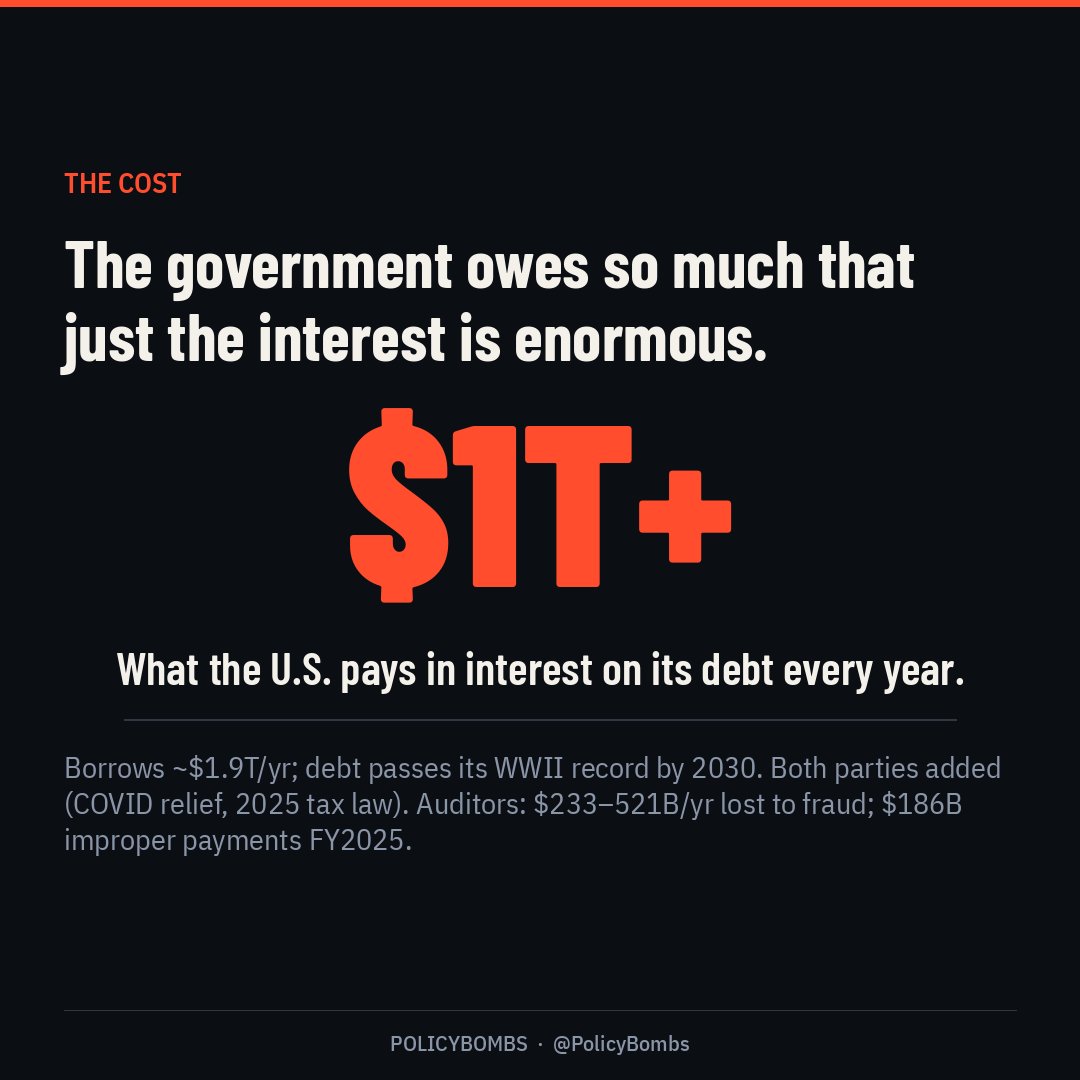
$1 trillion+. That's what the federal government now pays in interest on its debt each year.
It borrows about $1.9 trillion a year, and debt will pass its World War II record by 2030. Both parties added to it: COVID relief under both, and the 2025 tax law. Government auditors estimate $233 to $521 billion a year lost to fraud, plus $186 billion in improper payments in FY2025.
The good: Emergency deficits like 2020 can be justified. The cost: Permanent ~6% of GDP deficits shift costs to future taxpayers.
PRO: Emergency deficits like 2020 can be justified.
CON / COST: Permanent ~6% of GDP deficits shift costs to future taxpayers.
SOCIETY: Interest is crowding out other spending.
Full analysis
Federal Deficit Spending: Policy Assessment
Debt path, CBO’s Feb 2026 projections, interest costs, COVID spending and the 2025 tax law, with a verdict. As of Nov 4, 2026.
Content as of Nov 4, 2026, 8:33 PM ET. Source Page: PolicyBombs canvas
Long-form deep analysis. Companion to the 10-minute quick reference (15-deficit-spending-summary.docx).
Contents
- 10-Minute Voter Guide
- Key facts
- Debt trajectory
- 1. What is the policy
- 2. Why it exists
- 3. Realized effects
- 4. Good or bad for society
- Local investigations and data anomalies
- Who supports / who opposes
- References
10-Minute Voter Guide
Who’s for / against: Both parties add to deficits. Democrats passed the 2021 American Rescue Plan alone, and Republicans passed the 2025 tax-and-spending law alone (CBO estimates it adds ~$3.4T over 10 years). Deficit hawks who broke ranks: Sen. Rand Paul and Rep. Thomas Massie (R). The 2023 Fiscal Responsibility Act passed with bipartisan votes.
The federal government borrows about $1.9 trillion a year, and interest on the debt now tops $1 trillion. Debt will pass its World War II record by 2030. Both parties added to it: COVID relief under both, and the 2025 tax law. On top of that, the government’s own auditors say it loses an estimated $233 to $521 billion a year to fraud, plus $186 billion in improper payments in FY2025.
Arguments that deficits are OK | Arguments that they are dangerous |
+ Emergency borrowing in 2020 prevented deeper damage + The US borrows in its own currency | – Interest crowds out everything else – Fraud losses rival the defense budget at the high end – Social Security trust fund runs dry in 2032 |
Bottom line for voters: Ask candidates for a specific plan to cut the deficit and a specific plan to cut fraud and improper payments. ‘Waste’ with no program named is not a plan. |
Bottom line: Running deficits near 6% of GDP in a full-employment economy is bad policy, and both parties caused it. The deficit is now driven by interest costs rather than new programs. Debt is projected to pass its 1946 record by 2030. The 2025 tax law made the gap wider. Tariff revenue offset part of it, but that offset is legally and politically uncertain. |
Key facts
Metric | Value | Source |
|---|---|---|
FY2026 deficit (projected) | $1.9T, 5.8% of GDP | CBO Feb 2026 |
FY2036 deficit (projected) | $3.1T, 6.7% of GDP | CBO Feb 2026 |
50-year average deficit | 3.8% of GDP | CBO |
Debt held by public | 99% (2025), 101% (2026), 120% (2036), 175% (2056) | CBO |
Net interest | $970B (2025), over $1.0T (2026), $2.1T (2036), 3.3% to 4.6% of GDP | CBO |
2026–35 deficits vs Jan 2025 baseline | +$1.4T total: +$3.4T OBBBA-driven, +$0.7T interest, minus $2.7T mostly tariffs | CBO via Fiscal Lab |
Social Security OASI trust fund | Exhausted 2032 | CBO |
COVID relief laws 2020–21 | About $5T (CARES, Dec 2020 act, ARP) | CRFB tracker; approximate |
Debt trajectory
Chart data (shown as a chart on the Page)
Label | Value |
|---|---|
2025 | 99% of GDP |
2026 | 101% of GDP |
2030 | 108% of GDP |
2036 | 120% of GDP |
2056 | 175% of GDP |
Note at 2030: Passes 1946 record (106%)
Debt held by the public, CBO current-law projections (Feb 2026). Points are unevenly spaced in time.
1. What is the policy
Item | Detail |
|---|---|
Structural deficit | Revenues around 17% of GDP and outlays around 23%. The gap comes from Social Security, Medicare and Medicaid growth, defense, and now interest. The primary deficit is 2.6% of GDP in 2026, falling to 2.1% by 2036. Total deficits rise anyway because of interest. |
COVID spending (2020–21) | CARES Act ($2.2T), Dec 2020 relief ($0.9T) and the American Rescue Plan ($1.9T). The FY2020 deficit was about $3.1T, the largest on record. |
One Big Beautiful Bill Act (July 4, 2025) | Made the 2017 TCJA individual cuts permanent and added tax breaks on tips, overtime and seniors. It cut Medicaid and SNAP (through work requirements), ended EV credits, and raised border and defense funding. CBO (2025) estimated about $3.4T in added deficits over 10 years before interest. |
Tariffs (2025–26) | Customs revenue jumped. CBO credits about $2.7T in lower deficits, mainly from tariffs. But on Feb 20, 2026 the Supreme Court held 6–3 in Learning Resources v. Trump that IEEPA does not authorize tariffs. CBO’s baseline reflects trade policy as of Nov 20, 2025, so part of the tariff offset is now legally void unless replaced under other statutes (e.g., Sections 232, 301, 122). The size of the remaining offset is not verified here. |
2. Why it exists
Stated reasons: emergency stabilization (2008, 2020), growth from tax cuts, national defense, and protecting seniors’ benefits.
Underlying drivers: voters reward tax cuts and benefits and punish the costs. Neither party will touch Social Security or Medicare, the largest drivers. The GOP prioritizes tax cuts and Democrats prioritize spending, and bipartisan deals stack both. Low rates in 2010–21 made borrowing look free. Lobbying for tax expenditures and defense procurement adds to the gap. The bond market has not yet forced discipline.
3. Realized effects
Item | Detail | Assessment |
|---|---|---|
Interest costs | Net interest went over $1T in 2026, exceeding defense spending. It is projected to be nearly a fifth of spending by 2036. | Worsening |
Inflation | Studies (SF Fed, Jordà et al. 2022) estimate US fiscal support added roughly 2.5–3 points to 2021 core inflation. Others (Bernanke and Blanchard 2023) put more weight on energy and supply shocks. | Contributor |
COVID payoff | Fast recovery and child poverty at a record low in 2021 (SPM), but also large fraud. GAO and SBA OIG estimate $200B+ in potentially fraudulent PPP and EIDL loans; that is the SBA IG figure. | Mixed |
Credit rating | Moody’s downgraded the US from Aaa in May 2025, so all three major agencies now rate below AAA. | Negative |
Crowding out | CBO estimates higher debt lowers private investment and future income. This is a slow erosion, not a sudden crisis. | Long-run cost |
4. Good or bad for society
Verdict: Bad. Deficits during emergencies like 2020 can be justified, though the 2021 ARP was oversized for a recovering economy. Permanent deficits near 6% of GDP at low unemployment shift costs to future taxpayers, and interest is crowding out other spending. The 2025 tax law worsened the structural gap. |
Case that deficits are fine | Case that they are dangerous |
+ The US borrows in its own reserve currency; Japan carries far higher debt + Stabilizers and emergency spending cut recession damage + Primary deficit is projected to shrink | – Interest grows faster than the economy when rates are above growth – Leaves little fiscal room for the next crisis – Trust fund exhaustion in 2032 forces automatic benefit cuts |
- Adopt a debt-stabilization target (e.g., primary surplus by 2035).
- Fix Social Security on a bipartisan commission timeline before 2032.
- Pay for extensions; trim tax expenditures.
Local investigations and data anomalies
Finding | Source | What investigators or courts concluded |
|---|---|---|
Federal fraud losses $233B-$521B a year (FY2018-22), 3-7% of obligations | GAO-24-105833 | First government-wide estimate; includes pandemic years; not predictive |
Improper payments $186B in FY2025 (up $24B); about $3T since 2003; TANF not even measured | GAO-26-108694 | Totals understate the problem because some risky programs don’t report |
Feeding Our Future (MN): claimed 91 million meals; about $250M in child-nutrition funds stolen; sponsor grew from $3.4M (2019) to nearly $200M (2021) | US District Court, D. Minn.; DOJ | 70 charged; Aimee Bock convicted on all counts (Mar 2025), sentenced to 500 months and $243M restitution (May 2026); a juror-bribery attempt was charged separately |
PPP and EIDL potentially fraudulent loans $200B+ | SBA OIG | Estimate, not adjudicated total |
The anomaly pattern: a sponsor’s funding jumped 58-fold in two years while the state agency flagged it but kept paying. That is the clearest local sign of control failure under emergency waivers. Verdict: unchanged (bad), with an added finding. Fraud and improper payments are a significant, measurable share of the deficit problem and get little attention in deficit debates.
Further reading (also listed in References):
- GAO: federal fraud loss estimate (2024) — gao.gov
- GAO-26-108694: improper payments $186B in FY2025 — gao.gov
- DOJ: Feeding Our Future ringleader sentenced to 500 months — justice.gov
- MPR News: Bock sentencing (May 2026) — mprnews.org
Who supports / who opposes
For = voted for the deficit-increasing law. Against = voted no on deficit grounds. Mixed = bipartisan restraint deal. Each row cites a numbered source below. Checked Nov 4, 2026.
Who | Party / level | Position | Evidence | Ref |
Speaker Kevin McCarthy (R) & President Biden (D) | Bipartisan | Mixed | Fiscal Responsibility Act of 2023 (H.R. 3746) passed House 314–117 and Senate 63–36; 71 R and 46 D voted no in the House | [1] |
Democrats; President Biden | Democrat | For | American Rescue Plan (H.R. 1319, 2021), $1.9T, passed with no Republican votes | [2] |
Republicans; President Trump | Republican | For | H.R. 1 (2025); CBO estimate ~$3.4T added to deficits over 2025–2034 | [3] |
Rep. Thomas Massie (R-KY); Sen. Rand Paul (R-KY) | Republican (defectors) | Against | Voted no on H.R. 1 (2025), citing deficits | [3] |
Cross-party defectors: Massie and Paul voted against their own party’s 2025 bill on deficit grounds. Dozens of Democrats and Republicans voted against the 2023 debt-limit deal.
How positions shifted: Republicans emphasized deficits under Obama and Biden, then passed deficit-increasing tax laws in 2017 and 2025. Democrats now cite CBO deficit scores against Republican bills.
Sources for this section:
- [1] Congress.gov: H.R. 3746 Fiscal Responsibility Act (congress.gov) https://www.congress.gov/bill/118th-congress/house-bill/3746
- [2] Congress.gov: H.R. 1319 American Rescue Plan (congress.gov) https://www.congress.gov/bill/117th-congress/house-bill/1319
- [3] CBO: Estimated budgetary effects of H.R. 1 (2025) (cbo.gov) https://www.cbo.gov/publication/61570
References
[1] GAO: federal fraud loss estimate (2024). gao.gov. https://www.gao.gov/products/gao-24-105833
[2] GAO-26-108694: improper payments $186B in FY2025. gao.gov. https://www.gao.gov/assets/gao-26-108694.pdf
[3] DOJ: Feeding Our Future ringleader sentenced to 500 months. justice.gov. https://www.justice.gov/opa/pr/feeding-our-future-ringleader-sentenced-500-months
[4] MPR News: Bock sentencing (May 2026). mprnews.org. https://www.mprnews.org/story/2026/05/21/aimee-bock-feeding-our-future-fraud-sentencing
[5] CBO: Budget and Economic Outlook 2026–2036. cbo.gov. https://www.cbo.gov/publication/62105
[6] CBO Director’s statement (Feb 2026). cbo.gov. https://www.cbo.gov/publication/62050
[7] Fiscal Lab: Feb 2026 CBO outlook breakdown. fiscallab.org. https://fiscallab.org/guides/cbo-budget-outlook-2026/
[8] Learning Resources v. Trump opinion (Feb 20, 2026). supremecourt.gov. https://www.supremecourt.gov/opinions/25pdf/24-1287%5F4gcj.pdf
[9] CRS: Supreme Court rules against IEEPA tariffs. congress.gov. https://www.congress.gov/crs-product/LSB11398
[10] CRFB COVID Money Tracker. covidmoneytracker.org. https://www.covidmoneytracker.org/
[11] SF Fed: Why is US inflation higher than in other countries?. frbsf.org. https://www.frbsf.org/research-and-insights/publications/economic-letter/2022/03/why-is-us-inflation-higher-than-in-other-countries/
[12] SBA OIG: COVID-19 pandemic EIDL and PPP loan fraud landscape. sba.gov. https://www.sba.gov/document/report-23-09-covid-19-pandemic-eidl-ppp-loan-fraud-landscape
PolicyBombs · Day 59. Follow @PolicyBombs on X.