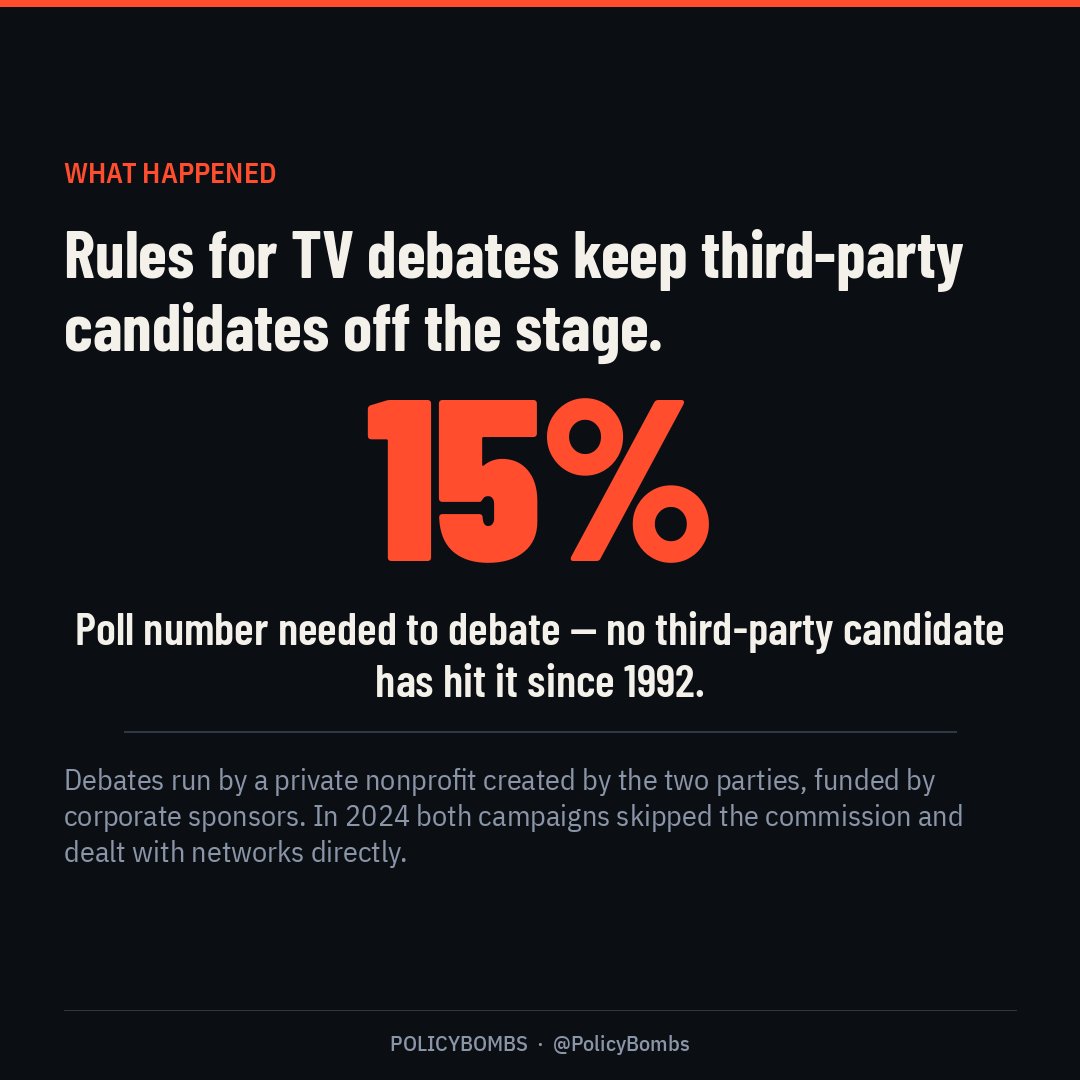
15%. That's the polling bar to get on the presidential debate stage. No third-party candidate has cleared it since 1992.
Presidential debates are run by a private nonprofit created by the Republican and Democratic parties and paid for by corporate sponsors. In 2024 the two campaigns skipped the commission entirely and cut deals with TV networks directly.
The good: Lowering the bar would cost little and improve legitimacy. The cost: A duopoly-run, self-fulfilling threshold shrinks voter choice.
PRO: Lowering the bar would cost little and improve legitimacy.
CON / COST: A duopoly-run, self-fulfilling threshold shrinks voter choice.
SOCIETY: Campaigns setting their own terms is worse still.
Full analysis
Open Presidential Debates: Policy Assessment
Who controls general-election debate access, how the 15% rule works, what happened in 2024, and whether third-party candidates should get in. As of Nov 4, 2026.
Content as of Nov 4, 2026, 8:33 PM ET. Source Page: PolicyBombs canvas
Long-form deep analysis. Companion to the 10-minute quick reference (16-open-debates-summary.docx).
Contents
- 10-Minute Voter Guide
- Key facts
- 1. What is the policy
- 2. Why it exists
- 3. Realized effects
- 4. Good or bad for society
- Local investigations and data anomalies
- Who supports / who opposes
- References
10-Minute Voter Guide
Who’s for / against: For keeping the current 15% gate: the CPD (founded by the RNC and DNC) and, in 2024, both the Biden and Trump campaigns. For opening debates: third-party candidates (RFK Jr., Jill Stein, Gary Johnson) and Level the Playing Field. The RNC voted to quit the CPD in 2022.
Presidential debates are run by a private nonprofit created by the Republican and Democratic parties and paid for by corporate sponsors. To get on stage, a candidate needs 15% in national polls, a bar no third-party candidate has cleared since 1992. In 2024 the two campaigns skipped the commission and cut deals with TV networks directly.
Arguments for the current rules | Arguments against |
+ Keeps the stage to people who could win + Rules are announced in advance | – Built by the two parties to exclude rivals – Corporate sponsors with policy interests fund it – You can’t reach 15% without debate exposure |
Bottom line for voters: The system protects incumbents of both parties. Support a lower, transparent entry bar run by an independent sponsor. |
Bottom line: Debate access is a private arrangement run by and for the two major parties. The 15% polling threshold has kept every third-party candidate out since 1996. In 2024 the two campaigns bypassed even the bipartisan commission and negotiated directly with networks. A lower, transparent threshold would serve voters better than the current setup. |
Key facts
Item | Detail | Status (Nov 2026) |
|---|---|---|
Commission on Presidential Debates (CPD) | Private nonprofit founded 1987 by the RNC and DNC chairs | Exists; says it will return in 2028 |
CPD criteria (since 2000) | Constitutional eligibility; ballot access for 270 electoral votes; 15% average in 5 national polls | Unchanged |
Last third-party candidate on stage | Ross Perot, 1992 (19% vote) | None since |
2024 arrangement | Biden and Trump camps agreed directly: CNN (June 27) and ABC (Sept 10); CBS VP debate (Oct 1) | Used 15% rule; RFK Jr. excluded |
Level the Playing Field v. FEC | Challenged the 15% rule | Lost (D.C. Cir. 2020) |
2028 arrangements | No sponsor, dates, format or party commitments announced | CPD says it will return; checked Nov 2026 |
1. What is the policy
Item | Detail |
|---|---|
CPD rules | FEC regulation (11 CFR 110.13) lets nonprofits stage debates if they use ‘pre-established objective criteria.’ The CPD set 15% in 2000 after Perot’s 1996 exclusion. Ballot access for 270 electoral votes is also required. |
2024 | In May 2024 both campaigns announced they would skip the CPD. Biden’s team cited CPD scheduling (debates after early voting). Trump agreed to CNN and ABC. The networks adopted the 15% rule plus 270-vote ballot access by deadline; RFK Jr. did not qualify. A second Trump–Harris debate never happened. |
Status | The CPD remains, but its role is uncertain. The RNC voted in 2022 to withdraw from CPD debates. Primary debates are run by the parties themselves. |
2. Why it exists
Stated reasons: keep stages to viable candidates, ensure orderly formats, give voters a serious choice between plausible winners.
Underlying drivers: the commission was created by the two parties, and its co-chairs have been party insiders. Both parties gain by keeping out spoilers (Perot, Nader, Johnson). Corporate sponsors underwrite the events. Campaigns now negotiate terms directly to gain format advantages, such as muted mics and no audience in CNN 2024. A catch-22: candidates can’t reach 15% without the exposure a debate gives.
3. Realized effects
Item | Detail | Assessment |
|---|---|---|
Exclusion | Gary Johnson polled in the high single digits to about 10% in 2016 and was excluded. RFK Jr. hit low-to-mid teens in some 2023–24 polls but fell short of a 15% average. Polls in 1992 had Perot below 15% before his debates. | Effective gatekeeping |
Viewership | Debates remain the largest civic audiences: 2024 ABC debate about 67M viewers (Nielsen), CNN about 51M. | High stakes |
Impact | The June 2024 debate led to Biden’s withdrawal on July 21, 2024, showing debates can change races. | Decisive |
Legal | Courts have deferred to the FEC; challenges argued the rule is a bipartisan in-kind contribution. They lost on deference grounds, not on evidence of fairness. | Stuck |
4. Good or bad for society
Verdict: Bad as structured. A duopoly-run gate with a self-fulfilling 15% threshold reduces voter choice and accountability. Lowering the bar (e.g., ballot access for 270 votes plus 5% polling, or a stage for any candidate who could mathematically win) would cost little and improve legitimacy. The 2024 practice of campaigns setting terms directly is worse still. |
Case for the 15% rule | Case for opening debates |
+ Keeps focus on candidates who can win + Limits fringe or novelty candidates + Objective and pre-announced | – Polls are noisy and depend on name recognition – Perot’s 1992 run shows outsiders can be viable – Large shares of voters say they want more choices (Gallup support for a third party is often above 50%) |
- Set entry at 270-vote ballot access plus 5% average or a mathematical path.
- Make the sponsor independent, with no party-appointed board.
- Fix the debate calendar before early voting starts.
Local investigations and data anomalies
Finding | Source | What investigators or courts concluded |
|---|---|---|
CPD is funded largely by corporate sponsors (e.g., Anheuser-Busch, $550,000 in 2000 and a sponsor every cycle since 1996) | Center for Public Integrity investigation; CPD Form 990s | Legal under FEC rules; sponsors gain access but no quid pro quo has been proven |
Complaints that the 15% rule is an illegal corporate contribution to the two parties | FEC MURs; Level the Playing Field v. FEC | FEC dismissed; D.C. Circuit upheld the dismissal (2020) |
Co-chairs are former party chairs; Frank Fahrenkopf receives no salary per 990s | CPD 990s (ProPublica) | No self-dealing found in filings |
No ‘dark money’ in the legal sense was found: CPD’s donors appear on its filings and in reporting. The structural conflict is in plain sight, not hidden. Verdict: unchanged.
Further reading (also listed in References):
- Center for Public Integrity: The buying of the presidential debates — publicintegrity.org
- ProPublica Nonprofit Explorer: CPD 990s — propublica.org
- FEC MUR file on CPD criteria — fec.gov
Who supports / who opposes
For = opening debates to third parties. Against = current gatekeeping. Mixed = bypassing the CPD while keeping the 15% bar. Each row cites a numbered source below. Checked Nov 4, 2026.
Who | Party / level | Position | Evidence | Ref |
Republican National Committee | Republican | Mixed | Voted unanimously (Apr 2022) to withdraw from CPD debates | [1] |
Biden and Trump campaigns | Both | Mixed | Bypassed CPD in 2024 and negotiated network debates using a 15% threshold | [2] |
Robert F. Kennedy Jr. (independent, 2024) | Independent | For | Filed FEC complaint against CNN’s debate criteria (2024) | [3] |
Level the Playing Field; Gary Johnson & Jill Stein (2016 suit) | Third parties | For | Sued over the 15% rule; lost (D.C. Cir. 2020) | [4] |
Cross-party defectors: The RNC quit the CPD it co-founded, but over alleged bias, not to open debates to third parties.
How positions shifted: Both major parties have backed tighter control. The 2024 deals moved debates from a bipartisan commission to direct campaign-network negotiations.
Not included or not fully verified: Could not source any sitting member of Congress’s bill to lower the 15% threshold; none found.
Sources for this section:
- [1] Ballotpedia: Commission on Presidential Debates (ballotpedia.org) https://ballotpedia.org/Commission_on_Presidential_Debates
- [2] Semafor: Why Biden and Trump ditched the CPD (semafor.com) https://www.semafor.com/article/05/17/2024/why-biden-and-trump-ditched-the-commission-on-presidential-debates
- [3] Ballotpedia: Presidential debates 2024 (ballotpedia.org) https://ballotpedia.org/Presidential_debates,_2024
- [4] FEC MUR file on CPD criteria (fec.gov) https://www.fec.gov/files/legal/murs/current/118231.pdf
References
[1] Center for Public Integrity: The buying of the presidential debates. publicintegrity.org. https://www.publicintegrity.org/politics/the-buying-of-the-presidential-debates/
[2] ProPublica Nonprofit Explorer: CPD 990s. propublica.org. https://projects.propublica.org/nonprofits/organizations/521500977
[3] FEC MUR file on CPD criteria. fec.gov. https://www.fec.gov/files/legal/murs/current/118231.pdf
[4] CPD: Overview and candidate criteria. debates.org. https://www.debates.org/about-cpd/overview/
[5] Semafor: Why Biden and Trump ditched the CPD. semafor.com. https://www.semafor.com/article/05/17/2024/why-biden-and-trump-ditched-the-commission-on-presidential-debates
[6] Ballotpedia: Commission on Presidential Debates. ballotpedia.org. https://www.ballotpedia.org/Commission_on_Presidential_Debates
[7] 11 CFR 110.13 (FEC debate staging). ecfr.gov. https://www.ecfr.gov/current/title-11/chapter-I/subchapter-A/part-110/section-110.13
[8] Citizens’ Debate Commission: reform proposals. citizensdebates.org. https://citizensdebates.org/debate-reform-today/
[9] The Hill: CPD chair says ‘we’ll be back in 2028’. thehill.com. https://thehill.com/newsletters/evening-report/4742020-evening-report-debates-chairman-rips-cnn-format/
PolicyBombs · Day 60. Follow @PolicyBombs on X.