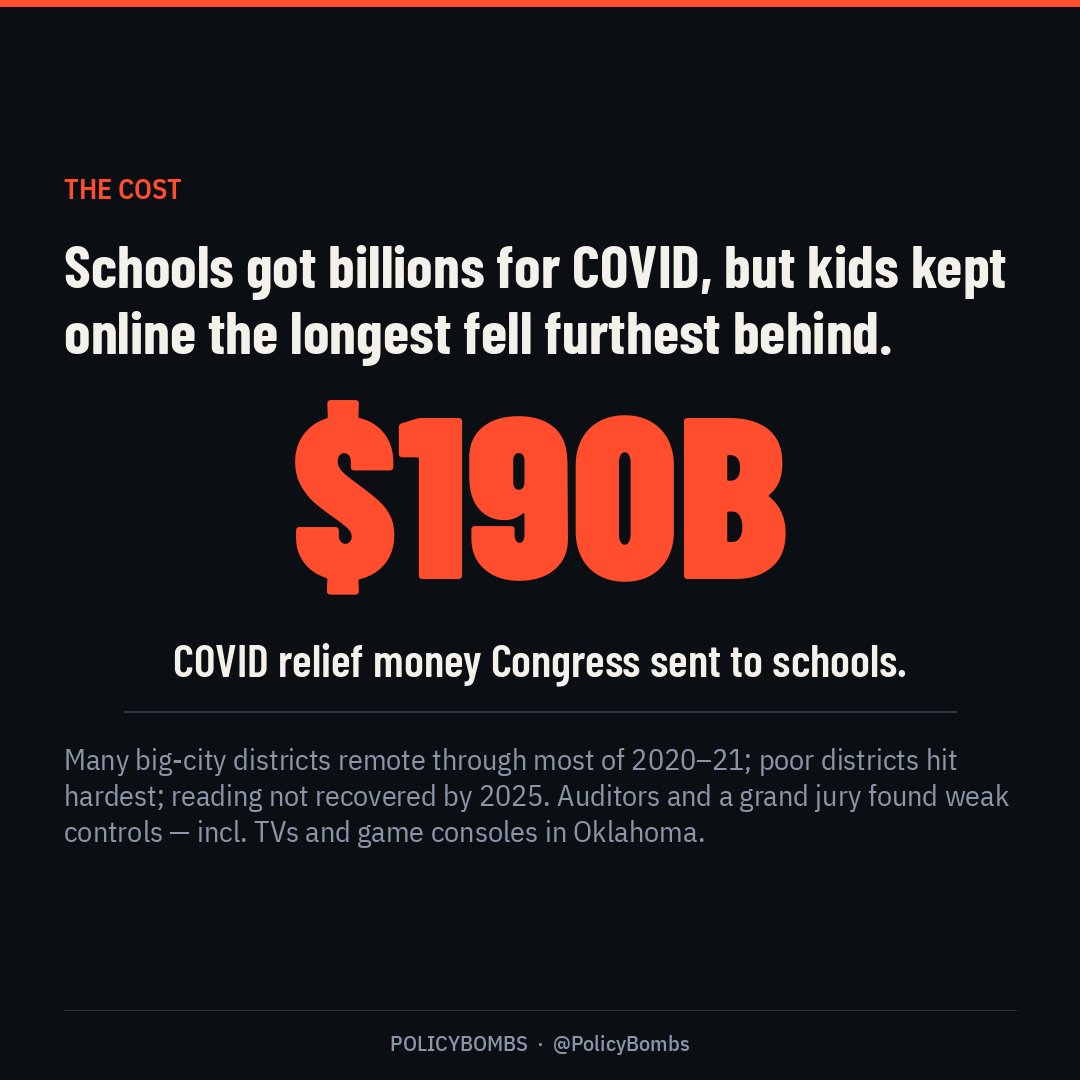
$190 billion. That's what Congress sent schools in COVID relief. Test scores still fell most where schools stayed remote longest.
Many big-city districts stayed remote through most of 2020-21. Poor districts were hit hardest, and reading still hadn't recovered by 2025. State auditors and a grand jury later found some relief money spent with weak controls, including on TVs and game consoles in Oklahoma.
The good: The fair defense covers spring 2020 only. The cost: Large, lasting learning, earnings and equity costs; small child health benefit.
PRO: The fair defense covers spring 2020 only.
CON / COST: Large, lasting learning, earnings and equity costs; small child health benefit.
SOCIETY: Union pressure and partisanship, not just evidence, kept districts closed.
Full analysis
COVID School Closures: Policy Assessment
How long US schools stayed remote, what NAEP and the Education Recovery Scorecard show, the union role in CDC guidance, and a verdict. As of Nov 4, 2026.
Content as of Nov 4, 2026, 8:32 PM ET. Source Page: PolicyBombs canvas
Long-form deep analysis. Companion to the 10-minute quick reference (17-school-closures-summary.docx).
Contents
- 10-Minute Voter Guide
- Key facts
- 1. What is the policy
- 2. Why it exists
- 3. Realized effects
- 4. Good or bad for society
- Local investigations and data anomalies
- Who supports / who opposes
- References
10-Minute Voter Guide
Who’s for / against: For fast reopening in 2020: President Trump and Gov. DeSantis (R). For longer closures: teachers’ unions (AFT’s Randi Weingarten) and many big-city districts that stayed remote into 2021. San Francisco Democrats recalled 3 school-board members in 2022, with Mayor Breed’s support.
Many big-city districts kept schools remote through most of 2020-21. Test scores fell the most in places that stayed remote longest, especially in poor districts, and reading still hadn’t recovered by 2025. Congress sent about $190 billion in school relief (ESSER). State auditors and a grand jury later found some of it was spent with weak controls, including on TVs and game consoles in Oklahoma.
Arguments for the closures | Arguments against |
+ Early 2020 was genuinely uncertain + Protected high-risk staff and families before vaccines | – Children were at very low risk; Europe reopened sooner – Largest learning losses on record, hitting poor kids hardest – Relief money was partly wasted with weak oversight |
Bottom line for voters: Back officials who commit to keeping schools open in emergencies and to publishing how every relief dollar was spent. |
Bottom line: Closing schools in spring 2020 was defensible given what was known then. Keeping many districts remote through 2020–21, after evidence showed in-person school was low-risk, was a serious policy failure. The heaviest costs fell on poor and minority students. Teachers’ union influence on federal guidance is documented. Scores were already sliding before COVID, and reading had not fully recovered as of 2025. |
Key facts
Item | Finding | Source |
|---|---|---|
NAEP 2022 math | Grade 4 down 5 points, grade 8 down 8, the largest drop on record | NCES |
NAEP 2024 | Reading down 2 more points in grades 4 and 8; grade 4 math up slightly; grade 8 math flat | NCES (Jan 2025) |
Remote vs in-person | Districts remote longer lost more, especially high-poverty ones | Education Recovery Scorecard (Harvard/Stanford) |
2026 Scorecard | Declines started about 2013; math rebounding since 2022; reading turned only in 2025; U-shaped recovery | Harvard CEPR, May 2026 |
CDC Feb 2021 guidance | CDC shared a draft with AFT and accepted AFT edits (GOP majority finding); AFT and committee Democrats say CDC consulted widely and AFT sought safe reopening | House Select Subcommittee final report, Dec 2024 |
ESSER relief | About $190B across three laws | US Dept of Education |
Chronic absenteeism | About doubled from about 15% pre-pandemic to about 28% in 2022; still elevated | AEI / Return to Learn tracker; approximate |
1. What is the policy
Item | Detail |
|---|---|
Spring 2020 | Nearly all US public schools closed by late March 2020 under state orders. |
2020–21 school year | Districts and states chose locally. Many Southern and rural districts and private and Catholic schools reopened in fall 2020. Many large urban districts (LA, Chicago, SF, Seattle, Washington DC) stayed fully or mostly remote into spring 2021, some for over a year. Chicago’s union held a strike vote in Jan 2022 and closed schools for several days. |
Federal guidance | CDC Feb 12, 2021 Operational Strategy tied reopening to community transmission tiers and six-foot distancing. Revised to three feet in March 2021. |
Status | No closures in force. ESSER funds expired Sept 2024 (liquidation into 2026). States are now adopting high-dosage tutoring and science-of-reading laws. |
2. Why it exists
Stated reasons: protect students, staff and families from COVID; uncertainty in early 2020; ventilation and staffing concerns.
Underlying drivers: teachers’ unions (AFT, NEA, and big-city locals in Chicago and LA) used reopening as leverage for safety demands and sometimes broader political demands. Democratic officials in union-aligned cities deferred to them. Brookings and other studies found reopening correlated more with local partisanship and union strength than with COVID case rates. Some parents in high-risk communities also wanted to stay remote. Liability fears pushed administrators toward caution.
3. Realized effects
Item | Detail | Assessment |
|---|---|---|
Learning loss | Scorecard research (Kane, Reardon et al.) finds remote time explains a meaningful share of district-level losses, with the highest-poverty remote districts losing the most. Losses are measurable in later earnings estimates. | Large |
Inequality | Gaps widened between high- and low-poverty districts and between high and low achievers. NAEP 2024 lowest-percentile students fell furthest. | Widened |
Health benefit | Studies of in-person schooling with mitigation found limited added transmission in 2020–21. European schools reopened in spring 2020 without major surges attributed to schools. The marginal health benefit of extended closure appears small. | Small |
Recovery | 2026 Scorecard: math is rebounding, aided by federal relief in high-poverty districts. Middle-income districts lag. Reading only started turning in 2025, and the decline predates COVID (since about 2013, linked by some to smartphones and reading curricula). | Partial |
Mental health and absenteeism | Chronic absenteeism nearly doubled and has stayed elevated. Youth mental-health crises rose, though causation is shared with social media trends. | Persistent |
4. Good or bad for society
Verdict: Extended closures were bad for society. The learning, earnings and equity costs were large and lasting, and the health benefit for children was small. Union pressure and partisanship, not just evidence, kept many urban districts closed. The fair defense covers spring 2020 only. |
Case for closures | Case against extended closures |
+ Early 2020 uncertainty and no vaccines + Protect older teachers and multigenerational households + Ventilation and staffing were not ready | – Children faced very low COVID risk; Europe reopened safely – Lost learning is worth trillions in lifetime earnings (Hanushek estimates) – Harm was concentrated on poor and minority students |
- Future pandemic plans: schools last to close, first to open.
- Make reopening decisions evidence-tiered and transparent, not negotiated.
- Sustain tutoring and phonics-based reading reform.
Local investigations and data anomalies
Finding | Source | What investigators or courts concluded |
|---|---|---|
Oklahoma ‘Bridge the Gap’ (GEER funds via ClassWallet): about $1.7M spent on non-educational items (Xbox consoles, TVs, appliances, furniture, Christmas trees); state declined available purchase controls | Oklahoma State Auditor Cindy Byrd (2022) | Mismanagement confirmed |
Same program | Oklahoma Multi-County Grand Jury, Oct 2024 | Found pervasive mismanagement and waste but returned no indictments |
State lawsuit against ClassWallet | Oklahoma AG Drummond, Jan 2026 | Case dismissed; AG called it baseless |
West Virginia: 37 of 54 county districts noncompliant with ESSER rules, including improper purchases | WV Legislative Auditor (PERD), Nov 2023 | Misspending and weak documentation; recoveries not verified here |
Tulsa Public Schools: $4.9M in reimbursements with inadequate invoices; $110,801 unallowable | Oklahoma State Auditor | Unsupported and unallowable costs |
Des Moines schools’ ESSER use | US Dept of Education OIG | Federal OIG audit of district spending; see report for findings |
Pattern: emergency education money moved faster than controls, and auditors repeatedly found unsupported or off-purpose spending. Grand juries and courts did not find criminal intent in the Oklahoma case. Verdict on closures: unchanged. New: relief spending oversight was weak and deserves its own accountability.
Further reading (also listed in References):
- Oklahoma AG: Multi-County Grand Jury on GEER education funds (Oct 2024) — oklahoma.gov
- Oklahoma AG: ClassWallet case dismissed (Jan 2026) — oklahoma.gov
- WV Legislative Auditor: ESSER review (Nov 2023) — wvlegislature.gov
- Oklahoma State Auditor: Tulsa Public Schools audit — sai.ok.gov
- ED OIG: Des Moines ESSER use — oig.ed.gov
Who supports / who opposes
For = in-person reopening in 2020–21. Against = prolonged closures. Each row cites a numbered source below. Checked Nov 4, 2026.
Who | Party / level | Position | Evidence | Ref |
President Donald Trump | Republican | For (qualified) | Jul 8, 2020 tweet: schools should open; "May cut off funding if not open!" | [1] |
Gov. Ron DeSantis (R-FL); Ed. Commissioner Richard Corcoran | Republican | For (qualified) | Emergency Order DOE 2020-EO-06 required brick-and-mortar schools to reopen (Jul 6, 2020, for August reopening) | [2] |
AFT President Randi Weingarten | Union (D-aligned) | Against (qualified) | AFT suggested language adopted in CDC Feb 2021 reopening guidance; testified to House panel (2023) | [3] |
SF voters; Mayor London Breed (D) | Democrat (local) | For (qualified) | Recalled board members Collins, López, Moliga (Feb 2022) amid parent anger over slow reopening | [4] |
Cross-party defectors: San Francisco’s recall was driven by Democratic parents and backed by a Democratic mayor.
How positions shifted: By 2022–24 most Democrats, including Biden, acknowledged the learning losses from long closures. The House select subcommittee’s final report (Dec 2024) criticized CDC/AFT coordination.
Not included or not fully verified: The AFT–CDC language detail comes from House select subcommittee findings, not re-opened this turn.
Sources for this section:
- [1] American Presidency Project: Trump tweets of July 8, 2020 (presidency.ucsb.edu) https://www.presidency.ucsb.edu/documents/tweets-july-8-2020
- [2] Florida DOE Emergency Order 2020-EO-06 (fldoe.org) https://www.fldoe.org/core/fileparse.php/19861/urlt/DOE-2020-EO-06.pdf
- [3] House Oversight: Select Subcommittee on the Coronavirus Pandemic (oversight.house.gov) https://oversight.house.gov/
- [4] Ballotpedia: San Francisco Unified School District recall (2022) (ballotpedia.org) https://ballotpedia.org/San_Francisco_Unified_School_District_recall,_California_(2021-2022)
References
[1] Oklahoma AG: Multi-County Grand Jury on GEER education funds (Oct 2024). oklahoma.gov. https://oklahoma.gov/oag/news/newsroom/2024/october/multi-county-grand-jury-finds-pervasive-mismanagement-waste-in-governors-pandemic-relief-funds-for-education.html
[2] Oklahoma AG: ClassWallet case dismissed (Jan 2026). oklahoma.gov. https://oklahoma.gov/oag/news/newsroom/2026/january/drummond-lauds-dismissal-of-baseless-classwallet-case.html
[3] WV Legislative Auditor: ESSER review (Nov 2023). wvlegislature.gov. https://www.wvlegislature.gov/legisdocs/reports/perd/DOE.ESSER_NOVEMBER_2023.pdf
[4] Oklahoma State Auditor: Tulsa Public Schools audit. sai.ok.gov. https://www.sai.ok.gov/Search%20Reports/database/TPS%20Audit%20Report%20web%20final.pdf
[5] ED OIG: Des Moines ESSER use. oig.ed.gov. https://oig.ed.gov/reports/other/des-moines-independent-community-school-districts-use-elementary-and-secondary-school
[6] Education Recovery Scorecard, May 2026 report. educationscorecard.org. https://educationscorecard.org/wp-content/uploads/2026/05/Education_Scorecard_May_2026_Report.pdf
[7] Harvard GSE: U-shaped recovery. gse.harvard.edu. https://www.gse.harvard.edu/ideas/news/26/05/new-education-scorecard-finds-u-shaped-recovery
[8] NAEP: Nation’s Report Card. nationsreportcard.gov. https://www.nationsreportcard.gov/
[9] Chalkbeat: Tom Kane on recovery (May 2026). chalkbeat.org. https://www.chalkbeat.org/2026/05/21/tom-kane-on-test-scores-and-learning-loss-recovery/
[10] Return to Learn tracker (AEI). returntolearntracker.net. https://www.returntolearntracker.net/
[11] House Select Subcommittee final report (Dec 4, 2024), AFT/CDC chapter pp. 415–437. oversight.house.gov. https://oversight.house.gov/wp-content/uploads/2024/12/12.04.2024-SSCP-FINAL-REPORT.pdf
[12] AFT rebuttal: The Select Subcommittee’s revisionist history. aft.org. https://www.aft.org/sites/default/files/media/documents/2024/TheSelectSubcommitteesRevisionistHistoryofSchoolClosures.pdf
PolicyBombs · Day 61. Follow @PolicyBombs on X.