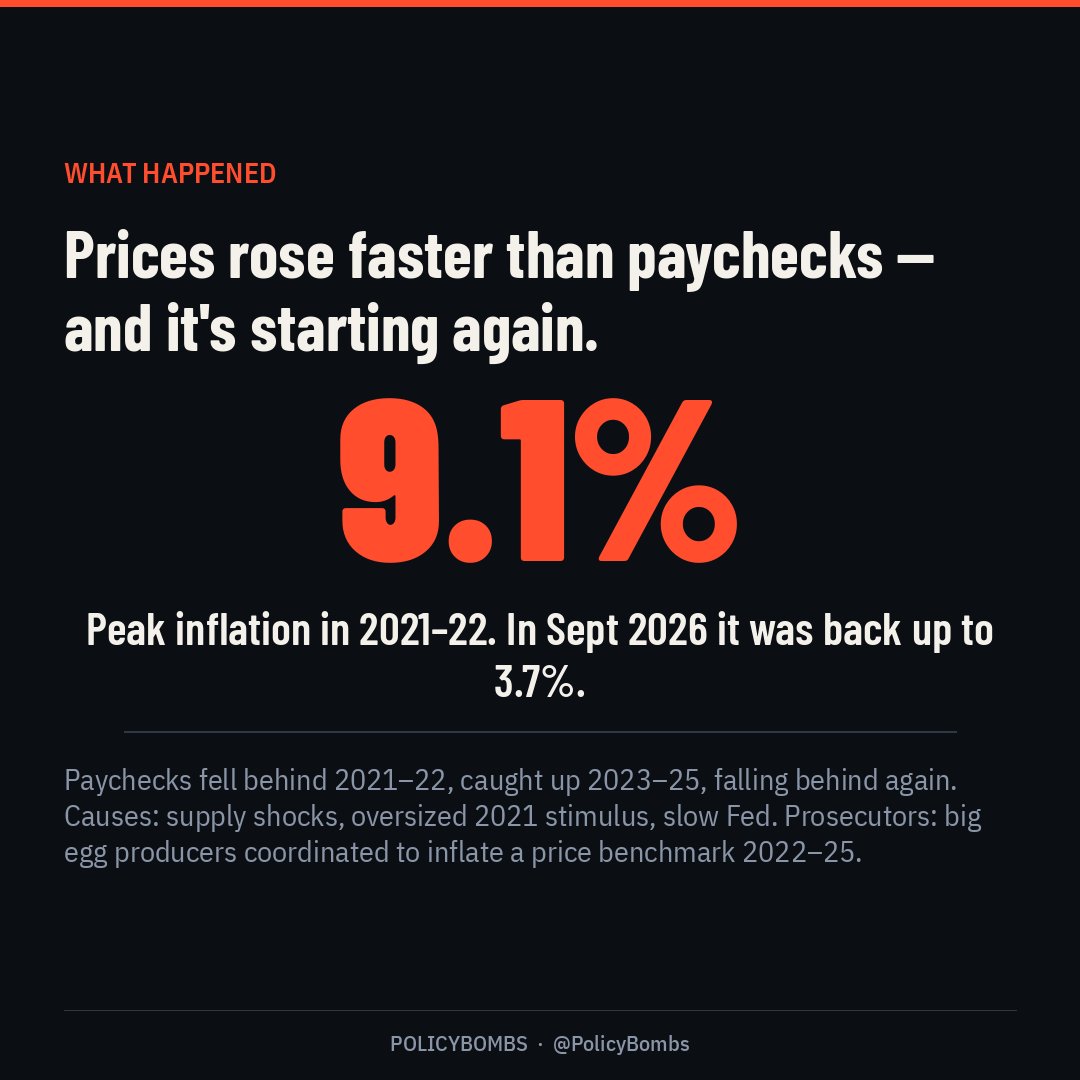
9.1%. That was peak inflation in 2021-22. And in 2026 it's rising again: 3.7% in September, mostly gasoline.
Paychecks fell behind in 2021-22, caught up in 2023-25, and are falling behind again. Causes: global supply shocks, an oversized 2021 stimulus, and a slow Fed. Prosecutors also found big egg producers coordinated to inflate a key price benchmark from 2022 to 2025.
The good: Fast, strong jobs recovery that past recoveries lacked. The cost: ARP oversized and Fed late turned a supply shock into broad inflation.
PRO: Fast, strong jobs recovery that past recoveries lacked.
CON / COST: ARP oversized and Fed late turned a supply shock into broad inflation.
SOCIETY: 2026 wage squeeze: energy plus tariff pass-through.
Full analysis
Inflation vs Wages, 2021–2026: Policy Assessment
CPI against real wages from 2021 to Sept 2026 using BLS data, and how much fiscal stimulus, Fed policy and supply shocks each explain. As of Nov 4, 2026.
Content as of Nov 4, 2026, 8:32 PM ET. Source Page: PolicyBombs canvas
Long-form deep analysis. Companion to the 10-minute quick reference (20-inflation-wages-summary.docx).
Contents
- 10-Minute Voter Guide
- Key facts
- CPI inflation, December readings
- 1. What is the policy
- 2. Why it exists
- 3. Realized effects
- 4. Good or bad for society
- Local investigations and data anomalies
- Who supports / who opposes
- References
10-Minute Voter Guide
Who’s for / against: For raising wages by law: most Senate Democrats (42 voted for Sanders’ 2021 $15 amendment), Gov. Newsom (CA $20 fast-food wage), and Sen. Josh Hawley (R), who co-led a $15 bill. Against: most Republicans. 8 Democratic-caucus senators voted against the $15 amendment in 2021.
Prices jumped in 2021-22 (peak 9.1%), cooled by 2024, and are rising again in 2026 (3.7% in September, mostly gasoline after the Iran war hit oil supply). Paychecks fell behind in 2021-22, caught up in 2023-25, and are falling behind again. Causes: global supply shocks, oversized 2021 stimulus, and a slow Fed. Prosecutors also found big egg producers coordinated to inflate a key price benchmark from 2022 to 2025.
Defense of 2021 policy | Criticism |
+ Fast jobs recovery, no recession + Low-wage workers gained most by 2024 | – Prices permanently higher – Real wages falling again in 2026 – Some producers exploited the chaos to manipulate prices |
Bottom line for voters: Ask how candidates will avoid stimulus that overheats the economy, keep energy supply stable, and enforce antitrust laws against price manipulation. |
Bottom line: Real wages fell through 2021–22, recovered in 2023–25, and are falling again in 2026: Sept 2026 CPI 3.7% vs 3.0% wage growth. The 2021–22 surge had three causes: supply shocks, oversized fiscal stimulus in 2021, and a Fed that waited too long. The price level never comes back down, so households still feel poorer even after wages caught up. |
Key facts
Item | Figure | Source |
|---|---|---|
CPI peak | 9.1% y/y, June 2022 (highest since 1981) | BLS |
CPI, Sept 2025 | 3.0% y/y | BLS |
CPI, Sept 2026 | 3.7% y/y; core 2.6%; energy +20.4% | BLS / JEC |
Avg hourly earnings, Sept 2026 | $37.81, up 3.0% y/y | BLS |
Real avg hourly earnings, Sept 2026 | Down 0.7% y/y ($11.24 in 1982–84 dollars) | BLS |
Real avg weekly earnings, Sept 2026 | Down 0.1% y/y (longer hours offset part) | BLS |
Fed funds rate | Near 0 until Mar 2022; 5.25–5.50% peak Jul 2023 to Sept 2024 | Federal Reserve |
Fiscal stimulus 2020–21 | About $5T, incl. $1.9T ARP (Mar 2021) | CRFB |
CPI inflation, December readings
Chart data (shown as a chart on the Page)
Label | Value |
|---|---|
2020 | 1.4% |
2021 | 7% |
2022 | 6.5% |
2023 | 3.4% |
2024 | 2.9% |
Sept 2025 | 3% |
Sept 2026 | 3.7% |
CPI-U, 12-month change. Dec 2020–2024 values from BLS annual releases. The last two points are September readings.
1. What is the policy
Item | Detail |
|---|---|
Fiscal | CARES (2020), Dec 2020 relief, and the American Rescue Plan (Mar 2021) included stimulus checks, enhanced unemployment benefits and the expanded Child Tax Credit. The Inflation Reduction Act (2022) had small near-term effects on inflation either way, per CBO. |
Monetary | Zero rates plus about $120B a month of asset purchases through late 2021. The Fed called inflation ‘transitory’ into Nov 2021, then raised rates 525 basis points from Mar 2022 to Jul 2023. Cuts began in Sept 2024. |
Supply and trade | Pandemic supply-chain snarls, the 2022 Russia–Ukraine energy and food shock, and 2025–26 tariffs (Yale Budget Lab and others estimate a price-level boost). The 2026 energy spike (energy +20.4% and gasoline +34.2% y/y in Sept 2026, per BLS) followed the Iran war’s disruption of oil flows through the Strait of Hormuz and strikes on Russian refineries; crude rose from below $70 to over $100 a barrel (AP, BBC). |
2. Why it exists
Stated reasons: avoid a 2008-style slow recovery, protect households, and pursue a ‘hot labor market’ under the Fed’s 2020 flexible average inflation targeting framework.
Underlying drivers: political incentive to send visible checks before 2020 and after the 2021 inauguration. Economists like Larry Summers and Jason Furman warned early in 2021 that the ARP was about three times the output gap. The Fed’s new framework biased it toward waiting. Tariffs in 2025–26 were pursued for industrial and revenue goals despite expected price effects.
3. Realized effects
Item | Detail | Assessment |
|---|---|---|
Real wages | Fell through 2021–22 as prices outpaced pay. Recovered 2023–25; lower-wage workers gained most, a compression documented by Autor, Dube and McGrew (2023). Turned negative again in 2026. | Round trip |
Causes, quantified | Bernanke and Blanchard (2023): early inflation driven mostly by energy, food and sectoral shortages, with labor-market tightness growing later. SF Fed (2022): US fiscal support added about 3 points relative to peer countries. Inflation also rose sharply in Europe with less stimulus, which points to global shocks. | Shared blame |
Labor market | Unemployment fell to 3.4% (Apr 2023) with no recession. A soft landing was achieved. | Positive |
Consumer sentiment | Sentiment stayed depressed after real wages recovered, because the price level is about 20%+ higher than in 2020 and borrowing costs rose. | Negative |
4. Good or bad for society
Verdict: The 2021 policy mix was bad on net for inflation. The ARP was oversized for a recovering economy and the Fed moved late, so a supply shock became broad inflation. The trade-off was a fast, strong jobs recovery that previous recoveries lacked. 2026’s renewed real-wage decline is driven by energy plus tariff pass-through, and warrants scrutiny of current trade and energy policy. |
Defense of 2021 policy | Critique |
+ Fastest jobs recovery in decades; no recession + Low-wage workers saw real gains by 2024 + Global inflation shows most was not US policy | – US core inflation ran hotter than peers – ‘Transitory’ delay required much higher rates later – Price level permanently higher; savers and fixed incomes lost |
- Size stimulus to the output gap.
- Fed: act on forecasts, not just realized data.
- Avoid tariffs and energy policy that add supply-side inflation.
Local investigations and data anomalies
Finding | Source | What investigators or courts concluded |
|---|---|---|
Cal-Maine, Versova and Hickman’s coordinated bids to inflate the Urner Barry daily egg-price benchmark, June 2022 to March 2025, raising prices to retailers and consumers | DOJ Antitrust Division with state AGs (NY, CA, TX and others), 2026 | Settlement: $3.3M to states, more than 53 million eggs donated, ban on competitor price communications, compliance programs. No admission of liability reported |
A settlement is not a court finding of guilt, and $3.3M is small next to the price effects alleged. Verdict: unchanged. Macro causes dominate; this is a documented example of manipulation inside the inflation period.
Further reading (also listed in References):
- DOJ: egg producers must end coordinated benchmark manipulation — justice.gov
- NY AG: 50M+ eggs and $3.3M after uncovering price scheme (2026) — ag.ny.gov
Who supports / who opposes
For = raising the minimum wage by law. Against = opposing a mandated increase. Each row cites a numbered source below. Checked Nov 4, 2026.
Who | Party / level | Position | Evidence | Ref |
Sen. Josh Hawley (R-MO) & Sen. Peter Welch (D-VT) | Bipartisan | For | Introduced S. 2013 Higher Wages for American Workers Act ($15 + inflation), Jun 10, 2025 | [1] |
Sen. Ron Johnson (R-WI) | Republican | Against | Said "I wouldn’t support it" about Hawley’s bill | [2] |
Gov. Gavin Newsom (D-CA) | Democrat | For | Signed AB 1228 (2023), $20 fast-food minimum wage | [3] |
Sen. Bernie Sanders (I-VT) | Independent | For | $15 amendment to the American Rescue Plan failed 42–58 (Mar 5, 2021); all Republicans and 8 Democratic-caucus senators voted no | [4] |
Cross-party defectors: Hawley is a rare Republican co-leading a minimum-wage hike. Eight Democratic-caucus senators voted against Sanders’ $15 amendment in 2021.
How positions shifted: Inflation from 2021 to 2023 outpaced wages until mid-2023. Republicans blamed Democratic spending, and the populist right has since warmed to wage floors.
Sources for this section:
- [1] Congress.gov: S. 2013 Higher Wages for American Workers Act (congress.gov) https://www.congress.gov/bill/119th-congress/senate-bill/2013
- [2] NBC News: Hawley introduces $15 minimum wage bill (nbcnews.com) https://www.nbcnews.com/politics/congress/gop-sen-josh-hawley-introduces-bill-raise-federal-minimum-wage-15-hour-rcna212095
- [3] CA Legislature: AB 1228 (2023) (leginfo.legislature.ca.gov) https://leginfo.legislature.ca.gov/faces/billNavClient.xhtml?bill_id=202320240AB1228
- [4] Senate: Roll call vote 117-1, No. 74 (Mar 5, 2021) (senate.gov) https://www.senate.gov/legislative/LIS/roll_call_votes/vote1171/vote_117_1_00074.htm
References
[1] DOJ: egg producers must end coordinated benchmark manipulation. justice.gov. https://www.justice.gov/opa/pr/justice-department-requires-egg-producers-end-coordinated-benchmark-manipulation
[2] NY AG: 50M+ eggs and $3.3M after uncovering price scheme (2026). ag.ny.gov. https://ag.ny.gov/press-release/2026/attorney-general-james-secures-more-50-million-eggs-and-33-million-after
[3] BLS Real Earnings, Sept 2026. bls.gov. https://www.bls.gov/news.release/realer.nr0.htm
[4] BLS Real Earnings Table A-1. bls.gov. https://www.bls.gov/news.release/realer.t01.htm
[5] CNBC: CPI report Sept 2026. cnbc.com. https://www.cnbc.com/2026/10/14/cpi-inflation-report-september-2026.html
[6] JEC monthly inflation update (Sept 2026). jec.senate.gov. https://www.jec.senate.gov/public/vendor/_accounts/JEC-R/inflation/Monthly%20Inflation%20Update%20(PDF).pdf
[7] BLS TED: gasoline up 34.2% over the year to Sept 2026. bls.gov. https://www.bls.gov/opub/ted/2026/prices-for-gasoline-increased-34-2-percent-over-the-year-ended-september-2026.htm
[8] AP: inflation accelerates on gasoline and energy (Oct 2026). apnews.com. https://apnews.com/article/consumer-prices-inflation-gasoline-energy-trump-c32cfa8b85ae53ceb7b1cc557d3b7400
[9] Bernanke and Blanchard: What caused the US pandemic-era inflation?. brookings.edu. https://www.brookings.edu/articles/what-caused-the-u-s-pandemic-era-inflation/
[10] SF Fed: Why is US inflation higher than in other countries?. frbsf.org. https://www.frbsf.org/research-and-insights/publications/economic-letter/2022/03/why-is-us-inflation-higher-than-in-other-countries/
[11] Autor, Dube and McGrew: The unexpected compression. nber.org. https://www.nber.org/papers/w31010
PolicyBombs · Day 64. Follow @PolicyBombs on X.