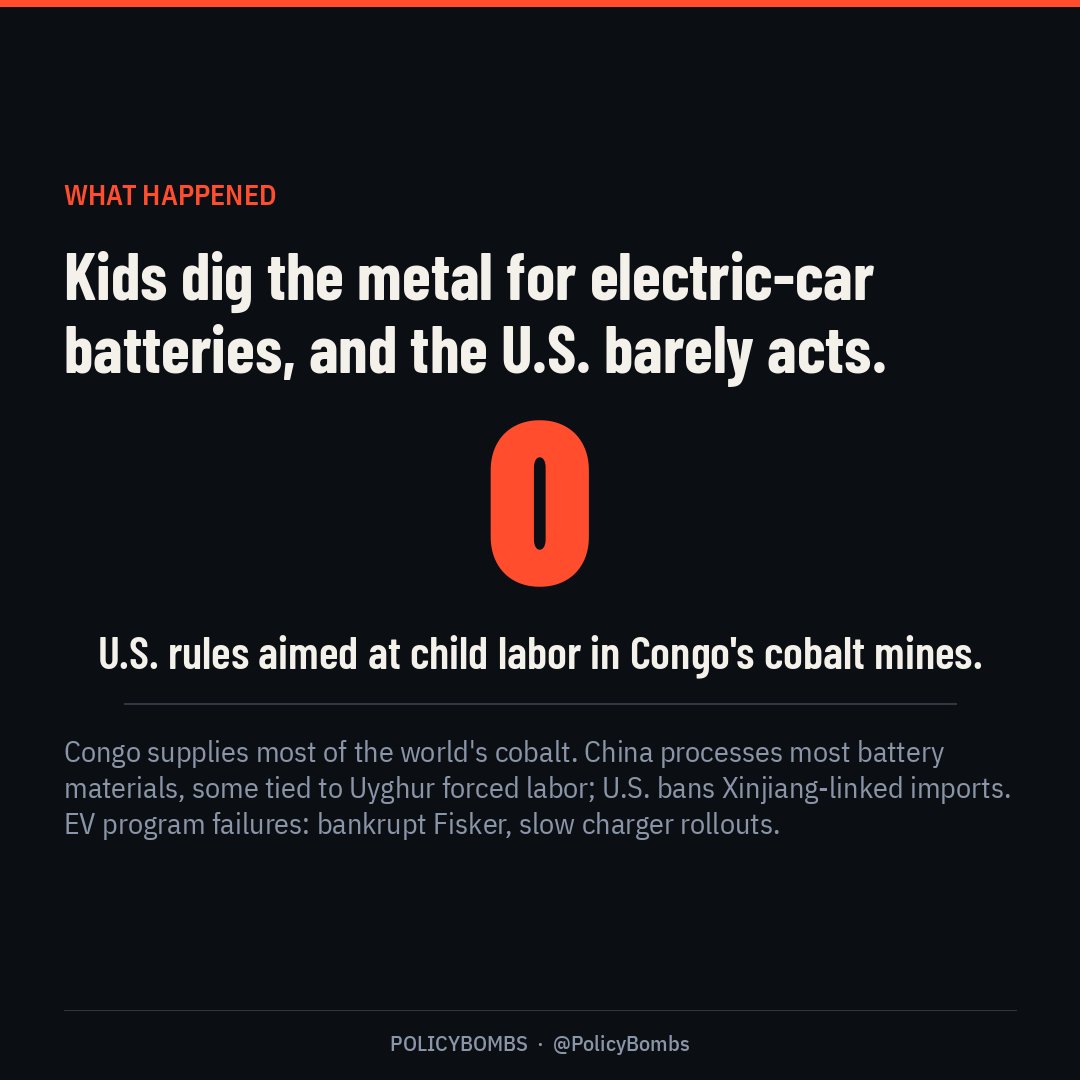
Zero. That's how many US rules specifically target child labor in Congo's cobalt mines, the source of most of the world's cobalt.
Children have been documented working in small-scale Congo mines. China processes most battery materials, some tied to Uyghur forced labor. The US bans Xinjiang-linked imports and restricted Chinese content in EV subsidies, but stays close to silent on Congo. Taxpayer EV programs had oversight failures too, from bankrupt Fisker to slow charger rollouts.
PRO: UFLPA is good policy.
CON / COST: EVs subsidized without traceable minerals.
SOCIETY: 'Child slavery' overstates; 'clean supply chain' understates.
Full analysis
Child and Forced Labor in EV Battery Supply Chains: Policy Assessment
Cobalt mining in the DRC, Uyghur forced labor, the UFLPA, and how US EV subsidy sourcing rules addressed or ignored it. As of Nov 4, 2026.
Content as of Nov 4, 2026, 8:32 PM ET. Source Page: PolicyBombs canvas
Long-form deep analysis. Companion to the 10-minute quick reference (21-ev-battery-labor-summary.docx).
Contents
- 10-Minute Voter Guide
- Key facts
- 1. What is the policy
- 2. Why it exists
- 3. Realized effects
- 4. Good or bad for society
- Local investigations and data anomalies
- Who supports / who opposes
- References
10-Minute Voter Guide
Who’s for / against: Bipartisan agreement against forced and child labor in supply chains (Uyghur Forced Labor Prevention Act, Rubio/Merkley). Split on EV mandates: Republicans plus 35 House Democrats voted to revoke California’s 2035 gas-car phase-out waiver (2025), and the 2025 law ended federal EV tax credits.
Most of the world’s cobalt, used in many EV batteries and phones, comes from Congo, where children have been documented working in small-scale mines. China processes most battery materials, and some suppliers are tied to Uyghur forced labor. The US bans Xinjiang-linked imports and restricted Chinese content in EV subsidies, but has no rule targeting Congo child labor. Taxpayer EV programs have also had oversight failures, from the bankrupt loan recipient Fisker to slow charger rollouts.
What policy gets right | What it misses |
+ Toughest forced-labor import ban in the world (UFLPA) + Pushes supply chains away from China | – No due-diligence rule for cobalt child labor – Weak oversight of EV subsidy and grant recipients – Consumer EV credit repealed, reducing leverage |
Bottom line for voters: Both ‘EVs run on child slavery’ and ‘clean supply chain’ are spin. Ask for mine-to-battery traceability and audited subsidy recipients. |
Bottom line: Child labor in Congolese cobalt and state-imposed Uyghur labor in Chinese minerals processing are documented. US policy targeted China (UFLPA, FEOC rules) far more than it targeted the DRC. EV subsidies were justified on climate grounds while the supply chain carried these abuses. The 2025 law ended the consumer EV credit anyway. Child labor in cobalt is real, but most cobalt also goes into phones, laptops and refining. Cobalt-free LFP batteries now reduce the exposure. |
Key facts
Item | Figure / status | Source |
|---|---|---|
DRC share of world cobalt mining | About 70%+ (2023–24) | USGS Mineral Commodity Summaries |
Children in southern DRC mines | About 40,000 (2014 estimate, cited by Amnesty 2016); old, not updated | UNICEF via Amnesty |
Artisanal share of DRC output | Estimates range roughly 10–30%; not verified for 2026 | Various (OECD, industry) |
China share of cobalt refining | About 75%+ | IEA |
Uyghur Forced Labor Prevention Act | In force since June 21, 2022; presumption of forced labor for Xinjiang-linked goods | CBP |
IRA 30D EV credit sourcing rules | Critical-mineral and battery-component thresholds; FEOC exclusions 2024–25 | IRS / Treasury |
30D termination | Ended for vehicles acquired after Sept 30, 2025 (OBBBA) | IRS |
45X battery FEOC threshold | Non-PFE material share 60% (2026) rising to 85% (2030+) | Treasury / IRS |
1. What is the policy
Item | Detail |
|---|---|
UFLPA (2021 law) | Goods made wholly or partly in Xinjiang, or by entities on the UFLPA Entity List, are presumed made with forced labor and barred at the border unless importers prove otherwise. Lithium, aluminum, polysilicon and battery-related firms have been added to the list over time. |
IRA Section 30D (2022) | The $7,500 credit was split. Half required critical minerals to be extracted or processed in the US or a free-trade partner. Half required battery components made in North America. Vehicles with batteries from a ‘foreign entity of concern’ (China and others) were excluded from 2024 (components) and 2025 (minerals). There was no explicit child-labor or DRC provision. |
2025 law | OBBBA ended 30D and 25E after Sept 30, 2025. The 45X manufacturing credit continues but, for tax years beginning after July 4, 2025, denies credit for battery components with ‘material assistance’ from a prohibited foreign entity. The non-PFE share of direct material costs must reach 60% in 2026, rising to 85% from 2030 (Treasury/IRS guidance). |
Other | Section 307 of the Tariff Act bars forced-labor goods (Withhold Release Orders). Dodd-Frank 1502 conflict-minerals rules cover tin, tantalum, tungsten and gold, not cobalt. EU Battery Regulation (2023) requires due diligence from 2025, later delayed. |
2. Why it exists
Stated reasons: human rights, energy security, climate, and reshoring manufacturing.
Underlying drivers: the FEOC and UFLPA rules are mostly about competing with China and protecting industry. Bipartisan China hawks and domestic manufacturers and unions backed them. Human-rights framing gave them broad support. The DRC gets less attention because Chinese firms (CMOC, Huayou) own most of its large mines, so US policy addressed it indirectly. Automakers lobbied to loosen IRA sourcing timelines.
3. Realized effects
Item | Detail | Assessment |
|---|---|---|
Child labor in DRC | Amnesty (2016) documented children as young as 7 in artisanal mines. Siddharth Kara’s ‘Cobalt Red’ (2023) is vivid but anecdotal. Industry and the Fair Cobalt Alliance say most battery cobalt comes from industrial mines, though artisanal ore mixes in at traders and refiners. Lawsuits against Apple, Tesla and others (Doe v. Apple) were dismissed in 2024. | Documented, scale unclear |
Uyghur forced labor | Sheffield Hallam ‘Driving Force’ (Dec 2022) found 96 auto-relevant firms in the Uyghur Region, at least 38 using state labor transfers, and over 100 international automakers or suppliers with exposure, including in batteries. CBP has detained billions in goods under UFLPA, mostly solar and apparel. Several battery-material firms are on the Entity List. | Documented |
Sourcing shifts | Fewer models qualified for 30D after FEOC rules. Automakers moved toward LFP (cobalt-free) and Korean, Japanese and US supply. Lower cobalt intensity reduces DRC exposure but raises dependence on Chinese LFP. | Partial |
Enforcement gaps | Traceability through refiners is weak. The UFLPA presumption does not reach DRC child labor. The 30D repeal removed the main US consumer-side lever. | Weak |
4. Good or bad for society
Verdict: Child and forced labor in battery supply chains is a real moral failure, and US policy treated it inconsistently. It was strict where China was the target, close to silent on DRC artisanal mining, and it subsidized EVs without requiring traceable minerals. UFLPA is good policy. A cobalt-specific due-diligence rule with audits is missing. "EVs run on child slavery" overstates the case. "Clean supply chain" understates it. |
Case that current policy is adequate | Case that it fails |
+ UFLPA is the world’s toughest forced-labor import ban + FEOC rules cut China dependence + LFP chemistry reduces cobalt need | – No DRC or cobalt child-labor provision – Refiner-level mixing defeats audits – Repeal of 30D removed leverage over automakers |
- Extend Dodd-Frank style due diligence to cobalt and lithium.
- Fund formalized artisanal mining and schooling in DRC (e.g., EGC, Fair Cobalt).
- Publish battery passports with mine-level traceability.
Local investigations and data anomalies
Finding | Source | What investigators or courts concluded |
|---|---|---|
DOE failed to obtain required financial and compliance audits for six for-profit EV grant recipients | DOE Inspector General (OAS-RA-12-11) | Control weakness confirmed |
Ecotality: about $100M charger project behind schedule, about 1,000 chargers uninstalled; DOE hadn’t fully disclosed concerns before its 2013 bankruptcy | DOE IG (OAS-RA-14-01) | Oversight failure; no fraud charges noted |
Fisker: $529M DOE loan guarantee; $192M disbursed; DOE recovered about $53M after bankruptcy | Center for Public Integrity; DOE | Taxpayer loss of about $139M; a business failure, not fraud |
NEVI federal charger program: 384 ports built by April 2025 under a $5B program | GAO-25-106992 | GAO called for improved performance management |
These are older (2010s) or program-level findings. A search for audits of 2022-25 IRA subsidy recipients found none to cite yet. Verdict: unchanged. Added point: subsidy oversight has been weak, so supply-chain ethics claims about subsidized products are hard to verify.
Further reading (also listed in References):
- DOE IG: Recent events related to Ecotality (2013) — energy.gov
- DOE IG audit OAS-RA-12-11 — energy.gov
- Center for Public Integrity: DOE bet on Fisker ends in bankruptcy — publicintegrity.org
- GAO-25-106992: EV infrastructure performance management — gao.gov
Who supports / who opposes
For = the named supply-chain or EV measure. Against = revoking or blocking it. Each row cites a numbered source below. Checked Nov 4, 2026.
Who | Party / level | Position | Evidence | Ref |
Sens. Marco Rubio (R-FL) & Jeff Merkley (D-OR) | Bipartisan | For | Uyghur Forced Labor Prevention Act (P.L. 117-78), signed Dec 23, 2021 | [1] |
House Republicans + 35 Democrats | Bipartisan | Against | H.J.Res. 88 revoking CA Advanced Clean Cars II waiver passed House (May 1, 2025); signed Jun 12, 2025 | [2] |
Gov. Gavin Newsom (D-CA); CARB | Democrat | For | Champions the Advanced Clean Cars II rule (100% zero-emission new-car sales by 2035), which H.J.Res. 88 revoked | [3] |
Republicans; President Trump | Republican | Against | H.R. 1 (2025) ended EV purchase credits after Sept 30, 2025 | [4] |
Cross-party defectors: 35 House Democrats voted to revoke California’s EV waiver.
How positions shifted: Democrats’ 2022 IRA tied EV credits to ‘foreign entity of concern’ sourcing rules. Republicans repealed the credits in 2025 instead of tightening the sourcing rules. Neither party has passed cobalt-specific DRC child-labor legislation.
Not included or not fully verified: Found no federal or California bill specifically on DRC cobalt child labor that received a vote.
Sources for this section:
- [1] Congress.gov: H.R. 6256 Uyghur Forced Labor Prevention Act (congress.gov) https://www.congress.gov/bill/117th-congress/house-bill/6256
- [2] House Clerk: Roll Call 114 (H.J.Res. 88) (clerk.house.gov) https://clerk.house.gov/Votes/2025114
- [3] CBS SF: House votes to block California gas-car ban (cbsnews.com) https://www.cbsnews.com/sanfrancisco/news/california-gas-powered-vehicle-ban-house-votes-to-block-hjres88/
- [4] Congress.gov: H.R. 1 One Big Beautiful Bill Act (119th) (congress.gov) https://www.congress.gov/bill/119th-congress/house-bill/1
References
[1] DOE IG: Recent events related to Ecotality (2013). energy.gov. https://www.energy.gov/sites/default/files/2013/11/f4/OAS-RA-14-01.pdf
[2] DOE IG audit OAS-RA-12-11. energy.gov. https://www.energy.gov/ig/articles/audit-report-oas-ra-12-11
[3] Center for Public Integrity: DOE bet on Fisker ends in bankruptcy. publicintegrity.org. https://publicintegrity.org/environment/energy-department-bet-on-fisker-automotive-ends-in-bankruptcy/
[4] GAO-25-106992: EV infrastructure performance management. gao.gov. https://files.gao.gov/reports/GAO-25-106992/index.html
[5] Amnesty: This is what we die for (2016). amnesty.org. https://www.amnesty.org/en/documents/afr62/3183/2016/en/
[6] USGS Mineral Commodity Summaries: Cobalt. usgs.gov. https://www.usgs.gov/centers/national-minerals-information-center/cobalt-statistics-and-information
[7] Sheffield Hallam: Driving Force (2022). shuforcedlabour.org. https://www.shuforcedlabour.org/drivingforce/
[8] IRS: guidance on prohibited foreign entity material assistance (OBBBA). irs.gov. https://www.irs.gov/newsroom/treasury-irs-provide-guidance-for-certain-energy-tax-credits-regarding-material-assistance-provided-by-prohibited-foreign-entities-under-the-one-big-beautiful-bill
[9] CBP: UFLPA statistics. cbp.gov. https://www.cbp.gov/newsroom/stats/trade/uyghur-forced-labor-prevention-act-statistics
[10] DHS: UFLPA Entity List. dhs.gov. https://www.dhs.gov/uflpa-entity-list
[11] IRS: Clean vehicle credits. irs.gov. https://www.irs.gov/credits-deductions/credits-for-new-clean-vehicles-purchased-in-2023-or-after
[12] IEA: Global critical minerals outlook. iea.org. https://www.iea.org/reports/global-critical-minerals-outlook-2024
PolicyBombs · Day 65. Follow @PolicyBombs on X.