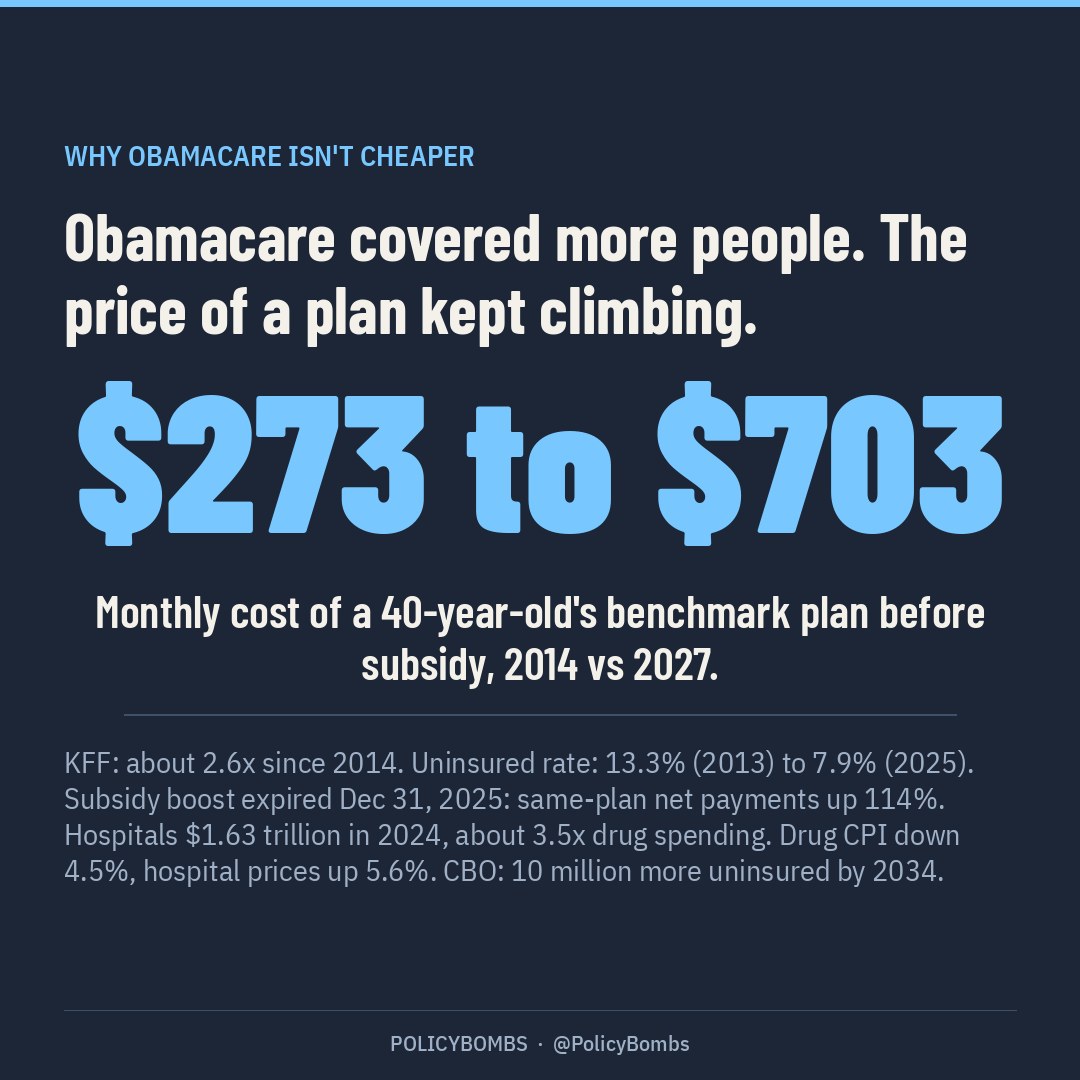
$273. That's what a 40-year-old's benchmark Obamacare plan cost per month in 2014, before subsidies. For 2027: $703. About 2.6 times as much. (KFF)
Coverage got better. Prices did not. The uninsured rate fell from 13.3% in 2013 to 7.9% in 2025. The law never attacked the price of care. It paid the bill. Subsidies rose with premiums, so taxpayers ate the increase.
Then the enhanced subsidies expired on Dec 31, 2025. People who kept the same plan saw net premium payments jump 114%. Enrollment fell from 21.8 million to 19.2 million.
The real bill is hospitals: $1.63 trillion in 2024, about 3.5 times what we spend on prescription drugs. Private plans paid hospitals 254% of Medicare rates. Hospital prices are still rising 5.6% a year.
The Trump administration's drug moves are real. TrumpRx, 26 most-favored-nation deals, Medicare negotiation cutting 15 drugs by 44%, PBM reform in law. Drug CPI is down 4.5%. But the big savings claims shrink under review: the Medicare GLOBE rule fell 96%, from $11.9 billion to $440 million. And CBO says the 2025 budget law leaves 10 million more uninsured by 2034.
The fraud was real. In one Florida broker scheme, street marketers sometimes bribed homeless people to sign up. Taxpayers paid at least $180 million in subsidies. Two executives got 20 years. GAO's fake applicants were still covered in 2025. Official estimates of improper subsidy payments run from $657 million to "as much as $20 billion," depending on who counts.
The debt: CBO scored the ACA as paid for. Then Congress repealed three of its taxes in 2019, a $373 billion revenue loss over 10 years (JCT), and borrowed for the 2021 subsidy boost. Subsidies went from $18 billion in 2014 to about $138 billion in 2025.
Is it sustainable? No. Subsidies rise with premiums, and premiums rise with prices. CBO projects federal debt at 175% of GDP by 2056, with interest at 6.9% of GDP. Through 2036, health care drives 63% of the growth in federal spending as a share of the economy (CBO via CRFB).
What would actually work: real dollar prices for every procedure, written into law with fines that scale (today's maximum is about $2 million a year for the biggest hospitals). Capping the highest hospital prices: one estimate says a cap at 200% of Medicare cuts premiums $889 billion over 10 years. Site-neutral pay, blocking price-raising mergers, targeting 340B, finishing PBM reform.
Immigrant eligibility? Undocumented immigrants already can't get federal Medicaid or marketplace coverage. The 2025 law cut most other noncitizens without green cards, saving $131 billion through 2034 (CBO). Emergency Medicaid was 0.4% of Medicaid in 2023. Real savings, but small next to a $1.63 trillion hospital bill.
PRO: The ACA cut the uninsured rate from 13.3% (2013) to 7.9% (2025). Medicaid expansion shows: poor adults uninsured 18.6% in expansion states vs 34.7% in non-expansion states. Recent drug moves are real: drug CPI down 4.5%, Medicare negotiation 44% on 15 drugs, PBM delinking in law.
CON / COST: Benchmark premium $273 (2014) to $703 (2027), about 2.6x. Same-plan net payments up 114% after the enhanced subsidies expired. Hospitals $1.63 trillion in 2024, about 3.5x drug spending, prices up 5.6% a year. GLOBE savings down 96%. CBO: 10 million more uninsured by 2034 from the 2025 budget law. Fraud: a convicted Florida broker scheme cost at least $180 million (20-year sentences, Feb 2026); GAO's fake applicants still covered in 2025; improper-payment estimates range from $657 million (CMS measurement) to "as much as $20 billion" (CMS rule citing Paragon, disputed). Debt: scored as paid for (CBO 2015), but $373 billion of ACA taxes repealed in 2019 (JCT) and the 2021 boost was borrowed; subsidies $18 billion (2014) to about $138 billion (2025).
SOCIETY: MIXED. Good policy: dollar prices for all care in law with scaling fines (max today about $2 million a year per large hospital); cap outlier hospital prices (200% of Medicare cap: $889 billion lower premiums over 10 years, CRFB/Arnold/West Health); target 340B; fix surprise-billing arbitration; enforce eligibility honestly (Emergency Medicaid $3.8 billion, 0.4% of Medicaid, FY2023; 2025 law immigrant limits $131 billion through 2034, 1.4 million uninsured, CBO). Coverage GOOD. Cost control, program integrity and fiscal sustainability BAD, under both parties. CBO: debt 100.6% of GDP (2026) to 175.1% (2056), interest 3.3% to 6.9% of GDP; Medicare hospital fund short in 2033 (Trustees) or 2040 (CBO). Fix the price of care (hospitals, mergers, middlemen), not just the size of the subsidy.
Full analysis
Research cutoff Nov 9, 2026, about 10:50 AM PST; updated about 11:45 AM PST with fraud, national debt and sustainability sections, and about 11:20 AM PST with what a good policy would include. Every figure comes from a source linked in References. Where sources disagree, both are named.
Key numbers
- $273 to $703: KFF average benchmark silver premium, 40-year-old, monthly, before subsidy, 2014 to 2027. About 2.6x (R1). [Substantiated]
- 105%: ASPE, average individual premium growth 2013 ($232) to 2017 ($476) in 39 HealthCare.gov states (R2). [Substantiated; not apples to apples]
- 114%: rise in net premium payments in 2026 for enrollees who kept the same plan after enhanced subsidies expired (R4). [Substantiated]
- 58% / 37%: average actual payment increase and deductible increase in 2026, after people bought down to cheaper plans (R4). [Substantiated]
- 21.8M to 19.2M: effectuated marketplace enrollment, 2025 to 2026, down 12% (R4, R5, R8). [Substantiated]
- 13.3% to 7.9%: uninsured rate, 2013 to 2025 (Census) (R11). [Substantiated]
- 18.6% vs 34.7%: uninsured rate for adults 19 to 64 below poverty, Medicaid expansion vs non-expansion states, 2025 (R12). [Substantiated]
- $5.3T, 18.0% of GDP, $15,474 per person: U.S. health spending, 2024. 2010: 17.2% and $8,377 (R13, R14). [Substantiated]
- $1,634.7B vs $467.0B: 2024 hospital spending vs prescription drug spending (R13). [Substantiated]
- 254%: what private plans paid hospitals relative to Medicare, 2022 (RAND) (R15). [Substantiated]
- $28,303: average family job-based premium, 2026; worker share $7,471 (R9). [Substantiated]
- -4.5% / +5.6%: CPI prescription drugs vs hospital services, Sept 2026 vs Sept 2025 (R18). [Substantiated]
- 10 million: CBO projected increase in uninsured in 2034 from the 2025 reconciliation law (R33). [Substantiated as projection]
- $180 million: subsidies the government paid in one Florida broker scheme; two executives sentenced to 20 years each, Feb 18, 2026 (DOJ) (R52). [Substantiated, convicted]
- 18 of 20: GAO's fictitious 2025 applicants still covered as of Sept 2025, at more than $10,000 a month in subsidies (R49). [Substantiated; GAO says results cannot be generalized]
- $657 million to "as much as $20 billion": official estimates of improper marketplace subsidy payments, depending on method (CMS measurement vs CMS rule citing Paragon) (R56, R55). [Disputed range]
- $353 billion: CBO and JCT, 2015: how much repealing the ACA would have added to deficits over 2016 to 2025 ($137 billion with economic feedback) (R63). [Substantiated as estimate]
- $373.3 billion: JCT cost of the 2019 repeal of three ACA taxes, 2020 to 2029 (R64). [Substantiated as estimate]
- $18 billion to about $138 billion: yearly premium tax credit cost, 2014 to 2025 (R65). [Substantiated; 2025 estimated]
- 100.6% to 175.1%: federal debt held by the public as a share of GDP, 2026 to 2056; net interest 3.3% to 6.9% of GDP (CBO, Feb 2026) (R70). [Substantiated as projection]
- 2033 vs 2040: Medicare hospital trust fund depletion, Trustees vs CBO (R69, R66). [Substantiated; sources disagree]
- $5,500 a day: the most CMS can fine the largest hospitals for hiding prices, about $2 million a year (R73). [Substantiated]
- +0.75%: change in billed charges when a New York price tool was released in a randomized trial; no change in use (NBER) (R77). [Substantiated]
- $3.8 billion, 0.4%: Emergency Medicaid spending in FY2023 and its share of Medicaid (R79). [Substantiated]
- 1.4 million, $131 billion: CBO estimate of lawfully present immigrants made uninsured and federal spending cut by 2034 under the 2025 law's eligibility limits (R80). [Substantiated as estimate]
- $10 billion a year: California state money for comprehensive Medi-Cal for undocumented residents, about one-quarter of Medi-Cal's General Fund cost (LAO) (R84). [Substantiated as estimate]
- $889 billion: premium savings over 10 years from capping commercial hospital prices at 200% of Medicare (CRFB/Arnold/West Health, not CBO) (R86). [Substantiated as estimate]
1. What is the policy
The Patient Protection and Affordable Care Act (H.R.3590), signed in March 2010, rebuilt the individual insurance market. Its core pieces: insurers must sell to everyone regardless of health and cannot price by health status; standardized "metal" plans (bronze, silver, gold, platinum) sold on marketplaces; income-based premium tax credits pegged to the second-lowest-cost silver ("benchmark") plan; cost-sharing reductions for lower-income buyers; and an option for states to expand Medicaid to adults up to 138% of the poverty line with a 90% federal match (R43).
Two later layers matter for 2026. First, the enhanced premium tax credits (2021 to 2025) removed the 400%-of-poverty cap and lowered what people paid. They expired on Dec 31, 2025, after Congress failed to extend them (R4, R36). Above 400% of poverty, buyers again get no tax credit (R5). Second, the 2025 reconciliation law, P.L. 119-21 (One Big Beautiful Bill Act, which the White House now calls the "Working Families Tax Cuts"), cut Medicaid and marketplace spending, added Medicaid work requirements, ended tax credits for some lawfully present immigrants from 2027, and expanded health savings accounts (R5, R20, R33, R44).
Why is Obamacare not cheaper, and what would fix it?
2. Why it exists
Before the ACA, people buying their own coverage could be turned down or charged more for pre-existing conditions, and about one in seven Americans had no insurance: Census puts the 2013 uninsured rate at 13.3%, and 18.5% for adults 19 to 64 (R11). The ACA's theory was coverage first: get everyone into a pool, subsidize the premium, and expand Medicaid.
The affordability promise was explicit. Candidate Barack Obama said his plan would cut a typical family's premium by up to $2,500 a year. PolitiFact rated it Promise Broken. An adviser, David Cutler, later said the figure meant total health costs, and a 2009 CBO analysis projected nongroup family premiums about $2,100 higher on average before subsidies, largely because the coverage was richer (R3).
The design choice that matters most for this bomb: the ACA mostly changed who pays and who is covered. It did not set or cap what hospitals, doctors or drug makers charge private insurers. Subsidies rise automatically with the benchmark premium, so taxpayers absorb price growth for subsidized buyers.
3. Realized effects
A. Coverage: the part that worked
- Uninsured rate: 13.3% (2013), 10.4% (2014), 9.1% (2015), 8.8% (2016), 7.9% (2022), 8.0% (2024), 7.9% (2025). That is 26.7 million people uninsured in 2025 (R10, R11). Adults 19 to 64: 18.5% to 11.0% (R11). [Substantiated]
- Medicaid expansion: 41 states including DC have expanded; more than 20 million people were covered through expansion as of June 2024; about 1.4 million adults fall into the coverage gap in the 10 non-expansion states (R43). In 2025, poor adults were uninsured at 18.6% in expansion states vs 34.7% in non-expansion states (R12). [Substantiated]
- Caveat: Census 2025 data predate the 2026 subsidy expiration, so there is no official 2026 uninsured number yet (R10). [Pending]
B. Price: the part that didn't
Sticker premiums, KFF benchmark silver, 40-year-old, monthly, before subsidy (R1):
- 2014: $273
- 2016: $299
- 2017: $359
- 2018: $481
- 2022: $438
- 2024: $477
- 2025: $497
- 2026: $625 (up 26%)
- 2027: $703 (up 13%; insurers' proposed median was 15%) (R5, R6)
- Up 42% in two years, 2025 to 2027 (R5). About 2.6x since 2014. [Substantiated]
ASPE measured the early jump differently: average individual market premiums went from $232 a month in 2013 to $476 in 2017 in 39 HealthCare.gov states, up 105%, and 62% of states at least doubled (R2). Critics note pre-ACA plans could exclude sick people and covered less, so this compares different products. Both points are true. [Substantiated]
Why premiums jumped again in 2026 and 2027: KFF says rising health prices are the main driver, with insurers estimating that a sicker, smaller risk pool (healthy people dropping out after subsidy cuts) added about 4 percentage points in 2026 and a similar amount for 2027 (R5, R6). [Substantiated]
C. What buyers actually paid
- While enhanced subsidies lasted, most marketplace buyers were shielded from the sticker price.
- After they expired: people keeping the same plan saw net premium payments rise 114%, more than $1,000 a year. Actual average payments rose 58% because many bought down to cheaper plans, raising their deductibles 37%, about $1,000 per person (R4). [Substantiated]
- Enrollment fell from a record 21.8 million (2025) to 19.2 million effectuated in early 2026, down 12%; KFF says it could drop to 17.5 million (R4). The share of sign-ups that actually paid fell from 90% to 83% (R7). [Substantiated]
- By state (CBPP): Ohio and Oklahoma down 32%, Arizona down 30%, South Carolina down 29%, Texas down 4%. New Mexico, which fully replaced the lost federal help with state money, was the only state up, 14% (R8). [Substantiated]
- The whole individual market fell from 25.2 million to 20.5 million by June 2026 (R5). CBO projects marketplace enrollment of 13.1 million in 2027, down from a 22.4 million peak (R5). [Substantiated as projection]
- Insurers: 11 are exiting at least one state for 2027 and 7 entering; Cigna is leaving the individual market in all 11 of its states (R5). [Substantiated]
- Unsubsidized buyers got a one-time $500 "Working Families Obamacare Refund," nearly 1 million people in 30 HealthCare.gov states, paid from surplus exchange user fees (R30). [Substantiated]
D. The job-based market tells the same price story
KFF's 2026 Employer Health Benefits Survey: average family premium $28,303, up 5%; worker contribution $7,471, up 9%; wages up 3.7% and inflation 2.7%. Family premiums are up 55% since 2016. The average single deductible is $1,955, up 34% over 10 years (R9). Half of Americans get coverage through work (R47). The ACA did not cause these increases, but it did not stop them either. [Substantiated]
E. Where the money goes
- 2024 national health spending: $5.3 trillion, up 7.2%, $15,474 per person, 18.0% of GDP (R13). In 2010: $2,588.7 billion, $8,377 per person, 17.2% of GDP (R14). Projected 20.6% of GDP by 2034 (R13).
- Hospitals: $1,634.7 billion. Prescription drugs: $467.0 billion. Private insurance spending: $1,644.6 billion. Out of pocket: $556.6 billion (R13).
- Peterson-KFF (2023 data): the U.S. spends $13,432 per person, 1.8x the peer-country average of $7,393. Americans do not use more care; they pay higher prices. Even Medicare's negotiated drug prices average 2.8x peer prices (R17). [Substantiated]
- RAND (2022 data): private plans paid hospitals 254% of Medicare (inpatient 255%, outpatient 289%). Seven states paid more than 300%. Hospital market power explains price variation more than anything else (R15). [Substantiated]
- Consolidation: a study reported by KFF Health News found prices 12.9% higher six years after hospital acquisitions, 16.3% for serial acquirers. In 2025 the administration revoked the 2021 competition executive order (R16). [Substantiated]
- PBMs: the three biggest (OptumRx, Express Scripts, CVS Caremark) handled 79% of prescription claims in 2023 (FTC data) (R19). [Substantiated]
- Recent prices (BLS CPI, Sept 2026 vs a year earlier): prescription drugs down 4.5%, hospital services up 5.6%, physicians' services up 2.1%, all medical care up 1.5% (R18). HHS says drug prices "plummeted at their fastest rate in more than 60 years" (R25); we confirmed the recent CPI drug declines but not the 60-year comparison. [Substantiated; 60-year claim Unverified]
F. What the Trump administration has done (dates, legal status, measured results vs promises)
1. Most-favored-nation drug pricing. Executive order May 12, 2025; letters to drug makers July 31, 2025 (R23). The White House counts 26 company deals covering "nearly 90% of the branded drug market" as of Aug 31, 2026 (R30). Legal status: private agreements, not regulation or statute; the Great Healthcare Plan asks Congress to codify them (R20). Results: terms are not public. Former Biden drug-pricing adviser John Barkett: "no one has seen" the deals and "it's not even clear the drug manufacturers were hurt" (R47). [Claims Substantiated as claims; impact Unverified]
2. TrumpRx.gov. Launched Feb 5, 2026 with 40 drugs from AstraZeneca, Eli Lilly, EMD Serono, Novo Nordisk and Pfizer. Examples: Ozempic from $1,028 to an average $350 (as low as $199); Zepbound from $1,088 to an average $346 (R23). May 2026: 600+ generics added, linked with Amazon Pharmacy, Cost Plus Drugs and GoodRx (R24). Limits: cash prices that cannot be used with insurance (R19). HHS claims more than $700 million saved and more than 800 drugs listed (R25). [Substantiated; savings is an agency claim]
3. GENEROUS Medicaid model (CMS). Launched Jan 2026, five years, voluntary. 40 states had signed by Sept 18, 2026, though the President said all 50. The Council of Economic Advisers claims $64.3 billion over 10 years ("could be $100 billion," Trump). Independent estimates: $8.6 billion in one year (JAMA, Hwang) and $3.1 billion a year (Ballreich), with more than a third of 86 drugs showing no savings. South Dakota found about $750,000 a year on three drugs. Drugs are about 6% of Medicaid spending (R32). [Substantiated; savings disputed]
4. GLOBE (Medicare Part B international reference pricing model). The final rule projects $440 million over 7 years, 96% less than the $11.9 billion first estimated, with only 4 manufacturers. GUARD (Part D) is pending (R32). [Substantiated; GUARD Pending]
5. Medicare drug price negotiation, round 2. Created by the 2022 Inflation Reduction Act, run by this CMS. 15 drugs, net savings 44% or about $12 billion versus 2024 spending, prices effective Jan 1, 2027 (R31). [Substantiated]
6. PBM reform. Consolidated Appropriations Act, 2026 (H.R.7148, signed Feb 2026): Part D PBM compensation delinked from drug prices from Jan 1, 2028; 100% of rebates passed through to ERISA employer plans; CBO saves $2.12 billion over 10 years. A Medicaid spread-pricing ban was dropped for cost. The FTC settled with Express Scripts in Feb 2026; the Labor Department proposed PBM fee disclosure rules in Jan 2026 (R19). [Substantiated; enacted]
7. Price transparency. Executive order Feb 2025 (R20). CMS has fined 28 hospitals. PatientRightsAdvocate found about 51% of 2,000 hospitals not fully compliant and only about 18% posting dollar prices for half their items (R29). HHS says more than 500 hospitals were flagged, with fines up to $2 million a year (R25). [Substantiated]
8. Site-neutral payment. Medicare now pays the lower physician-office rate for drug administration in off-campus hospital outpatient departments (from 2026, $8.3 billion projected savings) and proposed a 60% cut for non-contrast imaging there from 2027 ($7.2 billion Medicare savings plus $4.9 billion for patients over 10 years). 79% of rural hospitals are exempt (R45). [Substantiated; imaging Pending]
9. P.L. 119-21 (OBBBA), July 2025. Health savings: bronze and catastrophic plans became HSA-eligible from Jan 1, 2026; direct primary care arrangements can be paid from HSAs; telehealth before the deductible made permanent (R44). Coverage: CBO projects 10 million more uninsured in 2034 (1.3 million in 2026, 5.2 million in 2027), from about $990 billion in Medicaid and CHIP cuts and $213 billion in marketplace cuts; subsidy expiration adds about 4.2 million more (R33). $50 billion Rural Health Transformation Program (R25). [Substantiated as projections]
10. Marketplace integrity. HHS canceled about 760,000 "phantom" enrollments in Sept 2026, some later reinstated, and paused new agent and broker registrations until Feb 2027 (R5). The fraud debate: a Paragon analysis found zero-claim enrollments rose from 19% (2021) to 35% (2024); critics, including KFF's Cynthia Cox and Cato's Michael Cannon, say that counts enrollments, not people, and overstates fraud (R35). [Substantiated; scale disputed]
11. Great Healthcare Plan (Jan 15, 2026). A proposal that needs Congress: codify MFN deals, move more drugs over the counter, send subsidy money "directly to eligible Americans," fund cost-sharing reductions (CBO, per the White House: save at least $36 billion and cut common plan premiums more than 10%), end PBM kickbacks to brokers, plain-English insurance and posted denial rates (R20). Trump: "UNAFFORDABLE Care Act"; drug prices would be "slashed by 300, 400 even 500%" (R21). A price cannot fall more than 100%. CNBC: no eligibility or dollar amounts; experts warn healthy people could leave the pool (R22). [Pending; not law]
12. MAHA (Make America Healthy Again). Commission order Feb 2025; strategy Sept 9, 2025 with more than 120 recommendations, mostly chronic disease, food and children's health (R26, R27). Results so far: 27 food companies pledged to remove dyes (voluntary); a GRAS rule was proposed Aug 2026; an ultra-processed food definition is under review (R25, R28); SNAP soda waivers in 23 states, litigated (R28). Effect on premiums or hospital prices: none measured yet. [Substantiated; price effect Cleared]
Promise vs measured result: the clearest wins are on drug prices (CPI drugs down 4.5%; Medicare negotiation 44%). But drug spending is less than a third of the hospital bill ($467.0 billion vs $1,634.7 billion), and hospital prices are still rising 5.6% a year (R13, R18). The biggest savings claims shrink under independent review (GLOBE down 96%; GENEROUS $64.3 billion over 10 years claimed vs $3.1 billion to $8.6 billion a year estimated) (R32). And the coverage cuts and subsidy expiration raised what families pay, which no drug discount offsets.
G. Who voted how, and who said what
- ACA passage. Senate, Dec 24, 2009: 60-39 (R42). House, Mar 21, 2010, Roll Call 165: 219-212; Democrats 219-34, Republicans 0-178 (R41).
- Dec 11, 2025, Senate: the Democratic 3-year extension of enhanced credits failed 51-48 (60 needed). Republicans voting yes: Susan Collins (ME), Josh Hawley (MO), Lisa Murkowski (AK), Dan Sullivan (AK). The Republican Crapo-Cassidy alternative ($1,000 a year into HSAs for enrollees under 50, $1,500 for ages 50 to 64, bronze or catastrophic plans) also failed 51-48; Rand Paul (R-KY) voted no. Majority Leader John Thune called the Democratic vote a "political messaging exercise" (R36).
- Jan 8, 2026, House: 3-year extension passed 230-196 with 17 Republicans, forced by a discharge petition led by Rep. Brian Fitzpatrick (R-PA) around Speaker Mike Johnson (R37). Trump threatened a veto (R38).
- Senate talks: a bipartisan framework from Sens. Bernie Moreno (R-OH) and Collins (2-year extension, income limits, $5 monthly minimum) collapsed in Feb 2026 over Hyde abortion language. Sen. Tim Kaine (D-VA) and Sen. Angus King (I-ME, "The issue is Hyde, 100%") blamed Hyde; Moreno blamed Chuck Schumer (R38, R39, R40).
- Against extension, on the record: House Budget Chair Jodey Arrington (R-TX) said it would "subsidize wealthy individuals on the backs of taxpayers" (R34). Speaker Johnson called the program a "boondoggle" and a "subsidy for insurance companies"; Vice President JD Vance pointed to fraud (R35).
- For: Sen. Ron Wyden (D-OR), the Finance Committee's top Democrat (R34, R39); Rep. Hakeem Jeffries (D-NY), who says restoring the credits is the top goal for 2027 (R47).
- Public opinion (KFF, March 2026): 61% favorable toward the ACA; 67% say Congress was wrong not to extend the credits, while 63% of Republicans said it was right (R4).
- On fraud: Vice President JD Vance pointed to fraud in the subsidy debate (R35). CMS under the Trump administration estimated up to $20 billion in improper 2024 enrollment and tightened rules (R55); KFF disputes the size (R54). DOJ under Attorney General Pam Bondi secured the 20-year sentences (R52).
- On debt: House Budget Chair Jodey Arrington (R-TX) and Ways and Means Chair Jason Smith (R-MO) asked CBO and JCT to score permanent credits, citing $383 billion with interest (R67). Speaker Pelosi supported the 2019 repeal of the ACA taxes (R64).
- Now: Democrats won the House and Senate on Nov 3, 2026; the new Congress takes office Jan 3, 2027. Trump said he would be "Mr. Veto." KFF's Larry Levitt says restored credits could be backdated to Jan 2027 (R47). Divided government means any fix needs a deal. [Pending]
H. Fraud, waste and abuse the ACA opened the door to
How to read this: "fraud" means a court finding or a criminal case. "Improper payment" is a government accounting term that includes paperwork errors and is not the same as fraud (CMS says so itself) (R56). "Legal but costly" means rules that were followed but cost taxpayers more. We found no primary source alleging that public officials were bribed to pass or run the ACA. [Cleared: not found]
Proven in court
- Florida broker scheme. A federal jury convicted Cory Lloyd (president of an insurance brokerage) and Steven Strong (CEO of a marketing company) in Nov 2025. On Feb 18, 2026 each was sentenced to 20 years and ordered to pay $180.6 million in restitution. DOJ says the scheme sought over $233 million in subsidies and the government paid at least $180 million. "Street marketers" offered bribes to homeless, unemployed and addicted people, incomes were falsified to qualify them for fully subsidized plans, and Medicaid applications were filed to be denied so people could be enrolled outside open enrollment. A third defendant, Dafud Iza, pleaded guilty and got 35 months (R52, R53). [Substantiated, convicted]
- Why this is ACA-linked: the scheme ran on ACA tax credits and on broker commissions paid per enrollee. KFF reports broker-assisted active selections on HealthCare.gov rose from 55% in 2021 to 78% in 2024, and that the 2018 to 2019 expansion of "enhanced direct enrollment" let brokers enroll people through private websites (R54). [Substantiated]
Documented weaknesses (government auditors)
- GAO covert testing (Dec 3, 2025): all 4 fictitious applicants in 2024 were approved, at about $2,350 a month in advance credits. 18 of 20 fictitious 2025 applicants were still covered in Sept 2025, at more than $10,000 a month. GAO found over 29,000 Social Security numbers (2023) and nearly 68,000 (2024) used for more than a year's worth of coverage in a single year, and at least 30,000 (2023) and 160,000 (2024) applications with likely unauthorized broker changes. It found no evidence that more than $21 billion in 2023 advance credits had been reconciled on tax returns, which GAO says is not necessarily overpayment. GAO says the results are illustrative and cannot be generalized (R49). CMS's fraud risk assessment had not been updated since 2018 (R50). [Substantiated]
- CMS complaints: 183,553 unauthorized-enrollment complaints and 90,863 unauthorized plan-switch complaints from Jan to Aug 2024; 850 agents and brokers suspended June to Oct 2024 (R51). [Substantiated]
- How big are improper subsidy payments? Official numbers disagree by a factor of about 30. CMS's own measurement for benefit year 2023: 0.89%, or $657.46 million, with 43% of that technically improper (right person, right amount, wrong process) (R56). The IRS reports a 31.6% improper rate on the net premium tax credit claimed at filing, but that is only $0.8 billion of $2.6 billion, not the advance payments (R57). CMS's June 2025 rule says "an estimated 5 million people may have been improperly enrolled, costing taxpayers as much as $20 billion" in 2024, citing the Paragon Health Institute; KFF says improper enrollment is not the same as fraud and disputes the method (R55, R54). [Disputed; we report the range, not one number]
- Medicaid expansion eligibility errors. HHS OIG sampled California's newly eligible adults (Oct 2014 to Mar 2015) and estimated $738.2 million ($628.8 million federal) paid for 366,078 ineligible people and $416.5 million ($402.4 million federal) for 79,055 potentially ineligible people. Cause: system gaps and caseworker errors, not proven fraud. Most of OIG's recommendations were later closed unimplemented (R58). [Substantiated]
- Nationally, Medicaid's FY2025 improper payment rate was 6.12%, or $37.39 billion, for all of Medicaid, not just expansion; 77.17% of it was missing documentation, which CMS says is generally not fraud (R56). [Substantiated]
Waste and failed spending
- HealthCare.gov launch. HHS OIG counted 60 contracts with an original estimated value of $1.7 billion; nearly $800 million had been obligated and nearly $500 million paid as of Feb 2014 (R61). A 2016 OIG case study found many missteps, including poor management of the key contract (R60). [Substantiated; $1.7 billion is estimated contract value, not final cost]
- CO-OP insurers. The ACA funded federal loans for new nonprofit insurers. By the end of 2014, 21 of 23 had net losses and 13 of 23 were far below projected enrollment; Iowa/Nebraska's was liquidated in March 2015 (R59). [Substantiated; total loan losses not verified this run]
- Risk corridors. The ACA promised to cover insurer losses in 2014 to 2016. Congress blocked the payments with appropriations riders; the Supreme Court ruled 8-1 in April 2020 that the government still had to pay a deficit that "exceeded $12 billion" (R62). Legal, but it paid insurers for underpriced plans. [Substantiated]
Legal but costly
- Cost-sharing workaround. Since federal cost-sharing payments stopped, insurers have built the cost into silver premiums, which raises tax credits. CRFB, citing CBO, says funding cost-sharing reductions directly would save about $50 billion (R65); the White House cites CBO at at least $36 billion (R20). [Substantiated; estimates differ]
- Medicaid financing games. CRFB describes provider taxes and state directed payments as "Medicaid financing schemes"; the 2025 law limited them as part of $1.2 trillion in Medicaid cuts through 2035 (R66). Our read: a 90% federal match for expansion adults makes these schemes cheaper for states to run. [Analysis; not a CBO finding]
Not caused by the ACA, or not proven
- Medicare Advantage overbilling ($23.67 billion improper Part C payments in FY2025, mostly unsupported diagnoses) is real but is not an ACA program (R56). Not counted here.
- Hospital consolidation kept raising prices after 2010 (R16), but we found no primary source proving the ACA caused it. [Unverified as ACA-caused]
I. What it did to the national debt
There is no honest single "the ACA added $X" number. Here are the measures and what each one counts.
- Scored as paid for. CBO and JCT estimated in June 2015 that repealing the ACA would raise deficits by $353 billion over 2016 to 2025, or $137 billion counting economic effects. In other words, the law's Medicare payment cuts and new taxes were projected to more than cover its coverage costs (R63). CRFB says the ACA and the 2022 Inflation Reduction Act extension roughly offset their costs (R65). [Substantiated as estimate]
- Then the offsets were repealed. In Dec 2019 Congress repealed the "Cadillac" tax on high-cost job plans, the medical device tax and the health insurer fee. JCT: $373.3 billion over 2020 to 2029 ($197 billion, $25.5 billion and $150.8 billion) (R64). Speaker Nancy Pelosi (D-CA) backed the repeal; Brian Riedl of the Manhattan Institute said it exposed the claim that the ACA was "fully paid for" (R64). The two estimates cover different years and methods, so they cannot simply be subtracted. [Substantiated as estimate]
- The enhanced subsidies were borrowed, then partly paid for. CBO estimated the 2021 American Rescue Plan boost at $34 billion for 2021 and 2022 and the Inflation Reduction Act extension through 2025 at $64 billion (as quoted by the House Budget and Ways and Means chairmen) (R67). CRFB says the 2021 boost was deficit financed (R65). [Substantiated]
- Gross outlays. Premium tax credits cost about $18 billion in 2014, $50 billion in 2018, $53 billion in 2020, $92 billion in 2023 and about $138 billion in 2025, as enrollment grew from 5.5 million to about 23 million (R65). Medicaid expansion adults cost $159.2 billion in federal money and $20.9 billion in state money in FY2024, out of $910.9 billion in total Medicaid spending (R68). [Substantiated]
- Bottom line: on paper, the original law cut deficits. In practice, Congress kept the spending, dropped some of the taxes and borrowed for the 2021 boost. We found no current CBO score of the ACA's net effect as actually enacted and amended, so any single number would be a guess. [Analysis]
J. Is it sustainable from here?
- The federal health bill. CBO's February 2026 baseline (via CRFB): federal health spending rises from $1.8 trillion in 2025 (6.0% of GDP) to $3.1 trillion in 2036 (6.7%). Health care explains 63% of the growth in federal spending as a share of GDP. Marketplace subsidies: $140 billion in 2025, $112 billion in 2026 after the enhanced credits ended, and $150 billion by 2036 (R66). [Substantiated as projection]
- The debt path. CBO's long-term data (Feb 2026): debt held by the public 100.6% of GDP in 2026, 120.2% in 2036, 175.1% in 2056. Net interest 3.3% of GDP in 2026, 4.6% in 2036, 6.9% in 2056. Medicare grows from 3.3% to 5.5% of GDP over the same 30 years; Medicaid and CHIP stay around 2.5% to 2.6% (R70). [Substantiated as projection]
- Medicare's hospital trust fund. The 2026 Trustees project depletion in 2033, after which it could pay 89% of scheduled benefits (R69). CBO projects 2040 and says its date moved 12 years earlier, largely because the 2025 tax law reduced revenue (R66). [Substantiated; sources disagree on the date]
- Credits stay expired: lower federal cost ($140 billion to $112 billion in one year) but higher family costs (net premiums up 114% for people who kept the same plan) and fewer insured (R66, R4). Even then, subsidy spending climbs back to $150 billion by 2036 because it is tied to premiums (R66).
- Credits renewed: a permanent extension costs $349.8 billion over 10 years and covers 3.8 million more people (CBO via R34). An earlier CBO estimate put the deficit cost at $335 billion plus $48 billion in extra interest (R67). A 2-year extension costs about $60 billion (R65). Without offsets, that is added debt.
- States. Expansion states pay 10% of the cost of expansion adults ($20.9 billion in FY2024) (R68). CBO told Sen. Wyden and Rep. Pallone that states would replace about half of reduced federal Medicaid funds (R71). State budgets absorb the 2025 cuts. [Substantiated]
- Verdict on sustainability: NOT SUSTAINABLE as built. The subsidy is pegged to the benchmark premium, and premiums follow hospital and drug prices, so federal costs rise automatically whenever prices rise. The offsets that made the law look paid for were partly repealed. Renewing the enhanced credits without offsets adds debt and interest; letting them lapse moves the cost to families and states instead. The only path that lowers the line for both taxpayers and families is slowing the price of care. [Analysis based on R63 to R71]
4. Good or bad for society
GOOD
- Millions more insured; pre-existing-condition protection; Medicaid expansion measurably lowers uninsurance among poor adults (R11, R12, R43).
- Recent drug moves are real: CPI drug prices down, Medicare negotiation savings, PBM delinking in law (R18, R19, R31).
BAD
- The ACA subsidized prices instead of fixing them. Subsidies rose with premiums, so the cost moved to taxpayers until the enhanced credits ended, and then to families (R1, R4).
- Health spending rose from 17.2% to 18.0% of GDP while per-person spending nearly doubled (R13, R14).
- Hospital prices, consolidation and PBM concentration were left largely alone (R15, R16, R19).
- 2025 and 2026 federal actions shrink coverage: 10 million more uninsured projected by 2034 (R33); enrollment already down 2.6 million (R4).
- Several administration savings claims are inflated or undisclosed (R21, R32, R47).
- Fraud was real and slow to be stopped: a convicted broker scheme cost at least $180 million, GAO's fake applicants kept getting covered into 2025, and CMS's fraud risk assessment went unchanged from 2018 (R49, R50, R52).
- Fiscally, the law was scored as paid for, but its taxes were later repealed ($373.3 billion), the 2021 boost was borrowed, and subsidies are tied to rising prices (R63, R64, R65).
What needs to happen to fix it: evidence-based options that lower the price of care
1. Hospital prices first. Expand site-neutral payment: CBO estimates a broad version saves $156.9 billion over 10 years; a study cited by KFF puts on-campus reforms at $119.3 billion (R45). Consider limits on commercial hospital prices, now 254% of Medicare (R15). Trade-off: hospital revenue, with real risk for rural and safety-net hospitals; KFF notes interest in carve-outs (R45).
2. Competition. Stronger merger review and limits on serial acquisitions that raise prices 12.9% to 16.3% (R16). Trade-off: a failing hospital may close without a buyer.
3. Transparency with teeth. Fines large enough to change behavior, dollar prices instead of formulas, and enforcement beyond 28 fines (R29). Trade-off: compliance burden; posting a price does not by itself lower it.
4. Finish PBM reform. Extend delinking to commercial and Medicaid plans and restore the spread-pricing ban (R19). Trade-off: CBO's $2.12 billion is small; more aggressive rules could shift costs to premiums.
5. Make drug deals durable. Codify MFN terms in law and make them public; keep Medicare negotiation running (R20, R31, R47). Trade-off: drug makers may resist or sue, and the effect on research spending is debated (not measured in sources we opened).
6. Lower sticker premiums directly. Fund cost-sharing reductions (CBO via the White House: premiums more than 10% lower) and state reinsurance (New Hampshire: 11.4% lower for 2026) (R20, R46). Trade-off: taxpayer cost; because subsidies are pegged to the benchmark, lower sticker prices can mean smaller tax credits for some subsidized buyers (magnitude not estimated in sources we opened).
7. Subsidies as a bridge, not a cure. A permanent extension: $349.8 billion over 10 years, 3.8 million more insured, benchmark premiums 7.6% lower (CBO via R34). Trade-off: cost, and it hides prices from buyers.
8. Close the Medicaid gap. The 10 non-expansion states have the biggest uninsured gaps (R12, R43). Trade-off: state budgets; OBBBA removed the extra incentive (R47).
9. Consumer tools. HSA-eligible bronze plans and direct primary care (R44) can help people who are healthy or price-shop. Trade-off: high deductibles; experts warn direct payments outside the pool can raise premiums for the sick (R22).
What a good policy would include
The evidence in this write-up points one way: the ACA paid prices instead of cutting them, and hospitals are the big bill. A good policy would do three things: put real prices in the open and enforce them, keep eligibility rules clear, enforced and honestly costed, and use the proposals that have an actual estimate behind them. Each pillar below names the evidence, the size of the effect, and the trade-off.
Pillar 1. Real dollar prices for every procedure, with fines that bite. [Substantiated; legislation Pending]
- What exists now. Since Jan 1, 2026, CMS requires hospitals to post actual dollar amounts (the median, 10th and 90th percentile allowed amounts, drawn from real remittance data) instead of estimates or formulas, plus a signed attestation naming a senior official. Enforcement began Apr 1, 2026 (R72).
- How big the fines are. The maximum is $300 a day for hospitals with 30 or fewer beds, $10 per bed per day for 31 to 550 beds, and $5,500 a day above 550 beds, before inflation adjustment (R73). For the largest hospital that is about $2 million a year ($5,500 times 365). CMS has fined 28 hospitals, and about half of hospitals checked were not fully compliant (R29).
- What would make it real. Put it in law so the next administration cannot undo it. The Patients Deserve Price Tags Act (S. 2355), from Sens. Roger Marshall (R-KS) and John Hickenlooper (D-CO), would require all negotiated rates and cash prices, actual prices for 300 shoppable services, executive sign-off, fines that rise the longer a hospital is out of compliance, and protection for patients billed "substantially in excess" of a quote. It passed the Senate HELP Committee on July 22, 2026 and awaits a floor vote (R74). [Pending] The House passed a broader transparency and PBM bill, the Lower Costs, More Transparency Act, 320-71 on Dec 11, 2023 (Republicans 166-40, Democrats 154-31) (R75); CBO and JCT scored that whole bill at $715 million in deficit reduction over 10 years (R76).
- Does posting prices lower them? The evidence is weak so far. In a randomized trial of a New York price tool, billed charges rose 0.75% and the amount of care did not change, which the authors read as little consumer shopping (R77). Our read: transparency is the foundation for enforcement, merger review and employer bargaining, not a price cut on its own, and emergency care cannot be shopped. [Analysis]
- Trade-off: compliance cost for hospitals, and a posted price is not a lower price unless someone uses it.
Pillar 2. Eligibility that is clear, enforced and honestly costed, including for people who are not citizens. [Substantiated]
Three groups get mixed up in this debate, and the law treats them differently: naturalized citizens (who are citizens), lawfully present immigrants (green card holders, refugees, asylees, people on work visas and others), and undocumented immigrants.
- Undocumented immigrants are already barred from federally funded Medicaid, CHIP and Medicare and from buying coverage on the ACA marketplaces, even at full price (R78). Emergency Medicaid pays hospitals for emergency care for people who meet Medicaid's income rules but lack an eligible status; that group includes undocumented immigrants and some lawfully present immigrants (R79). Most of that spending is labor and delivery (R79).
- Lawfully present immigrants: before 2025, those with a "qualified" status could get Medicaid, often after a five-year wait, and could get marketplace tax credits during that wait (R79).
- What the 2025 law (P.L. 119-21) already changed. From Jan 1, 2026, lawfully present immigrants below the poverty line who cannot get Medicaid lost marketplace tax credits. From Oct 1, 2026, Medicaid and CHIP are limited to green card holders, Cuban and Haitian entrants, Compact of Free Association migrants, and lawfully residing children and pregnant people in states that cover them. From Jan 1, 2027, marketplace subsidies and Medicare are limited to the same core groups, so refugees and asylees without green cards, people with Temporary Protected Status and people on work visas lose subsidies (R80, R81). DACA recipients have been barred from the marketplace since Aug 25, 2025 by rule (R80). The federal match for Emergency Medicaid for expansion-type adults also drops from 90% to the regular state rate on Oct 1, 2026 (R81).
- CBO's estimates for those limits: 1.4 million lawfully present immigrants uninsured, about $131 billion less federal spending and $4.8 billion more revenue by 2034. By piece: Medicaid and CHIP, $6.2 billion and 100,000 people; marketplace subsidies from 2027, $91.4 billion over 2026 to 2035 and 1 million people; the below-poverty credit, $27.3 billion and 200,000; Medicare, $5.1 billion and 100,000 (R80). The Emergency Medicaid match cut saves $28 billion over 10 years with no coverage change (R81). [Substantiated as estimates]
- EMTALA. Since 1986, Medicare-participating hospitals with emergency departments must screen anyone who asks for emergency care, including women in labor, and stabilize or appropriately transfer them, regardless of ability to pay (R82). It requires emergency screening and stabilization, not ongoing coverage. Emergency Medicaid reimburses part of that care; without it, KFF notes, the cost shifts to hospitals or to states (R79).
How big is this, honestly?
- Emergency Medicaid: $3.8 billion in FY2023, 0.4% of all Medicaid spending; $27 billion in federal and state money over FY2017 to 2023 (CBO via KFF) (R79, R83). Next to $1,634.7 billion in 2024 hospital spending, $3.8 billion is about 0.2% (our arithmetic; the years differ) (R13).
- Marketplace: the 2027 subsidy limit saves about $9 billion a year on average ($91.4 billion over 10 years), against $112 billion to $150 billion a year in subsidy spending, roughly 6% to 8% (our arithmetic from R80 and R66). Real money, not the main driver.
- Medicaid enrollment: eligible noncitizens are 6% of Medicaid enrollees under 65 (R79). Immigrants' average health spending was $5,453 a person in 2023, versus $7,838 for U.S.-born citizens (R78).
- Uninsured: 46% of likely undocumented adults and 21% of lawfully present immigrant adults reported being uninsured in 2025, versus 7% of naturalized and 6% of U.S.-born citizens. Most uninsured people are citizens (R78).
- State money is where the cost is large. California covers about 1.7 million undocumented residents in comprehensive Medi-Cal with state funds, about $10 billion a year, roughly one-quarter of Medi-Cal's General Fund spending and more than double first estimates (R84). It froze new adult enrollment from Jan 2026, ended adult dental from July 2026 and adds $30 monthly premiums from July 2027; the freeze saves $78 million in 2025-26, rising to $3.3 billion in 2028-29 (R85). The lost 90% emergency match alone costs California about $1 billion a year (R84). Several other states have also cut back state-funded immigrant coverage (R78).
- Gaps: we found no reliable national official figure for hospital uncompensated care by immigration status. [Unverified] We found no primary source tying a material share of the marketplace fraud documented above to immigration status. [Cleared: not found]
- Judgment: federal law already excludes undocumented immigrants from federal coverage, and the 2025 law removed most lawfully present immigrants without green cards from subsidies and Medicaid. Further removal would save a single-digit share of marketplace spending and well under 1% of Medicaid and hospital spending. Ending Emergency Medicaid would not end the cost, because EMTALA still requires the care; it would move the bill to hospitals, states and insured patients. A good policy enforces the eligibility rules consistently with real verification, counts the savings honestly, and does not sell them as a fix for prices. Trade-off: CBO's 1.4 million newly uninsured, more uncompensated emergency care, and pressure on state budgets.
- On the record: the 2025 law was passed by congressional Republicans and signed by President Trump (R80). In California, the Legislature pulled back its own expansion because costs ran more than double estimates (R84).
Pillar 3. Other proposals with a real estimate behind them
- Cap the highest commercial hospital prices. Capping commercial hospital prices at 200% of Medicare would cut national health spending by just over $1 trillion over 2021 to 2030, premiums by $889 billion and the federal deficit by $216 billion; 44% of eligible hospitals would be affected, with an average revenue cut of 25%. A 150% cap nearly doubles the savings (CRFB, Arnold Ventures and West Health; not a CBO score) (R86). Trade-off: hospital finances; the option excludes rural and critical access hospitals. [Substantiated as estimate]
- All-payer rate setting (Maryland). An independent evaluation for CMS found Maryland's all-payer model (2014 to 2018) cut total Medicare spending 2.8% and hospital spending 4.1% versus comparison groups, and commercial hospital spending grew 6.1% more slowly, though total commercial spending did not slow (R87). Trade-off: needs a strong state regulator and a federal waiver; savings can leak to non-hospital care. [Substantiated]
- Target 340B. Hospitals and clinics bought $81.4 billion of discounted drugs through 340B in 2024 (R88). CBO estimates paying 340B hospitals a drug's average sales price minus 22.5% in Medicare would save $73.5 billion over 2025 to 2034 ($15.4 billion if set at average sales price) (R89). Trade-off: safety-net hospital revenue. [Substantiated as estimate]
- Fix surprise-billing arbitration. CBO first estimated the No Surprises Act would lower premiums about 1% and deficits by $17 billion through 2030. In June 2026 CBO warned that arbitration, where providers win more than 80% of disputes and 3.4 million disputes were filed by mid-2025 against 22,000 a year expected, could push prices and premiums up instead (as reported by HFMA) (R90). A good policy restores a firm payment benchmark. Trade-off: provider opposition and litigation. [Substantiated via secondary report]
- Repeal or narrow certificate-of-need laws. The FTC and the Justice Department told Virginia in 2015 that the evidence "does not suggest that CON laws have generally succeeded in controlling costs or improving quality" and suggested repeal or retrenchment (R91). No national dollar estimate was found. Trade-off: rural capacity concerns. [Substantiated as agency view; size Unverified]
- Drug importation: not proven. Florida's program, the first FDA-authorized one (Jan 2024), had imported no drugs as of its April to June 2026 report, while the state paid its contractor about $82 million. Gov. Ron DeSantis (R) defends the program; former Republican state Sen. Jeff Brandes called it "lighting money on fire" (R92). [Substantiated]
- Public option: no current federal score found this run; CRFB cites a 2010 CBO analysis that a public plan paying near Medicare rates would pressure exchange prices (R86). [Unverified for today]
- Not included: interstate insurance sales, association and short-term plans, and scope-of-practice changes. We found no estimate this run showing they lower prices or raise coverage. [Unverified]
A good policy, in one list: (1) dollar prices for all care in law, with fines that scale; (2) cap the highest commercial hospital prices or adopt all-payer budgets; (3) site-neutral payment; (4) block price-raising mergers and retire certificate-of-need barriers; (5) target 340B; (6) fix surprise-billing arbitration; (7) enforce eligibility rules with real verification and honest scoring; (8) pay for any subsidy extension instead of borrowing it.
VERDICT: MIXED. The ACA was a coverage law dressed as a cost law. Coverage: GOOD. Cost control: BAD, under both parties. Program integrity: BAD, with proven fraud and weak checks for years. Fiscal sustainability: BAD, because the subsidies follow prices up and the offsets were partly repealed. The Trump administration's drug actions are real but aimed at the smaller bill, and its coverage cuts raise what families pay. The fix is the price of care (hospitals, consolidation, middlemen), not just the size of the subsidy.
Unverified and caveats
- MFN deal terms and the "nearly 90% of branded market" figure: White House claim; terms not public (R30, R47).
- HHS "fastest drop in 60 years" for drug prices: recent CPI declines confirmed; the 60-year comparison was not checked (R18, R25).
- CBO numbers for CSR funding come via the White House fact sheet (R20); CBO publication 60437 on permanent credits did not load directly, so the figures come from Roll Call (R34).
- ASPE's 2013 to 2017 comparison mixes pre-ACA underwritten plans and richer ACA plans (R2).
- 2026 national uninsured rate: not yet published (R10).
- Improper marketplace payments: CMS's own 0.89% ($657 million) and its rule's "as much as $20 billion" are not comparable; the $20 billion relies on Paragon's method, which KFF disputes. Paragon's 2025 estimate of 6.4 million improper enrollees was not opened this run (R54, R55, R56). [Disputed]
- HHS OIG audits of other states' expansion eligibility (New York, Kentucky, Louisiana) were found in search results but not opened; not used. Total CO-OP loan losses not verified (R59).
- CBO's 2015 repeal score and the May 2025 Wyden-Pallone letter are cited from the CBO links listed; cbo.gov blocked direct downloads this run for some files (R63, R71). The ARPA and IRA cost figures are CBO estimates as quoted in a House committee letter (R67).
- CBO's long-term figures come from CBO's official data file on GitHub, not the report PDF (R70).
- No current CBO estimate of the ACA's net deficit effect as amended; we do not give one.
- Price transparency: little evidence yet that posting prices lowers them; the NBER trial covers one state tool (R77). The CBO $715 million score covers a broader bill, not transparency alone (R76).
- Hospital uncompensated care by immigration status: no reliable national official figure found.
- The commercial price cap estimate is from CRFB, Arnold Ventures and West Health using a 2020 baseline, not CBO (R86). The No Surprises Act update is CBO as reported by HFMA (R90).
- Public option, interstate sales, association and short-term plans, scope of practice: no current estimate found; not recommended here.
References (all opened Nov 9, 2026)
R1. KFF State Health Facts, Marketplace Average Benchmark Premiums (40-year-old, monthly, before subsidy), 2014 to 2027. https://www.kff.org/affordable-care-act/state-indicator/marketplace-average-benchmark-premiums/
R2. HHS ASPE Data Point, "Individual Market Premium Changes: 2013 to 2017," May 23, 2017. https://aspe.hhs.gov/sites/default/files/private/pdf/256751/IndividualMarketPremiumChanges.pdf
R3. PolitiFact Obameter, "Cut cost of typical family's health insurance premium by up to $2,500 a year," rated Promise Broken, Aug 31, 2012. https://politifact.com/truth-o-meter/promises/obameter/promise/383505/cut-cost-typical-familys-health-insurance-premium/article/383508/
R4. KFF, "Midterm Election Update: The Affordable Care Act Marketplaces," Oct 6, 2026. https://www.kff.org/elections/midterm-election-update-the-affordable-care-act-marketplaces/
R5. KFF, "9 Things to Watch for the 2027 ACA Open Enrollment Period," Nov 6, 2026. https://www.kff.org/affordable-care-act/9-things-to-watch-for-the-2027-aca-open-enrollment-period/
R6. KFF, "How Much and Why ACA Marketplace Premiums Are Going Up in 2027," Aug 3, 2026. https://www.kff.org/affordable-care-act/how-much-and-why-aca-marketplace-premiums-are-going-up-in-2027/
R7. KFF, "How Has ACA Marketplace Enrollment Changed Across States in 2026?" https://www.kff.org/affordable-care-act/how-has-aca-marketplace-enrollment-changed-across-states-in-2026/
R8. CBPP, "ACA Marketplace Enrollment Shrank in Nearly Every State After Premium Tax Credit Enhancements" (state table). https://www.cbpp.org/blog/aca-marketplace-enrollment-shrank-in-nearly-every-state-after-premium-tax-credit-enhancements
R9. KFF, 2026 Employer Health Benefits Survey, Oct 22, 2026. https://www.kff.org/health-costs/2026-employer-health-benefits-survey/
R10. U.S. Census Bureau, P60-291, "Health Insurance Coverage in the United States: 2025," Sept 15, 2026. https://www.census.gov/library/publications/2026/demo/p60-291.html
R11. Census P60-291 Table 6 (uninsured rate by year). https://www2.census.gov/programs-surveys/demo/tables/p60/291/table6.xlsx
R12. Census P60-291 Table 7 (uninsured by Medicaid expansion status, 2025). https://www2.census.gov/programs-surveys/demo/tables/p60/291/table7.xlsx
R13. CMS, National Health Expenditure Fact Sheet (2024 data, 2025 to 2034 projections). https://www.cms.gov/data-research/statistics-trends-and-reports/national-health-expenditure-data/nhe-fact-sheet
R14. CMS, NHE summary including share of GDP, 1960 to 2024 (data file). https://www.cms.gov/files/zip/nhe-summary-including-share-gdp-cy-1960-2024.zip
R15. RAND, press release on hospital price transparency study Round 5, May 13, 2024. https://www.rand.org/news/press/2024/05/13.html
R16. KFF Health News (Elisabeth Rosenthal), on health system mergers and prices, Nov 10, 2025. https://kffhealthnews.org/health-care-costs/health-system-mergers-higher-prices-trump-regulators-hospitals-insurers/
R17. Peterson-KFF Health System Tracker, "How do healthcare prices and use in the U.S. compare to other countries?" Sept 4, 2025. https://www.healthsystemtracker.org/chart-collection/how-do-healthcare-prices-and-use-in-the-u-s-compare-to-other-countries/
R18. BLS CPI-U series (not seasonally adjusted): prescription drugs https://data.bls.gov/timeseries/CUUR0000SEMF01 ; hospital services https://data.bls.gov/timeseries/CUUR0000SEMD01 ; physicians' services https://data.bls.gov/timeseries/CUUR0000SEMC01 ; medical care https://data.bls.gov/timeseries/CUUR0000SAM
R19. KFF, "What to Know About Pharmacy Benefit Managers (PBMs) and Federal Efforts at Regulation," updated Feb 9, 2026. https://www.kff.org/other-health/what-to-know-about-pharmacy-benefit-managers-pbms-and-federal-efforts-at-regulation/
R20. White House Fact Sheet, "President Donald J. Trump Calls on Congress to Enact the Great Healthcare Plan," Jan 15, 2026. https://www.whitehouse.gov/fact-sheets/2026/01/fact-sheet-president-donald-j-trump-calls-on-congress-to-enact-the-great-healthcare-plan/
R21. White House release, "President Trump Unveils the Great Healthcare Plan," Jan 2026. https://www.whitehouse.gov/releases/2026/01/president-trump-unveils-the-great-healthcare-plan-to-lower-costs-and-deliver-money-directly-to-the-people/
R22. CNBC, on Trump's direct health care payments plan, Jan 15, 2026. https://www.cnbc.com/2026/01/15/trump-direct-payments-health-care.html
R23. White House Fact Sheet, TrumpRx.gov launch, Feb 5, 2026. https://www.whitehouse.gov/fact-sheets/2026/02/fact-sheet-president-donald-j-trump-launches-trumprx-gov-to-bring-lower-drug-prices-to-american-patients/
R24. White House Fact Sheet, TrumpRx.gov expansion to everyday medicines, May 2026. https://www.whitehouse.gov/fact-sheets/2026/05/fact-sheet-president-donald-j-trump-announces-expansion-of-trumprx-gov-to-bring-americans-transparency-and-choice-on-everyday-medicines/
R25. HHS press release, "18 Months of Action" (Trump and Kennedy MAHA reforms), Aug 21, 2026. https://www.hhs.gov/press-room/trump-kennedy-18-months-make-america-healthy-again-reforms.html
R26. HHS press release, MAHA Commission strategy, Sept 9, 2025. https://www.hhs.gov/press-room/maha-commission-report-childhood-disease-strategy.html
R27. The MAHA Strategy (PDF), Sept 2025. https://whitehouse.gov/wp-content/uploads/2025/09/The-MAHA-Strategy-WH.pdf
R28. Marion Nestle, Food Politics, "What has MAHA accomplished to date?" July 2026. https://www.foodpolitics.com/2026/07/what-has-maha-accomplished-to-date/
R29. Healthcare Dive, hospital price transparency compliance (PatientRightsAdvocate report), Sept 11, 2026. https://www.healthcaredive.com/news/hospital-compliance-price-transparency-regulations-pra-report/830087/
R30. White House Fact Sheet, "Working Families Obamacare Refunds," Sept 10, 2026. https://www.whitehouse.gov/fact-sheets/2026/09/fact-sheet-president-donald-j-trump-announces-the-working-families-obamacare-refunds/
R31. CMS press release, second cycle of Medicare drug price negotiation (15 drugs), Nov 25, 2025. https://www.cms.gov/newsroom/press-releases/cms-delivers-savings-seniors-15-major-drugs-cancer-chronic-disease
R32. FactCheck.org, "Trump Touts Medicaid Drug Savings, but Details Remain Murky," Oct 2026. https://www.factcheck.org/2026/10/trump-touts-medicaid-drug-savings-but-details-remain-murky/
R33. Georgetown CCF, on CBO coverage estimates of the 2025 reconciliation law, Aug 14, 2025. https://ccf.georgetown.edu/2025/08/14/new-cbo-health-coverage-estimates-of-budget-reconciliation-law/
R34. Roll Call, "Permanent health tax credit extension would insure 3.8 million: CBO," Sept 18, 2025 (CBO publication 60437, https://www.cbo.gov/publication/60437, did not load directly this run). https://rollcall.com/2025/09/18/permanent-health-tax-credit-extension-would-insure-3-8-million-cbo/
R35. PolitiFact / KFF Health News, on "phantom" ACA enrollees, Oct 27, 2025. https://politifact.com/article/2025/oct/27/aca-health-insurance-phantom-enrollee/
R36. NBC News, Senate rejects ACA extension and Republican alternative, Dec 11, 2025. https://www.nbcnews.com/politics/congress/senate-rejects-aca-funding-republican-alternative-premiums-set-spike-rcna248497
R37. NPR, House passes three-year ACA subsidy extension, Jan 8, 2026. https://www.npr.org/2026/01/08/nx-s1-5662625/house-vote-affordable-care-act-subsidies
R38. NBC News, Senate ACA talks fizzle as higher premiums take effect, Jan 2026. https://www.nbcnews.com/politics/congress/senate-aca-funding-talks-fizzle-higher-premiums-take-effect-millions-rcna254227
R39. The Hill, Moreno-Collins proposal fizzles, Feb 2026. https://thehill.com/policy/healthcare/5723559-moreno-collins-proposal-fizzles/
R40. The Maine Monitor, ACA negotiations stalled. https://themainemonitor.org/aca-negotiations-stalled/
R41. Office of the Clerk, U.S. House, Roll Call 165, H.R.3590, Mar 21, 2010. https://clerk.house.gov/Votes/2010165
R42. U.S. Senate Roll Call Vote 396, 111th Congress, Dec 24, 2009. https://www.senate.gov/legislative/LIS/roll_call_votes/vote1111/vote_111_1_00396.htm
R43. KFF, "5 Key Facts About Medicaid Expansion," Apr 25, 2025. https://www.kff.org/medicaid/5-key-facts-about-medicaid-expansion/
R44. IRS IR-2025-119, guidance on new HSA benefits under the One Big Beautiful Bill (Notice 2026-05), Dec 9, 2025. https://www.irs.gov/newsroom/treasury-irs-provide-guidance-on-new-tax-benefits-for-health-savings-account-participants-under-the-one-big-beautiful-bill
R45. KFF Quick Take, "The Trump Administration Continues to Advance Incremental Site-Neutral Payment Reforms," July 6, 2026. https://www.kff.org/quick-insights/the-trump-administration-continues-to-advance-incremental-site-neutral-payment-reforms/
R46. CMS fact sheet, New Hampshire section 1332 reinsurance waiver extension, Nov 19, 2024. https://www.cms.gov/files/document/1332-nh-waiver-extension-fact-sheetfinal.pdf
R47. NBC News, "5 healthcare fights Democrats could take on after midterms sweep," Nov 4, 2026. https://www.nbcnews.com/health/health-care/5-healthcare-fights-democrats-take-midterms-sweep-rcna607457
R48. USAspending.gov, federal account 075-8308, "Medicare Prescription Drug Account, CMS, HHS." https://api.usaspending.gov/api/v2/federal_accounts/075-8308/
R49. GAO, "Patient Protection and Affordable Care Act: Covert Testing and Data Analysis Show Continued Fraud Risks in Marketplace Enrollment," GAO-26-108742 (testimony GAO-26-108811), Dec 3, 2025. https://www.gao.gov/products/gao-26-108742
R50. Axios, "GAO finds fraud risks in Obamacare exchanges," Dec 4, 2025. https://www.axios.com/2025/12/04/obamacare-aca-exchange-fraud-gao
R51. CMS press release, "CMS Update on Actions to Prevent Unauthorized Agent and Broker Marketplace Activity," Oct 2024. https://www.cms.gov/newsroom/press-releases/cms-update-actions-prevent-unauthorized-agent-broker-marketplace-activity
R52. U.S. Department of Justice, "President of Insurance Brokerage Firm and CEO of Marketing Company Sentenced in $233M Affordable Care Act Enrollment Fraud Scheme," Feb 18, 2026. https://www.justice.gov/opa/pr/president-insurance-brokerage-firm-and-ceo-marketing-company-sentenced-233m-affordable-care
R53. U.S. Department of Justice, "Executive Vice President of Insurance Brokerage Pleads Guilty to $133M Affordable Care Act Fraud," Apr 18, 2025. https://www.justice.gov/opa/pr/executive-vice-president-insurance-brokerage-pleads-guilty-133m-affordable-care-act-fraud
R54. KFF, "Fraud in Marketplace Enrollment and Eligibility: Five Things to Know," June 30, 2025 (updated July 11, 2025). https://www.kff.org/patient-consumer-protections/fraud-in-marketplace-enrollment-and-eligibility-five-things-to-know/
R55. CMS press release, "CMS Finalizes Major Rule to Lower Individual Health Insurance Premiums for Americans," June 20, 2025. https://www.cms.gov/newsroom/press-releases/cms-finalizes-major-rule-lower-individual-health-insurance-premiums-americans
R56. CMS, "Fiscal Year 2025 Improper Payments Fact Sheet." https://www.cms.gov/newsroom/fact-sheets/fiscal-year-2025-improper-payments-fact-sheet
R57. Treasury Inspector General for Tax Administration, "Assessment of Fiscal Year 2025 Compliance With Improper Payment Reporting Requirements," Report 2026-400-039, July 27, 2026. https://www.oversight.gov/sites/default/files/documents/reports/2026-07/2026400039fr.pdf
R58. HHS OIG, "California Made Medicaid Payments on Behalf of Newly Eligible Beneficiaries Who Did Not Meet Federal and State Requirements," A-09-16-02023, Feb 20, 2018. https://oig.hhs.gov/reports/all/2018/california-made-medicaid-payments-on-behalf-of-newly-eligible-beneficiaries-who-did-not-meet-federal-and-state-requirements/
R59. HHS OIG, "Actual Enrollment and Profitability Was Lower Than Projections Made by the Consumer Operated and Oriented Plans," A-05-14-00055, July 29, 2015. https://oig.hhs.gov/reports/all/2015/actual-enrollment-and-profitability-was-lower-than-projections-made-by-the-consumer-operated-and-oriented-plans-and-might-affect-their-ability-to-repay-loans-provided-under-the-affordable-care-act/
R60. HHS OIG, "HealthCare.gov: CMS Management of the Federal Marketplace, A Case Study," OEI-06-14-00350, Feb 22, 2016. https://oig.hhs.gov/reports/all/2016/healthcaregov-case-study-of-cms-management-of-the-federal-marketplace/
R61. HHS OIG, "An Overview of 60 Contracts That Contributed to the Development and Operation of the Federal Marketplace," OEI-03-14-00231, Aug 26, 2014. https://oig.hhs.gov/reports/all/2014/an-overview-of-60-contracts-that-contributed-to-the-development-and-operation-of-the-federal-marketplace/
R62. Supreme Court of the United States, Maine Community Health Options v. United States, No. 18-1023, Apr 27, 2020. https://www.supremecourt.gov/opinions/19pdf/18-1023_m64o.pdf
R63. CBO and JCT, "Budgetary and Economic Effects of Repealing the Affordable Care Act," June 19, 2015 (publication 50252). https://www.cbo.gov/sites/default/files/114th-congress-2015-2016/reports/50252-effectsofacarepeal.pdf
R64. UPI, "Affordable Care Act taxes repeal will cost $373B, analysis says" (Joint Committee on Taxation estimate), Dec 17, 2019. https://www.upi.com/Top_News/US/2019/12/17/Affordable-Care-Act-taxes-repeal-will-cost-373B-analysis-says/1881576614440/
R65. Committee for a Responsible Federal Budget, "Understanding the ACA Subsidy Discussion," Nov 5, 2025. https://www.crfb.org/blogs/understanding-aca-subsidy-discussion
R66. Committee for a Responsible Federal Budget, "CBO Projects High Federal Health Program Costs," Feb 25, 2026 (on CBO's February 2026 baseline). https://www.crfb.org/blogs/cbo-projects-high-federal-health-program-costs
R67. House Budget Committee Chairman Jodey Arrington and Ways and Means Chairman Jason Smith, letter to CBO Director Swagel and JCT Chief of Staff Barthold (quotes CBO estimates of ARPA, IRA and permanent-extension costs). https://budget.house.gov/imo/media/doc/cbo_joint_committee_on_taxation_letter.pdf
R68. KFF State Health Facts, "Medicaid Expansion Spending," FY2024. https://www.kff.org/medicaid/state-indicator/medicaid-expansion-spending/
R69. 2026 Medicare Trustees Report (CMS) and Social Security and Medicare Boards of Trustees summary. https://www.cms.gov/oact/tr/2026 and https://www.ssa.gov/oact/trsum/index.html
R70. CBO, The Long-Term Budget Outlook data, February 2026 (official CBO data file, annual_fy_2026-02.csv, US-CBO GitHub repository). https://raw.githubusercontent.com/US-CBO/cbo-data/main/data/budget/long_term_budget/annual_fy_2026-02.csv
R71. CBO, letter to Sen. Ron Wyden and Rep. Frank Pallone on state responses to reduced federal Medicaid funding, May 2025. https://www.cbo.gov/system/files/2025-05/Wyden-Pallone_Letter.pdf
R72. CMS fact sheet, "CY 2026 OPPS and Ambulatory Surgical Center Final Rule: Hospital Price Transparency Policy Changes," Nov 21, 2025. https://www.cms.gov/newsroom/fact-sheets/cy-2026-opps-ambulatory-surgical-center-final-rule-hospital-price-transparency-policy-changes
R73. 45 CFR 180.90, Civil monetary penalties (hospital price transparency), eCFR. https://www.ecfr.gov/current/title-45/subtitle-A/subchapter-E/part-180/subpart-C/section-180.90
R74. Sen. John Hickenlooper press release, "Hickenlooper, Marshall Celebrate Committee Passage of Bipartisan Bill to Make Health Care Costs Transparent" (S. 2355, Patients Deserve Price Tags Act), July 22, 2026. https://www.hickenlooper.senate.gov/press_releases/hickenlooper-marshall-celebrate-committee-passage-of-bipartisan-bill-to-make-health-care-costs-transparent/
R75. Clerk of the U.S. House, Roll Call 708, H.R. 5378 (Lower Costs, More Transparency Act), Dec 11, 2023. https://clerk.house.gov/evs/2023/roll708.xml
R76. CBO and JCT, "Estimated Direct Spending and Revenue Effects of H.R. 5378, The Lower Costs, More Transparency Act," Dec 8, 2023, summary as posted by LegiStorm (the cbo.gov PDF returned 403 this run). https://www.legistorm.com/reports/view/cbo/21394/Estimated_Direct_Spending_and_Revenue_Effects_of_H_R_5378_The_Lower_Costs_More_Transparency_Act.html
R77. Barnes, Glied, Handel and Kim, "The Impact of Price Transparency in Outpatient Provider Markets," NBER Working Paper 32580, 2024. https://www.nber.org/papers/w32580
R78. KFF, "Key Facts on Health Coverage of Immigrants," May 19, 2026 (updated June 12, 2026). https://www.kff.org/racial-equity-and-health-policy/key-facts-on-health-coverage-of-immigrants/
R79. KFF, "5 Key Facts About Immigrants and Medicaid," Feb 19, 2025. https://www.kff.org/racial-equity-and-health-policy/5-key-facts-about-immigrants-and-medicaid/
R80. KFF, "1.4 Million Lawfully Present Immigrants are Expected to Lose Health Coverage due to the 2025 Tax and Budget Law," Sept 25, 2025. https://www.kff.org/immigrant-health/1-4-million-lawfully-present-immigrants-are-expected-to-lose-health-coverage-due-to-the-2025-tax-and-budget-law/
R81. KFF, "Health Provisions in the 2025 Federal Budget Reconciliation Law" (Sections 71109, 71110, 71301 to 71303 with CBO estimates). https://www.kff.org/medicaid/health-provisions-in-the-2025-federal-budget-reconciliation-law/
R82. CMS, "Emergency Medical Treatment and Labor Act (EMTALA)." https://www.cms.gov/medicare/regulations-guidance/legislation/emergency-medical-treatment-labor-act
R83. KFF Quick Take, "Less than 1% of Total Medicaid Spending Goes to Emergency Care for Noncitizen Immigrants" (on a CBO report), Oct 4, 2024. https://www.kff.org/quick-insights/less-than-1-of-total-medicaid-spending-goes-to-emergency-care-for-noncitizen-immigrants/
R84. California Legislative Analyst's Office, "Considering Medi-Cal in the Midst of a Changing Fiscal and Policy Landscape," Oct 24, 2025. https://www.lao.ca.gov/Publications/Report/5083
R85. California Legislative Analyst's Office, "The 2025-26 California Spending Plan: Health." https://www.lao.ca.gov/Publications/Report/5075
R86. Committee for a Responsible Federal Budget (Health Savers Initiative, with Arnold Ventures and West Health), "Capping Hospital Prices," Feb 23, 2021. https://www.crfb.org/papers/capping-hospital-prices
R87. CMS Innovation Center, "Maryland All-Payer Model Final Evaluation Report (2014-2018): Findings at a Glance" (RTI evaluation). https://www.cms.gov/priorities/innovation/files/reports/md-allpayer-finalevalrpt-fg.pdf
R88. HRSA, "2024 340B Covered Entity Purchases." https://www.hrsa.gov/opa/updates/2024-340b-covered-entity-purchases
R89. CBO, "Reduce Payments for Drugs Delivered by 340B Hospitals," Options for Reducing the Deficit: 2025 to 2034, Dec 12, 2024. https://www.cbo.gov/budget-options/60909
R90. HFMA, "No Surprises Act arbitration may raise premiums and healthcare costs, CBO says," June 16, 2026 (reports a June 15, 2026 CBO blog post). https://www.hfma.org/payment-reimbursement-and-managed-care/no-surprises-act-arbitration-cbo-savings/
R91. Federal Trade Commission and DOJ Antitrust Division, Joint Statement to the Virginia Certificate of Public Need Work Group, 2015. https://www.justice.gov/atr/case-document/file/788171/dl
R92. WKMG News 6 (ClickOrlando), "'Lighting money on fire': Florida paid $82M for Canadian drug program that never imported a drug," Oct 28, 2026. https://www.clickorlando.com/news/local/2026/10/28/lighting-money-on-fire-florida-paid-dollar82-million-for-canadian-drug-program-that-never-imported-a-drug/
PolicyBombs. Follow @PolicyBombs on X.
Accountability Scorecard
MixedPolicy #87 grade: Mixed. MIXED. The ACA was a coverage law dressed as a cost law. Coverage improved: the uninsured rate fell from 13.3% in 2013 to 7.9% in 2025. Prices did not: a 40-year-old's benchmark plan rose from $273 a month in 2014 to $703 for 2027. Cost control, program integrity, and fiscal offsets are weak.
Measured outcome: Uninsured rate fell from 13.3% in 2013 to 7.9% in 2025 (Census). A 40-year-old's benchmark marketplace premium rose from $273 a month in 2014 to $703 for 2027 (KFF), before subsidies. [1] [2] [3]
Positions on record
- Barack ObamaD For (campaign promise): Promised to cut a typical family's health insurance premium by up to $2,500 a year; PolitiFact later rated the promise Broken. Source
- Nancy PelosiD Yes vote (House passage): House Roll Call 165 on H.R. 3590, March 21, 2010, passed 219-212; Democrats 219-34, Republicans 0-178. Source For (2019 tax repeal): Backed the December 2019 repeal of the ACA Cadillac tax, medical device tax, and health insurer fee, which JCT scored at $373.3 billion over 2020 to 2029. Source
- Brian FitzpatrickR For (subsidy extension): Led the discharge petition that forced the Jan 8, 2026 House vote on a 3-year enhanced-credit extension, which passed 230-196. Source
- Mike JohnsonR Against (subsidy extension): The Jan 8, 2026 House extension vote was forced around Speaker Johnson; he called the program a boondoggle and a subsidy for insurance companies. Source
- Donald TrumpR Against (subsidy extension): Threatened to veto the Jan 8, 2026 House 3-year extension of enhanced ACA credits. Source For (drug-price actions): Launched TrumpRx.gov on Feb 5, 2026 with cash drug prices, later expanded in May 2026. Source
- JD VanceR Against (cited fraud): Pointed to fraud in the ACA subsidy-extension debate. Source
- Jodey ArringtonR Against (permanent credits): Said a permanent extension would subsidize wealthy individuals on the backs of taxpayers, and with Jason Smith asked CBO and JCT to score the cost. Source
- Jason SmithR Against (permanent credits): With Jodey Arrington, asked CBO and JCT to score permanent enhanced credits, citing $383 billion with interest. Source
- Ron WydenD For (subsidy extension): As the Senate Finance Committee's top Democrat, supported extending the enhanced ACA credits. Source
- Hakeem JeffriesD For (restoring credits): Said restoring the enhanced ACA credits is the top goal for 2027 after the November 2026 midterms. Source
- Pam BondiR Enforcement (fraud sentences): DOJ under Attorney General Bondi secured 20-year sentences and $180.6 million in restitution in the Florida ACA enrollment-fraud case (Cory Lloyd and Steven Strong), Feb 18, 2026. Source
Positions are listed as the research records them, each with its source. Full graded rows (author, yes votes, signer, funders) are being sourced.
How we grade
Grades come from the "good or bad for society" verdict (question 4) in each PolicyBomb research pack and rest on measured outcomes, not motives. Harmful means the research found net harm, Mixed means real benefits and real costs, Helpful means net benefit. Every name is tied to a documented action (an authored bill, a signature, a recorded vote, a filed donation, an order or a public statement) with a linked source. Only full scorecard rows count toward a person's Harmful, Mixed and Helpful tally; positions listed from the research are shown with their source but are not tallied yet.
Grade basis: 87-healthcare-affordability-aca-full.md (Day 87), verdict.