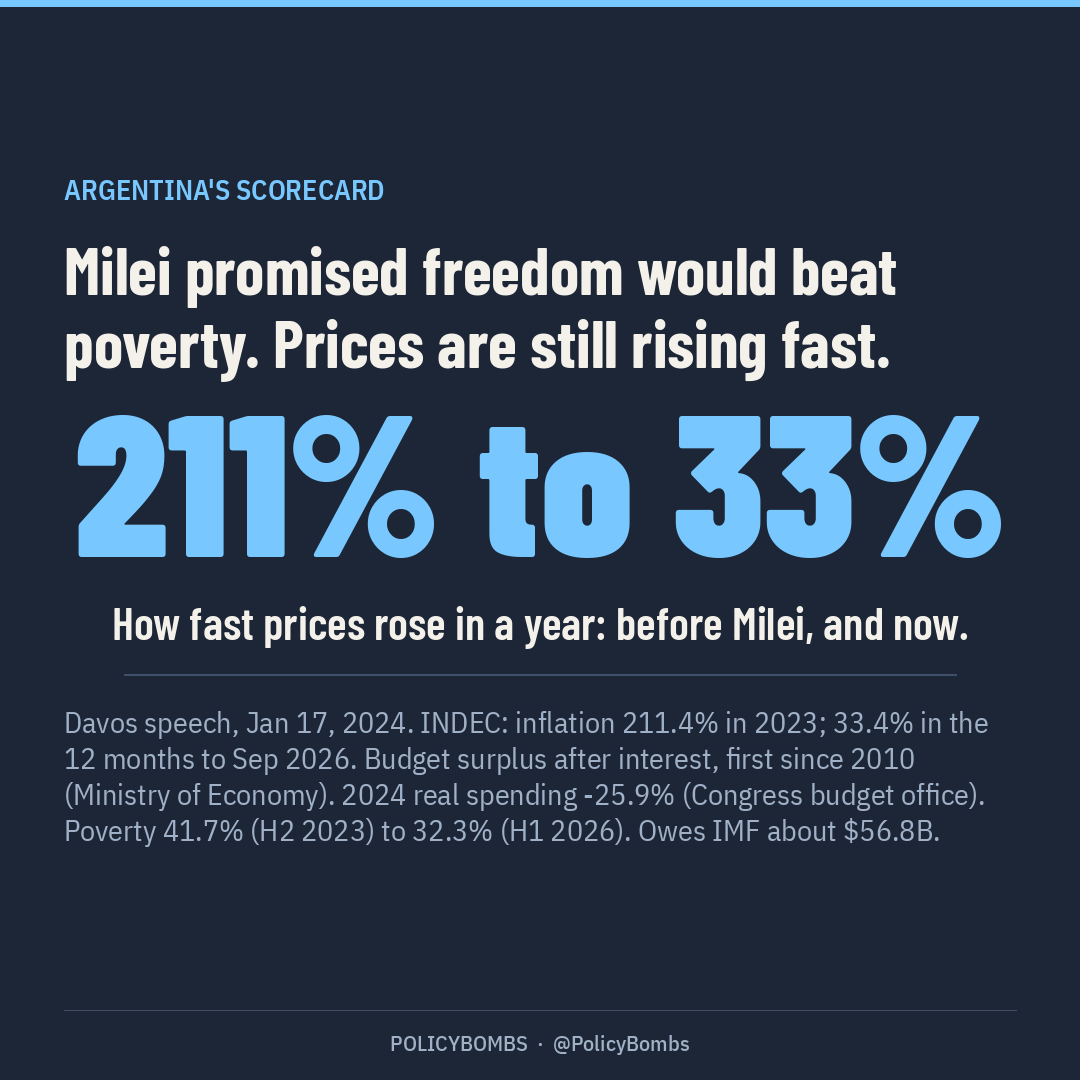
211% to 33%. That's Argentina's inflation for 2023, before Javier Milei's policies took hold, vs. the last 12 months. Official numbers from INDEC.
In January 2024 Milei went to Davos and told the world's elites that the West is in danger, "social justice" is unjust, and market failures "do not exist." Capitalism, he said, is the only way to end poverty.
So did it work at home? Here's the scorecard.
The budget: first surplus after interest since 2010. He did it by cutting real spending 25.9% in one year. Pensions took a 17% hit. Public works: down 74%.
Inflation: 25.5% in a single month when he started. Under 2% a month now. Huge. But annual inflation has been stuck between 31% and 34% for a full year.
Poverty: 41.7% when he started. Spiked to 52.9%. Fell to 28.2%. Now back up to 32.3%.
Growth: +4.4% in 2025. Then the economy was 1.7% smaller in August 2026 than a year before. The IMF just cut its 2026 forecast to 2.1%.
Dollars: gross reserves went from $21 billion to $50 billion. But Argentina owes the IMF about $56.8 billion and has a $20 billion U.S. Treasury swap line behind it.
And the speech? "Extreme poverty fell to 5%." The World Bank's current count is 811 million people, roughly 1 in 10. "Free countries are 12 times richer." The Fraser Institute's latest says 6.2 times. Big gap, smaller than claimed.
"No market failures"? His own government raised energy subsidies 44% this year to cushion a gas price shock.
Verdict: MIXED, leaning GOOD. The fiscal fix is real and overdue. The promise was prosperity. Right now it's stability on borrowed dollars.
Speech quotes are PolicyBombs translations of the official Spanish transcript published by the Casa Rosada; the World Economic Forum's page could not be retrieved (403). October 2026 inflation is due from INDEC on Nov. 12, 2026 and is not included.
Full analysis
Content checked November 9, 2026 (PST).
Finding tags: Substantiated = supported by the cited official or independent source; Pending = not final; Cleared = a specific claim is contradicted or fails on the evidence; Unverified = no reliable official or independent figure found. Judgments are labeled as judgments.
Executive finding
MIXED, leaning GOOD on fiscal stabilization; the speech's sweeping claims outrun the evidence. Official Argentine data show the Milei government closed the budget deficit (first annual surplus after interest since 2010), cut monthly inflation from 25.5% to as low as 1.5%, and more than doubled gross reserves. The same official data show the cost and the unfinished business: real spending cuts fell hardest on pensions and public works, annual inflation has been stuck between 31% and 34% for a year, poverty rose again in the first half of 2026, and economic activity fell 1.7% year over year in August 2026. The Davos claim that "market failures do not exist" is a definition, not a finding, and the government's own 2026 energy subsidies contradict it in practice. [1,3 to 18]
1. What is the policy?
The speech
The speech is Milei's special address to the World Economic Forum's 54th Annual Meeting in Davos on January 17, 2024. The WEF page returned 403 (Access Denied) when this analysis tried to retrieve it, so the full official Spanish transcript published by the Argentine Presidency (Casa Rosada) is used instead. English quotes are PolicyBombs translations of that transcript. [1,2]
Core claims and proposals, from the transcript (PolicyBombs translation):
- "The West is in danger" because its leaders are "co-opted" by a worldview that "leads to socialism, and therefore to poverty." [1]
- Free-enterprise capitalism is "the only morally desirable system" to end poverty. Extreme poverty fell from about 95% of the world in 1800 to 5% in 2020. [1]
- Countries that respect economic freedom are "12 times richer" than repressed ones. [1]
- "Social justice" is unjust because the state is financed by taxes "collected coercively." [1]
- "Market failures do not exist"; regulations justified by market failure "only generate distortions in the price system." Regulating monopolies would "destroy economic growth." [1]
- A successful entrepreneur "is a hero"; this is "the model we are proposing for the Argentina of the future." [1]
The policies that followed (what can actually be measured)
- Fiscal anchor ("deficit zero"): across-the-board real spending cuts in 2024, led by pensions and social benefits, capital spending and subsidies. [13]
- Deregulation and delegated powers: the Ley Bases package passed the Senate on June 12, 2024 after a 36 to 36 tie broken by Vice President Villarruel, and passed the Chamber of Deputies 147 to 107 on June 27, 2024. It included delegated powers and the RIGI large-investment incentive regime. [18,22,23]
- Monetary and exchange-rate regime: a currency band with exchange-rate flexibility under an IMF Extended Fund Facility of USD 20 billion agreed in April 2025, plus a U.S. Treasury exchange-stabilization agreement of up to USD 20 billion signed October 20, 2025. [17,18]
- Status (Nov 9, 2026): IMF staff reached a staff-level agreement on the program's third review in late October 2026, worth about USD 900 million, with board consideration possible in early December. [18,19]
2. Why does this policy exist?
Stated reasons
Milei's stated reason is moral and empirical: he argues collectivism caused Argentina's decline and capitalism is the only system that lifts people from poverty. [1]
Underlying drivers, honestly separated
- A real crisis. When he spoke, Argentina had just recorded 211.4% inflation for 2023 and 25.5% in December alone, and 41.7% of people in the 31 surveyed urban areas were poor. Gross reserves were about USD 21.0 billion on December 11, 2023. These are official numbers, not rhetoric. [3,6,16]
- Chronic deficits. The Ministry of Economy describes the 2024 surplus after interest as the first since 2010, meaning more than a decade of deficits financed partly by money printing. [9]
- Political incentive. A global stage builds international backing, investment interest and, later, U.S. and IMF financing. The USD 20 billion IMF program and USD 20 billion U.S. swap line show the backing mattered. That is an observation about incentives, not evidence of bad faith. [17,18]
- Ideology. The speech is explicitly Austrian-school libertarian, citing Israel Kirzner and Alberto Benegas Lynch (h). The "no market failures" claim follows from that definition of a market, not from data. [1]
3. What has it actually done?
Inflation: the big win, then a plateau
| Period | Inflation | Source |
|---|---|---|
| December 2023 (month) | 25.5% | INDEC [3] |
| Calendar 2023 | 211.4% | INDEC [3] |
| Calendar 2024 | 117.8% | INDEC index, PolicyBombs arithmetic [5] |
| May 2025 (month) | 1.5% | INDEC index, PolicyBombs arithmetic [5] |
| Calendar 2025 | 31.5% | INDEC [4,5] |
| September 2026 (month) | 1.9% | INDEC [4] |
| 12 months to September 2026 | 33.4% | INDEC [4] |
| IMF forecast for 2026 | 32.5% | IMF October WEO, as reported [18] |
Finding [Substantiated]: Monthly inflation fell from 25.5% to under 2% within about 17 months. Finding [Substantiated]: It has stalled. Annual inflation was 31.3% in October 2025 and 33.4% in September 2026, so the last year brought no further improvement. Cumulatively, the price index rose about 247% between December 2023 and August 2026. [4,5]
The budget: balanced, by real cuts
- 2024: financial surplus of 0.3% of GDP, primary surplus 1.8%; the ministry calls it the first annual financial surplus since 2010. [9]
- 2025: financial surplus about 0.2% of GDP, primary about 1.4%. [10]
- 2026 through September: primary about 1.2% of GDP, financial about 0.3%, against an IMF primary target of 1.4% for the year. The government missed the first-half target (ARS 6.29 trillion vs ARS 6.86 trillion). [11,12]
- How it was done (2024, Congress's budget office): total National Administration spending fell 25.9% in real terms while revenue fell 3.5%. Social benefits (mostly pensions) fell 17.0%, capital spending 73.9%, economic subsidies 37.8%. [13]
Finding [Substantiated]: The deficit closed mainly through spending cuts, not tax increases. Judgment: Cutting capital spending by three quarters is not a durable saving; deferred road and infrastructure maintenance tends to come back as a cost. No official estimate of that deferred cost was found [Unverified].
Poverty: down, then up again
| Half-year | People in poverty | Indigence | Source |
|---|---|---|---|
| H2 2023 (before Milei's policies) | 41.7% | 11.9% | INDEC [6] |
| H1 2024 (devaluation shock) | 52.9% | 18.1% | INDEC [7] |
| H2 2024 | 38.1% | 8.2% | INDEC [7] |
| H1 2025 | 31.6% | 6.9% | INDEC [7] |
| H2 2025 | 28.2% | 6.3% | INDEC [7] |
| H1 2026 | 32.3% | 7.5% | INDEC [7] |
In the first half of 2026, household incomes rose 11.5% while the food and total poverty baskets rose 21.4% and 19.6%, so poverty rose 4.1 points in a single half-year. INDEC says the H1 2026 rate is not significantly different from H1 2025. [7]
Counter-analysis [Unverified, contested]: IPyPP, an opposition-aligned institute, argues the official decline is overstated because survey-reported wages rose about 20% in real terms while INDEC's own wage index for registered private workers fell 6.6%, and because the poverty basket still uses 2004 to 2005 spending weights. These are serious methodological questions, not proof that the official series is wrong. [8]
Growth and jobs
GDP fell 1.3% in 2024 and grew 4.4% in 2025. Economic activity was 1.7% lower in August 2026 than a year earlier, and the IMF cut its 2026 growth forecast to 2.1% from 3.5%. Mortgage defaults reportedly tripled to 12.8% over the past year. Job-level data for 2026 were not retrieved for this analysis [Unverified]. [14,15,18]
Reserves and debt
Gross international reserves rose from USD 21,017 million (Dec 11, 2023) to USD 50,298 million (Nov 3, 2026), per the central bank's own data series. The IMF says net reserves beat the end-June 2026 target by about USD 4 billion and the central bank bought nearly USD 16 billion in 2026. But gross reserves include IMF disbursements, and Argentina is the IMF's largest debtor at about USD 56.8 billion, with a USD 20 billion U.S. Treasury line behind it. Finding [Substantiated]: the dollar cushion is bigger, and part of it is borrowed. [16,17,18]
Testing the speech's claims
- Global poverty, 95% to 5%. [Partly Cleared] The long-run direction is correct. The World Bank's current measure, under USD 3 a day in 2021 prices, counts 811 million people in extreme poverty in 2026, down from about 2.3 billion in 1990. With a world population around 8 billion, that is about 10%, roughly double the speech's 5%. The difference is mostly the newer, higher poverty line, but the speech's number is outdated. The World Bank also says growth alone "is not enough" and points to infrastructure, human capital and institutions. [1,20]
- "12 times richer." [Unverified as stated] Fraser's 2025 report (2023 data) finds average incomes 6.2 times greater in the freest quarter of countries than the least free, and the poorest tenth earn 7.8 times more; life expectancy is about 17 years longer. The direction supports Milei. The size does not match his number in the current edition, and cross-country correlation does not isolate cause. [1,21]
- "Market failures do not exist." [Cleared as a factual claim] It is true by definition only if every outcome without coercion is labeled a success. In practice the government raised energy subsidies 44.1% year over year in September 2026 to shield households from a gas price shock, and it relies on IMF and U.S. Treasury backstops, both of which exist because markets can run on a currency. [1,11,17,18]
- Argentina's history ("first world power" after 1860; fell to 140th). [Unverified] These historical rank claims were not tested against long-run data in this analysis.
Unintended consequences
- Pensioners carried a large share of the 2024 cut (-17% real). [13]
- Program exits: IPyPP counts 875,000 youths dropped from Progresar and the closure of the former Potenciar Trabajo program. Counts are IPyPP's, not independently verified. [8]
- Household credit stress (12.8% mortgage defaults, as reported). [18]
4. Is it good or bad for society?
The strongest case for it
Argentina had a decade of deficits, 211% inflation and a central bank with few dollars. Three years later the budget is balanced after interest, inflation is under 2% a month, and gross reserves are more than double. Every previous government promised this and did not deliver. The speech's core economic claim, that economic freedom correlates with higher incomes and longer lives, has independent cross-country support. [3,9,16,21]
The strongest case against it
The speech promised that capitalism ends poverty. Argentina's poverty rate is rising again, inflation has not improved in a year and is still around 33%, the economy is contracting year over year, the budget was balanced partly by gutting public investment, and stability depends on the IMF and U.S. Treasury. The "no market failures" ideology is not what the government practices when energy prices spike. [7,11,13,15,18]
Direct verdict
MIXED, leaning GOOD. The fiscal fix is real and was necessary. The speech oversold what it would deliver, on poverty and on markets needing no correction. A fair grade today: stabilized, not yet prosperous.
Fiscal and debt sustainability
Primary surpluses of 1.8% (2024) and 1.4% (2025) of GDP, and an IMF-agreed 1.4% for 2026 and 2027, are sustainable only if spending restraint holds through elections and growth resumes. The IMF exposure (about USD 56.8 billion) is the largest single risk. [9,10,18]
Data integrity check
The main anomaly is the gap IPyPP flags between survey wages and the INDEC wage index. It is a measurement issue, not evidence of manipulation, and INDEC publishes confidence intervals for the poverty rate (H1 2026: 30.8% to 33.7%). No evidence of falsified official data was found. [7,8]
Named politicians and parties
| Person or bloc | Position | Evidence |
|---|---|---|
| Javier Milei (La Libertad Avanza), President | For | Davos speech; program architect [1] |
| Luis Caputo, Economy Minister | For | Reports monthly surpluses [11,12] |
| Victoria Villarruel, Vice President | For (tie-break) | Broke 36 to 36 Senate tie, Jun 12, 2024 [22] |
| PRO and UCR blocs | Mostly for | Final Ley Bases passage 147 to 107 [23] |
| Unión por la Patria (Peronism), the left, socialists | Against | Voted against Ley Bases [23] |
| Senators Sandra Mendoza, Carolina Moisés, Guillermo Andrada | Broke with Unión por la Patria to support | La Nación [22] |
| Trump administration (Treasury) | For | USD 20 billion swap, Oct 20, 2025 [17] |
| IMF staff | For, with conditions | "Stay the course" [19] |
What a good policy would include
- Hold the primary surplus at the IMF-agreed 1.4% of GDP in 2026 and 2027. This is the one target with an official number. Argentina was at about 1.2% through September 2026. [11,12,18]
- Restore capital spending gradually from the 2024 low (-73.9% real) under a published, prioritized maintenance list. Cost and payoff: Unverified; no official estimate found. [13]
- Target protection instead of eroding pensions across the board. Shift a share of subsidy savings to means-tested transfers for children, where poverty is highest (44.5% of children 0 to 14 in H1 2026). Fiscal cost: Unverified. [7]
- Update the CPI and poverty baskets to the 2017 to 2018 household survey so the government's scorecard is trusted. Cost: Unverified but administrative. [8]
- Build owned reserves and cut dependence on borrowed dollars. Central-bank purchases of nearly USD 16 billion in 2026 are the right direction. Specific net-reserve targets: Unverified (the IMF staff report could not be retrieved). [18]
- Growth reforms the IMF lists: deeper capital and mortgage markets, more flexible labor rules, and executing the USD 76 billion of approved RIGI projects. Growth effect: Unverified. [18,19]
Gaps and Unverified items
- IMF staff report PDF returned 403; IMF figures come from two news reports quoting IMF statements. [18,19]
- WEF page returned 403; the official Casa Rosada transcript was used, and English quotes are PolicyBombs translations. [1,2]
- No 2026 employment series was retrieved.
- Historical rank claims in the speech were not tested.
- October 2026 CPI is due November 12, 2026 and is not included.
Sources
- [1] Casa Rosada (Presidency of Argentina), official transcript, Javier Milei, World Economic Forum 54th Annual Meeting, Davos, Jan 17, 2024 (Spanish). Used as the official mirror because weforum.org returned 403 when this analysis tried to retrieve it. English quotes are PolicyBombs translations: https://www.casarosada.gob.ar/informacion/discursos/50299-discurso-completo-del-presidente-de-la-nacion-javier-milei-en-el-foro-economico-mundial-de-davos
- [2] World Economic Forum, Special Address by Javier Milei, President of Argentina (returned 403 Access Denied when this analysis tried to retrieve it; disclosed): https://www.weforum.org/stories/2024/01/special-address-by-javier-milei-president-of-argentina/
- [3] INDEC, Consumer Price Index, December 2023 (25.5% monthly; 211.4% for 2023): https://www.indec.gob.ar/uploads/informesdeprensa/ipc_01_24DBD5D8158C.pdf
- [4] INDEC, Consumer Price Index, September 2026, published Oct 13, 2026 (1.9% monthly; 23.6% year to date; 33.4% year over year; monthly and annual series Oct 2025 to Sep 2026): https://www.indec.gob.ar/uploads/informesdeprensa/ipc_10_268C45A9444C.pdf
- [5] Argentina open-data series API, INDEC national CPI index (series 148.3_INIVELNAL_DICI_M_26), Nov 2023 to Aug 2026. PolicyBombs arithmetic from index levels: Dec 2024 / Dec 2023 = +117.8%; Dec 2025 / Dec 2024 = +31.5%; Aug 2026 / Dec 2023 = +247%; May 2025 monthly = +1.5%: https://apis.datos.gob.ar/series/api/series/?ids=148.3_INIVELNAL_DICI_M_26&start_date=2023-11-01&format=csv&limit=50
- [6] INDEC, Poverty and indigence, 31 urban areas, second half of 2023 (41.7% of people poor; 11.9% indigent): https://www.indec.gob.ar/uploads/informesdeprensa/eph_pobreza_03_2442F61D046F.pdf
- [7] INDEC, Poverty and indigence, 31 urban areas, first half of 2026 (Table 1: people in poverty 52.9% H1 2024, 38.1% H2 2024, 31.6% H1 2025, 28.2% H2 2025, 32.3% H1 2026; 9,729,000 people in the 31 areas; incomes +11.5% vs baskets +19.6% to +21.4% in the half): https://www.indec.gob.ar/uploads/informesdeprensa/eph_pobreza_09_2670733F4C4D.pdf
- [8] IPyPP (Instituto de Pensamiento y Politicas Publicas, opposition-aligned think tank), Poverty results H1 2026: methodology critique and program-cut counts. Treated as a counter-analysis, not an official source: https://ipypp.org.ar/descargas/2026/Resultados%20de%20Pobreza_1S26.pdf
- [9] Ministry of Economy, 2024 national public sector result: financial surplus 0.3% of GDP, first annual financial surplus since 2010; primary surplus 1.8% of GDP: https://www.argentina.gob.ar/noticias/el-sector-publico-nacional-registro-superavit-financiero-anual-por-primera-vez-desde-el
- [10] Ministry of Economy, 2025 national public sector result: financial surplus about 0.2% of GDP; primary about 1.4% of GDP: https://www.argentina.gob.ar/noticias/en-el-ano-2025-el-sector-publico-nacional-registro-un-superavit-financiero-de-1453819
- [11] Ministry of Economy, September 2026 result: nine-month primary surplus about 1.2% of GDP, financial about 0.3%; energy subsidies +44.1% year over year: https://www.argentina.gob.ar/noticias/en-septiembre-el-sector-publico-nacional-continuo-generando-resultado-financiero-1
- [12] Bloomberg Linea, Oct 2026: 1.4% of GDP primary target for 2026; first-half 2026 target missed (ARS 6.29 trillion vs ARS 6.86 trillion): https://www.bloomberglinea.com/latinoamerica/argentina/argentina-sostiene-el-superavit-en-septiembre-y-se-acerca-a-la-meta-del-fmi/
- [13] Oficina de Presupuesto del Congreso (OPC), 2024 budget execution of the National Administration: total spending -25.9% real; social benefits -17.0%; capital spending -73.9%; economic subsidies -37.8%: https://opc.gob.ar/ejecucion-presupuestaria/ejecucion-mensual-base-devengado/analisis-de-la-ejecucion-presupuestaria-de-la-administracion-nacional-2024/
- [14] INDEC, Advance report on economic activity, Q4 2025: GDP +4.4% in 2025 after -1.3% in 2024: https://www.indec.gob.ar/uploads/informesdeprensa/pib_03_26D14C2E1ADC.pdf
- [15] INDEC, Monthly Economic Activity Estimator (EMAE), August 2026: -1.7% year over year; +0.1% month over month: https://www.indec.gob.ar/uploads/informesdeprensa/emae_10_263A9DC1ED2B.pdf
- [16] BCRA (central bank) statistics API, variable 1, gross international reserves: USD 21,017 million on Dec 11, 2023; USD 50,298 million on Nov 3, 2026: https://api.bcra.gob.ar/estadisticas/v4.0/monetarias/1?desde=2026-10-28&hasta=2026-11-09
- [17] BCRA, Oct 20, 2025: agreement with the U.S. Treasury for exchange-rate stabilization of up to USD 20 billion: https://www.bcra.gob.ar/en/news/el-bcra-y-el-departamento-del-tesoro-de-los-estados-unidos-firman-un-acuerdo-de-estabilizacion-cambiaria-por-usd-20-000-millones/
- [18] Buenos Aires Times, IMF staff-level agreement on the third review (Oct 2026): USD 20 billion EFF from April 2025; about USD 900 million; net reserves about USD 4 billion above end-June target; central bank bought nearly USD 16 billion in 2026; USD 76 billion approved RIGI investments; 1.4% primary target for 2026 and 2027; IMF October WEO cut 2026 growth to 2.1% from 3.5% and raised inflation forecast to 32.5%; about USD 56.8 billion owed to the IMF; mortgage defaults 12.8% (as reported): https://www.batimes.com.ar/news/economy/imf-approves-third-review-of-argentinas-programme.phtml
- [19] MercoPress, Oct 29, 2026: IMF spokeswoman Julie Kozack on "stay the course"; board could consider in early December; four agreed growth measures: https://en.mercopress.com/2026/10/29/the-imf-urges-argentina-to-stay-the-course-despite-doubts-over-growth-and-country-risk
- [20] World Bank, Poverty overview: people in extreme poverty (under USD 3 a day, 2021 PPP) fell from about 2.3 billion in 1990 to 811 million in 2026: https://www.worldbank.org/en/topic/poverty/overview
- [21] Fraser Institute, Economic Freedom of the World 2025 Annual Report (2023 data): freest quartile vs least free quartile: average incomes 6.2 times greater; bottom 10% incomes 7.8 times greater; about 17 years longer life: https://www.fraserinstitute.org/studies/economic-freedom-world-2025-annual-report
- [22] La Nacion, Jun 12, 2024: Senate tie at 36 votes on Ley Bases; Vice President Victoria Villarruel broke the tie: https://www.lanacion.com.ar/politica/ley-bases-en-una-votacion-electrizante-debio-desempatar-villarruel-y-el-oficialismo-logro-aprobar-en-nid12062024/
- [23] Infobae, Jun 28, 2024: final Ley Bases passage in the Chamber of Deputies, 147 in favor, 107 against (Peronism, the left, socialists and Natalia de la Sota against): https://www.infobae.com/politica/2024/06/28/finalmente-el-gobierno-logro-la-sancion-de-la-ley-bases-y-el-paquete-fiscal-y-milei-inicia-una-nueva-etapa-de-gestion/
PolicyBombs · Policy #80. Follow @PolicyBombs on X.
Accountability Scorecard
MixedPolicy #80 grade: Mixed. MIXED, leaning GOOD on the fiscal fix; the speech oversold. Argentina posted its first annual budget surplus after interest since 2010 by cutting real spending 25.9% in 2024, and monthly inflation fell from 25.5% to under 2%; but annual inflation has been stuck between 31% and 34% for a year, poverty rose back to 32.3% in early 2026, and stability leans on about USD 56.8 billion owed to the IMF plus a USD 20 billion U.S. Treasury swap line.
Measured outcome: 211% to 33%: INDEC inflation of 211.4% in calendar 2023 vs 33.4% in the 12 months to September 2026. Budget: financial surplus of 0.3% of GDP in 2024, the first annual surplus after interest since 2010 (Ministry of Economy). Poverty: 41.7% (H2 2023) to 32.3% (H1 2026), INDEC, 31 urban areas.
Positions on record
Responsible parties being sourced. Names appear here only once they are tied to a documented action with a source.
How we grade
Grades come from the "good or bad for society" verdict (question 4) in each PolicyBomb research pack and rest on measured outcomes, not motives. Harmful means the research found net harm, Mixed means real benefits and real costs, Helpful means net benefit. Every name is tied to a documented action (an authored bill, a signature, a recorded vote, a filed donation, an order or a public statement) with a linked source. Only full scorecard rows count toward a person's Harmful, Mixed and Helpful tally; positions listed from the research are shown with their source but are not tallied yet.
Grade basis: Day 80 Javier Milei Davos speech PolicyBomb, verdict.