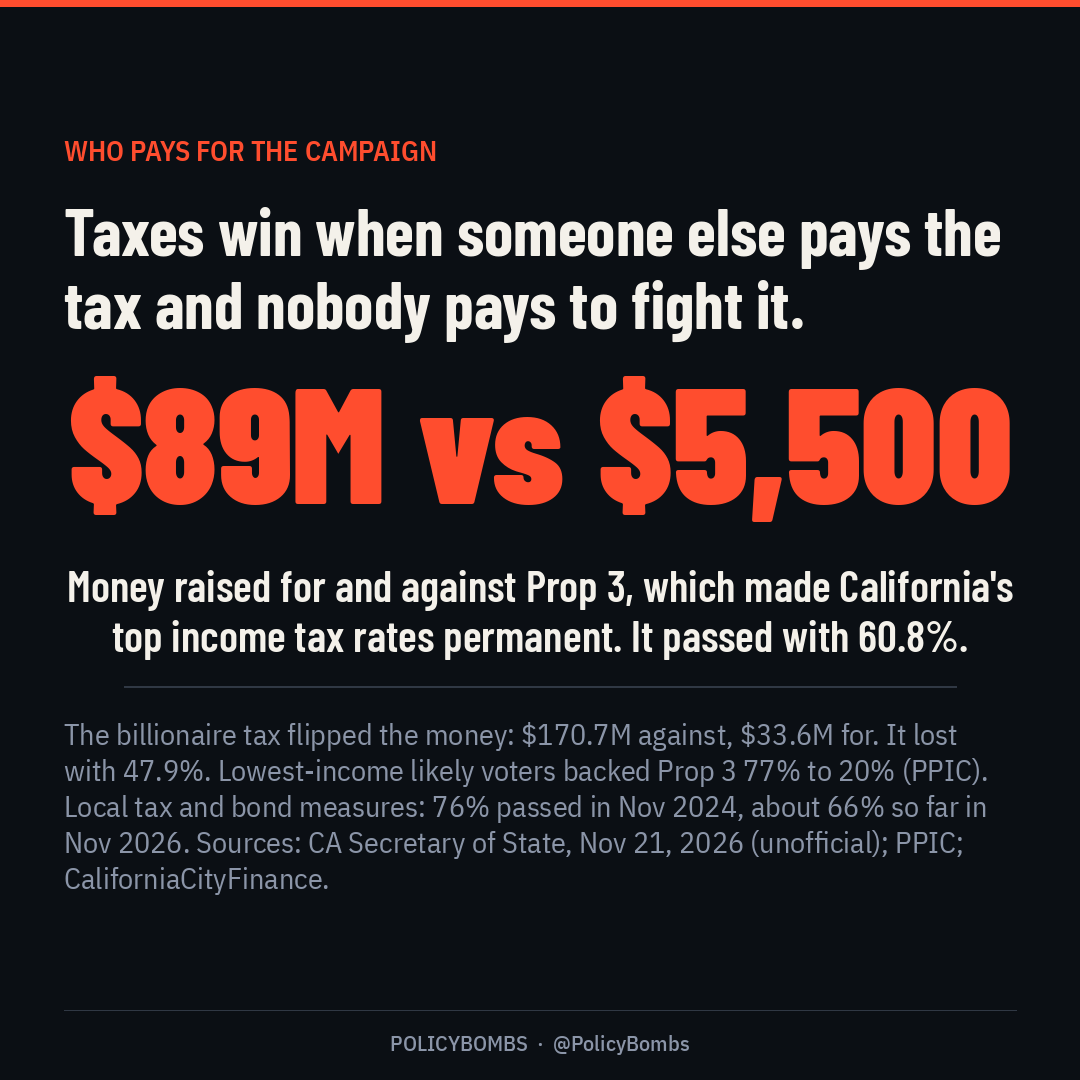
$89 million to $5,500. The money for and against making California’s top income tax rates permanent. It passed. The billionaire tax flipped the money: $171 million against, $34 million for. It failed. Taxes win when someone else pays and nobody pays to fight.
PRO: Prop 3 keeps $5 billion to $15 billion a year for schools and services (LAO). Lowest-income voters backed it 77% (PPIC). Voters still reject about a third of local measures; school bond approval is down from 82% (2014) to 64% so far in 2026. Majority-vote citizen taxes let residents act when officials will not.
CON / COST: Beneficiaries fund yes campaigns (teachers’ unions $70M+ for Prop 3); opposition often unfunded ($5,500 vs Prop 3). Labels written by the agency seeking the money; two court-rewritten measures failed in June 2026. Upland loophole lets majority votes pass earmarked taxes. Prop 41 audits lost. LAO: $18.5B operating deficit in 2026-27.
SOCIETY: MIXED. Predictable, not irrational. Influence is real and filed in public; a hidden coordinated plot is Unverified. Money alone deciding: Contested.
Full analysis
Full PolicyBomb write-up. Policy #83: tax ballot measures, fees and taxes. Election figures are Secretary of State unofficial returns as of Nov 21, 2026, 4:37 p.m. PT, 100% of precincts reporting, with certification due Dec 11 [1]. Every figure below carries a numbered source. Labels: Supported (the record backs it), Contested (real evidence on both sides), Unverified (no adequate source found for this analysis).
The question
Californians tell pollsters they are falling behind. In October, 73% of likely voters said their income is not keeping up with inflation; among households under $40,000 it was 89% [12]. Yet the same electorate keeps approving taxes and bonds. In November 2024 local voters passed 410 of 539 tax and bond measures, 76% [18]. On Nov 3, 2026 they made the top income tax rates permanent (Prop 3, 60.8%) and approved an $11.25 billion housing bond (Prop 1, 61.2%) [1][51]. Then they turned down a one-time 5% tax on billionaires (Prop 40, 47.9%) [1].
Is that a contradiction? Or is something steering the vote? This analysis tests ten explanations against the record.
The short answer
California voters do not vote for taxes in general. They vote for taxes with five features:
- Someone else pays. The top 2%, property sellers over $5 million, hotel guests, or whoever owns property when a bond comes due.
- It already exists. Extensions beat new taxes.
- The label names a service. Schools, firefighters, 911, homelessness.
- A majority is enough. General taxes and citizen initiatives clear 50%, not two-thirds.
- Nobody funds the other side. Prop 3’s opponents raised $5,500.
The billionaire tax broke four of the five. It was new. It was a first-in-the-nation wealth tax with a credible exit threat. Its money ran five to one against it. And the governor and much of the Democratic establishment told voters to reject it. That is not a mystery. It is a pattern, and the money behind it is filed in public.
1. What the policy is
The 2026 tax measures (results as of Nov 21, 2026) [1]
| Prop | What it does | Yes | No | Yes % | Result |
|---|---|---|---|---|---|
| 1 | $11.25 billion housing bond | 7,888,697 | 5,004,101 | 61.2% | Passing |
| 2 | Bigger rainy day fund | 7,896,115 | 4,984,870 | 61.3% | Passing |
| 3 | Makes high-income tax rates permanent | 7,910,056 | 5,089,900 | 60.8% | Passing |
| 38 | Immunology research bond | 6,928,265 | 5,923,381 | 53.9% | Passing |
| 40 | One-time 5% billionaire wealth tax | 6,277,656 | 6,819,469 | 47.9% | Failing |
| 41 | Audits of new special taxes; spending-limit rule | 5,753,831 | 7,101,761 | 44.8% | Failing |
| 42 | Bans new state wealth and personal property taxes | 6,642,594 | 6,338,564 | 51.2% | Passing |
| 43 | Two-thirds vote for citizen-proposed local special taxes | 5,399,478 | 7,367,126 | 42.3% | Failing |
- Prop 3 keeps the higher rates first passed in 2012 (Prop 30) and extended in 2016 (Prop 55), which otherwise expire after 2030. The top 2% pay them; LAO puts the value at $5 billion to $15 billion a year [15]. The rates reach 10.3% above $371,000 for individuals and 12.3% above $744,000 [36].
- Prop 40 would have taxed billionaires who lived in California on Jan 1, 2026 at 5% of net worth, once, with real estate, pensions and retirement accounts generally excluded. LAO: “tens of billions of dollars” spread over several years, and a possible ongoing loss of “less than $1 billion per year” in income tax if billionaires left [14].
- Prop 43 would have closed the court-made gap that lets citizen initiatives pass local special taxes by simple majority [16].
The vote thresholds
- Local general taxes (money for any purpose): simple majority [22].
- Local special taxes (money earmarked for a purpose), including parcel taxes: two-thirds when a local government places them on the ballot [22].
- School bonds: 55% (CaliforniaCityFinance tables) [17].
- Citizen initiatives: in California Cannabis Coalition v. City of Upland (2017) the state Supreme Court held that “local government” in the Prop 218 election rules does not include voters acting by initiative [22]. Appeals courts then upheld San Francisco’s June 2018 Prop C, a commercial rent tax for child care that passed with about 51%, ruling that neither Prop 13 nor Prop 218 imposes a two-thirds rule on a tax imposed by initiative, and that an elected official’s participation in the initiative did not change that [23].
2. Why it exists: ten explanations, tested
(a) Money: who funds yes, who funds no
Statewide money, through Nov 9, 2026 (Secretary of State; committees that work several measures are counted under each, so totals overlap) [2][3][4][5][6][7]:
| Measure | For | Against | Ratio | Result |
|---|---|---|---|---|
| Prop 3 (top rates permanent) | $89,362,975 | $5,500 | about 16,000 to 1 for | Passed |
| Prop 1 (housing bond) | $16,463,175 | no committee | one-sided | Passed |
| Prop 40 (billionaire tax) | $33,578,577 | $170,704,496 | about 5 to 1 against | Failed |
| Prop 42 (ban wealth taxes) | $159,277,037 | $22,906,303 | about 7 to 1 for | Passed |
| Prop 41 (audits) | $58,376,446 | $22,906,303 | about 2.5 to 1 for | Failed |
| Prop 43 (two-thirds rule) | $17,559,668 | $11,911,449 | about 1.5 to 1 for | Failed |
Who wrote the checks (FPPC top-10 lists, Nov 18, 2026) [8]:
- Prop 3, yes: California Teachers Association $60.5 million, National Education Association $7.5 million, California School Employees Association $2.6 million, California Federation of Teachers $1.85 million, SEIU councils, California Professional Firefighters. The people whose budgets the tax funds paid for the campaign.
- Prop 1 housing bond, yes: two carpenters’ councils ($1 million each), Airbnb ($1 million), Building a Better California ($1 million), a Meta committee ($602,000), OpenAI and Anthropic ($500,000 each), a housing developer ($500,000). No opposition committee reached the reporting threshold.
- Prop 43, no (keep majority-vote citizen taxes): SEIU councils, Professional Firefighters, CTA, carpenters, and two construction-industry groups, California Alliance for Jobs and Southern California Partnership for Jobs ($500,000 each).
- Prop 43, yes: California Business Roundtable ($11.64 million; top donors Peter Thiel and Eric Schmidt), Howard Jarvis Taxpayers Association, and office landlords Kilroy Realty and Douglas Emmett ($1 million each).
- Prop 40, no: the main committee, named “Doctors, Teachers, Small Businesses, Working Families and Public Safety Against the Reckless Wealth Tax Experiment,” took $158.5 million of its money from Building a Better California, whose top donors are Sergey Brin and John Doerr. Ripple Labs and Chris Larsen gave $5 million each to a second committee. CalMatters counts $378.4 million from ultra-wealthy opponents across Props 40, 41 and 42 [9]. POLITICO counted $612 million from more than 70 current and former California billionaires in the 2026 state elections, nearly half against Prop 40 [49].
- Prop 42, yes: “Protect Retirement & Life Savings, a Coalition of Retirees, Blue-Collar Workers, Seniors, Veterans, Small Businesses & Taxpayers” got $159.2 million from Building a Better California.
- Prop 40, yes: SEIU-United Healthcare Workers West and its committees, about $31.8 million of the $33.6 million [8].
Local measures. School districts cannot spend public money campaigning for their own bonds, which leaves the field to “underwriters, builders and organized labor” [31]. A 2012 California Watch review found five major underwriters gave $1.8 million to 111 successful school bond measures authorizing $15.5 billion in debt; in only five of the 111 cases did a donor fail to get a bond-selling contract [31]. The firms said they gave only after being hired.
The test. Money and outcomes do not line up one for one. Prop 41’s backers outspent its foes 2.5 to 1 and lost. Prop 43’s backers outspent and lost. In Los Angeles, the 2022 mansion tax (Measure ULA) passed with 58% even though opponents raised close to $8 million against the yes side’s $3.6 million [29]. USC’s John Matsusaka: money does not buy votes on core values, “but it can exploit uncertainty” [9].
- Organized beneficiaries of a tax fund the yes campaign: Supported.
- Committees carry names that hide their real funders, on both sides: Supported.
- Money alone decides tax votes: Contested.
- A hidden, coordinated plot: Unverified. The influence is real, and it is filed in public.
(b) Incidence: who actually pays
Voters back taxes that land on someone else, and the people who feel poorest back them most. PPIC likely voters, Oct 16 to 22, 2026 [12]:
| Group | Prop 3 yes | Prop 40 yes | Income not keeping up |
|---|---|---|---|
| All likely voters | 58% | 46% | 73% |
| Household income under $40,000 | 77% | 64% | 89% |
| $40,000 to $100,000 | 61% | 51% | 81% |
| $100,000 or more | 55% | 43% | 68% |
| Renters | 69% | 65% | 83% |
| Homeowners | 54% | 39% | 69% |
The voters who feel the pinch hardest are not voting against their wallets. On these two measures they voted for a bill addressed to someone else.
Small and hidden beats big and visible. In a grocery-store field experiment, posting tax-inclusive prices cut demand by 8% [45]. When tolls moved to electronic collection, toll rates ended up an estimated 20% to 40% higher than they would have been [46]. A quarter-cent here and a quarter-cent there adds up: 115 California city rate listings now charge 10% or more in sales tax, and Lancaster and Palmdale charge 11.75%, against a 7.25% statewide base (CDTFA, effective Oct 1, 2026; PolicyBombs count of the table) [37].
The “no new tax” frame. A state appeals court in September 2026 ordered a school district to drop the title “No-Tax-Rate-Increase School Repair, Improvement, Health and Safety Measure” from a $225 million bond, finding “no-tax-rate-increase” impermissibly misleading [26].
Why the billionaire tax was different. Its targets could leave, and did. Forbes found Brin registered to vote in Nevada on Dec 10, 2025, three weeks before the residency date; his representatives say Larry Page is now a Florida resident [33]. The New York Times reported that an entity tied to Brin terminated or moved 15 California LLCs out of state in the 10 days before Christmas [34]. The exit threat gave voters a reason to fear the tax would cost more than it raised. LAO’s estimate of that loss was modest, “less than $1 billion per year” against “tens of billions” one-time [14]. A UC Berkeley Citrin-POLITICO poll found 45% favored taxing billionaires more and 35% favored keeping them in state for the revenue and jobs, yet only 46% backed Prop 40 [9].
- Taxes framed as falling on others pass more easily, and the lowest-income voters back them most: Supported.
- Incidence alone explains the split: Not supported. Prop 3 and Prop 40 both hit the rich; one passed by 21 points and one failed. Design, novelty and the exit threat made the difference: Supported.
(c) Ballot wording, labels and earmarks
Local ballot questions are written by the government that wants the money, within limits. State law requires a local tax question to state the amount it raises each year, the rate and how long it lasts (Elections Code 13119, extended to all local tax measures in 2017) [27].
Read a real one. LA County’s 2024 Measure A asked: “To require accountability and results, create affordable housing, support home ownership, provide rental assistance, increase mental health and addiction treatment, reduce and prevent homelessness … shall the measure repealing the Measure H tax and replacing it with a 1/2 cent sales tax, raising approximately $1,076,076,350 annually until voters decide to end it, with new audits and oversight, be adopted?” It passed with 57.78%, a majority, under the citizen-initiative rule [28]. The cost comes after eight promised services.
When courts made governments rewrite, the measures lost:
- Riverside Measure Z (June 2026). A judge ordered the title changed from “City of Riverside Services Renewal Measure” to “City of Riverside Voter-Approved Transaction and Use Tax Renewal Measure,” and changed “continue maintaining” to “fund” [24]. The rate would have risen from 1% to 1.25% with no end date. It failed with 41.5% [20].
- Contra Costa Measure B (June 2026). A judge ordered supervisors to strip “deep” and “critical” from the question for a 0.625% sales tax raising about $150 million a year [25]. It failed with 42.6% [20].
Wording works for taxes too. In Washington state, a court let the ballot carry a statement, drafted by the attorney general’s office, warning of cuts to education and health care if a 9.9% tax on income over $1 million were repealed. A Seattle pollster found voters “significantly more likely” to support the tax with that warning. The tax survived, 58% to 42% [10].
- Labels and earmarks move votes: Supported (court findings, the Washington polling, and two June 2026 failures after rewrites). The size of the effect statewide: Unverified; other factors also changed in those races.
(d) Turnout and timing
Political scientist Sarah Anzia found average turnout in off-cycle California city elections runs 35 percentage points below turnout in presidential years, and that low turnout raises the clout of organized groups. Districts with off-cycle school board elections paid their most senior teachers more than 4% higher base salaries [38].
But California’s current data do not show low turnout rescuing tax measures. The June 2, 2026 primary drew 40.80% of registered voters [48]. Local measures passed at 63%, which CaliforniaCityFinance calls “below most primary elections over the past 20 years” [20]. November 2024 passed 76% [18]. And the November electorate is not dominated by renters or the young: likely voters are 74% homeowners, 49% age 55 or older, and 70% from households earning $100,000 or more [13].
- Low-turnout elections amplify organized groups: Supported (research).
- Timing explains California’s high pass rates today: Contested. Taxes pass in high-turnout Novembers among an older, owner-heavy electorate.
(e) The Prop 13 dynamic
Prop 13 caps the property tax rate and limits assessment growth, so long-time owners pay on old values. LAO found about two-thirds of Prop 13’s tax relief goes to households earning over $80,000, and that local governments responded by “increasing fees on home builders and assessments on owners of newer homes” [32]. School bonds are levied per $100,000 of assessed value. At a typical $30 rate, an owner assessed at $300,000 pays $90 a year; a new buyer assessed at $1.2 million pays $360 (PolicyBombs arithmetic on the CaliforniaCityFinance rate column) [17]. The longer you have owned, the cheaper the next bond.
Renters see none of it on a bill. Economists call the result “renter illusion,” a hypothesis that renters underestimate their share and support more spending (Oates) [42]. The evidence is mixed: a survey of 1,000 Danish renters and owners “raises doubts” about it [44]. California renters do back taxes more. Prop 1 housing bond: 77% of renters yes versus 54% of owners [12]. But renters are only 26% of likely voters [13].
- Prop 13 shields long-time owners from the cost of new local taxes and bonds: Supported.
- Renter illusion drives outcomes: Contested.
(f) Thresholds: why the bar matters most
CaliforniaCityFinance passage rates [17][18][19]:
| Type (vote needed) | Nov 2022 | Nov 2024 | Nov 2026 (prelim, Nov 4) |
|---|---|---|---|
| City general tax (majority) | 82% (98 of 119) | 86% (121 of 141) | 84% (102 of 122) |
| City special tax or bond (two-thirds) | 53% | 61% | 71% |
| Special district tax or bond (two-thirds) | 38% | 55% | 49% |
| School bond (55%) | 72% | 77% | 53% prelim; 64% by Nov 18 [21] |
| All local tax and bond measures | 69% (208 of 302) | 76% (410 of 539) | 66% (220 of 331) |
Twenty citizen-initiative special taxes appeared on Nov 2026 local ballots; 14 appear to have passed, 70%, at majority vote [17]. LA’s mansion tax (58%) and Measure A (57.78%) would both have failed under two-thirds [28][30]. The measure to close that gap, Prop 43, lost with 42.3% [1]. Its own author, Asm. Buffy Wicks, wrote it “merely to kill a worse proposal” and urged a no vote [30].
- The threshold, more than mood, decides which taxes pass: Supported.
- Officials use citizen initiatives to reach the majority threshold: Supported in the San Francisco case the court addressed; how common it is: Unverified.
(g) Opposition that never shows up
Prop 3’s opponents, led by the California Taxpayers Association, reported $5,500 [3]. Prop 1 and Prop 38 had no opposition committee reach the reporting threshold [7][8]. At the local level the only check is often a resident with a lawyer. “It is disappointing that individual citizens, using their own resources, have to fight City Hall,” said the Riverside resident who won the Measure Z rewrite [24].
- Statewide tax and bond measures often face little or no funded opposition: Supported.
- The same holds for most local measures: Unverified. No statewide dataset of local opposition spending was compiled for this analysis.
(h) Party cues and trust
Likely voters are 46% Democrats and 27% Republicans [13]. Prop 3 drew 80% of Democrats and 19% of Republicans [12]. Party tells most voters how to vote on taxes.
When the party splits, the vote moves. Gov. Gavin Newsom backed Prop 3, opposed Prop 40 and endorsed the countermeasure Prop 42 [9][35]. Xavier Becerra and Katie Porter also opposed Prop 40, as did Planned Parenthood and several unions; a strategist called it a “permission slip” for moderate Democrats to vote no [10]. Democratic support fell to 64% for Prop 40 against 80% for Prop 3 [11]. In Washington, the governor backed the millionaire tax and it held [10]. Matsusaka: “When your tribe is arguing, people start to listen to the counterarguments” [9].
Trust and mood: 82% of California adults say the country is on the wrong track, the highest PPIC has recorded, and nearly eight in ten expect bad economic times [11]. That gloom did not stop Prop 3 or the bonds.
- Partisan and elite cues shape tax votes: Supported.
- Low trust in government restrains tax votes: Unverified. No direct trust measure was compiled for this analysis, and the gloom coexisted with yes votes.
(i) Fiscal illusion and rational ignorance
- Buchanan (1967) devoted a chapter to “fiscal illusion”: indirect taxes, debt and other devices that hide the true price of government and push spending up [40]. Buchanan and Wagner (1977) extended it to deficits [41].
- Downs (1960) argued the opposite: voters are rationally ignorant of diffuse benefits, so democratic budgets end up too small [39].
- Oates (1988) sorted fiscal illusion into five forms, including revenue complexity, debt illusion and renter illusion [42]; Dollery and Worthington (1996) reviewed the tests [43].
- The salience studies above (8% demand drop; tolls 20% to 40% higher) give modern, measured support to the hidden-tax mechanism [45][46].
Label: hidden or spread-out taxes meet less resistance: Supported. Fiscal illusion explains California’s tax votes on its own: Contested; the theory cuts both ways, and Downs predicts underspending.
(j) The record: pass rates and the billionaire result
Local tax and bond measures passed at 69% (Nov 2022), 76% (Nov 2024), 63% (June 2026) and about 66% on Nov 2026 election-night counts [17][18][19][20]. School bonds are slipping: 82% passed in Nov 2014 and 81% in Nov 2018, against 64% so far in Nov 2026 [21]. Statewide, voters approved Prop 3, Prop 1, Prop 2 and Prop 38, rejected Prop 40, and banned future wealth taxes with Prop 42 [1]. PPIC tracked Prop 40 falling from 52% support in September to 46% in October as ads hit [11].
- Californians approve most tax and bond measures, but not all, and fewer than a decade ago: Supported.
3. Realized effects
- Prop 3: keeps $5 billion to $15 billion a year that would have expired after 2030 [15].
- Prop 40: none; it failed by 541,813 votes [1].
- Prop 42: forecloses a state wealth tax. LAO: “When and by how much future revenues would be reduced is unclear” [50].
- Prop 43: none; citizen-proposed local special taxes still need only a majority [16].
- The money: ultra-wealthy opponents gave $378.4 million against the billionaire tax across Props 40, 41 and 42 [9]; teachers’ unions gave more than $70 million for Prop 3 [8]. The biggest checks came from the people who would pay and the people who would be paid.
4. Good or bad for society
The strongest counterargument
Voters may simply want the services. Majorities backed every bond on the ballot [11]. They funded a bigger rainy day fund (61.3%) [1]. They are also discerning: a third of local measures fail, school bond approvals have dropped, two rewritten tax measures lost in June, and the billionaire tax lost in November [17][20][21]. Those voters who feel poorest are not confused when they vote to tax higher earners. The bill really does land elsewhere, and the schools and clinics really are theirs.
What the counterargument misses
A vote for a tax someone else pays is not a vote on what government costs. Nobody on the November ballot asked whether the money is spent well. The one measure that did, Prop 41’s audits, lost [1]. The state’s own budget office projects an operating deficit of $18.5 billion in 2026-27 and $8 billion or more each year through 2029-30 [47]. Taxes keep passing. The gap keeps coming back.
Fiscal sustainability
Prop 3 deepens reliance on the top 2%, who pay about half of state income taxes, and on a revenue stream LAO says swings by $10 billion [15]. Prop 42 removes one future option for the rich to pay more [50].
Fraud, waste, and abuse
No sourced fraud allegation relates to these measures. The pay-to-play pattern in school bond underwriting is documented, not alleged [31]. Riverside’s challenger alleged that Measure Z money went largely to pension bonds and raises; that claim is the challenger’s, not a court finding [24].
Verdict: MIXED
California’s tax votes are not irrational. They are predictable. Taxes pass when someone else pays, when a service sits in the title, when a majority suffices and when nobody funds the no side. The billionaire tax failed because it lost those advantages, not because voters turned against taxing the rich. The influence is in plain sight: the beneficiaries pay for yes, the payers pay for no, and each side hides behind friendlier names. Voters keep the services they value. Nobody on the ballot is asked to account for the spending.
Named politicians, groups and figures
| Who | Party or role | Position | Source |
|---|---|---|---|
| Gov. Gavin Newsom | D | Yes on 3; No on 40; endorsed 42 | [9][35] |
| Xavier Becerra | D, gubernatorial front-runner | Yes on 3; No on 40 | [10][35] |
| Katie Porter | D | No on 40 | [10] |
| California Democratic Party | D | Yes on 40; No on 41 and 42 | [9] |
| Asm. Buffy Wicks | D | Wrote Prop 43; urged No | [30] |
| Lorena Gonzalez, California Federation of Labor Unions | Labor | Yes on 40 | [9] |
| David Goldberg, California Teachers Association | Labor | Led Yes on 3; No on 40 | [36] |
| Dave Regan, SEIU-UHW | Labor | Sponsor, Yes on 40 | [9] |
| Sergey Brin | Investor | $102M+ against 40 via Building a Better California; funded Yes on 41 and 42; $1M Yes on Prop 1 | [8][33] |
| Peter Thiel, Eric Schmidt | Investors | Top donors to Business Roundtable money behind Yes on 43 | [8] |
| Chris Larsen, Ripple Labs | Investor | $5M each against 40 | [8] |
| Jon Coupal, Howard Jarvis Taxpayers Assn. | Taxpayer group | Sponsor, Yes on 43 | [30] |
| California Taxpayers Association | Taxpayer group | No on 3 ($5,500) | [3][8] |
| John Matsusaka, USC | Scholar | Money “can exploit uncertainty” | [9] |
What a good policy would include
- Cost first on the ballot. Put the annual cost and the rate at the start of every local tax question, before the list of services. Elections Code 13119 already requires both; it does not require them first [27]. No official score exists (Unverified).
- Neutral label writers. Have county counsel or an independent office write all local tax titles, not the agency asking for money. Riverside and Contra Costa show what a court can catch only after a resident sues [24][25].
- Funder names on committee names. Committees that call themselves retirees, doctors or working families should carry their top funders in the name itself [8].
- One threshold rule. Decide in the Constitution whether earmarked local taxes need a majority or two-thirds, no matter who places them on the ballot [16][23].
- Audit before you renew. Require a public performance audit before any extension vote, the narrow part of Prop 41 that drew less fire [4].
- Competitive bond sales. Bar underwriters who donate to a bond campaign from selling those bonds, ending the pattern California Watch documented [31].
Gaps and Unverified items
- All 2026 results are unofficial until certification on Dec 11, 2026.
- Measure-level money totals overlap because multi-measure committees count under each measure.
- Local opposition spending statewide: not compiled.
- No exit poll of actual Prop 40 voters was found; PPIC figures are pre-election likely-voter surveys.
- Whether officials routinely use citizen initiatives to reach majority thresholds: not measured.
References
- California Secretary of State, statewide ballot measure returns, Nov 3, 2026 General Election (unofficial, Nov 21, 2026, 4:37 p.m.). https://api.sos.ca.gov/returns/ballot-measures
- Secretary of State, Prop 40 contribution totals (through Nov 9, 2026). https://www.sos.ca.gov/campaign-lobbying/helpful-resources/measure-contributions/2026-ballot-measure-contribution-totals/proposition-40-imposes-one-time-tax-certain-individuals-and-trusts-initiative-constitutional-amendment-and-statute
- Secretary of State, Prop 3 contribution totals. https://www.sos.ca.gov/campaign-lobbying/helpful-resources/measure-contributions/2026-ballot-measure-contribution-totals/proposition-3-provides-permanent-funding-schools-and-healthcare-extending-existing-tax-high-incomes-initiative-constitutional-am
- Secretary of State, Prop 41 contribution totals. https://www.sos.ca.gov/campaign-lobbying/helpful-resources/measure-contributions/2026-ballot-measure-contribution-totals/proposition-41-requires-audits-programs-funded-new-state-special-taxes-prohibits-new-state-taxes-are-excluded-existing-voter-app
- Secretary of State, Prop 42 contribution totals. https://www.sos.ca.gov/campaign-lobbying/helpful-resources/measure-contributions/2026-ballot-measure-contribution-totals/proposition-42-prohibits-new-state-personal-property-taxes-and-certain-retroactive-state-taxes-initiative-constitutional-amendme
- Secretary of State, Prop 43 contribution totals. https://www.sos.ca.gov/campaign-lobbying/helpful-resources/measure-contributions/2026-ballot-measure-contribution-totals/proposition-43-aca-22-wicks-local-taxes-limitation-res-ch-132-2026
- Secretary of State, Prop 1 contribution totals. https://www.sos.ca.gov/campaign-lobbying/helpful-resources/measure-contributions/2026-ballot-measure-contribution-totals/proposition-1-sb-417-limon-veterans-and-affordable-housing-bond-act-2026-ch-16-2026
- FPPC, Top 10 Contributors, November 2026 General Election (updated Nov 18, 2026). https://www.fppc.ca.gov/search-filings/top-10-contributors-list/november-2026-general-election/
- CalMatters (via Jefferson Public Radio), “California voters reject Prop. 40 billionaire tax,” Nov 10, 2026. https://www.ijpr.org/elections/2026-11-10/california-voters-reject-prop-40-billionaire-tax
- Los Angeles Times, “Why two blue states voted differently on taxing the rich,” Nov 18, 2026. https://www.latimes.com/politics/newsletter/2026-11-18/california-billionaire-tax-prop-40-washington-state-millionaire-tax-initiative-645
- PPIC press release, Oct 27, 2026. https://www.ppic.org/press-release/californians-head-to-polls-in-historically-sour-mood-billionaire-wealth-tax-slips-below-majority-support/
- PPIC Statewide Survey, October 2026, likely voter crosstabs (fieldwork Oct 16 to 22). https://www.ppic.org/wp-content/uploads/crosstabs-likely-voters-1026.pdf
- PPIC, California’s Likely Voters (2026 fact sheet). https://www.ppic.org/publication/californias-likely-voters/
- LAO, Proposition 40 (2026). https://lao.ca.gov/BallotAnalysis/Proposition?number=40&year=2026
- LAO, Proposition 3 (2026). https://lao.ca.gov/BallotAnalysis/Proposition?number=3&year=2026
- LAO, Proposition 43 (2026). https://lao.ca.gov/BallotAnalysis/Proposition?number=43&year=2026
- CaliforniaCityFinance.com, Local Revenue Measure Results, November 2026 (preliminary, Nov 4, 2026). https://www.californiacityfinance.com/Votes2611prelim.pdf
- CaliforniaCityFinance.com, November 2024 (final, Dec 6, 2024). https://www.californiacityfinance.com/Votes2411final.pdf
- CaliforniaCityFinance.com, November 2022 (final, Dec 30, 2022). https://www.californiacityfinance.com/Votes2211final.pdf
- CaliforniaCityFinance.com, June 2026 (final, Jul 3, 2026). https://www.californiacityfinance.com/Votes2606final.pdf
- Coalition for Adequate School Housing, “November 2026 Local Bond Election Preliminary Results,” Nov 19, 2026. https://cashnet.org/news/739219/November-2026-Local-Bond-Election-Preliminary-Results-.htm
- LAO, Voter Requirements for Local Taxes (legislative handout). https://lao.ca.gov/handouts/state_admin/2018/Voter-Requirements-030718.pdf
- Howard Jarvis Taxpayers Assn. v. City and County of San Francisco (Cal. Ct. App., Jan 27, 2021), A157983. https://law.justia.com/cases/california/court-of-appeal/2021/a157983.html
- Raincross Gazette, “Judge Orders City to Rename Measure Z Ballot Measure, Citing Misleading Language,” Apr 1, 2026. https://www.raincrossgazette.com/judge-orders-city-to-rename-measure-z-ballot-measure-citing-misleading-language/
- KALW, “Contra Costa County judge orders ballot initiative language revised,” Apr 7, 2026. https://www.kalw.org/bay-area-news/2026-04-07/contra-costa-county-judge-orders-ballot-initiative-language-revised
- Bloomberg Tax, “California Court of Appeal Finds Ballot Tax Rate Language Misleading, Requires Change,” Sept 1, 2026. https://news.bloombergtax.com/daily-tax-report-state/california-court-of-appeal-finds-ballot-tax-rate-language-misleading-requires-change
- California Elections Code section 13119. https://leginfo.legislature.ca.gov/faces/codes_displaySection.xhtml?lawCode=ELEC§ionNum=13119.
- Ballotpedia, Los Angeles County Measure A (November 2024). https://ballotpedia.org/Los_Angeles_County,_California,_Measure_A,Sales_Tax_Measure(2024)
- Shelterforce, “How Los Angeles Won the Largest Municipal Housing Program in the Country,” May 31, 2023 (advocacy-sympathetic outlet; spending figures as reported). https://shelterforce.org/2023/05/31/how-los-angeles-won-the-largest-municipal-housing-program-in-the-country/
- CalMatters, Prop 43 result, Nov 2026. https://calmatters.org/politics/2026/11/california-election-2026-prop-43/
- California Watch via KQED, “With Campaign Donations, California Bond Underwriters Secure Contracts,” May 4, 2012. https://www.kqed.org/news/64532/with-campaign-donations-california-bond-underwriters-secure-contracts
- LAO, Common Claims About Proposition 13 (Sept 2016). https://lao.ca.gov/Reports/2016/3497/common-claims-prop13-091916.pdf
- Forbes, “He Spent More Than Anyone Opposing California’s Billionaire Tax. But He’ll Be Voting In His New Home State Of Nevada,” Oct 16, 2026. https://www.forbes.com/sites/mattdurot/2026/10/16/sergey-brin-registered-to-vote-in-nevada-amid-california-billionaire-tax-frenzy/
- New York Times, “Google Co-Founders Sergey Brin and Larry Page Reduce Ties to California,” Jan 9, 2026. https://www.nytimes.com/2026/01/09/technology/google-founders-california-wealth-tax.html
- Los Angeles Times, Prop 3 explainer, Oct 27, 2026 (lists Newsom and Becerra as Yes on 3, No on 40). https://www.latimes.com/california/story/2026-10-27/california-prop-3-school-funding-tax-explained
- EdSource, “Split decision on taxing the wealthy: Prop. 3 wins, Prop. 40 losing,” Nov 2026. https://edsource.org/2026/billionaire-wealth-tax-vote-status/769708
- CDTFA, California City and County Sales and Use Tax Rates (effective Oct 1, 2026). https://cdtfa.ca.gov/taxes-and-fees/rates.aspx
- Sarah Anzia, “How the Timing of Elections Shapes Turnout, Election Outcomes, and Public Policy,” Scholars Strategy Network; and Timing and Turnout (University of Chicago Press, 2014). https://scholars.org/contribution/how-timing-elections-shapes-turnout-election ; https://press.uchicago.edu/ucp/books/book/chicago/T/bo16956602.html
- Anthony Downs, “Why the Government Budget Is Too Small in a Democracy,” World Politics 12 (1960): 541-563. https://doi.org/10.2307/2009337
- James M. Buchanan, Public Finance in Democratic Process (1967), ch. 10, “The Fiscal Illusion.” https://www.econlib.org/library/Buchanan/buchCv4.html
- James M. Buchanan and Richard E. Wagner, Democracy in Deficit (1977). https://oll.libertyfund.org/titles/wagner-democracy-in-deficit-the-political-legacy-of-lord-keynes
- Wallace Oates, “On the Nature and Measurement of Fiscal Illusion: A Survey,” in Taxation and Fiscal Federalism (1988), 65-82. http://citeseerx.ist.psu.edu/viewdoc/summary?doi=10.1.1.409.4839
- Brian Dollery and Andrew Worthington, “The Empirical Analysis of Fiscal Illusion,” Journal of Economic Surveys 10(3) (1996): 261-297. https://doi.org/10.1111/j.1467-6419.1996.tb00014.x
- Jens Blom-Hansen, “Renter Illusion: Fact or Fiction?” Urban Studies 42(1) (2005): 127-140. https://doi.org/10.1080/0042098042000309739
- Raj Chetty, Adam Looney and Kory Kroft, “Salience and Taxation: Theory and Evidence,” American Economic Review 99(4) (2009): 1145-1177. https://doi.org/10.1257/aer.99.4.1145
- Amy Finkelstein, “E-ZTax: Tax Salience and Tax Rates,” Quarterly Journal of Economics 124(3) (2009): 969-1010. https://doi.org/10.1162/qjec.2009.124.3.969
- LAO, The 2026-27 Budget: Overview of the Spending Plan. https://lao.ca.gov/Publications/Report/5197
- Secretary of State, certification of the June 2, 2026 Primary Election. https://www.sos.ca.gov/administration/news-releases-and-advisories/2026-news-releases-and-advisories/california-secretary-state-shirley-n-weber-phd-has-certified-results-june-2-2026-primary-election
- POLITICO, “Billionaires shatter spending record to fight California wealth tax,” Oct 28, 2026. https://www.politico.com/news/2026/10/28/billionaires-spending-california-wealth-tax-01137778
- LAO, Proposition 42 (2026). https://lao.ca.gov/BallotAnalysis/Proposition?number=42&year=2026
- ABC7 Los Angeles, “What to know about California Props 1, 2, 3,” 2026 (Prop 1: $11.25 billion in bonds). https://abc7.com/post/what-know-california-props-1-2-3-housing-bond-rainy-day-fund-high-income-tax/20011892/
PolicyBombs · Policy #83. Follow @PolicyBombs on X.
Accountability Scorecard
MixedPolicy #83 grade: Mixed. MIXED. Predictable, not irrational. Influence is real and filed in public; a hidden coordinated plot is Unverified. Money alone deciding: Contested.
Measured outcome: Measured outcome: being sourced for the scorecard.
Positions on record
Responsible parties being sourced. Names appear here only once they are tied to a documented action with a source.
How we grade
Grades come from the "good or bad for society" verdict (question 4) in each PolicyBomb research pack and rest on measured outcomes, not motives. Harmful means the research found net harm, Mixed means real benefits and real costs, Helpful means net benefit. Every name is tied to a documented action (an authored bill, a signature, a recorded vote, a filed donation, an order or a public statement) with a linked source. Only full scorecard rows count toward a person's Harmful, Mixed and Helpful tally; positions listed from the research are shown with their source but are not tallied yet.
Grade basis: the verdict in the Policy #83 write-up.