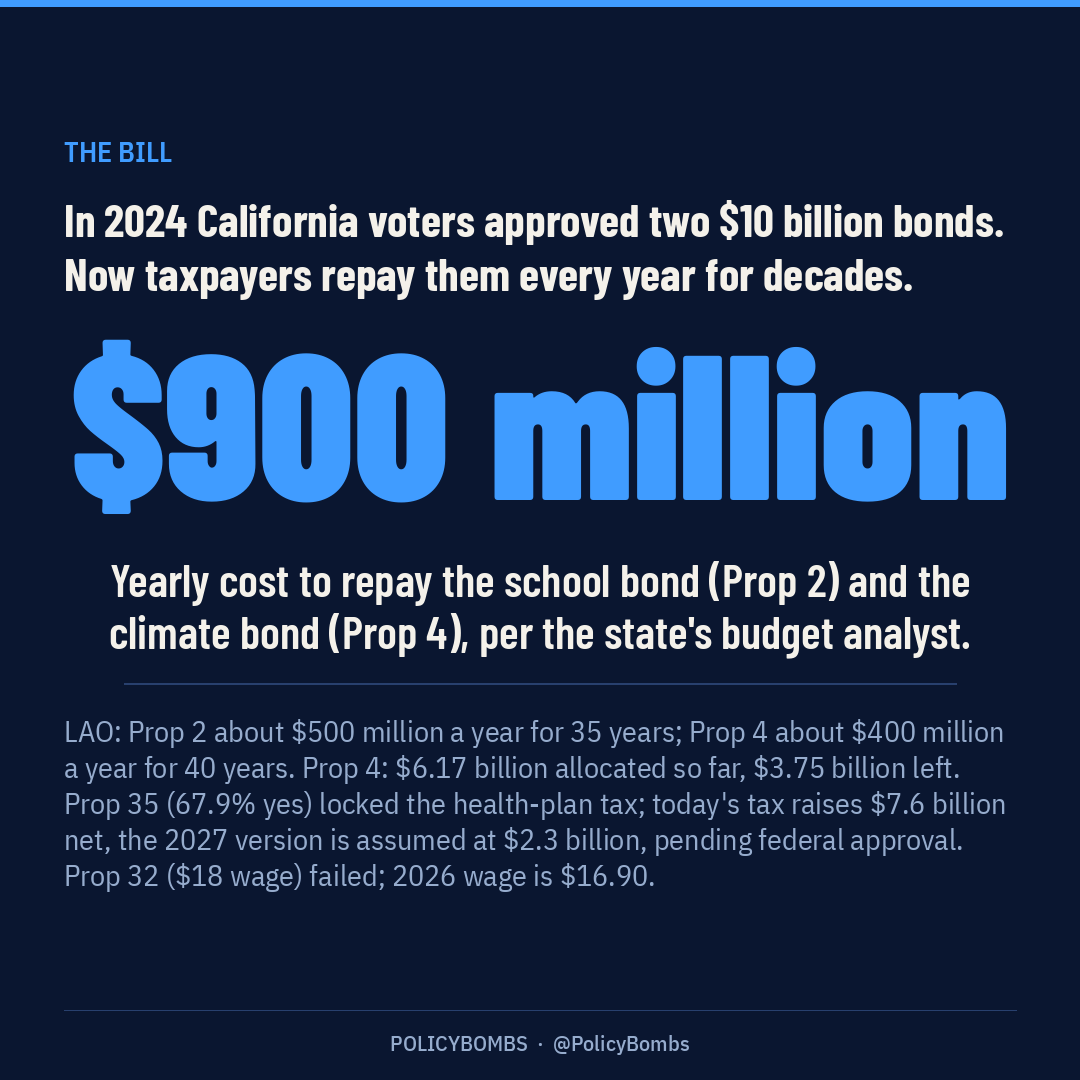
Voters approved $20 billion in bonds: about $900 million a year for up to 40 years. They also locked the rules on a $7.6 billion health-plan tax. The 2027 budget assumes $2.3 billion, and that those spending rules will not apply.
PRO: Prop 4 is moving: $3.46 billion (2025-26) and $2.71 billion (2026-27) allocated, $3.75 billion left (LAO). Prop 2 awards have started ($652.8 million on the Oct 22, 2025 Allocation Board agenda; $580.8 million in charter preliminary awards on Aug 5, 2026). Each bond, LAO said, is less than one-half of 1 percent of the General Fund and only about 10 percent costlier than cash after inflation. Prop 35 raised Medi-Cal funding in 2025 and 2026. Prop 3 has no fiscal effect. Voters rejected rent-control expansion, an $18 wage, and a lower local-bond threshold.
CON / COST: About $900 million a year in combined bond repayments at full issuance (LAO: $500 million for 35 years; $400 million for 40 years), inside a budget with an $18.5 billion operating deficit in 2026-27 (LAO). Prop 35’s design plus H.R. 1: current MCO tax $7.639 billion net, 2027-29 assumed tax $2.313 billion net, with Prop 35’s spending rules assumed not to apply, pending federal approval (LAO, Oct 2026). More of the smaller tax would fall on private enrollees. Prop 36 treatment uptake 17%. Prop 34 enforcement: Unverified. Prop 2 completions still early.
SOCIETY: MIXED. Measured outcomes are mostly dollars allocated, cases filed, and tax designs assumed, not results delivered. The biggest fiscal swing traceable to the 2024 ballot is the MCO tax. Bond payments are a fixed cost inside a budget the administration projects in operating deficit through 2029-30. The official money trail shows a landlord-AHF war on Props 33 and 34 and a health-industry lock on Prop 35.
Full analysis
Policy #84: the ten statewide measures on California’s Nov 5, 2024 ballot, with realized effects as of Nov 22, 2026. Research cutoff Nov 22, 2026 (PT).
Every figure below is tied to a source fetched for this analysis. Derived arithmetic is labeled. Advocacy-funded estimates are labeled. Correlation is not treated as causation. Claims are tagged Supported, Contested, or Unverified.
1. What the policy is
On Nov 5, 2024, California voted on ten statewide propositions. Five were placed on the ballot by the Legislature. Five were initiative statutes qualified by petition. Certified results are from the Secretary of State’s Statement of Vote [1].
| Prop | Short title | Type and legislative vehicle | Yes | No | Yes % | Result |
|---|---|---|---|---|---|---|
| 2 | School and community college facilities bond | Legislative statute. AB 247 (Muratsuchi), Chapter 81, Statutes of 2024 [15] | 8,820,842 | 6,207,390 | 58.7% | Passed |
| 3 | Constitutional right to marry | Legislative constitutional amendment. ACA 5 (Low), Resolution Chapter 125, Statutes of 2023 [15] | 9,477,435 | 5,658,187 | 62.6% | Passed |
| 4 | Climate, water, and wildfire bond | Legislative statute. SB 867 (Allen), Chapter 83, Statutes of 2024 [15] | 9,055,116 | 6,086,414 | 59.8% | Passed |
| 5 | 55% vote for local housing and infrastructure bonds | Legislative constitutional amendment. ACA 1 (Aguiar-Curry), Resolution Chapter 173, Statutes of 2023, as amended by ACA 10, Resolution Chapter 134, Statutes of 2024 [15] | 6,738,890 | 8,239,337 | 45.0% | Failed |
| 6 | Ban involuntary servitude as punishment for crime | Legislative constitutional amendment. ACA 8 (Wilson), Resolution Chapter 133, Statutes of 2024 [15] | 6,895,604 | 7,882,137 | 46.7% | Failed |
| 32 | $18 minimum wage | Initiative statute [15] | 7,469,803 | 7,686,126 | 49.3% | Failed |
| 33 | Expand local rent control authority | Initiative statute [15] | 5,979,880 | 8,975,542 | 40.0% | Failed |
| 34 | Restrict use of federal drug-discount revenue by certain providers | Initiative statute [15] | 7,378,686 | 7,121,317 | 50.9% | Passed |
| 35 | Permanent managed care organization (MCO) tax and rules for its use | Initiative statute [15] | 10,124,174 | 4,783,434 | 67.9% | Passed |
| 36 | Felony charges and longer sentences for certain drug and theft crimes | Initiative statute [15] | 10,307,296 | 4,756,612 | 68.4% | Passed |
Jurisdiction is statewide. Closest result: Prop 34, passed by 257,369 votes (50.9%) [1]. Widest yes: Prop 36, 68.4% [1]. Widest no among those that failed: Prop 33, 40.0% yes [1].
Measure-by-measure provisions (Legislative Analyst’s Office)
Prop 2. Authorizes a $10 billion general obligation bond: $8.5 billion (85%) for K-12 public school facilities, split among four project types and awarded for new construction and renovation mainly first come, first served, with competitive awards for career technical education and charter schools and a set-aside for small districts; $1.5 billion (15%) for community college facilities, with the Governor and Legislature selecting projects from a statewide priority list. The measure requires specified planning and accountability tasks. LAO: about $500 million a year for 35 years from the General Fund to repay the bond, “less than one-half of 1 percent of the state’s total General Fund budget.” After inflation, the total cost would be about 10 percent more than paying cash [2]. Official VIG supporters included the California Teachers Association, the California School Nurses Organization, and the Community College League of California. Official opponent: Howard Jarvis Taxpayers Association [16].
Prop 3. Updates the California Constitution to recognize a fundamental right to marry regardless of sex or race, and removes language stating that marriage is only between a man and a woman, to match federal court rulings. LAO: no change in who can marry, and no fiscal effect [3]. Official VIG supporters included Equality California, the Dolores Huerta Foundation, and the Sierra Pacific Synod of the Evangelical Lutheran Church in America. Official opponents included Jonathan Keller of the California Family Council and Rev. Tanner DiBella [16].
Prop 4. Authorizes a $10 billion general obligation bond for natural resources and climate work, much of it as loans and grants to local governments, tribes, nonprofits, and businesses. LAO category split: drought, flood, and water supply $3.8 billion; forest health and wildfire prevention $1.5 billion; sea-level rise and coastal areas $1.2 billion; land conservation and habitat restoration $1.2 billion; energy infrastructure $850 million (including $475 million for offshore wind, $325 million for transmission, and $50 million for large batteries); parks $700 million; extreme heat $450 million; farms and agriculture $300 million [4]. LAO: about $400 million a year for 40 years to repay, again “less than one-half of 1 percent” of the General Fund, and about 10 percent more than cash after inflation [4]. Official VIG supporters included Clean Water Action, CALFIRE Firefighters, the National Wildlife Federation, and The Nature Conservancy. Official opponent: Howard Jarvis Taxpayers Association [16].
Prop 5. Would have lowered the voter threshold for specified local housing and infrastructure bonds from two-thirds to 55%, with accountability requirements. Borrowing would be repaid by local property taxes. The amount would have depended on later local decisions [5]. Official VIG supporters included California Professional Firefighters, the League of Women Voters of California, and Habitat for Humanity California. Official opponents included the California Taxpayers Association, the California Hispanic Chambers of Commerce, and Women Veterans Alliance [16]. Failure left the two-thirds rule in place. Supported.
Prop 6. Would have banned involuntary servitude as punishment for crime and barred prisons from disciplining people who refuse to work. LAO: state costs or savings likely under tens of millions a year [6]. Official VIG supporter: Assemblymember Lori Wilson. Official opponents: none submitted [16].
Prop 32. Would have set the statewide minimum wage at $18 in 2025 for employers with 26 or more workers and $17 for smaller ones, then $18 for all in 2026, with inflation adjustments paused until 2027. Without it, LAO expected about $16.50 in 2025 and about $17 in 2026 [7]. LAO fiscal: state and local costs could rise or fall by up to hundreds of millions a year; revenues likely would fall by no more than a few hundred million a year [7]. Official VIG summary listed no supporters submitted and listed the California Chamber of Commerce among opponents [16].
Prop 33. Would have repealed the Costa-Hawkins Rental Housing Act, the 1995 state law that blocks local rent control on single-family homes, on housing built on or after Feb 1, 1995, and on the starting rent charged to a new tenant. The measure itself would not have changed existing local ordinances; cities and counties would have had to act separately [8]. LAO: a decline in rental-property values would cut local property tax revenue by at least tens of millions of dollars a year over time, less than one-half of 1 percent of all property tax revenue, with about half of the loss hitting schools [8]. Official VIG supporters included the California Nurses Association, the Coalition for Economic Survival, and Tenants Together [16].
Prop 34. Requires certain health care entities that meet specified conditions to spend at least 98% of their net California revenue from the federal 340B drug discount program on “direct patient care,” with reporting and penalties, including for conduct that is unprofessional, dishonest, or harmful to public health or safety [9]. LAO: state enforcement costs likely in the millions of dollars a year, paid by fees on the affected entities [9]. Official VIG supporters included the ALS Association. Official opponents included the National Organization for Women and Consumer Watchdog [16]. The Yes committee was sponsored by the California Apartment Association. The No committee was sponsored by AIDS Healthcare Foundation [15]. Whether the conditions were written to reach one organization is discussed in section 2.
Prop 35. Makes the existing enrollment-based tax on health plans (the MCO tax) permanent in state law beginning in 2027, still subject to federal approval, and sets rules for how the money is used, with different rules for 2025-2026 and for 2027 onward. It also directs the state to seek federal approval for a tax that uses “models and methodologies” that are “substantially similar” to the then-current tax, and it limits the annual non-Medicaid portion of that tax [10][24]. LAO’s 2024 ballot analysis: short-term, $2 billion to $5 billion more a year for Medi-Cal and related programs, counting federal funds, and $1 billion to $2 billion a year in state costs; long-term effects unknown [10]. Official VIG supporters included Planned Parenthood Affiliates of California, the American College of Obstetricians and Gynecologists, and the American Academy of Pediatrics, California. Official opponents: none submitted [16].
Prop 36. Allows felony charges and longer sentences for specified repeat theft and drug crimes, and creates treatment-mandated felonies. LAO: state criminal-justice costs from several tens of millions to the low hundreds of millions of dollars a year, mainly from a prison population increase of “around a few thousand,” plus local costs in the tens of millions [11]. Official VIG supporters included Crime Victims United of California, the California District Attorneys Association, and the Family Business Association of California. Official opponents included Contra Costa County District Attorney Diana Becton and Crime Survivors for Safety and Justice [16]. A fuller treatment is in the Day 73 PolicyBomb.
2. Why it exists
Stated reasons
The official pamphlet and LAO analyses stated the public case for each measure:
- Bonds (Props 2 and 4): repair and upgrade aging school and college facilities; fund drinking water, wildfire prevention, drought preparedness, and other climate and natural-resource work [2][4][16].
- Prop 3: align the state Constitution with the federal right to marry [3][16].
- Prop 5: make it easier for local governments to finance affordable housing and infrastructure [5][16].
- Prop 6: end a constitutional exception that allows involuntary servitude as punishment for crime [6][16].
- Prop 32: raise the statewide minimum wage to $18 [7].
- Prop 33: let cities and counties expand rent control [8].
- Prop 34: force certain providers to spend federal drug-discount revenue on patient care [9][16].
- Prop 35: stop the Legislature from redirecting MCO tax money to fill other budget holes, and raise or protect Medi-Cal provider pay [10][16].
- Prop 36: respond to retail theft, fentanyl, and drug addiction after Proposition 47 (2014) lowered penalties (Day 73) [11][16].
Those are the stated goals. They are not, by themselves, proof of the results.
Underlying drivers: money, incentives, and who wrote the checks
The deeper story is who paid, and what each coalition stood to gain or lose.
Official Secretary of State contribution totals, through Dec 31, 2024 unless noted [15]:
| Prop | Support (SOS) | Opposition (SOS) | Outcome |
|---|---|---|---|
| 2 | $13,718,542 | No committees identified | Passed |
| 3 | $3,997,687 | No committees identified | Passed |
| 4 | $11,957,398 | No committees identified | Passed |
| 5 | $15,210,690 | $28,560,565 | Failed |
| 6 | $1,593,533 | No committees identified | Failed |
| 32 | $11,887,159 | $855,076 | Failed |
| 33 | $48,482,311 | $124,920,206 | Failed |
| 34 | $44,798,042 | $16,512,317 | Passed |
| 35 | $54,067,417 (through Oct 30, 2024) | No committees identified as of Oct 30, 2024 | Passed |
| 36 | $16,809,101 | $7,739,562 | Passed |
These are committee-reported totals for each measure. Some committees, and some large checks, appear on more than one measure (for example the California Association of Realtors’ Homeownership for Families committee is listed at $27,038,043 on both Prop 5 and Prop 33; NextGen California Action is listed at $1,700,000 on both Prop 2 and Prop 4; a Kevin de Leon ballot-measure committee is listed at $841,741 on Props 3, 32, and 33) [15]. Adding the columns would double-count those dollars. The FPPC’s top-contributor lists carry the same warning [17]. The table is useful measure by measure. It is not a unique statewide total.
Borrowing when the operating budget was tight (Props 2 and 4). Supported: the Legislature, not a signature campaign, put both $10 billion bonds on the ballot [15]. LAO later recorded that the enacted 2026-27 budget still has an $18.5 billion operating deficit, narrowing to $10.4 billion in 2027-28, $8.7 billion in 2028-29, and $8.3 billion in 2029-30, because each year’s ongoing revenues fall short of that year’s ongoing spending [20]. Bonds move capital spending off the annual budget and onto 35 to 40 years of debt service [2][4]. That is a genuine fiscal design choice, not automatically a smear. The honest driver is that long-lived buildings and water projects are often financed this way, and that doing so also avoids a same-year cut or tax increase. Both can be true. Top official FPPC donors to the main Yes on 2 committee included the California Building Industry Association Issues Committee ($3,202,000), the California Teachers Association/Issues PAC ($2,118,880), and the Coalition for Adequate School Housing Issues Committee ($1,550,000), plus building-trades committees and PG&E Corporation and affiliated entities ($275,000) [17]. Kat Taylor gave $1,700,000 to a NextGen committee supporting Props 2 and 4 [17]. Top official donors to the main Yes on 4 committee included The Nature Conservancy ($2,008,879), the California Trust for Public Land Action Fund ($1,450,000), and the Federated Indians of Graton Rancheria ($1,000,000) [17]. Contractors, unions, and land-conservation groups had a direct interest in the work the bonds would fund. That does not, by itself, make the school or water need false. It does identify who had a reason to write the checks.
A $173 million rent-control war, and a companion measure aimed at the same nonprofit (Props 33 and 34). This is the clearest interest-group fight on the ballot. AIDS Healthcare Foundation’s committee reported $47,640,570 in support of Prop 33; SOS support for the measure totaled $48,482,311 [15]. FPPC: AHF itself gave $37,000,524 to its Yes committee [17]. Opposition to Prop 33 totaled $124,920,206 [15]. The California Apartment Association-sponsored No committee reported $89,802,157, and FPPC lists the CAA Issues Committee at $88,790,000, with Essex Property Trust Inc. and Equity Residential named as top donors to that committee [15][17]. The California Association of Realtors’ committee reported $27,038,043, including $22,000,000 from its Issues Mobilization PAC and $5,000,000 from the National Association of Realtors [15][17]. The same apartment-industry coalition then sponsored Yes on Prop 34, which raised $44,798,042, with FPPC listing $44,475,000 from the CAA Issues Committee [15][17]. AHF’s No on 34 committee reported $16,512,317 [15]. The official No argument in the voter guide called Prop 34 a measure “sponsored by the billionaire landlords” and described AHF as the target [16]. The official Yes committee’s name was “Protect Patients Now,” sponsored by the apartment association [15]. Supported: the two campaigns were funded, on opposite sides, by the same two principals, AHF and the apartment industry, in the same election. Contested: that Prop 34’s legal conditions apply to one organization only. LAO described “affected entities” that meet specified conditions, not a named organization [9]. AHF said in pre-election litigation that the measure “illegally applies to one, and only one, organization” [26]. No official post-election determination confirming that only AHF qualifies was found for this analysis (Unverified). The incentive, however, is not subtle. AHF used 340B-related resources to finance a rent-control campaign. Landlords financed both the defeat of that campaign and a spending rule that would constrain the same nonprofit. Legal campaign spending is not, by itself, corruption. Using a patient-care ballot title to settle a housing fight is a bait-and-switch the official disclosures make visible. Supported as a description of the money trail. Contested as a completed legal finding that the measure is a bill of attainder.
A health-industry lock on a tax the state had been using as a budget tool (Prop 35). Prop 35 passed with 67.9% and no official opposition committee as of the SOS snapshot [1][15]. FPPC top donors to the main Yes committee: California Hospitals Committee on Issues, $15,800,000 (top donors to that committee: Kaiser Foundation Health Plan, Inc. and the hospitals, and the California Association of Hospitals and Health Systems); Global Medical Response, Inc. and its subsidiaries, $13,900,000; California Medical Association Physicians Issues Committee, $11,476,197 [17]. Clinics, dentists, and ambulance firms wrote seven-figure checks too [17]. The stated aim was to keep MCO tax money in health programs and raise provider pay [10][16]. The underlying incentive was to take that allocation away from the Legislature, which had used the tax to help close General Fund gaps [10][22]. Ballot-box budgeting is the name for that move. It can protect a program from raids. It also reduces the state’s room to maneuver when federal rules change, which is what happened next (section 3).
Retailers versus progressive donors on crime (Prop 36). FPPC top Yes donors to the main committee: Walmart, Inc. $4,083,840; Target Corporation $1,000,000; Home Depot USA, Inc. $1,000,000; plus 7-Eleven, In-N-Out Burgers, and the California Correctional Peace Officers Association Truth in American Government Fund [17]. SOS support total: $16,809,101 [15]. Top No donors: Patty Quillin $2,500,000; Mark W. Heising $1,500,000; Elizabeth Simons $1,500,000; Stacy G. Schusterman $1,000,000; plus SEIU and the California Nurses Association [17]. SOS opposition total: $7,739,562 [15]. Retailers had a direct interest in felony tools against repeat theft. Prison-officer money is an interest too. Large individual donors on the No side are not a “public interest” by definition; they are a funding source. The 68.4% yes vote is still the electorate’s judgment, not a checkbook’s [1]. A committee controlled by San Jose Mayor Matt Mahan, Elk Grove Mayor Bobbie Singh-Allen, and Sacramento County District Attorney Thien Ho reported $847,621 in support [15].
One donor almost entirely funded the $18 wage (Prop 32). FPPC: Joseph N. Sanberg gave $10,434,815 to Working Hero Action for the Living Wage Act [17]. SOS support total: $11,887,159 [15]. Opposition was $855,076, mostly a small-business and grocer committee [15]. The measure still lost, by 216,323 votes [1]. Money did not buy this one. Supported.
Housing-bond threshold (Prop 5). Chan Zuckerberg Initiative Advocacy gave $7,000,000 to the Yes side, the largest official single contribution listed for that measure [15][17]. Firefighters and housing nonprofits joined [17]. Opposition at SOS was $28,560,565, dominated by the Realtors’ $27,038,043 committee that also opposed Prop 33, plus $1,488,691 from a Howard Jarvis Taxpayers Association project [15]. A lower vote threshold would have made it easier to raise local property taxes to repay housing and infrastructure bonds [5]. Homeowners and taxpayer groups had a reason to defend the two-thirds rule. Housing advocates and a large philanthropic 501(c)(4) had a reason to lower it. Voters kept the higher bar [1].
Prop 6 drew $1,593,533 in support and no identified opposition committees, and still failed, 46.7% to 53.3% [15][1]. Low spending against a measure is not the same as public agreement with it.
Named politicians and figures
| Who | Role | Position | Source |
|---|---|---|---|
| Assemblymember Al Muratsuchi (D) | Author of AB 247 | Placed Prop 2 on the ballot | [15] |
| Assemblymember Evan Low (D) | Author of ACA 5 | Placed Prop 3 on the ballot. Official Yes argument signer | [15][16] |
| Senator Ben Allen (D) | Author of SB 867 | Placed Prop 4 on the ballot | [15] |
| Assemblymember Cecilia Aguiar-Curry (D) | Author of ACA 1 / ACA 10 | Placed Prop 5 on the ballot | [15] |
| Assemblymember Lori Wilson (D) | Author of ACA 8 | Placed Prop 6 on the ballot. Official VIG supporter | [15][16] |
| Governor Gavin Newsom (D) | Governor | Signed the legislative bills and amendments that put Props 2, 3, 4, 5, and 6 on the ballot. The official No argument on Prop 4 cited a “budget emergency” he had declared. Alignment on Prop 36: opposed, per the Day 73 PolicyBomb | [15][16], Day 73 |
| Speaker Robert Rivas (D), Senate leader Mike McGuire (D) | Legislative leaders | Opposed Prop 36, per the Day 73 PolicyBomb | Day 73 |
| Contra Costa County D.A. Diana Becton | Official VIG opponent of Prop 36 | Opposed | [16] |
| Mayors Matt Mahan and Bobbie Singh-Allen; D.A. Thien Ho | Controlled a Yes on 36 committee | Supported | [15] |
| Senator Toni Atkins (D) and Assemblymember Rick Chavez Zbur (D) | Ballot-measure committees | Contributed to Yes on Prop 3 | [15][17] |
| Former L.A. City Councilmember Kevin de Leon | Ballot-measure committee | Yes on Props 3, 32, and 33 ($841,741 reported) | [15] |
| Assemblymember Liz Ortega (D) | Ballot-measure committee | Yes on Props 2 and 3 ($33,000 reported) | [15] |
| Joseph N. Sanberg | Donor | $10,434,815 for Prop 32 | [17] |
| AIDS Healthcare Foundation / Michael Weinstein (AHF president, public proponent of the rent-control campaign) | Sponsor and nearly exclusive funder of Yes on 33; funder of No on 34 | Yes on 33, No on 34 | [15][17] |
| California Apartment Association (Thomas Bannon is widely reported as the Prop 34 proponent; the official Yes committee was CAA-sponsored) | Sponsor of No on 33 and Yes on 34 | No on 33, Yes on 34 | [15][17] |
| Chan Zuckerberg Initiative Advocacy | Donor | $7,000,000 for Prop 5 | [15][17] |
| Walmart, Target, Home Depot | Donors | Leading Yes on 36 retail checks | [17] |
| Howard Jarvis Taxpayers Association | Official opponent of Props 2, 4, and (through a project committee) Prop 5 | Opposed the bonds and the 55% threshold | [15][16] |
No on-record comment by Elon Musk or Marc Andreessen specifically on these ten 2024 measures was found in sources fetched for this analysis. None is invented here.
Official pamphlet language, in the state’s own words, is the cleanest primary record of the public arguments. Prop 2 Yes: the bond would “help more California students learn in safe, clean, upgraded schools,” with “strict taxpayer accountability protections” [16]. Prop 2 No, from the Howard Jarvis Taxpayers Association: “Proposition 2 is yet another attempt to circumvent” ordinary budgeting, and “those tax dollars rarely go where politicians say they will” [16]. Prop 36 Yes: “a tailored reform focused on the root causes of rising crime,” including “repeat retail theft,” “fentanyl trafficking,” and “drug addiction without incentives for treatment” [16]. Prop 36 No, in the official overview: “Don’t be fooled. Proposition 36 will lead to more crime, not less. It reignites the failed war on” drugs, as abbreviated in the pamphlet’s summary box [16]. Those are campaign arguments in an official book. They are not findings.
3. Realized effects (as of Nov 22, 2026)
Prop 2: the first sales and awards, still early
The Treasurer’s October 2025 Debt Affordability Report, using figures as of June 30, 2025, listed the entire $8.5 billion K-12 authorization and the entire $1.5 billion community-college authorization as unissued [18]. After that date, the Treasurer’s November 2025 newsletter said the office completed two general obligation sales totaling $3.4 billion in the fall, and that “the first GO bonds were issued under Proposition 2,” alongside Proposition 1 (the March 2024 behavioral-health bond) and refunding that the office said will save $182 million in debt service over 20 years [19]. The $3.4 billion is the combined sale, not the Prop 2 share. The Prop 2-only issued amount was not broken out in that newsletter (Unverified as a stand-alone figure).
On Oct 22, 2025, the State Allocation Board’s official agenda included an action item “to provide priority School Facility Program Apportionments in the amount of $652.8 million for the projects that submitted a valid certification” [27]. That is an official agenda figure. A post-meeting official board minute confirming the exact number of projects approved was not retrieved for this analysis. Treat $652.8 million as the official amount scheduled for that meeting, not as a counted list of completed schools.
The Governor’s 2026-27 Budget Summary (Infrastructure) said the budget “continues to allocate $1.5 billion Proposition 2 bond funds to support school construction projects in 2026-27, similar to amounts allocated in prior years.” It also said Proposition 2 “authorized $1.5 billion” for community colleges, and that the budget “proposes $736.9 million General Obligation Bond funds for 10 new projects and 29 continuing projects, all of which are funded by Proposition 2.” It anticipated the first critical-infrastructure projects funded with Prop 2 would be completed in 2027 and the first new building projects in 2028 [21]. Those are Governor’s Budget figures, not independently audited completions. Classrooms actually opened, and a running official total of K-12 awards through Nov 2026, remain incomplete in the documents fetched for this analysis (partly Unverified). An official Office of Public School Construction webinar packet reported that on Aug 5, 2026, the State Allocation Board awarded $580.8 million in 44 preliminary apportionments for 29 charter schools under Prop 2, with a conversion deadline of Aug 5, 2030 [28].
Metric gap: dollars authorized, proposed, or awarded are inputs. Buildings completed and students served are the outcomes, and those are only beginning to appear in official forecasts (2027-2028) [21].
Prop 4: money is moving; outcome metrics are still thin
LAO’s October 2026 review of the 2026-27 natural-resources spending plan [12]:
| Amount (millions) | |
|---|---|
| Bond total | $10,000 |
| 2025-26 allocations | $3,462 |
| 2026-27 allocations | $2,711 |
| Remaining for future years | $3,752 |
Derived: $3,462 million plus $2,711 million equals $6,173 million committed in those two years, about $6.2 billion. LAO: the 2026-27 total was higher than the $2.1 billion the administration proposed in January, reflecting legislative additions. Largest remaining balances included safe drinking water, drought, flood, and water resilience ($1.5 billion); coastal resilience ($697 million); and wildfire and forest resilience ($561 million). Statewide bond costs were estimated at $75 million [12]. Dollars committed are not acres treated, levees finished, or water systems upgraded. Those outcome metrics were not found in a comprehensive official scorecard for this analysis (Unverified as a complete accounting). LAO’s 2024 analysis noted that if the spending reduces disaster damage, state and local response costs could fall, but “the amount of such potential savings is uncertain” [4]. That remains the right caution.
Prop 35 meets H.R. 1: the biggest fiscal swing on the 2024 ballot
LAO’s May 2026 Medi-Cal analysis said that under Prop 35 plus federal H.R. 1, the 2027 MCO tax “was expected to be very small, raising just tens of millions of dollars annually,” with a proposed separate $2 billion workaround awaiting federal approval [13]. The enacted 2026-27 budget, as described by LAO on Oct 19, 2026, goes further, and with harder numbers [22].
The current MCO tax, based on enrollment, expires Dec 31, 2026. In 2026 it charges about $274 per member month on Medi-Cal enrollment and $2.25 on private enrollment, using tax tiers. LAO’s Figure 4: net revenue in 2026 is $7,639 million, about $7.6 billion, almost all from the Medi-Cal side ($7,604 million net) and only $35 million from private enrollment [22]. DHCS, in a May 22, 2026 fact sheet cited in contemporaneous reporting and consistent with this LAO table, described net revenues of more than $7.6 billion a year for the current tax; the fact sheet file itself was blocked by the department’s bot filter in this analysis, so the figures used here are LAO’s [22][13].
Federal H.R. 1 (Public Law 119-21, July 2025) prohibits health-care-related taxes that put a higher rate, or a disproportionate burden, on Medicaid enrollment [22][24]. California cannot simply renew the current structure after Dec 31, 2026. Prop 35 still requires the state to seek federal approval for a “substantially similar” tax, and it limits the non-Medicaid piece [22][24].
Trailer-bill legislation, Chapter 24 of 2026 (SB 125), establishes a new MCO tax from 2027 through 2029 at an average $8.85 per enrollee per month, the same rate on Medi-Cal and private enrollment, with no required tiers [22]. LAO’s Figure 4: that new tax is expected to raise $2,313 million in net revenue, about $2.3 billion, “less than one-third of the amount generated by the current MCO tax.” Of that, $776 million net would come from Medi-Cal enrollment and $1,537 million from private enrollment [22]. LAO’s words: “the tax on private enrollment falls directly on health plans and their consumers.” Of nearly 50 plans, “more than 80 percent of the tax on private enrollment falls on just four of them” [22]. The tax still must receive federal approval to take effect. Pending.
How the spending plan treats Prop 35: the administration planned to submit two components. The first, “substantially similar” to the current tax, is assumed to be rejected as noncompliant with H.R. 1. The second is the new $8.85 tax. The administration argues the second component is in addition to what Prop 35 requires and is therefore not subject to Prop 35’s spending rules. “Because the spending plan assumes the first component is rejected by the federal government, but the second component approved, the overall effect will be an MCO tax that does not implement Proposition 35’s requirements” [22]. The new tax is scored as a budget solution: $575 million General Fund savings in 2026-27, rising to $2.3 billion in later years. About $300 million a year would continue certain 2024 provider rate increases [22]. The spending plan also shifts $1.9 billion over two years within the current tax to help cover base provider-rate growth, and redirects Prop 35’s behavioral-health allocation toward other recent initiatives. LAO noted that “to date, the administration has not provided complete back up of the revised Proposition 35 spending plan” [22].
Realized effect, labeled. Supported: Prop 35 governed uses of the current tax in 2025 and 2026 and, in LAO’s 2024 estimate, was expected to add $2 billion to $5 billion a year, including federal funds, in those years [10]. Supported: the current tax raises about $7.6 billion net a year and expires at the end of 2026 [22]. Supported: H.R. 1 makes a same-structure renewal illegal after that date [22]. Supported as an official budget assumption, not yet as a federal decision: the 2027 tax is scored at $2.3 billion net, with Prop 35’s spending rules assumed not to apply [22]. Pending: federal approval. Contested: whether routing a new tax around Prop 35 honors the 67.9% vote or evades it. That is a legal and political dispute, not a fact already adjudicated in the documents fetched here.
The earlier “tens of millions” figure was LAO’s May 2026 description of a Prop 35-compliant tax under H.R. 1, not the enacted workaround [13]. The figures above are the October 2026 enacted-plan figures.
Prop 32: the wage path without it
The measure failed by 216,323 votes [1]. The official DIR minimum-wage FAQ: effective Jan 1, 2026, the statewide minimum wage is $16.90 an hour for employers not covered by a higher industry or local wage. Fast food and certain health-care workers already have higher statutory floors, and some cities and counties are higher still [14]. Under Prop 32 the 2026 statewide rate would have been $18 [7]. For a full-time worker at 2,080 hours, the difference from $16.90 to $18 is $1.10 an hour, or $2,288 a year (derived). That arithmetic is not an employment effect. What would have happened to jobs, prices, or hours is Unverified as a counterfactual. LAO had already said government costs could move either way [7].
Prop 36: filings are up; treatment uptake is low; crime-drop credit is not proven
From the Day 73 PolicyBomb, which used Judicial Council data: 34,612 felony Prop 36 cases in 2025 (19,104 drug, 15,508 theft). Of 18,666 treatment-mandated felony drug cases, 3,207 (17%) involved people who opted for treatment. Courts reported 57 cases dismissed after successful completion [Day 73]. The 2026-27 budget provides $50 million one-time ($10 million courts, $20 million pretrial, $20 million behavioral health). A Senate Republican caucus figure of $350 million in annual need is a partisan estimate, not independently verified in that analysis. California shoplifting fell 8.1% in 2025, but FBI property crime fell 12.4% nationally the same year, so the drop cannot be credited to Prop 36 on timing alone (Day 73: Unverified as causation). This analysis does not relitigate Day 73. It records that the 2024 ballot’s most popular measure is, two years later, still mostly a caseload story, not a proven treatment or crime-rate story.
Prop 34: the vote happened; enforcement is still thin in the public record
The measure passed by 257,369 votes [1]. Pre-election suits by AIDS Healthcare Foundation seeking to keep it off the ballot did not succeed; a Sacramento County Superior Court petition was denied without prejudice to a post-election challenge [26]. A post-election official enforcement determination, a published list of “affected entities,” or a later appellate judgment on constitutionality was not confirmed in official documents fetched for this analysis (Unverified). The money trail in section 2 is documented. The legal end-state is not.
Props 3, 5, 6, and 33
No change in operative law except Prop 3’s wording update, which LAO said has no fiscal effect and no change in who can marry [3][5][6][8]. Prop 5’s failure keeps the two-thirds local-bond threshold [5]. Prop 33’s failure keeps Costa-Hawkins [8]. Those are realized non-effects, and they matter: voters rejected a lower bar for local borrowing and rejected a statewide repeal of limits on rent control.
Costs to citizens, and comparisons
- Bond debt service. About $900 million a year, derived from LAO’s $500 million (Prop 2) plus $400 million (Prop 4) [2][4]. That figure is a full-issuance annual estimate, not the amount already being paid in 2025-26, because most of the authority was still unissued as of June 30, 2025 [18]. LAO said each bond, taken alone, is less than one-half of 1 percent of the General Fund [2][4]. The enacted 2026-27 General Fund is $251.477 billion [20]. $900 million is 0.36% of that total (derived). The Treasurer, using 2024-25 figures, put General Fund-supported debt service at $7.96 billion, 3.59% of $221.8 billion in General Fund revenues (2.82% after about $1.7 billion in offsets). The office estimated 3.95% in 2025-26, or 3.11% after offsets, on $8.23 billion of payments versus $208.6 billion of revenues [18]. It also estimated $19.2 billion of new-money General Fund-supported issuance in 2025-26 and 2026-27 combined, and a $1 billion increase in General Fund debt-service payments in 2026-27 [18]. Props 2 and 4 are part of that rise, not the whole of it. Moody’s, as quoted by the Treasurer, listed California’s net tax-supported debt per capita at $2,563 [18]. That is a statewide debt stock, not the incremental cost of these two bonds.
- Opportunity cost. $900 million a year, once both bonds are fully issued, is in the same range as large one-time items in the 2026-27 budget (for example $400 million for the Homeless Housing, Assistance and Prevention program, or $250 million in public-hospital grants) [20]. That is a comparison, not a claim that the school or water projects have no value. The trade is time: 35 to 40 years of fixed payments inside a budget that the administration itself projects will run operating deficits through 2029-30 [20].
- MCO tax incidence. The new 2027 structure, if approved, shifts a much larger share of the remaining tax onto private enrollment: $1.537 billion of $2.313 billion net, versus $35 million of $7.639 billion today [22]. LAO says that piece “falls directly on health plans and their consumers” [22]. That is a cost to privately insured people, not a free federal match. It is also a smaller tax than the one voters were told would be made permanent. Both are true.
- Minimum wage. California’s 2026 statewide floor is $16.90, lower than the $18 Prop 32 would have set [14][7]. DIR notes that fast food and certain health-care workers already have higher statutory floors, and that some cities and counties are higher still [14]. A compiled official table of other states’ 2026 rates was not fetched for this analysis.
- Rent control. Costa-Hawkins remains the statewide limit [8]. No 2025-2026 official estimate of rents “saved” or housing “not built” is applicable, because Prop 33 failed.
4. Good or bad for society
Fiscal cost, opportunity cost, and secondary effects
The certain, voter-approved, long-term bill is the bonds: about $900 million a year for 35 to 40 years, once issued, inside a General Fund that is already carrying an $18.5 billion operating deficit in 2026-27 [2][4][20]. That is not a crisis by itself. It is a fixed claim on future budgets. Secondary effect: less flexibility when revenues dip, because debt service is paid first.
The largest fiscal swing traceable to the 2024 ballot is Prop 35. Voters locked rules around a $7.6 billion tax. Federal law then forbade the old structure. The state’s answer, still pending federal approval, is a $2.3 billion tax that the budget assumes is outside those rules, with more of the burden on private enrollees [22]. Provider groups bought a lock. They may not get the lock they paid for. Medi-Cal still gets a tax, just a smaller one, used more like the old General Fund offset. Secondary effect: if the workaround is approved, privately insured customers may pay more of it; if it is not, the hole is larger.
Prop 36 created a large new felony caseload and a treatment promise that only 17% of eligible drug defendants took in year one, against $50 million in one-time funding (Day 73). Secondary effect: court and jail load now, with the crime-reduction claim still unproven because the 2025 property-crime drop was national.
Prop 34’s social merit depends on whether it is a patient-care rule or a targeted shutdown of a political opponent. The money trail supports the second reading as a motive. The legal merits are not finished. Unverified as an enforcement result.
Failed measures also have effects: no $18 statewide wage, no Costa-Hawkins repeal, no 55% local-bond threshold, no constitutional ban on prison labor as involuntary servitude. Those are choices the electorate made, not residual “unfinished business” this write-up pretends to settle.
Strongest counterargument
Bonds are how governments pay for long-lived assets. LAO itself said each of these bonds costs less than half a percent of the General Fund and only about 10 percent more, after inflation, than paying cash [2][4]. Schools, water systems, and wildfire work are real capital needs, not party favors, even if contractors and unions helped pay for the campaigns. Prop 4 is already allocating billions on a published schedule [12]. Prop 2 awards have started [27][21][28]. Prop 35 did, in 2025 and 2026, steer MCO revenue toward health programs as advertised [10][22]. The $2.3 billion 2027 tax, if approved, is still billions, not zero, and it is the federal government, not a state sleight of hand, that barred the old structure [22]. Voters were not a rubber stamp: they rejected rent-control expansion, an $18 wage, a lower local-bond bar, and the prison-labor amendment, while passing a crime measure by 68.4% [1]. A “bad ballot” story that ignores those nos is incomplete.
Verdict
MIXED. The 2024 ballot added a real, decades-long debt-service bill of about $900 million a year and a voter-written lock on a health-plan tax that federal law and the 2026 budget have already rerouted. The most popular measure, Prop 36, is an unfinished test. The most expensive political fight, Props 33 and 34, was a landlord-versus-AHF war dressed, on one side, as patient protection. Voters also refused several expansions of regulation and local debt. Measured outcomes are still mostly dollars allocated, cases filed, and tax designs assumed, not classrooms opened or crime proven to have fallen because of the vote. That is not a reason to grade the package “good.” It is a reason not to grade it simply “bad.”
What good ballot measures would include
- Outcome metrics in every bond, published annually. Classrooms completed, community-college projects finished, acres treated, water systems upgraded, not only dollars appropriated. Prop 4’s remaining-balance report is a start [12]. It is not an outcome scorecard. Unverified: no official cost estimate for building that scorecard was found for this analysis.
- Federal contingency clauses in any revenue measure that depends on Washington. Prop 35 told the state to seek a “substantially similar” tax. H.R. 1 then made similarity illegal. A measure that can be amended, or that states what happens if federal approval is denied, would have given voters a more honest 2027 picture [13][22].
- A debt-affordability line on the ballot itself. Show the state’s existing General Fund debt-service ratio (3.59% in 2024-25, 3.95% estimated in 2025-26 before offsets [18]) next to the new payment. LAO already tells readers each of these bonds is under half a percent of the General Fund [2][4]. That sentence should be on the stamp side of the pamphlet, next to the $10 billion headline.
- Fund what you mandate. Prop 36 created treatment-mandated felonies without a standing funding source. Year one: 17% uptake, 57 completions, $50 million one-time (Day 73). A good measure would have tied the new felony to a paid treatment slot, or omitted the promise.
- Sunsets and honest titles for ballot-box budgeting. Prop 35’s allocation rules should have carried a review date. Prop 34 should have been described to voters as a spending rule written and financed by the apartment industry in the same cycle as its fight with AHF, which is what the official contribution reports show [15][17]. A patient-care title can be accurate as far as it goes and still hide the sponsor’s incentive.
- Do not treat a business tax, or a tax on insurers, as free money. LAO’s warning that the 2027 private-enrollment tax “falls directly on health plans and their consumers” is the right standard [22]. If the state needs the revenue, say who pays.
Gaps and Unverified items
- The Prop 2-only dollar amount inside the fall 2025 $3.4 billion combined general obligation sales [19].
- An official, cumulative K-12 project-completion tally through Nov 2026.
- A complete official Prop 4 outcome scorecard (acres, systems, miles of levee), as opposed to dollars allocated [12].
- Federal approval of the 2027 MCO tax, and any court test of the claim that the new tax is outside Prop 35 [22].
- Prop 34 post-election enforcement, the official list of affected entities, and any later appellate ruling [26].
- Employment and price effects of the failed $18 wage, as a counterfactual.
- Any on-record Musk or Andreessen comment on these ten measures (none found for this analysis).
References
- California Secretary of State, Statement of Vote, Nov 5, 2024 General Election. https://elections.cdn.sos.ca.gov/sov/2024-general/sov/complete-sov.pdf
- Legislative Analyst’s Office, Proposition 2 (2024). https://lao.ca.gov/BallotAnalysis/Proposition?number=2&year=2024
- LAO, Proposition 3 (2024). https://lao.ca.gov/BallotAnalysis/Proposition?number=3&year=2024
- LAO, Proposition 4 (2024). https://lao.ca.gov/BallotAnalysis/Proposition?number=4&year=2024
- LAO, Proposition 5 (2024). https://lao.ca.gov/BallotAnalysis/Proposition?number=5&year=2024
- LAO, Proposition 6 (2024). https://lao.ca.gov/BallotAnalysis/Proposition?number=6&year=2024
- LAO, Proposition 32 (2024). https://lao.ca.gov/BallotAnalysis/Proposition?number=32&year=2024
- LAO, Proposition 33 (2024). https://lao.ca.gov/BallotAnalysis/Proposition?number=33&year=2024
- LAO, Proposition 34 (2024). https://lao.ca.gov/BallotAnalysis/Proposition?number=34&year=2024
- LAO, Proposition 35 (2024). https://lao.ca.gov/BallotAnalysis/Proposition?number=35&year=2024
- LAO, Proposition 36 (2024). https://lao.ca.gov/BallotAnalysis/Proposition?number=36&year=2024
- LAO, The 2026-27 California Spending Plan: Natural Resources and Environmental Protection (Report 5207). https://lao.ca.gov/Publications/Report/5207
- LAO, Medi-Cal at the May Revision (2026). https://abgt.assembly.ca.gov/system/files/2026-05/initial-lao-analysis-of-medi-cal-at-may-revision.pdf
- California Department of Industrial Relations, Labor Commissioner’s Office, Minimum Wage Frequently Asked Questions. https://www.dir.ca.gov/dlse/faq_minimumwage.htm
- California Secretary of State, 2024 Ballot Measure Contribution Totals (and each proposition page, totals through Dec 31, 2024 except Prop 35 through Oct 30, 2024). https://www.sos.ca.gov/campaign-lobbying/helpful-resources/measure-contributions/2024-ballot-measure-contribution-totals
- California Secretary of State, Official Voter Information Guide, Nov 5, 2024 General Election. https://vig.cdn.sos.ca.gov/2024/general/pdf/complete-vig.pdf
- Fair Political Practices Commission, Top 10 Contributors, November 2024 General Election (page last modified Dec 27, 2024). https://www.fppc.ca.gov/search-filings/top-10-contributors-list/november-2024-general-election
- California State Treasurer, Debt Affordability Report, October 2025 (figures as of June 30, 2025). https://www.treasurer.ca.gov/sites/default/files/2026-01/2025.pdf
- California State Treasurer, November 2025 newsletter. https://www.treasurer.ca.gov/sites/default/files/2025-12/november-2025.pdf
- LAO, The 2026-27 Budget: Overview of the Spending Plan (Report 5197), Aug 26, 2026. https://www.lao.ca.gov/Publications/Report/5197
- Department of Finance, Governor’s Budget Summary 2026-27, Infrastructure. https://ebudget.ca.gov/2026-27/pdf/BudgetSummary/Infrastructure.pdf
- LAO, The 2026-27 California Spending Plan: Health (Report 5210), Oct 19, 2026. https://lao.ca.gov/Publications/Report/5210
- LAO, The 2026-27 Budget: Proposition 4 Spending Plan (Report 5115). https://www.lao.ca.gov/Publications/Report/5115
- Cited in LAO Report 5210 and in DHCS materials described there: H.R. 1, Public Law 119-21 (July 2025); Chapter 24 of 2026 (SB 125), establishing the 2027-2029 MCO tax.
- Pre-election litigation history as summarized in the University of the Pacific McGeorge School of Law California Initiative Review (citing AIDS Healthcare Foundation v. Weber, Sacramento County Superior Court No. 24WM000018, and related appellate proceedings). Use as a secondary account of court docket events, not as a finding on constitutionality. https://scholarlycommons.pacific.edu/california-initiative-review/
- State Allocation Board, Meeting Notice and Agenda, Oct 22, 2025, priority School Facility Program apportionments of $652.8 million. https://www.dgs.ca.gov/-/media/Divisions/OPSC/Agenda-Items/2025/10-October/10222025-Meeting-Notice-and-Agenda-Final-ADA.pdf
- Office of Public School Construction, Charter School Facilities Program Proposition 2 Filing Round packet, reporting State Allocation Board awards of $580.8 million on Aug 5, 2026 (44 preliminary apportionments, 29 schools). https://www.dgs.ca.gov/-/media/Divisions/OPSC/Services/Charter/OPSC-CSFP-Converting-a-Preliminary-Apportionment-and-Accessing-Cash.pdf
Day 73 PolicyBomb: Judicial Council Prop 36 caseload and treatment figures; 2026-27 one-time funding; shoplifting and national property-crime comparison. Used only for Prop 36 realized effects, not re-derived here.
PolicyBombs · Policy #84. Follow @PolicyBombs on X.
Accountability Scorecard
MixedPolicy #84 grade: Mixed. MIXED. Measured outcomes are mostly dollars allocated, cases filed, and tax designs assumed, not results delivered. The biggest fiscal swing traceable to the 2024 ballot is the MCO tax. Bond payments are a fixed cost inside a budget the administration projects in operating deficit through 2029-30. The official money trail shows a landlord-AHF war on Props 33 and 34 and a health-industry lock on Prop 35.
Measured outcome: Measured outcome: being sourced for the scorecard.
Positions on record
Responsible parties being sourced. Names appear here only once they are tied to a documented action with a source.
How we grade
Grades come from the "good or bad for society" verdict (question 4) in each PolicyBomb research pack and rest on measured outcomes, not motives. Harmful means the research found net harm, Mixed means real benefits and real costs, Helpful means net benefit. Every name is tied to a documented action (an authored bill, a signature, a recorded vote, a filed donation, an order or a public statement) with a linked source. Only full scorecard rows count toward a person's Harmful, Mixed and Helpful tally; positions listed from the research are shown with their source but are not tallied yet.
Grade basis: the verdict in the Policy #84 write-up.