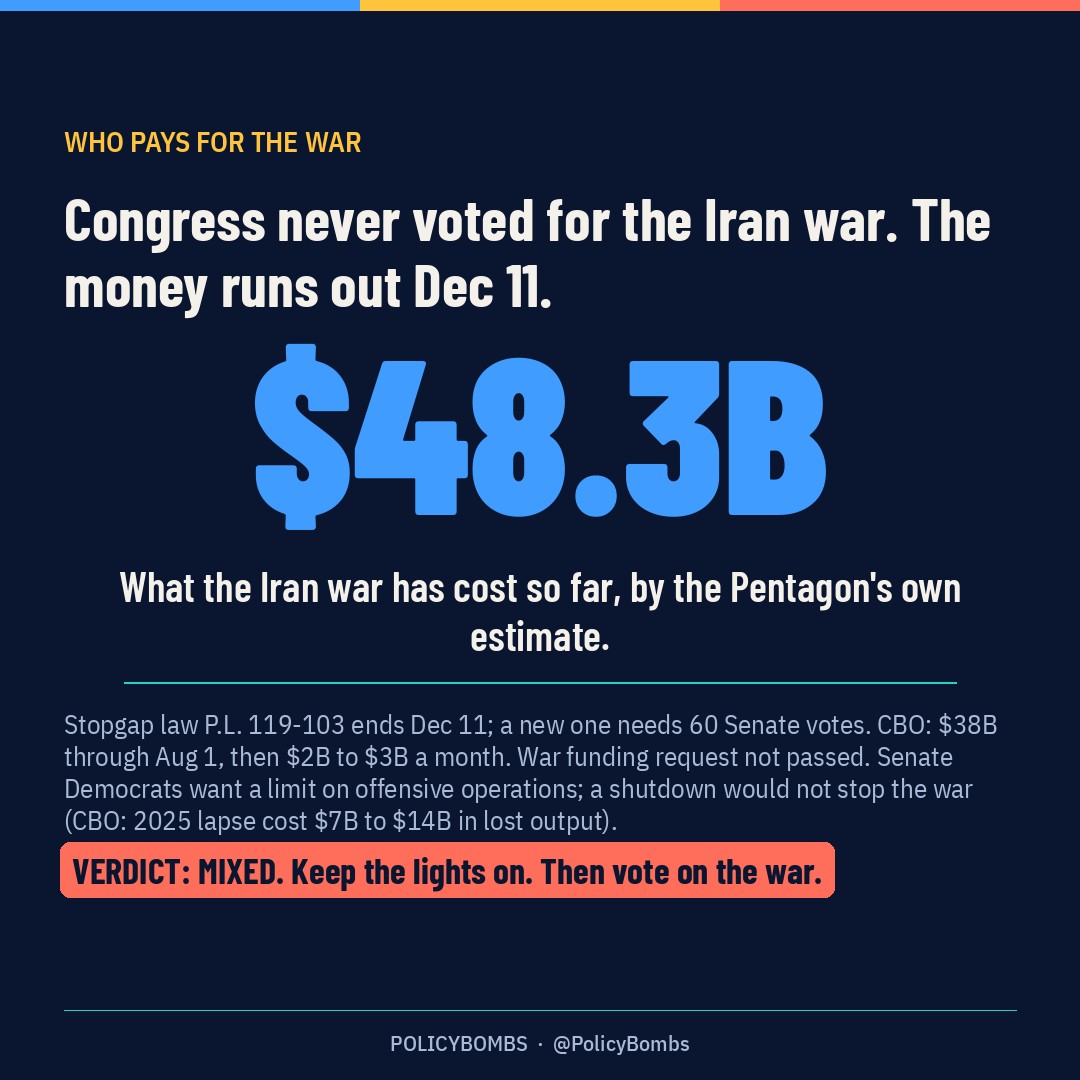
$48.3 billion. That is what the Iran war has cost so far, by the Pentagon’s own estimate (AP, November 13). Congress never voted to start it. Congress never voted to pay for it. And on December 11 the money for the rest of the government runs out.
The deadline. The current stopgap, Public Law 119-103, funds agencies at last year’s rates through December 11. CBO puts it at $1.701 trillion a year in discretionary spending. A new stopgap needs 60 Senate votes. Republicans hold 53.
The war money. CBO estimated the Pentagon’s cost at $38 billion through August 1, rising $2 billion to $3 billion a month. The White House asked for $87.6 billion in June; CBO found $42.3 billion of it tied to the war. Congress has not passed it. On November 19 the Senate rejected an Iran war powers resolution 48 to 51.
The fight. Senate Democrats have drafted language that would bar money for offensive operations unless Congress authorizes the war, while funding the defense of US troops. Some say no stopgap without it. Others warn a shutdown cannot stop a war: ships keep sailing, paychecks stop. CBO estimated the 2025 shutdown permanently erased $7 billion to $14 billion of output.
Verdict: MIXED. Keep the lights on with a short, clean stopgap. Then put the war to a recorded vote in January: authorize it and pay for it, or cut it off by law. A $48 billion war with nobody on record is the deeper failure.
Full analysis
Long-form analysis of the FY2027 funding deadline (December 11, 2026) and the fight over limits on Iran war funding. Content checked November 23, 2026 (America/Los_Angeles). Finding tags: Substantiated, Pending, Contested, Unproven, Unverified.
Research cutoff: 2026-11-23
Verdict: MIXED. Pass a clean short stopgap; then hold a recorded vote on the war. A shutdown is the wrong lever.
1. What is the policy?
The vehicle
- Current law. The Continuing Appropriations and Extensions Act, 2027 (H.R. 6500, Public Law 119-103) was signed September 2, 2026. The House agreed to the Senate version 370 to 48 on September 1; the Senate passed it 90 to 6 on August 8. Division A funds all 12 regular appropriations areas from October 1 through December 11, 2026, a 72-day period (CRS R49353).
- Rate. Most programs run at FY2026 levels and conditions. CBO estimates the stopgap provides $1.701 trillion in annualized discretionary budget authority (CRS R49353). Defense new starts, higher production rates and certain multiyear buys are barred under section 102.
- The deadline. If neither a new stopgap nor the regular bills pass, a funding gap starts December 12, 2026 (CRS R49353).
- Regular bills. The House passed the Military Construction and Veterans Affairs bill (H.R. 8469) 400 to 15 on May 15, 2026. A Senate motion to proceed to it was made November 20 (Congress.gov). The House also passed a GOP stopgap (H.R. 9770) 220 to 205 on July 21 that would have run to December 4; it did not become law. DeLauro told Reuters “Being able to finish all 12 bills is not possible.”
- Defense money. Reuters (Nov 20) reports President Trump has asked for $350 billion in new Pentagon spending; Senate Republicans chose to negotiate a $1.1 trillion defense appropriations bill that includes $69 billion of that request, with budget reconciliation still on the table.
The war rider
- The war. CBO dates US combat operations against Iran to February 28, 2026 (Operation Epic Fury). A ceasefire began April 8; the president declared it over on July 10 after Iranian attacks on tankers. The conflict has since been less intense but includes a US blockade of Iranian commercial shipping and periodic strikes (CBO, Sept 15, 2026; CBS News, Nov 20, 2026).
- No authorization. The president did not seek an authorization for use of military force; he notified Congress under the War Powers Resolution, citing his “constitutional authority as Commander in Chief” (CBS News).
- The draft. Senate Democrats led by Sen. Tim Kaine have drafted language barring funds for offensive actions against Iran unless Congress authorizes the war, while allowing spending to defend US troops and evacuate civilians (Politico, Nov 20; Washington Post, Nov 23). Kaine said of the group, “I think we’ve gotten agreement.” The text has not been released. [Pending]
- The votes. A stopgap needs 60 Senate votes; Republicans hold 53 seats (Senate roll call 254, Sept 30, 2026 shows 53 Republicans), so at least 7 Democrats are needed (The Hill).
2. Why does it exist?
Stated reasons
- For the stopgap: keep agencies open while the 12 bills are unfinished, and push full-year decisions to the new Congress. Democrats take control of both chambers on January 3 after the November 3 midterms (Reuters; CBS News).
- For the war rider: restore Congress’s power of the purse over a war it never authorized. Sens. Van Hollen, Bennet, Sanders and Duckworth: “we should not accept a short-term spending deal that continues to provide billions of additional dollars for President Trump’s war of choice” (The Hill). Kaine: if the administration ignores war powers votes, “our only choice is to use the appropriations process” (CBS News).
- Against the rider: the White House says its “economic pressure campaign is devastating Iran to such an extent that the President does not have any need to conduct major combat operations,” and calls Democratic plans baseless obstruction (CBS News).
Underlying drivers
- Leverage before the handover. The lame-duck stopgap is the last must-pass bill before Democrats hold majorities. Some Democrats want to act now; others, including the incoming chairs DeLauro and Meeks, prefer to wait (CBS News).
- A leadership contest. Reuters reports a December 1 Senate Democratic leadership election between Chuck Schumer and Chris Van Hollen. Van Hollen is a lead voice for the rider. Republicans argue Democrats are delaying talks until after that vote. [Contested: motive claims are partisan]
- War weariness and prices. Reuters/Ipsos (Nov 13 to 16, 1,521 adults) found 31% approve of US strikes on Iran and 64% disapprove. The Silver Bulletin average (Nov 20) shows 30.8% support and 60.4% opposition. Rasmussen (Nov 10 to 12, 1,044 likely voters) found 68% approve of ending military action, including 68% of Republicans.
- The unvoted bill. The White House sent an $87.6 billion supplemental in June, $67.1 billion for the Pentagon. CBO found $42.3 billion of it appears directly related to the war, about 10% above CBO’s own DoD cost estimate (CBO, Sept 15). Congress has not enacted it (Reuters reporting; RealClearPolicy).
3. Realized effects
The war’s measured cost
| Estimate | Amount | Through | Source and limits |
|—|—|—|—|
| CBO, DoD direct costs | $38 billion | Aug 1, 2026 | CBO letter to Rep. Boyle, Sept 15, 2026. Built from public data; DoD did not respond to CBO requests. Excludes costs already in the base budget. |
| CBO, monthly run rate | $2B (low intensity) to $3B (July-level) per month | ongoing | Same letter |
| CSIS | about $40B ($34B to $42B) incl. $4.0B to $9.4B base damage | June 2026 | CSIS, June 23, 2026 (independent think tank) |
| Pentagon | $48.3 billion, excluding base damage | Nov 13, 2026 | AP; InsideDefense, from testimony of Navy comptroller nominee Arthur Miller to Senate Armed Services |
The estimates disagree on scope, not direction. The Pentagon’s own number is now the highest.
Opportunity and economic costs
- Interceptors. CBO says the main military opportunity cost is the large expenditure of missile defense interceptors, leaving a reduced inventory “for several years,” a problem in any conflict with a missile-heavy opponent such as China (CBO).
- Prices. CBO estimates higher energy prices from the Strait of Hormuz disruption added 2.3 percentage points to annualized PCE inflation in Q2 2026, when PCE inflation was 5.3%. Year-over-year PCE inflation in Q1 2027 is projected 0.5 points higher than CBO’s February forecast; core PCE 0.3 points higher (CBO).
- Rates. CBO estimates 3-month Treasury bill rates are nearly 0.2 points higher in 2026 than it projected in February. Budget effects are “roughly offsetting” because inflation also lifts revenue (CBO).
- Gasoline. EIA’s November Short-Term Energy Outlook shows Brent crude averaging $97.44 a barrel in 2026 versus $69.04 in 2025 and wholesale gasoline at $3.09 a gallon versus $2.15. Correlation with the war is strong in timing; EIA tables do not apportion causes. [Substantiated as data; causal share Unverified]
The cost of a lapse
- CBO (Oct 29, 2025) estimated the 2025 shutdown would cut Q4 2025 annualized real GDP growth by 1.0 to 2.0 points and that $7 billion to $14 billion of real GDP (2025 dollars) would be permanently lost for a 4 to 8 week lapse. CRS (R48832) reports CBO’s six-week figure as $11 billion. Most of the decline is recovered after reopening; furloughed hours are not.
- Reuters counts three shutdowns since January 2025, including the longest large-scale shutdown in US history.
Unintended consequences
- Base-budget raid. With no supplemental, the services are paying for the war from accounts appropriated for training, maintenance and modernization. A RealClearPolicy op-ed cites a DoD inspector general finding of “strategic inventory shortfalls.” [Unverified: the IG report itself was not retrieved this run]
- Stopgap drag. Section 102 bars new starts and higher production rates under the stopgap. A long stopgap delays the munitions restocking both parties say they want.
4. Good or bad for society?
The direct judgment
MIXED. Two separate questions are being forced into one bill.
- Keep the government open: GOOD. A lapse has a measured cost ($7 billion to $14 billion of output gone for a comparable shutdown), falls on workers and contractors, and does not stop military operations. DeLauro: “Shutting the government down doesn’t stop the war.”
- Make Congress decide on the war: GOOD in principle, and overdue. Article I gives Congress the purse. A war at $48.3 billion with no supplemental and no authorization means no member is on record for its cost.
- Use a shutdown to force it: BAD. It trades a certain cost for an uncertain gain, a veto is likely, and the target (offensive operations) is undefined until the text is public.
The strongest case for the rider now
War powers resolutions have not worked. One passed both chambers in June under a procedure that skips the president’s signature, and the administration said the law is unconstitutional (CBS News). Brookings senior fellow Scott R. Anderson: “You need some sort of affirmative bar to block the president from acting.” A must-pass bill is the only vehicle a president cannot simply ignore. The 1973 cutoff for Vietnam, Cambodia and Laos is the precedent, signed by President Nixon (CBS News).
The strongest case against
Anderson also warns: “If you do an absolute funding cutoff, what do you do when you have U.S. vessels traversing the Strait of Hormuz and they do get shot at?” Presidents have claimed inherent power to defend US nationals regardless of funding law (CBS News). Rep. Adam Smith says Trump may find “loopholes.” And a stopgap ends in weeks; any limit in it may expire before it bites.
Testing the slogans
- “Starve the war, fund the Pentagon.” The draft separates offensive from defensive operations. The current war is mostly a blockade and escorts. Whether those count as offensive is unresolved. [Unverified]
- “Democrats will shut down the government.” No Democrat leader has committed to that; several key members oppose it (DeLauro, Meeks). [Contested]
- “The war is effectively over.” The president said so; the blockade and occasional strikes continue (CBS News; Rasmussen question wording). [Contested]
Fiscal sustainability
CBO reports a $2.0 trillion FY2026 deficit (via CRFB, Nov 2026). Treasury reported net interest above $1 trillion (CNBC, Oct 16). The war’s direct cost is about 2% of one year’s deficit, so it is not the cause. But it is unbudgeted, borrowed at higher rates partly caused by its own energy shock, and growing $2 billion to $3 billion a month. No fraud signal was found in the cost data; the main integrity gap is that DoD did not answer CBO’s questions. [Unverified as to why]
Eligibility and who is affected
No benefit eligibility is at stake. In a lapse, excepted federal workers keep working without pay until it ends and furloughed workers stop; recent practice under P.L. 119-37 paid workers retroactively (CRS R48832). Contractors are not guaranteed back pay. [Substantiated for 2025; future back pay depends on the law passed]
What a good policy would include
1. A clean stopgap into February or March. Murray and DeLauro favor a short stopgap; the administration has considered one through March (Roll Call). Benefit: avoids the CBO-estimated loss of a lapse.
2. A recorded war-money vote. Either pass a supplemental trimmed to CBO’s $42.3 billion war-related share, or pass a funding limit as standalone law. CBO already did the line-by-line review.
3. An authorization vote. An authorization for use of force with scope, end date and reporting, or a vote against one.
4. Mandatory cost reporting. Monthly war-cost reports to CBO and both appropriations committees; CBO had to rely on public data because DoD did not respond.
5. Statutory definitions. If limits pass, define offensive and defensive operations, the blockade, and escorts in the text.
No official score exists for items 3 to 5. [Unverified]
Politicians for and against
Clean stopgap, no shutdown: Rep. Rosa DeLauro (D-CT); Rep. Gregory Meeks (D-NY), incoming House Foreign Affairs chair: he would oppose a stopgap only “if I believed shutting down government helped us actually achieve that”; Sen. Patty Murray (D-WA); Sen. John Thune (R-SD); Sen. Mike Rounds (R-SD).
Stopgap must limit the war: Sens. Chris Van Hollen (D-MD), Michael Bennet (D-CO), Bernie Sanders (I-VT), Tammy Duckworth (D-IL); Sen. Tim Kaine (D-VA); Reps. Yassamin Ansari (D-AZ), Ro Khanna (D-CA). Sens. Elizabeth Warren (D-MA) and Kirsten Gillibrand (D-NY) plan amendments to block war funding until authorized (CBS News).
Against limits: President Trump, who has “vowed to use his veto power liberally” (CBS News); the White House; most Senate Republicans. Senate roll call on H.Con.Res. 93, Nov 19: 48 to 51; Collins, Murkowski and Paul (R) voted yes; Fetterman (D) voted no; Murphy did not vote (Senate Press Gallery).
Undecided or open: Sens. Mazie Hirono, Richard Blumenthal, Tammy Baldwin (D) want both goals without committing (The Hill); Sen. John Hickenlooper (D-CO); Senate GOP leaders per the Washington Post (Nov 23).
Gaps and unverified items
- Draft war-limit text: not public. [Pending]
- DoD inspector general report on base-budget funding: not retrieved; cited via a RealClearPolicy op-ed. [Unverified]
- Washington Post Nov 23 article body: paywalled; only headline, subhead and the reported terms were read. [Partially verified]
- CBO Monthly Budget Review: read through CRFB’s summary; cbo.gov did not respond to the fetch. [Substantiated via secondary]
References
- Congress.gov, H.R. 6500 (P.L. 119-103) actions: https://www.congress.gov/bill/119th-congress/house-bill/6500
- CRS R49353, Overview of Continuing Appropriations for FY2027 (Sept 17, 2026): https://www.congress.gov/crs_external_products/R/PDF/R49353/R49353.1.pdf
- Congress.gov, H.R. 8469 (MilCon-VA FY2027): https://www.congress.gov/bill/119th-congress/house-bill/8469
- Congress.gov, H.R. 9770 (House stopgap): https://www.congress.gov/bill/119th-congress/house-bill/9770
- CBO letter to Rep. Brendan Boyle, Estimating the Cost of Combat Operations Against Iran (Sept 15, 2026): https://www.warren.senate.gov/wp-content/uploads/2026/09/Final-for-posting_Iran-Letter_9-15-26-V2.pdf
- CSIS, The War May Be Ending. What Did Epic Fury Cost? (June 23, 2026): https://www.csis.org/analysis/war-may-be-ending-what-did-epic-fury-cost
- CSIS, War Costs Make Up a Third of the $87.6 Billion Supplemental Request: https://www.csis.org/analysis/war-costs-make-third-876-billion-supplemental-request
- AP, Iran war costs surpass $48 billion: https://apnews.com/article/iran-war-costs-base-damage-congress-effe3c444d5a5d83a506e47d28add19b
- InsideDefense, Iran war cost has reached $48.3 billion: https://insidedefense.com/insider/iran-war-cost-has-reached-483-billion-navy-comptroller-nominee-says
- CBO letter to Rep. Jodey Arrington, effects of the shutdown (Oct 29, 2025): https://arrington.house.gov/uploadedfiles/61823-quantitative-effects-of-a-shutdown-1.pdf
- CRS R48832, The 2025 (FY2026) Government Shutdown: Economic Effects: https://www.congress.gov/crs-product/R48832
- CRFB, CBO Estimates $2.0 Trillion Deficit for Fiscal Year 2026: https://www.crfb.org/press-releases/cbo-estimates-20-trillion-deficit-fiscal-year-2026
- CNBC, U.S. budget deficit for 2026 fiscal year near $2 trillion (Oct 16, 2026): https://www.cnbc.com/2026/10/16/us-budget-deficit-2026.html
- EIA, Short-Term Energy Outlook, November 2026, Table 2: https://www.eia.gov/outlooks/steo/tables/pdf/2tab.pdf
- Reuters via Investing.com, Congress struggles to avert US shutdown as Iran war divides lawmakers (Nov 20, 2026): https://www.investing.com/news/economy-news/congress-struggles-to-avert-us-shutdown-as-iran-war-divides-lawmakers-5041259
- The Hill, Senate Democrats seek to leverage Dec. 11 funding deadline to end Iran war: https://thehill.com/homenews/senate/6217635-senate-democrats-threaten-shutdown-iran/
- Politico Inside Congress, Dems draft a curb on Iran war cash (Nov 20, 2026): https://www.politico.com/newsletters/inside-congress/2026/11/20/dems-draft-a-curb-on-iran-war-cash-01177672
- Washington Post, GOP leaders signal openness to cutting off Iran war funding (Nov 23, 2026): https://www.washingtonpost.com/business/2026/11/23/senate-gop-leaders-signal-openness-cutting-off-iran-war-funding/
- CBS News, Democrats want to force Trump to end the Iran war when they take Congress. Can they? (Nov 20, 2026): https://www.cbsnews.com/news/iran-war-democrats-congress-trump/
- Roll Call, Democrats mulling Iran war funding cutoff strategy (Nov 12, 2026): http://rollcall.com/2026/11/12/democrats-mulling-iran-war-funding-cutoff-strategy
- US Senate Press Gallery, Thursday, November 19, 2026 floor log: https://www.dailypress.senate.gov/thursday-november-19-2026/
- Reuters/Ipsos poll via IBTimes (Nov 18, 2026): https://www.ibtimes.com/trump-approval-rating-historic-lows-reuters-ipsos-poll-3809871
- Silver Bulletin, Iran War support: Latest Polls (Nov 20, 2026): https://www.natesilver.net/p/iran-war-polls-popularity-approval
- Rasmussen Reports, Iran War questions, Nov 10 to 12, 2026: https://www.rasmussenreports.com/public_content/politics/questions/questions/november_2026/questions_iran_war_november_10_12_2026
- RealClearPolicy, Congress Hasn’t Voted to Pay for the Iran War (Oct 3, 2026, op-ed): https://www.realclearpolicy.com/articles/2026/10/03/congress_hasnt_voted_to_pay_for_the_iran_war_1209676.html
- Related PolicyBomb, Iran Funding: Sanctions Relief, Unfrozen Assets, and Proxy Timing: https://policybombs.com/policybomb-iran-funding/