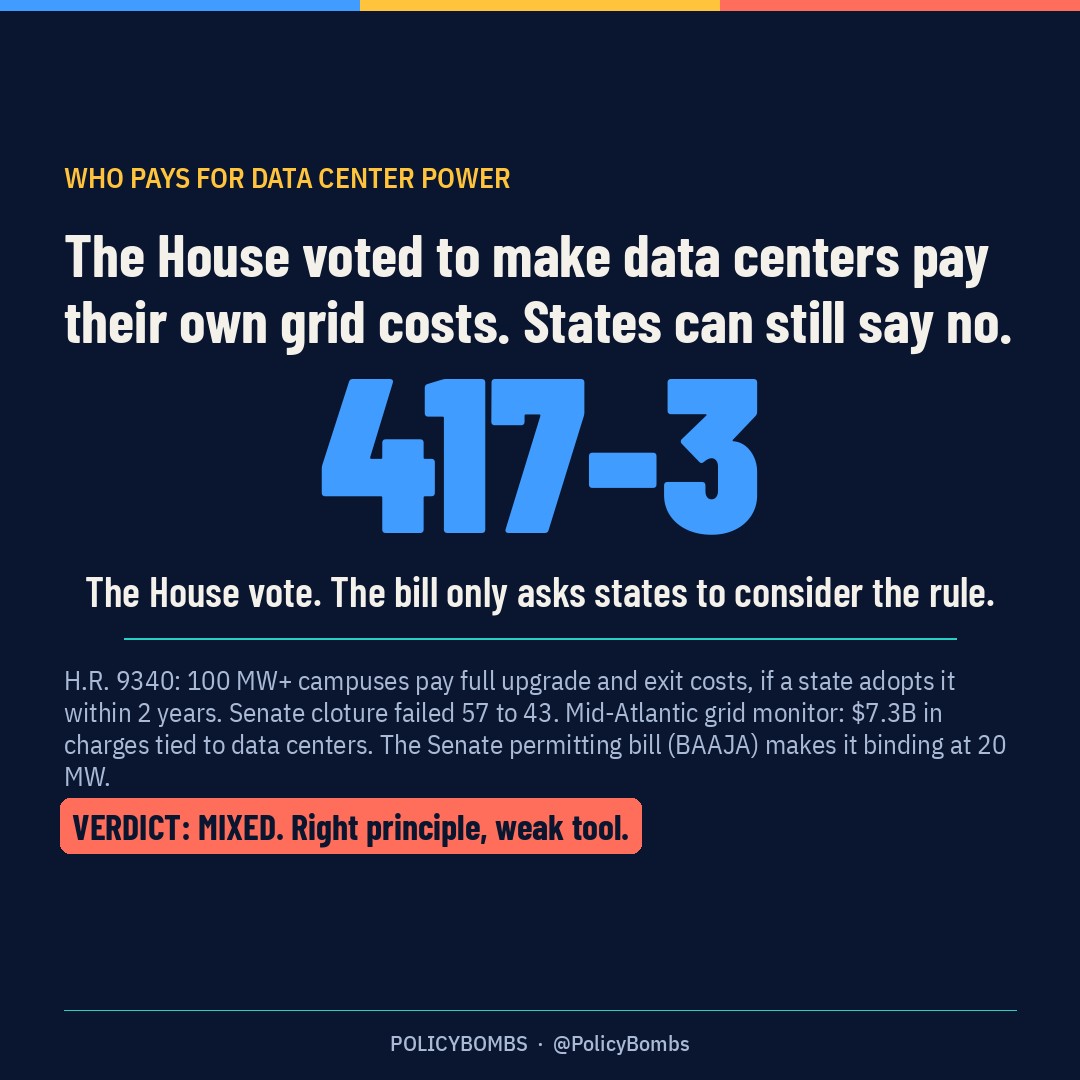
417 to 3. That was the House vote on the Ratepayer Protection Act. Almost nobody voted no, because the bill asks almost nothing: states must consider making big data centers pay their own grid costs. They do not have to do it.
The bill. H.R. 9340 adds a standard to a 1978 law, PURPA. Data center campuses of 100 megawatts or more would pay the full incremental cost of the plants and lines built for them, post collateral, and pay exit costs if they leave. State regulators must start considering it within 1 year and decide within 2. States that already acted or held a hearing are exempt. CBO scores it at $0.
The Senate. Cloture failed 57 to 43 on September 30. All 53 Republicans and four Democrats voted yes. Democratic leaders called it toothless; Republican leaders called the no votes politics.
Who pays now. Nationally, retail prices rose 29% from 2019 to 2025 but about 3% after inflation, and load growth often lowered rates (LBNL and Brattle). On the PJM grid, the market monitor ties $7.3 billion in capacity charges this year to data centers, and some households pay $16 to $18 more a month. Studies of utility rates conflict. Contested.
Verdict: MIXED. Right principle, weak tool. The Senate-passed permitting bill (BAAJA) contains the binding version: no part of a large data center’s incremental cost may be charged to other customers, at 20 megawatts and up. Related: Policy #71 on state data center tariffs and tax breaks.
Full analysis
Long-form analysis of the Ratepayer Protection Act (H.R. 9340) and related federal bills on who pays for data center power. Content checked November 23, 2026 (America/Los_Angeles). Finding tags: Substantiated, Pending, Contested, Unproven, Unverified.
Research cutoff: 2026-11-23
Verdict: MIXED. Right principle, weak tool. The binding version is the 20 MW floor in BAAJA.
Related PolicyBombs: Policy #71, Data-Center Ratepayer and Subsidy Rules (state tariffs, tax breaks, NDAs): https://policybombs.com/policybomb-71-data-center-ratepayer-subsidy-rules/ ; Policy #69, Data Center Ballot Measures: https://policybombs.com/policybomb-69-data-center-ballot-measures-2026/ . This piece grades the federal bills only.
1. What is the policy?
H.R. 9340, Ratepayer Protection Act (engrossed text, Sept 16, 2026)
- Mechanism. Adds paragraph (22) to section 111(d) of PURPA (16 U.S.C. 2621(d)), a list of “standards” that state regulators and nonregulated utilities must consider.
- The standard. Rates for a large-load customer “shall be designed to recover from the large-load customer the full, incremental cost of any generation, transmission, or distribution upgrade necessary to serve” it, including if the customer terminates its contract or stops buying power. Before building, the utility “shall require” financial assurances or contributions covering the upgrade.
- Who is covered. A non-residential customer that, on or after enactment, contracts for facilities that run mainly “information technology infrastructure” for data storage and computing and have an aggregate peak demand of 100 MW or more at one site or campus.
- Deadlines. States and nonregulated utilities must commence consideration within 1 year and complete it, making a determination, within 2 years.
- Exemption. The consideration requirement does not apply in a state that, before enactment, implemented the standard “or a comparable standard,” held a proceeding to consider it, or had its legislature vote on it.
- History. Introduced June 18, 2026 by Rep. Gabe Evans (R-CO); 42 cosponsors including Rep. Kathy Castor (D-FL). Energy and Commerce ordered it reported 52 to 0 on July 21 (H. Rept. 119-814). Passed the House under suspension 417 to 3 on September 16 (Roll no. 312). Senate cloture on the motion to proceed failed 57 to 43 on September 30 (record vote 254). A unanimous consent request by Sen. Jon Husted drew an objection earlier in September (Roll Call).
- Cost. CBO: no effect on direct spending, revenues or appropriations; the intergovernmental mandate on state commissions is below the 2026 UMRA threshold of $107 million (CBO estimate as indexed by LegiStorm and congress.gov report listings). [Substantiated via secondary index]
Companion and competing bills
- S. 5028 (Husted, R-OH), identical Senate bill, 16 Republican cosponsors, in Energy and Natural Resources.
- H.R. 6529, Protecting Families from AI Data Center Energy Costs Act (Rep. Greg Landsman, D-OH; 25 cosponsors, all Democrats except Rep. Morgan Griffith, R-VA): FERC must hold a commissioner-led technical conference within 90 days and report recommendations within 180 days after. Ordered reported 44 to 0 on July 21.
- H.R. 10322, Data Center Fair Share Act (Rep. Suhas Subramanyam, D-VA): mandatory standards, enforced by withholding highway funds. No cosponsors.
- S. 3852, GRID Act (Sens. Josh Hawley, R-MO, and Richard Blumenthal, D-CT, Feb 11, 2026): new data centers must use power sources separate from the grid, with a 10-year off-ramp for existing ones; consumers get grid priority; usage disclosure. Not out of committee (FactCheck.org).
- H.R. 2347, BAAJA (Bipartisan American Affordability and Jobs Act of 2026), Senate-passed 62 to 33 on November 19: adds section 229 to the Federal Power Act. “No portion of the retail incremental cost may be allocated to, or recovered in the rates of, any customer other than a computational load owner or a computational load operator.” Covers computational loads of 20 MW or more connecting after enactment; cost “estimated by the electric utility” and approved by FERC or a state; FERC must revise its 1994 transmission pricing policy within 90 days (The Duck Curve; Bommarito Consulting line-by-line review). House action expected the week of November 30 (reported, not scheduled). [Pending]
2. Why does it exist?
Stated reasons
- Thune: “a simple piece of legislation designed to protect hardworking Americans from the increased energy costs associated with data centers” (Roll Call).
- Barrasso: it “guarantees” data centers “would end up paying the full cost of their electricity use, not the consumers” (Realtor.com news report of floor remarks).
- Husted: “This bill is the only path that we can take today that will lower electricity prices” (Roll Call).
- Roll Call describes it as codifying parts of President Trump’s voluntary “Ratepayer Protection Pledge.”
Underlying drivers
- Election-year backlash. Data centers became a midterm issue. Realtor.com cites a CNN poll in which two-thirds of voters called data centers an important issue. FactCheck.org reports “tens of millions of dollars” of ads making claims about data centers and power prices.
- Load growth. A 2026 DOE study (via CRS R49326) put data centers at about 4.7% of US electricity use in 2024 (192 TWh), rising to 9.5% to 15.3% by 2030.
- The pledge has no teeth. Experts quoted by FactCheck.org called the pledge “just a messaging document” and “a PR stunt”; Harvard’s Ari Peskoe: “Compliance is not being monitored or enforced by anyone.”
- Why the design is weak. PURPA “consider and determine” standards leave rate design to states, which is how Congress avoids overriding state utility commissions. That respects federalism and also lets a bill pass 417 to 3 without binding anyone. [Substantiated as text; motive is inference]
- Why Senate Democrats blocked it. Schumer: “toothless,” “a fraud,” and “Senate Democrats want to make it mandatory for data centers to cover their own costs, by law, not by suggestion or hope or whim.” Thune called that playing politics to deny Republicans a win (Roll Call). Both explanations fit the record. [Contested]
3. Realized effects
The bill is not law, so the measurable question is the problem it targets: are households paying for data center power?
What the data show
- Prices are rising. EIA’s November 2026 Short-Term Energy Outlook puts the average residential price at 17.24 cents per kWh in 2025 and 18.17 cents in 2026 (partly forecast), up 5.4%.
- Mostly not from data centers, nationally. LBNL and Brattle (July 2026 update, via FactCheck.org and CRS): national average retail prices rose 29% from 2019 to 2025, but only 3% after inflation; states with the most load growth generally saw average prices fall as fixed costs spread over more sales. The report cautions the residential link is less clear and may not hold.
- PJM is the exception. PJM’s independent market monitor (Monitoring Analytics) calls data centers “the primary reason” for high capacity prices and attributes $7.3 billion in extra capacity charges this delivery year and $6.5 billion next year to them (January report, via FactCheck.org). Sanya Carley (Penn Kleinman Center): capacity increases added about $18 a month in western Maryland and $16 in Ohio from mid-2025 to mid-2026, 63% due to data centers.
- Utility-level evidence. An MIT CEEPR working paper (Pless co-author) finds data center entry raised retail rates 2.7% on average from 2010 to 2024, 5.6% for investor-owned utility customers. An EPRI study (EPRI is largely utility-funded) estimates data centers lowered average rates about 6% from 2015 to 2024. [Contested; neither is final peer-reviewed work]
- States already acting. EEI (industry) counts 25 states with at least one approved large-load tariff as of September 2026 and 7 pending; SWCA counted 23 approved and 7 pending as of June. Oregon’s POWER Act and Portland General Electric’s Schedule 96 (effective July 8, 2026) charge large loads 100% of distribution upgrades (SWCA).
What H.R. 9340 would change
- In the 23 to 25 states with approved tariffs, likely nothing: the prior-action exemption appears to apply. [Unverified: “comparable standard” is undefined in the text]
- In the rest, a required hearing within 1 year and a decision within 2 years. No state would be required to adopt the standard.
- Contracts signed before enactment stay as they are. Existing PJM capacity costs are a wholesale market issue under FERC, not a retail upgrade charge; H.R. 9340 does not touch the capacity market. [Substantiated as text]
Unintended consequences (projected)
- Higher bar for small builders? At 100 MW, effects on smaller facilities are nil. Under BAAJA’s 20 MW floor, more projects pay full incremental cost, which Policy #71 found can push siting decisions. [Pending]
- Self-supply shift. Making grid upgrades costlier pushes some builders behind the meter. CRS cites Cleanview data: only 25% of planned capacity intends behind-the-meter power and 2.2% of announced behind-the-meter power was operating by mid-2026. Policy #71 covers the reliability risk when existing plants are pulled off the grid.
4. Good or bad for society?
The direct judgment
MIXED. The principle is sound and widely shared: the customer who causes a grid upgrade should pay for it, including if it leaves. The bill’s tool is weak: a requirement to consider, with exemptions for states that already acted, a 2-year clock, and a 100 MW threshold. It cannot deliver what its name promises. BAAJA’s binding 20 MW floor does.
Strongest case for H.R. 9340
It passed 417 to 3, costs taxpayers nothing, and sets a national benchmark that state commissions and courts can point to. PURPA standards have shaped state rate design before. A weak law now beats no law, and Husted argued it was the only data center bill that could reach the president before the midterms. Yale’s Kenneth Gillingham: “the basic ideas are very reasonable.”
Strongest case against
“Consider” is not “adopt.” Schumer’s critique is accurate on the text. Gillingham adds that “implementation will really determine how much and/or if it will help.” The measured harm is concentrated in PJM’s capacity market, which this bill does not reach. And Peskoe warns past studies may understate future effects: “Today’s data centers use 10 to 100x more electricity than the previous generation.”
Testing the claims on both sides
- “Citizens are paying for AI’s electricity.” Substantiated in PJM via capacity charges; Contested nationally; Unproven as a blanket claim. A rate freeze or tax deal is a different mechanism from a rate subsidy; Policy #71 separates them.
- “Data centers lower your bill.” Contested. True where spare capacity exists (LBNL; some Great Plains states), false in constrained PJM. DOE Secretary Chris Wright says they “almost always are accompanied by a multiyear freeze”; FactCheck.org found DOE’s own lab shows the opposite in places.
- “This bill guarantees data centers pay.” Unproven. The text guarantees a hearing.
Fiscal and eligibility notes
No federal spending; CBO scores $0. No benefit eligibility is involved. The integrity question is auditability: without public reporting of each large-load contract, no one can check whether “full incremental cost” was actually recovered. [Unverified: no state audit found this run]
What a good policy would include
1. A binding floor. BAAJA’s section 229 language, at 20 MW, applied prospectively. Rhodium Group projects BAAJA overall would lower household bills $50 to $78 a year by 2040 (whole bill, not this section alone; model projection).
2. Collateral and exit fees equal to the upgrade cost, as both H.R. 9340 and BAAJA require.
3. Public cost-recovery reports per large-load contract. No score. [Unverified]
4. Capacity-market reform in PJM, where forecasted rather than actual load sets prices; FERC’s large-load docket (RM26-4) is open.
5. Off-grid as an option, not a mandate. The GRID Act’s mandate would protect households but forfeit fixed-cost sharing where grids have room. No score. [Unverified]
Politicians for and against
For H.R. 9340: Rep. Gabe Evans (R-CO), sponsor; Rep. Kathy Castor (D-FL); cosponsors include Reps. Jefferson Van Drew (R-NJ), Michael McCaul (R-TX), Sanford Bishop (D-GA), Jennifer McClellan (D-VA), Josh Gottheimer (D-NJ), Henry Cuellar (D-TX), Brian Fitzpatrick (R-PA), Mike Lawler (R-NY), Jim Jordan (R-OH), John Moolenaar (R-MI), Maggie Goodlander (D-NH), David Valadao (R-CA). Senate: Jon Husted (R-OH), John Thune (R-SD), John Barrasso (R-WY); all 53 Republicans voted for cloture, with Democrats Maggie Hassan (NH), Amy Klobuchar (MN), Jon Ossoff (GA), Raphael Warnock (GA).
Against as written: Chuck Schumer (D-NY) and 40 other Democrats plus 2 independents on cloture; House nays Summer Lee (D-PA), Delia Ramirez (D-IL), Rashida Tlaib (D-MI).
Alternatives: Josh Hawley (R-MO) and Richard Blumenthal (D-CT), GRID Act; Greg Landsman (D-OH), H.R. 6529; Suhas Subramanyam (D-VA), H.R. 10322; Mike Lee (R-UT), Shelley Moore Capito (R-WV), Martin Heinrich (D-NM), Sheldon Whitehouse (D-RI), BAAJA.
Outside groups: Edison Electric Institute (utilities) supports; Public Citizen and state consumer counsels backed cost-causation rules at the state level (Policy #71).
Gaps and unverified items
- Whether existing state tariffs meet the “comparable standard” exemption: untested. [Unverified]
- CBO estimate: read via LegiStorm and congress.gov listings, not the CBO PDF. [Substantiated via secondary]
- Monitoring Analytics January report and the MIT CEEPR paper: cited via FactCheck.org, not read directly. [Substantiated via secondary]
- BAAJA text: read via The Duck Curve and Bommarito Consulting summaries quoting SA 6883; final House action pending.
References
- Congress.gov, H.R. 9340 bill status and actions: https://www.congress.gov/bill/119th-congress/house-bill/9340
- GovInfo, H.R. 9340 engrossed text: https://www.govinfo.gov/content/pkg/BILLS-119hr9340eh/xml/BILLS-119hr9340eh.xml
- House Clerk, Roll Call 312 (Sept 16, 2026): https://clerk.house.gov/evs/2026/roll312.xml
- US Senate, Roll Call Vote 254, 119th Congress, 2nd Session: https://www.senate.gov/legislative/LIS/roll_call_votes/vote1192/vote_119_2_00254.xml
- Congress.gov, H. Rept. 119-814: https://www.congress.gov/committee-report/119th-congress/house-report/814/1
- LegiStorm, CBO report on H.R. 9340: https://www.legistorm.com/reports/view/cbo/24056/Ratepayer_Protection_Act.html
- Congress.gov, S. 5028: https://www.congress.gov/bill/119th-congress/senate-bill/5028
- Congress.gov, H.R. 6529 and text: https://www.congress.gov/bill/119th-congress/house-bill/6529
- Congress.gov, H.R. 10322: https://www.congress.gov/bill/119th-congress/house-bill/10322
- Congress.gov, S. 3852 GRID Act: https://www.congress.gov/bill/119th-congress/senate-bill/3852/all-info
- Sen. Hawley, GRID Act release (Feb 11, 2026): https://www.hawley.senate.gov/hawley-blumenthal-introduce-bill-to-prevent-data-centers-from-increasing-electricity-costs-for-americans/
- Roll Call, Voluntary ratepayer protection bill blocked in Senate again (Sept 30, 2026): https://www.rollcall.com/2026/09/30/voluntary-ratepayer-protection-bill-blocked-in-senate-again
- Realtor.com News, Senate Sinks Data Center Energy Cost Bill Ahead of Midterms (Sept 30, 2026): https://www.realtor.com/news/real-estate-news/senate-blocks-data-center-energy-cost-bill/
- FactCheck.org, Data Centers and Electricity Prices: It’s Not as Simple as Voters May Think (Oct 2026): https://www.factcheck.org/2026/10/data-centers-and-electricity-prices-its-not-as-simple-as-voters-may-think/
- CRS R49326, Data Centers and the Electricity Grid: Frequently Asked Questions (Sept 1, 2026): https://www.everycrsreport.com/files/2026-09-01_R49326_f662038826029025393efc9c628e3bd62a60322e.pdf
- LBNL, Retail Electricity Price Trends and Drivers: Data Update, 2026 Edition: https://emp.lbl.gov/publications/retail-electricity-price-trends-and
- EIA, Short-Term Energy Outlook, November 2026, Table 2: https://www.eia.gov/outlooks/steo/tables/pdf/2tab.pdf
- Edison Electric Institute, 2026 Ratepayer Protection Act statement (industry): https://www.eei.org/news/news/all/2026-ratepayer-protection-act
- Edison Electric Institute, Large Load Projects and Tariffs (Oct 2026, industry): https://www.eei.org/-/media/Project/EEI/Documents/Issues%20and%20Policy/List%20of%20Large%20Customer%20Projects%20and%20Tariffs.pdf
- SWCA Regulatory Radar, Twenty-Three States Have Adopted Policies Requiring Data Center Developers to Fund Grid Infrastructure Upgrades: https://www.swca.com/regulatory-radar/articles/twenty-three-states-have-adopted-policies-requiring-data-center-developers-to-fund-grid-infrastructure-upgrades/
- Senate ENR Committee, BAAJA passage release (Nov 19, 2026): https://www.energy.senate.gov/press/rep/senate-resoundingly-passes-chairman-lees-landmark-bipartisan-american-affordability-and-jobs-act/
- The Duck Curve, Senate passes BAAJA permitting bill 62-33: https://theduckcurve.com/posts/senate-passes-baaja-permitting-bill-house-next
- Bommarito Consulting, Checking the Case for BAAJA: https://bommaritollc.com/insights/baaja-supporter-claims-checked/
- US Senate Press Gallery, Thursday, November 19, 2026 floor log: https://www.dailypress.senate.gov/thursday-november-19-2026/
- FERC, Large load docket RM26-4: https://ferc.gov/rm26-4