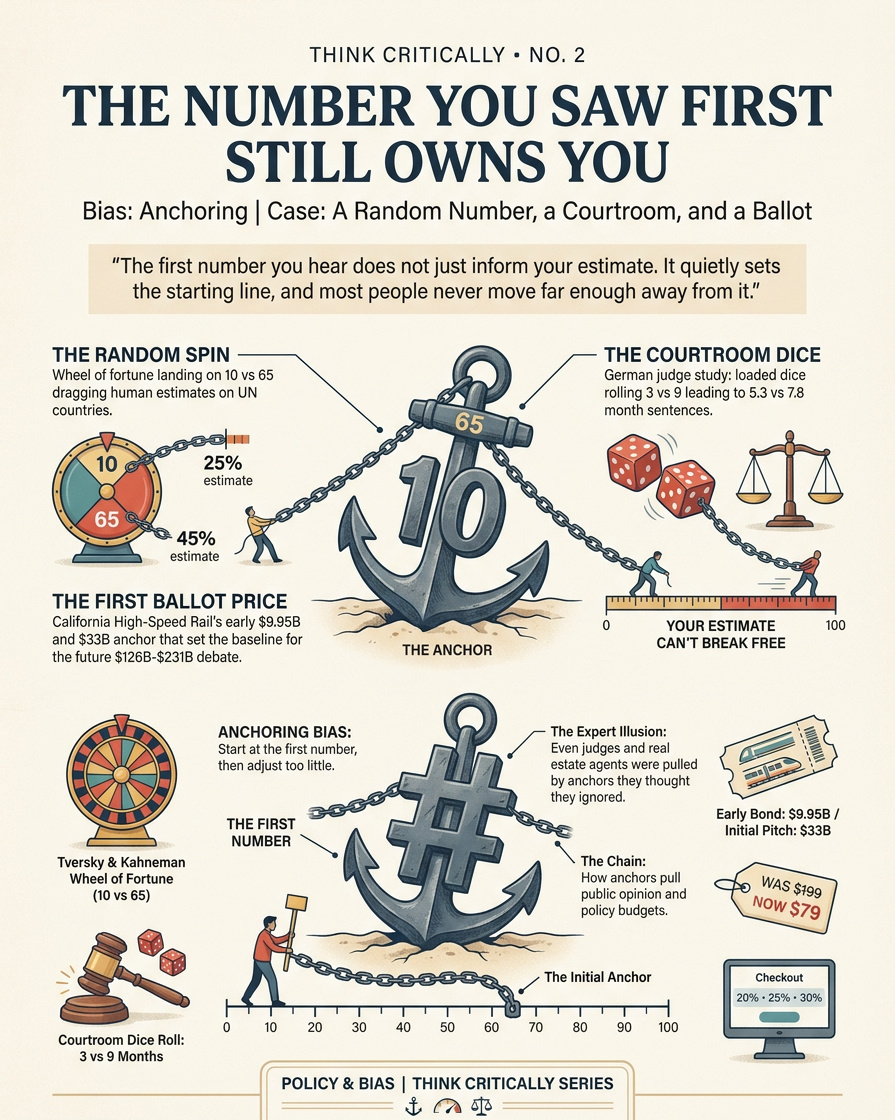
Think Critically, No. 2 | Bias: anchoring | Case: a random number, a courtroom, and a ballot
The first number you hear does not just inform your estimate. It quietly sets the starting line, and most people never move far enough away from it.
In a famous experiment from the early 1970s, researchers spun a wheel of fortune in front of their subjects. The wheel landed on a number between 0 and 100. Subjects were then asked whether the percentage of African countries in the United Nations was higher or lower than that number, and then asked for their own estimate.
The wheel was obviously irrelevant. It still mattered. People who saw 10 gave a median estimate of 25%. People who saw 65 gave a median estimate of 45%. Paying people for accuracy did not make the effect go away (Tversky & Kahneman, 1974).
That is anchoring: start from whatever number is on the table, then adjust too little.
It works on experts too
It would be comforting if training cured this. It does not.
In one study, young German lawyers who had begun serving as judges read a detailed, fictional shoplifting case. Then they rolled a pair of dice to set the prosecutor’s sentencing demand. The dice were loaded to show either 3 or 9. Those who rolled 9 gave an average sentence of about 7.8 months. Those who rolled 3 gave about 5.3 months (Englich et al., 2006). The anchor was a dice roll they had made themselves, and it still moved their sentences by more than two months.
Real estate agents in another study toured the same house and saw the same facts, but were handed different listing prices. Their appraisals moved with the listing price. Yet when asked what drove their judgment, only 14.3% of the expert agents named the listing price among their top three considerations, and the researchers wrote that the experts “flatly denied” using it (Northcraft & Neale, 1987). The anchor worked best on the people most sure it had not.
Replication caveat. Many famous psychology findings have shrunk or vanished when retested. Anchoring is not one of them. In a large replication project across 36 samples and 6,344 participants, anchoring effects replicated consistently and were among the largest effects tested (Klein et al., 2014).
The policy version: the first official price
California’s high-speed rail project shows how anchors shape public debate. In 2008, voters approved a $9.95 billion bond, and the project’s first phase was sold at about $33 billion (Bailey, 2008). Those numbers became the reference point for every later argument. The 2026 Business Plan now estimates a pared-down Phase 1 at about $126.1 billion, and the full Phase 1 scope at about $231.3 billion (California High-Speed Rail Authority, 2026).
Here is where slow thinking earns its keep. The fact that the cost rose is documented. The claim that the early figures “anchored” public opinion is a reasonable inference, not a measured fact. And the anchor cuts both ways. Supporters can lean on the small bond figure to make the project feel affordable. Critics can treat every update as a betrayal, when sometimes the real failure is that the first number was never a serious forecast. The right question is not only “How far has the number moved?” It is “How was the first number built?”
How anchors get used on you
- The “was” price. A sale tag shows a crossed-out high price next to the real one. The high number makes the real price feel like a win, whether or not anyone ever paid it.
- The opening offer. In a negotiation, salary talk, or car purchase, whoever names the first number sets the range the rest of the conversation stays inside.
- The tip screen. A checkout tablet that suggests 20%, 25%, and 30% sets your reference point before you have thought about it.
- The budget baseline. A politician calls a smaller-than-planned increase a “cut,” or a smaller-than-planned cut an “increase.” The comparison point was chosen for you.
- The shock statistic. A viral post leads with an extreme figure, then “corrects” it to a merely alarming one. You end up somewhere near alarming and feel you have been careful.
Deception check: five steps for any number someone hands you
- Ask where the first number came from. Was it measured, estimated, or simply chosen? An anchor someone picked for you deserves no automatic weight.
- Make your own estimate first. Before reading the asking price, the proposed budget, or the projected savings, write down what you think is reasonable. Then compare.
- Generate the opposite anchor. If you were shown a high number, ask what a low but defensible number would be, and why. Considering reasons the anchor is wrong is one of the better-supported ways to weaken its pull (Mussweiler et al., 2000).
- Check the comparison point. “Up 40%” from what, and since when? “A cut” relative to last year’s spending, or to a projection no one voted on?
- Notice your confidence. If you feel sure an irrelevant number did not affect you, remember the real estate agents. Feeling unmoved is not evidence that you were unmoved.
The lesson
Anchors are not always lies. Sometimes the first number is the best available estimate. But the first number arrives with an authority it has not earned, simply by arriving first. A careful reader treats it as one data point, rebuilds the estimate from the ground up, and asks who chose where the conversation would start.
References
Bailey, E. (2008, October 15). Backers hope voters give bullet train a shot. Los Angeles Times. https://www.latimes.com/archives/la-xpm-2008-oct-15-me-fasttrain15-story.html
California High-Speed Rail Authority. (2026). 2026 business plan. https://hsr.ca.gov/wp-content/uploads/2026/06/2026-Final-Business-Plan-060126-A11Y.pdf
Englich, B., Mussweiler, T., & Strack, F. (2006). Playing dice with criminal sentences: The influence of irrelevant anchors on experts’ judicial decision making. Personality and Social Psychology Bulletin, 32(2), 188-200. https://doi.org/10.1177/0146167205282152
Klein, R. A., Ratliff, K. A., Vianello, M., Adams, R. B., Bahník, Š., Bernstein, M. J., Bocian, K., Brandt, M. J., Brooks, B., Brumbaugh, C. C., Cemalcilar, Z., Chandler, J., Cheong, W., Davis, W. E., Devos, T., Eisner, M., Frankowska, N., Furrow, D., Galliani, E. M., . . . Nosek, B. A. (2014). Investigating variation in replicability: A “many labs” replication project. Social Psychology, 45(3), 142-152. https://doi.org/10.1027/1864-9335/a000178
Mussweiler, T., Strack, F., & Pfeiffer, T. (2000). Overcoming the inevitable anchoring effect: Considering the opposite compensates for selective accessibility. Personality and Social Psychology Bulletin, 26(9), 1142-1150. https://doi.org/10.1177/01461672002611010
Northcraft, G. B., & Neale, M. A. (1987). Experts, amateurs, and real estate: An anchoring-and-adjustment perspective on property pricing decisions. Organizational Behavior and Human Decision Processes, 39(1), 84-97. https://doi.org/10.1016/0749-5978(87)90046-X
Tversky, A., & Kahneman, D. (1974). Judgment under uncertainty: Heuristics and biases. Science, 185(4157), 1124-1131. https://doi.org/10.1126/science.185.4157.1124