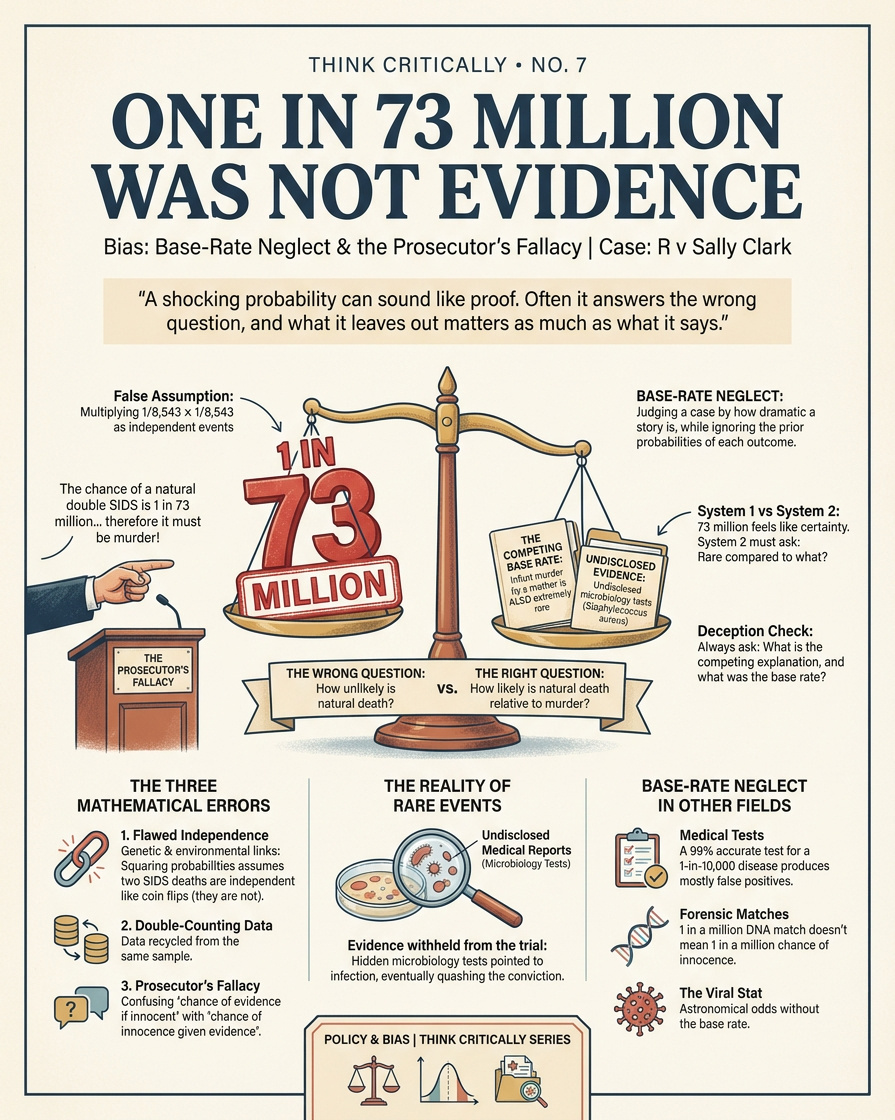
Think Critically, No. 7 | Bias: base-rate neglect and the prosecutor’s fallacy | Case: R v Sally Clark
A shocking probability can sound like proof. Often it answers the wrong question, and what it leaves out matters as much as what it says.
On November 9, 1999, a jury in Chester, England, convicted Sally Clark, a solicitor, of murdering her two baby sons, Christopher and Harry. The vote was 10 to 2. Her first appeal was dismissed in October 2000 (R v Clark, 2003).
One moment from the trial became infamous. A prominent pediatrician, Professor Sir Roy Meadow, cited a government-funded study estimating that the chance of a sudden infant death (SIDS, or cot death) in a family like the Clarks’ was about 1 in 8,543. He then said: “you have to multiply 1 in 8,543 times 1 in 8,543 … it’s approximately a chance of 1 in 73 million.” He added that such a double death would happen by chance about once every hundred years, and compared it to backing an 80-to-1 long shot in the Grand National four years running and winning (R v Clark, 2003).
The trial judge cautioned the jury: “we do not convict people in these courts on statistics.” But the Court of Appeal later observed that the headline figure of 1 in 73 million “would be uppermost in the jury’s minds” (R v Clark, 2003).
Three things wrong with one number
In January 2002, the Royal Statistical Society wrote to the Lord Chancellor to explain why the figure was invalid (Green, 2002).
First, it assumed independence. Squaring 1 in 8,543 is only valid if two cot deaths in the same family are independent events, like two coin flips. There are strong reasons to think they are not. Unknown genetic or environmental factors may make a second death far more likely in a family that has already suffered one.
Second, it reused the data. The family characteristics used to pick the 1-in-8,543 figure were chosen using the same data used to estimate it, a double use that can quietly bias the result.
Third, and most important, it answered the wrong question. Some press reports treated 1 in 73 million as the chance that the deaths were natural. That is a logical error known as the prosecutor’s fallacy (Thompson & Schumann, 1987). As the Society put it, the jury had to weigh two competing explanations, natural death or murder. Two natural deaths in one family are rare, but two murders of infants by a mother are also rare. What matters is how likely the evidence is under each explanation relative to the other, not how unlikely it is under just one (Green, 2002).
The evidence nobody saw
The statistic is the famous part of the story. It is not the whole story, and a tidy “bad math convicted her” version is itself too simple.
After the first appeal, Clark’s family found records of microbiology tests on Harry’s body. They showed Staphylococcus aureus in several sites, including his cerebrospinal fluid, which suggested he may have died of natural causes. The pathologist had not disclosed these results, and neither side’s lawyers at trial knew they existed (R v Clark, 2003). The Criminal Cases Review Commission referred the case back, and in January 2003 the Court of Appeal quashed both convictions. The court’s main ground was the undisclosed medical evidence; it also criticized the statistical evidence (R v Clark, 2003).
Sally Clark spent about three years in prison. She died in March 2007, aged 42. Her family’s solicitor said she never fully recovered from the miscarriage of justice (BBC News, 2007).
What base-rate neglect is
Base-rate neglect is judging a case by how well it fits a story, while ignoring how common each possible explanation actually is. Tversky and Kahneman described the related habit of judging by representativeness, or resemblance to a stereotype, and showed that people routinely underuse prior probabilities (Tversky & Kahneman, 1974; Bar-Hillel, 1980).
In System 1 terms, a huge number such as 73 million feels like certainty, and two dead infants feel like a pattern that demands a culprit. System 2 has to ask: rare compared to what?
Where the same error shows up
- Medical screening. A test that is “99% accurate” can still produce more false alarms than true cases when the condition is rare. The base rate decides what a positive result means.
- DNA and forensic matches. “The chance of a random match is one in a million” is not “the chance the defendant is innocent is one in a million.” In a large database search, a few coincidental matches are expected.
- Risk scores. Child-protection, fraud, and policing algorithms flag people as “high risk.” Ask what share of those flagged actually turn out to be cases.
- Viral “odds” claims. “The odds of this happening by chance are astronomical” is a common hook for conspiracy theories. Rare events happen constantly when there are millions of chances for them to occur.
- Political attack ads. A frightening statistic about a rare event, stripped of its base rate, can make one case look like an epidemic.
Deception check: five questions for any shocking probability
- Probability of what, given what? “The chance of this evidence if innocent” is not “the chance of innocence given this evidence.” Restate the claim precisely.
- What is the competing explanation, and how rare is it? Compare the likelihood of the evidence under each explanation, not just one.
- Were the events really independent? Multiplying probabilities assumes no shared cause. Families, neighborhoods, and markets rarely satisfy that.
- Who is giving the number, and are they qualified? The Royal Statistical Society urged that statistical evidence come from qualified statisticians (Green, 2002).
- What evidence is missing? In the Clark case, the most important evidence was never shown to the jury. A dramatic number can draw attention away from what has not been disclosed.
The lesson
A big number is not a verdict. The Sally Clark case shows two failures working together: a misleading statistic that sounded like proof, and medical evidence that never reached the courtroom. A careful reader unpacks the number, asks what it is really the probability of, and then asks what else has not been shown.
References
Bar-Hillel, M. (1980). The base-rate fallacy in probability judgments. Acta Psychologica, 44(3), 211-233. https://doi.org/10.1016/0001-6918(80)90046-3
BBC News. (2007, March 16). Sally Clark dies at family home. http://news.bbc.co.uk/2/hi/uk_news/6460595.stm
Green, P. (2002, January 23). Letter from the President to the Lord Chancellor regarding the use of statistical evidence in court cases. Royal Statistical Society. https://rss.org.uk/RSS/media/File-library/Membership/Sections/2020/Sally-Clark-RSS-letter-2002.pdf
R v Clark [2003] EWCA Crim 1020 (Court of Appeal, Criminal Division, April 11, 2003). https://www.inference.org.uk/sallyclark/Judgment03.html
Thompson, W. C., & Schumann, E. L. (1987). Interpretation of statistical evidence in criminal trials: The prosecutor’s fallacy and the defense attorney’s fallacy. Law and Human Behavior, 11(3), 167-187. https://doi.org/10.1007/BF01044641
Tversky, A., & Kahneman, D. (1974). Judgment under uncertainty: Heuristics and biases. Science, 185(4157), 1124-1131. https://doi.org/10.1126/science.185.4157.1124