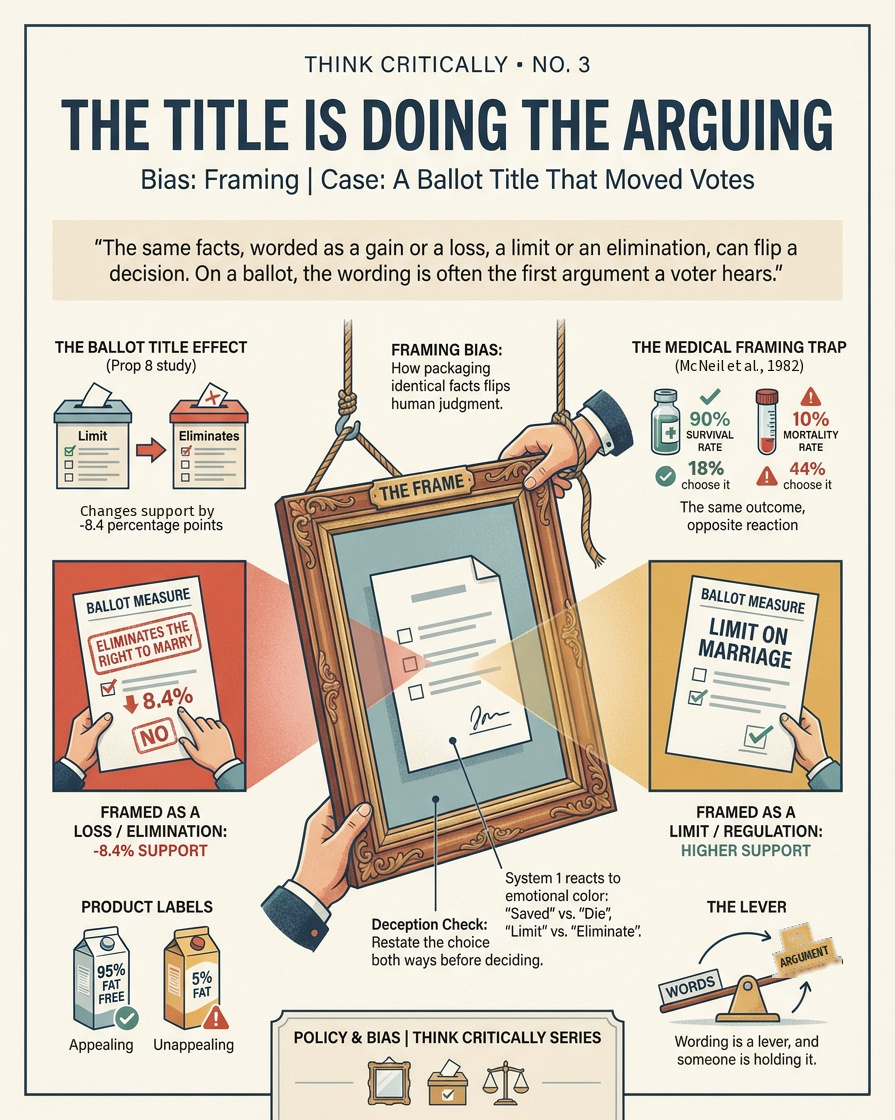
Think Critically, No. 3 | Bias: framing | Case: a ballot title that moved votes
The same facts, worded as a gain or a loss, a limit or an elimination, can flip a decision. On a ballot, the wording is often the first argument a voter hears.
In 2008, California’s Proposition 8 asked voters to amend the state constitution so that only marriage between a man and a woman would be valid or recognized. The original ballot description spoke of a “limit on marriage.” After the state Supreme Court ruled that same-sex couples had a right to marry, Attorney General Jerry Brown rewrote the official title to say the measure “eliminates” that right. Backers of the measure objected that the new wording was “inherently argumentative” and would prejudice voters against it (Burnett & Kogan, 2015).
Was it? Political scientists Craig Burnett and Vladimir Kogan tested exactly that. In a survey experiment, they showed people versions of the measure that differed only in wording. Describing the measure as one that “eliminates” the right to marry, rather than as a “limit on marriage,” cut support by 8.4 percentage points when respondents saw no other information. That is large enough to decide a close election. But when respondents also saw endorsements from prominent groups, the wording effect shrank to 3.7 points (Burnett & Kogan, 2015).
Both halves of that finding matter. Words on the ballot can move votes. And ordinary campaign information can blunt the effect.
What framing is
Framing is the tendency to choose differently when the same facts are packaged differently: as lives saved or lives lost, as a gain or a loss, as a right granted or a right taken away.
The classic demonstration comes from Amos Tversky and Daniel Kahneman. They asked people to imagine an outbreak expected to kill 600 people and to choose between two programs. When the options were worded in terms of lives saved (“200 people will be saved”), 72% chose the safe option. When the identical outcomes were worded in terms of deaths (“400 people will die”), 78% chose the risky option instead (Tversky & Kahneman, 1981). Nothing about the numbers changed. Only the frame did.
Experts are not immune. In a study of lung-cancer treatment choices, radiation was chosen by 18% of respondents when outcomes were described as survival rates and by 44% when the same outcomes were described as mortality rates. Physicians in the study showed the effect too (McNeil et al., 1982).
In System 1 terms, the fast mind reacts to the emotional color of the words. “Saved” feels like safety; “die” feels like a threat worth gambling to avoid. System 2 can see that the two descriptions are the same, but only if it is prompted to restate the choice.
Replication caveat. The gain-versus-loss framing effect replicated consistently in a 36-sample replication project (Klein et al., 2014). Framing is not one single effect, though. Researchers distinguish framing of risky choices, framing of a single attribute (describing a product by its good feature or its bad one), and framing of goals, and these do not always behave the same way (Levin et al., 1998). One survey experiment also does not prove that any particular election was decided by its title. Treat framing as a strong, real tendency, not a magic switch.
How frames get used on you
- Ballot titles and bill names. A measure labeled as “protecting” something invites a yes; one labeled as “banning” or “eliminating” invites a no. The label is chosen by people who may have a stake in the outcome.
- Tax language. “Tax relief” implies a burden being lifted. “Tax cut for the wealthy” implies a gift. The same provision can be sold either way.
- Product labels. “95% fat-free” and “5% fat” describe the same food. The first one is the one on the box.
- Medical choices. A treatment with “a 90% survival rate” sounds safer than one with “a 10% mortality rate.” Ask for both.
- Viral posts. In a hypothetical city, “program wastes $2 million” and “program costs 30 cents per resident” could both be accurate. The frame decides whether you are outraged or indifferent.
Deception check: five ways to escape a frame
- Restate it both ways. Describe the measure in terms of what it allows and what it forbids, what it saves and what it costs. If your opinion flips, the frame was doing the work.
- Read past the title. Find the actual text or a neutral analysis. In California, the official voter guide includes an analysis by the nonpartisan Legislative Analyst’s Office; read it before the campaign mailers.
- Convert percentages into counts. “Saves 200 of 600” and “400 of 600 die” are easier to compare when both are written out.
- Ask who chose the words. Titles, bill names, and survey questions are written by people with interests. Who wrote this one?
- Look for the missing comparison. A frame often hides the alternative. Compared to what: doing nothing, the current law, or a different proposal?
The lesson
“Just read the ballot” is not enough when the ballot is already doing some of the arguing. A careful voter treats the title as the first pitch, not the final word, and restates the question in neutral terms before deciding. The point is not that every title is rigged. It is that wording is a lever, and someone is always holding it.
References
Burnett, C. M., & Kogan, V. (2015). When does ballot language influence voter choices? Evidence from a survey experiment. Political Communication, 32(1), 109-126. https://doi.org/10.1080/10584609.2014.894160
Klein, R. A., Ratliff, K. A., Vianello, M., Adams, R. B., Bahník, Š., Bernstein, M. J., Bocian, K., Brandt, M. J., Brooks, B., Brumbaugh, C. C., Cemalcilar, Z., Chandler, J., Cheong, W., Davis, W. E., Devos, T., Eisner, M., Frankowska, N., Furrow, D., Galliani, E. M., . . . Nosek, B. A. (2014). Investigating variation in replicability: A “many labs” replication project. Social Psychology, 45(3), 142-152. https://doi.org/10.1027/1864-9335/a000178
Levin, I. P., Schneider, S. L., & Gaeth, G. J. (1998). All frames are not created equal: A typology and critical analysis of framing effects. Organizational Behavior and Human Decision Processes, 76(2), 149-188. https://doi.org/10.1006/obhd.1998.2804
McNeil, B. J., Pauker, S. G., Sox, H. C., & Tversky, A. (1982). On the elicitation of preferences for alternative therapies. New England Journal of Medicine, 306(21), 1259-1262. https://doi.org/10.1056/NEJM198205273062103
Tversky, A., & Kahneman, D. (1981). The framing of decisions and the psychology of choice. Science, 211(4481), 453-458. https://doi.org/10.1126/science.7455683