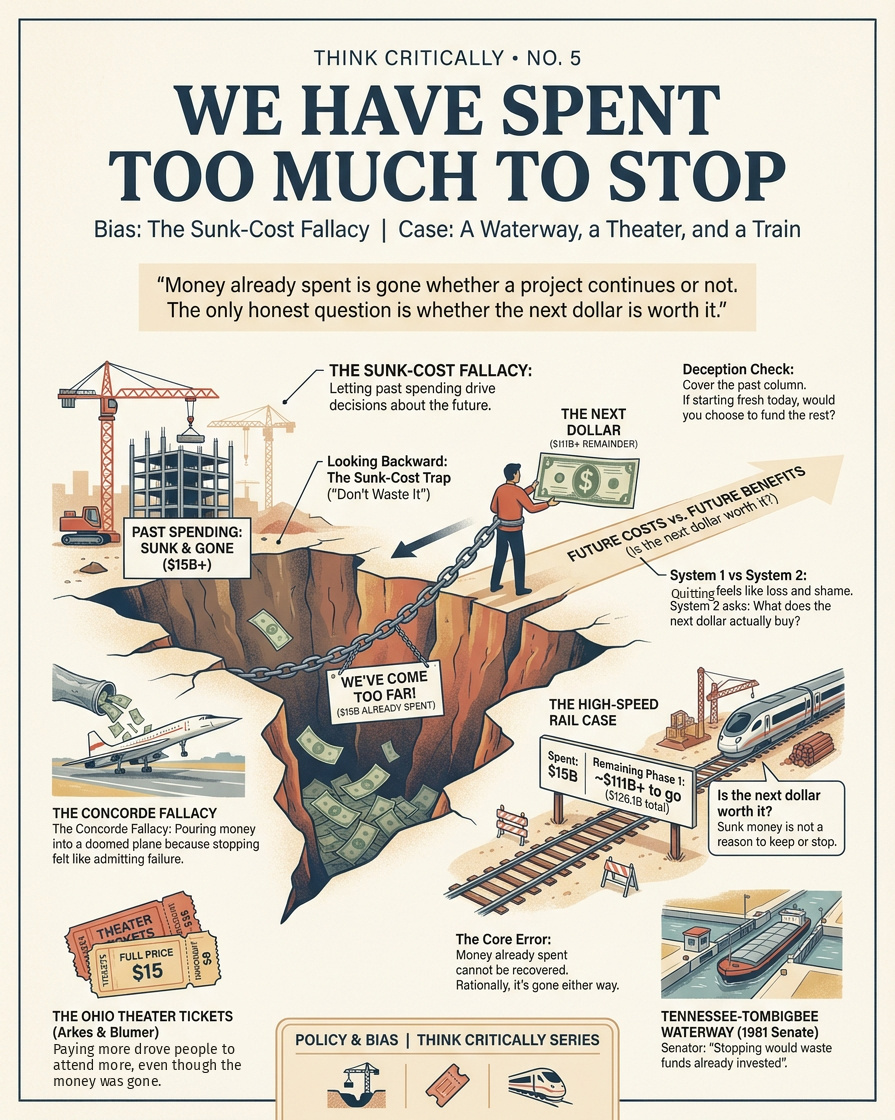
Think Critically, No. 5 | Bias: the sunk-cost fallacy | Case: a waterway, a theater, and a train
Money already spent is gone whether a project continues or not. The only honest question is whether the next dollar is worth it.
On November 4, 1981, the U.S. Senate debated whether to keep funding the Tennessee-Tombigbee Waterway, a canal project that was already deep into construction. Two senators made the case for pressing on. Senator Denton said that terminating a project in which $1.1 billion had been invested “represents an unconscionable mishandling of taxpayers’ dollars.” Senator Sasser said that stopping “at this late stage of development would … represent a serious waste of funds already invested” (as quoted in Arkes & Blumer, 1985).
Notice what both arguments lean on. Not the future value of the waterway, but the money already gone. Psychologists Hal Arkes and Catherine Blumer opened their classic 1985 paper on sunk costs with exactly those two quotes.
What the sunk-cost fallacy is
A sunk cost is money, time, or effort that has already been spent and cannot be recovered. The sunk-cost fallacy is letting that past spending drive a decision about the future. Rationally, the money is gone either way. What matters is what happens next: future costs against future benefits.
Arkes and Blumer tested this in the real world. At the Ohio University Theater, people buying season tickets were randomly sold them at full price ($15), at a $2 discount, or at a $7 discount. Over the first half of the season, the full-price buyers used more of their tickets: 4.11 on average, compared with 3.32 and 3.29 for the two discount groups. Everyone had the same tickets in hand. The only difference was what they had paid (Arkes & Blumer, 1985). The effect faded in the second half of the season, which is a useful reminder that biases are tendencies, not laws.
Evolutionary biologists Richard Dawkins and T. R. Carlisle gave the error a memorable nickname, the “Concorde fallacy,” after the Anglo-French supersonic airliner whose funding continued despite poor economic prospects (Dawkins & Carlisle, 1976). Arkes and Ayton later reviewed the evidence, found no clear-cut cases of the error in lower animals, and argued that humans commit it partly because they overgeneralize a learned rule: “don’t waste” (Arkes & Ayton, 1999).
In System 1 terms, the fast mind feels the pain of a loss and the shame of waste. Quitting feels like admitting the money was thrown away. System 2 has to separate two questions: “Was the past spending wise?” and “Is the next dollar wise?” They often have different answers.
Replication caveat. The basic sunk-cost effect held up in a large, 36-sample replication project, using a scenario about whether to attend a game in freezing weather after paying for tickets (Klein et al., 2014). It is a real tendency, though its size varies by setting.
The policy version: a train already under construction
California’s high-speed rail program had spent about $15.0 billion through February 2026, most of it on the Central Valley segment (California High-Speed Rail Authority [CHSRA], 2026b). Its 2026 Business Plan estimates a pared-down Phase 1 at about $126.1 billion (CHSRA, 2026a). In July 2025, federal regulators terminated about $4 billion in federal grants, citing doubts the first segment could be finished by 2033 (Federal Railroad Administration, 2025).
At this stage, “we have already spent too much to stop” is a tempting argument. So is its mirror image, “we have already wasted too much, kill it.” Both make the same mistake: they look backward.
The forward-looking question is harder and more useful. Given what is built, what remains to be spent, and what the finished pieces would deliver, is the next increment worth it? That question might favor finishing a usable segment, changing scope, or stopping. A PolicyBombs reader does not need to pick an answer here to see that the $15 billion already spent is not, by itself, a reason either way.
One more caution. Sunk does not mean worthless. Track, land, and permits already in hand can lower the cost of finishing, and that is a legitimate forward-looking factor. Cancelling also has real costs, including contract penalties and lost trust. The discipline is not “always quit.” It is “never use yesterday’s spending as the reason.”
How sunk costs get used on you
- “Finish what we started.” Political speeches often frame continued spending as honoring past investment rather than earning future value.
- Subscriptions and memberships. “You’ve already paid for the year” keeps people going to something they no longer want, or keeps them from cancelling something they never use.
- Repair spirals. After a costly repair, people keep pouring money into an old car or a failing system because of what they already put in.
- Escalating commitments in organizations. Managers who launched a project are often the last to admit it is failing, because stopping looks like a verdict on their judgment.
- Casinos and losing bets. “I’m in too deep to walk away now” is the sunk-cost fallacy with flashing lights.
Deception check: five questions before you hear “we’ve come too far”
- Cover the past column. If you were starting fresh today, with the current situation and no history, would you choose to fund the rest?
- What does the next dollar buy? Ask for the remaining cost and the remaining benefit, separate from what is already spent.
- What can be salvaged? Distinguish money that is truly gone from assets that still have value if the plan changes.
- Who loses face if it stops? The people defending a project may be defending their past decisions.
- What would the opposite argument look like? If someone says “we’ve wasted too much, kill it,” apply the same test. Backward-looking arguments cut both ways.
The lesson
Past spending is a fact, not a reason. Good decisions on bridges, wars, software, and trains all require the same uncomfortable move: setting aside what has been paid and asking only what the next step is worth.
References
Arkes, H. R., & Ayton, P. (1999). The sunk cost and Concorde effects: Are humans less rational than lower animals? Psychological Bulletin, 125(5), 591-600. https://doi.org/10.1037/0033-2909.125.5.591
Arkes, H. R., & Blumer, C. (1985). The psychology of sunk cost. Organizational Behavior and Human Decision Processes, 35(1), 124-140. https://doi.org/10.1016/0749-5978(85)90049-4
California High-Speed Rail Authority. (2026a). 2026 business plan. https://hsr.ca.gov/wp-content/uploads/2026/06/2026-Final-Business-Plan-060126-A11Y.pdf
California High-Speed Rail Authority. (2026b). 2026 business plan technical supporting document: Capital cost basis of estimate report. https://hsr.ca.gov/wp-content/uploads/2026/06/2026-Business-Plan-Basis-of-Estimate-A11Y.pdf
Dawkins, R., & Carlisle, T. R. (1976). Parental investment, mate desertion and a fallacy. Nature, 262(5564), 131-133. https://doi.org/10.1038/262131a0
Federal Railroad Administration. (2025, July 16). Letter from Acting Administrator Feeley to Ian Choudri, California High-Speed Rail Authority. U.S. Department of Transportation. https://railroads.dot.gov/sites/fra.dot.gov/files/2025-07/FRA%20Acting%20Administrator%20Feeley%20Letter%20to%20Mr.%20Ian%20Choudri%207.16.25.pdf
Klein, R. A., Ratliff, K. A., Vianello, M., Adams, R. B., Bahník, Š., Bernstein, M. J., Bocian, K., Brandt, M. J., Brooks, B., Brumbaugh, C. C., Cemalcilar, Z., Chandler, J., Cheong, W., Davis, W. E., Devos, T., Eisner, M., Frankowska, N., Furrow, D., Galliani, E. M., . . . Nosek, B. A. (2014). Investigating variation in replicability: A “many labs” replication project. Social Psychology, 45(3), 142-152. https://doi.org/10.1027/1864-9335/a000178