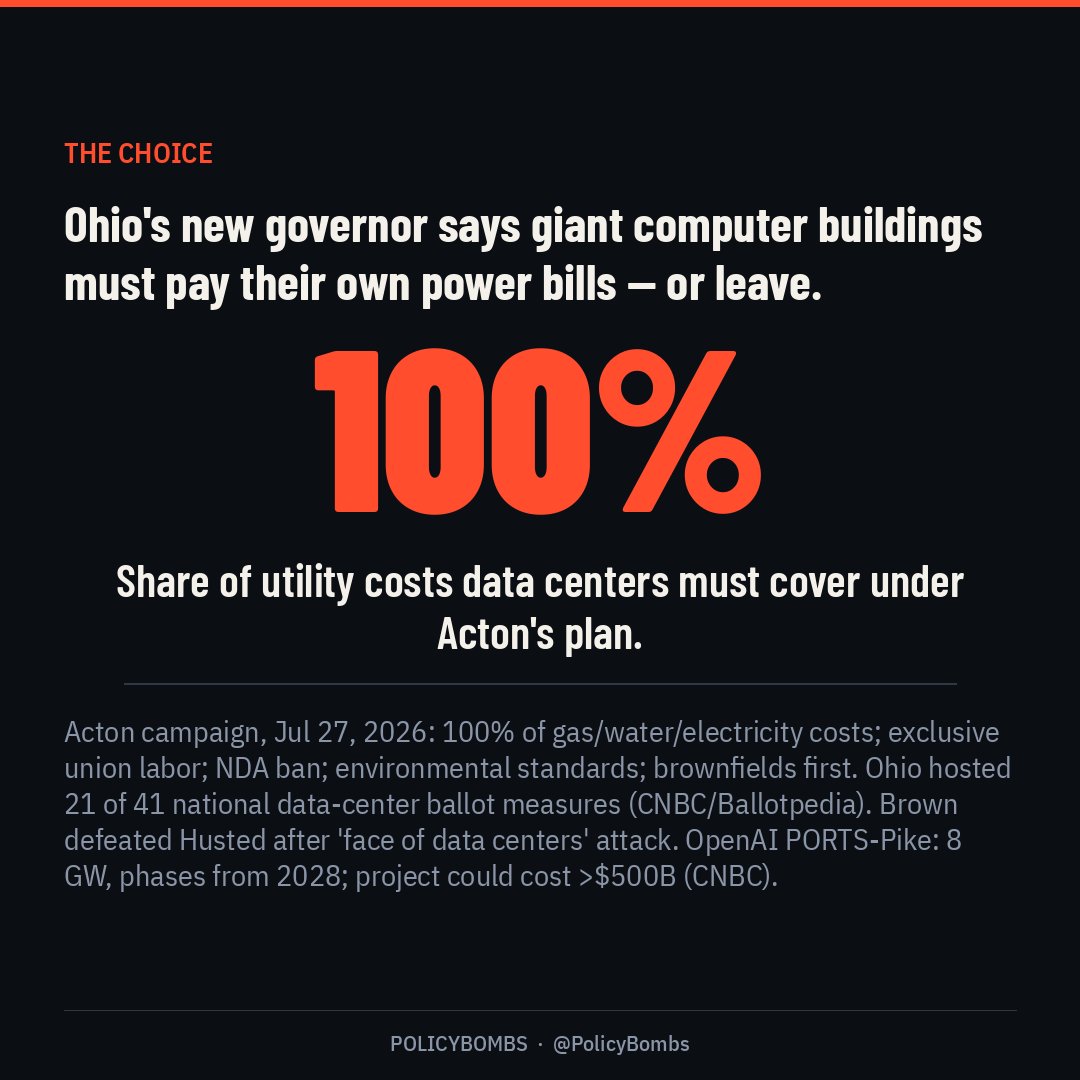
100%. That's the share of utility costs Ohio's new governor says data centers must pay — or they don't get built.
Gov.-elect Amy Acton (D) supports a "conditional moratorium": cover 100% of gas, water and electricity costs, build exclusively with union labor, ban NDAs, meet environmental standards, prefer brownfields. "If you do not meet these conditions, we do not want you in Ohio."
Ohio wasn't subtle. It hosted 21 of the 41 local data-center ballot measures nationwide. Sen. Sherrod Brown beat Sen. Jon Husted after branding him "the face of data centers." OpenAI's PORTS-Pike campus — 8 GW, Nvidia-backstopped, potentially >$500B — now sits in a tougher political climate.
PRO: Ratepayers stop subsidizing Big Tech's power bill; secrecy NDAs get banned.
CON / COST: Exclusive-union mandates and vague 'zero impact' language can turn a cost rule into a de facto ban — including on an 8 GW mega-campus.
SOCIETY: MIXED — ratepayer cost internalization and anti-NDA rules are sound; exclusive-union + vague 'zero impact' conditions risk a protectionist veto.
Full analysis
Ohio Conditional Data-Center Moratorium: Acton’s 100% Utility Costs + Union Labor Rules
Ohio Gov.-elect Amy Acton backs a conditional moratorium — new data centers only if they cover 100% of utility costs, use exclusive union labor, ban NDAs, meet environmental standards and prioritize brownfields — in a state that hosted 21 of 41 national ballot measures and flipped Brown over Husted. As of Nov 5, 2026, 11:40 PM ET.
Content as of Nov 5, 2026, 11:40 PM ET. Source: primary reporting + Ballotpedia / campaign statements fetched this run
Long-form deep analysis. Companion to the 10-minute quick reference (68-ohio-conditional-data-center-moratorium-summary.docx).
Contents
- 10-Minute Lazy Voter Guide
- 1. What is the policy
- 2. Why it exists
- 3. Realized effects
- Local investigations and anomalies
- Who supports / who opposes
- 4. Good or bad for society
- References
- Gaps / unverified
10-Minute Lazy Voter Guide
Ohio’s new Democratic governor wants to block new data centers unless they meet her checklist: pay every dollar of their own electricity/gas/water costs (no shifting to household bills), hire only union workers to build, no secret NDAs, follow environmental rules, and prefer old industrial sites over farmland. Ohio voters also passed a pile of local bans and restrictions, and Sen. Sherrod Brown beat Sen. Jon Husted after branding him ‘the face of data centers.’
Verdict: MIXED — MIXED — ratepayer cost internalization and anti-NDA rules are sound; exclusive-union + vague ‘zero impact’ conditions risk a protectionist veto. |
Figure | Meaning | Tag |
|---|---|---|
100% | Utility costs Acton says operators must cover — gas, water, electricity — with proof projects won’t raise household rates (Acton campaign, Jul 27, 2026) | Substantiated |
21 of 41 | Ohio’s share of local data-center ballot measures nationwide in the 2026 midterms (CNBC / Ballotpedia) | Substantiated |
8 GW | Computing capacity OpenAI secured at PORTS-Pike Technology Campus in Ohio — described as the world’s largest planned AI data-center campus; phases from 2028 (CNBC) | Substantiated |
>$500B | Potential total cost of the Nvidia-backstopped Ohio campus project (CNBC) | Substantiated |
14+ | Ohio municipalities that passed bans/restrictions including Sunbury (Amazon ~$2B proposal) per Guardian tally | Substantiated |
1. What is the policy
Gov.-elect Amy Acton’s ‘conditional moratorium’: new Ohio data centers allowed only if they (1) cover 100% of utility costs and prove no household rate increase / regional reliability hit, (2) exclusively use union labor to build/maintain, (3) ban NDAs / operate with full transparency, (4) meet environmental standards (campaign also used ‘zero environmental impact’), (5) prioritize brownfields/former industrial sites, (6) support local communities / community-benefit agreements (July list; later releases varied). She asked the General Assembly to pass legislation — not yet enacted as of Nov 5, 2026. Parallel: Sherrod Brown defeated Jon Husted after casting Husted as ‘the face of data centers’; NRSC memo warned blaming data centers for a Husted loss would poison the issue for future GOP candidates (The Verge).
2. Why it exists
Stated reasons: Protect Ohio families from bill spikes; end secret deals; ensure good union jobs; stop farmland conversion; force developers to bring their own generation.
Underlying drivers (evidence-based assessment): Affordability politics; union coalition demands; anti-tech populism that worked in 2026; OpenAI/SoftBank mega-campus as a visible target; Brown’s Senate playbook. Interest-group note: unions support the labor condition (and often support construction); environmental groups want water/air limits; hyperscalers want speed. Capture risk runs both ways — tax-break era favored capital; union-exclusive era favors organized labor.
3. Realized effects
Acton won the governorship; Brown won the Senate; Ohio locals passed numerous MW caps and bans (Guardian: ≥14 municipalities). Market: Ohio political risk layered onto national AI selloff Nov 5. PORTS-Pike first construction phase slated to begin 2026 with capacity from 2028 — more exposed to new conditions than already-pouring projects. Fact-check gap: campaign has not fully defined how ‘100%’ is measured vs existing PUCO tariffs (Ohio Policy Updates).
Local investigations and anomalies
Exact statutory text Pending. ‘Zero environmental impact’ vs ‘adhere to Ohio’s environmental standards’ wording inconsistency Contested. Whether PORTS-Pike is grandfathered Unverified. Community-benefit condition dropped from some later campaign lists (Ohio Policy Updates). … Full gaps listed below.
Who supports / who opposes
Supports: Acton; Brown; Ohio local majorities; AFL-CIO-aligned building trades (labor mandate); anti-data-center municipal organizers.
Opposes: Ramaswamy campaign (defeated); developers needing open-shop flexibility; SoftBank/SB Energy/OpenAI partners; some Republicans who shifted to ratepayer-protection bills without full moratoriums (Husted’s later Ratepayer Protection Act).
Further reading (also listed in References):
- [1] Acton for Governor: Conditional moratorium announcement (Jul 27, 2026)
- [2] Acton for Governor: Calls for Statehouse to pass conditional moratorium
- [3] CNBC: Voters rebuff data centers — Ohio 21 of 41 measures; Acton; Brown/Husted; PORTS-Pike 8 GW (Nov 4, 2026)
- [4] The Verge: Data centers lost the midterms — Brown/Husted NRSC memo
- [5] Guardian: Ohio municipalities passed bans; Sunbury Amazon $2B
4. Good or bad for society
Society gains if Ohio stops socializing grid upgrades onto households and ends NDA darkness. Society loses if ‘conditional’ means only politically connected union contractors can build the compute the Midwest was courting — and if 8 GW of planned capacity dies in process purgatory. Measurable tests: Did residential rates stabilize? Did brownfield sites get used? Did MW get built under clear tariffs? Or did projects flee to friendlier states?
Forcing data centers to pay their own power and water freight, kill NDAs, and face local scrutiny is GOOD policy. Grafting an exclusive-union mandate and undefined ‘zero impact’ language onto a ‘conditional’ freeze is how a transparent cost rule becomes a patronage gate. Ohio voters clearly wanted brakes — 21 ballot fights and Brown’s win prove it. PolicyBombs call: keep the ratepayer and transparency conditions; drop or narrowly tailor the union exclusivity so it doesn’t become a veto dressed up as labor justice. Net: MIXED.
References
[1] Acton for Governor: Conditional moratorium announcement (Jul 27, 2026). https://actonforgovernor.com/dr-amy-acton-announces-support-for-conditional-moratorium-on-data-centers/
[2] Acton for Governor: Calls for Statehouse to pass conditional moratorium. https://actonforgovernor.com/dr-amy-acton-calls-for-statehouse-to-pass-immediate-conditional-data-center-moratorium-legislation-as-they-reconvene/
[3] CNBC: Voters rebuff data centers — Ohio 21 of 41 measures; Acton; Brown/Husted; PORTS-Pike 8 GW (Nov 4, 2026). https://www.cnbc.com/2026/11/04/data-center-ballot-measures-2026-midterm.html
[4] The Verge: Data centers lost the midterms — Brown/Husted NRSC memo. https://www.theverge.com/policy/1026365/data-centers-midterms-results
[5] Guardian: Ohio municipalities passed bans; Sunbury Amazon $2B. https://www.theguardian.com/us-news/2026/nov/04/datacenters-midterm-elections
[6] Statehouse News Bureau: Acton conditional moratorium (Jul 27, 2026). https://www.statenews.org/government-politics/2026-07-27/democrat-running-for-ohio-governor-calls-for-conditional-moratorium-on-new-data-centers
[7] Ohio Policy Updates fact-check: What would Acton’s moratorium actually do?. https://ohiopolicyupdates.com/fact-check/amy-acton-data-center-moratorium/
Gaps / unverified
Exact statutory text Pending. ‘Zero environmental impact’ vs ‘adhere to Ohio’s environmental standards’ wording inconsistency Contested. Whether PORTS-Pike is grandfathered Unverified. Community-benefit condition dropped from some later campaign lists (Ohio Policy Updates).
PolicyBombs · Day 68. Follow @PolicyBombs on X.