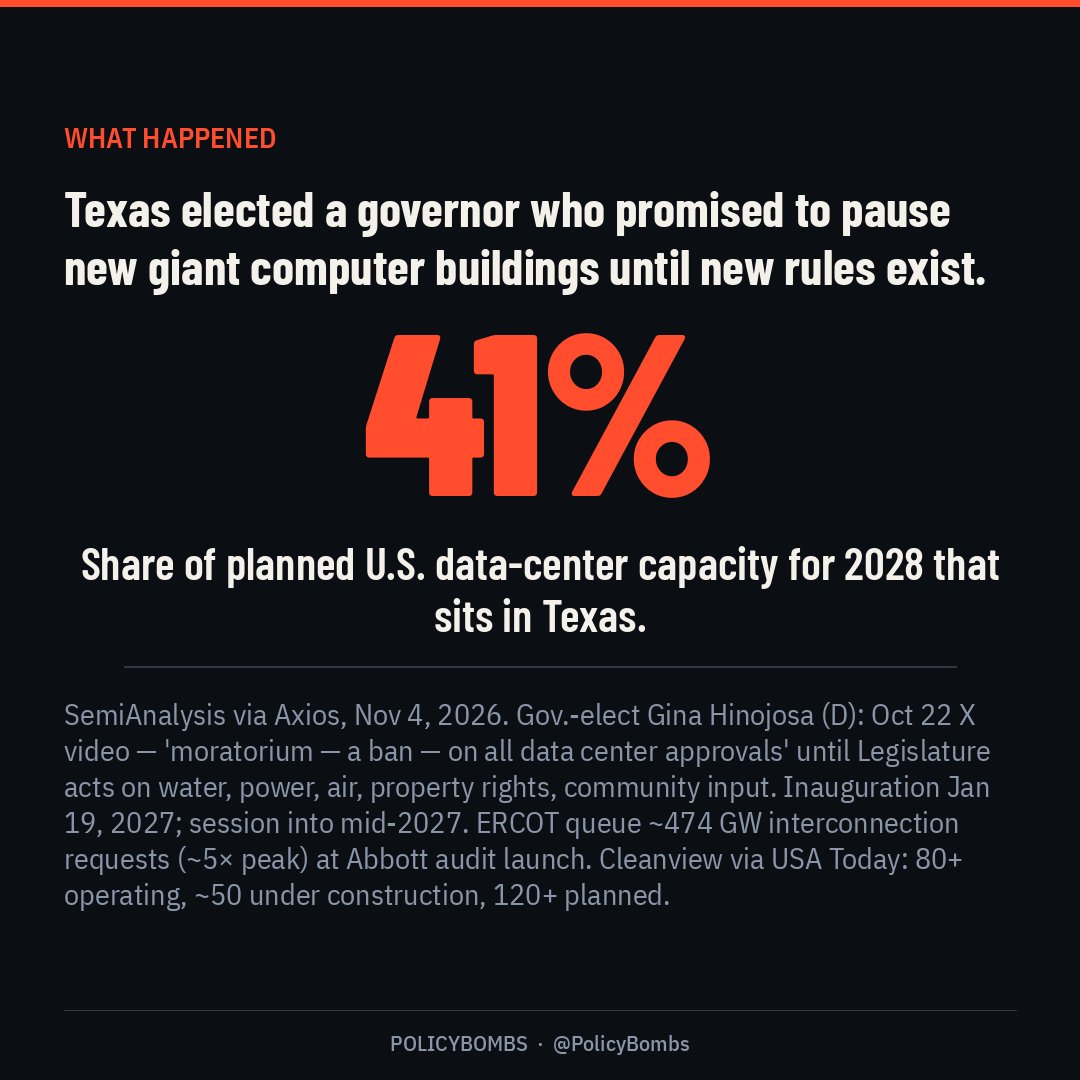
41%. That's Texas's share of planned U.S. data-center capacity for 2028 — and the new governor just promised a statewide ban on new approvals.
Gov.-elect Gina Hinojosa (D) said on Oct. 22 she will issue a "moratorium — a ban — on all data center approvals" until the Legislature passes laws on water, power, air, property rights and community say-so. She takes office Jan. 19, 2027; the session runs into mid-2027.
That's bigger than Abbott's 2026 audit pause. ERCOT's queue had ~474 GW of data-center interconnection requests — about five times peak demand — when that audit began. Trackers count 80+ operating Texas centers, ~50 under construction, 120+ planned.
Markets noticed: Texas is the boom's epicenter. Projects already pouring concrete are generally expected to continue; 2028+ permits are the fight.
PRO: Communities get water/power/air rules and a seat at the table after a free-for-all boom.
CON / COST: A mid-2027 legislative clock on the state with ~41% of U.S. 2028 capacity is a national AI growth tax.
SOCIETY: MIXED — justified pause for water/power/community rules in the #1 2028 capacity state; dangerous if it becomes an open-ended political freeze.
Full analysis
Texas Data-Center Moratorium: Hinojosa’s Statewide Pause Until 2027 Rules
Texas Gov.-elect Gina Hinojosa pledged a statewide ban on new data-center approvals until the Legislature passes water, power, air, property-rights and community-input rules — in the state holding the largest share of planned U.S. 2028 capacity. As of Nov 5, 2026, 11:40 PM ET.
Content as of Nov 5, 2026, 11:40 PM ET. Source: primary reporting + Ballotpedia / campaign statements fetched this run
Long-form deep analysis. Companion to the 10-minute quick reference (67-texas-data-center-moratorium-summary.docx).
Contents
- 10-Minute Lazy Voter Guide
- 1. What is the policy
- 2. Why it exists
- 3. Realized effects
- Local investigations and anomalies
- Who supports / who opposes
- 4. Good or bad for society
- References
- Gaps / unverified
10-Minute Lazy Voter Guide
Texas just elected a governor who promised to stop approving new giant computer buildings (data centers) until the Legislature writes new rules on water, electricity, air, property rights and community say-so. Projects already being built are generally expected to continue; the freeze targets new approvals. She takes office Jan. 19, 2027; the regular legislative session runs into mid-2027.
Verdict: MIXED — MIXED — justified pause for water/power/community rules in the #1 2028 capacity state; dangerous if it becomes an open-ended political freeze. |
Figure | Meaning | Tag |
|---|---|---|
41% | Share of planned U.S. 2028 data-center capacity in Texas (SemiAnalysis, cited by Axios Nov 4, 2026) | Substantiated |
474 GW | Data-center interconnection requests in ERCOT’s queue when Abbott launched his summer 2026 audit — ~5× peak demand (Heatmap / Abbott framing) | Substantiated |
Jan 19, 2027 | Hinojosa inauguration date (Texas Tribune) | Substantiated |
Oct 22, 2026 | Hinojosa X video: ‘moratorium — a ban — on all data center approvals until laws can be passed’ | Substantiated |
80+ / 50 / 120+ | Operating / under construction / planned Texas data centers (Cleanview via USA Today Nov 5, 2026) | Substantiated |
~25–30% | Dan Ives estimate of Texas share of data-center GW/capacity (Guardian Nov 4) — different metric from SemiAnalysis 41% of 2028 capacity | Contested |
1. What is the policy
Governor-elect Gina Hinojosa’s campaign pledge to issue a statewide moratorium (her word: ‘a ban’) on new Texas data-center approvals until the Legislature passes statutes on water, electricity, air, property rights, community input, NDA limits, union labor and ending tax subsidies. Distinct from outgoing Gov. Greg Abbott’s 2026 audit/pause on ERCOT interconnections and TCEQ environmental permits (expected to wrap ~December 2026). Hinojosa called Abbott’s temporary pause ‘a scam’ and said only enacted laws protect Texans. Takes office Jan. 19, 2027; Democrat-dominated Texas House incoming.
2. Why it exists
Stated reasons: Protect Texans from power-bill spikes, water stress in drought country, secret deals via NDAs, and tax giveaways; give communities ‘a seat at the table.’
Underlying drivers (evidence-based assessment): Grassroots backlash in red and blue counties; affordability politics after electricity and water fears; Democratic coalition (unions, environmental NGOs, rural populists); campaign contrast with Abbott’s earlier ‘epicenter of AI’ pitch. Data Center Watch: 43% of 74 gubernatorial candidates studied backed a moratorium/ban. Capture note: data-center-related donors gave Abbott ~$9M since July 2025 (Texas Tribune) — Hinojosa ran against that influence. Not proven that industry ‘bought’ policy outcomes; the donor pattern and community anger are both real.
3. Realized effects
Realized as of Nov 5, 2026: (1) Hinojosa won; pledge is campaign commitment, not yet an executive order. (2) Markets priced Texas risk — Nomura/CNBC: 2028 projects more exposed than 2027 (mostly already under construction). (3) Axios: a hold >6 months in Texas (41% of 2028 U.S. capacity) would extend delays; nearly two-thirds of 2028 U.S. capacity could face delays across flipped states. (4) Industry (Data Center Coalition) says it will work with new leadership. (5) Musk post: ‘Data centers in space looking pretty appealing right now.’ Local anomaly: advocates said some TCEQ permits issued despite Abbott’s pause, forcing the agency to shut its online filing system (Texas Tribune).
Local investigations and anomalies
Exact executive-order text not yet issued (Pending). Whether already-permitted but not-under-construction projects are caught is disputed (Contested). SemiAnalysis 41% is behind Axios paywall/citation — treated as Substantiated via Axios secondary. Cleanview 80/50/120+ counts are tracker estimates. ‘$2.5T’ tech wipe appears in some commentary; NPR documented >$2T — use >$2T. … Full gaps listed below.
Who supports / who opposes
Supports: Hinojosa; Texas House Democrats; Public Citizen’s Kathryn Guerra; Americans for Responsible Innovation (Brad Carson: ‘AI earthquake’); community groups in drought-stressed counties.
Opposes: Data Center Coalition; developers/hyperscalers with Texas pipelines; Abbott allies and AI-expansion investors; Musk publicly mocked the outcome.
Further reading (also listed in References):
- [1] Texas Tribune: Under Hinojosa, Texas data center approvals could stay paused (Nov 4, 2026)
- [2] Axios: Voters deliver ‘AI earthquake’ (Nov 4, 2026) — SemiAnalysis 41% of 2028 capacity
- [3] CNBC: Midterms could fuel K-shaped AI trade / Texas moratorium (Nov 5, 2026)
- [4] Heatmap News: What a Bluer Texas Means for Energy and Data Centers
- [5] Data Center Dynamics: Hinojosa promises continued moratorium
4. Good or bad for society
Direct judgment: Stopping secretive, ratepayer-subsidized, water-blind approvals is GOOD governance. Freezing the largest planned U.S. capacity market until a political session finishes is a real cost — higher AI infra prices, delayed compute, relative advantage to states/countries that keep building, and multiple compression on chip and neocloud equities. Opportunity cost: if China/allied jurisdictions keep adding capacity while Texas argues, U.S. AI leadership pays. Trade-off the honest voter faces: local water bills and grid reliability vs. national compute growth. PolicyBombs call: pass the water/power/transparency statutes fast; do not weaponize the moratorium into a years-long ban.
Communities have a legitimate case: Texas invited a historic AI buildout with thin water, grid and disclosure rules, and voters just punished that. A time-boxed pause to write real statutes — especially ratepayer protection, water efficiency and ending NDA secrecy — is defensible. A statewide ban that drags deep into the 2027 session, layered with union mandates and local vetoes, is a growth tax on the country’s largest planned capacity hub. Net: MIXED — good that Texas stops pretending there are no externalities; bad if ‘until the Legislature acts’ becomes an indefinite political hostage for AI infrastructure the U.S. still needs.
References
[1] Texas Tribune: Under Hinojosa, Texas data center approvals could stay paused (Nov 4, 2026). https://www.texastribune.org/2026/11/04/data-center-texas-pause-gina-hinojosa-governor-policies/
[2] Axios: Voters deliver ‘AI earthquake’ (Nov 4, 2026) — SemiAnalysis 41% of 2028 capacity. https://www.axios.com/2026/11/04/ai-data-center-election-slowdown
[3] CNBC: Midterms could fuel K-shaped AI trade / Texas moratorium (Nov 5, 2026). https://www.cnbc.com/2026/11/05/ai-data-centers-midterms-capacity.html
[4] Heatmap News: What a Bluer Texas Means for Energy and Data Centers. https://heatmap.news/politics/hinojsas-win-data-centers
[5] Data Center Dynamics: Hinojosa promises continued moratorium. https://www.datacenterdynamics.com/en/news/texas-governor-elect-gina-hinojosa-promises-continued-data-center-moratorium-further-legislation/
[6] USA Today: Texas is done with data centers until further notice (Nov 5, 2026). https://www.usatoday.com/story/news/nation/2026/11/05/texas-is-done-with-data-centers-until-further-notice-new-governor-says/92634485007/
[7] Guardian: Datacenters were on the ballot (Nov 4, 2026). https://www.theguardian.com/us-news/2026/nov/04/datacenters-midterm-elections
[8] CNBC: Top Democrats call to rein in AI buildout (Nov 5, 2026) — Wells Fargo 27% planned capacity. https://www.cnbc.com/2026/11/05/democrats-data-center-restrictions-midterms.html
Gaps / unverified
Exact executive-order text not yet issued (Pending). Whether already-permitted but not-under-construction projects are caught is disputed (Contested). SemiAnalysis 41% is behind Axios paywall/citation — treated as Substantiated via Axios secondary. Cleanview 80/50/120+ counts are tracker estimates. ‘$2.5T’ tech wipe appears in some commentary; NPR documented >$2T — use >$2T.
PolicyBombs · Day 67. Follow @PolicyBombs on X.