No-Bail / Cashless Bail

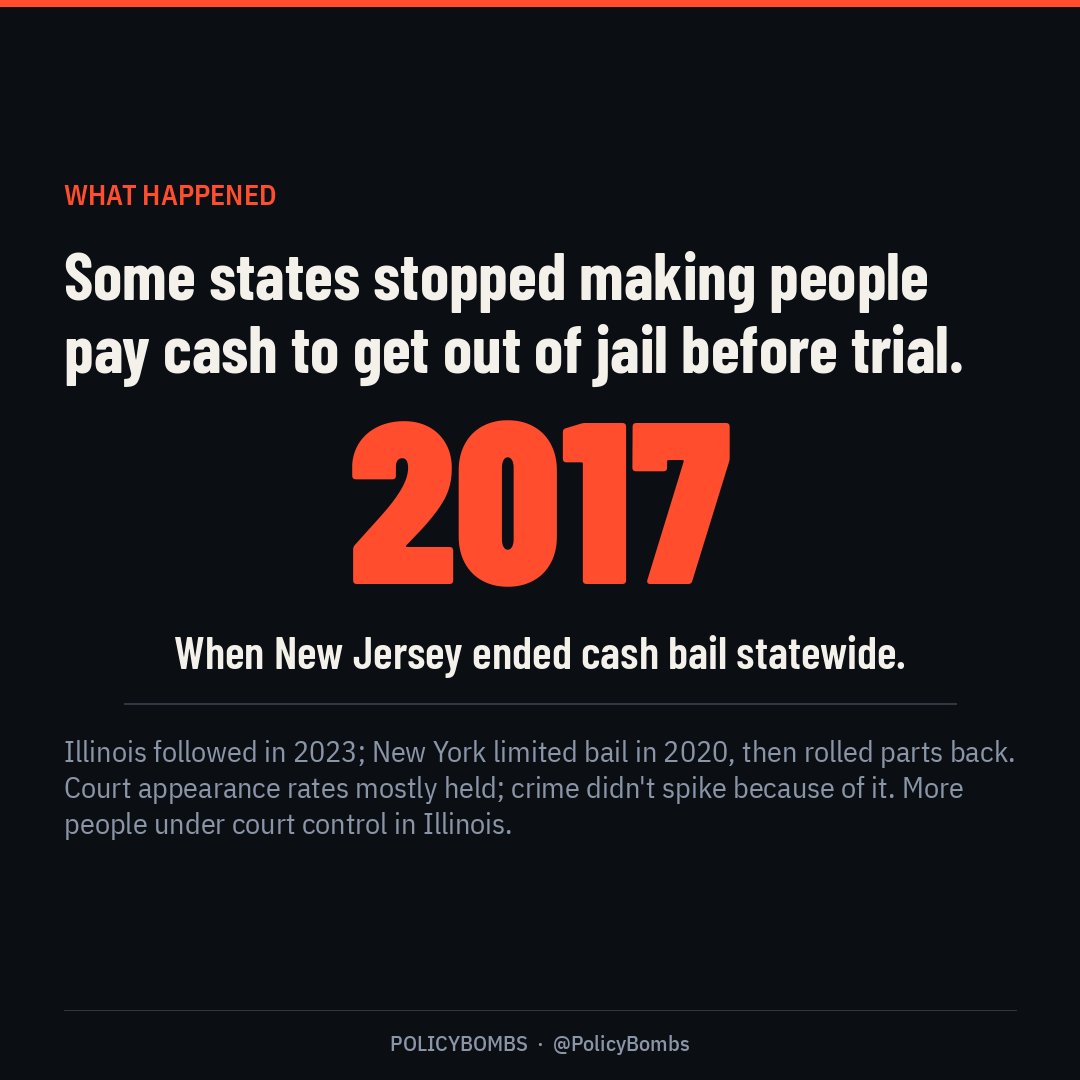
2017. That's when New Jersey ended cash bail statewide. Illinois followed in 2023; New York limited bail in 2020 and then rolled parts back.

Cashless bail means judges decide release with conditions or detention for danger or flight risk, not a dollar amount. Data so far: court appearance rates mostly held and crime did not spike because of it. But the number of people under some form of court control actually went up in Illinois.

PRO: Money bail sorts by wealth, not risk.

CON / COST: Removing judicial discretion over dangerous repeat offenders (NY 2020) backfired.

SOCIETY: Net good when designed like New Jersey.


Full analysis

No-Bail / Cashless Bail: Policy Assessment

Illinois, New Jersey, New York and California: what changed, why, what the appearance and rearrest data show, and a verdict. As of Nov 4, 2026.

Content as of Nov 4, 2026, 8:33 PM ET. Source Page: PolicyBombs canvas

Long-form deep analysis. Companion to the 10-minute quick reference (12-no-bail-summary.docx).

Contents

  • 10-Minute Voter Guide
  • Key facts
  • 1. What is the policy
  • 2. Why it exists
  • 3. Realized effects
  • 4. Good or bad for society
  • Local investigations and data anomalies
  • Who supports / who opposes
  • References

10-Minute Voter Guide

Who’s for / against: For ending cash bail: Gov. JB Pritzker (D-IL, SAFE-T Act), Gov. Jerry Brown (D-CA, SB 10). Against: Republicans, President Trump (Aug 2025 EO), the bail industry, and California voters (Prop 25, 2020). Some civil-rights groups also opposed SB 10’s risk algorithms.

Cashless bail means judges no longer set a dollar amount to get out of jail before trial. Instead they decide whether to release someone with conditions or hold them because they are dangerous or likely to flee. Illinois (2023) and New Jersey (2017) did it statewide; New York limited bail in 2020 and then rolled parts back. Data so far: court appearance rates mostly held, crime did not spike because of it, but the number of people under some form of court control actually went up in Illinois.

Pros

Cons

+ Poor people no longer sit in jail just because they can’t pay

+ Dangerous people can be held outright instead of buying their way out

+ New Jersey’s results are good and well documented

– Some repeat offenders reoffended more under New York’s first version

– Felony no-show rates rose in Illinois

– State courts have been slow to publish the monitoring data the law requires

Bottom line for voters: Support versions that let judges hold dangerous people after a hearing and that publish their data. Be skeptical of versions that tie judges’ hands or that never report results.

Bottom line: Getting rid of money bail has not caused the crime waves opponents predicted, and court appearance rates mostly held steady. The design is what matters. New Jersey paired abolition with risk assessment and real detention hearings, and it worked. New York’s first version barred judges from weighing dangerousness and had to be rolled back three times. Bail reform done carefully is good policy. Releasing people across the board without letting judges assess risk is bad policy.

Key facts

Jurisdiction

Start

Status (Nov 2026)

Key number

New Jersey Criminal Justice Reform Act

Jan 2017

In force

Pretrial jail pop. down about 40%+ by 2018 vs 2015 (NJ Courts); NIJ/MDRC found no rise in rearrest or FTA

New York bail reform

Jan 2020

In force, amended 2020, 2022, 2023

Data Collaborative for Justice: bail elimination linked to lower rearrest for most groups; higher for some repeat-offense groups

Illinois Pretrial Fairness Act (SAFE-T Act)

Sept 18, 2023

In force

FTA warrant rate 13.6% before vs 12.5% after (Loyola, 22 counties)

Illinois, Cook County

2023–25

In force

87% of released people appeared; 84% had no new charge while released (Aug 2025 data)

California, In re Humphrey

Mar 2021

Binding case law

Courts must consider ability to pay; Prop 25 (statewide abolition) rejected by voters 56–44 in Nov 2020

Federal pressure: EO ‘Taking Steps to End Cashless Bail’

Aug 25, 2025

Signed; no funding cut or lawsuit reported as of search

Directs DOJ to list jurisdictions and federal funds that could be suspended; Illinois law remains in force

1. What is the policy

Item

Detail

New Jersey (2017)

Constitutional amendment (2014) plus statute. Money bail almost entirely replaced by a Public Safety Assessment risk score, release conditions, and a hearing where prosecutors can seek detention without bail. Speedy-trial deadlines.

New York (2019 law, effective Jan 2020)

Mandatory release for most misdemeanors and nonviolent felonies. Judges could not consider dangerousness, which is unusual nationally. Amended April 2020 (more bail-eligible offenses), 2022 (repeat offenses, gun charges), and 2023 (dropped the ‘least restrictive’ standard for serious charges).

Illinois Pretrial Fairness Act (part of the 2021 SAFE-T Act)

Ended cash bail statewide on Sept 18, 2023, after the IL Supreme Court upheld it in Rowe v. Raoul (July 2023). Prosecutors can file for detention on listed offenses and must show by clear and convincing evidence that the person is dangerous or a willful flight risk.

California (In re Humphrey, 2021)

CA Supreme Court: judges must consider ability to pay and may detain only when no other condition will protect public safety or ensure appearance. SB 10 (2018) abolished cash bail, but voters repealed it via Prop 25 in 2020. Practice still varies by county.

2. Why it exists

Stated case for reform

Stated case against

+ Wealth, not risk, decided who sat in jail before trial

+ Even a few days in jail cost jobs and housing, and pressure innocent people to plead guilty

+ Cases like Kalief Browder (NYC, 3 years at Rikers without trial) made the problem visible

+ Jail costs for counties

– Bail creates an incentive to show up to court

– Repeat offenders get released quickly

– Victims and police lose trust

– Judges should be able to weigh dangerousness

Underlying drivers: there was a bipartisan reform movement in the 2010s (Koch-funded groups as well as the ACLU and Arnold Ventures, which funded the PSA risk tool). The commercial bail bond industry spent heavily against reform. In CA it funded the referendum that put SB 10 on the ballot. Prosecutors and police unions opposed the measures. Progressive DAs and legislative majorities in one-party states passed the strongest versions. Republicans have used reform as a midterm crime issue (NY 2022), which pushed the NY rollbacks.

3. Realized effects

Item

Detail

Assessment

New Jersey

NJ Judiciary reports and an NIJ/MDRC evaluation found pretrial jail population fell sharply. There was no statistically significant change in failure to appear, and no rise in new criminal activity two years out. This is the best-documented success.

Positive

New York

Data Collaborative for Justice (John Jay) found that eliminating bail reduced rearrest overall. Rearrests rose for people with recent prior arrests charged with certain offenses, which is the group the amendments targeted. Statewide crime rose in 2020–22, as it did in states without reform, so it is hard to pin on bail.

Mixed

Illinois

Loyola CCJ (state-commissioned): no dramatic change in FTA; felony FTA rose (non-detainable felonies 13.1% to 16.1%). Jail populations fell 14–25% early, then rebounded in Cook, Lake and Kane by July 2025. People under some pretrial control rose 17%. Crime fell 2024–25, matching national trends.

Neutral to positive

California

Humphrey has been unevenly applied. Studies are limited (PPIC tracked arrest/booking data). No clear statewide effect can be attributed to it.

Unclear

Caveat: advocacy groups on both sides cherry-pick individual crimes or single-county numbers. FTA definitions differ (warrant vs any missed hearing), so cross-state comparisons are weak. 2020–22 crime trends were national and swamp any bail signal.

4. Good or bad for society

Verdict: Net good when designed like New Jersey: risk-based detention hearings, supervision, and speedy trials. Bad when it removes judicial discretion over dangerous repeat offenders, as New York’s 2020 law did. Money bail itself is a bad tool, because it sorts by wealth, not risk.

Strongest case FOR

Strongest case AGAINST

+ NJ shows large jail reductions without measurable rises in FTA or rearrest

+ Ends wealth-based detention and coerced pleas

+ Lets dangerous people be held outright instead of bonding out with money

– Specific subgroups (recent repeat arrestees) did reoffend more in NY

– IL shows rising felony FTA and growth in supervision and revocations, so it shifts control rather than ending it

– Requires court and pretrial-services capacity many counties lack

  1. Keep money out of release decisions; let judges hold people based on risk, with a hearing.
  2. Publish standardized FTA and rearrest data by charge type every quarter.
  3. Fund court reminders (texts measurably cut FTA) and speedy trials.

Local investigations and data anomalies

Finding

Source

What investigators concluded

Cook County electronic monitoring: no meaningful difference in violent rearrest between people on EM and those released without it; violent rearrest under 1% in the studied group

Chicago Appleseed review of Circuit Court of Cook County data, Aug 2025 (reform-leaning)

EM adds cost and control without clear safety gain; the Sheriff’s EM program is being absorbed into the court’s

PFA’s required 60-day reviews of detention largely ineffective

Same report

Process requirement not working as written

State courts slow to publish SAFE-T Act electronic monitoring data

Better Government Association, Mar 2025 (local investigative)

Data the law mandates was lagging; independent verification is harder

Total people under pretrial control up 17%; rural pretrial supervision up 138%

Loyola CCJ, July 2025 (state-commissioned)

Reform shifted control from jail to supervision rather than reducing it

Cook, Lake and Kane pretrial jail populations above pre-PFA levels by July 2025

Loyola CCJ

Early jail drop reversed in the biggest counties, partly from release-violation detentions

No fraud or corruption finding tied to bail reform turned up. The bail bond industry it replaced had a long record of local corruption cases, which this review did not re-examine. Verdict: unchanged. The local data reinforces that design and transparency matter, and adds a new concern: reform can grow supervision rather than shrink it.

Further reading (also listed in References):

Who supports / who opposes

For = ending or limiting cash bail. Against = keeping cash bail. Each row cites a numbered source below. Checked Nov 4, 2026.

Who

Party / level

Position

Evidence

Ref

Gov. JB Pritzker (D-IL)

Democrat

For

Signed SAFE-T Act (HB 3653, 2021); cash bail ended Sept 18, 2023

[1]

Gov. Jerry Brown (D-CA); Sen. Bob Hertzberg (D)

Democrat

For

Signed SB 10 (2018) ending cash bail

[2]

California voters

Ballot

Against

Rejected SB 10 via Prop 25 (Nov 2020), ~56% no

[2]

President Donald Trump

Republican

Against

EO 14342 "Taking Steps to End Cashless Bail" (Aug 25, 2025) targets federal grants to cashless-bail jurisdictions

[3]

Illinois Republicans

Republican

Against

Voted against SAFE-T Act; state’s attorneys sued (lost 2023)

[1]

Cross-party defectors: The ACLU of California withdrew support for SB 10 over risk-assessment tools, so it ended up opposed by the bail industry and some reformers at once.

How positions shifted: New York’s 2019 bail reform was rolled back in 2020 under Gov. Cuomo (D), then again in 2022 and 2023 at Gov. Hochul’s (D) urging. Democrats have moved toward judicial discretion.

Not included or not fully verified: Did not cite a specific Hochul statement link; the rollbacks are documented in NY budget bills, which were not opened this turn.

Sources for this section:

References

[1] Chicago Appleseed: PFA and electronic monitoring in Cook County (2025). chicagoappleseed.org. https://www.chicagoappleseed.org/2025/08/05/new-report-the-impact-of-the-pretrial-fairness-act-on-electronic-monitoring/

[2] BGA: State courts lag on EM data required by SAFE-T Act. bettergov.org. https://www.bettergov.org/2025/03/26/state-courts-lag-on-electronic-monitoring-data-required-by-safe-t-act/

[3] Circuit Court of Cook County: pretrial research and statistics. cookcountycourtil.gov. https://www.cookcountycourtil.gov/department/adult-probation/adult-probation-department-research-statistics/pretrial-curfew

[4] Loyola CCJ: The First Year of the Pretrial Fairness Act. loyolaccj.org. https://pfa-1yr.loyolaccj.org/

[5] Loyola CCJ: Pretrial detention and supervision under the PFA (2025). loyolaccj.org. https://loyolaccj.org/blog/pretrial-detention-and-supervision-under-the-pfa

[6] NPR Illinois: Cook County pretrial data (Aug 2025). nprillinois.org. https://www.nprillinois.org/illinois/2025-08-26/trump-threatens-illinois-federal-funding-for-eliminating-cash-bail

[7] NJ Courts: Criminal Justice Reform reports. njcourts.gov. https://www.njcourts.gov/public/concerns/criminal-justice-reform

[8] MDRC: Evaluation of New Jersey’s bail reform. mdrc.org. https://www.mdrc.org/work/projects/evaluation-new-jerseys-bail-reform

[9] Data Collaborative for Justice: NY bail reform and recidivism. datacollaborativeforjustice.org. https://datacollaborativeforjustice.org/work/bail/

[10] In re Humphrey opinion (CA Supreme Court, Mar 25, 2021). courts.ca.gov. https://www4.courts.ca.gov/opinions/archive/S247278.PDF

[11] White House fact sheet: EO on cashless bail (Aug 2025). whitehouse.gov. https://www.whitehouse.gov/fact-sheets/2025/08/fact-sheet-president-donald-j-trump-takes-steps-to-end-cashless-bail-to-protect-americans/

[12] Coalition to End Money Bond: one-year review (advocacy). endmoneybond.org. https://endmoneybond.org/one-year-after-implementation-this-is-what-we-know-about-the-pretrial-fairness-act/

PolicyBombs · Day 56. Follow @PolicyBombs on X.
Concealed Carry

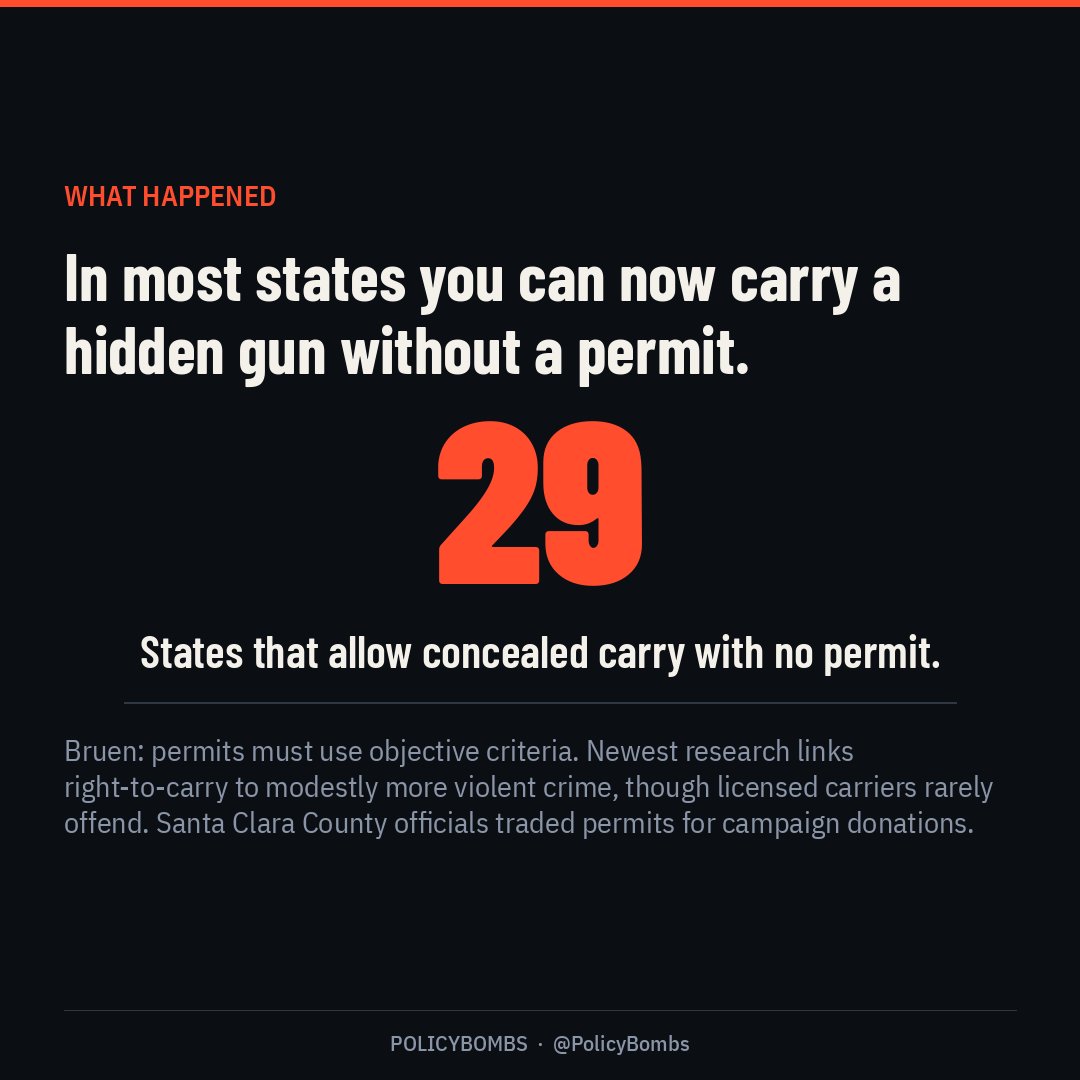
29 states now let you carry a concealed gun with no permit.

Bruen forced every state to issue permits on objective criteria. The newest research links right-to-carry laws to modestly more violent crime, though licensed carriers rarely commit crimes. And discretionary systems can rot: in Santa Clara County, sheriff's officials traded carry permits for campaign donations.

The good: Ending arbitrary may-issue regimes was fair. The cost: More carrying doesn't cut crime and probably raises it modestly.

PRO: Ending arbitrary may-issue regimes was fair.

CON / COST: More carrying doesn't cut crime and probably raises it modestly.

SOCIETY: Shall-issue with real training and background checks is the best balance.


Full analysis

Concealed Carry: Policy Assessment

The spread of shall-issue and permitless carry, Lott’s ‘more guns, less crime’ against Donohue’s right-to-carry studies, and what is known after Bruen. As of Nov 4, 2026.

Content as of Nov 4, 2026, 8:34 PM ET. Source Page: PolicyBombs canvas

Long-form deep analysis. Companion to the 10-minute quick reference (11-concealed-carry-summary.docx).

10-Minute Voter Guide

Who’s for / against: For national concealed-carry reciprocity and permitless carry: Rep. Richard Hudson (R-NC), House Republicans, Gov. DeSantis. Against: Democrats and Gov. Newsom, who signed SB 2 to limit where permit-holders can carry after Bruen.

29 states now allow carrying a concealed gun with no permit, and Bruen forced every state to issue permits on objective criteria. The newest research links right-to-carry laws to modestly more violent crime, though licensed carriers rarely commit crimes. Local court records show what discretionary permit systems can become: in Santa Clara County, sheriff’s officials traded carry permits for campaign donations.

Pros of expanded carry

Cons

+ Constitutional right

+ Ends permits awarded by favoritism or bribery (Santa Clara)

+ Licensed carriers have low crime rates

– Violent crime 13–15% higher a decade after right-to-carry laws (Donohue)

– Permitless carry drops training and the permit check

– More guns in everyday disputes

Bottom line: Favor shall-issue permits with training and checks over both permitless carry and permits issued at officials’ discretion.

Contents

  • 10-Minute Voter Guide
  • Key facts
  • 1. What is the policy
  • 2. Why it exists
  • 3. Realized effects
  • Abuse findings
  • 4. Good or bad for society
  • Who supports / who opposes
  • References

Bottom line: The ‘more guns, less crime’ finding has not held up. Newer, stronger methods (synthetic controls, more data years) link right-to-carry laws to modestly higher violent crime. Licensed carriers themselves commit crimes at very low rates. Shall-issue with training is a defensible compromise. Permitless carry drops screening and training for small gains.

Key facts

Item

Detail

Permitless carry states, 2026

29 (Vermont always; Alaska 2003; most since 2015)

May-issue states before Bruen

About 8 (CA, NY, NJ, MD, MA, HI, DE, RI); all forced to shall-issue by Bruen, 2022

Lott & Mustard (1997)

Right-to-carry laws lower violent crime

National Research Council (2004)

No credible evidence either way (one dissent)

Donohue, Aneja & Weber (2019)

Violent crime 13–15% higher 10 years after a right-to-carry law (synthetic control)

RAND rating, shall-issue laws (2024)

Supportive evidence they increase total and firearm homicides

RAND rating, permitless carry (2024)

Limited evidence of more fatal police shootings

Active carry permits

About 21M+ (Crime Prevention Research Center est.; not independently verified)

Post-Bruen ‘sensitive places’ laws (NY, CA, HI, MD)

Mostly upheld by circuits, but Wolford v. Lopez (June 25, 2026, 6–3) struck Hawaii’s default ban on carrying onto private property open to the public

1. What is the policy

Item

Detail

Shall-issue

The state must issue a permit to anyone who meets objective criteria (background check, often training). Florida’s 1987 law started the wave.

Permitless (constitutional) carry

No permit needed for adults allowed to own guns. Many states keep optional permits for reciprocity. Recent adopters include Texas (2021) and Florida (2023). North Carolina’s SB 50 is not law: Gov. Stein vetoed it in June 2025, the Senate overrode 30–19, and the House has not held an override vote as of Nov 2026.

After Bruen

Discretionary ‘proper cause’ rules are unconstitutional. States responded with broad sensitive-place bans and stricter training (e.g. NY CCIA 2022, CA SB 2 2023).

2. Why it exists

Stated reasons

Underlying drivers

+ Self-defense is a core right (Heller, Bruen)

+ May-issue regimes were arbitrary and favored the connected (NYC celebrity permits)

+ Deterrence: criminals can’t tell who is armed

– NRA and state gun groups made permitless carry a litmus test in GOP primaries

– Gun sales and the carry-insurance industry (USCCA) profit from expansion

– Blue states’ post-Bruen restrictions were partly symbolic defiance

3. Realized effects

Item

Detail

Assessment

Lott line

County panel data from 1977–1992 found crime falls after right-to-carry laws. Later work showed the results depend heavily on the model and the years studied, and the crack-era crime wave confounds them.

Not robust

Donohue line

Using more years and synthetic controls, violent crime rises 13–15% within a decade. Proposed mechanisms: guns stolen from cars, escalated confrontations, and police time diverted. Lott and Moody dispute the choice of controls.

Stronger evidence

Permit-holder conduct

State data (e.g. Texas DPS, Florida) show permit holders are convicted at lower rates than the general public, and lower than police on some measures.

Low misuse

Defensive use

Estimates range from about 70,000 a year (NCVS) to 1.7M+ (surveys such as English 2021). The huge range makes cost-benefit claims weak.

Disputed

After Bruen

Permit applications surged in former may-issue states. Too few years of data exist for causal crime estimates.

Too early

Abuse findings

Finding

What investigators or courts concluded

Source

Santa Clara County carry permits for donations

Permits allegedly traded for donations to the sheriff’s campaign. Sheriff Smith resigned after a 2022 civil corruption verdict; a former captain was convicted; the former undersheriff pleaded guilty (Sept 2026).

Santa Clara DA; LA Times

Killings by concealed-carry permit holders

Violence Policy Center counts 3,079 incidents and 3,345 deaths since 2007. VPC is an advocacy group, and its count includes pending cases and suicides.

VPC (advocacy; not a government count)

What changed: the verdict now explicitly favors objective shall-issue permits over discretionary ones, because discretion produced documented bribery. The rest of the verdict is unchanged.

4. Good or bad for society

Verdict: The right to carry is settled law, and abolishing arbitrary may-issue regimes was fair. On the evidence, though, more carrying doesn’t reduce crime and probably raises it modestly. Shall-issue with real training and background checks is the best balance. Permitless carry removes the screening that keeps permit-holder misuse low, and it weakens police tools for checking who is carrying.

Strongest case for expansive carry

Strongest case against

+ Constitutional right; may-issue was discriminatory

+ Licensed carriers rarely commit crimes

+ Self-defense where police response is slow (rural areas)

– The best recent studies show more violent crime after right-to-carry laws

– Permitless carry drops training and the permit check

– More guns in public raises the stakes of everyday conflicts

Who supports / who opposes

For = national reciprocity or permitless carry. Against = tighter carry limits. Each row cites a numbered source below. Checked Nov 4, 2026.

Who

Party / level

Position

Evidence

Ref

Rep. Richard Hudson (R-NC)

Republican

For

Sponsor of Concealed Carry Reciprocity Act (H.R. 38); passed House 231–198 (Dec 6, 2017); reintroduced 119th

[1]

Gov. Ron DeSantis (R-FL)

Republican

For

Signed HB 543 (2023), permitless carry

[2]

Gov. Gavin Newsom (D-CA); Sen. Anthony Portantino (D)

Democrat

Against

SB 2 (2023) restricts carry in "sensitive places"; partly enjoined in court

[3]

House Democrats

Democrat

Against

Overwhelmingly opposed H.R. 38 (2017)

[1]

Cross-party defectors: A handful of House Democrats voted for H.R. 38 in 2017 and a handful of Republicans voted no (see roll call).

How positions shifted: After NYSRPA v. Bruen (2022), blue states moved from permit discretion to sensitive-place limits. Red states moved to permitless carry (29 states).

Not included or not fully verified: Exact Democratic yes/Republican no counts on 2017 H.R. 38 not verified this turn; described as ‘a handful’.

Sources for this section:

References

[1] Donohue, Aneja & Weber, Right-to-Carry Laws and Violent Crime (JELS 2019). onlinelibrary.wiley.com. https://onlinelibrary.wiley.com/doi/10.1111/jels.12219

[2] Lott & Mustard, Crime, Deterrence, and Right-to-Carry (1997). journals.uchicago.edu. https://www.journals.uchicago.edu/doi/10.1086/467988

[3] NRC, Firearms and Violence: A Critical Review (2004). nap.edu. https://nap.nationalacademies.org/catalog/10881/firearms-and-violence-a-critical-review

[4] RAND: Effects of concealed-carry laws. rand.org. https://www.rand.org/research/gun-policy/analysis/concealed-carry.html

[5] Santa Clara DA: gun permit bribery conviction. santaclaracounty.gov. https://da.santaclaracounty.gov/former-sheriffs-captain-guilty-gun-permit-bribery-scheme

[6] LA Times: Former undersheriff pleads guilty (2026). latimes.com. https://www.latimes.com/california/story/2026-09-22/undersheriff-guilty-gun-permit-bribery-scheme

[7] VPC: Concealed Carry Killers. concealedcarrykillers.org. https://concealedcarrykillers.org/

[8] NYSRPA v. Bruen (2022). supremecourt.gov. https://www.supremecourt.gov/opinions/21pdf/20-843_7j80.pdf

[9] Wolford v. Lopez (2026). supremecourt.gov. https://www.supremecourt.gov/opinions/25pdf/24-1046_nmio.pdf

[10] NC SB 50 (2025-26) bill history. ncleg.gov. https://house.ncleg.gov/BillLookup/2025/S50

[11] CarryMaps: State of Concealed Carry 2026. carrymaps.com. https://carrymaps.com/reports/2026.html

[12] Crime Prevention Research Center permit reports. crimeresearch.org. https://crimeresearch.org/

PolicyBombs · Day 55. Follow @PolicyBombs on X.

Gun Control

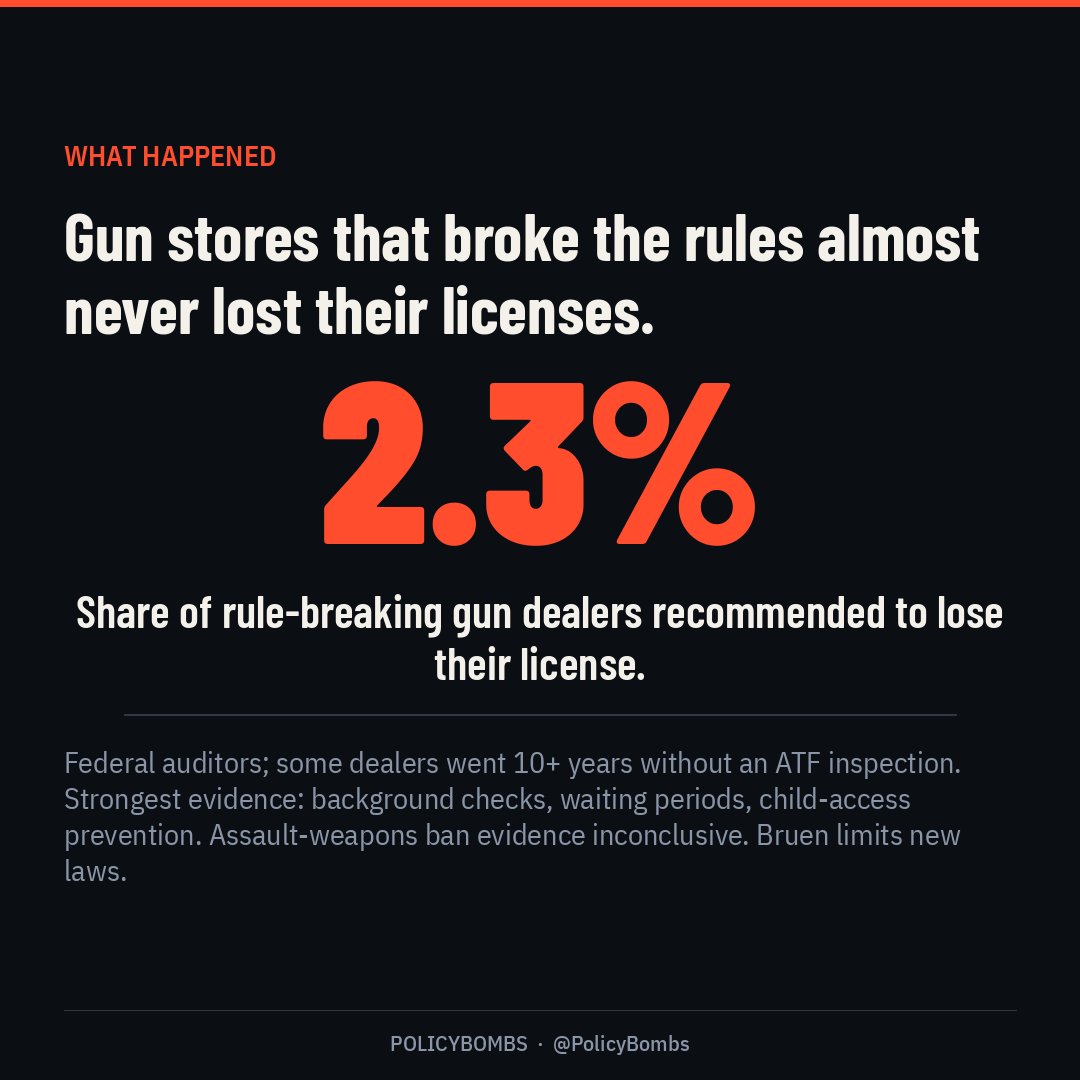
2.3%. That's the share of gun dealers with revocable violations that were recommended for revocation, per federal auditors.

Some dealers went more than 10 years without an ATF inspection. The laws with the strongest evidence: background checks, waiting periods, child-access prevention, and repealing stand-your-ground. Evidence on assault weapons bans is inconclusive. Bruen limits new laws, but courts still allow disarming dangerous people.

PRO: Targeted access laws work and fit Bruen/Rahimi.

CON / COST: Assault weapons bans burn political capital for unproven gains.

SOCIETY: Suicide prevention is where the most lives can be saved.


Full analysis

Gun Control: Policy Assessment

California’s gun laws, assault weapons bans, RAND’s evidence ratings, and the constitutional limits after Bruen. As of Nov 4, 2026.

Content as of Nov 4, 2026, 8:33 PM ET. Source Page: PolicyBombs canvas

Long-form deep analysis. Companion to the 10-minute quick reference (10-gun-control-summary.docx).

10-Minute Voter Guide

Who’s for / against: For gun control: Democrats, Gov. Newsom (CA laws), and the 2022 assault-weapons-ban vote (2 Republicans yes). Against: most Republicans. Cross-party: 15 Senate Republicans voted for the 2022 Bipartisan Safer Communities Act, and Trump’s administration banned bump stocks in 2018.

The gun laws with the strongest evidence are background checks, waiting periods, child-access prevention laws, and repealing stand-your-ground. The evidence on assault weapons bans is inconclusive. Federal auditors also found the laws already on the books are weakly enforced: some gun dealers went more than 10 years without an ATF inspection, and only 2.3% of dealers with revocable violations were recommended for revocation. Bruen limits new laws, but courts still allow disarming dangerous people.

Pros of stricter gun laws

Cons

+ Background checks and waiting periods have moderate evidence of saving lives

+ Most gun deaths are suicides, which delay laws reduce

+ Licensing linked to fewer homicides (CT, MO studies)

– Assault weapons bans unproven

– Existing laws underenforced (DOJ Inspector General)

– Constitutional limits after Bruen

Bottom line: Favor enforcing existing laws and adopting the measures backed by evidence over symbolic bans.

Contents

  • 10-Minute Voter Guide
  • Key facts
  • 1. What is the policy
  • 2. Why it exists
  • 3. Realized effects
  • Enforcement gaps and abuse findings
  • 4. Good or bad for society
  • Who supports / who opposes
  • References

Bottom line: The strongest evidence supports the less symbolic laws: child-access prevention, waiting periods, background checks plus licensing, and repealing stand-your-ground. The evidence for assault weapons bans, the most fought-over measure, is inconclusive. Rifles of every kind are a small share of gun homicides. Bruen now limits what states can do, but disarming people who are dangerous survived (Rahimi).

Key facts

Item

Detail

Status / rating

Child-access prevention laws

Reduce firearm suicides and unintentional injuries among youth

RAND: supportive

Stand-your-ground laws

Increase firearm homicides

RAND: supportive (harmful effect)

Waiting periods

Reduce firearm suicides and total homicides

RAND: moderate

Background checks

Reduce firearm and total homicides

RAND: moderate

High-capacity magazine bans

Reduce mass shootings and fatalities

RAND: limited

Assault weapons bans

Effect on mass shootings and homicides

RAND: inconclusive

Federal AWB 1994–2004

Expired; Koper’s federal evaluations found effects too small to measure reliably

Not renewed

CA Roberti-Roos AWB

1989, the first state ban

In force; Miller v. Bonta litigation ongoing

NYSRPA v. Bruen

June 23, 2022, 6–3: history-and-tradition test

Binding

US v. Rahimi

June 21, 2024, 8–1: domestic-violence-order ban upheld

Binding

1. What is the policy

Item

Detail

California

Universal background checks (1991), 10-day waiting period, assault weapons ban (1989, expanded 1999 and 2016), ban on magazines over 10 rounds (2000; possession 2016, upheld en banc in Duncan v. Bonta, 2025), red-flag orders (GVROs, 2016), ammunition background checks (2019; a July 2025 Ninth Circuit panel struck them down, but the court vacated that ruling for en banc rehearing, argued Mar 25, 2026; still in effect, decision pending), Firearm Safety Certificate, microstamping and handgun roster, and one gun purchase per 30 days (partly struck).

Federal

The Gun Control Act (1968), Brady checks (1994), and the Bipartisan Safer Communities Act (2022: enhanced checks for under-21 buyers, red-flag grants, and closing the ‘boyfriend loophole’). The 2025 administration loosened ATF rules, for example on pistol braces and the definition of ‘engaged in the business’.

2. Why it exists

Stated reasons

Underlying drivers

+ About 47,000 US gun deaths a year, more than half of them suicides (CDC)

+ Mass shootings with semi-automatic rifles

+ Peer nations have much lower firearm death rates

– Assault weapons bans are popular after high-profile shootings, even though rifles are a small share of homicides (FBI: handguns dominate)

– Gun-control groups (Everytown, Giffords) and the NRA both raise money from the fight

– Partisan sorting: guns are a core identity issue for each base

3. Realized effects

Item

Detail

Assessment

California outcomes

CA’s firearm death rate is well below the national average (CDC WONDER). That partly reflects its laws and partly lower gun ownership and demographics. Cross-state comparisons cannot isolate causation.

Lower rates

Assault weapons bans

Some newer studies link bans to fewer mass-shooting deaths. RAND still rates the evidence inconclusive because mass shootings are rare and the studies have weak designs.

Inconclusive

Licensing (permit to purchase)

Connecticut adopted licensing (1995) and gun homicides fell. Missouri repealed it (2007) and gun homicides rose (Webster et al.). These are among the strongest quasi-experiments.

Effective

After Bruen

A wave of lawsuits followed. Courts split on magazine and assault weapons bans; the Supreme Court has so far declined to take a ban case (Snope, 2025).

In flux

Enforcement gaps and abuse findings

Finding

What investigators or courts concluded

Source

ATF dealer oversight

Some licensed dealers went more than 10 years without inspection; only 2.3% of dealers with revocable violations were recommended for revocation

DOJ Inspector General report

Santa Clara County concealed-carry permits for donations

The sheriff’s office allegedly traded carry permits for campaign donations. Sheriff Laurie Smith resigned after a 2022 civil corruption verdict. A former captain was convicted, and the former undersheriff pleaded guilty (Sept 2026).

Santa Clara DA; LA Times

What changed: the verdict now ranks enforcement of existing dealer and background-check law ahead of new restrictions. It also notes that discretionary permit systems invited bribery in California.

4. Good or bad for society

Verdict: Targeted access laws (licensing, waiting periods, child-access prevention, red-flag orders) are good policy on the evidence and fit the Bruen and Rahimi framework. Assault weapons bans use a lot of political capital for unproven gains. Suicide prevention is where the most lives can be saved.

Strongest case for strict gun control

Strongest case against

+ Several laws have supportive or moderate evidence of saving lives

+ Most gun deaths are suicides, which delay and access laws prevent

+ Peer nations show what lower gun access does to death rates

– Constitutional right confirmed in Heller and Bruen

– Defensive gun use is real, though estimates vary enormously

– Feature-based bans regulate cosmetic features and don’t show measurable effects

Who supports / who opposes

For = new federal or state gun restrictions. Against = expanding gun rights. Each row cites a numbered source below. Checked Nov 4, 2026.

Who

Party / level

Position

Evidence

Ref

Congress (Sen. Chris Murphy D-CT, Sen. John Cornyn R-TX lead negotiators)

Bipartisan

For

Bipartisan Safer Communities Act signed Jun 25, 2022; Senate 65–33 with 15 Republicans; House 234–193 with 14 Republicans

[1]

House Democrats; Reps. Brian Fitzpatrick (R-PA) & Chris Jacobs (R-NY)

Democrat + 2 R

For

Passed H.R. 1808 assault weapons ban 217–213 (Jul 29, 2022); 5 Democrats voted no

[2]

Gov. Gavin Newsom (D-CA)

Democrat

For

Signed SB 2 (2023) and other gun-safety laws

[3]

Democratic Party

Platform

For

2024 platform calls for an assault weapons ban and universal background checks

[4]

Republican Party

Platform

Against

2024 platform pledges to protect the Second Amendment

[5]

President Donald Trump

Republican

Mixed

His administration banned bump stocks by rule (2018); Supreme Court struck it down in Garland v. Cargill (2024)

[6]

Cross-party defectors: 15 Senate Republicans (including McConnell) backed the 2022 law. Two House Republicans backed the assault weapons ban.

How positions shifted: Republicans have moved toward gun-rights absolutism since the 1990s, when some backed the 1994 assault weapons ban. Democrats have made gun control a core plank again since 2012.

Sources for this section:

References

[1] RAND Gun Policy in America. rand.org. https://www.rand.org/research/gun-policy.html

[2] NYSRPA v. Bruen (2022). supremecourt.gov. https://www.supremecourt.gov/opinions/21pdf/20-843_7j80.pdf

[3] US v. Rahimi (2024). supremecourt.gov. https://www.supremecourt.gov/opinions/23pdf/22-915_8o6b.pdf

[4] DOJ OIG: ATF risk-based inspections of dealers. oig.justice.gov. https://oig.justice.gov/news/doj-oig-releases-report-bureau-alcohol-tobacco-firearms-and-explosives-risk-based-inspection

[5] Santa Clara DA: gun permit bribery conviction. santaclaracounty.gov. https://da.santaclaracounty.gov/former-sheriffs-captain-guilty-gun-permit-bribery-scheme

[6] CDC WONDER mortality data. cdc.gov. https://wonder.cdc.gov/

[7] CA DOJ firearms laws. oag.ca.gov. https://oag.ca.gov/firearms

[8] Koper, Updated assessment of the federal AWB (2004). ojp.gov. https://www.ojp.gov/pdffiles1/nij/grants/204431.pdf

[9] Johns Hopkins Center for Gun Violence Solutions. publichealth.jhu.edu. https://publichealth.jhu.edu/center-for-gun-violence-solutions

PolicyBombs · Day 54. Follow @PolicyBombs on X.

US Healthcare

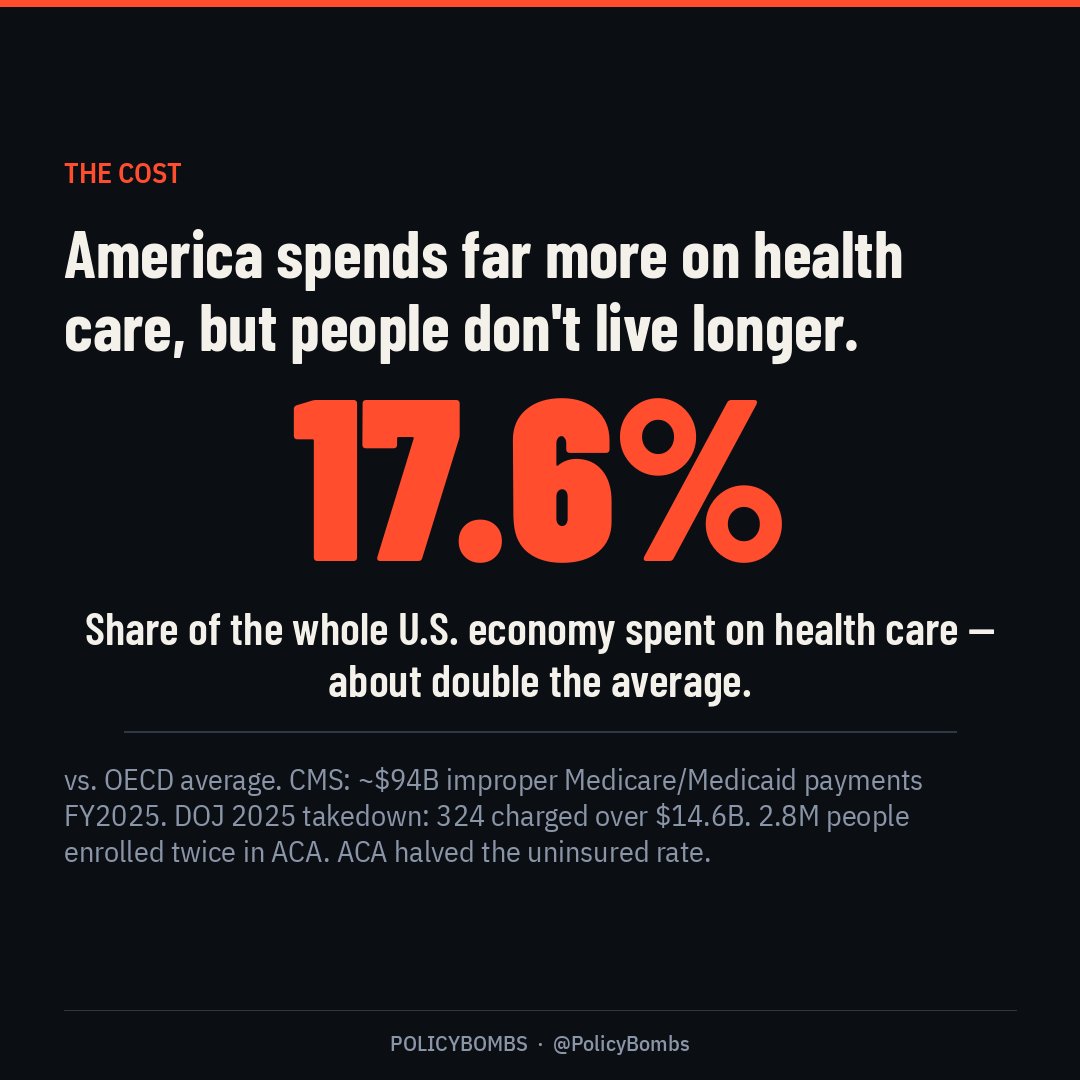
17.6% of GDP. That's what the US spends on health care, roughly double the OECD average, and Americans still live shorter lives.

The main driver is high prices. CMS estimated about $94B in improper Medicare and Medicaid payments in FY2025, and DOJ's 2025 takedown charged 324 people over $14.6B in alleged fraud. ACA subsidies drew broker schemes, and 2.8M people were enrolled twice. Yet the ACA cut the uninsured rate in half, and the 2025 cuts will reverse part of that.

PRO: ACA was a net good on coverage and mortality.

CON / COST: Subsidies fueled broker fraud; 2025 cuts drop more eligible than fraudulent (CBO: 10M more uninsured).

SOCIETY: Real fix is price discipline plus means-tested coverage.


Full analysis

US Healthcare System: Policy Assessment

The ACA, US costs against outcomes in other OECD countries, and the fiscal path of Medicare and Medicaid, including the 2025 law and the 2026 expiry of enhanced subsidies. As of Nov 4, 2026.

Content as of Nov 4, 2026, 8:33 PM ET. Source Page: PolicyBombs canvas

Long-form deep analysis. Companion to the 10-minute quick reference (09-healthcare-summary.docx).

10-Minute Voter Guide

Who’s for / against: For single-payer: Sen. Sanders, Rep. Pramila Jayapal, and CA Asm. Ash Kalra (CalCare). For the ACA: Democrats (passed with zero GOP votes). Against ACA repeal: Sens. McCain, Collins, and Murkowski (R), whose votes defeated the 2017 repeal. Republicans’ 2025 law added Medicaid work requirements.

The US spends about 17.6% of GDP on health care, roughly double the OECD average, and Americans live shorter lives. The main driver is high prices. CMS estimated about $94B in improper payments in Medicare and Medicaid in FY2025, and DOJ’s 2025 takedown charged 324 people over $14.6B in alleged fraud. ACA subsidies attracted broker schemes, including a $233M fraud conviction, and 2.8M people were enrolled twice. The ACA cut the uninsured rate in half. The 2025 cuts will reverse part of that.

Pros of expanding public coverage

Cons

+ Medicaid expansion linked to lower death rates

+ Uninsured rate fell from about 16% to 8%

+ Medical debt protection

– About $94B a year in improper payments (CMS FY2025)

– Brokers enrolled people without their consent for subsidies

– Medicare hospital fund runs out in 2033

Bottom line: Support candidates who pair coverage with hard anti-fraud verification and price limits. Distrust both cut-only and spend-only plans.

Contents

  • 10-Minute Voter Guide
  • Key facts
  • 1. What is the policy
  • 2. Why it exists
  • 3. Realized effects
  • Fraud, waste and abuse findings
  • 4. Good or bad for society
  • Who supports / who opposes
  • References

Bottom line: The US spends about twice the OECD average per person and gets shorter lives. The main reason is higher prices (hospitals, physicians, drugs, administration), not more care. The ACA cut the uninsured rate sharply but didn’t control prices. The 2025 rollbacks are reversing some of its coverage gains. Medicare’s hospital fund runs dry in 2033.

Key facts

Item

Figure

Source

US health spending, 2023

$4.9T; 17.6% of GDP

CMS National Health Expenditure data

OECD average health spending

About 9% of GDP

OECD Health Statistics

US life expectancy, 2023

78.4 years (OECD peers mostly 81–84)

CDC NCHS

ACA Marketplace effectuated enrollment

22.3M (2025) to about 17.5M projected 2026

KFF

Enhanced premium tax credits

Expired Dec 31, 2025

ARPA/IRA sunset

Average net Marketplace premium payment

$113 to $178 a month (+58%), 2026

KFF

Medicare HI trust fund depletion

2033 (2026 Trustees)

Medicare Trustees, June 2026

Medicare enrollment / spending, 2025

69.3M; about $1.2T

Medicare Trustees

2025 reconciliation law Medicaid changes (work requirements etc.)

10M more uninsured in 2034 (7.5M Medicaid/CHIP, 2.4M Marketplace); about 15M including subsidy expiry

CBO, Aug 2025

1. What is the policy

Item

Detail

Affordable Care Act (2010)

Medicaid expansion to 138% FPL (optional after NFIB v. Sebelius; 40 states plus DC have expanded), subsidized Marketplaces, guaranteed issue and community rating, and an individual mandate (penalty zeroed in 2019).

Medicare

Federal coverage for 65+ and disabled people. Part A is funded by payroll tax. Parts B and D are about 75% general revenue. Medicare Advantage now covers about 51% of enrollees. The IRA (2022) introduced drug price negotiation, starting in 2026.

Medicaid

Joint federal-state coverage for low-income people. The 2025 law (OBBBA) adds work requirements for expansion adults (from 2027), more frequent eligibility checks, limits on provider taxes, and cost-sharing.

Employer coverage

About half of Americans, subsidized by the tax exclusion for employer premiums, the largest tax expenditure in the code.

2. Why it exists

Stated reasons

Underlying drivers

+ Cover the uninsured and people with preexisting conditions

+ Cost control (ACA ‘bending the curve’; GOP: entitlement reform)

+ Medicare: seniors’ security since 1965

+ 2025 cuts: fiscal savings and ‘able-bodied’ work norms

– Hospitals, insurers, pharma and physician groups shaped the ACA in exchange for support (2009 industry deals)

– Price regulation is blocked by provider lobbies; health care is among the top lobbying sectors

– Medicare Advantage overpayment from coding intensity, estimated at tens of billions a year by MedPAC

– 2025 Medicaid cuts helped offset the cost of the tax cuts in the same bill

3. Realized effects

Item

Detail

Assessment

Coverage

The uninsured rate fell from about 16% (2010) to about 8% (2023, Census). Medicaid expansion is linked to lower mortality in several quasi-experimental studies (e.g. Miller, Johnson and Wherry, QJE 2021).

Big gain

Costs

Spending growth slowed in the 2010s but share of GDP stayed near 17–18%. Anderson et al., ‘It’s the prices, stupid’ (2003, updated 2019): US use of care is near OECD levels, and prices drive the gap.

Not controlled

Outcomes

The US is strong on cancer survival and specialty care. It’s weak on life expectancy, maternal mortality, and avoidable deaths. Part of the life-expectancy gap is guns, drugs and car crashes, not medical care alone.

Poor value

2026 reversal

Enhanced subsidies expired, and Marketplace enrollment is dropping. 2.2M fewer by Feb 2026 (CBPP), with deductibles at a record $3,786 (KFF).

Coverage falling

Fiscal

Medicare and Medicaid are the main drivers of long-term federal deficits in CBO projections. HI turns to deficit in 2027.

Unsustainable

Fraud, waste and abuse findings

Finding

What investigators concluded

Source

Medicare fee-for-service improper payments, FY2025

6.55%, $28.83B. Improper means not properly paid or documented; it is not all fraud.

CMS FY2025 fact sheet

Medicare Advantage (Part C), FY2025

6.09%, $23.67B, mostly diagnoses that plans’ records failed to support (upcoding risk)

CMS

Medicaid, FY2025

6.12%, $37.39B; 77% was insufficient documentation, which CMS says is generally not a sign of fraud

CMS

ACA advance premium tax credit (APTC) improper rate

0.89%, $657M (benefit year 2023). This measures payment errors, not identity fraud.

CMS

2025 National Health Care Fraud Takedown

324 defendants, including 96 licensed professionals; $14.6B intended loss alleged

HHS-OIG / DOJ

Duplicate enrollment, 2024

Each month, 1.2M people were in Medicaid in two or more states and 1.6M in both Medicaid and subsidized ACA plans

CMS press release

Broker enrollment fraud

Cory Lloyd and Steven Strong convicted (Nov 2025) for ACA enrollments without consent: $233M sought, at least $180M paid. CMS cut off subsidies for about 1.5M ineligible or unauthorized enrollees in 2025.

DOJ; Paragon citing CMS

Phantom enrollees

35% of 2024 enrollees (about 11.7M) filed no claims. Paragon estimates 6.4M improper enrollees and $27B in 2025. Paragon is a market-oriented think tank; zero claims alone don’t prove fraud.

Paragon Health Institute (contested)

Minnesota Housing Stabilization Services (Medicaid)

Program shut down after widespread fraud; 8 charged (Sept 2025), with guilty pleas following

MPR News; KARE 11

What changed: the verdict now treats fraud and improper payments as a first-order problem. At about $94B a year, they are comparable to the savings in the 2025 cuts. Enhanced ACA subsidies with zero-premium plans plus enrollment through broker sites with no verification created a measurable fraud channel. Requiring verification is justified; cutting coverage wholesale is a blunter tool than the evidence supports.

4. Good or bad for society

Verdict: The US system is bad value: world-leading spending, middling results, and a price problem that both parties avoid because providers fight back. The ACA was a net good on coverage and mortality. Revised: the enhanced subsidies did fuel real broker fraud, so verification reforms are justified. But letting the subsidies lapse entirely, plus the 2025 Medicaid cuts, removes far more eligible people than fraudulent ones (CBO: 10M more uninsured). The fix that would work is price discipline (site-neutral payment, all-payer or reference pricing, MA coding reform) plus means-tested coverage.

Strongest defense of the US system

Strongest critique

+ Innovation: most new drugs and devices are developed and launched in the US

+ Short waits for specialists and elective surgery compared with Canada and the UK

+ Consumer choice, and high quality at the top end

– About twice the OECD cost per person, for shorter lives

– Medical debt and coverage gaps that peer countries don’t have

– Lobbying keeps prices high, a textbook case of capture

Who supports / who opposes

For = expanding government-run or government-financed coverage. Against = repeal or cuts. Each row cites a numbered source below. Checked Nov 4, 2026.

Who

Party / level

Position

Evidence

Ref

Sen. Bernie Sanders (I-VT); Rep. Pramila Jayapal (D-WA)

Democrat/Ind.

For

Lead sponsors of the Medicare for All Act

[1]

Asm. Ash Kalra (D-CA)

Democrat

For

Authored AB 1400 (CalCare single-payer); pulled without floor vote Jan 2022

[2]

Gov. Gavin Newsom (D-CA)

Democrat

For

Signed SB 770 (2023) to pursue federal waiver toward unified financing; 2018 campaign backed single-payer

[3]

House Democrats (219)

Democrat

For

Passed ACA 219–212 (Mar 21, 2010); 34 Democrats and all Republicans voted no

[4]

Sens. John McCain, Susan Collins, Lisa Murkowski (R)

Republican (defectors)

For (qualified)

Voted no on 2017 "skinny repeal," which failed 49–51

[5]

Republicans; President Trump

Republican

Against

H.R. 1 (2025) added Medicaid work requirements and cuts; no Democrat voted yes

[6]

Cross-party defectors: Three Republicans saved the ACA in 2017; 34 Democrats voted against it in 2010.

How positions shifted: Republicans moved from ‘repeal and replace’ (2017) to trimming Medicaid (2025). California Democrats campaigned on single-payer but have not passed it.

Sources for this section:

References

[1] 2026 Medicare Trustees Report. cms.gov. https://www.cms.gov/oact/tr/2026

[2] CMS National Health Expenditure data. cms.gov. https://www.cms.gov/data-research/statistics-trends-and-reports/national-health-expenditure-data

[3] KFF: 2026 Marketplace enrollment and premiums. kff.org. https://www.kff.org/affordable-care-act/what-we-know-so-far-about-2026-aca-marketplace-enrollment-premiums-and-deductibles/

[4] CBPP: Health coverage tracker. cbpp.org. https://www.cbpp.org/research/health/health-coverage-tracker-millions-of-people-are-losing-coverage-following-2025

[5] CMS FY2025 improper payments fact sheet. cms.gov. https://www.cms.gov/newsroom/fact-sheets/fiscal-year-2025-improper-payments-fact-sheet

[6] HHS-OIG: 2025 National Health Care Fraud Takedown. oig.hhs.gov. https://oig.hhs.gov/newsroom/media-materials/2025-national-health-care-fraud-takedown/

[7] CMS: 2.8M duplicate enrollments. cms.gov. https://www.cms.gov/newsroom/press-releases/cms-finds-2-8-million-americans-potentially-enrolled-two-or-more-medicaid-aca-exchange-plans

[8] DOJ: $233M ACA enrollment fraud conviction. justice.gov. https://www.justice.gov/opa/pr/president-insurance-brokerage-firm-and-ceo-marketing-company-convicted-233m-affordable-care

[9] Paragon: The Greater Obamacare Enrollment Fraud. paragoninstitute.org. https://paragoninstitute.org/private-health/the-greater-obamacare-enrollment-fraud/

[10] MPR: 8 charged in MN housing stabilization fraud. mprnews.org. https://www.mprnews.org/story/2025/09/18/feds-charge-8-tied-to-massive-minnesota-housing-fraud

[11] OECD Health Statistics. oecd.org. https://www.oecd.org/health/health-data.htm

[12] Miller, Johnson & Wherry, Medicaid and Mortality (QJE 2021). academic.oup.com. https://academic.oup.com/qje/article/136/3/1783/6124643

[13] CBO: Uninsured effects of H.R. 1 in 2034. cbo.gov. https://www.cbo.gov/publication/61463

PolicyBombs · Day 53. Follow @PolicyBombs on X.

Marxism vs Capitalism

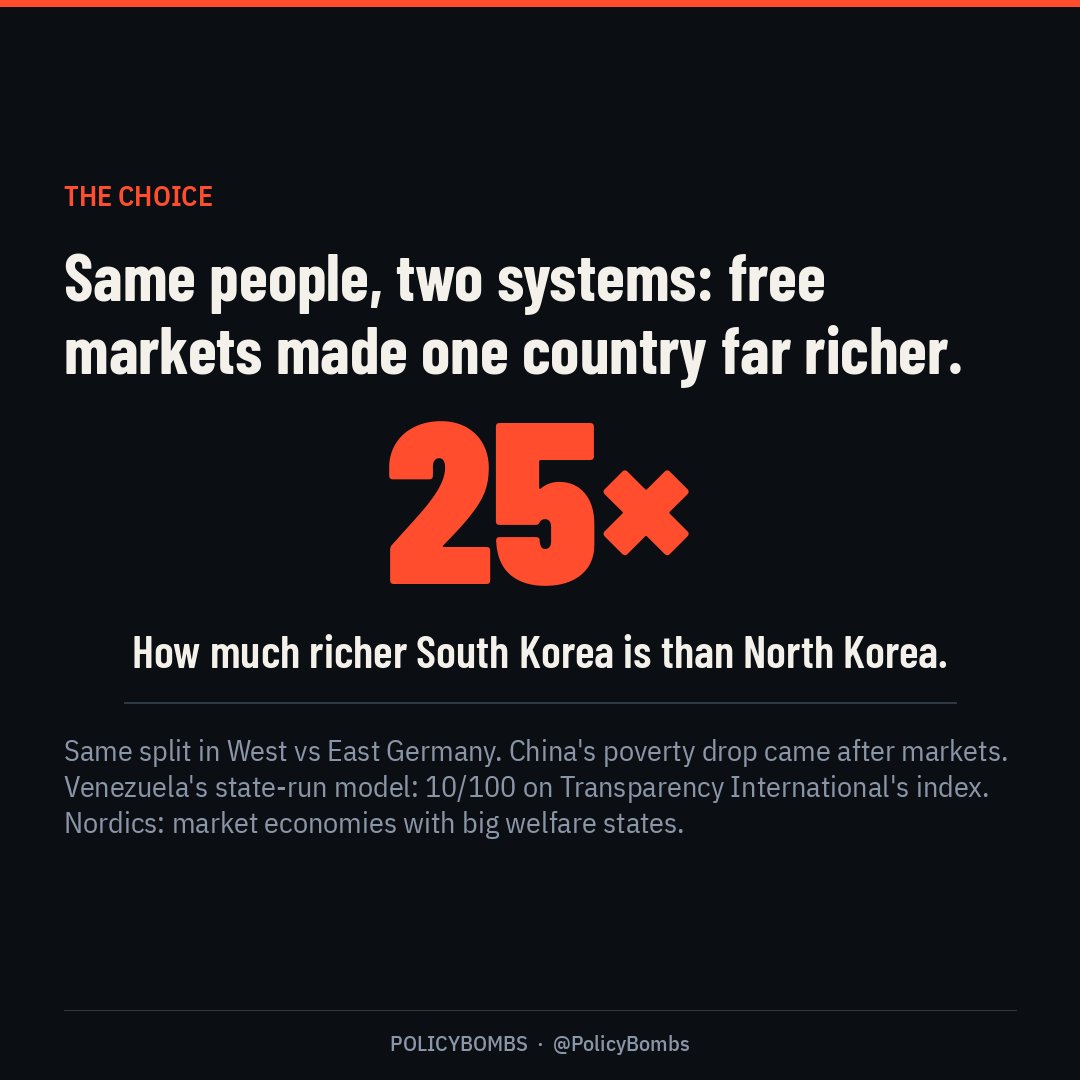
25 times. That's roughly how much richer South Korea is than North Korea. Same people, different systems.

Every country split between a planned economy and a market one shows the same result: the market side became richer, longer-lived, and freer. West vs East Germany too. China's huge drop in poverty came after it adopted markets. Venezuela's state-run model brought collapse, scoring 10/100 on Transparency International's index. The Nordics? Market economies with big welfare states.

PRO: Markets produced nearly all large poverty reductions since 1980.

CON / COST: Inequality, financial crises and pollution are real.

SOCIETY: Fix problems with welfare states and regulation, not by abolishing prices.


Full analysis

Marxism vs Capitalism: The Head-to-Head Evidence

Tests both ‘Marxism is best’ and ‘capitalism is bad’ against natural experiments: the two Germanys, the two Koreas, the USSR, China before and after 1978, Venezuela, and the Nordic model. As of Nov 4, 2026.

Content as of Nov 4, 2026, 8:32 PM ET. Source Page: PolicyBombs canvas

Long-form deep analysis. Companion to the 10-minute quick reference (08-marxism-vs-capitalism-summary.docx).

10-Minute Voter Guide

Who’s for / against: No major party backs Marxism. Self-described democratic socialists include Sen. Sanders, Rep. Ocasio-Cortez, and NYC Mayor Zohran Mamdani (DSA). The House denounced socialism 328–86 in 2023, with 109 Democrats voting yes.

Every country split between a planned economy and a market one shows the same result: the market side became richer, longer-lived, and freer. Examples are South Korea against North Korea (about 25 times richer) and West against East Germany. China’s huge drop in poverty came after it adopted markets. Venezuela’s state-run model brought collapse and some of the world’s worst corruption, scoring 10/100 on Transparency International’s index. The Nordic countries are market economies with big welfare states.

Socialist critique: valid points

Against Marxist systems

+ Inequality and financial crises are real

+ Climate change is a huge market failure

+ Welfare states reduce poverty

– Lost every head-to-head comparison

– Concentrated power breeds corruption (Venezuela 180th of 182)

– Famines and repression with millions of deaths

Bottom line: Regulated capitalism with a safety net beats central planning on every measure.

Contents

  • 10-Minute Voter Guide
  • Key facts
  • 1. What is the policy
  • 2. Why it exists
  • 3. Realized effects
  • Corruption record
  • 4. Good or bad for society
  • Who supports / who opposes
  • References

Bottom line: Every clean natural experiment points the same way. Where a population was split and one side got central planning while the other got markets, the market side became far richer, longer-lived, and freer. The best-performing societies on welfare, the Nordics, are market capitalist economies with large welfare states, not Marxist ones. "Capitalism is bad" holds only for specific failures (inequality, crises, externalities), which regulated capitalism handles better than any planned alternative has.

Key facts

Comparison

Planned / Marxist side

Market side

Note

Korea: GDP per person

About $1,261 per-capita GNI, 2024 (North, Bank of Korea est.)

About $33,000 (South, World Bank)

Same people and culture; split 1945

Korea: life expectancy

About 73 (UN est.)

About 83

Famine of the 1990s in the North

Korea: Freedom House score

3/100

83/100

2024–25 editions (verify yearly)

Germany at reunification (1990)

East productivity about one-third of the West’s (commonly cited)

West

Same nation, split 1949

Germany: emigration

About 3M+ fled East before the 1961 Wall

Net receiver

Wall built to stop exodus

China: extreme poverty

Mass famine 1959–61 (15–45M deaths, estimates vary)

88% (1981) to under 1% (2019), World Bank $2.15 line

After market reforms in 1978

Venezuela 2013–2021

Real GDP fell more than 75% (IMF); 6.98M emigrants in Latin America and the Caribbean alone, Aug 2026 (R4V)

Oil-socialist model

Not pure Marxism; nationalizations plus price controls

Nordics

Not Marxist

High Economic Freedom ranks plus high taxes

Danish PM, 2015: "Denmark is a market economy"

1. What is the policy

Item

Detail

Marxism-Leninism in practice

State ownership of the means of production, central planning, a one-party state, and collectivized agriculture. USSR 1917–1991, Eastern Bloc, North Korea, Mao’s China, Cuba.

Market capitalism

Private ownership, price signals, and competition, with widely varying welfare and regulation: US (lighter), Nordics (heavy redistribution), South Korea (state-guided industrialization).

Hybrids

China since 1978 (markets under a Leninist party), Vietnam’s Doi Moi (1986), and Venezuela’s chavismo (elected, nationalizing, price controls).

2. Why it exists

Stated case for Marxism / against capitalism

Underlying drivers

+ Capitalism exploits labor and concentrates wealth

+ Boom-bust crises (1929, 2008)

+ Environmental and social costs are unpriced

+ Planning can mobilize resources fast (Soviet industrialization)

– Marxist parties seized power by revolution, then used planning to centralize control

– Planned economies lack price signals and incentives (Hayek’s knowledge problem; Kornai’s soft budget constraint)

– Elites in planned states captured the privileges (the nomenklatura)

– Western critics often compare actual capitalism with an idealized socialism

3. Realized effects

Item

Detail

Assessment

USSR

Fast growth from industrialization from the 1930s to the 1960s (contested estimates), then stagnation from the 1970s. Famines (1932–33 Holodomor), the Gulag, chronic shortages, and collapse in 1991.

Failed

East vs West Germany

The West’s ‘social market economy’ outgrew the East. The East needed a wall to keep people in. Reunification costs ran past €1.5 trillion (estimates vary).

Market wins

North vs South Korea

The North was richer in the 1950s–60s (industrial base inherited from Japan). The South overtook it by the mid-1970s and is now roughly 25x richer per person.

Market wins

China pre/post 1978

Maoist planning brought the Great Leap famine and stagnant output per person. Deng’s market reforms (household responsibility, special economic zones, private firms) produced history’s largest poverty reduction. That was a move toward capitalism, under authoritarian rule.

Markets drove gains

Venezuela

Price controls, expropriations, and oil dependence led to hyperinflation and the largest peacetime economic collapse outside war in modern Latin America (IMF data). Roughly a fifth to a quarter of the population has left (R4V counts 6.98M in Latin America and the Caribbean alone).

Failed

Nordic model

Top life expectancy, low poverty, and high happiness, built on free trade, private firms, flexible labor markets (Danish flexicurity), and high taxes. Sweden’s 1970s–80s turn toward more state control ended in a 1990s crisis and pro-market reforms.

Regulated capitalism

Corruption record

Finding

What investigators or courts concluded

Source

Venezuela, Corruption Perceptions Index 2025

10/100, ranked 180th of 182

Transparency International

CLAP food boxes and PDVSA oil (Alex Saab)

Charged in Miami with laundering proceeds of corrupt food-import contracts and PDVSA oil sales through shell companies and false invoices. These are charges, not a conviction.

DOJ; Miami Herald

Soviet bloc

Nomenklatura privileges and the black economy are documented in post-1991 archives. Estimates of their scale vary.

Academic histories (summary)

What changed: nothing in the verdict. The record adds that state control of the economy concentrated both power and money that could be stolen, and that the corruption in Venezuela was prosecuted abroad, not at home.

4. Good or bad for society

Verdict: "Marxism is best" fails every comparison available: growth, poverty, life expectancy, and freedom. "Capitalism is bad" is an overreach. Markets have produced nearly all of the large reductions in global poverty since 1980. Inequality, financial crises, and pollution are real problems that welfare states and regulation address, without abandoning private ownership and prices.

Strongest arguments for the socialist critique

Strongest arguments against

+ The 2008 crisis and rising inequality show markets misallocate risk

+ Soviet literacy, health care, and industrialization gains were real

+ Climate change is a market failure on a huge scale

– Every split-country experiment favors markets by large margins

– One-party planning concentrated power and produced famines with millions of deaths

– The models the left admires (Nordics) are capitalist

Who supports / who opposes

For = democratic socialism (no major figure backs Marxism outright). Against = denouncing socialism. Each row cites a numbered source below. Checked Nov 4, 2026.

Who

Party / level

Position

Evidence

Ref

Rep. María Elvira Salazar (R-FL) + all voting Republicans

Republican

Against

Sponsored H.Con.Res. 9 "Denouncing the horrors of socialism"; passed 328–86–14 (Feb 2, 2023)

[1]

109 House Democrats

Democrat

Against

Voted yes on H.Con.Res. 9

[1]

86 House Democrats (incl. Ocasio-Cortez, Tlaib)

Democrat

For (qualified)

Voted no on H.Con.Res. 9 (democratic socialists, not Marxist)

[1]

Sen. Bernie Sanders (I-VT)

Independent

For (qualified)

Self-described democratic socialist; June 2019 George Washington University speech defining it

[2]

NYC Mayor Zohran Mamdani (D, DSA member)

Democrat / DSA

For (qualified)

Elected Nov 4, 2025 (50.8%) as a self-described democratic socialist

[3]

President Donald Trump

Republican

Against

2019 State of the Union: "America will never be a socialist country"

[4]

Cross-party defectors: Democrats split almost evenly on the 2023 anti-socialism resolution.

How positions shifted: Democratic socialism has gone from fringe to winning offices since 2016, from Sanders’ runs to the ‘Squad’ to Mamdani. Republicans have made anti-socialism a central message.

Not included or not fully verified: No politician on record supporting Marxism as such; the ‘For (qualified)’ rows are democratic socialists.

Sources for this section:

References

[1] World Bank: Poverty and Inequality Platform. worldbank.org. https://pip.worldbank.org/

[2] World Bank: GDP per capita, Korea. data.worldbank.org. https://data.worldbank.org/indicator/NY.GDP.PCAP.CD?locations=KR

[3] Bank of Korea: North Korea GDP estimates. bok.or.kr. https://www.bok.or.kr/eng/main/main.do

[4] Freedom House: Freedom in the World. freedomhouse.org. https://freedomhouse.org/report/freedom-world

[5] UN World Population Prospects (life expectancy). population.un.org. https://population.un.org/wpp/

[6] R4V: Venezuelan refugees and migrants. r4v.info. https://www.r4v.info/en/refugeeandmigrants

[7] Transparency International: Venezuela. transparency.org. https://www.transparency.org/en/countries/venezuela

[8] DOJ: Alex Saab money laundering charges. justice.gov. https://www.justice.gov/opa/pr/maduro-regime-ally-alex-saab-arrested-money-laundering-charges-involving-venezuelan-food

[9] Heritage Index of Economic Freedom. heritage.org. https://www.heritage.org/index/

[10] Our World in Data: life expectancy. ourworldindata.org. https://ourworldindata.org/life-expectancy

PolicyBombs · Day 52. Follow @PolicyBombs on X.

The Two-Party System

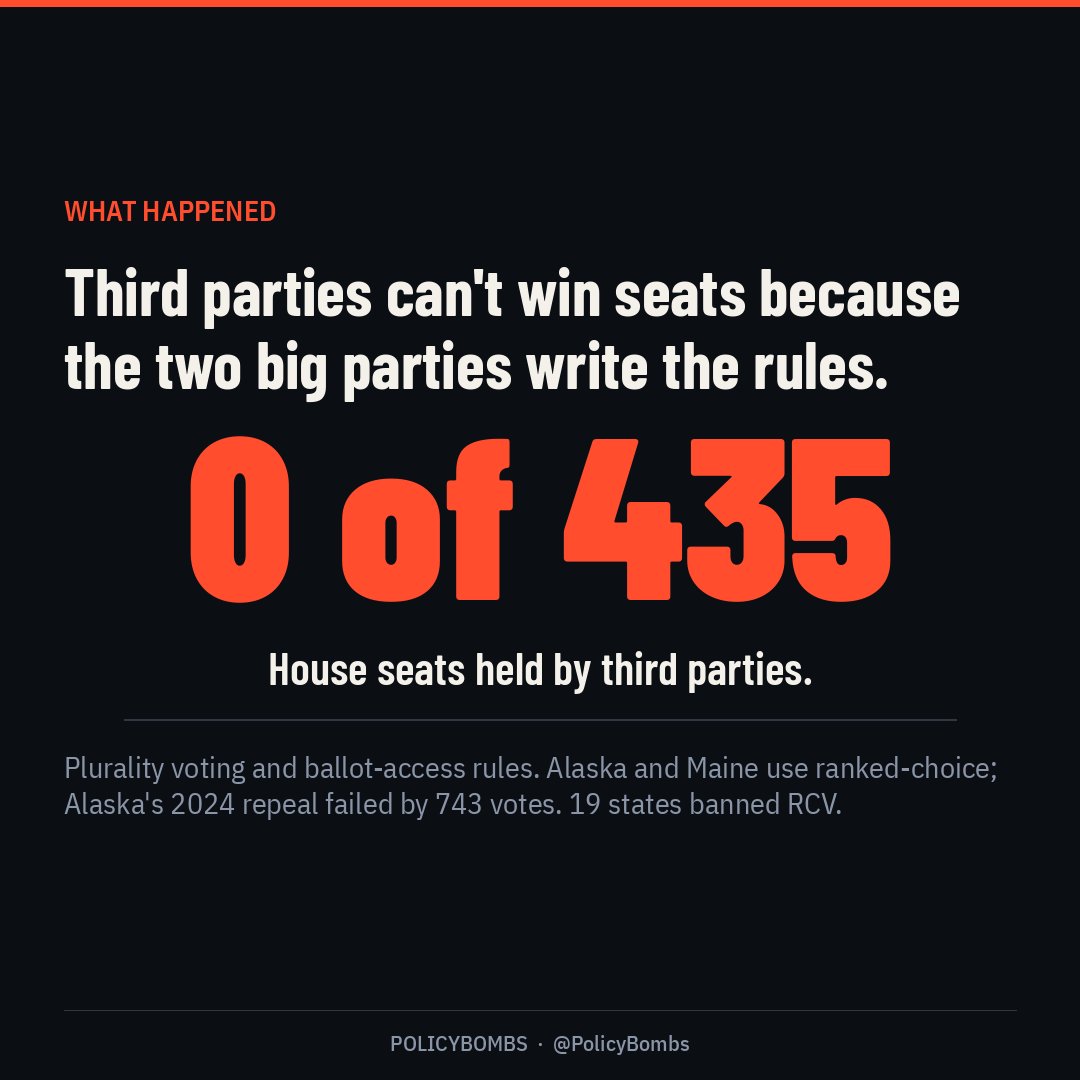
0 of 435. That's how many House seats third parties hold. The rules are written by the two parties that benefit.

Plurality voting and ballot-access rules make third parties nearly impossible. Alaska and Maine use ranked-choice voting, and Alaska's 2024 repeal failed by just 743 votes. Meanwhile 19 states have banned RCV. Both sides of these fights are funded by a few big donors, and Alaska's regulator cited a campaign for hiding its donors.

PRO: RCV and open primaries elect more crossover winners; no spoiler effect.

CON / COST: Slower counts, exhausted ballots, and no viable third parties yet.

SOCIETY: Lock-in suppresses competition; RCV and fair ballot access are modest real fixes.


Full analysis

The Two-Party System: Policy Assessment

The rules that lock in two parties (first-past-the-post, ballot access, sore-loser laws) and the reforms tested in Alaska, Maine and California. As of Nov 4, 2026.

Content as of Nov 4, 2026, 8:32 PM ET. Source Page: PolicyBombs canvas

Long-form deep analysis. Companion to the 10-minute quick reference (06-two-party-summary.docx).

10-Minute Voter Guide

Who’s for / against: For reforms that weaken the two-party grip (top-two, RCV, open primaries): Sen. Lisa Murkowski (R), Gov. Jared Polis (D), Arnold Schwarzenegger (R, CA Prop 14). Against: both major state parties in CA and CO, and GOP legislatures that banned RCV (e.g., Florida).

Plurality voting and ballot-access rules written by the two major parties make third parties nearly impossible. Alaska and Maine use ranked-choice voting, and Alaska voters have refused twice to repeal it. Meanwhile 19 states have banned it. Both sides of these fights are funded by a few big donors, and Alaska’s regulator has cited a campaign for hiding its donors.

Pros of RCV and open primaries

Cons

+ More crossover and moderate winners (Murkowski, Peltola)

+ No spoiler effect

+ Voters in Alaska kept it twice

– Slower counts and confusing results

– Ballots that don’t rank finalists drop out of the count

– Has not created viable third parties

Bottom line: Ranked-choice voting and fair ballot access are modest, real improvements. Ask who funds each side.

Contents

  • 10-Minute Voter Guide
  • Key facts
  • 1. What is the policy
  • 2. Why it exists
  • 3. Realized effects
  • Money and enforcement record
  • 4. Good or bad for society
  • Who supports / who opposes
  • References

Bottom line: Two parties aren’t written into the Constitution. They come from single-member, plurality (first-past-the-post) elections, reinforced by ballot-access and sore-loser laws that the two parties themselves write. Ranked-choice and top-two reforms have changed things at the margin (a few moderates and crossover winners) but have not produced viable third parties. Only proportional representation would.

Key facts

Item

Detail

Status (Nov 2026)

First-past-the-post

Plurality winner in single-member districts; Duverger’s law predicts two parties

Used for nearly all US offices

Maine RCV

Approved 2016; used in primaries and federal general elections since 2018

In force

Alaska top-4 primary plus RCV (Measure 2, 2020)

Passed with 50.55%; first used in 2022

Repeal failed 2024 by 743 votes; 2026 repeal trailing 48.1–51.9 (uncertified)

California top-two (Prop 14, 2010)

All candidates in one primary; top two advance regardless of party

In force

State RCV bans

AL, AR, FL, ID, IN, IA, KS, KY, LA, MS, MO, MT, ND, OH, OK, SD, TN, WV, WY

19 states (NCSL/Ballotpedia, Nov 2026)

Sore-loser laws

A candidate who loses a primary can’t run as an independent

Most states (about 45; count not verified)

Third-party share of House seats

0 of 435 seats held by a third party

Long-run norm

1. What is the policy

Item

Detail

Electoral formula

A 1967 federal law (2 U.S.C. 2c) requires single-member House districts, which rules out multi-member proportional representation without new legislation. States choose plurality, RCV, or runoff.

Ballot access

Each state sets the petition signatures and vote thresholds a party needs to keep its ballot line. Major parties qualify automatically. Minor parties must petition, sometimes needing tens of thousands of signatures, and face challenges in court (e.g. Democratic suits against Greens and RFK Jr. in 2024; GOP suits against No Labels and others).

Debate access

The Commission on Presidential Debates’ 15% polling threshold, set by a commission the two parties created.

Reforms

Maine: RCV. Alaska: nonpartisan top-4 primary, RCV general election, and dark-money disclosure. California and Washington: top-two primaries.

2. Why it exists

Stated reasons

Underlying drivers

+ Stable majorities and clear accountability

+ Ballot thresholds keep frivolous candidates off long ballots

+ Sore-loser laws protect the meaning of primaries

+ RCV opponents: it’s confusing and slow, and ballots get exhausted

– Incumbent parties write the election laws: a duopoly protecting itself

– Spoiler fear helps each party discipline its own flank

– RCV bans followed Peltola’s 2022 win and Murkowski’s survival: parties lose control

– The Alaska 2026 repeal was backed largely by GOP donors, including Musk-linked money (reported)

3. Realized effects

Item

Detail

Assessment

Alaska

Murkowski won in 2022 despite being censured by the state GOP. Democrat Mary Peltola won the at-large seat in 2022 over Palin and Begich. Critics note confusing outcomes and long counts. Voters kept the system twice.

More moderate/crossover winners

Maine

In 2018 Jared Golden won ME-2 after trailing in first choices, the first federal RCV comeback. Turnout and voter understanding surveys are broadly positive. No third party has become viable.

Works, limited impact

California top-two

Studies are mixed: small moderating effects in some legislative races, many same-party general elections, and minor parties nearly vanished from the general-election ballot. Legislative polarization has not clearly fallen.

Mixed

Third parties

Ballot-access costs and spoiler fear keep third-party presidential vote shares low except in rare years (Perot got 18.9% in 1992 and won 0 electoral votes).

Locked out

Money and enforcement record

Finding

What regulators or records show

Source

‘No on 2’ ads, Alaska 2020

The Alaska Public Offices Commission found the main opposition campaign violated disclosure law by airing ads with outdated top-donor information. It ordered the ads fixed or pulled and referred the case for possible fines.

APOC via Alaska Public Media, Oct 2020

2020 Measure 2 money

Most yes-side money came from outside groups; Alaska Republicans funded the opposition.

Anchorage Daily News, Sept 2020

2026 repeal money

Repeal side raised about $2.6M, mostly via a Musk-funded group; opponents raised $10.4M.

IVN, citing Alaska Public Media

Ballot-access litigation

Major parties routinely sue to remove minor-party and independent candidates (e.g. 2024 challenges to Greens, Cornel West, RFK Jr.). Outcomes varied by state.

State court records (summary)

What changed: nothing in the verdict. The record adds evidence that both reform and repeal campaigns depend on concentrated outside money, and that disclosure enforcement matters.

4. Good or bad for society

Verdict: The two-party lock-in is mostly bad. It suppresses competition, forces lesser-evil voting, and lets primaries driven by polarized bases pick most officeholders. Primary reform plus RCV is a modest, evidence-backed improvement worth keeping. Fair ballot access is cheap and clearly good. A real multi-party system would require proportional representation for the House, which neither party wants.

Strongest case for the two-party system

Strongest case against

+ Coalitions form inside parties before elections, so governments are stable

+ Clear accountability: voters know whom to blame

+ Multi-party systems can fragment (Israel, Italy)

– Low primary turnout lets about 10% of voters effectively pick most winners

– Spoiler logic punishes sincere votes

– Parties write the rules to exclude challengers

Who supports / who opposes

For = reforms that open elections beyond the two parties (top-two, RCV, open primaries). Against = keeping party-controlled primaries. Each row cites a numbered source below. Checked Nov 4, 2026.

Who

Party / level

Position

Evidence

Ref

Gov. Arnold Schwarzenegger (R-CA); Sen. Abel Maldonado (R)

Republican

For

Backed Prop 14 (2010), creating California’s top-two primary; passed 53.7%

[1]

California Democratic and Republican parties

Both parties

Against

Both opposed Prop 14

[1]

Gov. Jared Polis (D-CO)

Democrat

For

Backed Colorado Prop 131 (2024) for all-candidate primaries + RCV; it failed

[2]

Colorado Democratic & Republican parties

Both parties

Against

Opposed Prop 131

[2]

Alaska voters; Sen. Lisa Murkowski (R-AK) won under the system

Ballot measure

For

Measure 2 (2020) top-four + RCV; repeal failed narrowly in 2024

[3]

Gov. Ron DeSantis (R-FL) and states incl. TN, ID, MT, SD

Republican

Against

Signed laws banning ranked-choice voting (FL SB 524, 2022)

[4]

Cross-party defectors: Party organizations on both sides oppose these reforms, while some governors (Polis, Schwarzenegger) break from their own parties to back them.

How positions shifted: Republican legislatures moved from indifference to outright RCV bans after RCV results in Alaska (2022) and Maine (2018). Democratic party organizations remain split.

Not included or not fully verified: Could not source a recent Newsom veto or signature on local RCV bills; omitted.

Sources for this section:

References

[1] Alaska Public Media: RCV repeal trailing (Nov 2026). alaskapublic.org. https://alaskapublic.org/news/politics/elections/2026-11-03/early-results-show-alaskans-rejecting-ranked-choice-voting-repeal

[2] Alaska Division of Elections results. elections.alaska.gov. https://www.elections.alaska.gov/election-results/e/

[3] NCSL: Ranked choice voting. ncsl.org. https://www.ncsl.org/elections-and-campaigns/ranked-choice-voting

[4] Maine RCV information. maine.gov. https://www.maine.gov/sos/cec/elec/upcoming/rankedchoicefaq.html

[5] Ballotpedia: ballot access requirements. ballotpedia.org. https://ballotpedia.org/Ballot_access_requirements_for_political_candidates_in_the_United_States

[6] Ballotpedia: California Prop 14 (2010). ballotpedia.org. https://ballotpedia.org/California_Proposition_14,_Top-Two_Primaries_Act_(June_2010)

[7] PPIC: California’s top-two primary. ppic.org. https://www.ppic.org/publication/californias-top-two-primary-a-successful-reform/

PolicyBombs · Day 50. Follow @PolicyBombs on X.

Defund the Police

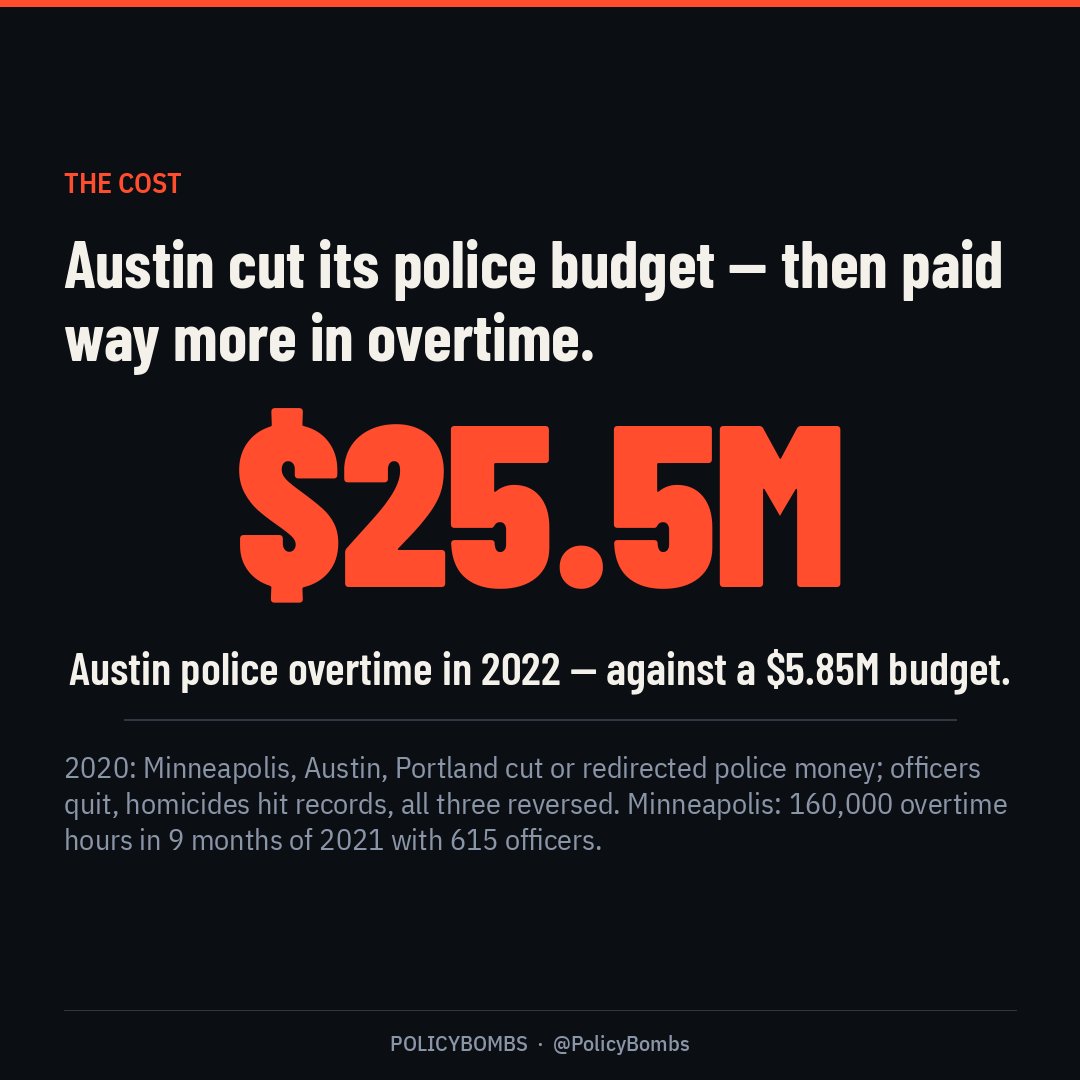
$25.5 million. That's what Austin spent on police overtime in 2022, against a $5.85M budget, after 'defunding.'

In 2020 Minneapolis, Austin and Portland cut or redirected police money. Officers quit, homicides hit records, and all three reversed course. The 'savings' leaked into overtime: Minneapolis ran up 160,000 overtime hours in nine months of 2021 with 615 officers.

The good: Civilian responders can handle some calls. The cost: Shrinking departments as violence spiked hurt high-crime neighborhoods most.

PRO: Civilian responders can handle some calls.

CON / COST: Shrinking departments as violence spiked hurt high-crime neighborhoods most.

SOCIETY: Bad as executed; pair funding with accountability instead.


Full analysis

Defund the Police: Policy Assessment

What Minneapolis, Austin and Portland actually cut in 2020, how fast they reversed it, and what crime data and research show. As of Nov 4, 2026.

Content as of Nov 4, 2026, 8:32 PM ET. Source Page: PolicyBombs canvas

Long-form deep analysis. Companion to the 10-minute quick reference (07-defund-police-summary.docx).

10-Minute Voter Guide

Who’s for / against: For defunding or redirecting police money: Reps. Ayanna Pressley and Rashida Tlaib (BREATHE Act framework) and 2020 Minneapolis council members. Against: President Biden (‘fund the police,’ 2022), Republicans, and Minneapolis voters (2021).

In 2020 Minneapolis, Austin and Portland cut or redirected police money. Officers quit, homicides hit records, and all three reversed course. City budget records show something rarely reported: the ‘savings’ leaked into overtime. Austin spent $25.5M on sworn overtime in 2022 against a $5.85M budget. Minneapolis ran up 160,000 overtime hours in nine months of 2021 with 615 officers.

Pros of defunding

Cons

+ Civilian crisis teams handle mental-health calls more cheaply

+ Forces scrutiny of police budgets

+ US police kill more people per capita than peer nations

– Homicides rose; officers reduce homicide in the best studies

– Cuts turned into expensive, unbudgeted overtime

– Every city reversed course within two years

Bottom line: Vote for funding civilian responders and for independent audits of police overtime. Don’t vote for across-the-board cuts.

Contents

  • 10-Minute Voter Guide
  • Key facts
  • 1. What is the policy
  • 2. Why it exists
  • 3. Realized effects
  • Budget anomalies: the overtime shift
  • 4. Good or bad for society
  • Who supports / who opposes
  • References

Bottom line: Real cuts were smaller than the slogan, but officer attrition was large. All three cities reversed course within one to two years. The 2020–21 homicide spike was national, so these cuts can’t be blamed for all of it. Still, strong research shows more police officers reduce homicides, especially of Black victims. Defunding as a strategy was a mistake. Shifting mental-health calls to non-police responders is the part worth keeping.

Key facts

City

2020 action

Reversal

Minneapolis

Council members pledged to dismantle the department (June 2020); $8M shifted from police in the 2021 budget

Question 2 (replace MPD) failed Nov 2021, about 56% No; budget restored

Austin

Aug 2020 vote redirected $150M of a $434M budget; only about $21M moved immediately, the rest was transfers of units and phased amounts

Texas HB 1900 (2021) penalized cuts; Austin restored funding in 2021

Portland

About $15M cut (2020); Gun Violence Reduction Team disbanded

Funding and gun-violence unit restored 2021–22

US homicides 2020

Up about 30%, the largest one-year rise on record

FBI / CDC

Minneapolis sworn officers

Fell from about 900 (2020) to about 600 (2022) (reported)

Attrition, not budget lines

1. What is the policy

Defunding means cutting police budgets and moving the money to social services, violence interruption, and civilian crisis response, sometimes framed as a step toward abolition. In practice, 2020 actions were budget trims, cancelled academy classes, disbanded specialized units, and new non-police responder programs (e.g. Minneapolis’s Behavioral Crisis Response, Portland Street Response, Austin’s mental-health first response).

2. Why it exists

Stated reasons

Underlying drivers

+ George Floyd’s murder (May 2020) and a record of police violence

+ Police handle mental-health and homelessness calls they are not trained for

+ Fund root causes: housing, jobs, treatment

– Council members responding to intense protest pressure and activist primaries

– Pandemic budget shortfalls made cuts easier to sell

– Police unions’ resistance to discipline drove calls to cut rather than reform

– Republicans used the slogan as a national campaign weapon (2020–22)

3. Realized effects

Item

Detail

Assessment

Minneapolis

97 homicides in 2021, tying the 1995 record (a later city report says 93). Response times went up and staffing fell sharply. A state court ordered the city to meet its charter’s minimum staffing (2021).

Crime up

Portland

Homicides hit a record 90 in 2021 and set another record in 2022 after the gun unit was disbanded. They fell from 2023 on after reinvestment and the national decline.

Crime up, then down

Austin

Homicides rose sharply in 2021, but Austin is a fast-growing city, and the cuts were partly accounting moves. Causal attribution is weak.

Unclear

Research

Chalfin, Hansen et al. (2022, AER: Insights): each added officer prevents about 0.06–0.1 homicides a year, with larger per-capita benefits for Black residents, but also brings more low-level arrests. Crisis-responder pilots (Denver STAR) reduced low-level crime reports in a published evaluation (Dee and Pyne, 2022).

Police reduce violence

Budget anomalies: the overtime shift

Finding

Record

Source

Austin sworn overtime

$14.67M actual vs $0.41M budgeted (2021); $25.48M vs $5.85M (2022). The council later demanded more overtime transparency (2025).

Austin budget office, July 2024; KUT

Minneapolis overtime, 2021

Projected up to $11.8M; 160,000 overtime hours in Q1–Q3, against 120,000 in 2020; 80,000 hours blamed on staffing shortage. Sworn officers fell from 808 to 615 on average.

MPD finance director via Minnesota Reformer

Minneapolis today

583 sworn officers (Mar 2025); MPD over budget by $19.6M in 2025.

Axios; Star Tribune

Portland overtime

2018: nearly 250,000 hours, $15.7M; auditor called management ‘lax.’ A 2021 follow-up found progress but gaps in supervisor approvals. FY21-22 budget counted on vacancy savings to fund overtime, which the city budget office called not best practice.

Portland City Auditor 2019/2021; CBO review FY21-22

No auditor found fraud. The finding is waste: staffing cuts and attrition were backfilled with overtime, which costs more per hour and burns out officers. What changed: the verdict now adds that the claimed savings from defunding were partly illusory.

4. Good or bad for society

Verdict: Bad as executed. Cuts plus demoralization shrank departments just as violence spiked, and the people hurt most were the residents of high-crime neighborhoods the movement meant to protect. Adding civilian responders and pairing police funding with accountability (body cameras, decertification, union contract reform) is the evidence-backed path.

Strongest case for defunding

Strongest case against

+ Many calls don’t need armed officers, and civilian response is cheaper and safer

+ US policing kills far more people per capita than peer nations

+ Violence interruption and other community programs show some promise

– Officers reduce homicide in the best causal studies

– Black residents bore the brunt of the 2020–21 spike

– Every city that tried it reversed course within two years, and voters rejected it at the ballot

Who supports / who opposes

For = cutting or redirecting police budgets. Against = maintaining or increasing them. Each row cites a numbered source below. Checked Nov 4, 2026.

Who

Party / level

Position

Evidence

Ref

Reps. Ayanna Pressley (D-MA) & Rashida Tlaib (D-MI)

Democrat

For

Announced the Movement for Black Lives’ BREATHE Act proposal (July 2020) to divest from policing; a proposal, not a formally introduced bill

[1]

Minneapolis City Council majority (2020)

Local, D/DFL

For

Pledged to "dismantle" MPD; ballot Question 2 (2021) would have replaced it

[2]

Minneapolis voters

Ballot measure

Against

Rejected Question 2 (Nov 2021), ~56% no

[2]

President Joe Biden (D)

Democrat (defector from the left)

Against

2022 State of the Union: "The answer is not to defund the police. It’s to fund the police."

[3]

Republican Party

Platform

Against

2024 platform pledges to support and fund law enforcement

[4]

Cross-party defectors: Biden and most Democratic leaders publicly rejected ‘defund’ despite pressure from the left.

How positions shifted: Many cities that cut police budgets in 2020 (e.g., Los Angeles, Minneapolis) restored or increased them by 2022–23.

Not included or not fully verified: Could not source LA City Council roll-call votes on the 2020 LAPD cut; omitted.

Sources for this section:

References

[1] Chalfin et al., Police Force Size and Civilian Race (AER: Insights 2022). aeaweb.org. https://www.aeaweb.org/articles?id=10.1257/aeri.20200792

[2] Dee & Pyne, A community response approach to mental health (Science Advances 2022). science.org. https://www.science.org/doi/10.1126/sciadv.abm2106

[3] Ballotpedia: Minneapolis Question 2 (2021). ballotpedia.org. https://ballotpedia.org/Minneapolis,_Minnesota,_Question_2,_Replace_Police_Department_with_Department_of_Public_Safety_Initiative_(November_2021)

[4] Texas HB 1900 (2021). capitol.texas.gov. https://capitol.texas.gov/BillLookup/History.aspx?LegSess=87R&Bill=HB1900

[5] Austin General Fund overview (overtime table), July 2024. austintexas.gov. https://services.austintexas.gov/edims/document.cfm?id=432895

[6] Minnesota Reformer: MPD overtime explodes. minnesotareformer.com. https://minnesotareformer.com/2021/10/18/mpd-overtime-explodes-due-to-staffing-shortage/

[7] Portland Auditor: police overtime follow-up. portland.gov. https://www.portland.gov/audit-services/news/2021/11/30/police-bureau-continued-make-headway-managing-overtime-and-second

[8] Star Tribune: MPD blows budget by $19.6M. startribune.com. https://www.startribune.com/minneapolis-police-blows-budget-2025/601529451

[9] FBI Crime Data Explorer. fbi.gov. https://cde.ucr.cjis.gov/

PolicyBombs · Day 51. Follow @PolicyBombs on X.

Lawfare

$653,881. That's what Georgia's DA paid the special prosecutor she hired and had a relationship with. She was disqualified.

Court records show misconduct on both sides. The Trump cases mostly passed judicial review but were badly timed. In 2025 roles flipped: DOJ indicted Comey and NY AG Letitia James, and both indictments were dismissed because the prosecutor was unlawfully appointed. Grand juries refused to re-indict James. Bolton's guilty plea is the exception.

PRO: Grand juries and a trial jury found evidence; no one is above the law.

CON / COST: Conflicts, unlawful appointments and president-driven cases corrode trust.

SOCIETY: Judge each case by its court record, not its target.


Full analysis

Lawfare: Using the Legal System Against Political Opponents

Tests lawfare claims on both sides: the 2023–24 Trump prosecutions and the 2025–26 DOJ cases against Trump opponents, judged on process, evidence and outcomes. As of Nov 4, 2026.

Content as of Nov 4, 2026, 8:32 PM ET. Source Page: PolicyBombs canvas

Long-form deep analysis. Companion to the 10-minute quick reference (05-lawfare-summary.docx).

10-Minute Voter Guide

Who’s for / against: Republicans called the 2023–24 cases against Trump ‘lawfare,’ while Democratic prosecutors such as Manhattan DA Alvin Bragg brought them. In 2025 the roles flipped: Trump’s DOJ indicted James Comey and NY AG Letitia James. A judge dismissed both cases (Nov 2025) because the prosecutor was unlawfully appointed, and DOJ has appealed.

Both parties accuse the other of using prosecutors as weapons. Court records show misconduct on both sides. In Georgia, the DA was disqualified over her relationship with the special prosecutor she hired and paid $653,881. In the 2025 Comey case, a magistrate judge found possible misconduct before the grand jury, and the indictment was thrown out because the prosecutor was unlawfully appointed. The Trump cases mostly passed judicial review. The 2025–26 cases against Trump critics have mostly collapsed, Bolton’s guilty plea excepted.

Arguments that the prosecutions were legitimate

Arguments that they were lawfare

+ Grand juries and a trial jury found evidence in the Trump cases

+ Bolton pleaded guilty: some cases have merit

+ No one should be above the law

– Willis–Wade conflict and disqualification

– Halligan was unlawfully appointed; a judge found ‘profound’ missteps

– Grand juries refused to re-indict Letitia James

Bottom line: Judge each case by its court record, not its target. Back candidates who support protecting DOJ independence and strict conflict-of-interest rules for prosecutors.

Contents

  • 10-Minute Voter Guide
  • Key facts
  • 1. What is the policy
  • 2. Why it exists
  • 3. Realized effects
  • Misconduct findings in the record
  • 4. Good or bad for society
  • Who supports / who opposes
  • References

Bottom line: Both sides have a real grievance, but the cases aren’t the same. The Trump cases were brought through grand juries, survived pretrial review on the merits, and one produced a jury conviction. Their weak spots were timing, a novel legal theory in Manhattan, and prosecutor misconduct in Georgia. The 2025–26 cases followed public presidential demands. They were obtained by a prosecutor courts found unlawfully appointed, and so far they’ve mostly collapsed. The second pattern is the more direct threat to the rule of law.

Key facts

Case

Outcome (Nov 2026)

Trump, Manhattan falsified records (34 counts)

Convicted May 30, 2024; unconditional discharge Jan 10, 2025; appeal pending

Trump, federal classified documents

Dismissed July 2024 (special counsel appointment ruling); dropped Nov 2024

Trump, federal Jan. 6 case

Narrowed by Trump v. US immunity ruling (July 2024); dropped Nov 2024

Trump, Georgia RICO

Willis disqualified (Dec 2024); dismissed in full Nov 26, 2025 at Skandalakis’s request

Trump, NY civil fraud

Liability upheld; about $500M penalty voided, Aug 2025

Comey, false statements (Sept 2025)

Dismissed Nov 24, 2025: Halligan unlawfully appointed; 4th Cir. appeal argued Sept 15, 2026

Letitia James, mortgage fraud (Oct 2025)

Dismissed Nov 24, 2025, same ruling; Norfolk and Alexandria grand juries declined to re-indict (Dec 2025)

Comey re-indicted, "86 47" post (Apr 2026)

Pending

John Bolton, classified documents (Oct 2025)

Pleaded guilty June 26, 2026 to one count; sentencing set for Dec 4, 2026

Adam Schiff, Lisa Cook mortgage referrals

No charges as of mid-2026

1. What is the policy

There’s no single lawfare statute. The concrete policies are prosecutorial discretion, DOJ independence norms (the post-Watergate contact policy that limits White House involvement in specific cases), the Justice Manual’s guidance against election-season action, and the rules for appointing US attorneys (28 U.S.C. 546). Since 2025 the White House has openly directed cases: Trump’s Sept 2025 post called on the Attorney General to prosecute Comey, Schiff and James. The previous EDVA US attorney left after reportedly declining to bring charges.

2. Why it exists

Stated reasons

Underlying drivers

+ No one is above the law, including a former president

+ Comey and James: alleged false statements and mortgage fraud

+ Accountability for Jan. 6 and mishandling of documents

– Elected local prosecutors (Bragg, Willis, James) campaigned on pursuing Trump

– The cases came years after the conduct, and several landed during the 2024 campaign

– 2025–26: presidential retaliation openly stated; loyalist appointees replaced career prosecutors who declined

– Both bases reward their side’s prosecutions with money and turnout

3. Realized effects

Item

Detail

Assessment

Process quality, Trump cases

Grand juries indicted, judges denied most motions on the merits, and a 12-person jury convicted unanimously. Weak points: the Bragg felony-upgrade theory was novel, Willis was disqualified over a relationship with a special prosecutor she hired, and the James civil penalty was voided as excessive.

Mostly lawful, some overreach

Process quality, 2025–26 cases

Courts found the indicting prosecutor unlawfully appointed. Judges also flagged grand jury irregularities in Comey. Grand juries refused some indictments, which is extremely rare. Schiff and Cook referrals did not produce charges. Bolton is the exception: the case was built by career prosecutors and ended in a guilty plea (June 26, 2026). Prosecutors seek five years; Bolton seeks probation.

Largely failed

Political effects

Trump’s indictments raised his primary support and fundraising in 2023 (polls and FEC data), and he won in 2024. Public trust in DOJ has become more partisan on both sides (Gallup and Pew trend data).

Backfired on initiators

Misconduct findings in the record

Issue

What courts or investigators concluded

Source

Willis hired Nathan Wade, then had a relationship with him

Wade was paid $653,881 (Nov 2021 to Dec 2023). The trial judge allowed Willis to stay if Wade left (Mar 2024); the Court of Appeals disqualified her (Dec 2024). A Georgia Senate committee investigated billing and funding. Claims that a seized-property fund paid Wade were called data errors by Fulton County.

GA courts; AP; Newsweek

Comey grand jury (2025)

Magistrate Judge Fitzpatrick found possible misconduct: use of old seized evidence without a new warrant, privilege concerns, and possibly misleading legal statements. He ordered grand jury materials disclosed to the defense.

Reuters; Politico, Nov 17, 2025

Halligan appointment

Ruled unlawful; both indictments dismissed (Nov 24, 2025). Appeal pending.

CRS; EDVA opinion

NY civil fraud penalty

Appellate Division voided the roughly $500M penalty as excessive but upheld liability.

NY App. Div., Aug 2025

What changed: the verdict now gives the Georgia case more weight as a real conflict-of-interest failure on the anti-Trump side. It still treats the 2025–26 retaliation campaign as the more serious abuse, because it was ordered from the top.

4. Good or bad for society

Verdict: Prosecuting a politician on evidence through normal processes is fine. Prosecuting because a president demands it is corrosive, whoever does it. The Trump prosecutions had real legal basis but were badly timed and partly overreached, which fed the lawfare narrative. The 2025–26 DOJ campaign against named opponents is the clearer abuse, and so far courts and grand juries have contained it.

Strongest defense of prosecuting political figures

Strongest critique

+ Immunity for powerful people is worse than the risk of politicized cases

+ Courts and grand juries filtered weak cases in both eras

+ Bolton shows real crimes can be charged even against critics

– Elected prosecutors campaigning against a named person destroys any appearance of neutrality

– The tit-for-tat escalation was predictable, and predicted

– Even a failed prosecution punishes through cost and stigma (the process is the punishment)

Who supports / who opposes

For = backing the named prosecutions. Against = calling them politicized "lawfare." Each row cites a numbered source below. Checked Nov 4, 2026.

Who

Party / level

Position

Evidence

Ref

Manhattan DA Alvin Bragg (D)

Democrat

For

Won 34-count felony conviction of Trump (May 2024)

[1]

Republican Party

Platform

Against

2024 platform pledges to end "the weaponization of government against the American people"

[2]

Rep. Jim Jordan (R-OH), House Judiciary Chair

Republican

Against

Led "weaponization" subcommittee probes of DOJ/FBI and Bragg

[3]

President Trump; acting U.S. Atty Lindsey Halligan

Republican

For

DOJ indicted James Comey (Sep 2025) and Letitia James (Oct 2025); both dismissed Nov 24, 2025 because Halligan was unlawfully appointed; DOJ appealed to the 4th Circuit

[4]

Cross-party defectors: Some Republicans criticized politicized prosecutions in both directions, e.g., Sen. Ted Cruz warned in Sept 2025 that using government power against opponents ‘will end up bad for conservatives’ (on the FCC; see Free Speech page).

How positions shifted: Each party condemns ‘lawfare’ when it targets its own side. Democrats defended prosecutions of Trump in 2023–24. Republicans who called those ‘lawfare’ backed DOJ cases against Trump critics in 2025.

Not included or not fully verified: Dropped a planned row on Democratic leaders calling the 2025 cases retribution, because no specific statement was opened this turn.

Sources for this section:

References

[1] CRS: Court says interim US attorney unlawfully appointed. congress.gov. https://www.congress.gov/crs_external_products/LSB/PDF/LSB11380/LSB11380.1.pdf

[2] US v. Comey, 4th Cir. docket. courtlistener.com. https://www.courtlistener.com/docket/72065969/united-states-v-james-comey-jr/

[3] Nolo: guide to the Comey and James cases. nolo.com. https://www.nolo.com/news/a-legal-guide-to-the-james-comey-and-letitia-james-cases.html

[4] DOJ: Bolton pleads guilty. justice.gov. https://www.justice.gov/opa/pr/former-us-national-security-advisor-john-r-bolton-ii-pleads-guilty-violating-espionage-act

[5] AP: Georgia case against Trump dismissed. apnews.com. https://apnews.com/article/georgia-trump-election-indictment-fani-willis-b9000b28e65fc8ebe57f6f9cca5cc3ef

[6] AP: DOJ again fails to re-indict Letitia James. apnews.com. https://apnews.com/article/letitia-james-grand-jury-6743e4d673d8b039059a958e507aea94

[7] Reuters: Judge finds ‘profound’ missteps in Comey probe. reuters.com. https://www.reuters.com/world/us-judge-orders-doj-turn-over-comey-grand-jury-materials-citing-misconduct-2025-11-17/

[8] AP: Georgia senators question Wade. apnews.com. https://apnews.com/article/fani-willis-trump-georgia-senate-nathan-wade-5cca5d58dfcdc67ede2d6d0935dbaf4f

[9] Trump v. United States (2024). supremecourt.gov. https://www.supremecourt.gov/opinions/23pdf/23-939_e2pg.pdf

[10] Protect Democracy retaliation tracker. protectdemocracy.org. https://protectdemocracy.org/work/retaliatory-action-tracker/

[11] ABC: list of individuals targeted. abcnews.com. https://abcnews.com/US/list-individuals-including-lisa-cook-targeted-trump-administration/story?id=124968309

PolicyBombs · Day 49. Follow @PolicyBombs on X.

Crime: No Prosecute

42,000+. That's how many misdemeanor cases LA DA Gascón's office declined in 2021.

The best study shows diverting first-time, low-level cases cuts reoffending, with no clear link to violent crime. But Prop 47 raised theft, and both campaigns were bankrolled by a few big donors. Now Prop 36 depends on each DA: in 2025 San Francisco filed 4 treatment-mandated felony cases. Los Angeles filed 1,660.

The good: Diversion for first-time, low-level offenders is evidence-backed. The cost: Blanket non-enforcement of repeat theft eroded order and trust.

PRO: Diversion for first-time, low-level offenders is evidence-backed.

CON / COST: Blanket non-enforcement of repeat theft eroded order and trust.

SOCIETY: Prop 36 is a reasonable correction, but needs treatment capacity.


Full analysis

"Crime: No Prosecute": Progressive Prosecutors and Props 47/36

Tests the claim that declining to prosecute drives crime, using Boudin, Gascón, Krasner, Prop 47 and Prop 36. As of Nov 4, 2026.

Content as of Nov 4, 2026, 8:32 PM ET. Source Page: PolicyBombs canvas

Long-form deep analysis. Companion to the 10-minute quick reference (04-crime-no-prosecute-summary.docx).

10-Minute Voter Guide

Who’s for / against: For progressive non-prosecution policies: DAs Larry Krasner (D-Philadelphia) and George Gascón (D, ousted 2024). Against: Prop 36 backers, a mix of Republicans, DAs, and Democratic mayors Breed and Mahan. Voters passed Prop 36 with 68%; Gov. Newsom opposed it.

Reform DAs stopped charging many low-level offenses. Gascón’s office declined more than 42,000 misdemeanor cases in 2021. The best study shows diversion of first-time, low-level cases cuts reoffending, and no clear link to violent crime has been shown. But Prop 47 raised theft, and the campaigns on both sides were bankrolled by a few big donors. Prop 36 now depends on each DA: San Francisco filed 4 treatment-mandated felony cases in 2025, Los Angeles 1,660.

Pros of reform prosecution

Cons

+ Diverting low-level cases cuts reoffending (Agan, Doleac and Harvey)

+ Of 187 people released in LA resentencing, the DA’s office reports no new convictions

+ Philadelphia homicides at a 60-year low under Krasner

– Prop 47 raised theft about 9%

– Diversion outcomes went untracked in SF (local reporting)

– Uneven Prop 36 enforcement means voters’ law depends on the DA’s choices

Bottom line: Divert first-time and low-level offenders, but require consequences for repeat theft and public outcome data from every DA.

Contents

  • 10-Minute Voter Guide
  • Key facts
  • 1. What is the policy
  • 2. Why it exists
  • 3. Realized effects
  • Local DA data and campaign money
  • 4. Good or bad for society
  • Who supports / who opposes
  • References

Bottom line: The evidence doesn’t support the strong claim that progressive prosecutors caused the 2020–22 violent crime spike: it hit every type of city. Not prosecuting low-level offenses reduced repeat offending in the best study. But Prop 47 did raise property theft modestly, and voters punished the visible disorder. They recalled Boudin, ousted Gascón, and passed Prop 36. Krasner survived as Philadelphia homicides hit 60-year lows.

Key facts

Item

Date

Status / result

Chesa Boudin (SF DA)

Elected 2019

Recalled June 2022, about 55% yes

George Gascón (LA DA)

Elected 2020

Lost Nov 2024 to Nathan Hochman by a wide margin

Larry Krasner (Philadelphia DA)

Elected 2017

Re-elected Nov 2025, 76.1%

Philadelphia homicides

2021 / 2025

562 (record) / 222 (lowest since 1966)

CA Prop 47

Nov 2014

Theft under $950 and drug possession made misdemeanors

CA Prop 36

Nov 2024, about 68% yes

Felony for repeat theft; treatment-mandated drug felony

Prop 36 drug cases, 2025

19,104 filed

17% chose treatment; 57 completed (Judicial Council)

1. What is the policy

Item

Detail

Progressive prosecution

Elected DAs adopted policies such as no cash bail requests, declining many low-level misdemeanors, ending sentence enhancements (Gascón’s Day 1 directives, Dec 2020), no juveniles tried as adults, and more prosecutions of police.

Prop 47 (2014)

Reclassified shoplifting, theft, and receiving stolen property under $950, plus simple drug possession, as misdemeanors. Savings went to treatment and schools through SSCF grants.

Prop 36 (2024)

Makes a third theft a felony regardless of value. Creates a treatment-mandated felony for repeat drug possession and adds fentanyl dealing enhancements. Passed about 68%. The legislature put up limited funding at first.

2. Why it exists

Stated reasons

Underlying drivers

+ Mass incarceration costs a lot and hits Black communities hardest

+ Prosecuting minor offenses can increase later offending

+ Prison overcrowding: Brown v. Plata (2011) forced CA to cut its prison population

+ Redirect money to treatment

– Low-turnout DA races were cheap for national donors to win (Soros-linked PACs funded Gascón, Krasner and Boudin campaigns)

– Prop 47 was partly a fiscal response to court-ordered cuts in the prison population

– Police and prosecutor unions and retailers funded the backlash (Prop 36 was retailer-backed)

– Both sides use crime as a turnout tool

3. Realized effects

Item

Detail

Assessment

Nonprosecution of misdemeanors

Agan, Doleac and Harvey (QJE 2023), Suffolk County MA: nonprosecuted marginal defendants were about 53% less likely to be re-arrested within 2 years. This is the strongest causal study, and it covers low-level cases only.

Reduced reoffending

Progressive DAs and violent crime

Multi-city studies (e.g. Petersen et al. 2023 on 35 jurisdictions) find no significant effect on crime rates. Hogan (2022) linked Krasner to about 75 extra homicides a year; critics disputed the method. The 2020–22 spike was nationwide, including in cities with tough DAs.

No clear effect

Prop 47

PPIC (Bird et al.): no effect on violent crime. Larceny, especially car break-ins and shoplifting, rose about 9% compared with control states. Recidivism dipped slightly for released people. Treatment money under-delivered relative to the promise.

Modest theft increase

Prop 36

In its first full year, 34,612 felony cases (19,104 drug, 15,508 theft). Only 17% of drug defendants chose treatment, and 57 completed it. Prison admissions for the new drug felony were 635 by Aug 2026. Retail theft trends are not yet causally separated from the national decline.

Early; weak treatment uptake

Philadelphia

Homicides fell from 562 (2021) to 222 (2025) under the same DA. This shows the DA was not the dominant driver either way.

Down sharply

Local DA data and campaign money

Finding

Record / conclusion

Source

LA misdemeanor declinations, 2021

More than 42,000 declined, over 25,000 of them public intoxication or simple drug possession. Crime analysis found the effect hard to isolate.

LA Times data analysis

LA resentencing under Gascón

About 244 resentenced over 3 years; 187 released; the office reports no new convictions. This is the office’s own data, not independently audited.

LA DA 2024 annual report

SF diversion under Boudin

Local outlet reports hundreds of violent-offense cases sent to diversion with no outcome tracking. Not confirmed by an audit.

The Voice of San Francisco

Prop 36 filings by county, 2025

San Francisco: 4 treatment-mandated felony cases. Los Angeles: 1,660. LA filed more than 1,000 felony theft charges by May 2025.

Judicial Council; LA DA

Prop 47 grant outcomes

15.3% recidivism among 21,706 participants, against 35–45% statewide. This is the program’s own evaluation with no randomized control, so selection bias is likely.

BSCC Cohort II evaluation

DA campaign money

Soros-linked committees: Gascón about $3M; Krasner $1.7M (2017) and $259K (2021); Boudin more than $620K via aligned donors. Figures are from conservative trackers; verify with county filings.

Washington Times; Capital Research Center

Ballot measure money

Prop 47 (2014): about $9.5M yes, including $1.4M from Open Society, against about $550K no. Prop 36 (2024): Walmart $4.08M, Target and Home Depot $1M each.

LA Times; CalMatters / Cal-Access

No court has found corruption in these DA policies. The pattern is concentrated money on both sides: national criminal-justice donors for reform, and retailers for the rollback. What changed: the verdict now adds that DA discretion is quietly undoing Prop 36 in some counties, and that self-reported program results (BSCC, DA offices) need independent audit.

4. Good or bad for society

Verdict: Not prosecuting first-time, low-level offenses is good policy, supported by evidence. Blanket non-enforcement of repeat theft and open drug use was bad policy that wore away public order and trust, and voters correctly corrected it. Prop 36 is a reasonable correction so far, but without treatment capacity it will mostly become incarceration.

Strongest case for reform prosecutors

Strongest case against

+ Best causal evidence shows less reoffending from diversion

+ No measurable violent-crime penalty across cities

+ Large savings from prisons and less harm to families

– Repeat offenders face no consequence, which has signaling effects (retail theft, open-air drug markets)

– Prop 47 measurably raised property crime

– DAs refusing to enforce laws voters passed undermines democratic legitimacy

Who supports / who opposes

For = progressive non-prosecution of low-level crime. Against = tougher charging and sentencing (e.g., Prop 36). Each row cites a numbered source below. Checked Nov 4, 2026.

Who

Party / level

Position

Evidence

Ref

CA District Attorneys Assn.; SF Mayor London Breed (D); San Jose Mayor Matt Mahan (D); CA Republicans

Mixed

Against

Backed Prop 36 (2024), rolling back parts of Prop 47; passed 68.4%–31.6%

[1]

Gov. Gavin Newsom (D-CA)

Democrat

Mixed

Opposed Prop 36, saying it would revive mass incarceration without funding

[2]

LA DA George Gascón (D)

Democrat

For

Ran on non-prosecution of low-level crimes; lost to Nathan Hochman (independent, ex-Republican) in Nov 2024

[3]

San Francisco voters

Local

Against

Recalled DA Chesa Boudin (Jun 2022)

[4]

Alameda County voters

Local

Against

Recalled DA Pamela Price (Nov 2024)

[5]

Philadelphia DA Larry Krasner (D)

Democrat

For

Impeached by the PA House in 2022 (articles lapsed; PA Supreme Court ruled 2024); re-elected to a third term Nov 2025

[6]

Cross-party defectors: Big-city Democratic mayors (Breed, Mahan) broke with Newsom and the Legislature’s leaders to back Prop 36.

How positions shifted: California voters passed Prop 47 (2014) with 60%, then reversed much of it with Prop 36 (2024) with 68%. Democratic support for progressive prosecutors has shrunk since 2022.

Sources for this section:

References

[1] Agan, Doleac & Harvey, Misdemeanor Prosecution (QJE 2023). academic.oup.com. https://academic.oup.com/qje/article/138/3/1453/7069279

[2] BSCC: Prop 47 Cohort II evaluation. bscc.ca.gov. http://www.bscc.ca.gov/wp-content/uploads/2024/02/H-2-Proposition-47-Cohort-2-Final-Evaluation-Report-FINAL-1.pdf

[3] LA DA 2024 annual report summary. da.lacounty.gov. https://da.lacounty.gov/sites/default/files/pdf/LADA_Fact_Sheet_Report.pdf

[4] Voice of SF: SF DA Prop 36 filings. thevoicesf.org. https://thevoicesf.org/san-francisco-district-attorney-has-filed-just-one-treatment-mandated-drug-possession-case-under-proposition-36/

[5] CalMatters: Prop 36 fundraising. calmatters.org. https://calmatters-voter-guide-2024.netlify.app/campaign-finance/prop/prop36

[6] LA Times: NY foundations bankrolled Prop 47. latimes.com. https://www.latimes.com/local/political/la-me-ff-new-york-foundations-bankrolled-prop-47-20150202-story.html

[7] PPIC: Prop 47’s impact on crime. ppic.org. https://www.ppic.org/publication/the-impact-of-proposition-47-on-crime-and-recidivism/

[8] Judicial Council: 2026 Prop 36 court data report. courts.ca.gov. https://courts.ca.gov/system/files/legislative-reports/lr-2026-proposition-36-court-data.pdf

[9] CA Policy Lab: Prop 36 prison data, Aug 2026. capolicylab.org. https://capolicylab.org/prop-36-august-2026-update/

[10] CalMatters: Is Prop 36 working?. calmatters.org. https://calmatters.org/justice/2026/09/prop-36-drug-treatment/

[11] Pew: Philadelphia’s homicides at historic lows. pew.org. https://www.pew.org/en/research-and-analysis/articles/2025/12/15/philadelphias-homicides-at-historic-lows

[12] Ballotpedia: Larry Krasner. ballotpedia.org. https://ballotpedia.org/Lawrence_Krasner

PolicyBombs · Day 48. Follow @PolicyBombs on X.

Homelessness in California

$24 billion. That's what California spent on homelessness from 2018 to 2023, and homelessness still rose 24% from 2019 to 2024.

A court-ordered audit found Los Angeles couldn't say how much it spent or what services were delivered. The county controller found LAHSA never recovered most cash advances to contractors. Federal prosecutors charged developers with diverting Homekey money. Meanwhile Houston cut homelessness 61% with one coordinated system and cheap rentals.

PRO: Housing First can work when coordinated (Houston).

CON / COST: Poor measurement, slow construction and fraud exposure in CA.

SOCIETY: Bad value so far; fix is coordination, accountability and zoning reform.


Full analysis

Homelessness in California: Policy Assessment

California’s spending since 2019, Housing First, Prop 1 and Grants Pass, compared with Houston. As of Nov 4, 2026.

Content as of Nov 4, 2026, 8:31 PM ET. Source Page: PolicyBombs canvas

Long-form deep analysis. Companion to the 10-minute quick reference (03-homelessness-summary.docx).

10-Minute Voter Guide

Who’s for / against: For encampment enforcement and treatment-first: President Trump (July 2025 EO), Gov. Newsom (D) and SF mayors after Grants Pass, Texas Gov. Abbott. For Housing First: the Biden administration’s federal plan and homeless-advocacy groups.

California spent at least $24B on homelessness from 2018 to 2023, and homelessness still rose 24% from 2019 to 2024. A court-ordered audit found Los Angeles could not say how much it spent or what services were delivered. The county controller found LAHSA never recovered most cash advances to contractors. Federal prosecutors have charged developers with diverting state Homekey money. Houston cut homelessness 61% with one coordinated system and cheap rentals.

Pros of CA’s current approach

Cons

+ Homekey motel conversions cost about $144K per unit, against $380K–$570K for new builds (State Auditor)

+ The 2025 count dipped 2.8%

+ Housing First keeps most placed people housed

– No outcome tracking for $24B (State Auditor)

– LA contracts too vague to verify services were delivered (Alvarez & Marsal)

– Federal fraud charges over Homekey grants; $6M lost to vacancies at one SF nonprofit (SF Controller)

Bottom line: Support measures that tie money to audited outcomes and claw back unspent advances. Be skeptical of new money for agencies that can’t account for the last round.

Contents

  • 10-Minute Voter Guide
  • Key facts
  • 1. What is the policy
  • 2. Why it exists
  • 3. Realized effects
  • Fraud, waste and abuse findings
  • 4. Good or bad for society
  • Who supports / who opposes
  • References

Bottom line: California spent tens of billions and homelessness still rose until a small dip in 2025, and the state didn’t measure what worked. Houston shows that Housing First can work when it runs as one coordinated system that moves people quickly into existing cheap rentals. California’s problem is less the philosophy than housing costs, scattered governance, and expensive new construction.

Key facts

Item

Figure

Source

CA homeless count (HUD PIT), 2019

151,278

HUD AHAR

CA homeless count, 2024

187,084

HUD AHAR

CA homeless count, 2025

181,934 (down 2.8%); unsheltered 115,583

HUD AHAR 2025

State spending, FY2018-19 to FY2022-23, 30 programs

$24B

CA State Auditor 2023-102.1 (Apr 2024)

Auditor finding

State did not consistently track outcomes; only 2 programs had cost-effectiveness evidence

CA State Auditor

Prop 1 (Mar 2024): $6.38B bond plus MHSA overhaul

Passed 50.2%

CA SOS

City of Grants Pass v. Johnson

June 28, 2024, 6–3: camping bans are not cruel and unusual

US Supreme Court

Houston region count, 2011 to 2025

8,538 to 3,325 (61% drop)

Coalition for the Homeless PIT counts

1. What is the policy

Item

Detail

State funding streams

HHAP block grants to cities and counties, Project Homekey (motel and hotel conversions), Encampment Resolution Funds, CalAIM housing supports, and No Place Like Home. Newsom-era state homelessness spending is commonly put at more than $24B (2019–2024).

Housing First (SB 1380, 2016)

State law requires state-funded programs to provide housing without preconditions such as sobriety or treatment.

Prop 1 (March 2024)

A $6.38B bond for treatment beds and supportive housing. It also redirects about 30% of Mental Health Services Act county funds to housing. Passed with 50.2%.

CARE Court (SB 1338, 2022) and SB 43 (2023)

Civil court-ordered treatment plans, and a broader definition of grave disability that allows conservatorship.

After Grants Pass

Newsom’s July 2024 executive order urged cities to clear encampments. In 2025 he tied HHAP funding to anti-camping ordinances and offered a model ordinance. Many cities, including SF and LA County areas, increased sweeps.

2. Why it exists

Stated reasons

Underlying drivers

+ Visible crisis: about 1 in 4 US homeless people live in CA

+ Housing First had strong evidence for keeping people housed

+ Humane response; addiction is easier to treat once housed

+ Prop 1: decades of underbuilt psychiatric capacity

– Spending shows action fast; outcome tracking does not

– A nonprofit provider sector grew around the grants, and the auditor and LA cases found weak oversight

– Prevailing wage, local permitting, and a single-project focus pushed costs per unit to $500K–$600K+ (LA Controller on HHH; verify current)

– Local NIMBY politics blocks the cheap housing that would cut demand

3. Realized effects

Chart data (shown as a chart on the Page)

Series

2019

2024

2025

California

151,278

187,084

181,934

Item

Detail

Assessment

CA outcomes

Homelessness rose about 24% from 2019 to 2024, with the 2022 count disrupted by COVID. The auditor (Apr 2024) found the Interagency Council had not tracked outcomes since 2021. LA’s homelessness agency, LAHSA, was criticized in a court-ordered audit (2025), and LA County is moving functions out of it.

Worse

Housing First evidence

RCTs (Pathways to Housing; Canada’s At Home/Chez Soi) show 70–85% housing retention against much lower rates with treatment-first. They find little effect on addiction, mental health, or employment. It works for keeping people housed, not for recovery.

Mixed

Houston

The Way Home coalition coordinates about 100 agencies with a single entry system. It places people quickly into existing apartments, using cheap Texas housing and a permissive building system. The count fell from 8,538 (2011) to 3,325 (2025), a 61% drop. It ticked up 1.4% in 2025 and unsheltered rose 15.8%.

Better

Grants Pass

Sweeps rose after the ruling. There’s no solid evidence yet that they cut overall homelessness, rather than moving people around.

Too early

Research consistently ties regional homelessness rates mainly to rents and vacancy rates, more than to drugs or mental illness (Colburn and Aldern, 2022). That points to housing supply as the root.

Fraud, waste and abuse findings

Anomaly

What investigators or courts concluded

Source

LA city programs (Roadmap, Alliance, Inside Safe), 2020–24

The city could not track exactly how much it spent, did not reconcile spending with services, and wrote vague contracts that left the system vulnerable to waste and fraud. This is a finding of weak controls, not proven fraud.

Alvarez & Marsal, court-ordered (Judge Carter), Mar 2025

LAHSA cash advances

Recovered only $2.5M of $50.8M in 2017–18 Measure H advances; $8M still outstanding (2016–23); no accurate list of contracts.

LA County Auditor-Controller, Nov 2024

Inside Safe hotel costs

$281 per bed per day at one site (FY23-24); service portion $181, against $55–$85 for other shelter types. Hotels billed damage repairs, some proven only by notes that a vendor was paid in cash.

Alvarez & Marsal

Project Roomkey rates

$94.23 per room per night average, about $120 downtown, plus about $100 per client per day for services; FEMA reimbursed occupied rooms only.

LA City Legislative Analyst, Sept 2020

Shangri-La Industries / Homekey

CFO Cody Holmes indicted (mail and loan fraud): allegedly faked balance sheets to get $25.9M for a Thousand Oaks project that was never completed; more than $2M allegedly went to his American Express bills. The case is pending, and the AG also sued civilly in 2024.

US v. Holmes indictment (C.D. Cal., Oct 2025)

Weingart / Cheviot Hills

A developer is charged with buying a property for $11.2M using allegedly fake documents and selling it to the nonprofit Weingart for $27.3M. Weingart put its CEO on leave and hired a law firm to review its property valuations. Allegations only so far.

DOJ complaint; LA Times, Nov 2025

HomeRise (SF)

Gross mismanagement: raises of 20% or more and $200K in bonuses while units sat vacant; more than $6M lost to vacancies, with some buildings 26–35% empty.

SF Controller / Sjoberg Evashenk audit, Apr 2024

What changed: the verdict now treats governance failure as the central problem, because weak controls invite and enable fraud. The State Auditor also found Homekey likely cost-effective. So the evidence supports buying existing buildings, not building new projects, provided grant recipients are verified.

4. Good or bad for society

Verdict: Revised: California’s approach has been bad value and is exposed to fraud: high spending, poor measurement, slow construction, and rising counts until 2025. The fix isn’t abandoning Housing First. It’s Houston-style coordination, cheap fast placements, accountability tied to outcomes, and large-scale zoning reform, plus enforcement only where real shelter is offered.

Strongest case for CA’s approach

Strongest case against

+ Homekey added units quickly at below new-build cost

+ The 2025 dip suggests recent shelter growth is working

+ Many people are housed who otherwise would not be

– $24B with no outcome tracking is a failure of governance

– Unsheltered share stays the highest in the nation

– Cost per unit is so high that scale is impossible

Who supports / who opposes

For = encampment enforcement and treatment-first. Against = Housing First without enforcement. Each row cites a numbered source below. Checked Nov 4, 2026.

Who

Party / level

Position

Evidence

Ref

President Donald Trump

Republican

For

EO 14321 "Ending Crime and Disorder on America’s Streets" (Jul 24, 2025): ends federal support for Housing First, backs civil commitment and anti-camping enforcement

[1]

Gov. Gavin Newsom (D-CA)

Democrat

For

Executive order (Jul 25, 2024) directing state agencies to clear encampments after Grants Pass v. Johnson

[2]

Gov. Greg Abbott (R-TX)

Republican

For

Signed HB 1925 (2021), a statewide ban on public camping

[3]

City of Grants Pass, OR (with amicus support from Newsom and SF)

Local

For

Won Supreme Court ruling (Jun 28, 2024) allowing camping bans

[4]

Biden administration (USICH)

Democrat

Against

"All In" federal strategic plan built on Housing First

[5]

NAACP Legal Defense Fund

Advocacy

Against

Oppose the 2025 EO as criminalizing homelessness

[6]

Cross-party defectors: Newsom, a Democrat, aligned with Republicans on encampment sweeps and filed a brief backing Grants Pass. Homeless advocates sued or criticized him.

How positions shifted: Housing First had bipartisan federal backing under George W. Bush and Obama. The federal government reversed it in 2025, and California Democrats moved toward enforcement in 2024.

Not included or not fully verified: Could not source a roll-call vote in Congress on Housing First; none found.

Sources for this section:

References

[1] CA State Auditor 2023-102.1: Homelessness in California. auditor.ca.gov. https://www.auditor.ca.gov/reports/2023-102.1/index.html

[2] Alvarez & Marsal court-ordered assessment (Dkt 905). cacd.uscourts.gov. https://www.cacd.uscourts.gov/sites/default/files/Dkt%20905%20FINAL%20AM%20REPORT.pdf

[3] LA Times: County audit finds lax accounting at LAHSA. latimes.com. https://www.latimes.com/california/story/2024-11-20/county-audit-finds-lax-accounting-at-l-a-homeless-authority

[4] US v. Cody Holmes indictment. documentcloud.org. https://s3.documentcloud.org/documents/28097013/holmes-indictment.pdf

[5] LAist: Federal charges over Homekey funds. laist.com. https://laist.com/news/housing-homelessness/bill-essayli-federal-charges-homelessness-homekey

[6] SF Standard: HomeRise audit. sfstandard.com. https://sfstandard.com/2024/04/02/san-francisco-homeless-nonprofit-homerise-report/

[7] LA CLA: Project Roomkey report (2020). lacity.org. https://cityclerk.lacity.org/onlinedocs/2020/20-0478_rpt_CLA_09-03-2020.pdf

[8] CalMatters: two-year Homekey investigation. calmatters.org. https://calmatters.org/newsletter/homekey-investigation/

[9] HUD 2025 AHAR Part 1. huduser.gov. https://www.huduser.gov/portal/datasets/ahar/2025-ahar-part-1-pit-estimates-of-homelessness-in-the-us.html

[10] Houston 2025 PIT results. cfthhouston.org. https://www.cfthhouston.org/2025-pit-results

[11] City of Grants Pass v. Johnson opinion. supremecourt.gov. https://www.supremecourt.gov/opinions/23pdf/23-175_19m2.pdf

[12] Prop 1 (2024) overview. lao.ca.gov. https://lao.ca.gov/BallotAnalysis/Proposition?number=1&year=2024

[13] At Home/Chez Soi final report. mentalhealthcommission.ca. https://www.mentalhealthcommission.ca/English/document/24376/national-homechez-soi-final-report

[14] Colburn & Aldern, Homelessness Is a Housing Problem. homelessnesshousingproblem.com. https://homelessnesshousingproblem.com/

PolicyBombs · Day 47. Follow @PolicyBombs on X.