Benefits for Illegal Immigrants: Shelter, Hotels, Cash Cards in Sanctuary Cities

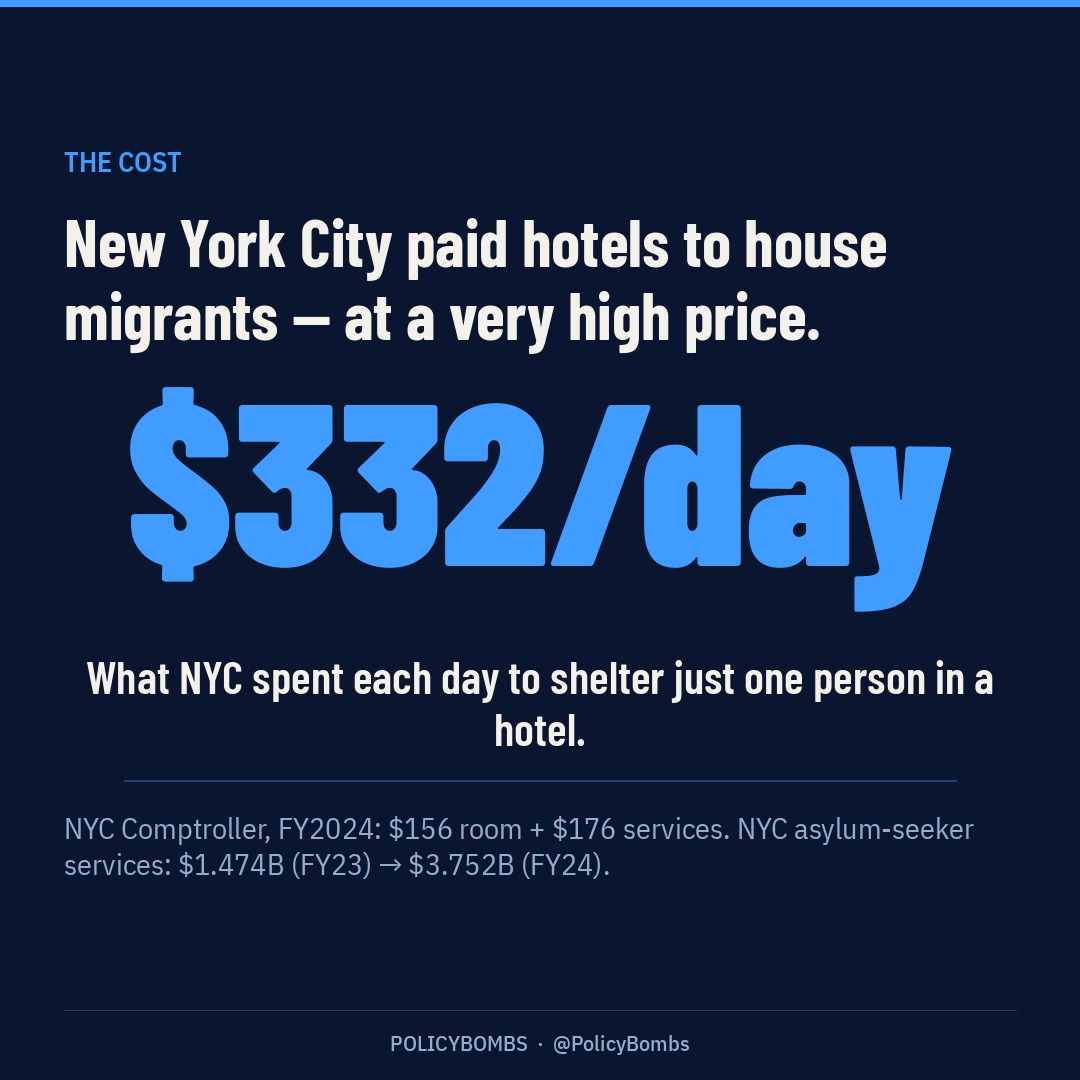
$332 a day. NYC's all-in cost to shelter one person in a DHS hotel in FY2024 — $156 room plus $176 services (NYC Comptroller).

NYC's asylum-seeker services: $1.474B in FY23, $3.752B in FY24.

Sanctuary limits on ICE plus a shelter entitlement created a durable incentive to stay while court dates sit years out — as citizens faced a housing crunch.

PRO: Humanitarian duty not to leave arrivals on the street; NYC's right-to-shelter legacy.

CON / COST: $5B+ in two years of local transfers while residents face housing scarcity; documented contractor waste.

SOCIETY: BAD — multi-billion local spending rewarded the surge and crowded out citizens' needs.


Full analysis

Benefits for Illegal Immigrants: Shelter, Hotels, Cash Cards in Sanctuary Cities

NYC/Chicago/Denver migrant shelter and prepaid-card programs, Comptroller per-diems ($332/day hotel all-in FY24 NYC DHS), multi-billion local spends, federal benefit rules vs local pull factors. New focused benefits page. As of Nov 5, 2026.

Content as of Nov 5, 2026, 6:12 AM ET. Source Page: PolicyBombs canvas

Long-form deep analysis. Companion to the 10-minute quick reference (16-benefits-illegal-immigrants-summary.docx).

Contents

  • 10-Minute Lazy Voter Guide
  • 1. What is the policy
  • 2. Why it exists
  • 3. Realized effects
  • Local investigations
  • Who supports / who opposes
  • 4. Good or bad for society
  • References
  • Gaps / unverified

10-Minute Lazy Voter Guide

Who’s for / against: For expansive shelter/services: sanctuary mayors (Adams early, then walked back; Chicago/Denver Dems), immigrant NGOs. Against: congressional Republicans, local GOP (Borelli NYC), and working-class residents priced out of fairness.

Arguments for benefits

Arguments against

+ Humanitarian duty not to leave arrivals on streets

+ NYC right-to-shelter litigation legacy

+ Prepaid cards claimed cheaper than boxed food delivery

– NYC ~$5.2B asylum-seeker services FY23–24 combined (Comptroller)

– Hotel all-in ~$332/person/day FY24 DHS; prepaid cards up to ~$350/week for some families

– Pull factor + unfairness vs citizen poor on SNAP

Verdict for voters: Bad fiscal and social policy at this scale. Cities advertised sanctuary, got a fiscal crisis, then taxed residents to hotel-house recent entrants. Federal illegal-presence rules + local benefits = magnet. Documented contractor waste (DocGo) strengthens the indictment.

1. What is the policy

Item

Detail

Assessment

Federal baseline

Many federal means-tested benefits barred for undocumented; asylum seekers/parolees may access some aid after process steps; emergency Medicaid exceptions exist.

Substantiated

Local shelter/hotels

NYC, Chicago, Denver, etc., used hotels, shelters, prepaid food cards, case management during 2022–24 surge.

Substantiated

Sanctuary interaction

Limits on ICE cooperation + shelter entitlement create durable stay incentives pending court dates years out.

Substantiated mechanism

2. Why it exists

Stated reasons: compassion; legal shelter consent decrees; public health; "we’re a welcoming city."

Underlying drivers: Progressive branding; NGO service industries; hotel-owner revenue; fear of visible street encampments; federal border policy exporting costs inland. Corruption/capture: emergency no-bid contracts (NYC DocGo) show classic disaster-waste patterns — Comptroller found unsupported payments. Not every debit card is a bribe; the contractor ecosystem is where to audit.

3. Realized effects

Chart data (shown as a chart on the Page)

Label

Value

NYC FY23 spend

$1.47B

NYC FY24 spend

$3.75B

DHS hotel all-in

$332/day

City / program

Figure

Source

Tag

NYC asylum services FY23

$1.474B

NYC Comptroller

Substantiated

NYC asylum services FY24

$3.752B

NYC Comptroller

Substantiated

NYC DHS hotel room rate FY24

$156/day average (HANYC)

Comptroller per-diem report

Substantiated

NYC DHS services beyond rent

$176/day average

Same

Substantiated

NYC all-in DHS hotel

$332/day

Same

Substantiated

NYC prepaid cards expansion

~$2.6M for 7,300+ migrants / 6 months; up to ~$350/week some families

Councilmember Borelli / Center Square Jul 2024

Substantiated

Denver migrant response since 2022

~$70M cited mid-program

NBC / city officials

Substantiated order

Local investigations

Finding

Source

Conclusion

DocGo no-bid migrant housing: unsupported invoices, empty rooms paid

NYC Comptroller audit 2024

Recoupment recommended; contract ended

Hotel vs standard shelter cost gap

Comptroller per-diem study

Emergency hotels far costlier than standard DHS shelters

Congressional GOP letters on debit cards / federal funds

Issa/Moore/Boebert inquiries

Oversight; tracking questions

Who supports / who opposes

Who

Party / level

Position

Evidence

Ref

Mayor Eric Adams (D-NYC)

Democrat

For services (later sought limits)

Debit-card defense as cost savings; declared emergency

[1]

CM Joseph Borelli (R-NYC)

Republican

Against prepaid cards

July 2024 critique vs working poor

[2]

Chicago/Denver Dem mayors

Democrat

For shelter/transition programs

City FAQs and Asylum Seekers Program

[3]

House GOP immigration hawks

Republican

Against local benefits magnet

Letters and hearings

[4]

Further reading (also listed in References):

4. Good or bad for society

Direct judgment: Bad. Multi-billion local transfers to recent illegal/asylum arrivals — while citizens face housing scarcity — rewards queue-jumping and NGO/hotel interests. Secondary effects: political backlash, shelter quality decline for homeless citizens, audit failures. End the magnet: federal enforcement + end local cash/hotel entitlements for new illegal entrants.

  1. Sunset emergency hotel contracts; publish unit costs weekly.
  2. No prepaid cash cards exceeding citizen SNAP benchmarks without vote.
  3. Audit every migrant NGO subcontractor.

References

[1] [1] NYC Comptroller asylum funding PDF. comptroller.nyc.gov. https://comptroller.nyc.gov/wp-content/uploads/2023/12/Funding-for-New-York-Citys-Services-for-People-Seeking-Asylum.pdf

[2] [2] Borelli: prepaid debit cards. council.nyc.gov. https://council.nyc.gov/joseph-borelli/2024/07/03/nyc-to-spend-millions-on-new-round-of-pre-paid-debit-cards-for-migrants/

[3] [3] Chicago new arrivals FAQs. chicago.gov. https://www.chicago.gov/city/en/sites/texas-new-arrivals/home/faqs.html

[4] [4] Comptroller hotel per-diem report. comptroller.nyc.gov. https://comptroller.nyc.gov/reports/comparing-per-diem-hotel-and-service-costs-for-shelter-for-asylum-seekers/

[5] NYC Comptroller fiscal impacts. comptroller.nyc.gov. https://comptroller.nyc.gov/services/for-the-public/accounting-for-asylum-seeker-services/fiscal-impacts/

[6] DocGo audit. comptroller.nyc.gov. https://comptroller.nyc.gov/reports/audit-of-the-department-of-housing-preservation-and-developments-oversight-of-its-contract-with-rapid-reliable-testing-ny-llc-aka-docgo/

Gaps / unverified

Item

Detail

Assessment

Nationwide sum of all city migrant benefits

No single audited national total.

Unverified

Exact federal vs local dollar split in debit cards

Cities claim local; congressional questions ongoing historically.

Pending clarity

PolicyBombs · Day 06. Follow @PolicyBombs on X.
Crimes by Illegal Immigrants: Sanctuary Policy, ICE Limits, and Case Evidence

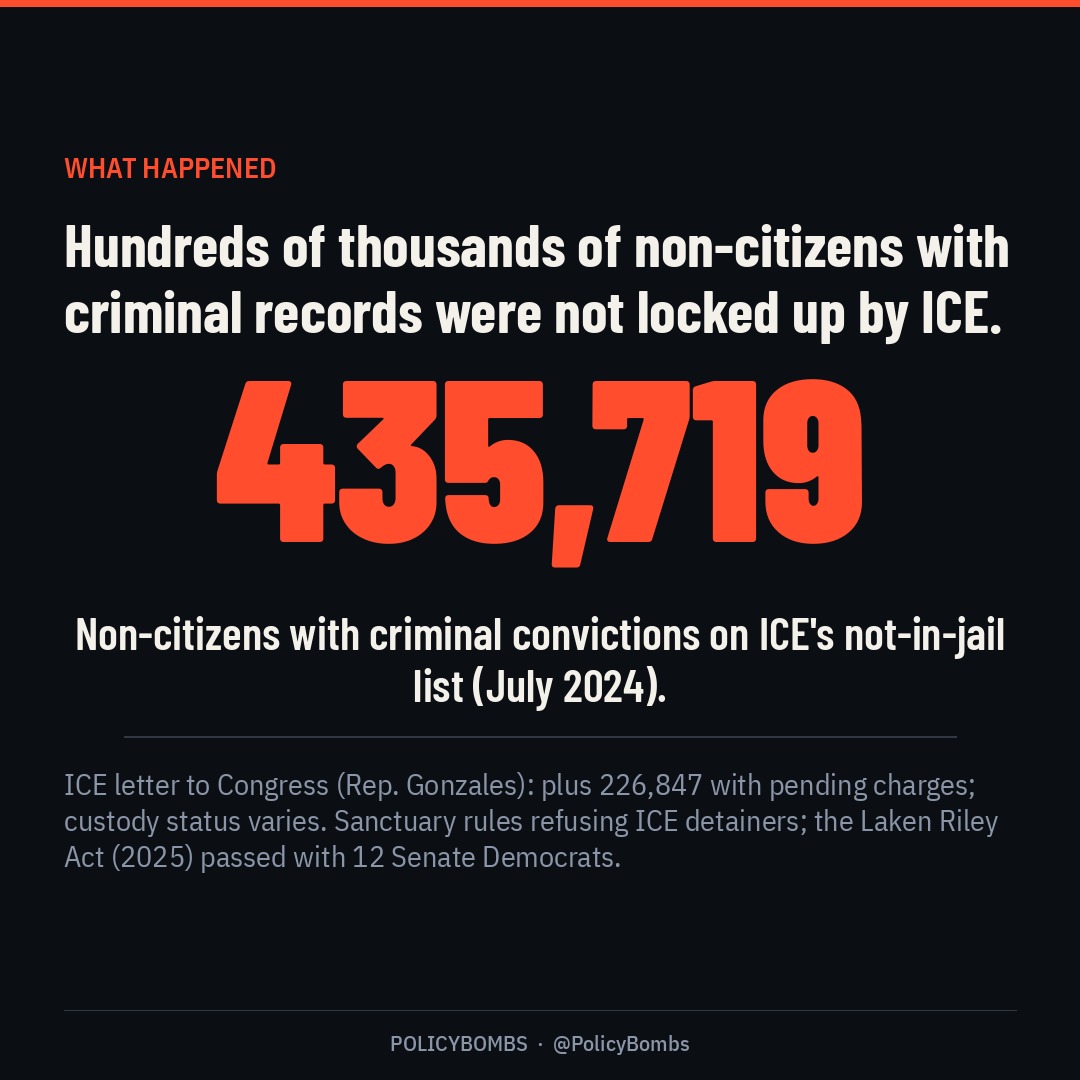
435,719. Noncitizens with criminal convictions on ICE's non-detained docket as of July 2024 — plus 226,847 with pending charges (ICE letter to Congress).

Not all are on the streets; custody status varies. But sanctuary rules that refuse ICE detainers create identifiable failures — Laken Riley's murder became the name of a 2025 law that 12 Senate Democrats helped pass.

Rate studies don't cancel absolute victims. High inflows raise the count of rare violent offenders.

PRO: Many studies find immigrants overall commit crime at lower rates than natives; ~76% of federal noncitizen convictions are immigration offenses (GAO).

CON / COST: Refusing detainers on known criminal removable aliens produces preventable victims.

SOCIETY: BAD — when policy blocks removal of criminal noncitizens, citizens pay in victimization.


Full analysis

Crimes by Illegal Immigrants: Sanctuary Policy, ICE Limits, and Case Evidence

ICE noncitizen criminal docket figures, sanctuary/detainer limits, high-volume illegal immigration context, and individual cases (Laken Riley / Jose Ibarra; Rachel Morin) — without inventing rates. New page focused on crime; overlaps prior Illegal Immigration canvas. As of Nov 5, 2026.

Content as of Nov 5, 2026, 6:08 AM ET. Source Page: PolicyBombs canvas

Long-form deep analysis. Companion to the 10-minute quick reference (10-crimes-by-illegal-immigrants-summary.docx).

Contents

  • 10-Minute Lazy Voter Guide
  • 1. What is the policy
  • 2. Why it exists
  • 3. Realized effects
  • Cases that mattered
  • Who supports / who opposes
  • 4. Good or bad for society
  • References
  • Gaps / unverified

10-Minute Lazy Voter Guide

Who’s for / against: For sanctuary limits on ICE: progressive city/state Democrats (e.g., CA SB 54). For mandatory detainers / deportation of criminal noncitizens: Republicans, Laken Riley Act bipartisan coalition (12 Senate Democrats). Academic literature often finds no sanctuary-driven crime spike; victims’ families experience policy as preventable tragedy.

Arguments minimizing the issue

Arguments the issue is urgent

+ Many studies find immigrants overall have lower crime rates than natives

+ GAO: most federal noncitizen convictions are immigration offenses

+ Sanctuary studies often find no significant violent-crime increase

– ICE July 2024 docket: hundreds of thousands of noncitizens with convictions/charges, including thousands with homicide/sexual-assault convictions (non-detained bucket includes people in other custody)

– Laken Riley and Rachel Morin murders: illegal-entrant defendants; life sentences

– Small absolute counts can decide elections and destroy families — policy should prioritize removable criminal aliens

Verdict for voters: Aggregate rate debates do not excuse releasing or declining to hold known criminal removable aliens. High illegal inflows raise absolute counts of rare violent offenders even if rates are low. Sanctuary detainer refusals create identifiable preventable-harm cases. Fix: detain and remove criminal noncitizens first — not spin.

1. What is the policy

Item

Detail

Assessment

Sanctuary rules

State/local limits on honoring ICE detainers or sharing release dates absent judicial warrant (e.g., CA Values Act SB 54).

Substantiated

ICE priority memos (Biden era)

Narrowed interior enforcement emphasis toward threats — in practice left large non-detained docket.

Substantiated

Border volume context

Record encounters FY21–24 increased absolute entries of people later charged with crimes (subset).

Substantiated

Laken Riley Act (2025)

Tightened detention for certain noncitizen accused/convicted of theft/assault-type offenses; bipartisan enactment.

Substantiated

2. Why it exists

Stated reasons (sanctuary): community trust so victims report crime; avoid racial profiling; immigration is federal.

Underlying drivers: Progressive coalition politics; immigrant-advocacy NGOs; local desire to avoid ICE controversy; federal incapacity/unwillingness to detain at scale. Corruption hypothesis: some jurisdictions’ migrant-services contractors profit from large noncitizen populations (see NYC DocGo anomaly on immigration page) — that is fiscal capture adjacent to sanctuary, not proof mayors want murders. Honest assessment: ideology + bureaucracy explain detainer refusals better than bribes; the body count of edge cases is still a moral indictment.

3. Realized effects

Data point

Figure

Caveat

Source

Tag

Noncitizens with convictions on ICE docket

435,719 (Jul 2024 ICE letter)

Historical docket; not all free on streets

ICE response to Rep. Gonzales

Substantiated

With pending charges

226,847

Same caveat

ICE

Substantiated

Homicide convictions (non-detained reporting)

13,099 cited in public debate

Includes various custody statuses; interpret carefully

ICE / AP explainers

Substantiated with caveat

Sexual assault convictions (non-detained reporting)

15,811 cited

Same

ICE / AP

Substantiated with caveat

Federal noncitizen convictions composition

~76% immigration-related FY18–23

Federal courts ≠ street crime

GAO-24-107598

Substantiated

AP and fact-checkers correctly warn against treating the entire ICE criminal docket as "Biden released murderers onto Main Street." Equally, dismissing the docket because "immigrants commit less crime" dodges the removable-criminal-alien problem the law already prioritizes.

Cases that mattered

Case

Facts

Policy link

Tag

Laken Riley / Jose Ibarra

UGA nursing student murdered Feb 2024; Ibarra (Venezuelan illegal entrant) convicted, life without parole

Prior ICE encounters/releases; Athens-Clarke detainer practice disputed as ‘sanctuary’

Substantiated

Rachel Morin / Victor Martinez-Hernandez

Maryland mother murdered; illegal-entrant defendant convicted, life sentence

Illegal presence + violent crime

Substantiated

Small numbers matter: one preventable murder is a total loss for that family. Elections have turned on less.

Who supports / who opposes

Who

Party / level

Position

Evidence

Ref

Sen. Katie Britt + 12 Senate Democrats

Bipartisan

For tougher criminal-alien detention

Laken Riley Act S.5 (2025)

[1]

CA Legislature / Gov. Brown era

Democrat

For sanctuary limits

SB 54 (2017)

[2]

Pres. Trump / DHS 2025+

Republican

Against sanctuary; mass removal push

Enforcement surge; funding fights

[3]

Clarke County Sheriff (Athens)

Local

Disputed sanctuary label; warrant policy

2024 public statements after Riley murder

[4]

House Homeland Republicans

Republican

Highlight ICE criminal docket

Published ICE letter 2024

[5]

Further reading (also listed in References):

4. Good or bad for society

Direct judgment: Bad to the extent policy prevents removal of criminal noncitizens or floods the country faster than vetting/ICE can work. Rate studies do not cancel absolute victimization. Fiscal: incarceration + victim costs. Bureaucracy: detainer ping-pong. Opportunity cost: every slot spent on low-priority cases while homicide convicts sit non-detained is malpractice.

  1. Mandatory ICE detainers for homicide, sexual assault, robbery, aggravated assault.
  2. Publish local detainer-decline lists with outcomes.
  3. Do not confuse ‘immigrant crime rate’ talking points with ‘remove criminal aliens’ duty.

References

[1] [1] Congress.gov S.5 Laken Riley Act. congress.gov. https://www.congress.gov/bill/119th-congress/senate-bill/5

[2] [2] CA SB 54. leginfo.legislature.ca.gov. https://leginfo.legislature.ca.gov/faces/billNavClient.xhtml?bill_id=201720180SB54

[3] [3] DHS enforcement news. dhs.gov. https://www.dhs.gov/

[4] [4] Atlanta News First: Clarke ICE policy. atlantanewsfirst.com. https://www.atlantanewsfirst.com/2024/03/07/clarke-county-sheriffs-office-explains-its-ice-policy-after-ongoing-speculation-following-laken-rileys-death/

[5] [5] ICE letter PDF (House Homeland). homeland.house.gov. https://homeland.house.gov/wp-content/uploads/2024/09/24-01143-ICEs-Signed-Response-to-Representative-Tony-Gonzales.pdf

[6] AP explainer on migrant criminal-past numbers. apnews.com. https://apnews.com/article/immigration-crime-border-detention-biden-trump-fc19e795599471c0ab21d76050a71a74

[7] GAO-24-107598 noncitizen federal incarcerations. gao.gov. https://www.gao.gov/products/gao-24-107598

[8] BBC: Ibarra life sentence. bbc.com. https://www.bbc.com/news/articles/c23829939rjo

Gaps / unverified

Item

Detail

Assessment

National illegal-immigrant homicide rate vs natives

Data incompleteness on status at arrest; Texas DPS series exists but methods debated.

Contested

How many ICE docket homicide convicts are free vs in prison

Public summaries blur custody status.

Pending clarity

PolicyBombs · Day 05. Follow @PolicyBombs on X.

Hunter Biden Laptop: Suppression and the ‘Russian Disinformation’ Label

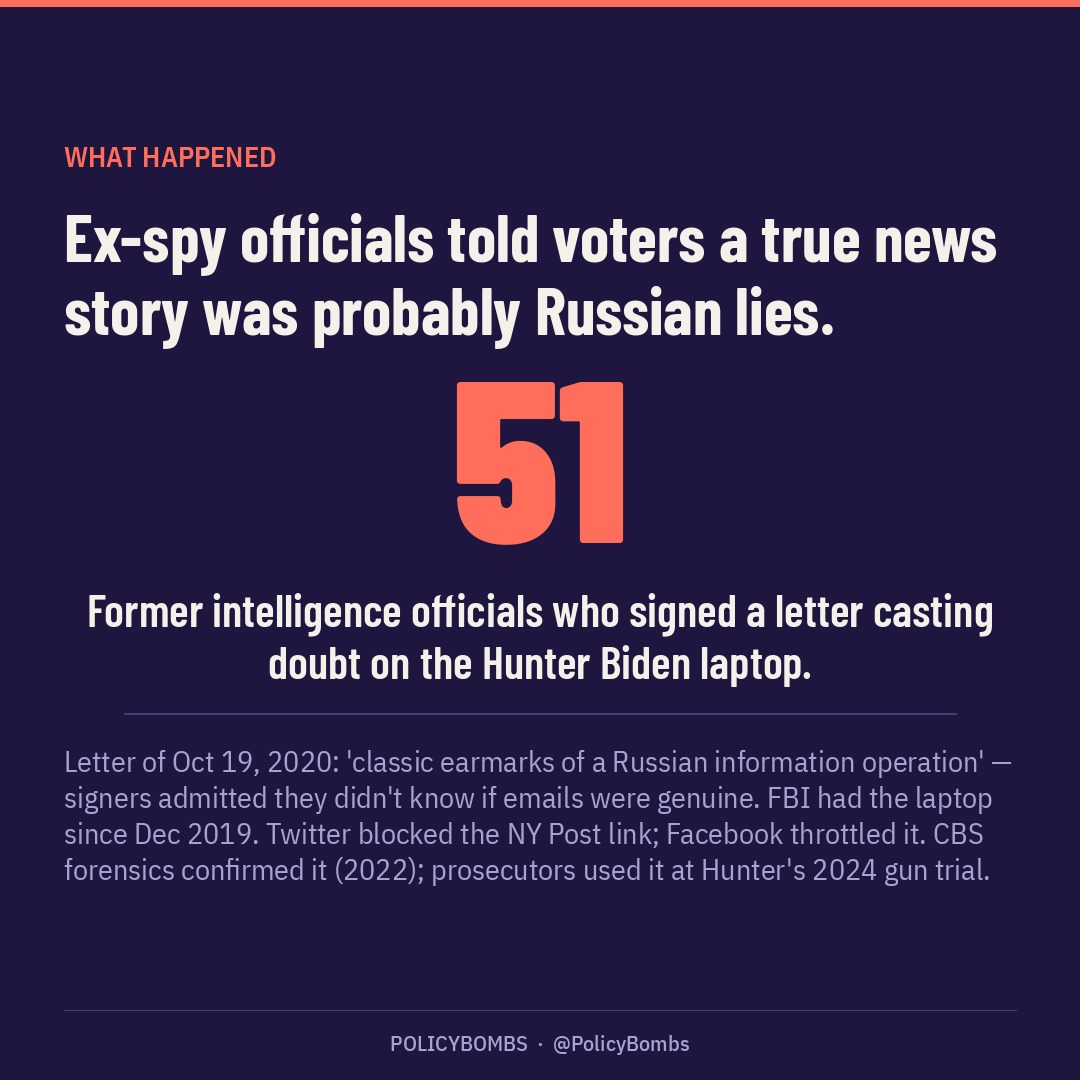
51. Former intelligence officials who signed an Oct 19, 2020 letter saying the Hunter Biden laptop story had the 'classic earmarks of a Russian information operation.'

They admitted they didn't know if the emails were genuine. The FBI had held the laptop since Dec 2019.

Twitter blocked the NY Post link. Facebook throttled it.

The laptop was real: CBS forensics confirmed it in 2022, and federal prosecutors used it at Hunter's 2024 gun trial.

PRO: Russia had run hack-and-leak operations before (DNC 2016); chain of custody looked messy in 2020.

CON / COST: An authentic story about a candidate's family business was suppressed weeks before an election.

SOCIETY: BAD — elite-driven suppression of a true story corroded trust in elections and media.


Full analysis

Hunter Biden Laptop: Suppression and the ‘Russian Disinformation’ Label

How media, tech platforms, and 51 former intel officials framed the Oct 2020 NY Post laptop story as likely Russian disinfo — while the FBI already had the authentic device — and what House Judiciary, Twitter Files, and later trials showed. As of Nov 5, 2026.

Content as of Nov 5, 2026, 6:05 AM ET. Source Page: PolicyBombs canvas

Long-form deep analysis. Companion to the 10-minute quick reference (04-hunter-biden-laptop-summary.docx).

Contents

  • 10-Minute Lazy Voter Guide
  • 1. What is the policy
  • 2. Why it exists
  • 3. Realized effects
  • Timeline and primary facts
  • Who supports / who opposes
  • 4. Good or bad for society
  • References
  • Gaps / unverified

10-Minute Lazy Voter Guide

Who’s for / against: Defended suppression / skepticism in Oct 2020: many Democratic officials, 51 ex-intel signatories, Twitter/Facebook moderators. Opposed suppression: NY Post, Trump campaign, later House Judiciary Republicans, Elon Musk via Twitter Files. Laptop authenticity later used by DOJ at Hunter’s trial — the ‘fake Russian plant’ theory collapsed.

Arguments for caution in 2020

Arguments that suppression was wrong

+ Russia had run hack-and-leak ops before (DNC 2016)

+ Giuliani chain of custody looked messy to outsiders

+ Platforms claimed they were applying hacked-materials rules

– FBI had the laptop since Dec 2019 and had authenticated it

– 51 officials said ‘earmarks’ while admitting no evidence of Russian involvement

– Twitter blocked links; Facebook throttled; voters lost information pre-election

Verdict for voters: This is one of the clearest documented election-adjacent information operations by domestic elites — not Russian spies. The laptop was real. The disinfo label was speculative cover that platforms treated as a cue to suppress. Bad for democratic legitimacy.

1. What is the policy

Not a law. A coordinated narrative and platform practice:

Item

Detail

Assessment

NY Post story (Oct 14, 2020)

Emails from Hunter Biden laptop left at a Delaware repair shop; Burisma/CEFC-related correspondence.

Substantiated

51 former intel officials letter (Oct 19, 2020)

Said story had ‘classic earmarks of a Russian information operation’ while stating they did not know if emails were genuine and had no evidence of Russian involvement.

Substantiated

Twitter / Facebook actions

Twitter blocked posting/DMing the link under hacked-materials policy; Facebook reduced distribution pending fact-checks.

Substantiated

FBI pre-briefings

FITF warned platforms about possible Russian hack-and-leak; after the story, FBI declined to tell platforms the laptop was real (per Dehmlow interview cited by House Judiciary).

Substantiated (committee record)

2. Why it exists

Stated reasons: stop foreign election interference; apply hacked-content rules; be careful with unverified dumps.

Underlying drivers: Partisan fear that authentic Biden-family influence evidence would hurt the 2020 ticket; institutional anti-Trump alignment in national-security alumni networks; platform desire to avoid a repeat of 2016 blame. Corruption/manipulation hypothesis: this fits manipulation of information power better than classic bribery. House Judiciary letter (Jul 20, 2023) states FITF personnel knew the laptop was not Russian disinfo yet the Bureau refused to answer platforms’ authenticity questions after conditioning them to expect a hack-and-leak. Zuckerberg told Joe Rogan FBI warnings prompted Facebook’s throttling. Tag: suppression mechanism substantiated; a criminal conspiracy indictment against the 51 signatories has not issued — speech can be wrong and still be speech.

3. Realized effects

Effect

Evidence

Tag

Pre-election information asymmetry

Major platforms limited NY Post distribution for days/weeks

Substantiated

Public narrative: ‘Russian disinfo’

Cable/press amplification of 51-letter framing

Substantiated

Later authentication

CBS forensic analysis (2022); Weiss prosecutors used laptop at gun trial (2024)

Substantiated

Missouri v. Biden litigation commentary

District court criticized FBI failure to correct the record

Substantiated (trial-court findings; appellate path complex)

Electoral impact

Could have shifted a close election; not rigorously proven as decisive

Unverified magnitude

"We want to emphasize that we do not know if the emails … are genuine or not and that we do not have evidence of Russian involvement—just that our experience makes us deeply suspicious…"

— 51 former intelligence officials, Oct 19, 2020

That caveat was widely dropped in headlines. The suspicion did the political work.

Timeline and primary facts

Date

Event

Source

Dec 2019

FBI obtains laptop from Delaware shop chain of custody

House Judiciary / IRS interviews

2020 (pre-Oct)

Dozens of FBI/CISA-industry meetings; hack/leak warnings

House Judiciary letter Jul 20, 2023

Oct 14, 2020

NY Post publishes Burisma email story

NY Post

Oct 14–

Twitter blocks; Facebook throttles

Twitter Files; Zuckerberg/Rogan

Oct 19, 2020

51 officials letter released via Politico

Public statement

2022+

Media outlets authenticate emails; Twitter Files drop

CBS, others

2024

Laptop evidence used in Hunter gun trial

Weiss filings / trial

Who supports / who opposes

Who

Party / level

Position

Evidence

Ref

James Clapper, Mike Morell, et al. (51)

Ex-intel / mixed

Suggested Russian earmarks

Signed Oct 19, 2020 letter

[1]

Joe Biden campaign 2020

Democrat

Amplified disinfo framing

Debate/remarks pointing to intel letter

[2]

Mark Zuckerberg

Meta CEO

Later said FBI warning drove throttle

Joe Rogan interview Aug 2022

[3]

Rep. Jim Jordan (R-OH)

Republican

Opposed; investigated FBI-platform pipeline

Judiciary letters / hearings

[4]

NY Post editors

Media

Opposed suppression

Continued publishing; sued/criticized bans

[5]

Further reading (also listed in References):

4. Good or bad for society

Direct judgment: Bad. Suppressing an authentic story about a presidential candidate’s family business dealings — via speculative intel branding and platform choke points — is elite election interference by another name. Fiscal cost is indirect; legitimacy cost is direct. Secondary effect: public distrust of intel alumni and "disinformation" bureaucracies. Opportunity cost: voters could not weigh Burisma/CEFC evidence before ballots.

  1. Platforms should not throttle domestic press based on anonymous government vibes.
  2. Ex-officials should not launder campaign messaging as intel consensus.
  3. FBI must correct false foreign-disinfo implications when it knows better.

References

[1] [1] 51 officials statement (Politico/WSJ text). politico.com. https://www.politico.com/news/2020/10/19/hunter-biden-laptop-russia-430172

[2] [2] Presidential debate references 2020. commissionondebates.org. https://www.debates.org/

[3] [3] BBC: Zuckerberg on FBI warnings. bbc.com. https://www.bbc.com/news/world-us-canada-62688532

[4] [4] House Judiciary letter to Wray Jul 20, 2023. judiciary.house.gov. https://judiciary.house.gov/sites/evo-subsites/republicans-judiciary.house.gov/files/evo-media-document/2023-07-20-jdj-to-wray-re-dehmlow-testimony.pdf

[5] [5] NY Post original laptop story. nypost.com. https://nypost.com/2020/10/14/email-reveals-how-hunter-biden-introduced-ukrainian-businessman-to-dad/

[6] CBS: laptop data analysis. cbsnews.com. https://www.cbsnews.com/news/hunter-biden-laptop-data-analysis/

[7] CNN: laptop as trial evidence. cnn.com. https://www.cnn.com/2024/05/22/politics/hunter-biden-laptop-gun-trial-special-counsel

[8] Newsweek fact check on 51 letter wording. newsweek.com. https://www.newsweek.com/hunter-biden-laptop-jim-jordan-facebook-disinformation-twitter-1767369

Gaps / unverified

Item

Detail

Assessment

Exact vote swing attributable to suppression

Polls exist; causal ID is contested.

Unverified magnitude

Criminal liability of letter signatories

No successful prosecution; First Amendment protects bad takes.

Cleared as crime; substantiated as false framing

PolicyBombs · Day 04. Follow @PolicyBombs on X.

Afghanistan Withdrawal 2021: Evacuation Failure and Equipment Left Behind

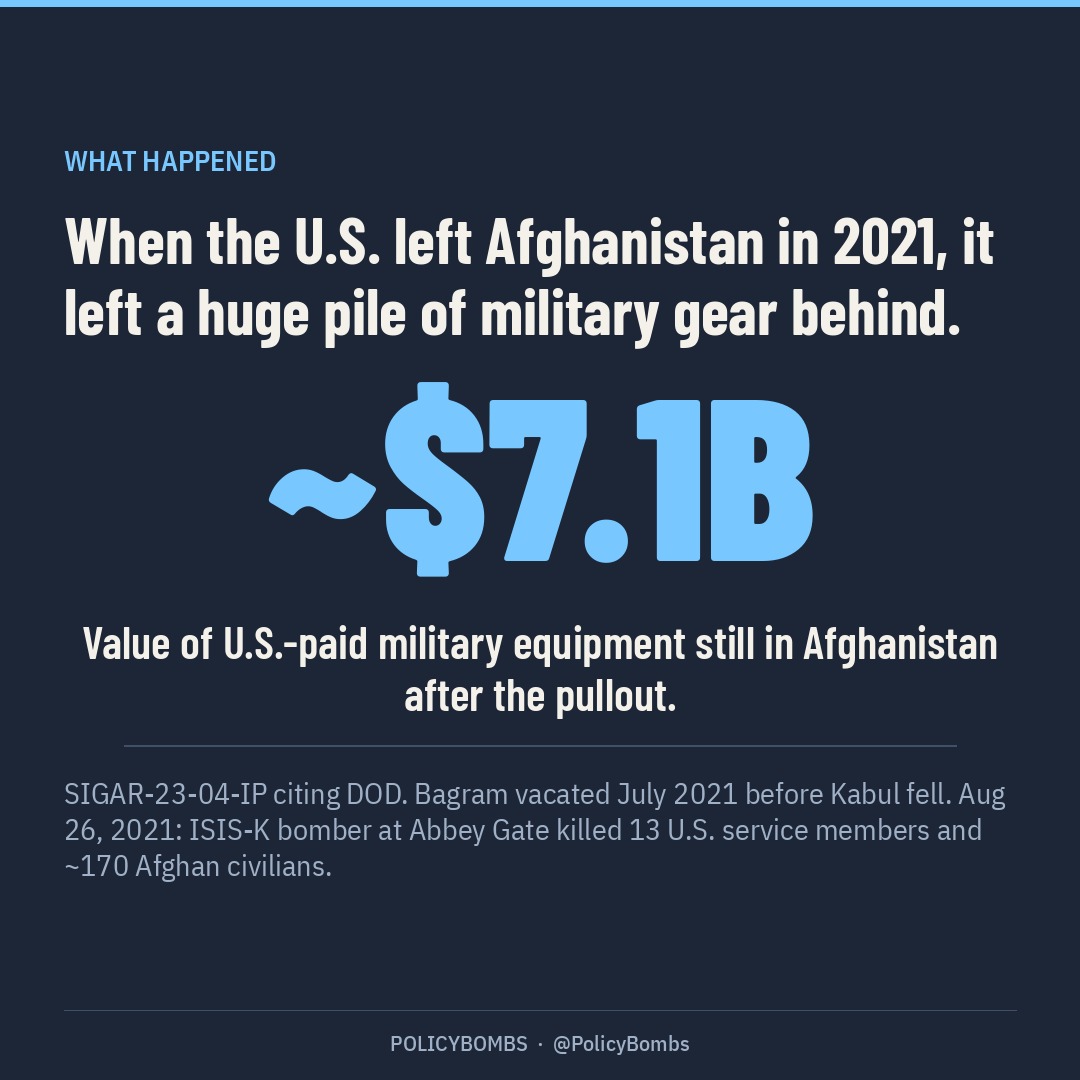
~$7.1 billion. That's the US-funded military equipment DOD told Congress remained in Afghanistan after the 2021 withdrawal (SIGAR).

Bagram was vacated in July 2021 — before Kabul fell — funneling the evacuation into one airport under Taliban outer security.

Aug 26, 2021: an ISIS-K bomber at Abbey Gate killed 13 US service members and ~170 Afghan civilians.

Ending a 20-year war was a legitimate choice. Executing it this way was a governance failure.

PRO: Ended America's longest war; the 2020 Doha deal had already committed the US to leave.

CON / COST: 13 US troops and ~170 civilians killed at Abbey Gate; ~$7.1B in equipment left; allies and Afghan partners abandoned.

SOCIETY: BAD — the exit itself was defensible; the execution cost lives, credibility and billions.


Full analysis

Afghanistan Withdrawal 2021: Evacuation Failure and Equipment Left Behind

August 2021 Kabul collapse, Abbey Gate bombing, SIGAR’s ~$7.1B equipment figure, DOD/State process failures, and whether corruption or incompetence best explains the outcome. As of Nov 5, 2026.

Content as of Nov 5, 2026, 6:04 AM ET. Source Page: PolicyBombs canvas

Long-form deep analysis. Companion to the 10-minute quick reference (02-afghanistan-withdrawal-summary.docx).

Contents

  • 10-Minute Lazy Voter Guide
  • 1. What is the policy
  • 2. Why it exists
  • 3. Realized effects
  • Investigations and anomalies
  • Who supports / who opposes
  • 4. Good or bad for society
  • References
  • Gaps / unverified

10-Minute Lazy Voter Guide

Who’s for / against: For a rapid 2021 exit on Biden’s timeline: Biden administration. For conditions-based / slower drawdown or staying: many Republicans, some military commanders in after-action critiques. Trump also negotiated the 2020 Doha deal that set withdrawal in motion — bipartisan ownership of exit, partisan fight over execution.

Arguments for withdrawing

Arguments against how it was done

+ End America’s longest war; stop US combat deaths after 20 years

+ Doha framework already committed the US to leave

+ Nation-building had failed despite trillions spent

– 13 US service members and ~170 civilians killed at Abbey Gate (Aug 26, 2021)

– Afghan government collapse; allies stranded; Bagram vacated early

– DOD reported ~$7.1B in US-funded defense articles left in-country (SIGAR caveats on inventory quality)

Verdict for voters: Ending the war was a legitimate strategic choice. Executing the exit by abandoning Bagram, compressing the embassy collapse into chaos, and leaving unverified mountains of gear was a governance failure. SIGAR and DOD IG document process breakdown, not a tidy "victory over forever war."

1. What is the policy

Item

Detail

Assessment

Doha Agreement (Feb 2020)

Trump administration deal with Taliban: US troop withdrawal in exchange for Taliban counterterror assurances and intra-Afghan talks. Afghan government was not a party.

Substantiated

Biden confirmation of exit

April 2021: Biden announced full withdrawal by Sept 11, 2021 (later Aug 31). Rejected conditions-based advice from some commanders.

Substantiated

Bagram vacated

US left Bagram Airfield July 2021 before Kabul fell — concentrating evacuation on HKIA under Taliban outer security.

Substantiated

NEO / Abbey Gate

Noncombatant evacuation amid collapse; ISIS-K suicide bombing Aug 26 killed 13 US troops and large numbers of Afghan civilians.

Substantiated

2. Why it exists

Stated reasons: war unwinnable; focus on China/Russia; honor Doha; stop American deaths; Afghans must stand for themselves.

Underlying drivers: Domestic war fatigue across parties; Biden’s long-standing skepticism of Afghanistan escalation; political desire to claim "end of forever wars" before midterms; sunk-cost fatigue after $2T+ reconstruction/war spending. Corruption/capture hypothesis for the twenty-year war: SIGAR spent years documenting Afghan elite theft of US aid, ghost soldiers, and contractor waste — that legacy corruption hollowed the ANSF that collapsed in days. For the 2021 exit decision itself: evidence points more to flawed assumptions (ANSF hold; slow Taliban advance) and rigid timeline politics than to a bribe. DOD 2025 departmental review and earlier after-action reports cite indecision and planning gaps. Say plainly: reconstruction-era graft is heavily documented; "Biden sold the withdrawal for personal gain" is not established by SIGAR/DOD IG.

3. Realized effects

Item

Figure / fact

Source

Tag

US service members killed Abbey Gate

13

DOD

Substantiated

Afghan civilian deaths Abbey Gate (approx.)

~170

DOD / contemporaneous reporting

Substantiated (approx.)

US-funded defense articles remaining (DOD to Congress)

~$7.1 billion

SIGAR-23-04-IP citing DOD Mar 2022

Substantiated with caveats

Equipment demilitarized at HKIA (examples)

70 MRAPs; 80 aircraft rendered inoperable (ad hoc)

SIGAR-23-04-IP

Substantiated

DIA note on Taliban aircraft repair

Taliban claimed repair of 7 former AAF aircraft

SIGAR citing DIA memo

Substantiated claim

On-budget FY21 funds to Afghan gov before collapse

Hundreds of millions (DOD/State/USAID breakdowns in SIGAR)

SIGAR-23-04-IP

Substantiated

Evacuees airlifted

~120,000+ in NEO window (US + allies)

State/DOD contemporaneous

Substantiated (order of magnitude)

Important SIGAR caveat: DOD CoreIMS inventory controls were unreliable historically; the $7.1B is what DOD reported remaining, not an audited garage inventory of working gear. Much equipment needs contractor maintenance and degrades — still a strategic gift of residual capability and propaganda win for the Taliban.

Investigations and anomalies

Finding

Source

Conclusion

Sensitive equipment monitoring failures pre-collapse

SIGAR 21-11-AR

DOD did not conduct required monitoring of sensitive articles

Withdrawal records / sensitive data handling

DODIG-2021-111

Management advisory: poor handling of equipment with sensitive information; weak retention

Taliban access to remaining funds/equipment

SIGAR-23-04-IP

Pre-FY21 on-budget funds likely spent; FY21 flows and $7.1B equipment remained as reported

After-action: indecisive civilian guidance

Declassified AARs / WaPo 2022; DOD 2025 review

Commanders described compressed timelines and shifting guidance

Anomaly: the US spent two decades building an Afghan force that evaporated in weeks while US contractors and elite networks had extracted enormous sums. That is the corruption story that matters — long-run capture of reconstruction — more than a last-week conspiracy.

Who supports / who opposes

Who

Party / level

Position

Evidence

Ref

Pres. Biden

Democrat

For rapid exit

Apr 14, 2021 withdrawal speech; held to Aug 31 deadline

[1]

Pres. Trump (2020)

Republican

For exit (Doha)

Feb 29, 2020 Doha Agreement signed

[2]

House Republicans (2021–22)

Republican

Against execution

Multiple oversight hearings; Afghanistan War Commission push

[3]

Sec. Lloyd Austin / Gen. Milley (public)

Biden officials

Defended plan with regrets

Congressional testimony Aug–Sep 2021

[4]

Sen. Mitch McConnell (R-KY)

Republican

Against chaotic exit

Floor statements blaming Biden planning after Kabul fall

[5]

Further reading (also listed in References):

4. Good or bad for society

Direct judgment: The war’s continuation had diminishing returns; a competent withdrawal could have been defensible. The actual 2021 execution was bad for US credibility, allied trust, Afghan partners left behind, and the families of Abbey Gate dead. Fiscal legacy includes wasted reconstruction plus residual equipment value transferred by collapse. Bureaucracy failed at basic contingency planning. Opportunity cost: diverted attention and readiness during a period of rising peer competition.

  1. Separate ‘should we leave’ from ‘how we leave’ — voters should punish incompetence even if they backed exit.
  2. Read SIGAR before accepting anyone’s tidy narrative.
  3. Demand published NEO playbooks and accountable timelines for future exits.

References

[1] [1] Biden withdrawal remarks Apr 2021. whitehouse.gov. https://www.whitehouse.gov/briefing-room/speeches-remarks/2021/04/14/remarks-by-president-biden-on-the-way-forward-in-afghanistan/

[2] [2] State Dept: Doha Agreement. state.gov. https://www.state.gov/agreement-for-bringing-peace-to-afghanistan/

[3] [3] House Foreign Affairs Afghanistan oversight. foreignaffairs.house.gov. https://foreignaffairs.house.gov/

[4] [4] Senate Armed Services hearings 2021. armed-services.senate.gov. https://www.armed-services.senate.gov/

[5] [5] McConnell statements on Afghanistan. republicanleader.senate.gov. https://www.republicanleader.senate.gov/

[6] SIGAR-23-04-IP: Taliban access to funds/equipment. sigar.mil. https://www.sigar.mil/Portals/147/Files/Reports/Audits-and-Inspections/Evaluation/SIGAR-23-04-IP.pdf

[7] SIGAR 21-11-AR: Sensitive articles monitoring. sigar.mil. https://www.sigar.mil/pdf/audits/SIGAR-21-11-AR.pdf

[8] DODIG-2021-111 management advisory. dodig.mil. https://www.dodig.mil/reports.html/Article/2730501/management-advisory-handling-of-equipment-with-sensitive-information-and-record/

[9] DOD departmental review of 2021 withdrawal (2025). defense.gov. https://media.defense.gov/2025/May/20/2003719398/-1/-1/1/DEPARTMENTAL-REVIEW-OF-THE-US-MILITARY-WITHDRAWAL-FROM-AFGHANISTAN-IN-2021.PDF

[10] NTSB is not the source — Abbey Gate contemporaneous DOD releases. defense.gov. https://www.defense.gov/

Gaps / unverified

Item

Detail

Assessment

Exact working inventory Taliban fielded

DIA/SIGAR fragments only; no complete public working census.

Pending

Personal financial corruption in exit decision

Not shown in IG record.

Not supported

PolicyBombs · Day 03. Follow @PolicyBombs on X.

Inflation Spike 2021–2023: American Rescue Plan and Policy Drivers

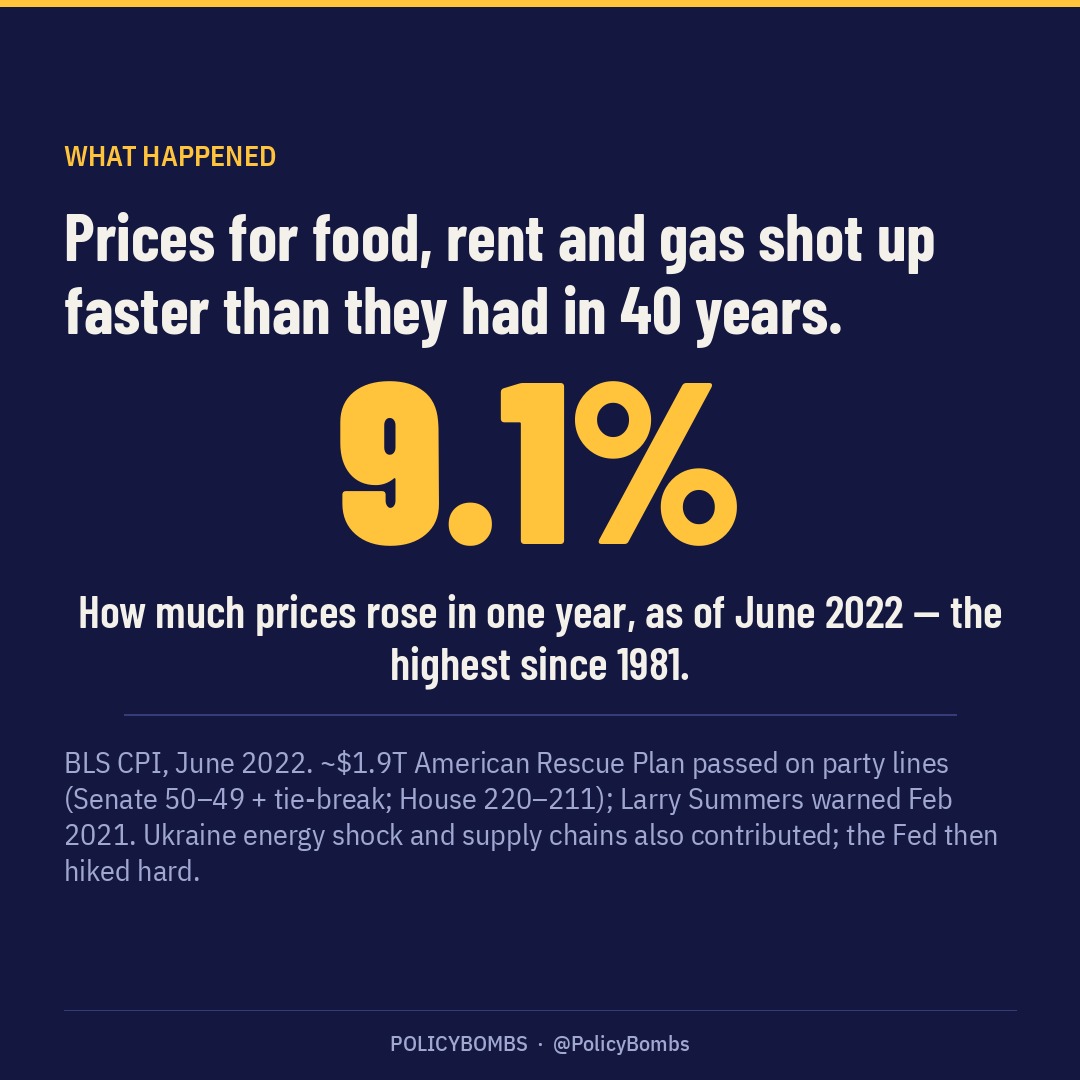
9.1%. Inflation in June 2022 — the highest since 1981.

Fifteen months earlier, the ~$1.9T American Rescue Plan passed on a party line: Senate 50–49 with a tie-break, House 220–211. Democratic economist Larry Summers warned in Feb 2021 it was far too large.

The Ukraine energy shock and broken supply chains piled on — it wasn't the only cause. But denying the stimulus' demand role is ideology, not economics.

Households paid on rent, food and fuel. Then the Fed hiked hard.

PRO: Early-2021 COVID uncertainty was real; the expanded child tax credit cut child poverty temporarily.

CON / COST: A 40-year inflation spike hit rent, food and fuel; higher rates raised federal debt service.

SOCIETY: BAD — temporary relief doesn't erase a 40-year price spike every household paid.


Full analysis

Inflation Spike 2021–2023: American Rescue Plan and Policy Drivers

CPI peak 9.1% (June 2022), ARP $1.9T party-line stimulus, energy/regulatory policy, supply shocks, Summers warnings, and who was right. New focused page overlapping prior Inflation vs Wages canvas. As of Nov 5, 2026.

Content as of Nov 5, 2026, 6:07 AM ET. Source Page: PolicyBombs canvas

Long-form deep analysis. Companion to the 10-minute quick reference (07-inflation-spike-summary.docx).

Contents

  • 10-Minute Lazy Voter Guide
  • 1. What is the policy
  • 2. Why it exists
  • 3. Realized effects
  • Competing analyses
  • Who supports / who opposes
  • 4. Good or bad for society
  • References
  • Gaps / unverified

10-Minute Lazy Voter Guide

Who’s for / against: For ARP: Biden, all voting Senate Democrats, House Democrats (party-line). Against ARP: all Senate Republicans (50–49), House Republicans. Later inflation fight: Fed hiked; Democrats blamed Putin/corporate greed; Republicans blamed ARP/energy.

Arguments ARP was needed

Arguments ARP fueled inflation

+ COVID uncertainty remained in early 2021

+ Child tax credit cut child poverty temporarily

+ State/local aid prevented some austerity layoffs

– Larry Summers and others warned $1.9T was far too large vs output gap

– CPI hit 9.1% YoY June 2022 — worst in 40 years (BLS)

– Real wages lagged for lower/middle incomes during the spike

Verdict for voters: ARP was oversized relative to the remaining hole and hit an economy with broken supply chains. It was not the only cause (energy shock after Ukraine invasion, housing, supply) — but denying its demand role is ideology. Households paid an inflation tax; debt rose.

1. What is the policy

Item

Detail

Assessment

American Rescue Plan Act

H.R.1319; ~$1.9T; signed Mar 11, 2021. Senate 50–49 (Harris break); House 220–211.

Substantiated

Key contents

$1,400 checks; expanded UIC; state/local fiscal recovery; CTC expansion; school/transit/health pots.

Substantiated

Energy / regulatory overlay

Pause on new federal oil/gas leases (early EO), pipeline politics (Keystone XL cancel), later SPR releases — debated contribution to energy component of CPI.

Substantiated actions; effects contested

Fed response

Delayed liftoff then rapid hikes 2022–23 to crush demand.

Substantiated

2. Why it exists

Stated reasons: finish COVID rescue; go big; avoid 2009 austerity mistake; equity via CTC.

Underlying drivers: Unified Democratic government with thin margins; progressive pressure after 2020; desire for durable social-spending beachheads; electoral timing for 2022. Corruption hypothesis: ARP had ordinary special-interest carve-outs, but the core error looks more like macroeconomic hubris than pay-to-play. Fiscal motive: deficit finance a consumption boom. Summers (Democratic economist) publicly warned in Feb 2021 — ignored.

3. Realized effects

Chart data (shown as a chart on the Page)

Label

Value

CPI peak

9.1%

ARP size

$1.9T

Senate vote

50–49

Metric

Value

Source

Tag

CPI YoY June 2022

9.1% (highest since 1981)

BLS

Substantiated

ARP enactment

Mar 11, 2021

Congress.gov

Substantiated

SF Fed / others on ARP contribution

Material demand impulse; estimates vary (~0.3pp/yr to several points)

FRBSF; academic range

Contested magnitude

Ukraine invasion energy shock

Mar 2022+ gasoline/food spike overlay

CBO inflation visual guide

Substantiated

Inflation cooling 2023

Disinflation with higher rates + supply repair

BLS / CBO

Substantiated

Overlap note: prior PolicyBombs page "Inflation vs Wages, 2021–2026" covers wage catch-up. This page focuses on ARP/policy causation and political ownership.

Competing analyses

Camp

Claim

Assessment

Summers / Blanchard-type

ARP too large → overheat

Largely vindicated on direction

White House 2021–22

Transitory; greed/Putinflation

Incomplete; politics over models

Team Transitory (early Fed)

Supply heal without big demand pullback

Wrong timing; forced into hikes

Only-supply camp

ARP irrelevant

Not supported by most mainstream estimates

Who supports / who opposes

Who

Party / level

Position

Evidence

Ref

Pres. Biden / Sen. Schumer / Speaker Pelosi

Democrat

For ARP

Passed and signed H.R.1319

[1]

All Senate Republicans

Republican

Against ARP

Senate vote 50–49 Mar 6, 2021

[2]

Larry Summers

Democrat economist

Warned against size

Feb 2021 WaPo op-ed / interviews

[3]

Sen. Joe Manchin (D-WV)

Democrat

For ARP; later blocked BBB

ARP yes; resisted further trillion-scale social bill

[4]

Fed Chair Powell

Independent

Hiked into inflation

FOMC 2022–23 actions

[5]

Further reading (also listed in References):

4. Good or bad for society

Direct judgment: Bad macroeconomic policy at the margin. Temporary poverty relief does not erase a 40-year inflation spike that hit rent, food, and fuel. Fiscal cost: higher debt service as rates rose. Bureaucracy grew (state SLFRF compliance). Opportunity cost: burned political capital and Fed credibility. Corruption angle undersells it — this was public choice excess spending, not a secret cartel — still a failure.

  1. Size stimulus to the output gap, not the activist wishlist.
  2. Index emergency aid to expire with unemployment triggers.
  3. Don’t gaslight voters with ‘greed’ as the primary CPI model.

References

[1] [1] Congress.gov H.R.1319 ARP. congress.gov. https://www.congress.gov/bill/117th-congress/house-bill/1319

[2] [2] Senate roll call vote 117-1-110. senate.gov. https://www.senate.gov/legislative/LIS/roll_call_votes/vote1171/vote_117_1_00110.htm

[3] [3] Harvard Gazette: Summers on inflation. harvard.edu. https://news.harvard.edu/gazette/story/2022/02/pandemic-only-partly-to-blame-for-record-inflation-says-lawrence-summers/

[4] [4] Manchin ARP/BBB coverage. congress.gov. https://www.congress.gov/member/joe-manchin/M001183

[5] [5] BLS CPI June 2022 release. bls.gov. https://www.bls.gov/opub/ted/2022/consumer-prices-up-9-1-percent-over-the-year-ended-june-2022-largest-increase-in-40-years.htm

[6] CBO inflation visual guide 2020–23. cbo.gov. https://www.cbo.gov/system/files/2024-09/60480-Inflation.pdf

[7] FRBSF: Is ARP taking us back to the 60s?. frbsf.org. https://www.frbsf.org/research-and-insights/publications/economic-letter/2021/10/is-american-rescue-plan-taking-us-back-to-1960s/

[8] PolitiFact: ARP fueled inflation (also shortages). politifact.com. https://www.politifact.com/factchecks/2022/apr/20/jane-timken/bidens-american-rescue-plan-fueled-inflation-so-di/

Gaps / unverified

Item

Detail

Assessment

Exact ARP percentage-point contribution

Model-dependent; ranges disagree.

Contested

Lease-pause causal share of gasoline

Global crude dominates short run; domestic policy effects lagged/partial.

Contested

PolicyBombs · Day 02. Follow @PolicyBombs on X.

Southern Border Crossings: Catch-and-Release, Asylum Expansion, and Record Encounters

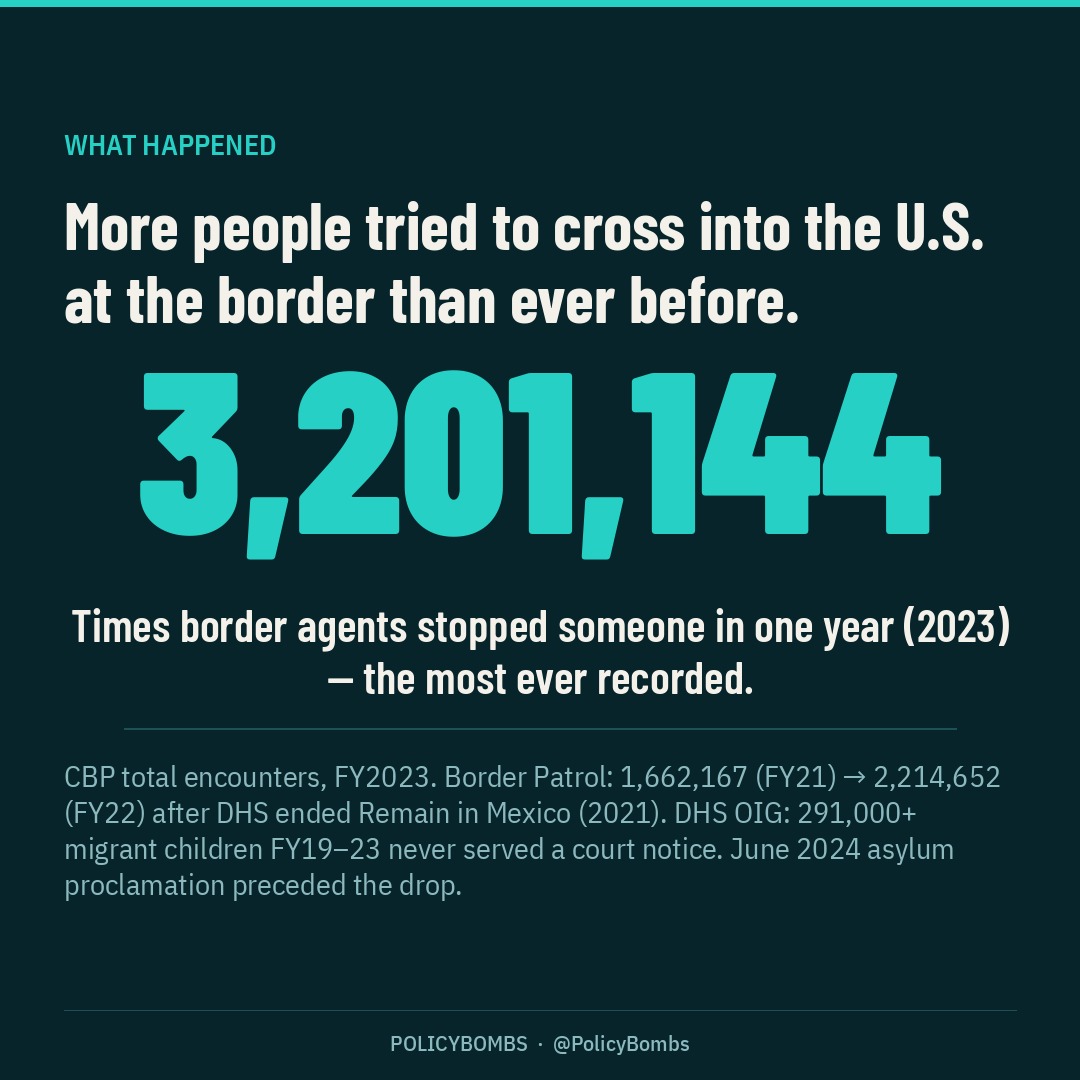
3,201,144. That's total CBP encounters in FY2023 — an all-time record.

It wasn't weather. In 2021 DHS ended Remain in Mexico, then released many crossers with Notices to Appear into courts backlogged for years. Border Patrol encounters went from 1,662,167 (FY21) to 2,214,652 (FY22).

The DHS Inspector General found 291,000+ migrant children transferred FY19–23 were never served a court notice.

Only after political pressure, June 2024, did a proclamation restrict asylum — and crossings fell.

PRO: Asylum seekers got a hearing instead of instant expulsion; CBO credited the surge with added labor and revenue.

CON / COST: Record illegal entries, overwhelmed courts, city budget shocks, cartel enrichment, and 291,000+ children never served court notices (DHS OIG).

SOCIETY: BAD — the 2021–24 surge was a policy choice that cities, courts and taxpayers are still paying for.


Full analysis

Southern Border Crossings: Catch-and-Release, Asylum Expansion, and Record Encounters

Biden-era termination of Remain in Mexico and Title 42, expanded parole/asylum processing, reduced interior enforcement, and CBP record encounters FY2021–24 — with DHS OIG findings, fiscal and trafficking costs, and a direct social verdict. As of Nov 5, 2026.

Content as of Nov 5, 2026, 6:04 AM ET. Source Page: PolicyBombs canvas

Long-form deep analysis. Companion to the 10-minute quick reference (01-southern-border-crossings-summary.docx).

Contents

  • 10-Minute Lazy Voter Guide
  • 1. What is the policy
  • 2. Why it exists
  • 3. Realized effects
  • Local investigations and anomalies
  • Who supports / who opposes
  • 4. Good or bad for society
  • References
  • Gaps / unverified

10-Minute Lazy Voter Guide

Who’s for / against: For catch-and-release / expansive asylum processing: Biden DHS (Mayorkas), most Democrats. For Remain in Mexico / Title 42-style expulsion / interior enforcement: Trump, most Republicans; some Democrats later backed Laken Riley Act and June 2024 asylum restrictions.

Arguments for the Biden approach

Arguments against

+ Humanitarian: asylum claims get a hearing instead of immediate expulsion

+ CBP One and parole were framed as orderly alternatives to illegal crossing

+ CBO credited the 2021–26 surge with lowering federal deficits via higher labor and revenue

– Record encounters (CBP: 3.20M total FY23) overwhelmed cities, courts, and ORR

– DHS OIG: 291,000+ unaccompanied children never served an NTA; trafficking risk rose

– Cartels monetized the pull factor; rule of law and legal immigration credibility eroded

Verdict for voters: The 2021–24 border surge was a policy choice with foreseeable pull effects, not a force of nature. Catch-and-release into multi-year court backlogs, ending MPP, and delayed Title 42 exit timing produced record crossings, city fiscal crises, and documented failures to track released children. Crossings later collapsed under harder enforcement — evidence that policy, not "root causes" alone, drove the numbers.

1. What is the policy

A cluster of Biden-Harris administration immigration actions that replaced Trump-era deterrence with processing, parole, and release pending distant hearings:

Item

Detail

Assessment

Remain in Mexico (MPP) ended

DHS Sec. Mayorkas terminated MPP June 1, 2021. Courts forced temporary restart; Supreme Court cleared termination June 2022; DHS ended it Aug 2022.

Substantiated

Title 42 ended

COVID-era public-health expulsions (Mar 2020–May 11, 2023) ended when the national emergency expired. Encounters then shifted fully to Title 8.

Substantiated

Catch-and-release / NTA processing

Many Title 8 border crossers released with Notices to Appear into immigration courts with multi-year backlogs; interior ICE priorities narrowed under Mayorkas memos.

Substantiated

Parole and CBP One

CHNV parole (~530,000), expanded TPS, and CBP One appointments at ports shifted some flows to ports while total encounters still hit records.

Substantiated

June 2024 asylum restriction

After political pressure, Biden issued a proclamation restricting asylum when daily encounters exceeded thresholds — crossings fell before the 2024 election.

Substantiated

2. Why it exists

Stated reasons: restore "humane" asylum processing; end "cruel" Trump policies; address "root causes" in Central America; process people lawfully at ports.

Underlying drivers (evidence-based assessment): Democratic coalition pressure from immigrant-advocacy NGOs and progressive activists; employer demand for low-wage labor with weak E-Verify; political incentive to contrast with Trump; asylum statute and TVPRA create durable legal pull for families and unaccompanied children; cartels earn smuggling fees and treat policy signals as market data. Corruption/capture hypothesis: emergency city migrant contracts (e.g., NYC DocGo) show waste and weak oversight when surge spending hits; federal ORR sponsor vetting failures are institutional neglect with trafficking risk — not proven cash-for-votes corruption at the White House level. Say so plainly: we did not find primary-source proof that border policy was sold for bribes; we do find interest-group capture, fiscal externalization onto cities, and inspector-general-documented operational failure.

3. Realized effects

CBP nationwide enforcement encounters (Title 8 + Title 42 where applicable):

Chart data (shown as a chart on the Page)

Label

Value

FY20

647K

FY21

1.96M

FY22

2.77M

FY23

3.20M

FY24

2.90M

Metric

Figure

Source

Tag

USBP encounters FY21

1,662,167

CBP FY24 stats

Substantiated

USBP encounters FY22 (peak)

2,214,652

CBP

Substantiated

Total CBP encounters FY23 (record)

3,201,144

CBP

Substantiated

USBP recidivism FY21

27%

CBP

Substantiated

UACs never served NTA

291,000+ (of 448,000+ transferred FY19–23)

DHS OIG-24-46

Substantiated

UACs who missed court

32,000+

DHS OIG-24-46

Substantiated

Immigration court backlog

~2.5M+ pending by FY23 end

DOJ EOIR / BJS

Substantiated

Cases dismissed for DHS NTA filing failure

~200,000 since 2021 (TRAC)

TRAC Syracuse

Substantiated

Item

Detail

Assessment

City fiscal strain

NYC spent multi-billion dollars at peak on migrant shelter; Denver, Chicago, and others declared emergencies.

High local cost

Child labor / trafficking risk

NYT (2023) and DOL WHD documented migrant minors in slaughterhouse sanitation and other hazardous work; HHS OIG found sponsor-vetting gaps.

Serious

Later reversal

Harder 2024–26 enforcement cut crossings sharply — strong evidence policy levers work both ways.

Substantiated

Local investigations and anomalies

Finding

Source

What investigators concluded

NYC $432M no-bid DocGo migrant housing: $11M of first $13.8M unsupported; empty room nights paid

NYC Comptroller audit 2024

Recommended recoupment; contract not renewed

ORR sponsor files missing required safety checks (16%); illegible IDs (35%); late follow-ups

HHS OIG OEI-07-21-00250, Feb 2024

ACF agreed to recommendations; fingerprinting tightened later

ICE cannot monitor all released UACs; hundreds of thousands without NTAs

DHS OIG-24-46 Aug 2024; OIG-25-21 Mar 2025

Heightened trafficking and absconder risk; management alert

~200,000 immigration cases dismissed because DHS failed to file paperwork

TRAC; House Judiciary letters to Mayorkas

Systemic NTA filing failure, not isolated clerk error

Anomaly read: release volume outran paperwork and sponsor vetting capacity. That is not "Russian disinformation"; it is inspector-general and comptroller record. Fraud-for-hire at the border (fake asylum coaching) is widely alleged; national quantified counts remain incomplete — tag Unverified at scale.

Who supports / who opposes

For = tougher deterrence/enforcement. Against = expansive release/asylum processing. Sourced Nov 5, 2026.

Who

Party / level

Position

Evidence

Ref

Alejandro Mayorkas / Biden DHS

Democrat / Cabinet

Against (ended MPP)

DHS termination of MPP June 1, 2021

[1]

Sen. James Lankford (R-OK), Chris Murphy (D-CT), Kyrsten Sinema (I-AZ)

Bipartisan

For (2024 border deal)

Failed cloture 49–50 Feb 7, 2024 after Trump opposition

[2]

Sen. Katie Britt + 12 Senate Democrats

Bipartisan

For

Laken Riley Act S.5 signed Jan 29, 2025; Senate 64–35

[3]

Pres. Biden (June 2024)

Democrat

Partial shift For

Proclamation restricting asylum at high encounter levels

[4]

Gov. Greg Abbott (R-TX)

Republican

For

Operation Lone Star; busing migrants; border barriers

[5]

Cross-party notes: 12 Senate Democrats backed Laken Riley Act. Republicans killed the 2024 Lankford deal. Biden himself restricted asylum in June 2024 after years of opposing Title 42-style tools.

Further reading (also listed in References):

4. Good or bad for society

Direct judgment: Bad for society at the 2021–24 scale. Measurable harms: record illegal entries, overwhelmed courts, city budget shocks, cartel enrichment, and inspector-general-documented failure to track released children. Claimed benefits (labor supply, humanitarian process) do not justify open-ended release into a 2.5M-case backlog. Opportunity cost: legal immigration and asylum credibility. Bureaucracy grew (parole offices, NGO shelter networks) while interior removal capacity did not keep pace. Later enforcement success shows the earlier surge was optional.

  1. Restore credible deterrence (returns, MPP-style waits, consequences for absconders).
  2. Mandatory E-Verify with real employer penalties.
  3. Fund asylum adjudication to months, not years; serve every NTA.
  4. ORR: fingerprint every sponsor, track every child, prosecute trafficking.

References

[1] [1] DHS: Termination of MPP (2021). dhs.gov. https://www.dhs.gov/news/2021/06/01/secretary-mayorkas-announces-termination-migrant-protection-protocols

[2] [2] Senate roll call Feb 7, 2024. senate.gov. https://www.senate.gov/legislative/LIS/roll_call_votes/vote1182/vote_118_2_00039.htm

[3] [3] Congress.gov S.5 Laken Riley Act. congress.gov. https://www.congress.gov/bill/119th-congress/senate-bill/5

[4] [4] White House asylum proclamation June 2024. whitehouse.gov. https://www.whitehouse.gov/briefing-room/presidential-actions/2024/06/03/a-proclamation-on-securing-the-border/

[5] [5] Texas DPS Operation Lone Star. dps.texas.gov. https://www.dps.texas.gov/news/operation-lone-star

[6] CBP Enforcement Statistics FY2024. cbp.gov. https://www.cbp.gov/newsroom/stats/cbp-enforcement-statistics-fy2024

[7] DHS OIG-24-46: ICE cannot monitor UACs. oig.dhs.gov. https://www.oig.dhs.gov/sites/default/files/assets/2024-08/OIG-24-46-Aug24.pdf

[8] HHS OIG: Gaps in sponsor screening (2024). oig.hhs.gov. https://oig.hhs.gov/reports/all/2024/gaps-in-sponsor-screening-and-followup-raise-safety-concerns-for-unaccompanied-children/

[9] TRAC: 200,000 cases dismissed for missing NTAs. tracreports.org. https://tracreports.org/reports/739/

[10] NYC Comptroller DocGo audit. comptroller.nyc.gov. https://comptroller.nyc.gov/reports/audit-of-the-department-of-housing-preservation-and-developments-oversight-of-its-contract-with-rapid-reliable-testing-ny-llc-aka-docgo/

[11] CBO: Immigration surge and the budget (2024). cbo.gov. https://www.cbo.gov/publication/60569

Gaps / unverified

Item

Detail

Assessment

Exact nationwide ‘gotaways’

CBP estimates exist but methodologies change; treat year-to-year gotaway totals carefully.

Pending

Asylum-coaching industry size

Widely reported; no single audited national dollar figure.

Unverified at scale

White House quid-pro-quo corruption

Not established by IG/court record for border policy design itself.

Not supported

PolicyBombs · Day 01. Follow @PolicyBombs on X.

Federal AI Regulation Risk After the Midterms: The Nov 5 Market Repricing

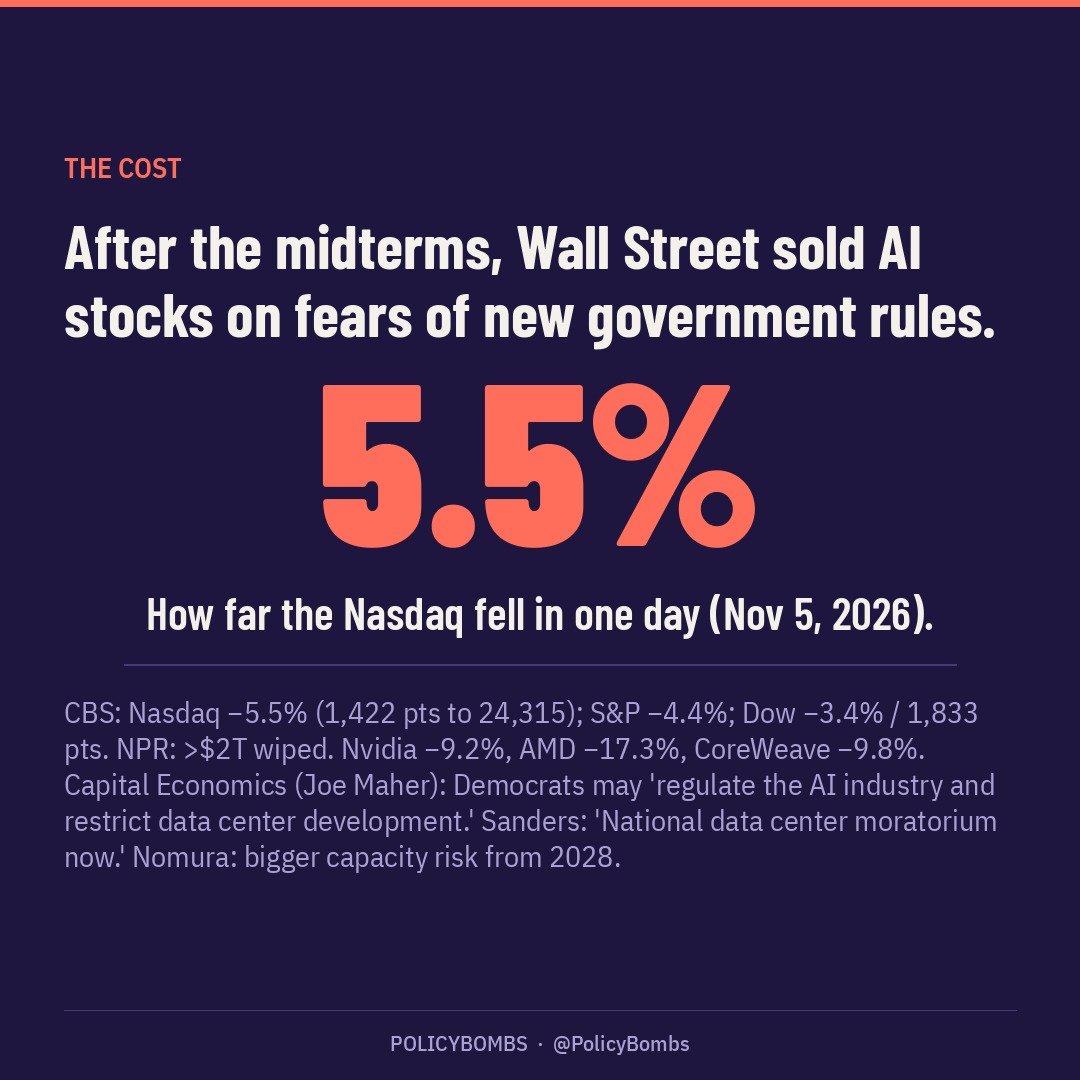
5.5%. That's how far the Nasdaq fell on Nov 5, 2026 — a one-day AI-policy scare after Democrats took Congress.

S&P 500 −4.4%. Dow −3.4% (~1,833 points). NPR: more than $2 trillion in market value wiped. Nvidia −9.2%, AMD −17.3%, CoreWeave −9.8% (CBS).

Capital Economics: the trigger was fear Democrats will "regulate the AI industry and restrict data center development." Sen. Bernie Sanders: "National data center moratorium now." Progressive Caucus chair Greg Casar wants AI CEOs under oath.

Wednesday's relief rally died Thursday when investors priced the mandate — not a signed bill, but expected rules on top of state pauses.

PRO: Voters who fear unconstrained AI buildout now have congressional power to write guardrails.

CON / COST: >$2T wiped on expected policy; a Sanders-style national freeze would hit U.S. compute leadership before any safety bill is drafted.

SOCIETY: MIXED — voters asked for AI guardrails and markets believed them; a national buildout freeze would be a strategic own-goal.


Full analysis

Federal AI Regulation Risk After the Midterms: The Nov 5 Market Repricing

Democratic control of the House and Senate plus anti-data-center governors triggered a Nov 5, 2026 tech rout — Nasdaq ~−5.5%, S&P ~−4.4%, Dow ~−3.4% (~1,833 points) — as investors priced federal AI rules and slower data-center buildout; >$2T market value wiped (NPR). As of Nov 5, 2026, 11:40 PM ET.

Content as of Nov 5, 2026, 11:40 PM ET. Source: primary reporting + Ballotpedia / campaign statements fetched this run

Long-form deep analysis. Companion to the 10-minute quick reference (70-federal-ai-regulation-post-midterms-summary.docx).

Contents

  • 10-Minute Lazy Voter Guide
  • 1. What is the policy
  • 2. Why it exists
  • 3. Realized effects
  • Local investigations and anomalies
  • Who supports / who opposes
  • 4. Good or bad for society
  • References
  • Gaps / unverified

10-Minute Lazy Voter Guide

The day after Democrats’ midterm sweep sank in, Wall Street sold AI and tech hard. Investors fear a Democratic Congress will pass new national rules on artificial intelligence and help states slow the giant computer buildings that power it. The Nasdaq had its correction-level drop; chipmakers got hit worst.

Verdict: MIXED — MIXED — voters asked for AI guardrails and markets believed them; a national buildout freeze would be a strategic own-goal.

Figure

Meaning

Tag

5.5%

Nasdaq Composite drop Nov 5, 2026 — 1,422 points to 24,315; index into >10% correction from October high (CBS News)

Substantiated

4.4%

S&P 500 drop — 335 points to 7,354 (CBS)

Substantiated

3.4% / 1,833 pts

Dow Jones Industrial Average plunge (CBS)

Substantiated

>$2T

Market value wiped as Nasdaq sank >5% (NPR Nov 5, 2026)

Substantiated

−9.2% / −17.3%

Nvidia / AMD one-day moves (CBS); CoreWeave −9.8%

Substantiated

~$100B

Anthropic IPO previously expected this month; analyst said rout could delay it (Vital Knowledge via CBS)

Substantiated

1. What is the policy

Post-midterm political risk that Democratic House+Senate majorities will advance federal AI industry regulation (safety, disclosure, executive oversight) and support restrictions on data-center development — layered on state moratoriums. Immediate realized effect: Nov 5, 2026 equity crash concentrated in AI/infra. Capital Economics’ Joe Maher: trigger was concern Democrats ‘will seek to regulate the AI industry and restrict data center development.’ Trajan Wealth’s David Busch (NPR): concern about ‘far more regulations coming to AI technology’ plus data-center pushback. Not a signed law — a repricing of expected law.

2. Why it exists

Stated reasons: Protect jobs, environment, ‘humanity’s future’ (Sanders); hold ‘AI billionaires’ accountable (Casar); respond to voter revolt.

Underlying drivers (evidence-based assessment): Midterm mandate politics; progressive caucus agenda; anti-oligarch branding after record tech/crypto GOP donor edge (CNBC FEC analysis); genuine local resource conflicts elevated to federal symbolism. Trump-era tariff/immigration/Iran policies largely executive — Moody’s/Morgan Stanley-type analyses (parent brief) say those stay; AI/data centers are the legislative battlefield markets chose to price.

3. Realized effects

CBS close: Nasdaq −5.5%, S&P −4.4%, Dow −3.4%/−1,833. NPR: >$2T wiped. Nvidia −9.2%, AMD −17.3%, CoreWeave −9.8%. Wednesday had rallied on reduced uncertainty; Thursday cracked on AI regulation narrative (Morgan Stanley E*TRADE’s Chris Larkin). Nomura: bigger capacity hit from 2028; 2027 mostly under construction. Goldman (Reuters/BI): state/local halts could touch a large share of planned U.S. expansion (one report: ~45%) but may be short-lived. Anthropic IPO delay risk.

Local investigations and anomalies

No enacted federal AI statute tied to this crash yet (Pending). Exact House/Senate bill vehicles Unverified. ‘$2.5T’ figure used in some commentary — not used here; NPR’s >$2T is the cited floor. SOXX ‘nearly 9%’ on ‘Tuesday’ in one CNBC line may be a day-label inconsistency vs Thursday crash — treat chip one-day CBS figures as primary. … Full gaps listed below.

Who supports / who opposes

Supports: Sanders, Ansari, Casar, Garcia; AI safety Caucus expanders (Axios: Rutinel, Little); state-level moratorium governors.

Opposes: AI industry lobby; chip/neocloud shareholders; executive-branch status quo on other Trump priorities; analysts warning of investment decline (BMI via CNBC).

Further reading (also listed in References):

  • [1] CBS News: Dow sheds >1,800 points — Nasdaq −5.5%, S&P −4.4%, Dow −3.4% (Nov 5, 2026)
  • [2] NPR: Stocks sink as AI fears build after midterms — >$2T wiped
  • [3] CNBC: Top Democrats call to rein in AI buildout — Sanders national moratorium (Nov 5, 2026)
  • [4] CNBC: Midterms could fuel K-shaped AI trade — Nomura 2028 risk
  • [5] Axios: AI earthquake

4. Good or bad for society

Society should want competent AI safety and honest ratepayer accounting. Society should not want Congress to nationalize the local zoning revolt into a compute drought. Fiscal/bureaucracy risk: new agencies and licensing regimes. Opportunity cost: every quarter of frozen U.S. capacity is capacity built elsewhere. Trade-off: voter legitimacy vs. strategic compute.

Pricing political risk is rational: Democrats campaigned against unconstrained AI buildout and now hold Congress. Hearings, disclosure rules and ending federal preference for opaque subsidies can be GOOD. A national data-center moratorium — Sanders’s words — would be BAD industrial policy, ceding compute to jurisdictions that keep building. The Nov 5 crash is a realized effect of expected policy, not of enacted statutes. Net: MIXED — mandate for guardrails is real; mandate for a national freeze is a market and strategic overreach.

References

[1] CBS News: Dow sheds >1,800 points — Nasdaq −5.5%, S&P −4.4%, Dow −3.4% (Nov 5, 2026). https://www.cbsnews.com/news/stocks-midterm-elections-tech-companies-ai-data-centers/

[2] NPR: Stocks sink as AI fears build after midterms — >$2T wiped. https://www.npr.org/2026/11/05/nx-s1-6031987/stock-markets-ai-midterm-elections

[3] CNBC: Top Democrats call to rein in AI buildout — Sanders national moratorium (Nov 5, 2026). https://www.cnbc.com/2026/11/05/democrats-data-center-restrictions-midterms.html

[4] CNBC: Midterms could fuel K-shaped AI trade — Nomura 2028 risk. https://www.cnbc.com/2026/11/05/ai-data-centers-midterms-capacity.html

[5] Axios: AI earthquake. https://www.axios.com/2026/11/04/ai-data-center-election-slowdown

[6] AP News: Stocks/markets AI midterm (linked in brief). https://apnews.com/article/stocks-markets-ai-midterm-oil-trump-7ee9c212805aa5e70cf34d25aab7a36e

[7] Reuters via Investing.com: Goldman ~45% planned capacity potentially affected. https://www.investing.com/news/stock-market-news/analysistrumps-midterm-drubbing-demonstrates-the-power-of-datacentre-opponents-4998061

Gaps / unverified

No enacted federal AI statute tied to this crash yet (Pending). Exact House/Senate bill vehicles Unverified. ‘$2.5T’ figure used in some commentary — not used here; NPR’s >$2T is the cited floor. SOXX ‘nearly 9%’ on ‘Tuesday’ in one CNBC line may be a day-label inconsistency vs Thursday crash — treat chip one-day CBS figures as primary.

PolicyBombs · Day 70. Follow @PolicyBombs on X.

Data-Center Ratepayer & Subsidy Rules: End Tax Breaks, Stop Bill-Shifting, Ban NDAs

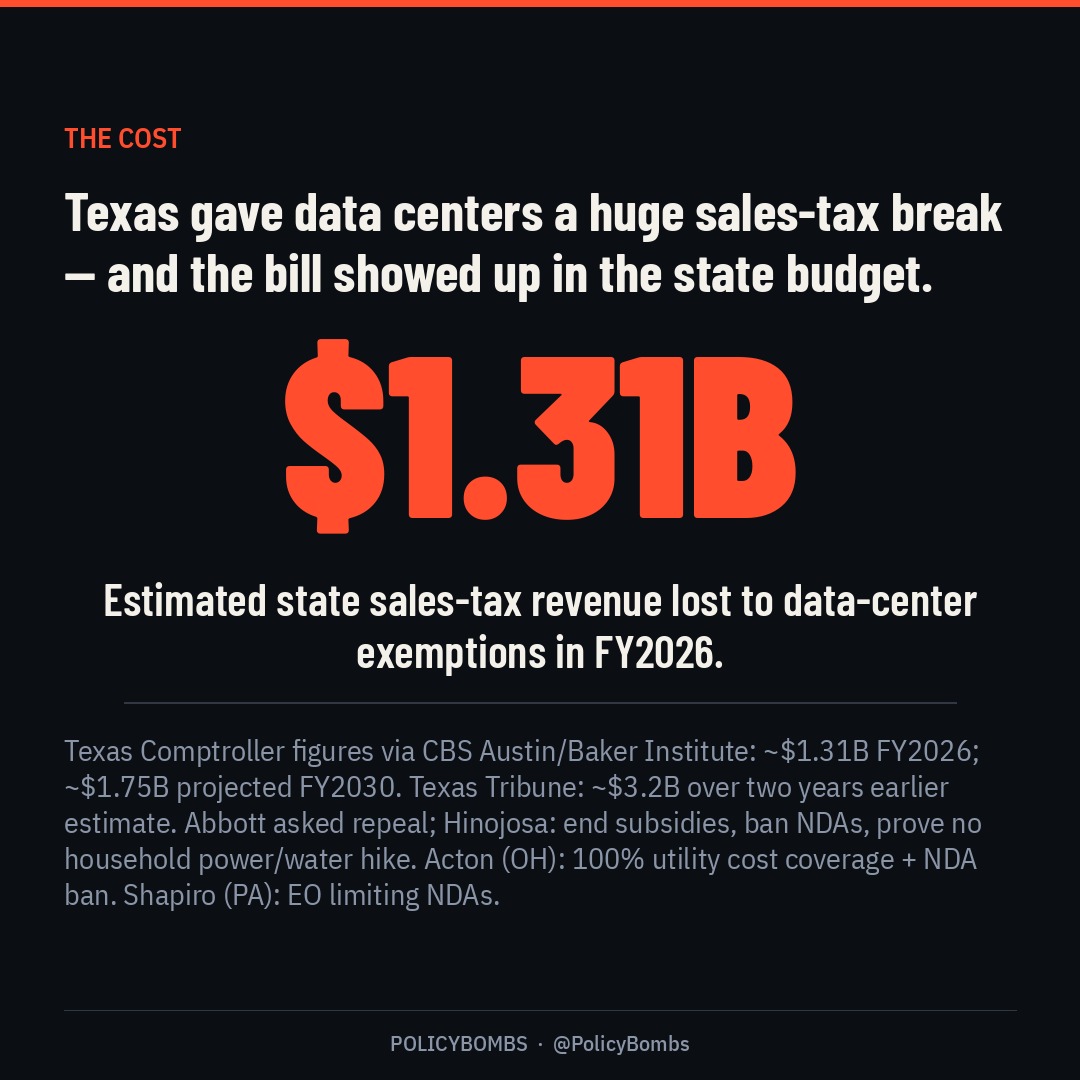
$1.31 billion. That's the estimated Texas state sales-tax revenue lost to data-center exemptions in FY2026 alone.

The Comptroller's figures (via CBS Austin / Baker Institute) climb toward ~$1.75B a year by FY2030. Abbott asked the Legislature to repeal the break. Hinojosa calls it a giveaway and adds: ban NDAs, make operators prove households won't pay more for power or water.

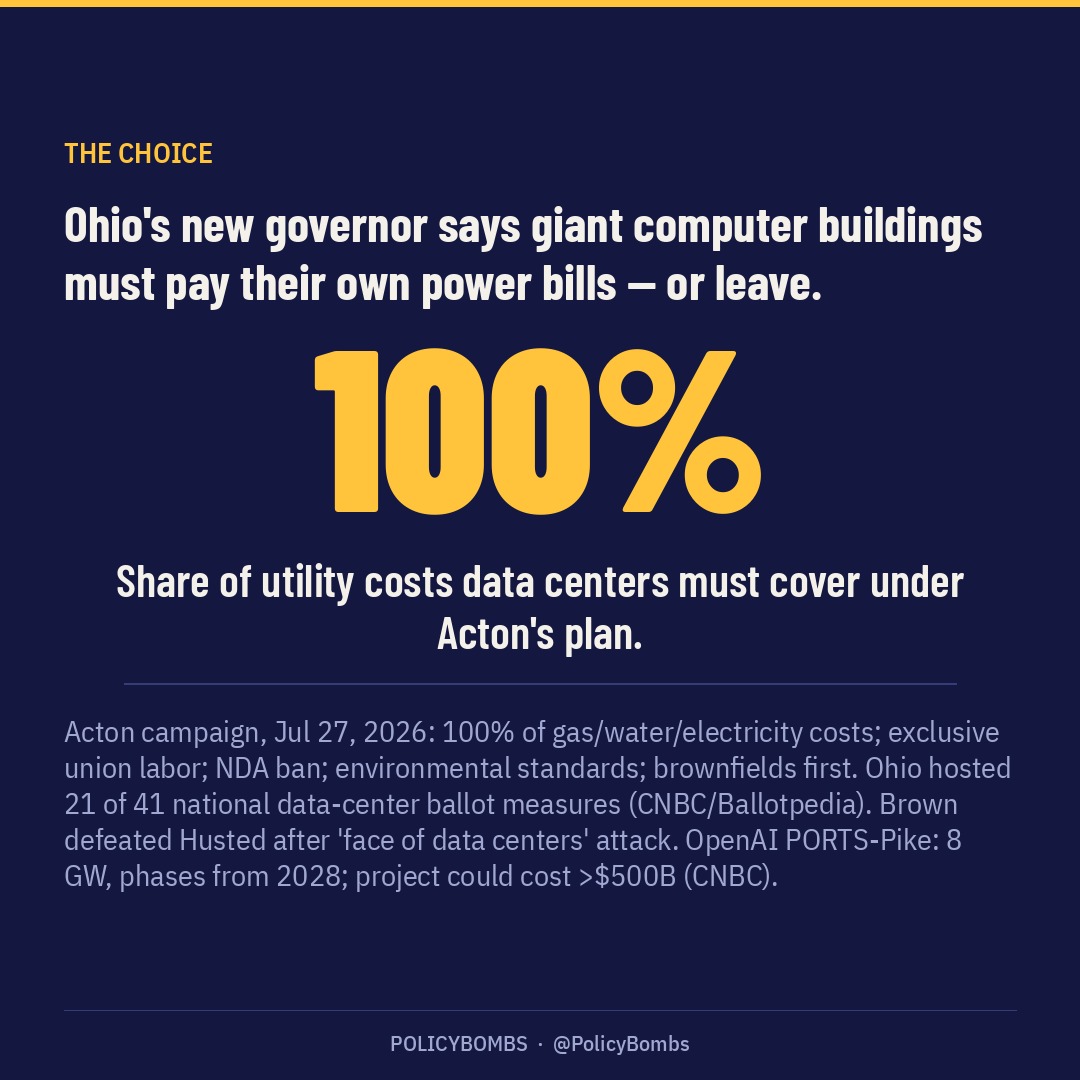
Ohio's Amy Acton: cover 100% of utility costs or you don't build. Pennsylvania's Josh Shapiro already moved against secrecy NDAs by executive order.

This is the bipartisan core of the revolt — not "no computers," but "stop putting Big Tech's power bill on grandma's meter."

PRO: Ends household subsidies for hyperscaler power and kills secret site NDAs.

CON / COST: Clumsy clawbacks can strand capital; states that keep breaks may poach projects.

SOCIETY: GOOD — making AI builders pay their own power and water freight, and killing secrecy NDAs, is basic fairness; phase out tax carve-outs cleanly.


Full analysis

Data-Center Ratepayer & Subsidy Rules: End Tax Breaks, Stop Bill-Shifting, Ban NDAs

Across Texas, Ohio and related states, the winning 2026 package is cost internalization: no electricity ratepayer subsidies, end sales-tax/property incentives, ban secrecy NDAs, and make operators fund their own grid and water infrastructure — with Texas Comptroller figures showing the sales-tax exemption alone at ~$1.31B in FY2026. As of Nov 5, 2026, 11:40 PM ET.

Content as of Nov 5, 2026, 11:40 PM ET. Source: primary reporting + Ballotpedia / campaign statements fetched this run

Long-form deep analysis. Companion to the 10-minute quick reference (71-data-center-ratepayer-subsidy-rules-summary.docx).

Contents

  • 10-Minute Lazy Voter Guide
  • 1. What is the policy
  • 2. Why it exists
  • 3. Realized effects
  • Local investigations and anomalies
  • Who supports / who opposes
  • 4. Good or bad for society
  • References
  • Gaps / unverified

10-Minute Lazy Voter Guide

Politicians who just won say giant computer buildings should pay their own power and water costs — not hide them on your monthly bill — and should lose special sales-tax breaks. They also want to ban secret contracts (NDAs) that keep neighbors in the dark. In Texas, the state sales-tax break alone is estimated around $1.31 billion for FY2026.

Verdict: GOOD — GOOD — making AI builders pay their own power and water freight, and killing secrecy NDAs, is basic fairness; phase out tax carve-outs cleanly.

Figure

Meaning

Tag

~$1.31B

Estimated Texas state sales-tax revenue lost to data-center exemption, FY2026 (Texas Comptroller figures via CBS Austin / Baker Institute reproduction)

Substantiated

~$1.75B

Projected annual cost of the same exemption by FY2030 (Comptroller projections)

Substantiated

$3.2B

Texas Tribune earlier report: sales-tax revenue the state was poised to lose over two years due to the exemption

Substantiated

100%

Utility-cost coverage Acton demands from operators (campaign)

Substantiated

~$66B

Researcher John Diamond’s estimate of Texas data-center investment in 2026, up from ~$3B in 2022 (CBS Austin)

Substantiated

1. What is the policy

Campaign and bipartisan policy package: (1) prohibit electricity/water cost shifting onto residential ratepayers — operators fund interconnection and prove no household rate spike; (2) repeal or rein in state sales-tax exemptions and local property abatements for data centers; (3) ban or sharply limit NDAs that hide projects from the public; (4) require water-efficient tech and reporting. Texas: Comptroller exemption tiers (100k–250k sq ft investment thresholds, 10–20 year terms). Ohio: Acton 100% utility + NDA ban + clawbacks on incentives. PA: Shapiro EO limiting NDAs / removing AI centers from fast track.

2. Why it exists

Stated reasons: Affordability; fairness; transparency; end ‘tax giveaways’ to billionaires.

Underlying drivers (evidence-based assessment): Bill shock is a winning midterm message; Comptroller numbers made the subsidy visible; community groups documented secrecy; even pro-growth Republicans (Abbott by mid-2026) had to pivot. Fiscal motive: reclaiming >$1B/year in Texas sales tax is real money.

3. Realized effects

Political consensus forming around ratepayer protection even where moratoriums differ. Market implication: project IRRs fall when free grid upgrades and sales-tax holidays disappear — especially painful for debt-funded neoclouds vs cash-rich hyperscalers (JPMorgan/CNBC K-shaped thesis). Not yet fully enacted nationwide — Pending in Texas Legislature 2027 and Ohio General Assembly.

Local investigations and anomalies

Exact FY2026 Comptroller line items should be confirmed from the primary tax-exemptions PDF (cited via CBS Austin/Baker Institute — Substantiated via reputable secondary). How many of 138 certified Texas centers fail audits (Comptroller: 6 of 20 audited out of compliance as of mid-2026 reporting) — sample, not census. Federal ratepayer bill status Pending. … Full gaps listed below.

Who supports / who opposes

Supports: Hinojosa; Abbott (repeal ask); Acton; Brown; Shapiro; Donalds’ ratepayer framing; local officials; Public Citizen.

Opposes: Certified exemption holders; site-competing economic-development agencies; developers warning capital flight.

Further reading (also listed in References):

  • [1] CBS Austin: Democrats’ wins and Texas data center tax policy — Comptroller $1.31B FY2026 / $1.75B FY2030 (Nov 5, 2026)
  • [2] Texas Tribune: Abbott recommends data-center crackdown / sales-tax repeal (Jun 10, 2026)
  • [3] Texas Tribune: Hinojosa policies — stop subsidies, NDAs, ratepayer protection (Nov 4, 2026)
  • [4] Data Center Dynamics: Hinojosa Texans First priorities — NDAs, subsidies, prove no household cost hike
  • [5] Acton campaign: 100% utility costs + NDA ban

4. Good or bad for society

Measurable good: lower cross-subsidy from households; transparent siting; fiscal recovery of carve-outs. Risk: clumsy clawbacks. Opportunity cost of keeping subsidies: every exempted dollar is a dollar not on schools/roads or tax-rate cuts. This is the part of the revolt that travels across party lines for a reason.

If any piece of the anti-data-center wave is straightforwardly GOOD for society, it is this: stop shifting hyperscaler grid and water costs onto households, stop opaque NDAs, and stop nine-figure sales-tax carve-outs that the Comptroller itself flags as ballooning. Abbott and Hinojosa agreeing on the subsidy problem is your tell. Caveats: grandfathering and phase-outs matter so you don’t create takings fights; keep the rule about cost causation, not about picking union winners. Net: GOOD — with implementation discipline.

References

[1] CBS Austin: Democrats’ wins and Texas data center tax policy — Comptroller $1.31B FY2026 / $1.75B FY2030 (Nov 5, 2026). https://cbsaustin.com/news/local/could-democrats-election-wins-reshape-texas-data-center-tax-policy

[2] Texas Tribune: Abbott recommends data-center crackdown / sales-tax repeal (Jun 10, 2026). https://www.texastribune.org/2026/06/10/texas-greg-abbott-data-centers-regulation-sales-tax/

[3] Texas Tribune: Hinojosa policies — stop subsidies, NDAs, ratepayer protection (Nov 4, 2026). https://www.texastribune.org/2026/11/04/data-center-texas-pause-gina-hinojosa-governor-policies/

[4] Data Center Dynamics: Hinojosa Texans First priorities — NDAs, subsidies, prove no household cost hike. https://www.datacenterdynamics.com/en/news/texas-governor-elect-gina-hinojosa-promises-continued-data-center-moratorium-further-legislation/

[5] Acton campaign: 100% utility costs + NDA ban. https://actonforgovernor.com/dr-amy-acton-calls-for-statehouse-to-pass-immediate-conditional-data-center-moratorium-legislation-as-they-reconvene/

[6] The Verge: Shapiro EO on NDAs; Donalds Protecting Ratepayers Act context. https://www.theverge.com/policy/1026365/data-centers-midterms-results

[7] DaveManuel summary of Comptroller exemption schedule / Baker Institute. https://www.davemanuel.com/2026/11/04/what-a-democratic-texas-governor-means-for-the-data-center-boom/

Gaps / unverified

Exact FY2026 Comptroller line items should be confirmed from the primary tax-exemptions PDF (cited via CBS Austin/Baker Institute — Substantiated via reputable secondary). How many of 138 certified Texas centers fail audits (Comptroller: 6 of 20 audited out of compliance as of mid-2026 reporting) — sample, not census. Federal ratepayer bill status Pending.

PolicyBombs · Day 71. Follow @PolicyBombs on X.

Data-Center Ballot Measures 2026: ~41 Local Fights, Voters Chose Restrictions

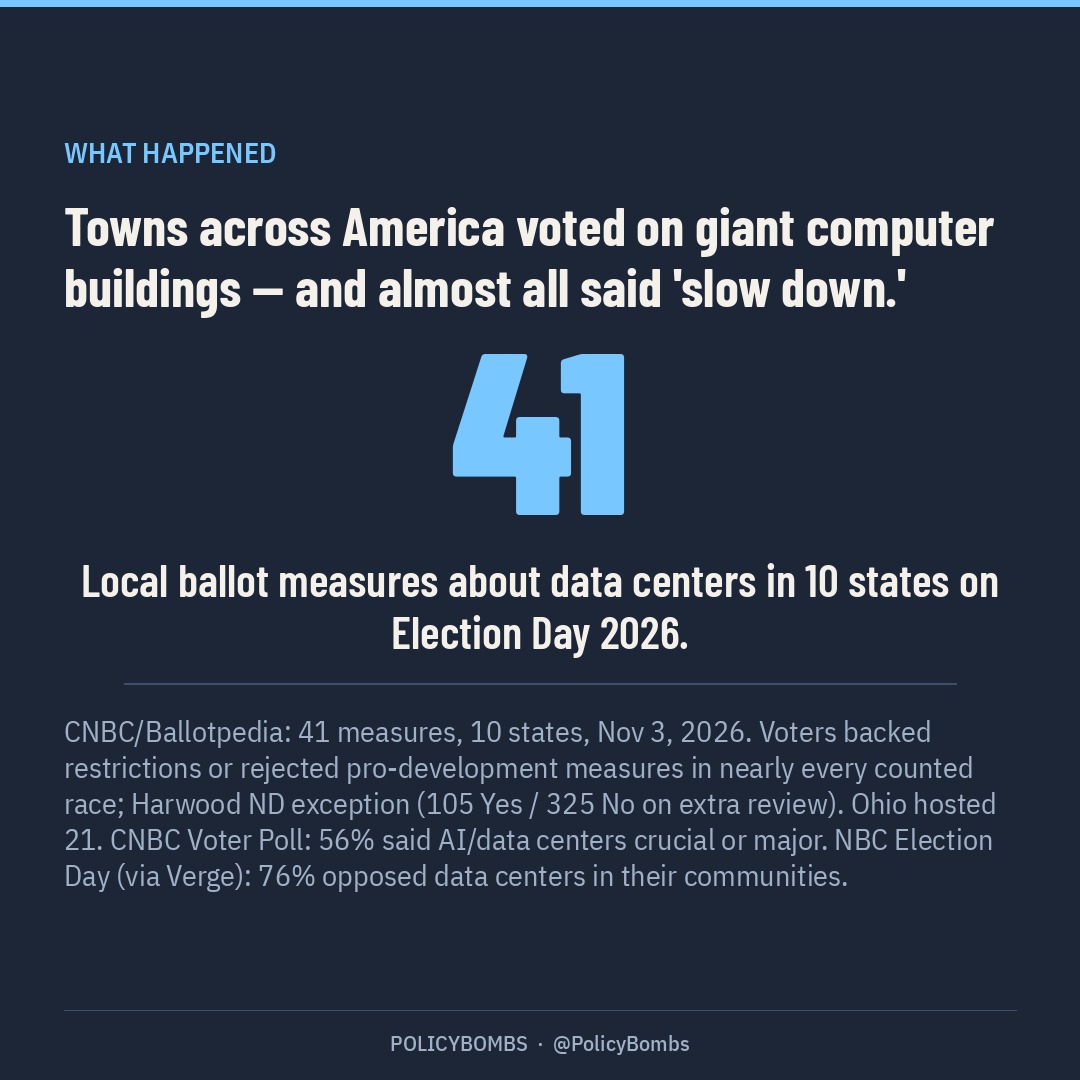
41. Local ballot measures on data centers across 10 states — and voters sided against them in nearly every counted race.

Nov 3, 2026: towns from Maine to California put AI's power plants on the ballot. CNBC/Ballotpedia: 41 measures in 10 states. Ohio alone had 21.

Results: restrictions won almost everywhere. Bans, MW caps, 180-day freezes. The rare exception: Harwood, North Dakota, rejected extra industrial review (105–325).

This wasn't a fringe issue. CNBC's voter poll: 56% said AI/data centers were a crucial or major factor. NBC Election Day: 76% opposed data centers in their own communities.

PRO: Voters who live with the noise, water draw and secrecy got a direct say — and used it.

CON / COST: 41 uncoordinated local bans are a slow, patchy way to run national AI infrastructure policy.

SOCIETY: MIXED — democratic local control over land and water is legitimate; a patchwork of bans is a real tax on national AI capacity.


Full analysis

Data-Center Ballot Measures 2026: ~41 Local Fights, Voters Chose Restrictions

About 41 local data-center ballot measures in 10 states went to voters in the 2026 midterms; with results in, voters backed restrictions or rejected pro-development measures in nearly every counted race — Harwood, North Dakota the notable exception. As of Nov 5, 2026, 11:40 PM ET.

Content as of Nov 5, 2026, 11:40 PM ET. Source: primary reporting + Ballotpedia / campaign statements fetched this run

Long-form deep analysis. Companion to the 10-minute quick reference (69-data-center-ballot-measures-2026-summary.docx).

Contents

  • 10-Minute Lazy Voter Guide
  • 1. What is the policy
  • 2. Why it exists
  • 3. Realized effects
  • Local investigations and anomalies
  • Who supports / who opposes
  • 4. Good or bad for society
  • References
  • Gaps / unverified

10-Minute Lazy Voter Guide

On Election Day 2026, dozens of towns and cities asked voters: should we ban, pause, or tightly limit giant computer buildings (data centers)? In almost every place that counted quickly, voters said yes to limits — or no to welcoming them. One small North Dakota town, Harwood, voted the other way.

Verdict: MIXED — MIXED — democratic local control over land and water is legitimate; a patchwork of bans is a real tax on national AI capacity.

Figure

Meaning

Tag

41

Local data-center-related ballot measures in 10 states on the Nov 3, 2026 ballot (CNBC citing Ballotpedia; Ballotpedia News pre-election)

Substantiated

Harwood, ND

Lone widely cited exception: voters rejected added industrial/data-center review requirements — 105 Yes (24%) / 325 No (76%) (Ballotpedia / CNBC)

Substantiated

56%

Voters who said AI/data centers were a crucial or major factor in their decision (CNBC Voter Poll)

Substantiated

76%

Election Day poll share opposing data centers in their communities (NBC via The Verge)

Substantiated

10

States with data-center-related local measures (Ballotpedia News)

Substantiated

1. What is the policy

A wave of municipal and county ballot questions on Nov 3, 2026 restricting data-center development via bans, MW caps, temporary moratoriums, or rejecting pro-development advisories. CNBC/Ballotpedia News: 41 measures in 10 states. Examples: Alhambra CA Measure DB prohibit (82% Yes); Edgewater FL prohibit new centers (77%); Bloomington IL advisory moratorium (78%); Emporia KS high-impact ban (60%); Wells ME 180-day moratorium (82%); Ohio MW caps and referenda (state hosted 21 measures). Harwood ND rejected extra industrial review. Post-election Ballotpedia pages reported additional decided measures with the same directional pattern (near-universal restriction support).

2. Why it exists

Stated reasons: Protect local water, power rates, farmland, property values and quality of life; stop being ‘sold out’ to hyperscalers.

Underlying drivers (evidence-based assessment): Visible construction + higher bills + drought fear + anti-billionaire politics after heavy Silicon Valley/GOP donor spending (CNBC: crypto/AI/gambling interests >$377M; Musk ≥$474M cycle spending). Data centers became a stand-in for AI-era inequality.

3. Realized effects

Near-sweep for restriction side on counted measures (CNBC Nov 4–5). Reinforced gubernatorial/Senate messaging in TX, OH, GA, WI, etc. Sanders: ‘National data center moratorium now.’ Market: contributed to Nov 5 AI/infra selloff narrative. Industry must now negotiate town-by-town.

Local investigations and anomalies

Final certified count may exceed 41 as late ballots/post-election listings finalize (Ballotpedia updated tallies Nov 4+). Some measures advisory only. Verge cited 45 measures / Redbud Consulting 33 restricting as of Wednesday morning — count Contested at the margin; direction Substantiated. … Full gaps listed below.

Who supports / who opposes

Supports: Local majorities; Sanders; Casar (‘AI earthquake’); municipal organizers; Americans for Responsible Innovation.

Opposes: Developers; Data Center Coalition; some local economic-development officials; Harwood ND majority.

Further reading (also listed in References):

  • [1] CNBC: Voters rebuff data centers in every ballot measure except one (Nov 4, 2026)
  • [2] Ballotpedia: Data center-related ballot measures, 2026
  • [3] Ballotpedia News: Voters in ten states will vote on 41 measures (Nov 3, 2026)
  • [4] Ballotpedia: Harwood ND Industrial Development Review Initiative
  • [5] The Verge: Data centers lost the midterms — NBC 76% oppose

4. Good or bad for society

Good: ends the fiction that megawatt campuses are just another warehouse. Bad: U.S. industrial policy by zoning referendum is slow, uneven and easy to capture by whichever side shows up. Better path: statewide ratepayer/water standards + local siting voice — not 41 incompatible ordinances.

Local voters have every right to police noise, water, land use and secretive PILOT deals in their backyard — and they just did, almost uniformly. That is democratic accountability, not ‘Luddism.’ The social cost is a fragmented permitting map that makes U.S. AI capacity slower and pricier precisely when China is not holding town-hall moratoriums. Net: MIXED — healthy local veto power; unhealthy if the only national energy policy is 41 uncoordinated municipal bans.

References

[1] CNBC: Voters rebuff data centers in every ballot measure except one (Nov 4, 2026). https://www.cnbc.com/2026/11/04/data-center-ballot-measures-2026-midterm.html

[2] Ballotpedia: Data center-related ballot measures, 2026. https://ballotpedia.org/Data_center-related_ballot_measures,_2026

[3] Ballotpedia News: Voters in ten states will vote on 41 measures (Nov 3, 2026). https://news.ballotpedia.org/2026/11/03/voters-in-ten-states-will-vote-on-data-center-related-ballot-measures-november-3/

[4] Ballotpedia: Harwood ND Industrial Development Review Initiative. https://ballotpedia.org/Harwood,_North_Dakota,_Industrial_Development_Review_Requirements_Initiative_(November_2026)

[5] The Verge: Data centers lost the midterms — NBC 76% oppose. https://www.theverge.com/policy/1026365/data-centers-midterms-results

[6] Guardian: Voters approved nearly every datacenter moratorium. https://www.theguardian.com/us-news/2026/nov/04/datacenters-midterm-elections

[7] Axios: AI earthquake / ~two dozen restriction proposals passing on initial returns. https://www.axios.com/2026/11/04/ai-data-center-election-slowdown

Gaps / unverified

Final certified count may exceed 41 as late ballots/post-election listings finalize (Ballotpedia updated tallies Nov 4+). Some measures advisory only. Verge cited 45 measures / Redbud Consulting 33 restricting as of Wednesday morning — count Contested at the margin; direction Substantiated.

PolicyBombs · Day 69. Follow @PolicyBombs on X.

Ohio Conditional Data-Center Moratorium: Acton’s 100% Utility Costs + Union Labor Rules

100%. That's the share of utility costs Ohio's new governor says data centers must pay — or they don't get built.

Gov.-elect Amy Acton (D) supports a "conditional moratorium": cover 100% of gas, water and electricity costs, build exclusively with union labor, ban NDAs, meet environmental standards, prefer brownfields. "If you do not meet these conditions, we do not want you in Ohio."

Ohio wasn't subtle. It hosted 21 of the 41 local data-center ballot measures nationwide. Sen. Sherrod Brown beat Sen. Jon Husted after branding him "the face of data centers." OpenAI's PORTS-Pike campus — 8 GW, Nvidia-backstopped, potentially >$500B — now sits in a tougher political climate.

PRO: Ratepayers stop subsidizing Big Tech's power bill; secrecy NDAs get banned.

CON / COST: Exclusive-union mandates and vague 'zero impact' language can turn a cost rule into a de facto ban — including on an 8 GW mega-campus.

SOCIETY: MIXED — ratepayer cost internalization and anti-NDA rules are sound; exclusive-union + vague 'zero impact' conditions risk a protectionist veto.


Full analysis

Ohio Conditional Data-Center Moratorium: Acton’s 100% Utility Costs + Union Labor Rules

Ohio Gov.-elect Amy Acton backs a conditional moratorium — new data centers only if they cover 100% of utility costs, use exclusive union labor, ban NDAs, meet environmental standards and prioritize brownfields — in a state that hosted 21 of 41 national ballot measures and flipped Brown over Husted. As of Nov 5, 2026, 11:40 PM ET.

Content as of Nov 5, 2026, 11:40 PM ET. Source: primary reporting + Ballotpedia / campaign statements fetched this run

Long-form deep analysis. Companion to the 10-minute quick reference (68-ohio-conditional-data-center-moratorium-summary.docx).

Contents

  • 10-Minute Lazy Voter Guide
  • 1. What is the policy
  • 2. Why it exists
  • 3. Realized effects
  • Local investigations and anomalies
  • Who supports / who opposes
  • 4. Good or bad for society
  • References
  • Gaps / unverified

10-Minute Lazy Voter Guide

Ohio’s new Democratic governor wants to block new data centers unless they meet her checklist: pay every dollar of their own electricity/gas/water costs (no shifting to household bills), hire only union workers to build, no secret NDAs, follow environmental rules, and prefer old industrial sites over farmland. Ohio voters also passed a pile of local bans and restrictions, and Sen. Sherrod Brown beat Sen. Jon Husted after branding him ‘the face of data centers.’

Verdict: MIXED — MIXED — ratepayer cost internalization and anti-NDA rules are sound; exclusive-union + vague ‘zero impact’ conditions risk a protectionist veto.

Figure

Meaning

Tag

100%

Utility costs Acton says operators must cover — gas, water, electricity — with proof projects won’t raise household rates (Acton campaign, Jul 27, 2026)

Substantiated

21 of 41

Ohio’s share of local data-center ballot measures nationwide in the 2026 midterms (CNBC / Ballotpedia)

Substantiated

8 GW

Computing capacity OpenAI secured at PORTS-Pike Technology Campus in Ohio — described as the world’s largest planned AI data-center campus; phases from 2028 (CNBC)

Substantiated

>$500B

Potential total cost of the Nvidia-backstopped Ohio campus project (CNBC)

Substantiated

14+

Ohio municipalities that passed bans/restrictions including Sunbury (Amazon ~$2B proposal) per Guardian tally

Substantiated

1. What is the policy

Gov.-elect Amy Acton’s ‘conditional moratorium’: new Ohio data centers allowed only if they (1) cover 100% of utility costs and prove no household rate increase / regional reliability hit, (2) exclusively use union labor to build/maintain, (3) ban NDAs / operate with full transparency, (4) meet environmental standards (campaign also used ‘zero environmental impact’), (5) prioritize brownfields/former industrial sites, (6) support local communities / community-benefit agreements (July list; later releases varied). She asked the General Assembly to pass legislation — not yet enacted as of Nov 5, 2026. Parallel: Sherrod Brown defeated Jon Husted after casting Husted as ‘the face of data centers’; NRSC memo warned blaming data centers for a Husted loss would poison the issue for future GOP candidates (The Verge).

2. Why it exists

Stated reasons: Protect Ohio families from bill spikes; end secret deals; ensure good union jobs; stop farmland conversion; force developers to bring their own generation.

Underlying drivers (evidence-based assessment): Affordability politics; union coalition demands; anti-tech populism that worked in 2026; OpenAI/SoftBank mega-campus as a visible target; Brown’s Senate playbook. Interest-group note: unions support the labor condition (and often support construction); environmental groups want water/air limits; hyperscalers want speed. Capture risk runs both ways — tax-break era favored capital; union-exclusive era favors organized labor.

3. Realized effects

Acton won the governorship; Brown won the Senate; Ohio locals passed numerous MW caps and bans (Guardian: ≥14 municipalities). Market: Ohio political risk layered onto national AI selloff Nov 5. PORTS-Pike first construction phase slated to begin 2026 with capacity from 2028 — more exposed to new conditions than already-pouring projects. Fact-check gap: campaign has not fully defined how ‘100%’ is measured vs existing PUCO tariffs (Ohio Policy Updates).

Local investigations and anomalies

Exact statutory text Pending. ‘Zero environmental impact’ vs ‘adhere to Ohio’s environmental standards’ wording inconsistency Contested. Whether PORTS-Pike is grandfathered Unverified. Community-benefit condition dropped from some later campaign lists (Ohio Policy Updates). … Full gaps listed below.

Who supports / who opposes

Supports: Acton; Brown; Ohio local majorities; AFL-CIO-aligned building trades (labor mandate); anti-data-center municipal organizers.

Opposes: Ramaswamy campaign (defeated); developers needing open-shop flexibility; SoftBank/SB Energy/OpenAI partners; some Republicans who shifted to ratepayer-protection bills without full moratoriums (Husted’s later Ratepayer Protection Act).

Further reading (also listed in References):

  • [1] Acton for Governor: Conditional moratorium announcement (Jul 27, 2026)
  • [2] Acton for Governor: Calls for Statehouse to pass conditional moratorium
  • [3] CNBC: Voters rebuff data centers — Ohio 21 of 41 measures; Acton; Brown/Husted; PORTS-Pike 8 GW (Nov 4, 2026)
  • [4] The Verge: Data centers lost the midterms — Brown/Husted NRSC memo
  • [5] Guardian: Ohio municipalities passed bans; Sunbury Amazon $2B

4. Good or bad for society

Society gains if Ohio stops socializing grid upgrades onto households and ends NDA darkness. Society loses if ‘conditional’ means only politically connected union contractors can build the compute the Midwest was courting — and if 8 GW of planned capacity dies in process purgatory. Measurable tests: Did residential rates stabilize? Did brownfield sites get used? Did MW get built under clear tariffs? Or did projects flee to friendlier states?

Forcing data centers to pay their own power and water freight, kill NDAs, and face local scrutiny is GOOD policy. Grafting an exclusive-union mandate and undefined ‘zero impact’ language onto a ‘conditional’ freeze is how a transparent cost rule becomes a patronage gate. Ohio voters clearly wanted brakes — 21 ballot fights and Brown’s win prove it. PolicyBombs call: keep the ratepayer and transparency conditions; drop or narrowly tailor the union exclusivity so it doesn’t become a veto dressed up as labor justice. Net: MIXED.

References

[1] Acton for Governor: Conditional moratorium announcement (Jul 27, 2026). https://actonforgovernor.com/dr-amy-acton-announces-support-for-conditional-moratorium-on-data-centers/

[2] Acton for Governor: Calls for Statehouse to pass conditional moratorium. https://actonforgovernor.com/dr-amy-acton-calls-for-statehouse-to-pass-immediate-conditional-data-center-moratorium-legislation-as-they-reconvene/

[3] CNBC: Voters rebuff data centers — Ohio 21 of 41 measures; Acton; Brown/Husted; PORTS-Pike 8 GW (Nov 4, 2026). https://www.cnbc.com/2026/11/04/data-center-ballot-measures-2026-midterm.html

[4] The Verge: Data centers lost the midterms — Brown/Husted NRSC memo. https://www.theverge.com/policy/1026365/data-centers-midterms-results

[5] Guardian: Ohio municipalities passed bans; Sunbury Amazon $2B. https://www.theguardian.com/us-news/2026/nov/04/datacenters-midterm-elections

[6] Statehouse News Bureau: Acton conditional moratorium (Jul 27, 2026). https://www.statenews.org/government-politics/2026-07-27/democrat-running-for-ohio-governor-calls-for-conditional-moratorium-on-new-data-centers

[7] Ohio Policy Updates fact-check: What would Acton’s moratorium actually do?. https://ohiopolicyupdates.com/fact-check/amy-acton-data-center-moratorium/

Gaps / unverified

Exact statutory text Pending. ‘Zero environmental impact’ vs ‘adhere to Ohio’s environmental standards’ wording inconsistency Contested. Whether PORTS-Pike is grandfathered Unverified. Community-benefit condition dropped from some later campaign lists (Ohio Policy Updates).

PolicyBombs · Day 68. Follow @PolicyBombs on X.