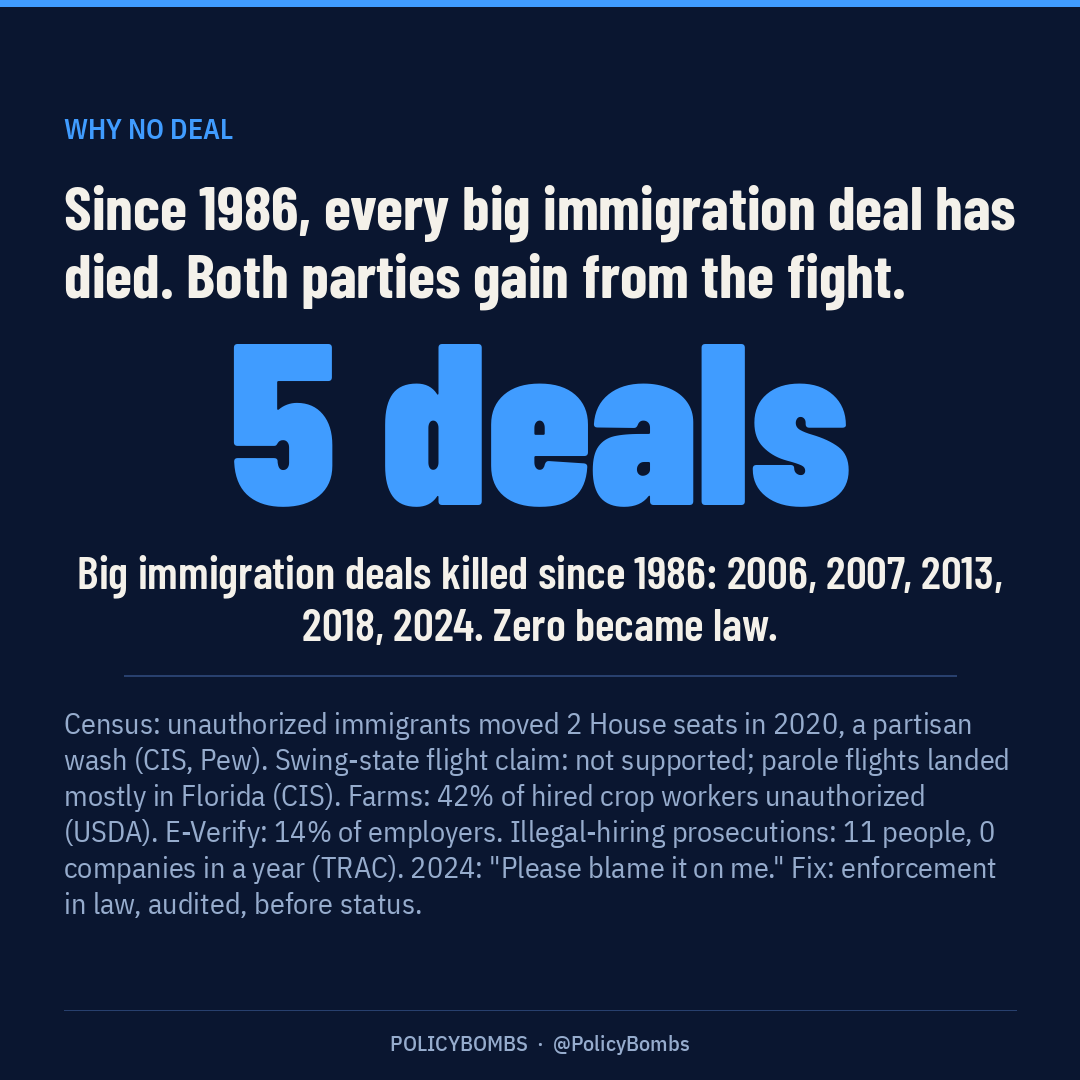
5 deals. That’s how many big immigration bargains Washington has killed since 1986: 2006, 2007, 2013, 2018 and 2024. Zero became law. Follow the incentives.
What Democrats stand to gain, tested against the record:
- Seats now. The census counts every resident. Unauthorized immigrants moved about 2 House seats in 2020, a partisan wash (CIS; Pew). Immigrants overall, mostly legal, moved 17, a net 14 toward Democratic-leaning states (CIS). The Census Bureau has now proposed dropping unauthorized immigrants from the 2030 count.
- Votes later, maybe. Biden’s 2021 bill offered an 8-year path to citizenship. After the 1986 amnesty, only 40% of 2.7 million had naturalized two decades on (DHS). Naturalized voters split 51 to 47 for Harris in 2024 (Pew).
- Parole at scale. CBP One: 936,500 appointments. CHNV: 531,690 paroled (CBP). A federal judge vacated Biden’s Parole+ATD releases in 2023, writing that DHS made the border “a meaningless line in the sand.”
- Noncitizen voting: rare in audits (Ohio 138, Georgia 9, North Carolina 41 of 4.8 million), but real in local races in San Francisco and D.C. New York City’s law was struck down 6 to 1.
- On the record: “The Emerging Democratic Majority” (2002) counted demographics as an asset; its authors later said they were “dead wrong.” Elon Musk calls it “voter importation.” We found no document proving a vote plan: Unverified.
- The case against: Trump won 48% of Hispanic voters in 2024, and Starr County, 97% Latino, went Republican for the first time since 1892.
What Republican-aligned employers gain: 42% of hired crop workers are unauthorized (USDA), E-Verify covers 14% of employers, and in one year 11 people and zero companies were prosecuted for illegal hiring (TRAC).
Verdict: MIXED, final grade PENDING. Every side has a stake in no deal. Enforcement written into law, audited by outsiders, met before status, with no citizenship until it is, takes both the vote incentive and the labor excuse off the table.
Full analysis
Long-form analysis of a possible Trump immigration deal (enforcement for legal status) against Reagan’s 1986 IRCA bargain, and of what each party gains from no deal. Content checked November 22, 2026 (America/Los_Angeles). Finding tags: Supported, Partly supported, Not supported, Contested, Unverified.
Research cutoff: Nov 22, 2026 (Pacific) for Sections 2A and 2; Nov 20, 2026 for the rest. Policy number 92.
Cross-reference: Day 63, Illegal Immigration (https://policybombs.com/policybomb-illegal-immigration/) already grades the 2021 to 2026 border surge, the fiscal-cost literature (CBO, NAS, FAIR, ITEP, Cato), labor effects and child-labor exploitation. Its verdict (large-scale illegal immigration is bad for society; restoring control was right; enforcement that ignores employers leaves exploitation in place) stands. This PolicyBomb grades a narrower question: should the country trade some form of legal status for enforcement, and in what order?
Verdict: MIXED, final grade PENDING. The incentives sharpen it: the incentives on both sides reward an unsolved problem, so a deal works only if enforcement is self-executing (in statute, audited, triggered) rather than dependent on trust. The section on Democratic gains adds: Democrats do stand to gain (census seats now, voters slowly), the vote payoff is too slow and too reversible to be a near-term plan, and a deliberate vote-building motive is Unverified. A deal that delays citizenship behind audited triggers removes the vote incentive for both sides.
1. What is the policy
1.1 The trigger: a post-midterm opening
- On 60 Minutes (aired Nov 8, 2026), President Trump said: “Get the killers out, get the rapists out, get all the rough ones out, get the drug dealers out. But let the people that are here, and in some cases here for 10 and 15 years, work a deal for them.” He also said enforcement may have been “too tough” on people who “had good jobs” [F1][F2].
- The White House: “The President never said the word amnesty” and “We want Democrats to show their cards.” It would not say what a deal could contain [F2].
- DHS Secretary Markwayne Mullin said Trump told him to start working with Democrats who called him, but, asked whether there had been “a conversation about changing the policy,” said “No, we haven’t had that conversation.” He added: “We’re never going to allow amnesty to happen.” He floated a congressional path for DACA recipients [F3].
- Trump later said “There won’t be amnesty” and that his policy had not changed. Fox News reported he “has not outlined a specific proposal” [F4].
- Senate Majority Leader John Thune: “I have not seen anything yet that’s being proposed.” Sen. James Lankford (R-OK), expected top Republican on Homeland Security: “I don’t know what that would be. But right now, we’re all waiting to see what the president wants to do” [F1][H1].
Status finding: As of Nov 20, 2026, there is no Trump immigration-deal proposal or bill text. Any grade of “the Trump deal” is a grade of a concept.
1.2 The starting source (opinion, labeled as such)
Mehek Cooke, “Trump can finally deliver the immigration bargain Reagan was promised,” Fox News Opinion, Nov 20, 2026 [OP]. Cooke is an attorney, political strategist and former counterterrorism adviser. Her argument:
- Reject both “deport everyone” and “blanket amnesty.”
- Congress should codify Trump’s border policies, mandate nationwide E-Verify, punish employers who knowingly hire illegal labor, and limit a future president’s ability to undo it.
- Any deal needs benchmarks: publicly reported removals, zero Border Patrol releases, and a fully operating nationwide employment-verification system “maintained for at least one year before legal relief expands.”
- Relief should be individual, through immigration judges, using cancellation of removal (10 years of presence, good moral character, no disqualifying convictions, hardship to a citizen or green-card relative), plus more immigration judges.
- She calls the Protect Our Neighbors Act “a nonstarter.”
1.3 Bills that actually exist in the 119th Congress
| Bill | Sponsor(s) | What it does | Status (Congress.gov / sources) |
|---|---|---|---|
| Dignity Act (DIGNIDAD), H.R. 4393 | Rep. Maria Elvira Salazar (R-FL); Rep. Veronica Escobar (D-TX) | Nationwide mandatory E-Verify; border barriers and technology; asylum “humanitarian campuses” with 60-day decisions; Dignity Program: 7-year renewable status for people here before Dec 31, 2020, $7,000 restitution, back taxes, background checks, check-ins every two years, no federal means-tested benefits, no path to citizenship; conditional green-card path for Dreamers/DACA; higher per-country visa caps | Introduced July 15, 2025; referred to Subcommittee on Border Security and Enforcement July 16, 2025; no further action [D1][D2]. 55 cosponsors per Congress.gov; Escobar’s office counts 56 supporters (35 D, 21 R) as of Nov 18, 2026 [D3][D4] |
| Protect Our Neighbors Act, H.R. 11120 | Rep. Lateefah Simon (D-CA); Reps. Garamendi, Lofgren, Vargas (D-CA) | Final removal orders expire 10 years after issuance; renewal only on DHS motion with clear and convincing evidence of significant cause for delay “unrelated to administrative or funding delays” and new public-interest evidence; people with expired orders may petition for any status they qualify for; separate discretionary cancellation and green card for some with old orders (fee up to $1,200, tax return required, per Simon’s released text) | Introduced and referred to House Judiciary Nov 19, 2026 [P1][P2][P3]. No Republican cosponsors. Congress.gov text not yet posted at research time |
| Permanent Trump Secure Border Act, H.R. 9773 | Rep. Chip Roy (R-TX) | Codifies Trump border actions: criminalizes visa overstays, raises unlawful-entry penalties, requires detention or return of most migrants pending cases, tightens asylum and parole, more CBP staff and technology. Omits nationwide E-Verify | Ordered reported by House Judiciary 16 to 14, July 21, 2026; no floor vote [R1][R2] |
Rep. Escobar said Nov 11, 2026 she will “reshape” the Dignity Act and reintroduce it in 2027, and that two senators, one from each party, are interested. She did not name them or release text [D5].
1.4 The 1986 baseline: IRCA
The Immigration Reform and Control Act (Pub. L. 99-603, Nov 6, 1986) had three legs: employer sanctions, more border enforcement, and legalization [I1][I3]. Legalization covered people continuously present since 1982 plus certain farmworkers (Special Agricultural Workers, SAW). Nearly 2.7 million people were legalized: about 1.6 million general and 1.1 million SAW [I2][I3].
1.5 Existing law the op-ed relies on
Cancellation of removal for non-permanent residents (8 U.S.C. 1229b(b)) requires 10 years of continuous presence, good moral character, no disqualifying convictions, and “exceptional and extremely unusual hardship” to a citizen or green-card spouse, parent or child. Section 1229b(e) caps grants at 4,000 per fiscal year [L1].
2A. What Democrats stand to gain: testing the voter-importation thesis
Added Nov 22, 2026. This section asks a plain question: what does the Democratic Party gain, politically, from high illegal immigration, from mass parole and other routes around the immigration statute, and from amnesty? We test the thesis, popularized by Elon Musk as “voter importation,” two ways: common sense (follow the incentive) and the documented record (votes, numbers, rulings, statements). We do not assert it. We do not dismiss it because no court has ruled on motive; courts rarely rule on motive, and motive can be shown by conduct. Each claim is labeled Supported, Contested or Unverified.
2A.1 The common-sense case
A party that wins most of a group’s votes gains if that group grows and gains the vote. In 2020, naturalized citizens backed Biden 59% to 38% (Pew) [N9]. A party that also gains House seats when a state’s population rises has a second reason to welcome growth. And a party whose city allies run on immigrant labor has a third. Incentives do not prove intent. But they tell you where to look. Below is what we found when we looked.
2A.2 Path to the vote: how long does an amnesty take to become ballots?
- Unauthorized immigrants cannot vote in federal elections, and amnesty does not change that on day one. Citizenship generally requires five years as a green-card holder (8 U.S.C. 1427). Supported.
- 1986 record. Of nearly 2.7 million people who got green cards under IRCA, 1.1 million, about 40%, had naturalized by the end of 2009, two decades later. The rate was 53% for pre-1982 residents and 34% for farmworkers (DHS Office of Immigration Statistics, Baker, 2010) [V1]. Supported.
- Biden-era proposal. The U.S. Citizenship Act of 2021, President Biden’s day-one bill, offered eligible undocumented immigrants a temporary status, a green card after five years, and citizenship three years later: an eight-year path (National Immigration Forum summary) [V2]. It never passed. Supported as to what was proposed.
- Dignity Act (2025). No path to citizenship at all [D2]. Supported.
- Who naturalized voters are. About 25 million naturalized citizens are eligible to vote, about one in ten eligible voters. About 92% have lived in the U.S. 11 years or more, and 73% have lived here 21 years or more (Pew, Oct 27, 2026) [V3]. Supported.
- How they vote. Naturalized voters favored Biden 59% to 38% in 2020, then split 51% Harris, 47% Trump in 2024 (Pew validated voters) [N9]. Supported.
Judgment. The vote payoff from any amnesty is real but slow: on the 1986 and 2021 models, eight years at the earliest, and on the 1986 record, most of the payoff two decades out. And the bloc that results is not locked: the 2020 margin of 21 points shrank to 4 in 2024. A plan to win near-term elections this way would be a poor plan. A long-run bet is plausible. The thesis that Democrats seek amnesty with citizenship partly for long-run votes is Contested: consistent with conduct (2A.5) but unproven as a motive.
2A.3 Apportionment: seats and electoral votes now, no citizenship needed
This is the channel that works without anyone voting.
- The rule. The census counts “the whole number of persons in each State” (14th Amendment). The 2020 residence rule counted “citizens of foreign countries living in the United States” (Census Bureau rule, 83 Fed. Reg. 5525, as quoted in Louisiana v. Commerce) [V4]. Every House seat moved is also an electoral vote moved. Supported.
- Size. Unauthorized immigrants moved about two House seats in 2020 (CIS) [N1]; Pew found the partisan result “a wash” (via Third Way) [N3]. A 2024 count would have moved four (CIS) [N1]. All immigrants, mostly legal, moved 17 seats, a net 14 toward Democratic-leaning states (CIS) [N1]. Supported.
- Money follows the count too. In fiscal 2021, 353 federal programs used census data to steer more than $2.8 trillion (Census Bureau working paper) [V5]. Supported.
- The fight over the count. In 2020 President Trump ordered unauthorized immigrants excluded from apportionment; the Supreme Court in Trump v. New York (2020) dismissed the challenge as premature rather than ruling on the merits, and the policy was not carried out [V6]. In August 2025 Trump posted that people here illegally “WILL NOT BE COUNTED IN THE CENSUS” (CNBC) [V6]. On Sept 10, 2026 the Census Bureau proposed 2030 rules that would exclude “illegal aliens and aliens whose legal status is less durable” than a green card from the apportionment base; it is not final (CRS; Federal Register 91 FR 57524) [V7]. Missouri dropped its own suit to exclude them after the proposal (Democracy Docket) [V8]. Supported as to the record. The constitutional question has never been squarely decided.
Judgment. Democrats gain from counting all residents, but mostly through legal immigration, and the illegal-immigration share is small and close to even by party on 2020 numbers. Both parties treat the count as a partisan weapon: one side defends it, the other is rewriting it. Supported that the incentive exists; Contested that it drives Democratic policy.
2A.4 Noncitizen voting today
- Audits find it, rarely.
- Ohio (2024): 597 apparent noncitizens referred; 138 had cast ballots and 459 registered without voting, out of more than 8 million registered voters (AP via WOSU) [V9].
- Georgia (2024): 20 noncitizens among 8.2 million registrants; 9 had voted [N8].
- North Carolina (2016 general election): 41 noncitizens with legal status cast ballots out of nearly 4.8 million voters (State Board audit) [V10]. In April 2026 the State Board began checking every registered voter against the federal SAVE database [V11].
- Supported: it happens, it is a crime, and the audited numbers are small compared with the rolls. Audits catch what they check; unaudited states are Unverified.
- Local laws that let noncitizens vote, all in Democratic-run jurisdictions.
- San Francisco: Proposition N (2016) lets noncitizen parents vote in school board races “regardless of citizenship”; the state Court of Appeal upheld it in Lacy v. San Francisco (Aug 2023) [V12]. In the Feb 2022 school recall, 328 noncitizens registered and 235 voted (LA Times, via search summaries) [V13].
- New York City: Local Law 11 would have let more than 800,000 green-card holders and work-authorized noncitizens vote in city races; the state’s highest court struck it down 6 to 1 on March 20, 2025, holding the state constitution limits voting to citizens (Fossella v. Adams) [V14].
- Washington, D.C.: the Local Resident Voting Rights Amendment Act of 2022 lets noncitizen residents vote in local elections; 981 noncitizens were registered by December 2024 (DC Board of Elections minutes) [V15]. The House passed H.R. 884 to repeal it in 2025; it has not passed the Senate (Congress.gov via search summaries) [V16].
- Supported: Democratic local governments have extended local ballots to noncitizens, in San Francisco and D.C. without regard to immigration status (per the measures’ sponsors and the DC Board, via search summaries). None of these laws reaches federal elections.
2A.5 On the record: strategy literature, officials, and Musk
- Strategy literature. John Judis and Ruy Teixeira’s “The Emerging Democratic Majority” (2002) argued that a growing nonwhite population, among other trends, favored Democrats; critics summarize it as “demographics is destiny” (The Federalist, quoted in The Nation) [V17]. Steve Phillips’s “Brown Is the New White” (2016) urged Democrats to invest in a “New American Majority” of voters of color and progressive whites [V18]. The authors of the 2002 book later said they were “dead wrong” to assume Democrats would hold the white working class (Macmillan, 2023) [V19]. Neither book calls for illegal immigration; both treat demographic growth as an electoral asset. Supported as to what the literature says.
- Officials. Senate Democratic Leader Chuck Schumer, Nov 16, 2022: “We have a population that is not reproducing on its own with the same level that it used to,” and “our ultimate goal is to help the Dreamers but get a path to citizenship for all 11 million or however many undocumented there are here” (Snopes transcript) [V20]. The stated reason was workers and population, not votes. Supported that Democratic leaders seek citizenship, not just legal status, for the whole population. Unverified that the reason is votes.
- Musk. Musk, a firsthand participant in the 2024 campaign and later a Trump administration adviser, posted that “The Dems are doing deliberate voter importation to swing states & fast-tracking them to citizenship” (Oct 3, 2024) [N5] and told CPAC in 2025 that Biden-era policy was “a giant voter importation scam” (PolitiFact) [V21]. The Center for Countering Digital Hate counted at least 42 such posts in 2024 with 747 million views (NBC News) [V22]. PolitiFact rated the claim False [V21]. Per PolicyBombs’ standard, his statements are evidence of what a credible, well-placed public figure believes, attributed to him. They are not evidence of a plan: we found no document, memo or recording in which a Democratic official describes immigration policy as a vote strategy. Unverified.
2A.6 Parole, CHNV and the routes around the statute
- The law. DHS may parole an inadmissible person “only on a case-by-case basis for urgent humanitarian reasons or significant public benefit” (8 U.S.C. 1182(d)(5)) [V23].
- The scale.
- CBP One app (January 2023 to December 2024): more than 936,500 people scheduled appointments at ports of entry; most were released with two years’ parole and a court date (CBP; CRS) [V24][V25].
- CHNV flights: about 531,690 Cubans, Haitians, Nicaraguans and Venezuelans arrived and were paroled through December 2024 (CBP) [V24].
- Supported.
- The rulings.
- Florida v. United States (N.D. Fla., March 8, 2023): Judge T. Kent Wetherell vacated the Parole+ATD border-release policy, finding it violated the statute’s case-by-case requirement, and wrote that DHS had “effectively turned the Southwest Border into a meaningless line in the sand” [V26][V27].
- Texas v. DHS (S.D. Tex., March 2024): Judge Drew Tipton dismissed the states’ challenge to CHNV for lack of standing, without deciding whether the program was lawful (National Immigration Forum) [V28].
- Noem v. Doe (May 30, 2025): the Supreme Court let the Trump administration end CHNV parole while litigation continues [V29].
- Supported: at least one federal court found a Biden release-by-parole policy unlawful, and the largest parole programs were never upheld on the merits.
- The other side. DHS called these “lawful pathways” and reported that crossings by CHNV nationals between ports fell 91% [V24]. Contested: whether parole at this scale was a lawful use of discretion or an end-run around the statute is the core dispute, and the merits were never finally resolved.
- Who it benefits politically. Parolees cannot vote. Parole does not lead to citizenship by itself. They do count in the census where they live, and the largest share of CHNV first landings were in Florida [N6]. Contested as a political benefit to Democrats.
2A.7 The strongest case against the thesis
- 1. The bloc moved right. Trump won 48% of Hispanic voters in 2024, up from 36% in 2020, and 47% of naturalized citizens (Pew) [N9]. Starr County, Texas, 97% Latino, voted Republican for president for the first time since 1892, after a 75-point swing toward Republicans since 2016 (WBUR; county history via search summaries) [V30]. Trump carried 12 of 14 Texas border counties (New York Times, via search summaries) [V31]. Latino voters swung back toward Democrats in 2026 (about 6 in 10, AP) [N10], which shows the bloc is earned each election, not imported.
- 2. The clock is too slow. Eight years minimum on Biden’s own bill, and only 40% of IRCA’s beneficiaries naturalized within two decades [V1][V2]. No near-term election can be won this way.
- 3. The count cuts both ways. Recent noncitizen growth went mostly to Republican-led states (Cato via Third Way) [N3].
- 4. Other motives are on the record. Labor shortages and population decline (Schumer’s own words) [V20]; humanitarian claims from Cuba, Haiti, Nicaragua and Venezuela [V24]; and urban and care-economy employers who depend on immigrant workers (Section 2.6).
2A.8 Grade
| Claim | Label |
|---|---|
| Democrats gain House seats and electoral votes from counting all residents | Supported (mostly via legal immigrants; illegal-immigrant share about 2 seats in 2020, roughly even by party) |
| Amnesty with citizenship would add Democratic voters | Contested (real but slow; naturalized voters split 51 to 47 in 2024) |
| Democratic leaders insist on citizenship, not just legal status | Supported (Schumer 2022; U.S. Citizenship Act 2021) |
| Democratic strategy literature counted demographic growth as an asset | Supported (Judis and Teixeira 2002, Phillips 2016; later recanted in part) |
| Biden-era parole went beyond what the statute allows | Contested (one court said yes for Parole+ATD; CHNV never decided on the merits) |
| Noncitizen voting in federal elections is rare in audited states | Supported (Ohio 138 of 8M+ registered, Georgia 9, North Carolina 41 of 4.8M voters); unaudited states Unverified |
| Democratic cities let noncitizens vote locally | Supported (San Francisco, D.C.; New York City struck down) |
| Democrats pursued high illegal immigration to build a future electorate | Unverified (no primary document; conduct is consistent with it and with labor and humanitarian motives; the 2024 results cut against it) |
What it means. The honest finding is uncomfortable for both camps. Democrats do stand to gain, and some of their conduct (insisting on citizenship, defending the all-resident count, local noncitizen voting, parole at a scale one court called unlawful) fits a party that sees immigrants as future allies. But the payoff is slow, uncertain and, on 2024 evidence, reversible. A deal that ties any status to enforcement written into law, and that withholds citizenship or delays it behind audited triggers, takes the vote incentive off the table for both sides.
2. Why it exists, and why no deal has stuck: the incentives
Added Nov 22, 2026. This section takes the parties apart: who gains from the status quo, who gains from a deal, and why every grand bargain since 1986 has died. Each claim below is graded Supported, Partly supported, Not supported, or Unverified, and each gets its strongest counterargument. Correlation is not treated as proof of motive.
2.1 Stated reasons (unchanged)
- Supporters of a deal: Trump says removing long-time workers with no other crimes “hurt” him politically and is “tough” [F2]. Laura Collins (George W. Bush Presidential Center): laws “are not working as intended” [F4].
- Enforcement-first advocates: lock in border gains before a future president reverses them (Rep. Jim Jordan, R-OH) [R1]. Sen. Thom Tillis (R-NC) urged pairing codified border policy with “merit-based immigration reform” [F1].
- Democrats: protect long-settled families (Rep. Simon) [P1]; some insist on citizenship (Rep. Nanette Barragan, D-CA) [H2].
- Near-term politics: Republicans lost Congress in the midterms; a September Fox News poll found 53% said Trump’s immigration policy had gone too far [F1].
2.2 Claim: Democrats gain House seats because the census counts unauthorized immigrants
What is true. The census counts every resident, citizen or not. The Supreme Court held in Franklin v. Massachusetts (1992) that “persons in each State” means everyone living there, and Evenwel v. Abbott (2016) confirmed apportionment reflects the whole population (as summarized by Third Way) [N3]. Seats and electoral votes follow. Steven Camarota (CIS): that “immigration redistributes house seats is not in dispute” [N4].
The numbers.
- Center for Immigration Studies (favors lower immigration), Tilting the Balance: all immigrants, legal and illegal, shifted 17 House seats in 2020. Immigrants in Democratic-leaning states produced a net 14 more seats; Republican states had 10 fewer and battleground states 4 fewer. The redistribution is “primarily due to legal immigrants, who make up roughly three-fourths of the total foreign-born” [N1].
- The same CIS study: “Illegal immigrants captured in the 2020 census redistributed two seats.” A 2024 census would have moved four: California and Arizona plus one each, Texas plus two, and Minnesota, Oregon, Ohio and Tennessee minus one. If growth continued, seven seats by 2030 [N1].
- Pew’s 2020 analysis (via Third Way): unauthorized immigrants affected six states; Florida, Texas and California each gained a seat, Alabama, Ohio and Minnesota each lost one. Net partisan result: “a wash” [N3].
- Third Way (center-left) summary: unauthorized immigration accounts for “between 0 and 1 additional Democratic representatives” from the 2020 census [N3]. FactCheck.org found Musk’s claim of about 20 seats “vastly overstated” [N4].
- Cato (via Third Way): 95% of noncitizen population growth from 2019 to 2023 went to Republican-led states, led by Texas; if that holds, Republicans may gain in 2030 [N3]. Secondhand: Cato’s original not found for this analysis.
Grade: Partly supported. The mechanism is real and lawful, and counting all immigrants, mostly legal ones, tilts seats toward Democratic-leaning states (CIS, 14 net in 2020). But the specific charge, illegal immigration as a seat machine for Democrats, is small on every estimate (2 to 4 seats moved, roughly even by party) and recent growth runs toward red states.
Strongest counterargument. If Democrats wanted seats, the cheapest lever is legal immigration, which both parties have expanded. Texas and Florida, run by Republicans, gain the most from recent noncitizen growth. And Republicans have tried to exclude unauthorized immigrants from the count: in 2020 (the Supreme Court dismissed the challenge as premature and the policy was not carried out) and again in the Census Bureau’s Sept 2026 proposed rule for 2030 (see 2A.3) [V6][V7]. Both parties read the census as a partisan tool.
2.3 Claim: migrants were placed in battleground states by design to win seats
What was said. Elon Musk posted on Oct 3, 2024: “The Dems are doing deliberate voter importation to swing states & fast-tracking them to citizenship” [N5]. Musk is a firsthand participant in politics and a major Trump backer; his post is treated as a credible public figure’s opinion, labeled as such, and tested against data.
What the data show.
- The Biden parole-flight program for Cubans, Haitians, Nicaraguans and Venezuelans (CHNV) required a U.S. sponsor. CIS (Bensman) counted at least 386,000 arrivals through February 2024, with nearly 326,000 initial landings processed in Florida [N6]. Initial landing is not final residence, but the program’s flow ran through a Republican-led state.
- Cato via Third Way: 2019 to 2023 noncitizen growth went 95% to red states [N3].
- The largest government-directed relocations went to Democratic cities, and they were run by Republican governors. Texas Gov. Greg Abbott’s office reports buses: over 45,900 migrants to New York City, 36,900 to Chicago, 19,200 to Denver, 12,500 to Washington, D.C., 3,400 to Philadelphia and 1,500 to Los Angeles [N7]. Only Philadelphia sits in a battleground state.
- No document, budget or order showing an intent to place migrants in swing states for apportionment was found for this analysis.
Grade: Not supported. Intent is Unverified (no primary evidence either way), and the outcome data contradict the claim: arrivals concentrated in Florida and Texas, and the busing to blue cities was Republican policy. Arizona did gain a projected seat from unauthorized immigrants in the CIS 2024 estimate [N1], which is the claim’s best data point.
Strongest counterargument (for the claim). Policy that admits large numbers and lets sponsors choose destinations will, over time, raise counts in some battleground metros (Phoenix, Atlanta, Philadelphia). A party need not plan a placement to benefit from a predictable result. That is a fair point about incentives, but it is not evidence of a deliberate flight plan.
2.4 Claim: Democrats are building a future voting bloc through immigration
- Unauthorized immigrants cannot legally vote in federal elections. Audits find very few noncitizens on rolls. Georgia’s Republican Secretary of State found 20 noncitizens among 8.2 million registered voters; 9 had voted [N8]. Rare is not zero, and Georgia opened 156 more files for review [N8].
- Citizenship is slow. Naturalization generally requires five years as a green-card holder (8 U.S.C. 1427). The Dignity Act grants no path to citizenship at all [D2].
- The bloc is not locked. Pew validated-voter data: naturalized citizens split 51% Harris, 47% Trump in 2024, after favoring Biden 59% to 38% in 2020. Hispanic voters went 51% Harris, 48% Trump [N9]. In the 2026 midterms, about 6 in 10 Hispanic voters backed Democratic House candidates (AP VoteCast, via search summaries) [N10]. The bloc swings.
- Ideas matter. Judis and Teixeira’s 2002 book “The Emerging Democratic Majority” argued demographic change would favor Democrats; Teixeira later revised that view (per Third Way) [N3].
Grade: Partly supported as an expectation, not supported as an outcome. Some Democrats long expected demographic change to help them, and amnesty with citizenship would, decades out, add voters. But legal immigration is the main channel, naturalized voters split nearly evenly in 2024, and Latino support moves with the economy and candidates.
Strongest counterargument. Democrats have backed bills that buy no near-term votes. The Dignity Act offers no citizenship and counts 35 Democratic supporters (Escobar’s office) [D4], and the 2024 Senate border bill they pushed was enforcement-heavy. A party chasing votes above all would not sign those.
2.5 Claim: Republicans shield employers who depend on low-cost unauthorized labor
- Dependence is real. USDA ERS: 42% of hired crop farmworkers were unauthorized (fiscal 2020 to 2022 average), down from about 55% around 2001 [N11].
- The legal substitute exploded. Certified H-2A farm-visa positions rose from about 48,000 in 2005 to about 378,000 in 2023 (ERS) [N12]; 384,900 in fiscal 2024, quadruple 2012 (American Farm Bureau Federation) [N13].
- The hiring law is barely enforced. TRAC: from April 2018 to March 2019, only 11 individuals and no companies were prosecuted for illegally employing immigrants, against 85,727 prosecuted for illegal entry [N14].
- E-Verify is still voluntary nationwide. 14% of employers use it [E1]. CIS documents labor and restrictionists pushing employer sanctions for decades, and historian Daniel Tichenor’s account of a grower-INS alliance that kept a steady supply of low-wage Mexican farmworkers flowing [N15].
Grade: Supported, with nuance. Republican-aligned agriculture and business groups have resisted enforcement that would cut off labor without a legal substitute. But the Chamber of Commerce backed a 2011 E-Verify bill and some Republicans, Romney among them, have filed universal E-Verify bills [N15]. Lobbying totals for immigration specifically were not verified for this analysis.
Strongest counterargument. Employers say they cannot find enough legal workers at any wage farms can pay against imports; the H-2A surge shows they will use a legal channel when one works. Lax worksite enforcement spans both parties’ administrations.
2.6 Claim: Democratic constituencies also depend on immigrant labor
- Organized labor switched sides. The AFL-CIO endorsed employer sanctions in 1986, then on Feb 16, 2000 called for amnesty “and an end to sanctions on employers who hire them” (Labor Notes) [N16]. Labor’s historic position, including the AFL’s 1950 call to penalize employers, was restriction [N15].
- Care and service work. About 42% of home health aides were foreign-born in 2023 (BLS, via search summaries; includes legal immigrants and citizens) [N17]. These jobs are concentrated in large metros, most run by Democrats.
- Limits. Unions still fought guest workers. In 2007 the Dorgan amendment to sunset the new guest-worker visa passed 49 to 48 with then-Sen. Obama voting yes (see 2.7).
Grade: Partly supported. Democratic constituencies (unions that now organize immigrants, urban service economies, care industries) gain from immigrant labor, but the foreign-born share figures mix legal and illegal workers, and no source fetched isolates unauthorized labor in Democratic-run economies.
Strongest counterargument. Democrats also back wage enforcement and union protections that raise the cost of exploitation; sanctuary policies limit police cooperation with ICE but do not lower wages by themselves.
2.7 Why deals fail: the record
| Year | Deal | What happened | Who killed it | Source |
|---|---|---|---|---|
| 2006 | Senate comprehensive bill | Passed Senate 62 to 36 (May 25, 2006) | House GOP leaders refused to take it up; Speaker Hastert: it “would not secure the border” | [N18] |
| 2007 | Senate comprehensive bill (S. 1639) | Cloture failed 46 to 53 (June 28, 2007) | 37 Republicans and 15 Democrats voted no | [N19] |
| 2007 | Dorgan amendment | Sunset the new guest-worker visa after 5 years; passed 49 to 48 (June 6, 2007), Obama voting yes | Union-aligned Democrats weakened business’s piece of the bargain | [N20] |
| 2013 | Gang of Eight (S. 744) | Passed Senate 68 to 32 (June 27, 2013) | Speaker Boehner: “the House does not intend to take up the Senate bill” | [N18] |
| 2018 | DACA for border money | White House plan failed 39 to 60; bipartisan plan failed 54 to 45 after a White House veto threat | Both parties’ plans fell short of 60 | [N21] |
| 2024 | Lankford, Murphy, Sinema border bill | Failed to advance in February with all but four Republicans opposed; failed 43 to 50 in May, Democrats Booker and Butler flipping to no | Trump: “Please blame it on me” | [N22][N23] |
Reading the record. Every failure had defectors in both parties. House refusals (2006, 2013) and Trump’s opposition (2018, 2024) were decisive in four of the five failed deals. In 2007, defections in both parties and a labor-business fight over guest workers killed it.
2.8 The incentive to keep the issue alive
- Evidence on the record. Sen. Mitt Romney (R-UT) in January 2024 called it “really appalling” that Trump told lawmakers not to solve the border problem so he could blame Biden (CNN and The Hill, via search summaries) [N24]. Sen. Lankford said a “popular commentator” told him: “I will do whatever I can to destroy you, because I do not want you to solve this during the presidential election” (Business Insider) [N25]. ABC: “both parties try to paint themselves as tough on the border” ahead of the vote [N22].
- Primary fear. House Majority Leader Eric Cantor’s 2014 primary loss is often blamed on immigration, but a post-primary poll found only 22% of Dave Brat voters named immigration as their main reason (Politico, via search summaries) [N26]. The fear is real; the evidence that immigration alone decides primaries is mixed.
- Fundraising value. Plausible, but no source found for this analysis measures immigration-specific fundraising. Unverified.
- Non-public motives. No document showing a secret plan by either party was found. Unverified. Grading rests on public votes and statements only.
Grade: Supported. Both parties have shown, in votes and on the record, that an unresolved issue can be worth more in an election than a solved one.
Strongest counterargument. Many members voted no for policy reasons they stated openly: Republicans because the bills did not secure the border first, progressives because they were too harsh. Calling every no vote cynical ignores real disagreement.
2.9 What the incentives mean for the bargain
The deal everyone says they want is the deal each side has a reason to block. Employers want workers without verification. One party wants status and eventually citizenship; the other wants enforcement first. Both can raise money and turn out voters on the fight. That is why 1986’s sequence (status now, enforcement promised) collapsed, and why any 2026 deal works only if enforcement runs on its own, written into law and certified by an outside auditor, so it does not depend on either party’s goodwill.
3. Realized effects: what the 1986 bargain actually did
3.1 The population
- CRS: about 3.2 million unauthorized immigrants in 1986; the number fell to about 1.9 million by 1988 as people legalized, then grew. “By the early 1990s, it had surpassed pre-IRCA levels” [I4].
- MPI (2014): the unauthorized population grew “more than threefold since 1986” [I3].
- Peer-reviewed: Orrenius and Zavodny (Federal Reserve economists, Demography, 2003) found border apprehensions “declined immediately following passage of the law but returned to normal levels” during and after the amnesty filing period; the amnesty “did not change long-term patterns of undocumented immigration from Mexico” [I5].
Reading this carefully. The study cuts both ways. Amnesty did not create a lasting surge (a point against the “magnet” claim), and it did not deter future flows (a point against “legalize and the problem ends”). Correlation in the population count does not prove the amnesty caused the regrowth: economic pull and the narrow legal-visa system mattered too (MPI calls IRCA’s “fatal flaw” its failure to plan for future labor needs) [I3].
3.2 Employer sanctions: the weakest leg
- IRCA made it unlawful to “knowingly” hire unauthorized workers and created the I-9 form [I4].
- Employers did not have to verify that documents were authentic, only that they “reasonably appear to be genuine”; more than two dozen document types were accepted [I3][E2].
- CRS: “The I-9 process was effectively undermined by the ready availability of genuine-looking fraudulent documents” [I4]. MPI: “a growth industry in fraudulent documents” appeared “almost immediately,” and employers shifted hiring to labor contractors and “independent contractors” [I3].
- GAO in 1988 recommended INS “begin systematically evaluating” counterfeit and fraudulent document use [G1]. GAO in 1990 also found widespread discrimination against work-authorized people who looked or sounded foreign; Congress took no action (CRS) [I4].
3.3 Border enforcement: came, but late
- GAO (1992): Border Patrol funding rose 82% from FY1986 to FY1991 ($164 million to $299 million), but authorized southwest positions went unfilled; agent time on border control fell from 71% of hours (FY1985) to 60% (FY1991); apprehensions per 10 agent hours fell from 4 to 2.7; 49% of vehicles exceeded replacement mileage; some high-traffic areas were left “unpatrolled” [G2].
- MPI: staffing rose 50% soon after IRCA, but “the executive branch did not request border security appropriations that were authorized under IRCA” and “the major border enforcement buildup didn’t begin in earnest until the mid-1990s.” Border control spending: under $700 million in 1986, $1.46 billion in 1996 [I3].
Claim test: “Reagan got amnesty, the enforcement never came.” Substantiated in part. Legalization was delivered in full. Border money rose but was not fully requested or funded in the early years, and the job-magnet fix failed. “Never” overstates it; “too little, too late, and easy to evade” fits the record.
3.4 What legalization did for the legalized
MPI, summarizing the research literature: wages of those legalized rose “as much as 15 percent within five years and 20 percent over the long run,” with gains in education, occupational status and homeownership and lower poverty [I3]. MPI also documents that “a significant portion” of SAW applications were attributed to fraud, aided by a lower bar for INS to deny SAW claims and fee incentives to approve volume [I3]. (MPI is a nonpartisan think tank generally supportive of legalization; co-author Charles Kamasaki worked on IRCA advocacy. Weigh accordingly.)
3.5 Where enforcement stands in 2026
- DHS (preliminary): FY2026 southwest border apprehensions 98,708, a 95% decline from more than 1.8 million per year under Biden; nationwide encounters 379,243, lowest ever; first fiscal year with zero Border Patrol releases [S1]. October 2026: 8,288 southwest apprehensions; zero-release streak at 18 months [F7]. These are agency figures; Day 63 already treats them in depth.
- Population: Pew estimates a record 14 million unauthorized immigrants in July 2023 [PW]; MPI 13.7 million [M1]. CIS (restriction-favoring) preliminarily estimates 13.5 million in July 2026, a net drop of 2.3 million since January 2025, with stated survey uncertainty [CI].
- These results rest mostly on executive action. H.R. 9773, which would write them into law, has not reached the House floor [R1][R2].
- E-Verify: only 14% of U.S. employers used it as of June 30, 2025 (MPI) [E1]. Ten states require it for all employers above a size threshold; 12 more for public employers or contractors; enforcement of state mandates is “reportedly quite incomplete” (AEI) [E2]. Since Arizona’s law took effect in 2008, “just three companies have faced fines” (MPI) [E1]. Across administrations, worksite enforcement has mostly targeted workers, not employers [E1].
- E-Verify confirms the data matches a work-eligible person, “but not necessarily that the individual is the person identified by the documents” (AEI). AEI reports an Omaha plant that said it used E-Verify where about 70 of 100 screened workers were taken into custody (anecdote, attributed) [E2].
4. Good or bad for society
4.1 Define the slogans
- “Amnesty.” Used by opponents for any legal status; the White House insists Trump “never said the word” [F2]. PolicyBombs definition: legal permission to remain granted to people who broke immigration law, with or without penalties. By that test the Dignity Program is a conditional amnesty with restitution and no citizenship; the Protect Our Neighbors Act is amnesty by expiration.
- “Secure border.” Measured by apprehensions, got-aways and releases. Apprehensions and releases are at record lows on agency data [S1]. Got-away data was not checked for this analysis.
- “Case-by-case compassion under the law” (op-ed). Tested below: the existing channel is capped at 4,000 a year.
4.2 The math problem in “case by case”
- MPI: 13.7 million unauthorized immigrants in mid-2023; 45% had lived in the U.S. 20+ years and 14% for 15 to 19 years [M1]. That is about 8.1 million people with 15+ years (PolicyBombs arithmetic: 13.7M x 59%).
- Cancellation of removal is capped at 4,000 grants a year [L1]. At that cap, 8.1 million cases would take about 2,000 years.
- Immigration courts already hold 3,037,800 pending cases (TRAC, end of Sept 2026); only 1.83% of FY2026 new cases cited alleged criminal activity [T1].
Finding: The op-ed’s individualized-relief model is unworkable at scale without new law. Raising the cap or creating a new program is exactly the “legal status” question the op-ed frames as a judge’s call.
4.3 Eligibility: separate the groups
| Group | Today | Under the Dignity model | Under Protect Our Neighbors | Source |
|---|---|---|---|---|
| U.S. citizens | Not directly covered. 5.3M citizen children live with an unauthorized parent; 14.0M citizens, green-card and visa holders share a household with one | Fewer family removals; E-Verify applies to every new hire, including citizens | Fewer family removals | MPI [M1] |
| Lawful immigrants | Most green-card holders wait 5 years for Medicaid | Per-country visa caps raised | No change | KFF [K1]; [D1] |
| Undocumented | Not eligible for Medicaid, CHIP, Medicare or ACA marketplace; emergency Medicaid (incl. some lawful immigrants) under 1% of Medicaid spending FY2023 | Status; no federal means-tested benefits; no citizenship; DACA group gets green-card path (and later benefit eligibility on normal rules) | Path to lawful status after 10 years under an order | KFF [K1]; [D2]; [P2] |
| DACA recipients | 436,350 active (June 30, 2026) | Conditional permanent residence, then green card | Not specific | USCIS via MPI [M2] |
| People with final orders | About 1.19M (Simon) or 1.6M (Lyons) | Not specific | Main target group | [P1][P2] |
4.4 Fiscal sustainability
- No score. No CBO or JCT estimate exists for the Dignity Act or for any 2026 deal (no score found for this analysis). Sponsor cost claims have not been independently scored.
- Closest official precedent. CBO (2013) found the Senate’s S. 744 (citizenship path plus large legal-immigration changes) would cut deficits $175 billion over 2014 to 2023 and about $700 billion over 20 years; spending rose $262 billion, mostly refundable tax credits and ACA subsidies, while revenue rose $459 billion (via MPI) [C1]. Not transferable: S. 744 was a different bill. It does show the mechanism: once people gain status that unlocks credits and benefits, outlays rise; payroll and income taxes rise faster in CBO’s model. Heritage (conservative) estimated a $6.3 trillion 50-year net cost for S. 744 (via MPI) [C1]. Contested.
- Cost of the alternative. Penn Wharton Budget Model (academic): permanent deportation of the unauthorized population would add about $900 billion over 10 years beyond about $170 billion already provided by the 2025 reconciliation law; average $70,236 per deportee across two estimates [W1]. ICE’s own average: $17,121 to arrest, detain and remove one person (via MinnPost) [W2].
- Taxes paid now. ITEP (progressive-leaning): undocumented immigrants paid $96.7 billion in taxes in 2022 ($59.4B federal, $37.3B state and local) [X1].
4.5 Integrity: fraud, waste and abuse risks
- IRCA’s farmworker program drew heavy fraud (purchased pay stubs and letters from labor contractors), helped by a weak denial standard and fee incentives (MPI) [I3].
- Document fraud undercut the I-9 then and identity fraud undercuts E-Verify now [I4][E2].
- The Protect Our Neighbors Act bars renewing an order for “administrative or funding delays.” That turns government backlog into a path to status. It is a design incentive, not evidence of abuse. We allege none.
4.6 Community impact
- Mixed-status families: 6.3 million children have an unauthorized parent, 5.3 million of them citizens [M1].
- Workplaces: Trump described hotel and landscaping workers “paying taxes” being removed as “a tough thing” [F2]. Firsthand presidential account, attributed; not a measurement.
- Rule of law and assimilation: Steven Camarota (CIS, restriction-favoring) argues amnesty rewards lawbreaking, is unfair to people who left when visas expired, and can overwhelm assimilation [F4].
4.7 The strongest case against a deal
Camarota: “It’s very hard to argue that the best way to restore the rule of law and deal with illegal immigration is to reward some large fraction of people who’ve broken the law” [F4]. The 1986 record backs the core worry: status was permanent, enforcement was partial. Today’s border gains are mostly reversible executive action. Any status granted before enforcement is in statute, funded, and measured repeats 1986.
4.8 The strongest case for a deal
Mass removal of 13 to 14 million people is very costly (about $900 billion more over 10 years, PWBM) and cuts through citizen families. The existing legal relief channel handles 4,000 a year. Doing nothing leaves millions working off the books, which Day 63 links to exploitation. Laura Collins: nearly every serious legalization bill has required back taxes, background checks and restitution [F4].
4.9 Judgment
MIXED, final grade PENDING.
- Good, if: enforcement is written into law first, E-Verify is mandatory and identity-proof, an independent auditor certifies public benchmarks before status starts, status carries restitution, back taxes and no federal means-tested benefits, and CBO scores it.
- Bad, if: it is status now and enforcement promised later (1986), or status by expiration (Protect Our Neighbors, as written).
- Pending because: there is no Trump text to grade.
- Vote-incentive test : Democrats gain census seats from counting all residents and could gain voters a decade or more after any amnesty with citizenship (Section 2A). Status without citizenship, or citizenship only after audited enforcement triggers, neutralizes that incentive.
- Incentive test: both parties and key employer and labor groups have reasons to keep the issue open (Section 2). Any deal whose enforcement depends on future goodwill should be presumed to fail, as in 1986, 2007 and 2024.
5. What a good policy would include
Each item names its evidence. Where no current official or independent score exists, it is marked Unverified.
- 1. Triggers before status, certified by GAO or the DHS Inspector General. Use the op-ed’s benchmarks: public removal reporting, zero Border Patrol releases, and nationwide E-Verify running for a year [OP]. Cost: Unverified.
- 2. Mandatory E-Verify with identity proofing. Close the photo-matching gap for state driver’s licenses that AEI identifies [E2]. Phase in from today’s 14% employer coverage [E1]. Cost and error rate at national scale: Unverified (no current score fetched).
- 3. Real employer penalties. Replace “knowingly” with a verification duty; fund worksite investigations of employers, not only workers (MPI) [E1].
- 4. Earned, conditional status with fraud screens. Restitution, back taxes, background checks and no federal means-tested benefits (Dignity model) [D2]. Add document verification and denial standards learned from the SAW fraud [I3].
- 5. Fix the court bottleneck. More immigration judges for a 3,037,800-case backlog [T1]; raise or restructure the 4,000 cap only alongside triggers [L1].
- 6. Legal labor channels. MPI’s “fatal flaw” finding: IRCA ignored future labor demand [I3]. Pair status with workable temporary-worker visas.
- 7. CBO score before any floor vote. No 2026 bill has one.
- 8. Incentive-proof design. Status that lapses or pauses automatically if certified triggers fail; employer penalties that bite companies, not only workers (TRAC found 11 individuals and no companies prosecuted in a year) [N14]; legal labor channels sized to demand so employers lose the excuse (H-2A growth shows they use legal visas when available) [N12][N13].
6. Politicians and public figures: for and against
| Person | Position | Evidence |
|---|---|---|
| President Donald Trump (R) | Open to “work a deal” for 10 to 15 year residents with no other crimes; later: “There won’t be amnesty” | [F2][F4] |
| DHS Sec. Markwayne Mullin | “No amnesty”; DACA path “up to Congress” | [F3] |
| Rep. Maria Elvira Salazar (R-FL) | Dignity Act sponsor; “What you described on 60 Minutes is what the Dignity Act is all about” | [F2][D1] |
| Rep. Veronica Escobar (D-TX) | Dignity Act co-lead; will reshape and reintroduce in 2027 | [D5] |
| Sen. Thom Tillis (R-NC, retiring) | Codify border, add merit-based reform; blames Stephen Miller for walk-back | [F1] |
| Sen. James Lankford (R-OK) | Waiting for Trump’s specifics; co-wrote the failed 2024 border deal | [H1][F1] |
| Senate Majority Leader John Thune (R-SD) | Willing to “hear them out” | [F1] |
| Rep. Lateefah Simon (D-CA) + Reps. Garamendi, Lofgren, Vargas | Protect Our Neighbors Act | [P1] |
| Rep. Nanette Barragan (D-CA) | Insists on a path to citizenship | [H2] |
| Rep. Jamie Raskin (D-MD) | Border bill must pair with ICE reforms and legal pathways | [R1] |
| Sen. Jim Banks (R-IN) | “Amnesty is off the table. I’ll never go for it.” | [F1] |
| Rep. Chip Roy (R-TX) | Sponsor, Permanent Trump Secure Border Act (enforcement codification) | [R1] |
| Rep. Jim Jordan (R-OH) | Codify border policy against a future president | [R1] |
| Steve Cortes (commentator) | An amnesty deal would be “a bigger betrayal than starting the foolish war in Iran” | [F2] |
| Steven Camarota (CIS) | Opposes amnesty on rule-of-law, fairness and assimilation grounds | [F4] |
| Laura Collins (Bush Center) | Supports earned legalization with restitution | [F4] |
| Elon Musk (businessman, Trump backer) | Opinion: Democrats doing “deliberate voter importation to swing states”; data do not support it (Section 2.3) | [N5][N4] |
| Sen. Chuck Schumer (D-NY) | Seeks “a path to citizenship for all 11 million” (Nov 2022), citing worker shortages and birth rates | [V20] |
| Judge T. Kent Wetherell (N.D. Fla.) | Vacated Parole+ATD; DHS made the border “a meaningless line in the sand” (2023) | [V26] |
| Sen. Mitt Romney (R-UT, then) | Called Trump’s push to kill the 2024 deal “really appalling” | [N24] |
7. Gaps and unverified items
- No Trump proposal text exists. Grade stays PENDING.
- Final-order count: 1.19M (Simon) vs 1.6M (Lyons). Contested.
- Protect Our Neighbors Act official text not yet on Congress.gov; details from the sponsor’s released text and press [P1][P2][P3].
- Hill reporting [H1][H2] read from search summaries; the pages timed out on direct fetch.
- Section 2: Cato noncitizen-growth figure and Pew 2020 apportionment figures read via Third Way, not the originals. AP Georgia audit, AP 2026 voter poll, BLS home health aide share, Romney quote and Cantor poll read from search summaries (direct fetch blocked or timed out).
- Section 2A: Census funds figure, CRS 2030 rule summary, San Francisco recall figures, NYC vote count, D.C. repeal status, Phillips and Judis-Teixeira book descriptions, Starr County history and Texas border-county count read from search summaries. No primary document on Democratic vote intent found: Unverified. States without citizenship audits: Unverified.
- Intent behind migrant placement: no primary evidence found either way. Unverified.
- Immigration-specific lobbying and fundraising totals: not measured. Unverified.
- Got-away (evasion) data and E-Verify national error rates not checked for this analysis.
References
[OP] Mehek Cooke, “Trump can finally deliver the immigration bargain Reagan was promised,” Fox News (Opinion), Nov 20, 2026. https://www.foxnews.com/opinion/trump-finally-deliver-immigration-bargain-reagan-was-promised
[F1] Alex Miller, “Trump opens door to immigration deal but Senate GOP rejects amnesty,” Fox News, Nov 12, 2026. https://www.foxnews.com/politics/trump-opens-door-immigration-deal-republicans-have-one-condition
[F2] Peter D’Abrosca, “White House doubles down after Trump angers base by floating illegal alien deal with Dems,” Fox News, Nov 9, 2026. https://www.foxnews.com/politics/white-house-doubles-down-trump-angers-base-floating-illegal-alien-deal-dems
[F3] Alec Schemmel, “Trump tells DHS chief to work with Democrats on immigration reform, no amnesty,” Fox News, Nov 9, 2026. https://www.foxnews.com/politics/trump-tells-dhs-chief-work-democrats-immigration-reform-no-amnesty
[F4] “Trump’s immigration olive branch threatens to open Pandora’s box as experts warn of far-reaching fallout,” Fox News, Nov 16, 2026. https://www.foxnews.com/politics/trumps-immigration-olive-branch-threatens-open-pandoras-box-experts-warn-far-reaching-fallout
[F7] “Trump border crackdown drives encounters to record October low,” Fox News, Nov 16, 2026. https://www.foxnews.com/us/trump-border-crackdown-drives-encounters-record-october-low-zero-release-streak-hits-18-months-dhs-says
[H1] Helen Huiskes, “Sen. James Lankford awaits signals from Trump on immigration reform,” The Hill, Nov 11, 2026. https://thehill.com/the-120/6214383-senate-immigration-reform-bipartisan-push/
[H2] “Immigration reform faces hurdles as Democrats weigh approach to Trump,” The Hill, Nov 2026. https://thehill.com/homenews/house/6220113-immigration-reform-democrats-trump/
[D1] Congress.gov, H.R. 4393, DIGNIDAD (Dignity) Act of 2025, actions. https://www.congress.gov/bill/119th-congress/house-bill/4393/all-actions
[D2] Rep. Maria Elvira Salazar, “The Dignity Act” (sponsor page). https://salazar.house.gov/dignity-act
[D3] Congress.gov, H.R. 4393 cosponsors. https://www.congress.gov/bill/119th-congress/house-bill/4393/cosponsors
[D4] Rep. Veronica Escobar press release, Nov 18, 2026. https://escobar.house.gov/news/documentsingle.aspx?DocumentID=3418
[D5] Aracely Lazcano, “Escobar plans to reshape Dignity Act for immigration push,” Border Report, Nov 11, 2026. https://www.borderreport.com/news/politics/escobar-plans-to-reshape-dignity-act-for-immigration-push/
[D6] Salazar office, “The Dignity Act” one-pager (2025). https://salazar.house.gov/sites/evo-subsites/salazar.house.gov/files/evo-media-document/the-dignity-act-2025.pdf
[P1] Rep. Lateefah Simon press release, Nov 19, 2026. https://simon.house.gov/media/press-releases/congresswoman-simon-introduces-new-immigration-bill-protect-community-members
[P2] Juhi Doshi, “House Dems to introduce immigration bill establishing a 10-year expiration on final orders of removal,” ABC News, Nov 18, 2026. https://abcnews.com/Politics/house-dems-introduce-immigration-bill-establishing-10-year/story?id=138185848
[P3] Congress.gov, H.R. 11120. https://www.congress.gov/bill/119th-congress/house-bill/11120
[R1] “Trump border security bill clears committee, heads to House floor,” Fox News, July 21, 2026. https://www.foxnews.com/politics/house-republicans-move-make-trumps-border-policies-permanent
[R2] watch.vote, H.R. 9773 actions (mirrors Congress.gov). https://watch.vote/congress/119/bills/119-hr-9773
[I1] USCIS glossary, Immigration Reform and Control Act of 1986. https://www.uscis.gov/glossary-term/50744
[I2] Pia Orrenius and Madeline Zavodny, “Do amnesty programs reduce undocumented immigration? Evidence from IRCA,” Demography 40 (2003). https://link.springer.com/article/10.1353/dem.2003.0028
[I3] Muzaffar Chishti and Charles Kamasaki, “IRCA in Retrospect: Guideposts for Today’s Immigration Reform,” Migration Policy Institute, Jan 2014. https://www.migrationpolicy.org/sites/default/files/publications/Lessons-of-IRCA-FINALWEB.pdf
[I4] Congressional Research Service, R40446, Electronic Employment Eligibility Verification (2018 version). https://www.everycrsreport.com/files/20180606_R40446_49df325cb8cdfa32381754e10d4ff4ae50ccdd37.html
[I5] Same as [I2].
[G1] GAO, GGD-89-16, Immigration Reform: Status of Implementing Employer Sanctions After Second Year, Nov 15, 1988. https://www.gao.gov/products/ggd-89-16
[G2] GAO, T-GGD-92-66, Border Patrol: Southwest Border Enforcement Affected by Mission Expansion and Budget, Aug 5, 1992. https://www.gao.gov/products/t-ggd-92-66
[L1] 8 U.S.C. 1229b (Cornell LII). https://www.law.cornell.edu/uscode/text/8/1229b
[S1] DHS, preliminary FY2026 border data, Oct 16, 2026. https://www.dhs.gov/news/2026/10/16/under-president-trump-and-secretary-mullin-dhs-announces-lowest-fiscal-year-border
[E1] Migration Policy Institute, “Employment Verification: The Next Front for U.S. Immigration Enforcement?” https://www.migrationpolicy.org/journal/policy-beat/employment-verification-next-front-us-immigration-enforcement
[E2] American Enterprise Institute, “Better Tools, Fewer Raids: The Digital Solution to Illegal Immigration,” Aug 28, 2025. https://www.aei.org/commentary/better-tools-fewer-raids-the-digital-solution-to-illegal-immigration/
[M1] Migration Policy Institute, “Changing Origins, Rising Numbers: Unauthorized Immigrants in the United States” (fact sheet, 2025). https://www.migrationpolicy.org/sites/default/files/publications/mpi-unauthorized-immigrants-fact-sheet-2025_FINAL.pdf
[M2] Migration Policy Institute, DACA recipients and eligible population by state (USCIS data as of June 30, 2026). https://www.migrationpolicy.org/data-tool/daca-recipients-eligible-population-state
[PW] Pew Research Center, “U.S. unauthorized immigrant population reached a record 14 million in 2023,” Aug 21, 2025. https://www.pewresearch.org/race-and-ethnicity/2025/08/21/u-s-unauthorized-immigrant-population-reached-a-record-14-million-in-2023/
[CI] Center for Immigration Studies, “Illegal Immigrant Population Was About 13.5 Million in July 2026.” https://cis.org/Richwine/Illegal-Immigrant-Population-Was-About-135-Million-July-2026
[T1] TRAC, Immigration Court quick facts (Sept 2026). https://tracreports.org/immigration/quickfacts/eoir.html
[K1] KFF, Key Facts on Health Coverage of Immigrants (May 2026). https://www.kff.org/racial-equity-and-health-policy/key-facts-on-health-coverage-of-immigrants/
[C1] Migration Policy Institute, “As Senate Debates Immigration Reform, CBO and New Studies Examine Effects,” June 19, 2013 (reports CBO’s S. 744 estimate and Heritage’s figure). https://www.migrationpolicy.org/journal/policy-beat/senate-debates-immigration-reform-cbo-and-new-studies-examine-effects
[W1] Penn Wharton Budget Model, “Mass Deportation of Unauthorized Immigrants: Fiscal and Economic Effects,” July 25, 2025. https://budgetmodel.wharton.upenn.edu/p/2025-07-25-mass-deportation-of-unauthorized-immigrants-fiscal-and-economic-effects/
[W2] MinnPost fact brief, “Does each ICE deportation cost taxpayers at least $17,000?” Nov 18, 2025. https://www.minnpost.com/fact-briefs/2025/11/does-each-ice-deportation-cost-taxpayers-at-least-17000/
[X1] ITEP, “Tax Payments by Undocumented Immigrants,” July 30, 2024. https://itep.org/undocumented-immigrants-taxes-2024/
[N1] Steven A. Camarota and Karen Zeigler, “Tilting the Balance: The Impact of Immigrants on the Apportionment of House Seats,” Center for Immigration Studies. https://cis.org/Report/Tilting-Balance
[N3] Third Way, “Is Illegal Immigration Really a Democratic Plot to Sway Congressional Apportionment?” (summarizes Pew, CIS, Cato, Franklin v. Massachusetts, Evenwel v. Abbott). https://www.thirdway.org/memo/is-illegal-immigration-really-a-democratic-plot-to-sway-congressional-apportionment
[N4] FactCheck.org, “Elon Musk Overstates Partisan Impact of Illegal Immigration on House Apportionment,” March 2024. https://www.factcheck.org/2024/03/elon-musk-overstates-partisan-impact-of-illegal-immigration-on-house-apportionment/
[N5] Elon Musk, X post, Oct 3, 2024 (archived). https://elonmuskarchive.org/posts/1841988880901537918
[N6] Todd Bensman, “The Florida Gateway: Data Shows Most Migrant Flights Landing in Gov. DeSantis’s Sunshine State,” Center for Immigration Studies, April 1, 2024. https://cis.org/Bensman/Florida-Gateway-Data-Shows-Most-Migrant-Flights-Landing-Gov-DeSantiss-Sunshine-State
[N7] Office of the Texas Governor, “Operation Lone Star Victories in Floating Marine Barriers, Busing Cases.” https://gov.texas.gov/news/post/operation-lone-star-victories-in-floating-marine-barriers-busing-cases
[N8] Georgia Secretary of State citizenship audit, Oct 2024, as reported by AP, AJC, CNN and ABC (search summaries; AP page timed out). https://apnews.com/article/georgia-noncitizens-voter-rolls-14532ef49b66f9cbf34ff483d2534280
[N9] Pew Research Center, “Behind Trump’s 2024 Victory, a More Racially and Ethnically Diverse Voter Coalition,” June 26, 2025. https://www.pewresearch.org/politics/2025/06/26/behind-trumps-2024-victory-a-more-racially-and-ethnically-diverse-voter-coalition/
[N10] AP, “How 5 key demographic groups shifted in the 2026 midterms: AP Voter Poll,” Nov 2026 (search summaries). https://apnews.com/article/2026-midterms-trump-democrats-young-voters-hispanic-voters-black-voters-9fc6de0b46af4336df2684c6d1d504d9
[N11] USDA Economic Research Service, “Legal status of hired crop farmworkers, fiscal 1991-2022” (chart data). https://ers.usda.gov/sites/default/files/_laserfiche/Charts/63465/LegalStatus2022_d.html
[N12] USDA Economic Research Service, “H-2A positions certified by State, fiscal years 2005-23” (chart data; national totals are PolicyBombs sums of the state series). https://ers.usda.gov/sites/default/files/_laserfiche/Charts/86845/H2Apositions2023_d.html
[N13] American Farm Bureau Federation, “Critical Farm Labor Visa Use Ticks Up,” Market Intel. https://www.fb.org/intel/markets/critical-farm-labor-visa-use-ticks-up
[N14] TRAC, “Few Prosecuted for Illegal Employment of Immigrants,” report 559 (2019). https://tracreports.org/immigration/reports/559/
[N15] Center for Immigration Studies, “Employer Sanctions and E-Verify” (history, quotes Tichenor and Romney’s universal E-Verify bill). https://cis.org/Report/Employer-Sanctions-EVerify
[N16] Labor Notes, “AFL-CIO in Dramatic Turnaround, Endorses Amnesty for Undocumented Immigrants,” April 2000. https://www.labornotes.org/2000/04/afl-cio-dramatic-turnaround-endorses-amnesty-undocumented-immigrants
[N17] Bureau of Labor Statistics, The Economics Daily, “In 2023, the majority of home health aides and personal care aides were women” (search summaries; direct fetch denied). https://www.bls.gov/opub/ted/2024/in-2023-the-majority-of-home-health-aides-and-personal-care-aides-were-women.htm
[N18] PolitiFact, “Did senators pass immigration reform bills in 2006 and 2013?” Jan 26, 2018. https://politifact.com/factchecks/2018/jan/26/ronald-brownstein/did-senators-pass-immigration-reform-bills-2006-20/
[N19] U.S. Senate roll call vote 235, 110th Congress, 1st session, June 28, 2007 (cloture on S. 1639). https://www.senate.gov/legislative/LIS/roll_call_votes/vote1101/vote_110_1_00235.htm
[N20] U.S. Senate roll call vote 201, 110th Congress, 1st session, June 6, 2007 (Dorgan amendment, Y-1 visa sunset). https://www.senate.gov/legislative/LIS/roll_call_votes/vote1101/vote_110_1_00201.htm
[N21] NPR, “Immigration Push Hits A Wall As Senate Deadline Nears,” Feb 15, 2018. https://www.npr.org/2018/02/15/585794696/immigration-push-hits-a-wall-as-senate-deadline-nears
[N22] ABC News, “Senate again fails to advance border security bill in election-year showdown vote,” May 23, 2024. https://abcnews.com/Politics/senate-hold-election-year-showdown-vote-immigration-border/story?id=110469665
[N23] BBC News, Senate border bill coverage, Feb 2024. https://www.bbc.com/news/world-us-canada-68235899
[N24] The Hill, “Romney: ‘Appalling’ Trump wants to kill border bill so he can ‘blame Biden’,” Jan 25, 2024; CNN, Jan 25, 2024 (search summaries). https://thehill.com/homenews/senate/4429211-romney-trump-border-bill-biden/
[N25] Business Insider, “Sen. Lankford says a ‘popular commentator’ threatened to ‘do whatever I can to destroy you’,” Feb 2024. https://www.businessinsider.com/james-lankford-popular-commentator-threatened-destroy-border-deal-2024-2
[N26] Politico, “Polls: Immigration didn’t sink Cantor,” June 2014 (search summaries). https://www.politico.com/story/2014/06/polls-eric-cantor-immigration-lose-107794
[V1] Bryan C. Baker, “Naturalization Rates among IRCA Immigrants: A 2009 Update,” DHS Office of Immigration Statistics, Oct 2010. https://ohss.dhs.gov/sites/default/files/2023-12/Naturalization%2520Rates%2520IRCA%2520Immigrants%25202009.pdf
[V2] National Immigration Forum, “U.S. Citizenship Act of 2021: Bill Summary.” https://forumtogether.org/article/u-s-citizenship-act-of-2021-bill-summary/
[V3] Pew Research Center, “What We Know About Eligible Voters Who Are Naturalized U.S. Citizens,” Oct 27, 2026. https://www.pewresearch.org/short-reads/2026/10/27/what-we-know-about-eligible-voters-who-are-naturalized-us-citizens/
[V4] Joint Motion to Continue Status Conference, Louisiana v. U.S. Department of Commerce, No. 6:25-cv-00076 (W.D. La., filed Oct 20, 2026) (quotes the 2020 Residence Rule, 83 Fed. Reg. 5525, and the 2030 NPRM, 91 Fed. Reg. 57524). https://vhdshf2oms2wcnsvk7sdv3so.blob.core.windows.net/thearp-media/documents/LA_625-cv-76_86.pdf
[V5] U.S. Census Bureau, “Uses of Decennial Census Programs Data in Federal Funds Distribution: Fiscal Year 2021” (2023, via search summaries). https://www2.census.gov/library/working-papers/2023/decennial/census-data-federal-funds-fy-2021.pdf
[V6] CNBC, “Trump census plan to cut noncitizens from 2030 count faces legal fight,” Oct 13, 2026 (reports the 2020 effort and the Aug 2025 post). https://www.cnbc.com/2026/10/13/trump-census-rule-noncitizens.html ; Trump v. New York, 592 U.S. ___ (2020) (dismissed as premature; via Democracy Docket and CNBC)
[V7] Congressional Research Service, IN12741, “Citizenship and Residence Criteria for the 2030 Census: Recent Developments” (via search summaries). https://www.congress.gov/crs-product/IN12741
[V8] Democracy Docket, “Missouri drops GOP-led bid … excluding undocumented from census count,” Sept 2026. https://www.democracydocket.com/news-alerts/missouri-drops-gop-led-bid-to-rig-elections-by-excluding-undocumented-from-census-count/
[V9] AP via WOSU, “Ohio finds 597 noncitizens who voted or registered recently, a fraction of its electorate,” Aug 22, 2024. https://www.wosu.org/politics-government/2024-08-22/ohio-finds-597-noncitizens-who-voted-or-registered-recently-a-fraction-of-its-electorate
[V10] North Carolina State Board of Elections, Post-Election Audit Report, 2016 General Election (April 2017). https://dl.ncsbe.gov/sboe/Post-Election%20Audit%20Report_2016%20General%20Election/Post-Election_Audit_Report.pdf
[V11] North Carolina State Board of Elections, “State Board to Check Voter Rolls to Identify, Remove Non-U.S. Citizens,” April 16, 2026. https://www.ncsbe.gov/news/press-releases/2026/04/16/state-board-check-voter-rolls-identify-remove-non-us-citizens
[V12] City and County of San Francisco, “Appeal Court upholds San Francisco’s noncitizen voting program,” Aug 8, 2023. https://www.sf.gov/news-appeal-court-upholds-san-franciscos-noncitizen-voting-program
[V13] Los Angeles Times, “Noncitizens banned from voting in federal elections but not some local races,” July 19, 2024 (recall figures via search summaries). https://www.latimes.com/california/story/2024-07-19/federal-law-bans-noncitizens-from-voting-for-president-but-not-in-these-local-california-elections
[V14] Fossella v. Adams, 2025 NY Slip Op 01668 (N.Y. Court of Appeals, March 20, 2025) (Justia); vote count and 800,000 figure per Reuters and Law.com (search summaries). https://law.justia.com/cases/new-york/court-of-appeals/2025/15.html
[V15] District of Columbia Board of Elections, Minutes of Regular Meeting, Dec 2, 2024. https://dcboe.org/getContentAsset/16d03493-c7f3-4791-bc80-71080c02be65/5ebbd046-860b-4ee1-81c8-43d0e3bc446e/December-2024-Board-Meeting-Minutes.pdf?language=en
[V16] Congress.gov, H.R. 884, 119th Congress (via search summaries). https://www.congress.gov/bill/119th-congress/house-bill/884
[V17] The Nation, “The GOP Is Lying About the ‘Great Replacement’ Theory” (quotes critics including The Federalist). https://www.thenation.com/article/politics/replacement-theory-judis-teixeira/
[V18] The New Press, Steve Phillips, “Brown Is the New White” (2016) (via search summaries). https://thenewpress.org/books/brown-is-the-new-white/
[V19] Macmillan, John B. Judis and Ruy Teixeira, “Where Have All the Democrats Gone?” (2023) (via search summaries). https://academic.macmillan.com/academictrade/9781250877482/wherehaveallthedemocratsgone/
[V20] Snopes, “Did Chuck Schumer say ‘our ultimate goal’ is to give citizenship to immigrants already in US?” (transcript of Nov 16, 2022 remarks). https://www.snopes.com/fact-check/schumer-immigrants-quote/
[V21] PolitiFact, “No, Joe Biden did not have a ‘voter importation’ plan. Fact-checking Elon Musk’s false CPAC claim,” Feb 21, 2025. https://politifact.com/factchecks/2025/feb/21/elon-musk/fact-check-elon-musk-cpac-bidens-immigration-polic/
[V22] NBC News, “Elon Musk’s misleading election claims have accrued 1.2 billion views on X, new analysis says,” Aug 2024 (CCDH analysis). https://www.nbcnews.com/tech/misinformation/elon-musk-misleading-election-claims-x-views-report-rcna165599
[V23] 8 U.S.C. 1182(d)(5)(A), as quoted in Center for Immigration Studies, “Federal Judge Vacates Biden’s ‘Parole+ATD’ Border Release Policy.” https://cis.org/Arthur/Federal-Judge-Vacates-Bidens-ParoleATD-Border-Release-Policy
[V24] U.S. Customs and Border Protection, “CBP Releases December 2024 Monthly Update,” Jan 14, 2025. https://www.cbp.gov/newsroom/national-media-release/cbp-releases-december-2024-monthly-update
[V25] Congressional Research Service, IF13030, “The CBP Home Mobile Application and ‘Self-Departure'” (via search summaries). https://www.congress.gov/crs-product/IF13030
[V26] Florida v. United States, No. 3:21-cv-1066-TKW-ZCB, Opinion and Order (N.D. Fla., March 8, 2023). https://legacy.myfloridalegal.com/webfiles.nsf/WF/GPEY-CPQPAB/$file/final%20order.pdf
[V27] Same case, summary in [V23].
[V28] National Immigration Forum, “Texas v. the Biden Administration: How Recent Lawsuits Have Redefined the Federal Immigration Agenda.” https://forumtogether.org/article/texas-v-the-biden-administration-how-recent-lawsuits-have-redefined-the-federal-immigration-agenda/
[V29] Noem v. Doe, No. 24A1079 (U.S., May 30, 2025) (order granting stay). https://www.supremecourt.gov/opinions/24pdf/24a1079%5Fp86b.pdf
[V30] WBUR On Point, “Starr County and the new politics of Texas border communities,” Nov 14, 2024; 1892 history per WSJ and pollingforecast (search summaries). https://www.wbur.org/onpoint/2024/11/14/starr-county-border-texas-election-trump-republican
[V31] New York Times, “Trump Flipped Hispanic South Texas,” Nov 8, 2024 (via search summaries). https://www.nytimes.com/2024/11/08/us/texas-border-latinos-election.html