Federal AI Regulation Risk After the Midterms: The Nov 5 Market Repricing

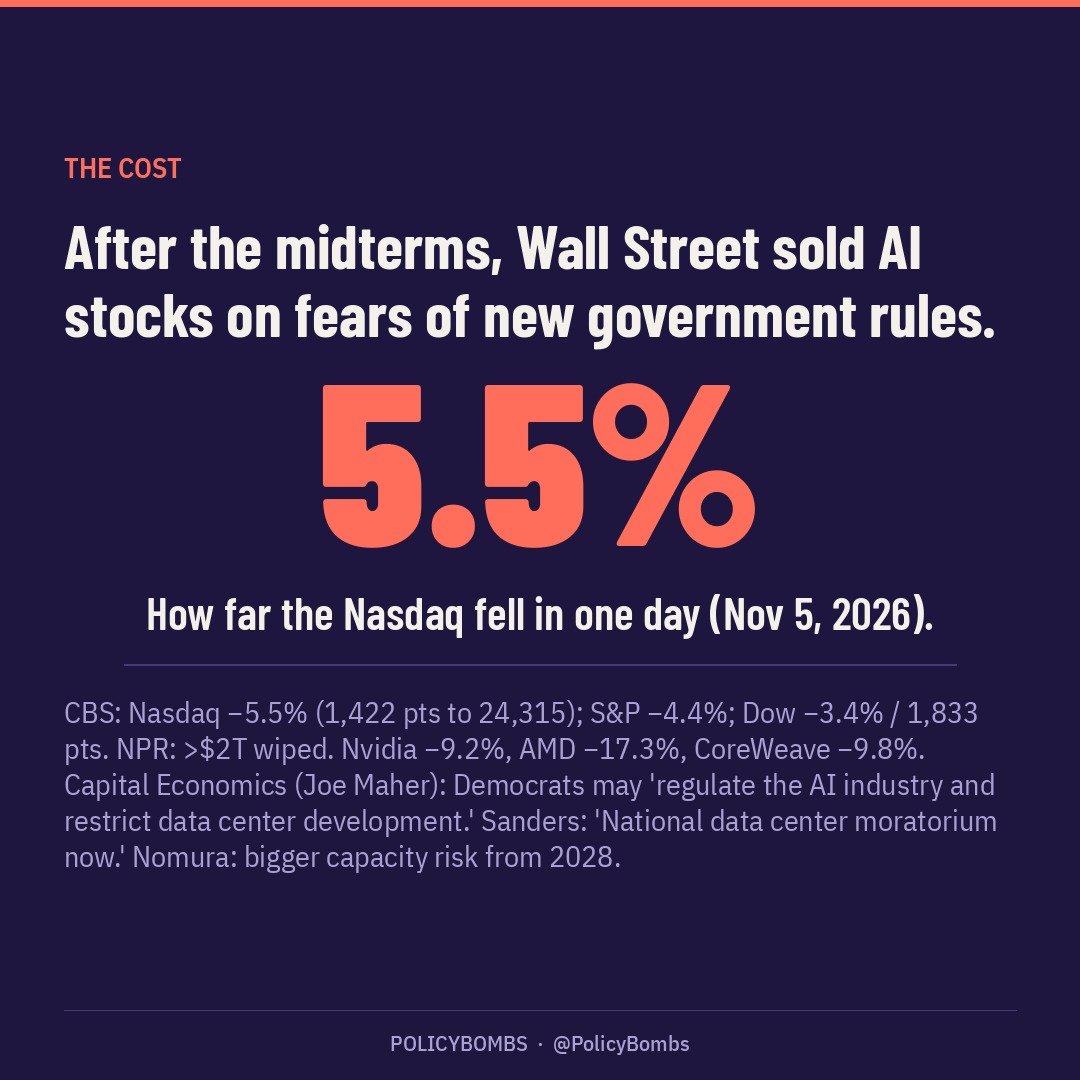
5.5%. That's how far the Nasdaq fell on Nov 5, 2026 — a one-day AI-policy scare after Democrats took Congress.

S&P 500 −4.4%. Dow −3.4% (~1,833 points). NPR: more than $2 trillion in market value wiped. Nvidia −9.2%, AMD −17.3%, CoreWeave −9.8% (CBS).

Capital Economics: the trigger was fear Democrats will "regulate the AI industry and restrict data center development." Sen. Bernie Sanders: "National data center moratorium now." Progressive Caucus chair Greg Casar wants AI CEOs under oath.

Wednesday's relief rally died Thursday when investors priced the mandate — not a signed bill, but expected rules on top of state pauses.

PRO: Voters who fear unconstrained AI buildout now have congressional power to write guardrails.

CON / COST: >$2T wiped on expected policy; a Sanders-style national freeze would hit U.S. compute leadership before any safety bill is drafted.

SOCIETY: MIXED — voters asked for AI guardrails and markets believed them; a national buildout freeze would be a strategic own-goal.


Full analysis

Federal AI Regulation Risk After the Midterms: The Nov 5 Market Repricing

Democratic control of the House and Senate plus anti-data-center governors triggered a Nov 5, 2026 tech rout — Nasdaq ~−5.5%, S&P ~−4.4%, Dow ~−3.4% (~1,833 points) — as investors priced federal AI rules and slower data-center buildout; >$2T market value wiped (NPR). As of Nov 5, 2026, 11:40 PM ET.

Content as of Nov 5, 2026, 11:40 PM ET. Source: primary reporting + Ballotpedia / campaign statements fetched this run

Long-form deep analysis. Companion to the 10-minute quick reference (70-federal-ai-regulation-post-midterms-summary.docx).

Contents

  • 10-Minute Lazy Voter Guide
  • 1. What is the policy
  • 2. Why it exists
  • 3. Realized effects
  • Local investigations and anomalies
  • Who supports / who opposes
  • 4. Good or bad for society
  • References
  • Gaps / unverified

10-Minute Lazy Voter Guide

The day after Democrats’ midterm sweep sank in, Wall Street sold AI and tech hard. Investors fear a Democratic Congress will pass new national rules on artificial intelligence and help states slow the giant computer buildings that power it. The Nasdaq had its correction-level drop; chipmakers got hit worst.

Verdict: MIXED — MIXED — voters asked for AI guardrails and markets believed them; a national buildout freeze would be a strategic own-goal.

Figure

Meaning

Tag

5.5%

Nasdaq Composite drop Nov 5, 2026 — 1,422 points to 24,315; index into >10% correction from October high (CBS News)

Substantiated

4.4%

S&P 500 drop — 335 points to 7,354 (CBS)

Substantiated

3.4% / 1,833 pts

Dow Jones Industrial Average plunge (CBS)

Substantiated

>$2T

Market value wiped as Nasdaq sank >5% (NPR Nov 5, 2026)

Substantiated

−9.2% / −17.3%

Nvidia / AMD one-day moves (CBS); CoreWeave −9.8%

Substantiated

~$100B

Anthropic IPO previously expected this month; analyst said rout could delay it (Vital Knowledge via CBS)

Substantiated

1. What is the policy

Post-midterm political risk that Democratic House+Senate majorities will advance federal AI industry regulation (safety, disclosure, executive oversight) and support restrictions on data-center development — layered on state moratoriums. Immediate realized effect: Nov 5, 2026 equity crash concentrated in AI/infra. Capital Economics’ Joe Maher: trigger was concern Democrats ‘will seek to regulate the AI industry and restrict data center development.’ Trajan Wealth’s David Busch (NPR): concern about ‘far more regulations coming to AI technology’ plus data-center pushback. Not a signed law — a repricing of expected law.

2. Why it exists

Stated reasons: Protect jobs, environment, ‘humanity’s future’ (Sanders); hold ‘AI billionaires’ accountable (Casar); respond to voter revolt.

Underlying drivers (evidence-based assessment): Midterm mandate politics; progressive caucus agenda; anti-oligarch branding after record tech/crypto GOP donor edge (CNBC FEC analysis); genuine local resource conflicts elevated to federal symbolism. Trump-era tariff/immigration/Iran policies largely executive — Moody’s/Morgan Stanley-type analyses (parent brief) say those stay; AI/data centers are the legislative battlefield markets chose to price.

3. Realized effects

CBS close: Nasdaq −5.5%, S&P −4.4%, Dow −3.4%/−1,833. NPR: >$2T wiped. Nvidia −9.2%, AMD −17.3%, CoreWeave −9.8%. Wednesday had rallied on reduced uncertainty; Thursday cracked on AI regulation narrative (Morgan Stanley E*TRADE’s Chris Larkin). Nomura: bigger capacity hit from 2028; 2027 mostly under construction. Goldman (Reuters/BI): state/local halts could touch a large share of planned U.S. expansion (one report: ~45%) but may be short-lived. Anthropic IPO delay risk.

Local investigations and anomalies

No enacted federal AI statute tied to this crash yet (Pending). Exact House/Senate bill vehicles Unverified. ‘$2.5T’ figure used in some commentary — not used here; NPR’s >$2T is the cited floor. SOXX ‘nearly 9%’ on ‘Tuesday’ in one CNBC line may be a day-label inconsistency vs Thursday crash — treat chip one-day CBS figures as primary. … Full gaps listed below.

Who supports / who opposes

Supports: Sanders, Ansari, Casar, Garcia; AI safety Caucus expanders (Axios: Rutinel, Little); state-level moratorium governors.

Opposes: AI industry lobby; chip/neocloud shareholders; executive-branch status quo on other Trump priorities; analysts warning of investment decline (BMI via CNBC).

Further reading (also listed in References):

  • [1] CBS News: Dow sheds >1,800 points — Nasdaq −5.5%, S&P −4.4%, Dow −3.4% (Nov 5, 2026)
  • [2] NPR: Stocks sink as AI fears build after midterms — >$2T wiped
  • [3] CNBC: Top Democrats call to rein in AI buildout — Sanders national moratorium (Nov 5, 2026)
  • [4] CNBC: Midterms could fuel K-shaped AI trade — Nomura 2028 risk
  • [5] Axios: AI earthquake

4. Good or bad for society

Society should want competent AI safety and honest ratepayer accounting. Society should not want Congress to nationalize the local zoning revolt into a compute drought. Fiscal/bureaucracy risk: new agencies and licensing regimes. Opportunity cost: every quarter of frozen U.S. capacity is capacity built elsewhere. Trade-off: voter legitimacy vs. strategic compute.

Pricing political risk is rational: Democrats campaigned against unconstrained AI buildout and now hold Congress. Hearings, disclosure rules and ending federal preference for opaque subsidies can be GOOD. A national data-center moratorium — Sanders’s words — would be BAD industrial policy, ceding compute to jurisdictions that keep building. The Nov 5 crash is a realized effect of expected policy, not of enacted statutes. Net: MIXED — mandate for guardrails is real; mandate for a national freeze is a market and strategic overreach.

References

[1] CBS News: Dow sheds >1,800 points — Nasdaq −5.5%, S&P −4.4%, Dow −3.4% (Nov 5, 2026). https://www.cbsnews.com/news/stocks-midterm-elections-tech-companies-ai-data-centers/

[2] NPR: Stocks sink as AI fears build after midterms — >$2T wiped. https://www.npr.org/2026/11/05/nx-s1-6031987/stock-markets-ai-midterm-elections

[3] CNBC: Top Democrats call to rein in AI buildout — Sanders national moratorium (Nov 5, 2026). https://www.cnbc.com/2026/11/05/democrats-data-center-restrictions-midterms.html

[4] CNBC: Midterms could fuel K-shaped AI trade — Nomura 2028 risk. https://www.cnbc.com/2026/11/05/ai-data-centers-midterms-capacity.html

[5] Axios: AI earthquake. https://www.axios.com/2026/11/04/ai-data-center-election-slowdown

[6] AP News: Stocks/markets AI midterm (linked in brief). https://apnews.com/article/stocks-markets-ai-midterm-oil-trump-7ee9c212805aa5e70cf34d25aab7a36e

[7] Reuters via Investing.com: Goldman ~45% planned capacity potentially affected. https://www.investing.com/news/stock-market-news/analysistrumps-midterm-drubbing-demonstrates-the-power-of-datacentre-opponents-4998061

Gaps / unverified

No enacted federal AI statute tied to this crash yet (Pending). Exact House/Senate bill vehicles Unverified. ‘$2.5T’ figure used in some commentary — not used here; NPR’s >$2T is the cited floor. SOXX ‘nearly 9%’ on ‘Tuesday’ in one CNBC line may be a day-label inconsistency vs Thursday crash — treat chip one-day CBS figures as primary.

PolicyBombs. Follow @PolicyBombs on X.
Data-Center Ratepayer & Subsidy Rules: End Tax Breaks, Stop Bill-Shifting, Ban NDAs

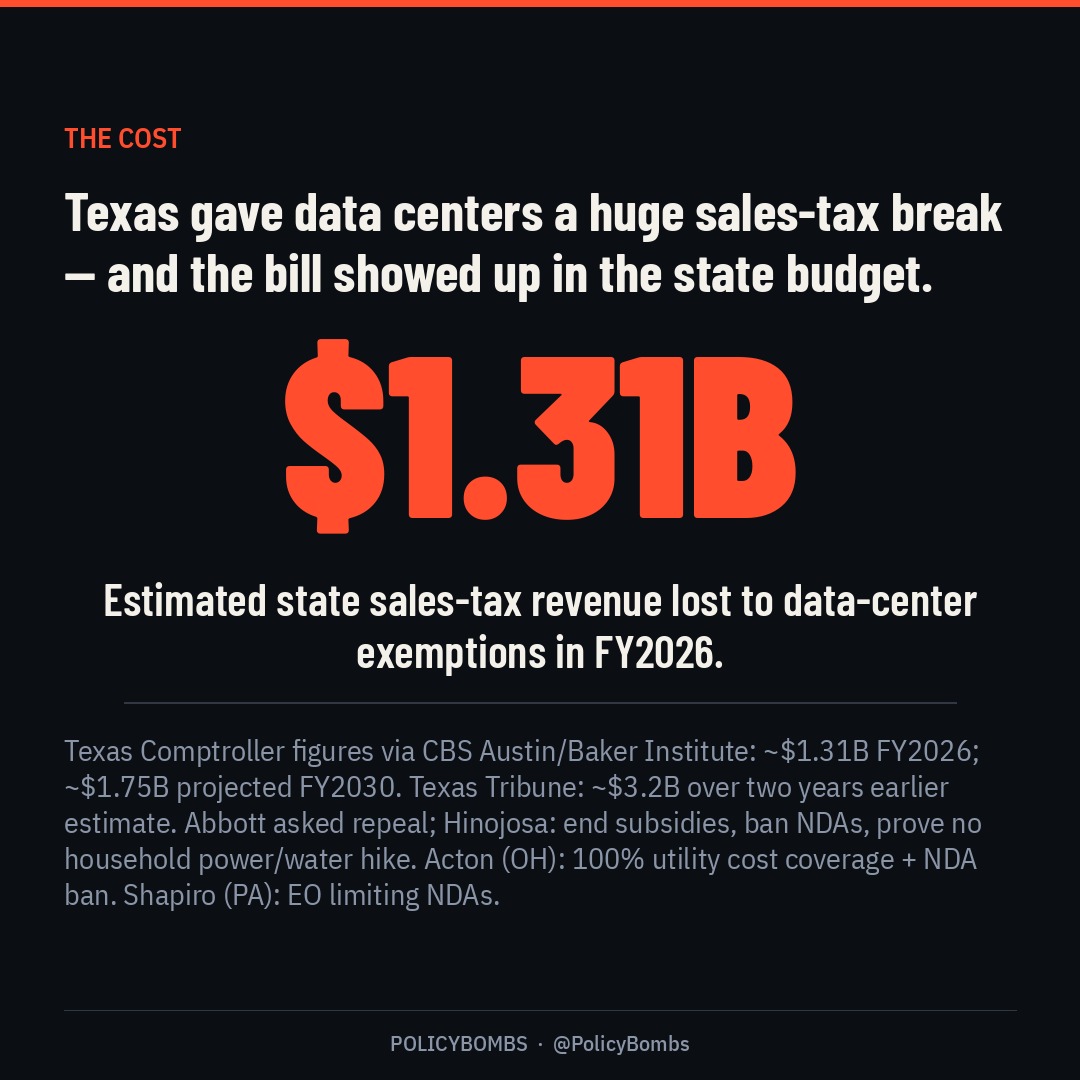
$1.31 billion. That's the estimated Texas state sales-tax revenue lost to data-center exemptions in FY2026 alone.

The Comptroller's figures (via CBS Austin / Baker Institute) climb toward ~$1.75B a year by FY2030. Abbott asked the Legislature to repeal the break. Hinojosa calls it a giveaway and adds: ban NDAs, make operators prove households won't pay more for power or water.

Ohio's Amy Acton: cover 100% of utility costs or you don't build. Pennsylvania's Josh Shapiro already moved against secrecy NDAs by executive order.

This is the bipartisan core of the revolt — not "no computers," but "stop putting Big Tech's power bill on grandma's meter."

PRO: Ends household subsidies for hyperscaler power and kills secret site NDAs.

CON / COST: Clumsy clawbacks can strand capital; states that keep breaks may poach projects.

SOCIETY: GOOD — making AI builders pay their own power and water freight, and killing secrecy NDAs, is basic fairness; phase out tax carve-outs cleanly.


Full analysis

Data-Center Ratepayer & Subsidy Rules: End Tax Breaks, Stop Bill-Shifting, Ban NDAs

Across Texas, Ohio and related states, the winning 2026 package is cost internalization: no electricity ratepayer subsidies, end sales-tax/property incentives, ban secrecy NDAs, and make operators fund their own grid and water infrastructure — with Texas Comptroller figures showing the sales-tax exemption alone at ~$1.31B in FY2026. As of Nov 5, 2026, 11:40 PM ET.

Content as of Nov 5, 2026, 11:40 PM ET. Source: primary reporting + Ballotpedia / campaign statements fetched this run

Long-form deep analysis. Companion to the 10-minute quick reference (71-data-center-ratepayer-subsidy-rules-summary.docx).

Contents

  • 10-Minute Lazy Voter Guide
  • 1. What is the policy
  • 2. Why it exists
  • 3. Realized effects
  • Local investigations and anomalies
  • Who supports / who opposes
  • 4. Good or bad for society
  • References
  • Gaps / unverified

10-Minute Lazy Voter Guide

Politicians who just won say giant computer buildings should pay their own power and water costs — not hide them on your monthly bill — and should lose special sales-tax breaks. They also want to ban secret contracts (NDAs) that keep neighbors in the dark. In Texas, the state sales-tax break alone is estimated around $1.31 billion for FY2026.

Verdict: GOOD — GOOD — making AI builders pay their own power and water freight, and killing secrecy NDAs, is basic fairness; phase out tax carve-outs cleanly.

Figure

Meaning

Tag

~$1.31B

Estimated Texas state sales-tax revenue lost to data-center exemption, FY2026 (Texas Comptroller figures via CBS Austin / Baker Institute reproduction)

Substantiated

~$1.75B

Projected annual cost of the same exemption by FY2030 (Comptroller projections)

Substantiated

$3.2B

Texas Tribune earlier report: sales-tax revenue the state was poised to lose over two years due to the exemption

Substantiated

100%

Utility-cost coverage Acton demands from operators (campaign)

Substantiated

~$66B

Researcher John Diamond’s estimate of Texas data-center investment in 2026, up from ~$3B in 2022 (CBS Austin)

Substantiated

1. What is the policy

Campaign and bipartisan policy package: (1) prohibit electricity/water cost shifting onto residential ratepayers — operators fund interconnection and prove no household rate spike; (2) repeal or rein in state sales-tax exemptions and local property abatements for data centers; (3) ban or sharply limit NDAs that hide projects from the public; (4) require water-efficient tech and reporting. Texas: Comptroller exemption tiers (100k–250k sq ft investment thresholds, 10–20 year terms). Ohio: Acton 100% utility + NDA ban + clawbacks on incentives. PA: Shapiro EO limiting NDAs / removing AI centers from fast track.

2. Why it exists

Stated reasons: Affordability; fairness; transparency; end ‘tax giveaways’ to billionaires.

Underlying drivers (evidence-based assessment): Bill shock is a winning midterm message; Comptroller numbers made the subsidy visible; community groups documented secrecy; even pro-growth Republicans (Abbott by mid-2026) had to pivot. Fiscal motive: reclaiming >$1B/year in Texas sales tax is real money.

3. Realized effects

Political consensus forming around ratepayer protection even where moratoriums differ. Market implication: project IRRs fall when free grid upgrades and sales-tax holidays disappear — especially painful for debt-funded neoclouds vs cash-rich hyperscalers (JPMorgan/CNBC K-shaped thesis). Not yet fully enacted nationwide — Pending in Texas Legislature 2027 and Ohio General Assembly.

Local investigations and anomalies

Exact FY2026 Comptroller line items should be confirmed from the primary tax-exemptions PDF (cited via CBS Austin/Baker Institute — Substantiated via reputable secondary). How many of 138 certified Texas centers fail audits (Comptroller: 6 of 20 audited out of compliance as of mid-2026 reporting) — sample, not census. Federal ratepayer bill status Pending. … Full gaps listed below.

Who supports / who opposes

Supports: Hinojosa; Abbott (repeal ask); Acton; Brown; Shapiro; Donalds’ ratepayer framing; local officials; Public Citizen.

Opposes: Certified exemption holders; site-competing economic-development agencies; developers warning capital flight.

Further reading (also listed in References):

  • [1] CBS Austin: Democrats’ wins and Texas data center tax policy — Comptroller $1.31B FY2026 / $1.75B FY2030 (Nov 5, 2026)
  • [2] Texas Tribune: Abbott recommends data-center crackdown / sales-tax repeal (Jun 10, 2026)
  • [3] Texas Tribune: Hinojosa policies — stop subsidies, NDAs, ratepayer protection (Nov 4, 2026)
  • [4] Data Center Dynamics: Hinojosa Texans First priorities — NDAs, subsidies, prove no household cost hike
  • [5] Acton campaign: 100% utility costs + NDA ban

4. Good or bad for society

Measurable good: lower cross-subsidy from households; transparent siting; fiscal recovery of carve-outs. Risk: clumsy clawbacks. Opportunity cost of keeping subsidies: every exempted dollar is a dollar not on schools/roads or tax-rate cuts. This is the part of the revolt that travels across party lines for a reason.

If any piece of the anti-data-center wave is straightforwardly GOOD for society, it is this: stop shifting hyperscaler grid and water costs onto households, stop opaque NDAs, and stop nine-figure sales-tax carve-outs that the Comptroller itself flags as ballooning. Abbott and Hinojosa agreeing on the subsidy problem is your tell. Caveats: grandfathering and phase-outs matter so you don’t create takings fights; keep the rule about cost causation, not about picking union winners. Net: GOOD — with implementation discipline.

References

[1] CBS Austin: Democrats’ wins and Texas data center tax policy — Comptroller $1.31B FY2026 / $1.75B FY2030 (Nov 5, 2026). https://cbsaustin.com/news/local/could-democrats-election-wins-reshape-texas-data-center-tax-policy

[2] Texas Tribune: Abbott recommends data-center crackdown / sales-tax repeal (Jun 10, 2026). https://www.texastribune.org/2026/06/10/texas-greg-abbott-data-centers-regulation-sales-tax/

[3] Texas Tribune: Hinojosa policies — stop subsidies, NDAs, ratepayer protection (Nov 4, 2026). https://www.texastribune.org/2026/11/04/data-center-texas-pause-gina-hinojosa-governor-policies/

[4] Data Center Dynamics: Hinojosa Texans First priorities — NDAs, subsidies, prove no household cost hike. https://www.datacenterdynamics.com/en/news/texas-governor-elect-gina-hinojosa-promises-continued-data-center-moratorium-further-legislation/

[5] Acton campaign: 100% utility costs + NDA ban. https://actonforgovernor.com/dr-amy-acton-calls-for-statehouse-to-pass-immediate-conditional-data-center-moratorium-legislation-as-they-reconvene/

[6] The Verge: Shapiro EO on NDAs; Donalds Protecting Ratepayers Act context. https://www.theverge.com/policy/1026365/data-centers-midterms-results

[7] DaveManuel summary of Comptroller exemption schedule / Baker Institute. https://www.davemanuel.com/2026/11/04/what-a-democratic-texas-governor-means-for-the-data-center-boom/

Gaps / unverified

Exact FY2026 Comptroller line items should be confirmed from the primary tax-exemptions PDF (cited via CBS Austin/Baker Institute — Substantiated via reputable secondary). How many of 138 certified Texas centers fail audits (Comptroller: 6 of 20 audited out of compliance as of mid-2026 reporting) — sample, not census. Federal ratepayer bill status Pending.

PolicyBombs. Follow @PolicyBombs on X.
Data-Center Ballot Measures 2026: ~41 Local Fights, Voters Chose Restrictions

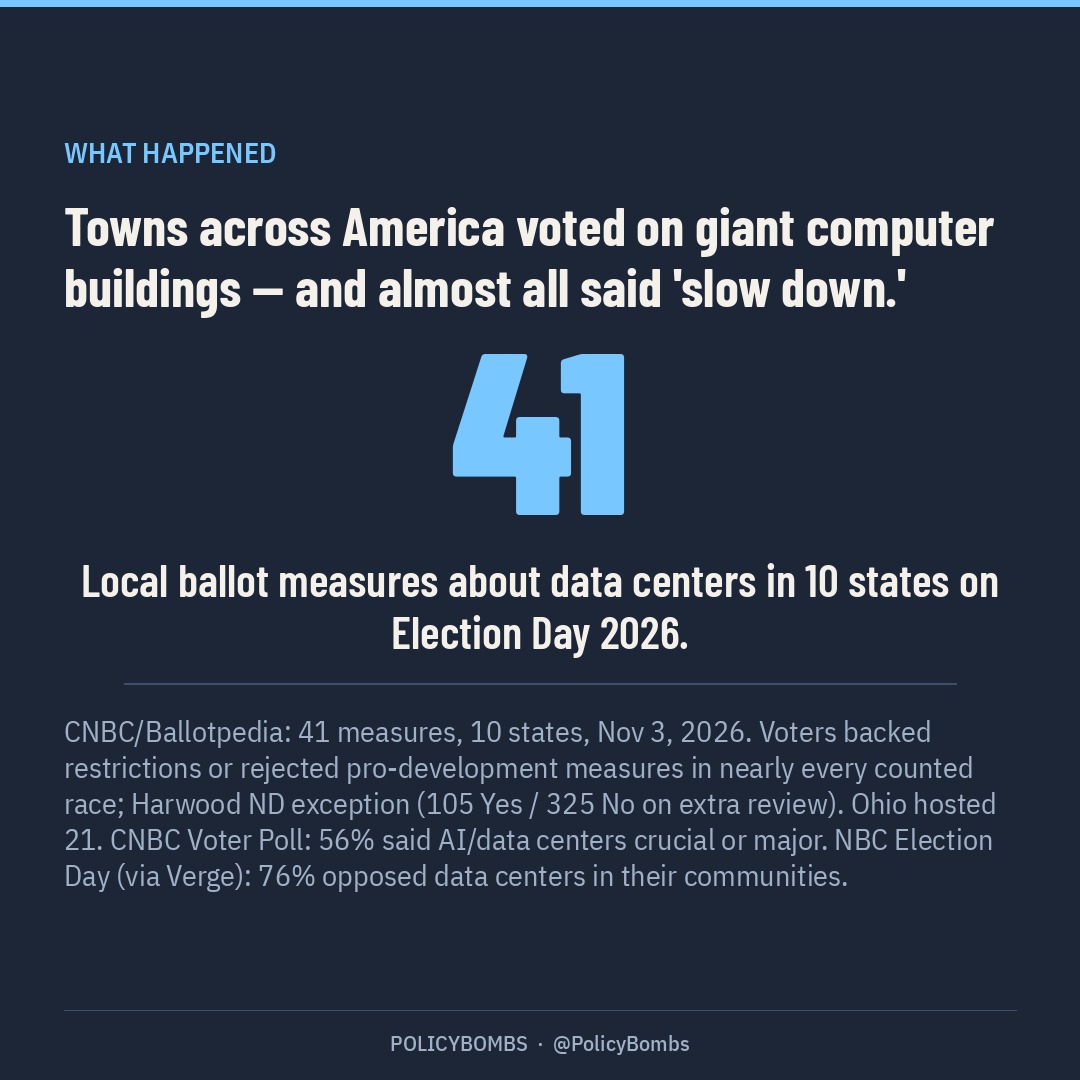
41. Local ballot measures on data centers across 10 states — and voters sided against them in nearly every counted race.

Nov 3, 2026: towns from Maine to California put AI's power plants on the ballot. CNBC/Ballotpedia: 41 measures in 10 states. Ohio alone had 21.

Results: restrictions won almost everywhere. Bans, MW caps, 180-day freezes. The rare exception: Harwood, North Dakota, rejected extra industrial review (105–325).

This wasn't a fringe issue. CNBC's voter poll: 56% said AI/data centers were a crucial or major factor. NBC Election Day: 76% opposed data centers in their own communities.

PRO: Voters who live with the noise, water draw and secrecy got a direct say — and used it.

CON / COST: 41 uncoordinated local bans are a slow, patchy way to run national AI infrastructure policy.

SOCIETY: MIXED — democratic local control over land and water is legitimate; a patchwork of bans is a real tax on national AI capacity.


Full analysis

Data-Center Ballot Measures 2026: ~41 Local Fights, Voters Chose Restrictions

About 41 local data-center ballot measures in 10 states went to voters in the 2026 midterms; with results in, voters backed restrictions or rejected pro-development measures in nearly every counted race — Harwood, North Dakota the notable exception. As of Nov 5, 2026, 11:40 PM ET.

Content as of Nov 5, 2026, 11:40 PM ET. Source: primary reporting + Ballotpedia / campaign statements fetched this run

Long-form deep analysis. Companion to the 10-minute quick reference (69-data-center-ballot-measures-2026-summary.docx).

Contents

  • 10-Minute Lazy Voter Guide
  • 1. What is the policy
  • 2. Why it exists
  • 3. Realized effects
  • Local investigations and anomalies
  • Who supports / who opposes
  • 4. Good or bad for society
  • References
  • Gaps / unverified

10-Minute Lazy Voter Guide

On Election Day 2026, dozens of towns and cities asked voters: should we ban, pause, or tightly limit giant computer buildings (data centers)? In almost every place that counted quickly, voters said yes to limits — or no to welcoming them. One small North Dakota town, Harwood, voted the other way.

Verdict: MIXED — MIXED — democratic local control over land and water is legitimate; a patchwork of bans is a real tax on national AI capacity.

Figure

Meaning

Tag

41

Local data-center-related ballot measures in 10 states on the Nov 3, 2026 ballot (CNBC citing Ballotpedia; Ballotpedia News pre-election)

Substantiated

Harwood, ND

Lone widely cited exception: voters rejected added industrial/data-center review requirements — 105 Yes (24%) / 325 No (76%) (Ballotpedia / CNBC)

Substantiated

56%

Voters who said AI/data centers were a crucial or major factor in their decision (CNBC Voter Poll)

Substantiated

76%

Election Day poll share opposing data centers in their communities (NBC via The Verge)

Substantiated

10

States with data-center-related local measures (Ballotpedia News)

Substantiated

1. What is the policy

A wave of municipal and county ballot questions on Nov 3, 2026 restricting data-center development via bans, MW caps, temporary moratoriums, or rejecting pro-development advisories. CNBC/Ballotpedia News: 41 measures in 10 states. Examples: Alhambra CA Measure DB prohibit (82% Yes); Edgewater FL prohibit new centers (77%); Bloomington IL advisory moratorium (78%); Emporia KS high-impact ban (60%); Wells ME 180-day moratorium (82%); Ohio MW caps and referenda (state hosted 21 measures). Harwood ND rejected extra industrial review. Post-election Ballotpedia pages reported additional decided measures with the same directional pattern (near-universal restriction support).

2. Why it exists

Stated reasons: Protect local water, power rates, farmland, property values and quality of life; stop being ‘sold out’ to hyperscalers.

Underlying drivers (evidence-based assessment): Visible construction + higher bills + drought fear + anti-billionaire politics after heavy Silicon Valley/GOP donor spending (CNBC: crypto/AI/gambling interests >$377M; Musk ≥$474M cycle spending). Data centers became a stand-in for AI-era inequality.

3. Realized effects

Near-sweep for restriction side on counted measures (CNBC Nov 4–5). Reinforced gubernatorial/Senate messaging in TX, OH, GA, WI, etc. Sanders: ‘National data center moratorium now.’ Market: contributed to Nov 5 AI/infra selloff narrative. Industry must now negotiate town-by-town.

Local investigations and anomalies

Final certified count may exceed 41 as late ballots/post-election listings finalize (Ballotpedia updated tallies Nov 4+). Some measures advisory only. Verge cited 45 measures / Redbud Consulting 33 restricting as of Wednesday morning — count Contested at the margin; direction Substantiated. … Full gaps listed below.

Who supports / who opposes

Supports: Local majorities; Sanders; Casar (‘AI earthquake’); municipal organizers; Americans for Responsible Innovation.

Opposes: Developers; Data Center Coalition; some local economic-development officials; Harwood ND majority.

Further reading (also listed in References):

  • [1] CNBC: Voters rebuff data centers in every ballot measure except one (Nov 4, 2026)
  • [2] Ballotpedia: Data center-related ballot measures, 2026
  • [3] Ballotpedia News: Voters in ten states will vote on 41 measures (Nov 3, 2026)
  • [4] Ballotpedia: Harwood ND Industrial Development Review Initiative
  • [5] The Verge: Data centers lost the midterms — NBC 76% oppose

4. Good or bad for society

Good: ends the fiction that megawatt campuses are just another warehouse. Bad: U.S. industrial policy by zoning referendum is slow, uneven and easy to capture by whichever side shows up. Better path: statewide ratepayer/water standards + local siting voice — not 41 incompatible ordinances.

Local voters have every right to police noise, water, land use and secretive PILOT deals in their backyard — and they just did, almost uniformly. That is democratic accountability, not ‘Luddism.’ The social cost is a fragmented permitting map that makes U.S. AI capacity slower and pricier precisely when China is not holding town-hall moratoriums. Net: MIXED — healthy local veto power; unhealthy if the only national energy policy is 41 uncoordinated municipal bans.

References

[1] CNBC: Voters rebuff data centers in every ballot measure except one (Nov 4, 2026). https://www.cnbc.com/2026/11/04/data-center-ballot-measures-2026-midterm.html

[2] Ballotpedia: Data center-related ballot measures, 2026. https://ballotpedia.org/Data_center-related_ballot_measures,_2026

[3] Ballotpedia News: Voters in ten states will vote on 41 measures (Nov 3, 2026). https://news.ballotpedia.org/2026/11/03/voters-in-ten-states-will-vote-on-data-center-related-ballot-measures-november-3/

[4] Ballotpedia: Harwood ND Industrial Development Review Initiative. https://ballotpedia.org/Harwood,_North_Dakota,_Industrial_Development_Review_Requirements_Initiative_(November_2026)

[5] The Verge: Data centers lost the midterms — NBC 76% oppose. https://www.theverge.com/policy/1026365/data-centers-midterms-results

[6] Guardian: Voters approved nearly every datacenter moratorium. https://www.theguardian.com/us-news/2026/nov/04/datacenters-midterm-elections

[7] Axios: AI earthquake / ~two dozen restriction proposals passing on initial returns. https://www.axios.com/2026/11/04/ai-data-center-election-slowdown

Gaps / unverified

Final certified count may exceed 41 as late ballots/post-election listings finalize (Ballotpedia updated tallies Nov 4+). Some measures advisory only. Verge cited 45 measures / Redbud Consulting 33 restricting as of Wednesday morning — count Contested at the margin; direction Substantiated.

PolicyBombs. Follow @PolicyBombs on X.
Ohio Conditional Data-Center Moratorium: Acton’s 100% Utility Costs + Union Labor Rules

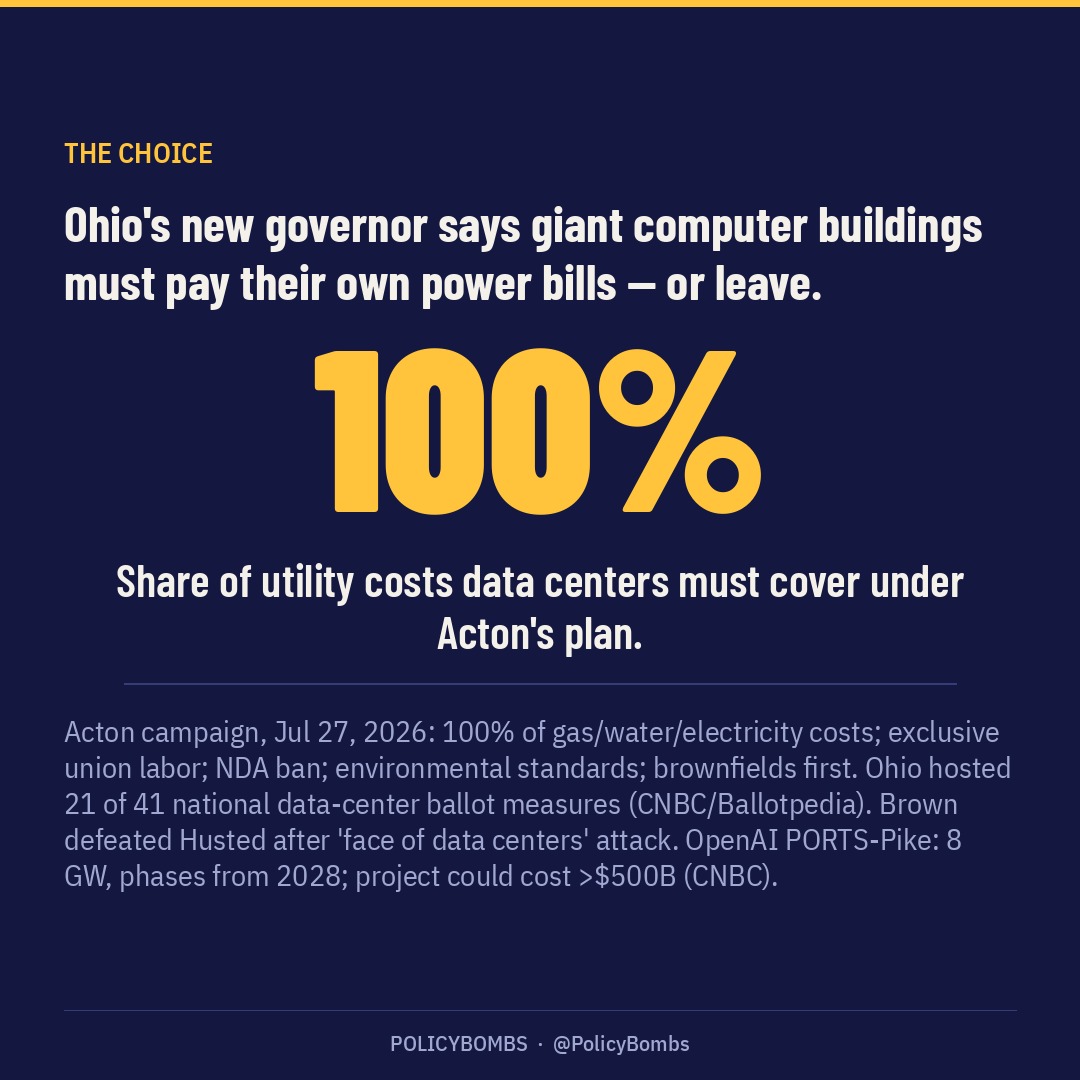
100%. That's the share of utility costs Ohio's new governor says data centers must pay — or they don't get built.

Gov.-elect Amy Acton (D) supports a "conditional moratorium": cover 100% of gas, water and electricity costs, build exclusively with union labor, ban NDAs, meet environmental standards, prefer brownfields. "If you do not meet these conditions, we do not want you in Ohio."

Ohio wasn't subtle. It hosted 21 of the 41 local data-center ballot measures nationwide. Sen. Sherrod Brown beat Sen. Jon Husted after branding him "the face of data centers." OpenAI's PORTS-Pike campus — 8 GW, Nvidia-backstopped, potentially >$500B — now sits in a tougher political climate.

PRO: Ratepayers stop subsidizing Big Tech's power bill; secrecy NDAs get banned.

CON / COST: Exclusive-union mandates and vague 'zero impact' language can turn a cost rule into a de facto ban — including on an 8 GW mega-campus.

SOCIETY: MIXED — ratepayer cost internalization and anti-NDA rules are sound; exclusive-union + vague 'zero impact' conditions risk a protectionist veto.


Full analysis

Ohio Conditional Data-Center Moratorium: Acton’s 100% Utility Costs + Union Labor Rules

Ohio Gov.-elect Amy Acton backs a conditional moratorium — new data centers only if they cover 100% of utility costs, use exclusive union labor, ban NDAs, meet environmental standards and prioritize brownfields — in a state that hosted 21 of 41 national ballot measures and flipped Brown over Husted. As of Nov 5, 2026, 11:40 PM ET.

Content as of Nov 5, 2026, 11:40 PM ET. Source: primary reporting + Ballotpedia / campaign statements fetched this run

Long-form deep analysis. Companion to the 10-minute quick reference (68-ohio-conditional-data-center-moratorium-summary.docx).

Contents

  • 10-Minute Lazy Voter Guide
  • 1. What is the policy
  • 2. Why it exists
  • 3. Realized effects
  • Local investigations and anomalies
  • Who supports / who opposes
  • 4. Good or bad for society
  • References
  • Gaps / unverified

10-Minute Lazy Voter Guide

Ohio’s new Democratic governor wants to block new data centers unless they meet her checklist: pay every dollar of their own electricity/gas/water costs (no shifting to household bills), hire only union workers to build, no secret NDAs, follow environmental rules, and prefer old industrial sites over farmland. Ohio voters also passed a pile of local bans and restrictions, and Sen. Sherrod Brown beat Sen. Jon Husted after branding him ‘the face of data centers.’

Verdict: MIXED — MIXED — ratepayer cost internalization and anti-NDA rules are sound; exclusive-union + vague ‘zero impact’ conditions risk a protectionist veto.

Figure

Meaning

Tag

100%

Utility costs Acton says operators must cover — gas, water, electricity — with proof projects won’t raise household rates (Acton campaign, Jul 27, 2026)

Substantiated

21 of 41

Ohio’s share of local data-center ballot measures nationwide in the 2026 midterms (CNBC / Ballotpedia)

Substantiated

8 GW

Computing capacity OpenAI secured at PORTS-Pike Technology Campus in Ohio — described as the world’s largest planned AI data-center campus; phases from 2028 (CNBC)

Substantiated

>$500B

Potential total cost of the Nvidia-backstopped Ohio campus project (CNBC)

Substantiated

14+

Ohio municipalities that passed bans/restrictions including Sunbury (Amazon ~$2B proposal) per Guardian tally

Substantiated

1. What is the policy

Gov.-elect Amy Acton’s ‘conditional moratorium’: new Ohio data centers allowed only if they (1) cover 100% of utility costs and prove no household rate increase / regional reliability hit, (2) exclusively use union labor to build/maintain, (3) ban NDAs / operate with full transparency, (4) meet environmental standards (campaign also used ‘zero environmental impact’), (5) prioritize brownfields/former industrial sites, (6) support local communities / community-benefit agreements (July list; later releases varied). She asked the General Assembly to pass legislation — not yet enacted as of Nov 5, 2026. Parallel: Sherrod Brown defeated Jon Husted after casting Husted as ‘the face of data centers’; NRSC memo warned blaming data centers for a Husted loss would poison the issue for future GOP candidates (The Verge).

2. Why it exists

Stated reasons: Protect Ohio families from bill spikes; end secret deals; ensure good union jobs; stop farmland conversion; force developers to bring their own generation.

Underlying drivers (evidence-based assessment): Affordability politics; union coalition demands; anti-tech populism that worked in 2026; OpenAI/SoftBank mega-campus as a visible target; Brown’s Senate playbook. Interest-group note: unions support the labor condition (and often support construction); environmental groups want water/air limits; hyperscalers want speed. Capture risk runs both ways — tax-break era favored capital; union-exclusive era favors organized labor.

3. Realized effects

Acton won the governorship; Brown won the Senate; Ohio locals passed numerous MW caps and bans (Guardian: ≥14 municipalities). Market: Ohio political risk layered onto national AI selloff Nov 5. PORTS-Pike first construction phase slated to begin 2026 with capacity from 2028 — more exposed to new conditions than already-pouring projects. Fact-check gap: campaign has not fully defined how ‘100%’ is measured vs existing PUCO tariffs (Ohio Policy Updates).

Local investigations and anomalies

Exact statutory text Pending. ‘Zero environmental impact’ vs ‘adhere to Ohio’s environmental standards’ wording inconsistency Contested. Whether PORTS-Pike is grandfathered Unverified. Community-benefit condition dropped from some later campaign lists (Ohio Policy Updates). … Full gaps listed below.

Who supports / who opposes

Supports: Acton; Brown; Ohio local majorities; AFL-CIO-aligned building trades (labor mandate); anti-data-center municipal organizers.

Opposes: Ramaswamy campaign (defeated); developers needing open-shop flexibility; SoftBank/SB Energy/OpenAI partners; some Republicans who shifted to ratepayer-protection bills without full moratoriums (Husted’s later Ratepayer Protection Act).

Further reading (also listed in References):

  • [1] Acton for Governor: Conditional moratorium announcement (Jul 27, 2026)
  • [2] Acton for Governor: Calls for Statehouse to pass conditional moratorium
  • [3] CNBC: Voters rebuff data centers — Ohio 21 of 41 measures; Acton; Brown/Husted; PORTS-Pike 8 GW (Nov 4, 2026)
  • [4] The Verge: Data centers lost the midterms — Brown/Husted NRSC memo
  • [5] Guardian: Ohio municipalities passed bans; Sunbury Amazon $2B

4. Good or bad for society

Society gains if Ohio stops socializing grid upgrades onto households and ends NDA darkness. Society loses if ‘conditional’ means only politically connected union contractors can build the compute the Midwest was courting — and if 8 GW of planned capacity dies in process purgatory. Measurable tests: Did residential rates stabilize? Did brownfield sites get used? Did MW get built under clear tariffs? Or did projects flee to friendlier states?

Forcing data centers to pay their own power and water freight, kill NDAs, and face local scrutiny is GOOD policy. Grafting an exclusive-union mandate and undefined ‘zero impact’ language onto a ‘conditional’ freeze is how a transparent cost rule becomes a patronage gate. Ohio voters clearly wanted brakes — 21 ballot fights and Brown’s win prove it. PolicyBombs call: keep the ratepayer and transparency conditions; drop or narrowly tailor the union exclusivity so it doesn’t become a veto dressed up as labor justice. Net: MIXED.

References

[1] Acton for Governor: Conditional moratorium announcement (Jul 27, 2026). https://actonforgovernor.com/dr-amy-acton-announces-support-for-conditional-moratorium-on-data-centers/

[2] Acton for Governor: Calls for Statehouse to pass conditional moratorium. https://actonforgovernor.com/dr-amy-acton-calls-for-statehouse-to-pass-immediate-conditional-data-center-moratorium-legislation-as-they-reconvene/

[3] CNBC: Voters rebuff data centers — Ohio 21 of 41 measures; Acton; Brown/Husted; PORTS-Pike 8 GW (Nov 4, 2026). https://www.cnbc.com/2026/11/04/data-center-ballot-measures-2026-midterm.html

[4] The Verge: Data centers lost the midterms — Brown/Husted NRSC memo. https://www.theverge.com/policy/1026365/data-centers-midterms-results

[5] Guardian: Ohio municipalities passed bans; Sunbury Amazon $2B. https://www.theguardian.com/us-news/2026/nov/04/datacenters-midterm-elections

[6] Statehouse News Bureau: Acton conditional moratorium (Jul 27, 2026). https://www.statenews.org/government-politics/2026-07-27/democrat-running-for-ohio-governor-calls-for-conditional-moratorium-on-new-data-centers

[7] Ohio Policy Updates fact-check: What would Acton’s moratorium actually do?. https://ohiopolicyupdates.com/fact-check/amy-acton-data-center-moratorium/

Gaps / unverified

Exact statutory text Pending. ‘Zero environmental impact’ vs ‘adhere to Ohio’s environmental standards’ wording inconsistency Contested. Whether PORTS-Pike is grandfathered Unverified. Community-benefit condition dropped from some later campaign lists (Ohio Policy Updates).

PolicyBombs. Follow @PolicyBombs on X.
Texas Data-Center Moratorium: Hinojosa’s Statewide Pause Until 2027 Rules

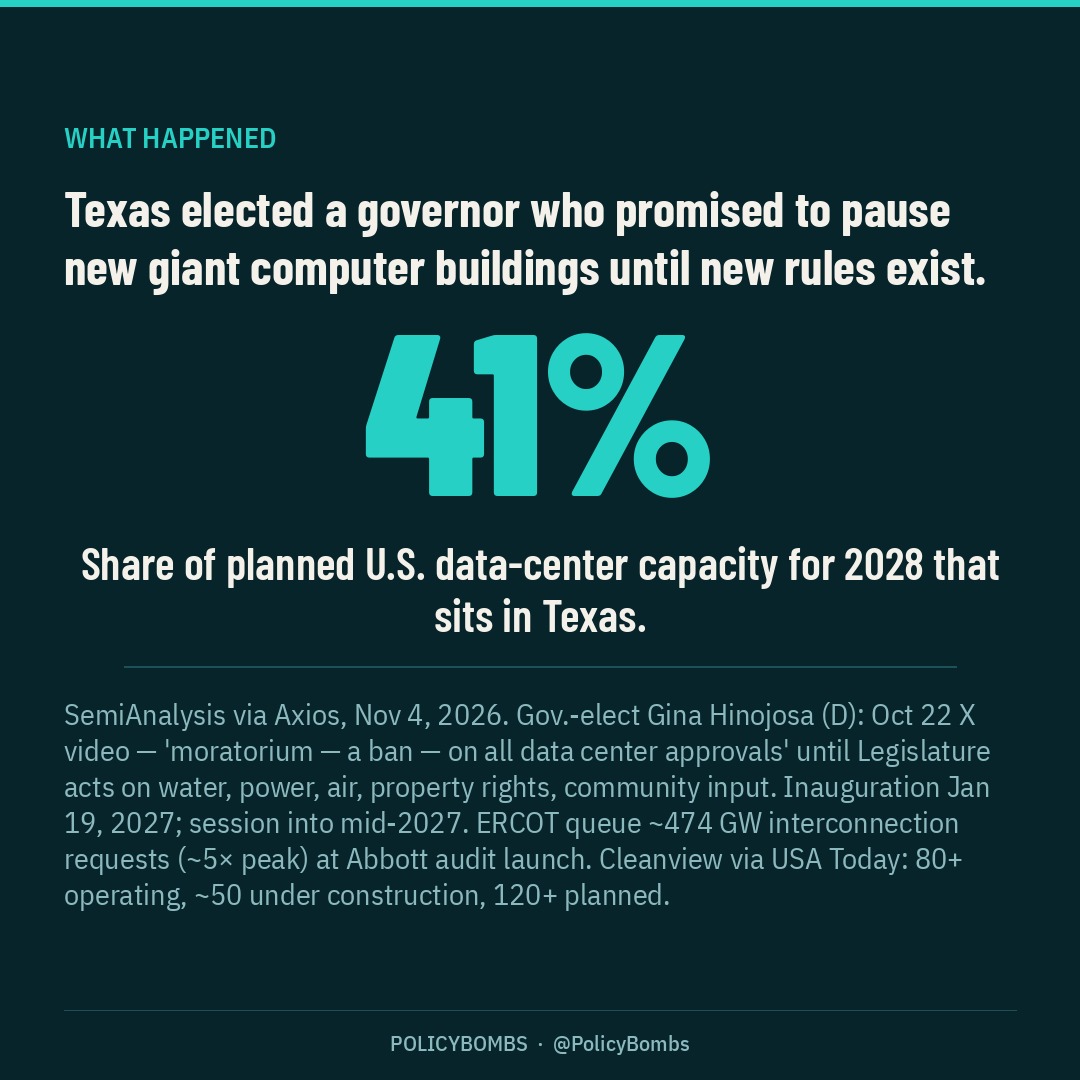
41%. That's Texas's share of planned U.S. data-center capacity for 2028 — and the new governor just promised a statewide ban on new approvals.

Gov.-elect Gina Hinojosa (D) said on Oct. 22 she will issue a "moratorium — a ban — on all data center approvals" until the Legislature passes laws on water, power, air, property rights and community say-so. She takes office Jan. 19, 2027; the session runs into mid-2027.

That's bigger than Abbott's 2026 audit pause. ERCOT's queue had ~474 GW of data-center interconnection requests — about five times peak demand — when that audit began. Trackers count 80+ operating Texas centers, ~50 under construction, 120+ planned.

Markets noticed: Texas is the boom's epicenter. Projects already pouring concrete are generally expected to continue; 2028+ permits are the fight.

PRO: Communities get water/power/air rules and a seat at the table after a free-for-all boom.

CON / COST: A mid-2027 legislative clock on the state with ~41% of U.S. 2028 capacity is a national AI growth tax.

SOCIETY: MIXED — justified pause for water/power/community rules in the #1 2028 capacity state; dangerous if it becomes an open-ended political freeze.


Full analysis

Texas Data-Center Moratorium: Hinojosa’s Statewide Pause Until 2027 Rules

Texas Gov.-elect Gina Hinojosa pledged a statewide ban on new data-center approvals until the Legislature passes water, power, air, property-rights and community-input rules — in the state holding the largest share of planned U.S. 2028 capacity. As of Nov 5, 2026, 11:40 PM ET.

Content as of Nov 5, 2026, 11:40 PM ET. Source: primary reporting + Ballotpedia / campaign statements fetched this run

Long-form deep analysis. Companion to the 10-minute quick reference (67-texas-data-center-moratorium-summary.docx).

Contents

  • 10-Minute Lazy Voter Guide
  • 1. What is the policy
  • 2. Why it exists
  • 3. Realized effects
  • Local investigations and anomalies
  • Who supports / who opposes
  • 4. Good or bad for society
  • References
  • Gaps / unverified

10-Minute Lazy Voter Guide

Texas just elected a governor who promised to stop approving new giant computer buildings (data centers) until the Legislature writes new rules on water, electricity, air, property rights and community say-so. Projects already being built are generally expected to continue; the freeze targets new approvals. She takes office Jan. 19, 2027; the regular legislative session runs into mid-2027.

Verdict: MIXED — MIXED — justified pause for water/power/community rules in the #1 2028 capacity state; dangerous if it becomes an open-ended political freeze.

Figure

Meaning

Tag

41%

Share of planned U.S. 2028 data-center capacity in Texas (SemiAnalysis, cited by Axios Nov 4, 2026)

Substantiated

474 GW

Data-center interconnection requests in ERCOT’s queue when Abbott launched his summer 2026 audit — ~5× peak demand (Heatmap / Abbott framing)

Substantiated

Jan 19, 2027

Hinojosa inauguration date (Texas Tribune)

Substantiated

Oct 22, 2026

Hinojosa X video: ‘moratorium — a ban — on all data center approvals until laws can be passed’

Substantiated

80+ / 50 / 120+

Operating / under construction / planned Texas data centers (Cleanview via USA Today Nov 5, 2026)

Substantiated

~25–30%

Dan Ives estimate of Texas share of data-center GW/capacity (Guardian Nov 4) — different metric from SemiAnalysis 41% of 2028 capacity

Contested

1. What is the policy

Governor-elect Gina Hinojosa’s campaign pledge to issue a statewide moratorium (her word: ‘a ban’) on new Texas data-center approvals until the Legislature passes statutes on water, electricity, air, property rights, community input, NDA limits, union labor and ending tax subsidies. Distinct from outgoing Gov. Greg Abbott’s 2026 audit/pause on ERCOT interconnections and TCEQ environmental permits (expected to wrap ~December 2026). Hinojosa called Abbott’s temporary pause ‘a scam’ and said only enacted laws protect Texans. Takes office Jan. 19, 2027; Democrat-dominated Texas House incoming.

2. Why it exists

Stated reasons: Protect Texans from power-bill spikes, water stress in drought country, secret deals via NDAs, and tax giveaways; give communities ‘a seat at the table.’

Underlying drivers (evidence-based assessment): Grassroots backlash in red and blue counties; affordability politics after electricity and water fears; Democratic coalition (unions, environmental NGOs, rural populists); campaign contrast with Abbott’s earlier ‘epicenter of AI’ pitch. Data Center Watch: 43% of 74 gubernatorial candidates studied backed a moratorium/ban. Capture note: data-center-related donors gave Abbott ~$9M since July 2025 (Texas Tribune) — Hinojosa ran against that influence. Not proven that industry ‘bought’ policy outcomes; the donor pattern and community anger are both real.

3. Realized effects

Realized as of Nov 5, 2026: (1) Hinojosa won; pledge is campaign commitment, not yet an executive order. (2) Markets priced Texas risk — Nomura/CNBC: 2028 projects more exposed than 2027 (mostly already under construction). (3) Axios: a hold >6 months in Texas (41% of 2028 U.S. capacity) would extend delays; nearly two-thirds of 2028 U.S. capacity could face delays across flipped states. (4) Industry (Data Center Coalition) says it will work with new leadership. (5) Musk post: ‘Data centers in space looking pretty appealing right now.’ Local anomaly: advocates said some TCEQ permits issued despite Abbott’s pause, forcing the agency to shut its online filing system (Texas Tribune).

Local investigations and anomalies

Exact executive-order text not yet issued (Pending). Whether already-permitted but not-under-construction projects are caught is disputed (Contested). SemiAnalysis 41% is behind Axios paywall/citation — treated as Substantiated via Axios secondary. Cleanview 80/50/120+ counts are tracker estimates. ‘$2.5T’ tech wipe appears in some commentary; NPR documented >$2T — use >$2T. … Full gaps listed below.

Who supports / who opposes

Supports: Hinojosa; Texas House Democrats; Public Citizen’s Kathryn Guerra; Americans for Responsible Innovation (Brad Carson: ‘AI earthquake’); community groups in drought-stressed counties.

Opposes: Data Center Coalition; developers/hyperscalers with Texas pipelines; Abbott allies and AI-expansion investors; Musk publicly mocked the outcome.

Further reading (also listed in References):

  • [1] Texas Tribune: Under Hinojosa, Texas data center approvals could stay paused (Nov 4, 2026)
  • [2] Axios: Voters deliver ‘AI earthquake’ (Nov 4, 2026) — SemiAnalysis 41% of 2028 capacity
  • [3] CNBC: Midterms could fuel K-shaped AI trade / Texas moratorium (Nov 5, 2026)
  • [4] Heatmap News: What a Bluer Texas Means for Energy and Data Centers
  • [5] Data Center Dynamics: Hinojosa promises continued moratorium

4. Good or bad for society

Direct judgment: Stopping secretive, ratepayer-subsidized, water-blind approvals is GOOD governance. Freezing the largest planned U.S. capacity market until a political session finishes is a real cost — higher AI infra prices, delayed compute, relative advantage to states/countries that keep building, and multiple compression on chip and neocloud equities. Opportunity cost: if China/allied jurisdictions keep adding capacity while Texas argues, U.S. AI leadership pays. Trade-off the honest voter faces: local water bills and grid reliability vs. national compute growth. PolicyBombs call: pass the water/power/transparency statutes fast; do not weaponize the moratorium into a years-long ban.

Communities have a legitimate case: Texas invited a historic AI buildout with thin water, grid and disclosure rules, and voters just punished that. A time-boxed pause to write real statutes — especially ratepayer protection, water efficiency and ending NDA secrecy — is defensible. A statewide ban that drags deep into the 2027 session, layered with union mandates and local vetoes, is a growth tax on the country’s largest planned capacity hub. Net: MIXED — good that Texas stops pretending there are no externalities; bad if ‘until the Legislature acts’ becomes an indefinite political hostage for AI infrastructure the U.S. still needs.

References

[1] Texas Tribune: Under Hinojosa, Texas data center approvals could stay paused (Nov 4, 2026). https://www.texastribune.org/2026/11/04/data-center-texas-pause-gina-hinojosa-governor-policies/

[2] Axios: Voters deliver ‘AI earthquake’ (Nov 4, 2026) — SemiAnalysis 41% of 2028 capacity. https://www.axios.com/2026/11/04/ai-data-center-election-slowdown

[3] CNBC: Midterms could fuel K-shaped AI trade / Texas moratorium (Nov 5, 2026). https://www.cnbc.com/2026/11/05/ai-data-centers-midterms-capacity.html

[4] Heatmap News: What a Bluer Texas Means for Energy and Data Centers. https://heatmap.news/politics/hinojsas-win-data-centers

[5] Data Center Dynamics: Hinojosa promises continued moratorium. https://www.datacenterdynamics.com/en/news/texas-governor-elect-gina-hinojosa-promises-continued-data-center-moratorium-further-legislation/

[6] USA Today: Texas is done with data centers until further notice (Nov 5, 2026). https://www.usatoday.com/story/news/nation/2026/11/05/texas-is-done-with-data-centers-until-further-notice-new-governor-says/92634485007/

[7] Guardian: Datacenters were on the ballot (Nov 4, 2026). https://www.theguardian.com/us-news/2026/nov/04/datacenters-midterm-elections

[8] CNBC: Top Democrats call to rein in AI buildout (Nov 5, 2026) — Wells Fargo 27% planned capacity. https://www.cnbc.com/2026/11/05/democrats-data-center-restrictions-midterms.html

Gaps / unverified

Exact executive-order text not yet issued (Pending). Whether already-permitted but not-under-construction projects are caught is disputed (Contested). SemiAnalysis 41% is behind Axios paywall/citation — treated as Substantiated via Axios secondary. Cleanview 80/50/120+ counts are tracker estimates. ‘$2.5T’ tech wipe appears in some commentary; NPR documented >$2T — use >$2T.

PolicyBombs. Follow @PolicyBombs on X.