Set an eye upon the watchman, and it proves his shield as much as ours.
After Ferguson, body cameras were sold as the fix for police force. Many officers and unions pushed back, fearing gotcha discipline. More than a decade later, most local departments use them (62% in 2020, covering 79% of local officers, per BJS). So what happened?
The crux. Reformers wanted less force and more accountability. Officers wanted protection from false complaints. Chiefs wanted evidence and lower liability. Vendors wanted recurring cloud contracts; Axon reported $2.8 billion in 2025 revenue, over $1.3 billion of it recurring. That is an incentive, not evidence of wrongdoing. Our read, as inference: the shield arrived sooner than the reform.
The record.
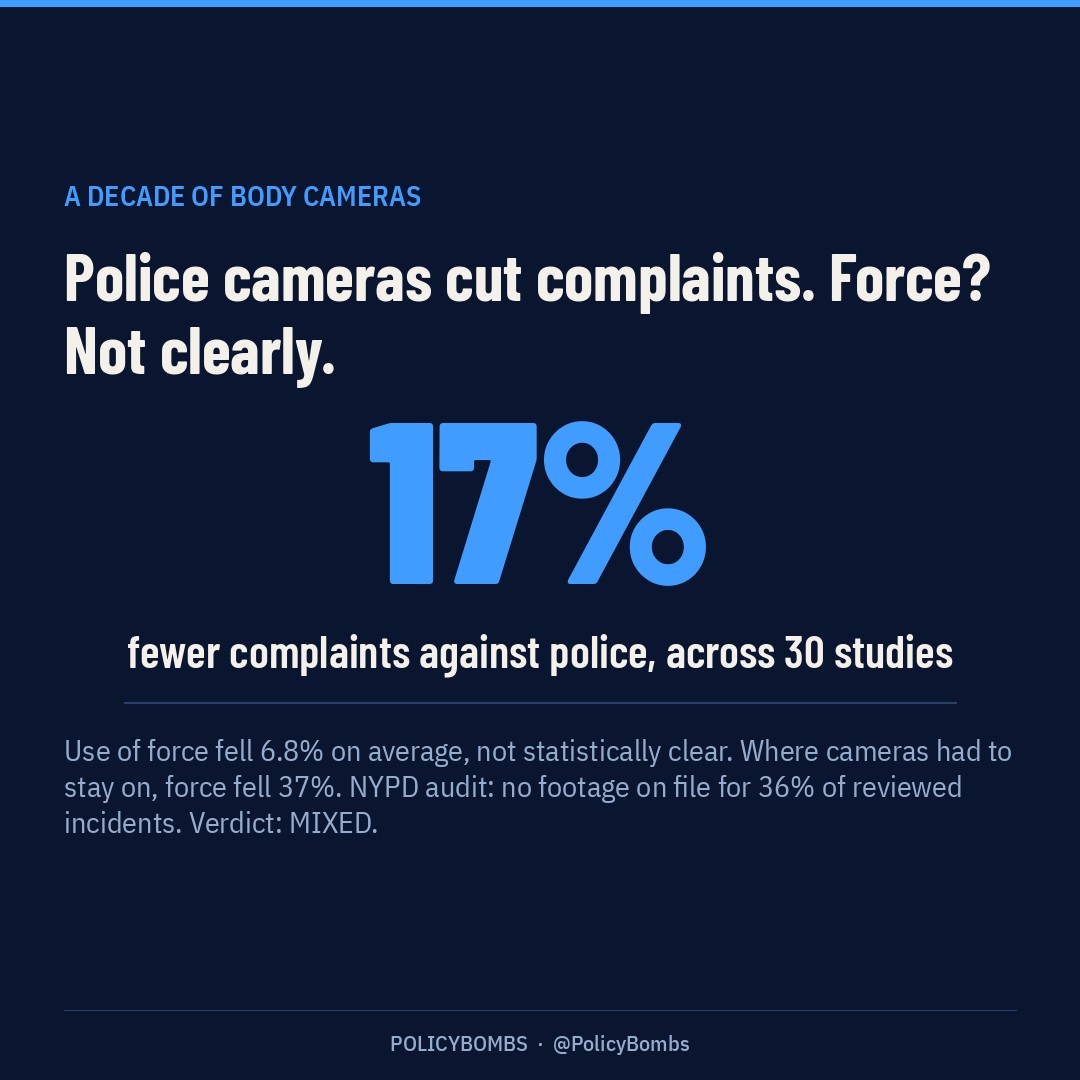
- Complaints: down 16.6% across 30 studies (Campbell Collaboration review, Lum et al.). Clear and consistent.
- Use of force: down 6.8%, not statistically significant. The largest trial, 2,224 officers in Washington, D.C., found no significant effect.
- The key: when officers had no choice about recording, force fell 37%. When they chose when to record, force rose 71% (10 randomized trials).
- National study of 593 agencies (2025): fewer police-involved homicides where activation rules were strict and incidents had been common; no drop in arrests or rise in crime.
- Domestic violence cases in Phoenix were more likely to be charged and to end in guilty pleas or verdicts.
For police. 97.6% of agencies with cameras say they shield officers from unwarranted complaints. In West Palm Beach, line officers’ support rose from 34% before rollout to 57% after. But many officers say cameras make them hesitate to use necessary force or police proactively, and Chicago saw fewer drug arrests.
The catch. A 2025 NYC Comptroller audit found no footage on file for 36% of reviewed incidents and an average of 133 business days to answer public requests for video. Storage and redaction bills recur every year, and long vendor contracts are hard to leave.
Who stands where. For: President Obama (2014 funding proposal), President Biden (EO 14074, 2022), legislators in the eight states with statewide mandates, the ACLU (only with strict recording, privacy and release rules), and police chiefs and sheriffs. Against or skeptical: President Trump (EO 14148 revoked the federal mandate in January 2025), DEA and ICE (ended their programs in 2025), the NYPD Patrolmen’s Benevolent Association (sued over cameras, later over footage release), and privacy advocates on recording inside homes and of victims.
Verdict: MIXED, leaning positive. Good on net for police and the public, but not good all around. Cameras work best as a record and a shield, and they change behavior when recording is mandatory.
What a good policy would include: always-on activation with consequences, independent audits, a release clock for critical incidents, victim and home privacy rules, and portable storage with competitive bids.
Full analysis
Long-form analysis of police body-worn cameras after more than a decade of wide use: adoption and state mandates, the federal record from 2014 to 2025, randomized trials and systematic reviews on complaints and use of force, officer attitudes, prosecution effects, costs and vendor economics, and compliance and privacy gaps. Content checked November 26, 2026 (America/Los_Angeles). Unverified items are labeled, and inference about motive is labeled as inference.
Research cutoff: Nov 26, 2026 (Pacific). Policy number 112.
Verdict: MIXED, leaning positive. Body cameras deliver a durable record, fewer complaints and better evidence, and police leaders now strongly back them. They have not, on average, delivered the large drop in police force that drove their adoption after 2014. That drop appears mainly where recording is mandatory and audited. Recurring storage, redaction and compliance costs are real.
Framing question: Many officers and unions opposed body cameras at first, fearing surveillance, “gotcha” discipline and hesitation in the field. After more than a decade of wide use, have the results been good all around, for the public and for police, or mixed?
1. What is the policy
Provisions
- A body-worn camera (BWC) is a small camera on an officer’s chest or head that records video and audio. Department rules set when officers must turn it on, when they may turn it off, how long footage is kept, who may view it and when the public may see it.
- Activation rules vary. NYPD policy requires officers to activate the camera before engaging in any police action (NYC Comptroller, 2025). Washington, D.C. requires recording from the moment a call is dispatched or a self-initiated action begins (Yokum et al., 2019). Some federal programs required cameras only for preplanned arrests and warrant searches (DEA policy as described by ProPublica, 2025).
- Retention: in a scenario for a routine incident with no arrest, complaint or force, agency answers ranged widely; 30.9 percent would keep the footage for over a year and up to five years, and 3.2 percent for less than one month (MSU national survey, 2026).
Status and jurisdiction
- Adoption (BJS). 47 percent of the 15,328 general-purpose state and local agencies had acquired BWCs in 2016. In 2020, 61.8 percent of local police departments used them, up 43 percent from 2016; all departments serving 1 million or more residents did, and 79.1 percent of local officers worked in departments that used them. About 68 percent of sheriffs’ offices used them in 2020.
- Adoption now (survey, not census). A 2025 national survey of 699 agencies, funded through BJA, found 91.6 percent had a BWC program. The authors caution that the 28 percent response rate may tilt toward agencies with cameras.
- State mandates. NCSL (2021): eight states mandate statewide use: Colorado, Connecticut, Delaware, Illinois, Maryland, New Jersey, New Mexico and South Carolina. Before May 2020 only South Carolina did. New Jersey and South Carolina make implementation contingent on state funding. Illinois phased its mandate in by population starting Jan. 1, 2023. Colorado requires release of footage within 21 days after a complaint, extendable to 45. New York and Vermont mandate cameras for state agencies, joining California and Nevada, which had earlier requirements (NCSL 2022). Counts differ across trackers depending on whether county-only or funding-contingent laws count as statewide.
- Federal. In December 2014, after Ferguson, the Obama White House proposed a three-year, $263 million community policing package including $75 million in 50 percent matching funds that “could help purchase 50,000 body worn cameras.” DOJ’s Office of Justice Programs then provided over $115 million in BWC grant funding from 2015 through 2021 (DOJ Inspector General, 2021). EO 14074 (May 2022) required federal law enforcement agencies to adopt BWC policies. EO 14148 revoked it on Jan. 20, 2025. DEA ended its program effective April 1, 2025; ICE dropped cameras in February 2025; the U.S. Marshals Service and ATF still required them as of May 2025 (ProPublica).
2. Why it exists
Stated reasons
- Accountability and trust after Michael Brown’s death in Ferguson (2014) and Eric Garner’s death in New York. The White House fact sheet tied its camera money directly to rebuilding trust between police and communities.
- The NYPD program was ordered as a remedy in Floyd v. City of New York, the stop-and-frisk case, to create objective records of encounters and help resolve misconduct claims (NYC Comptroller, 2025).
- Agencies themselves cited officer safety, better evidence, fewer civilian complaints and lower liability as the main reasons to buy cameras (BJS 2016 supplement, as summarized by the NYC Comptroller).
Underlying drivers
- Political pressure. Mayors and legislators needed a visible, fundable reform. Cameras were one that both reform advocates and many police executives could accept. Most statewide mandates came within a year of George Floyd’s death in 2020 (NCSL).
- Police labor resistance, then acceptance. Unions bargained over cameras. The NYPD’s Patrolmen’s Benevolent Association dropped its lawsuit over cameras as part of a 2017 contract that required all NYPD officers to have cameras by the end of 2019; NBC New York reported that “costs and union resistance” had slowed camera rollouts. The same union later went to court to block release of footage (New York Times, Jan. 9, 2018; paywalled; headline cited). Over time, police leaders came to see footage as protection: 97.6 percent of responding agencies with cameras agree they protect officers from unwarranted complaints (MSU, 2026).
- Vendor economics. Cameras are cheap; storage and software are not. Axon, the dominant U.S. vendor, reported $2.8 billion in 2025 revenue, over $1.3 billion in annual recurring revenue (up 35 percent), $14.4 billion in total future contracted bookings and net revenue retention of 125 percent in Q4 2025 (Axon Q4 2025 shareholder letter). DOJ itself awarded Axon a $30.4 million contract in 2021 for cameras and evidence software (ProPublica). Recurring contracts give vendors a strong interest in mandates and long terms. This is an incentive, not evidence of wrongdoing.
3. Realized effects
Early trials vs. large trials
- Rialto, California (2012 trial; published 2014). Use of force by officers fell 59 percent and complaints fell 87 percent compared with the prior year, in a 12-month trial that randomized shifts. The authors warned it was one experiment and urged replication (University of Cambridge summary of Ariel, Farrar and Sutherland). These headline numbers were compared with the prior year, so they mix the camera effect with whatever else changed department-wide.
- Washington, D.C. (2019, PNAS). The largest randomized trial: 2,224 officers, about half given cameras. “BWCs have very small and statistically insignificant effects on police use of force and civilian complaints, as well as other policing activities and judicial outcomes.” The authors noted contamination: officers without cameras often worked alongside officers with them.
- Las Vegas (2017, NIJ-funded). Officers with cameras: share with at least one complaint fell from 54.6 to 38.1 percent (controls 48.0 to 45.5); share with at least one use-of-force report fell from 31.2 to 19.7 percent (controls rose 26.3 to 27.3). Costs $828 to $1,097 per officer per year vs. $4,006 in savings, mainly from fewer and faster misconduct investigations.
- Ten-trial multisite study (2016). No average effect on use of force, but a sharp split. When officers followed protocol with no discretion, force was 37 percent lower. When officers chose when to turn cameras on or off, force was 71 percent higher. A companion paper reported more assaults against officers wearing cameras.
Systematic reviews and national studies
- Campbell Collaboration review (Lum et al., 2020). 30 studies, 116 effect sizes. Complaints: minus 16.6 percent (95 percent confidence interval minus 30.0 to minus 0.7). Use of force: minus 6.8 percent (minus 19.5 to plus 7.9), not significant. Arrests, self-initiated activity and calls for service: no consistent effect. Assaults or resistance against officers: plus 15.9 percent (minus 4.9 to plus 41.3), not significant. The authors: expectations “have not yet been consistently realized,” and it remains unclear whether the complaint drop reflects better interactions or a change in reporting.
- Benefit-cost update (Williams et al., NBER 2021). Adding the NYPD trial and national data: complaints minus 16.9 percent (minus 28.2 to minus 3.8), use of force minus 9.6 percent (minus 21.3 to plus 3.8, p = 0.152). Baseline benefit-cost ratio 4.95, with a “defensible range” from 0.95 to 26.51. Costs: $1,221 to $3,219 per camera per year. Funding note: the report was funded by a Citadel grant to the Council on Criminal Justice and the University of Chicago Crime Lab; the Crime Lab also received two $5,000 Axon travel grants. Not peer-reviewed as a working paper.
- Chicago (Ferrazares, Journal of Urban Economics, 2024). Cameras were associated with 29 percent fewer use-of-force complaints and 34 percent fewer officer reports of striking civilians; no change in officer injuries or force from civilians; but fewer drug-related arrests, which the author reads as some de-policing.
- National (Kim, Journal of Public Economics, 2025). 593 agencies. Drops in police-involved homicides were concentrated where such incidents were common beforehand and in agencies with stricter activation requirements, with no measurable change elsewhere. No significant trade-off in overall arrest or crime rates.
- NIJ CrimeSolutions rates BWCs’ effects on officer behavior as “Ineffective” for use of force, officer injuries, officer-initiated calls, traffic stops, field interviews and arrests.
Complaints and false-complaint protection
- The complaint drop is the most consistent result. Whether it means better behavior or fewer frivolous complaints is not settled by the research.
- In Chicago, cameras raised the share of complaints sustained by about 9.9 percentage points, from a 15.4 percent baseline, and reduced “not sustained” findings (Cubukcu, Sahin, Tekin and Topalli, NBER 2021): footage resolves disputes in both directions.
- Firsthand account: former U.S. Attorney David DeVillers told ProPublica that when he reviewed footage prompted by defense allegations, “95% of the time it absolves the cop of wrongdoing.” This is a credible, attributable firsthand account, not a measured rate.
Officer attitudes
- Pew (7,917 officers in 54 departments surveyed May to August 2016, published January 2017): 66 percent of officers favored body cameras; 82 percent of administrators. Half said cameras make officers more likely to act appropriately; 44 percent said no difference.
- West Palm Beach before and after: line officers’ support rose from 34.2 percent before rollout to 56.7 percent about eight months after; opposition fell from 24.4 to 16.7 percent. But after rollout most respondents agreed cameras would make officers more reluctant to use necessary force, and 57 percent said they would be less likely to do proactive policing. Officers who had been issued a camera were less supportive (42.6 percent) than those not yet issued one (60 percent).
- MSU national survey (agency respondents, 2025): 97.6 percent agree cameras protect officers from unwarranted complaints; 96.8 percent that they provide reliable evidence; 89.6 percent that they help supervision; 66.9 percent that they reveal misconduct that would otherwise go unseen; 57.5 percent that they improved community relationships.
Prosecution and courts
- Phoenix domestic violence study (Morrow, Katz and Choate, 2016): camera cases were more likely to lead to arrest (about 6.5 percent), charges (about 11 percent), cases furthered (about 6.5 percent), guilty pleas (about 3 percent) and guilty verdicts at trial (about 3.5 percent); no difference in sentence length; slower case processing than comparison cases. Rated “Promising” (one study) by NIJ.
- 81.5 percent of agencies have written policies for sharing footage with prosecutors, but 43.1 percent still download and physically transfer evidence (MSU, 2026).
Costs, storage, redaction and vendor lock-in
- Per-officer cost estimates: $828 to $1,097 per year (Las Vegas); $1,221 to $3,219 per camera per year (NBER, from PERF and BJA cost tools).
- 72.2 percent of agencies use a third-party cloud for footage. Storage costs (52.8 percent) and redaction (50.3 percent) are agencies’ most significant evidence-management concerns. Preparing footage from a 30-minute, two-officer traffic stop for a public request takes one to two hours at 41 percent of agencies, three to four hours at 24.3 percent, and five hours or more at 9.1 percent (MSU, 2026).
- Vendor concentration: Axon’s 125 percent net revenue retention means existing customers keep spending more each year, the signature of a sticky platform.
Privacy and compliance gaps
- NYC Comptroller (Oct. 28, 2025): footage was not on file for 36 percent of incidents in NYPD’s own dispatch audits; where footage existed, cameras were activated late or deactivated early 18 percent of the time; self-inspections were missing for 53 percent of sampled months. Proper activation in reviewed videos improved to 90 percent in 2023 and 95 percent in 2024.
- Public access: NYPD took an average of 133 business days to grant or deny records requests for footage; it missed a 25-business-day benchmark 85 percent of the time; 97 percent of appeals for footage were granted; 12 of 13 court challenges ended with footage released or ordered released.
- Privacy: the ACLU backs cameras only with rules limiting recording inside homes and of victims, short default retention and limits on use, and it has said it would reevaluate its support if good policies do not become standard.
4. Good or bad for society
For the public
- Gains: fewer complaints, an objective record in disputed encounters, more sustained misconduct findings where footage exists, stronger domestic violence prosecutions, and lower police-involved homicides where activation is strict and incidents were common.
- Limits: no reliable average drop in force; footage is often missing, late or withheld; privacy risks for people filmed at their worst moments.
For police
- Gains: protection from false claims, faster complaint resolution, training material and now near-universal leadership support.
- Costs: monitoring stress, reported reluctance to use necessary force and less proactive policing in some surveys, some evidence of fewer discretionary drug arrests (Chicago), and a non-significant rise in assaults on officers in the Campbell review.
Strongest counterargument (pro-camera)
The benefit-cost case is strong even with modest effects: a 4.95 baseline ratio, Las Vegas savings above costs, and national evidence of fewer police-involved homicides where rules are strict. Judging cameras only on average use of force ignores evidence value and dispute resolution.
Strongest counterargument (skeptic)
The best-designed trial (D.C.) found nothing, the main meta-analysis finds no significant force effect, and the benefit-cost estimate leans on a force effect that is itself not statistically significant (p = 0.152; low end 0.95, roughly break-even). Billions in recurring contracts buy a record that is often missing when it matters.
Verdict
MIXED, leaning positive. Good on net for both the public and police, but not “good all around.” The cameras work best as a record and a shield, and they change behavior mainly when officers have no discretion over recording. The policy is worth keeping, but only with mandatory activation, real audits and fair release and storage rules.
What a good policy would include
- Mandatory activation with consequences. Record from dispatch or the start of any enforcement contact, announce recording early, and treat unexplained gaps seriously (the 37 percent vs. plus 71 percent split; Colorado’s statutory inferences and sanctions for failure to activate, per R Street’s state table). Estimate: the evidence supports the direction; no official estimate of the national effect exists. Unverified for magnitude.
- Independent activation audits, published. Random dispatch-to-footage audits by an inspector general, not only self-inspection (NYC Comptroller recommendations).
- Release clock. A statutory deadline for releasing critical-incident footage, like Colorado’s 21 days after a complaint (45 if an investigation would be compromised), with narrow exceptions.
- Victim and home privacy. Redaction and consent rules for victims, minors and home interiors, following the ACLU model principles.
- Portable storage and competitive bidding. Require open export formats, data portability on contract exit, shorter terms and separate bids for hardware, storage and redaction software to limit lock-in. Unverified: no independent study quantifying savings was found.
- Funded redaction capacity. Budget staff or automated redaction for public requests; 45.1 percent of agencies already use automated redaction software (MSU).
- Measure what matters. Require agencies to report activation rates, complaint outcomes and force data annually so effects can be tracked.
Eligibility and who is affected
Cameras record anyone police encounter: citizens, lawfully present immigrants and undocumented immigrants alike. No source found breaks down camera effects by immigration status; this does not apply as a program-eligibility question.
Fiscal note
Using NBER’s range of $1,221 to $3,219 per camera per year, a department of 1,000 officers with one camera each would spend roughly $1.2 to $3.2 million a year (simple multiplication of the cited range; actual contracts vary). Las Vegas found savings exceeded costs, mainly through cheaper misconduct investigations. No national total of public spending on BWC programs was found. Unverified.
Politicians and groups for and against
- For: President Obama (2014 proposal); President Biden (EO 14074, 2022); legislators in Colorado, Connecticut, Delaware, Illinois, Maryland, New Jersey, New Mexico and South Carolina (statewide mandates); ACLU (with conditions); police chiefs and sheriffs (MSU survey); National Association for Civilian Oversight of Law Enforcement (Cameron McEllhiney, quoted by ProPublica); former U.S. Attorney David DeVillers (footage usually absolves officers).
- Against or skeptical: President Trump (EO 14148 revoked the federal mandate); DEA and ICE (ended programs in 2025); NYPD Patrolmen’s Benevolent Association (sued over cameras, later over footage release); privacy advocates on home and victim recording.
Gaps and unverified
- No current national census of activation compliance; the NYPD audit is one large city.
- No national total of BWC program spending, or of vendor share of that spending.
- Whether complaint drops reflect better conduct or fewer false complaints is unresolved.
- No measured national rate at which footage clears vs. implicates officers; the 95 percent figure is one former prosecutor’s account.
- State mandate counts differ by tracker. Claims that California or Virginia have statewide mandates for all local police were not verified and are not made here.
- DOJ BWC grant totals after 2021 were not verified from an official source.
References
[R1] BJS, Body-Worn Cameras in Law Enforcement Agencies, 2016 (press release). https://bjs.ojp.gov/press-release/body-worn-cameras-law-enforcement-agencies-2016
[R2] BJS, Local Police Departments, Procedures, Policies, and Technology, 2020 (Nov. 2023). https://bjs.ojp.gov/document/lpdppt20st.pdf
[R3] BJS, Sheriffs’ Offices, Procedures, Policies, and Technology, 2020. https://bjs.ojp.gov/library/publications/sheriffs-offices-procedures-policies-and-technology-2020-statistical-tables
[R4] Michigan State University and JSS, Adopting and Implementing Body-Worn Cameras: Results from a National Survey (Jan. 2026; BJA-funded). https://edge.sitecorecloud.io/michigansta4a14-msu70a4-prod718c-8cd0/media/project/msu/criminaljustice/docs/bwc-national-survey-report.pdf
[R5] NCSL, Body-Worn Camera Laws Database (updated Apr. 30, 2021). https://www.ncsl.org/civil-and-criminal-justice/body-worn-camera-laws-database
[R6] NCSL, Law Enforcement Legislation: Significant Trends 2022. https://www.ncsl.org/civil-and-criminal-justice/law-enforcement-legislation-significant-trends-2022
[R7] R Street Institute, The Past, Present, and Future of Police Body Cameras. https://www.rstreet.org/research/the-past-present-and-future-of-police-body-cameras/
[R8] White House, Fact Sheet: Strengthening Community Policing (Dec. 1, 2014). https://obamawhitehouse.archives.gov/the-press-office/2014/12/01/fact-sheet-strengthening-community-policing
[R9] DOJ Office of the Inspector General, Audit of the Department of Justice Policy on Body Worn Cameras (21-085, 2021). https://oig.justice.gov/sites/default/files/reports/21-085.pdf
[R10] Federal Register, Initial Rescissions of Harmful Executive Orders and Actions (EO 14148). https://www.federalregister.gov/documents/2025/01/28/2025-01901/initial-rescissions-of-harmful-executive-orders-and-actions
[R11] ProPublica, The DEA Once Touted Body Cameras for Their “Enhanced Transparency.” Now the Agency Is Abandoning Them (May 6, 2025). https://www.propublica.org/article/drug-enforcement-administration-ends-body-camera-program-trump
[R12] Lum et al., Body-worn cameras’ effects on police officers and citizen behavior: A systematic review, Campbell Systematic Reviews (2020). https://onlinelibrary.wiley.com/doi/full/10.1002/cl2.1112
[R13] Yokum, Ravishankar and Coppock, A randomized control trial evaluating the effects of police body-worn cameras, PNAS (2019). https://www.pnas.org/doi/10.1073/pnas.1814773116
[R14] Braga et al., The Las Vegas Body-Worn Camera Experiment: Research Summary (UNLV, 2017). https://www.unlv.edu/sites/default/files/media/document/2024-04/The-Las-Vegas-Body-Worn-Camera-Experiment-Research-Summary-V1.pdf
[R15] Ariel et al., Increases in police use of force in the presence of body-worn cameras are driven by officer discretion, Journal of Experimental Criminology (2016). https://link.springer.com/article/10.1007/s11292-016-9261-3
[R16] Ariel et al., Wearing body cameras increases assaults against officers and does not reduce police use of force, European Journal of Criminology (2016). https://journals.sagepub.com/doi/full/10.1177/1477370816643734
[R17] University of Cambridge, First scientific report shows police body-worn-cameras can prevent unacceptable use-of-force (Rialto). https://www.cam.ac.uk/research/news/first-scientific-report-shows-police-body-worn-cameras-can-prevent-unacceptable-use-of-force
[R18] Williams et al., Body-Worn Cameras in Policing: Benefits and Costs, NBER Working Paper 28622 (2021). https://www.nber.org/system/files/working_papers/w28622/w28622.pdf
[R19] Ferrazares, Monitoring Police with Body-Worn Cameras: Evidence from Chicago, Journal of Urban Economics (2024). https://ideas.repec.org/a/eee/juecon/v141y2024ics0094119023000086.html
[R20] Kim, Facilitating police reform: Body cameras, police-involved homicides, and law enforcement outcomes, Journal of Public Economics (2025). https://ideas.repec.org/a/eee/pubeco/v248y2025ics0047272725001227.html
[R21] Cubukcu, Sahin, Tekin and Topalli, Body-Worn Cameras and Adjudication of Citizen Complaints of Police Misconduct, NBER Working Paper 29019 (2021). https://www.nber.org/papers/w29019
[R22] NIJ CrimeSolutions, Practice Profile: Body-Worn Cameras’ Effects on Police Officer Behavior. https://crimesolutions.ojp.gov/ratedpractices/body-worn-cameras-effects-police-officer-behavior
[R23] NIJ CrimeSolutions, Program Profile: Police Body-Worn Cameras for Intimate-Partner Violence Cases (Phoenix). https://crimesolutions.ojp.gov/ratedprograms/police-body-worn-cameras-intimate-partner-violence-cases-phoenix-ariz
[R24] Pew Research Center, Behind the Badge, chapter 5 (Jan. 11, 2017). https://www.pewresearch.org/social-trends/2017/01/11/reimagining-the-police-through-training-and-reforms/
[R25] Smykla and Crichlow, West Palm Beach Police Department Body-Worn Camera Survey (2017). https://discover.pbc.gov/publicsafety/criminaljustice/BodyWorn%20Camera%20Clearinghouse/WPBPD_Police_Survey_Waves_1_and_2.pdf
[R26] NYC Comptroller, Review of the New York City Police Department’s Body-Worn Camera Program (MD24-071S, Oct. 28, 2025). https://comptroller.nyc.gov/wp-content/uploads/2025/10/MD24-071S.pdf
[R27] NBC New York, NYC Reaches Long-Awaited Contract Deal With Police Union (2017). https://www.nbcnewyork.com/news/local/nyc-police-union-contract-mayor-de-blasio/287481/
[R28] New York Times, New York Police Union Sues to Stop Release of Body Camera Videos (Jan. 9, 2018; paywalled). https://www.nytimes.com/2018/01/09/nyregion/new-york-police-union-body-camera-lawsuit.html
[R29] ACLU, Police Body-Mounted Cameras: With Right Policies in Place, a Win For All (2013, updated 2015). https://www.aclu.org/documents/police-body-mounted-cameras-right-policies-place-win-all
[R30] Axon, Q4 2025 shareholder letter (Feb. 24, 2026). https://investor.axon.com/2026-02-24-Axon-reports-Q4-2025-revenue-of-797-million,-up-39-year-over-year