A gift looks like compassion. A down payment looks like a plan.
After the immigration deals died, Democratic-led states opened benefits, and in some places ballots, to people federal law leaves out. Our inference: they want a future voting bloc. Opponents want citizenship as the line for every ballot. Legal immigrants still in line want a fair queue. Taxpayers want a program that is not a political investment.
The payoffs. No official quoted said the aim was partisan advantage. A Hochul spokesperson said the governor does not support New York City’s noncitizen voting law. House Democrats voted 162 to 42 against disapproving the D.C. law, and 208 to 4 against the SAVE Act. Some Democrats voted the other way.
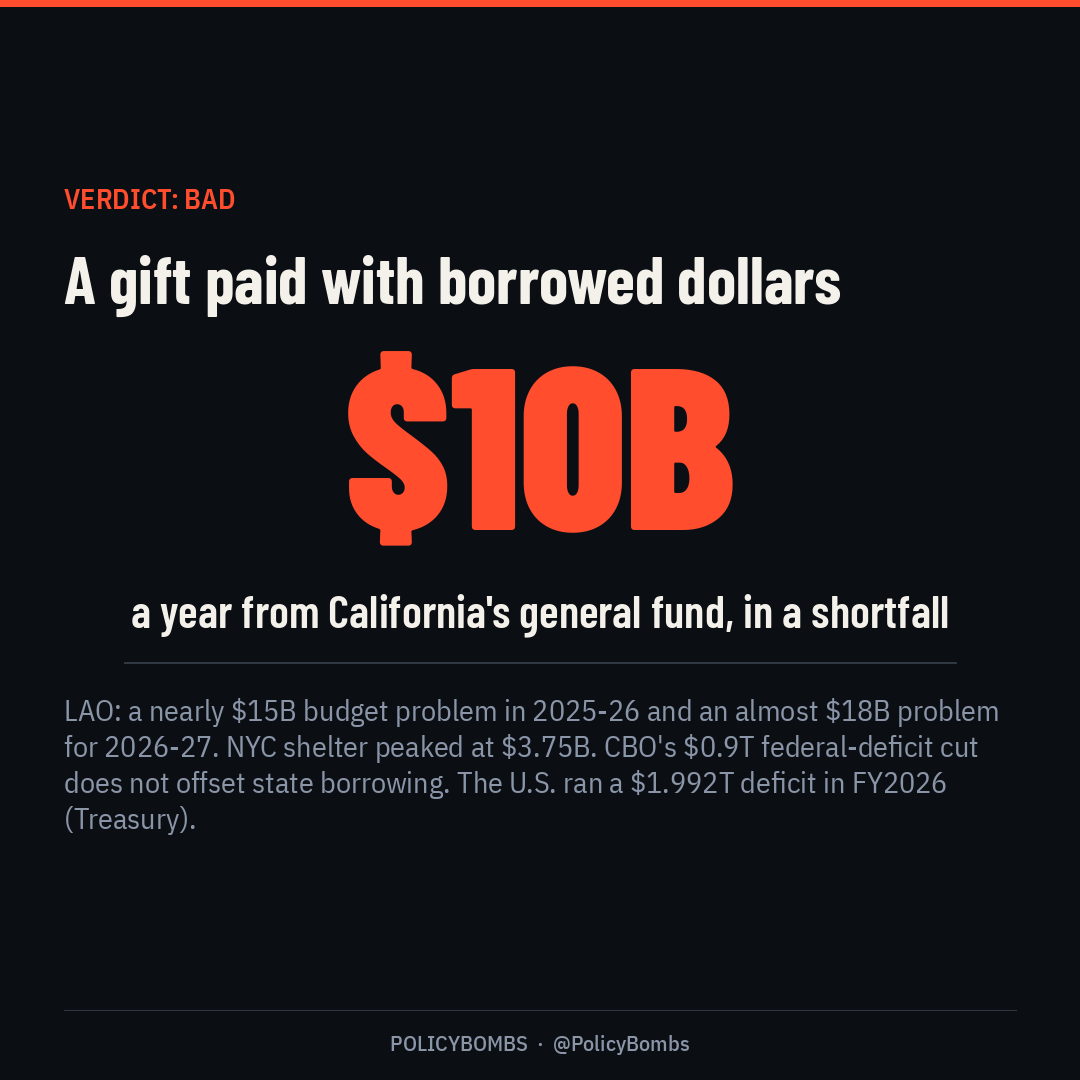
The record. California spends about $10 billion a year in General Fund money on Medi-Cal for people here illegally, more than double original estimates, covering 1.7 million enrollees, during a nearly $15 billion shortfall in 2025-26 and an almost $18 billion budget problem for 2026-27 (LAO). New adult enrollment froze in January 2026 (LAO). New York City asylum-seeker shelter costs peaked at $3.752 billion in FY2024 (Comptroller). CBO: the 2021-2026 surge lowers federal deficits $0.9 trillion over 10 years, and cost states and cities $9.2 billion net in 2023. That federal figure is a surge estimate. It does not offset state borrowing. The U.S. still ran a $1.992 trillion deficit in FY2026 (Treasury).
The ballots. Passed or not, the bills show what their authors wanted. New York’s Home Act would have let people here illegally, after conditions, vote in state and local races. NYC passed a narrower city law; courts struck it 6 to 1. San Francisco’s Prop N is in force for school board, regardless of status.
The California model: Republican for president in 9 of 10 elections from 1952 to 1988. GOP registration fell from 39.3% (1990) to 25% (2024). No Republican has won statewide since 2006.
Then vs. now: the 1880-1924 wave had a public-charge screen (Immigration Act of 1882) and no modern federal safety net. Newcomers relied on family, mutual-aid societies, churches and settlement houses.
2024 shows the loyalty is not locked. Naturalized voters split 51 to 47 for Harris. Hispanic naturalized voters went 51% for Trump (Pew). A party can spend billions and still watch the bloc move the other way.
Verdict: BAD. Even if it works as a political bet, it is funded with borrowed money, and it is bad policy regardless. Our reasoning: every new program is funded at the margin with borrowed dollars. Citizenship is the line for every ballot. Do not treat state entitlements as a political investment. Unfair to legal immigrants still in line, and a legitimacy risk if a majority looks purchased. Companion PolicyBomb #92 grades why no deal on immigration sticks.
Full analysis
Long-form analysis of the benefit programs and ballot bills put in place to influence immigration outcomes, including California Medi-Cal, New York City shelter costs, noncitizen voting attempts, the California model, and the 1880-to-1924 then-versus-now comparison. Companion PolicyBomb #92 grades why no deal sticks. Content checked November 25, 2026 (America/Los_Angeles). Finding tags: Supported, Partly supported, Not supported, Contested, Unverified, and Reasoned inference where motive is inferred from conduct.
Research cutoff: Nov 25, 2026 (Pacific) for the lead cost figures (California Legislative Analyst’s Office on Medi-Cal; New York City Comptroller on asylum-seeker shelter), for California budget-problem figures (LAO Reports 5079, 5091, and 5197), and for the fiscal year 2026 federal deficit (Treasury Monthly Treasury Statement; CBO Monthly Budget Review: September 2026). Nov 24, 2026 (Pacific) for the California model, noncitizen-voting inventory, intent on the record, then-versus-now comparison, and implications. Policy number 109.
Companion: PolicyBomb #92, The Immigration Bargain: Who Profits From No Deal (https://policybombs.com/policybomb-92-immigration-bargain-reagan-trump/), grades the problem and the incentive to keep the issue open: five deals killed since 1986, census seats now, possible votes later, employers’ cheap labor, and a campaign issue. This PolicyBomb grades the programs and ballot rules that party implemented to influence the outcome.
Day 63, Illegal Immigration (https://policybombs.com/policybomb-illegal-immigration/), already grades the 2021 to 2026 border surge and the fiscal-cost literature. Its verdict stands. This PolicyBomb grades a narrower question: once a party has a reason to leave the immigration problem unsolved, what incentives did it put in place, and what follows if those incentives work.
Verdict: BAD. Even if it works as a political bet, it is funded with borrowed money, and it is bad policy regardless. California’s Medi-Cal expansion for people here illegally costs about $10 billion General Fund a year, then froze new adult enrollment (Legislative Analyst’s Office). The state has been running budget shortfalls: the Analyst’s Office estimates that the 2025-26 budget package addressed a nearly $15 billion budget problem [IM21], and its November 2025 Fiscal Outlook estimated an almost $18 billion budget problem for 2026-27 [IM22]. In its later August 2026 Overview of the Spending Plan, the Analyst’s Office reported that the administration estimates an $18.5 billion operating deficit in 2026-27, even though the enacted budget was balanced by drawing down prior-year reserves [IM23]. New York City shelter costs peaked at $3.75 billion in FY2024 (Comptroller). CBO found the recent surge lowered federal deficits by $0.9 trillion over 10 years and cost states and cities $9.2 billion net in 2023. That federal figure is a surge estimate. It does not offset state borrowing, and it is not a finding that these state programs reduce the federal deficit. The United States still runs large deficits: Treasury’s final statement for fiscal year 2026 reports a $1.992 trillion deficit [IM24]. Our reasoning: because the federal government is already running a deficit of that size, every new program is funded at the margin with borrowed dollars. Some jurisdictions opened or tried to open local ballots to noncitizens. The New York is Home Act, sponsored by Sen. Gustavo Rivera with Sens. Julia Salazar and Jose M. Serrano, would have let people here illegally, after residence and tax conditions, vote in state and local races. New York City’s Council passed Local Law 11 for green-card holders and work-authorized noncitizens; the state high court later struck it 6 to 1. San Francisco’s Proposition N is in force for school board and has no legal-status test. California voted Republican for president in 9 of 10 elections from 1952 to 1988; GOP registration fell from 39.3% (1990) to 25% (2024); no Republican has won statewide since 2006. Our inference: these benefits and ballot bills are a down payment on a future bloc. That is a reading of the pattern of actions and of who would collect the payoff, not a proven written plan. No official quoted here said the aim was partisan advantage. A Hochul spokesperson said the governor does not support the city law. Forty-two and later 52 House Democrats voted to disapprove or repeal the D.C. ordinance; 4 House Democrats voted for the SAVE Act, while 208 voted against it. Pew’s 2024 study shows the loyalty is not locked: Hispanic naturalized voters went 51% for Trump. The 1880-to-1924 wave had a public-charge screen and no modern federal safety net. The method is unfair to legal immigrants still in line, and it is a legitimacy risk if a majority looks purchased.
Finding tags: Supported, Partly supported, Not supported, Contested, Unverified, and Reasoned inference (Our inference) where motive is inferred from conduct.
1. What is the policy
This is not one bill. It is a set of state and local programs and ballot rules, mostly in Democratic-led jurisdictions, that extend benefits, and in some places local ballots, to people federal law leaves out, including people here illegally.
- Health and shelter, paid by taxpayers. California opened comprehensive Medi-Cal to undocumented residents. The Legislative Analyst’s Office now puts the cost at about $10 billion General Fund a year, more than double the original estimates, covering about 1.7 million undocumented comprehensive enrollees. Beginning in January 2026, the state froze new adult enrollment in that comprehensive coverage. New York City’s asylum-seeker shelter spending peaked at $3.752 billion in FY2024 (Comptroller). Other Democratic-led states opened or tried to open state-funded health coverage, food aid, or tuition. Federal law (PRWORA, 1996) still bars most federal means-tested benefits for people here illegally. The state programs are a deliberate workaround, paid almost entirely by state funds. Details, freezes, and the then-versus-now comparison are in Sections 2D and 2F.
- Local and state ballots, attempted or in force. Passed or not, the bills show what their authors wanted. The New York is Home Act would have let people regardless of status, after conditions, vote in all state and local races. New York City passed a narrower city law; courts struck it 6 to 1. San Francisco’s Proposition N is in force for school board, regardless of status. Other attempts reached D.C., Illinois, Maryland, Oakland, and Portland, Maine. A modern inventory of 44 rows is in Section 2C.5. None of these laws reaches federal elections. Federal law already makes noncitizen voting in federal races a crime (18 U.S.C. 611).
- The California sequence, as a working model. The same state that expanded benefits and opened a local school-board ballot also ran a longer sequence: amnesty under the 1986 law, licenses, sanctuary rules, and a census count that added seats. GOP registration fell from 39.3% in 1990 to 25% in 2024. No Republican has won statewide since 2006. Our inference, labeled as such in Section 2B, is that this is the model the national choices follow. Immigration did not do this alone. Prop 187, suburban shifts, and the collapse of the aerospace base are real complications, and 2024 is the warning that the payoff is not permanent.
- What this PolicyBomb is not. It does not re-litigate why five national bargains since 1986 died. That is PolicyBomb #92. It does not claim a memo exists that says “buy a voting bloc.” Where motive is inferred from conduct and from who would collect the payoff, it is labeled Our inference.
2. Why it exists
Stated reasons are mercy, public health, and, for the ballot bills, the claim that people who pay local taxes should have a say in local government. Those reasons are real and should be tested against measured results, not against the warmth of the speeches that launched the programs (see Empathy by law, in Section 2D).
The record also shows a political interest. Allied strategists treated post-1965 demographic growth, including Hispanic growth after the 1965 immigration reform, as a durable Democratic electoral asset (Judis and Teixeira, 2002; later walked back in 2023). Democratic leaders have insisted on a path to citizenship, not status alone (Schumer, 2022; the 2021 U.S. Citizenship Act). Democratic-led states and cities opened benefits and, in some places, local ballots. Our inference, developed in Sections 2E, 2D, and 2B: a party that both extends benefits to a population and tries to put that population, or its legally present neighbors, onto the rolls is making a long-run political investment, not only a humanitarian one. No official quoted in this PolicyBomb said the aim was partisan advantage. The 2024 shift among Hispanic and naturalized voters is the strongest evidence that the investment can fail.
2B. The California Model
Added Nov 24, 2026. The national choices in 2A.7 are not a theory. One state has already run them, start to finish. California has the largest immigrant population in the country, and it took the steps first. So we test the sequence where the results are in: what California chose, what followed, and what else changed at the same time. Every figure below is sourced. The conclusion at the end is labeled for what it is: an inference from conduct and payoff.
2B.1 Then and now: who governed California, 1952 to 2024
| Measure | 1952 to 1988 | 1992 to 2024 |
|---|---|---|
| President | Republican in 9 of 10 elections; only 1964 went Democratic. Reagan won 57.5% in 1984; Bush won 51.1% in 1988 [CA1] | Democratic in 9 of 9. Biden won 63.5% in 2020; Harris 58.5% in 2024 [CA1] |
| Governor | Republicans Warren, Knight, Reagan (two terms, 1967 to 1975) and Deukmejian (elected 1982 and 1986); Wilson followed (1991 to 1999) [CA2] | Schwarzenegger (2003 to 2011) was the last Republican. Democrats have held the office since January 2011 [CA2] |
| Legislature | Democrats held the Assembly in most years from 1959; Republicans held it in 1969 to 1970 and again in 1995 to 1996 [CA2] | Two-thirds Democratic supermajority in both houses after the 2012 election: 29 of 40 senators and 55 of 80 members of the Assembly in 2013. Briefly lost in 2015 to 2016; held in every session since 2017. In 2025: 30 of 40 and 60 of 80 [CA2] |
| Republican share of registered voters | 40.9% (1952); 38.6% (1988); 39.3% (1990), the post-1950 high [CA3] | 23.8% (2022); 24.95% (October 2024) [CA3][CA4] |
| Democratic share of registered voters | 55.2% (1952); 50.4% (1988) [CA3] | 46.9% (2022); 45.8% (October 2024) [CA3][CA4] |
| Republicans holding statewide office | Common | Last Republicans elected statewide: 2006 (Gov. Schwarzenegger; Insurance Commissioner Steve Poizner). Zero Republicans have held statewide elected office since January 2011 [CA2] |
Read it straight. California was Republican at the top of the ticket, not across the board. Democrats out-registered Republicans throughout 1952 to 1988 and ran the Legislature most years. What changed is that Republicans collapsed: their share of registered voters fell about 15 points from 1990 to 2022, and they stopped winning statewide. Democrats did not surge. Their share of registrants slid too, and the growth went to voters with no party preference (22.07% in 2024) [CA4].
2B.2 Who moved in
- Foreign-born share of Californians: 8.8% in 1970, 15.1% in 1980, 21.7% in 1990 [CA6], 26.2% in 2000 [CA7], 28% in 2024, the highest of any state [CA8].
- The citizenship channel: 54% of California’s immigrants were naturalized citizens in 2024, up from 31% in 1990 [CA8].
- Unauthorized population: Pew, as reported by PPIC: a peak of 2.8 million in 2007 and 2.25 million in 2023; California’s share of the nation’s unauthorized immigrants fell from 23% to 16% [CA8]. PPIC’s own range: 2.35 million to 2.6 million in 2014, more than 6% of residents [CA9].
- The 1986 amnesty landed here first: 1,622,074 IRCA applications came from California, more than half the national total [CA10]. Of 2,705,002 people who got green cards through IRCA, 1,439,266, or 53.2%, were in California [CA11].
2B.3 The steps California took
| Year | Step | What the record shows |
|---|---|---|
| 1986 | Mass legalization | IRCA, signed by President Reagan: about 1.44 million Californians got green cards [CA11] |
| 1994 to 1999 | The enforcement attempt that died | Voters passed Proposition 187, cutting public services to illegal immigrants, 58.93% to 41.07%. Courts blocked it; Democratic Gov. Gray Davis halted the state’s appeals in July 1999 [CA12] |
| 2013 to 2015 | Licenses regardless of status | AB 60, signed by Gov. Jerry Brown, took effect January 2015. About 1,001,000 licenses issued by March 30, 2018 (DMV, via LA Times) [CA13]; more than 1 million people licensed by 2023 [CA14] |
| 2016 | Local noncitizen ballots | San Francisco’s Proposition N opened school board races to noncitizen parents [V12] |
| 2017 | Sanctuary in state law | California Values Act (SB 54), signed by Gov. Jerry Brown: state and local police may not use money or personnel to arrest for immigration enforcement [V33] |
| Every census | Count everyone | California’s House delegation grew from 30 seats (1950) to 53 (2010), a gain of 23 seats and 23 electoral votes; it fell to 52 in 2020 [CA5]. CIS (favors lower immigration) estimates immigrants, mostly legal, gave California 8 more seats in 2020, 11 counting their U.S.-born children; only 87% of residents were citizens [N1]. Unauthorized immigrants alone moved about 1 California seat (Pew 2020 via Third Way; CIS 2024 estimate) [N3][N1] |
2B.4 The same steps, nationally
| California step | National counterpart (2A.7) |
|---|---|
| IRCA amnesty, half of it in California | Citizenship, not just status: the 2021 bill’s eight-year path; “a path to citizenship for all 11 million” [V2][V20] |
| Prop 187 killed in court and abandoned by the next Democratic governor | Interior enforcement narrowed: 2021 DHS guidance that being removable “should not alone be the basis” of enforcement [V32] |
| AB 60 licenses for more than 1 million | Parole at scale with work permits: CBP One 936,500+ appointments; CHNV 531,690 paroled [V24] |
| SB 54 sanctuary law | Sanctuary is itself one of the seven national choices; the Values Act is the case study in 2A.7 [V33] |
| San Francisco noncitizen school ballots | D.C. local noncitizen voting; New York City’s attempt, struck down 6 to 1 [V14][V15] |
| Count every resident; plus 8 seats from immigrants | Fight to keep every resident in the count: New York v. Trump (2020); the 2030 rule fight [V6][V7][V34] |
2B.5 What else changed (these complicate the story; they do not erase it)
- 1. Republicans helped. Gov. Pete Wilson’s embrace of Prop 187 was followed by a long-term 7.1-point Democratic shift among California Hispanics (State Politics and Policy Quarterly, 2016) [CA15]. Naturalizations jumped from 68,100 in 1993 to 118,567 in 1994 and 378,014 in 1996 [CA16]. And IRCA itself was signed by a Republican president. The backlash had force because the population was already here and becoming citizens.
- 2. The suburbs moved. In 2016 Orange County voted for a Democrat for president for the first time since 1936, helped by college-educated women as well as minority voters [CA18].
- 3. The defense economy shrank. California held one in four U.S. aerospace jobs at the 1987 peak. By the mid-1990s state aerospace employment was down 33%, and Los Angeles County’s industry was half its 1987 size (RAND) [CA19].
- 4. The new electorate came through citizenship, not illegal voting. The voting change runs through naturalized citizens (31% of immigrants in 1990, 54% in 2024) and their U.S.-born children [CA8]. One study found IRCA naturalizations by themselves did not drive the growth in Latino voting from 1996 to 2000; registration drives and mobilization did [CA17]. Audits find noncitizen voting rare (2A.4).
- 5. 2024 cut the other way. Trump rose from 34.3% in 2020 to 38.3% in 2024 [CA1]. Imperial County, majority Latino, voted Republican for president, 49% to 48%, for the first time since 1988, one of 10 California counties that flipped (KPBS) [CA20].
2B.6 Our inference
The evidence of conduct and payoff points one way. California ran the sequence first: amnesty for about 1.4 million residents, an enforcement measure voters approved and the state then abandoned, licenses and sanctuary written into state law, noncitizen school ballots in San Francisco, and a census count that added seats. Over the same years the Republican share of registered voters fell from 39.3% to under 25%, no Republican has won statewide since 2006, and Democrats hold two-thirds of both houses. Immigration did not do this alone. Republicans handed Democrats Prop 187, the suburbs moved, and the aerospace base collapsed. But the population growth that turned Republican mistakes into permanent losses came largely through immigrants who naturalized and their U.S.-born children, and the party that gained kept choosing policies that protected and enlarged that population. The national choices graded in PolicyBomb #92 follow the same steps in the same order.
Our inference: California is the working model, and national Democratic choices track it. This is reasoned inference from conduct and payoff, not proven fact, and no document states it. Imperial County in 2024 is the warning label: the payoff is not permanent, and voters who arrive as a bloc do not stay one by default.
2C. Opening the polls
Added Nov 24, 2026, and revised the same day. Section 2A.4 established that noncitizen voting in audited federal and statewide races is rare, and that some Democratic-run cities have opened local ballots to noncitizens. This section tests a sharper claim: that bills designed to put noncitizens, including in some cases people here illegally, onto the rolls show an intent to gain votes.
Passed or not, the bills show what their authors wanted. The test of intent is the attempt: who wrote the bill, who it would have covered, and which elections it would have opened. Court rulings, committee referrals and later repeal fights tell you how far the attempt got. They do not erase what the authors put on paper.
The map has to stay precise. Who was covered? Which elections? What did the sponsors say, in their own words? Where those words do not say the aim was partisan advantage, the motive is stated as our inference, not as a confession. The inventory of jurisdictions is in 2C.5. Statements, House votes and counterevidence are in Section 2E.
2C.1 The New York is Home Act: people regardless of status, in state and local races
The broadest New York attempt is the New York is Home Act, introduced in the Senate as S4279 in the 2021-22 session and, in earlier forms, in 2013-14 (S7879 and Assembly A10129), 2015-16 (S776), 2017-18 (S1215) and 2019-20 (S1021) [NV12][NV25]. In 2021-22 the sponsor was Sen. Gustavo Rivera (D, also Working Families). The co-sponsors were Sens. Julia Salazar (D) and Jose M. Serrano (D). There was no Assembly “same as” companion in that session [NV12].
The bill would have created a form of “New York state citizenship” for a person who, “regardless of federal immigration status,” held a qualifying New York identity document, had lived in the state for three years, had filed New York income taxes for three years (with listed exemptions), and made a pledge and an attestation about jury service and taxes [NV25]. Those state citizens “may vote in all State and local elections” [NV25]. Localities would have been required to honor that franchise and could have gone further. Federal elections were not included.
That is the attempt: a Democratic state senator, with two Democratic co-sponsors, wrote a bill that would have put people here illegally, after residence and tax conditions, onto the rolls for every state and local race in New York. The 2021-22 text was referred to the Senate Finance Committee on February 3, 2021, and again on January 5, 2022 [NV12]. Status is recorded in the table in 2C.5. It is not a rebuttal of what the authors wanted.
No quote was found, in the sources reviewed for this analysis, in which Rivera, Salazar or Serrano tied the bill to partisan advantage. The public statements that were found are civic. Rivera, July 17, 2014, on an earlier introduction of the same bill family: “There has not been a proposal that is this broad and this comprehensive.” “The purpose of this bill is to recognize that there are people who are already contributing.” “I understand that it is new and out-of-the-box thinking” (Stateline) [NV26]. Rivera, June 16, 2014: “Nearly 3 million people in the state of New York currently reside here and make New York their home, but can’t fully participate in civic, political, and economic life” (Reuters) [NV27].
A narrower 2021 Assembly proposal, A4185, from Assembly Members Nathalia Fernandez, Catalina Cruz, Richard Gottfried and Yuh-Line Niou (all D), would have amended the state constitution so that “every non-citizen lawfully admitted for permanent residence” could vote in “non-federal elections.” It was referred to the Election Law committee [NV11]. That draft covered legal permanent residents only, not people here illegally, so it does not belong in the lead list of bills that would have included undocumented residents. It still shows state legislators trying to open non-federal elections to noncitizens.
2C.2 New York City Local Law 11: the Council passed it, the courts struck it
On December 9, 2021, the New York City Council passed a bill, later Local Law 11 of 2022, to amend the city charter so “municipal voters” could vote for Mayor, Public Advocate, Comptroller, Borough President and City Council. A municipal voter had to be: (1) “either a lawful permanent resident or authorized to work in the United States”; (2) a city resident for 30 consecutive days; and (3) otherwise qualified except for U.S. citizenship (New York City Charter, as quoted in Fossella v. Adams) [NV1].
Two facts fix the scope. First, the law did not cover people here illegally who lacked work authorization. It did cover green-card holders and work-authorized noncitizens, including some DACA recipients [NV2][NV3]. Second, it reached only city offices, not state or federal elections [NV1]. Supporters put the eligible pool at more than 800,000 [NV2][NV4].
Mayor Bill de Blasio left office without signing or vetoing the bill. Mayor Eric Adams, taking office January 1, 2022, also neither signed nor vetoed it. The bill became Local Law 11 on January 9, 2022, by charter inaction [NV1]. Adams then said: “While I initially had some concerns about one aspect of the bill, I had a productive dialogue with my colleagues in government that put those concerns at ease. I believe allowing the legislation to be enacted is by far the best choice, and look forward to bringing millions into the democratic process” (CBS New York, Jan 9, 2022) [NV5]. The word “millions” is his; the published eligible pool was about 800,000.
The bill’s sponsor, Council Member Ydanis Rodriguez, said at a December 2, 2021, City Hall press conference: “People pay taxes. People should have the right to decide who are the mayor, comptroller, public advocate, borough president, councilmember that will be deciding how their taxpayer dollars are used” [NV6]. After the Council vote he wrote that New York had become “the largest city in the nation to enfranchise non-citizen immigrant New Yorkers” and that “Nearly 1 Million non-citizen immigrant New Yorkers will be allowed to participate in our City’s election!” [NV7].
Council Speaker Adrienne Adams, after a June 2022 trial-court defeat, said: “The Council passed Local Law 11 to enfranchise nearly one million voters, many Black and brown New Yorkers, who live here, pay taxes, and contribute to our city. By providing city residents with a voice in their local government representation, we provide them with an equal stake in the long-term success of our city” [NV8]. After the Court of Appeals ruling she said the Council had sought “to strengthen our city’s democratic process and increase civic engagement by enfranchising the hundreds of thousands of New Yorkers who pay taxes and contribute to our communities but are unable to make their voices heard in local elections” [NV9].
None of those statements says the purpose was to help Democrats win. The stated reasons are taxes, civic engagement and inclusion.
On March 20, 2025, the New York Court of Appeals struck the law down 6 to 1 in Fossella v. Adams. Chief Judge Rowan D. Wilson wrote: “We hold that Article II, Section 1 of our Constitution limits voting to citizens, and affirm on that ground” [NV1][NV4]. Associate Judge Jenny Rivera dissented. Status: struck.
Gov. Kathy Hochul’s public position, as given by a campaign spokesperson in February 2026, is opposition, not endorsement: “The Governor sets policy for the state of New York – she does not support this measure” (New York Post, Feb 8, 2026) [NV10]. That is counterevidence on the governor. It is not a rebuttal of what the Council, the sponsor and the two mayors who let the bill become law wanted. No statement by Hochul was found, in the sources reviewed for this analysis, that ties noncitizen voting to partisan advantage, or that urges opening the polls to people here illegally. The claim that statements from the New York governor emphasize a vote-gaming intent is not supported by the public record found here.
2C.3 San Francisco school board: Proposition N (2016), in force, regardless of status
In November 2016, San Francisco voters approved Proposition N, 54.39% to 45.61% [NV14]. It amended the city charter so that a parent, legal guardian or caregiver of a child under 19 living in the school district could vote in Board of Education elections “regardless of whether the person is a United States citizen” [NV15]. That wording covers people here illegally, not only green-card holders. It covers only school-board races, not mayor, supervisor, state or federal offices. A sunset clause later let the Board of Supervisors keep the program by ordinance [NV15].
A trial court struck the program down in 2022. On August 8, 2023, the California Court of Appeal, First District, reversed that ruling in Lacy v. City and County of San Francisco, holding that the state constitution does not bar a charter city from expanding a local school-board electorate to noncitizen parents, and that home-rule authority covers the choice [NV15]. The challengers later dropped the case (Los Angeles Times, Oct 11, 2023) [NV16]. In the February 2022 school-board recall, 328 noncitizens registered and 235 voted [V13]. Status: in force.
2C.4 Other attempts that would include undocumented residents
Washington, D.C. The D.C. Council’s Local Resident Voting Rights Amendment Act of 2022 (D.C. Law 24-242, effective Feb 23, 2023) amended the definition of a qualified elector so that the U.S. citizenship requirement “shall not apply in a local election” [NV17]. “Local election” means Mayor, Council, Attorney General, State Board of Education, Advisory Neighborhood Commissioner, and local initiative, referendum, recall or charter measures. It does not include federal offices [NV17][NV18]. The statute does not require lawful immigration status. The D.C. Board of Elections tells noncitizen residents they may vote in those local contests if they are 18 by the next general election, have lived in the District 30 days, do not claim the right to vote elsewhere, and have not been found incompetent to vote [NV18]. Noncitizen registration reached 981 by December 2024 (D.C. Board of Elections minutes) [V15]. Status: in force. The U.S. House later voted to disapprove or repeal the law; those votes are in 2E. The Senate did not pass those measures, and the D.C. law remains in force.
Illinois. Sen. Celina Villanueva (D-Chicago) introduced SB 1565 in the 102nd General Assembly (Feb 26, 2021) and SB 1345 in the 103rd (Feb 6, 2023) [NV34][NV35]. The bills would have let a parent, guardian or caregiver of a child under 19 vote in school-board elections. The required affidavit would have the person attest that he or she “is not a United States citizen,” is 18, and lives in the district [NV34]. There is no legal-status test, so the bills would have included people here illegally. They covered school-board races only. Status: introduced.
Chicago Local School Councils. This is already in force. Under the Chicago School Reform framework (School Code 105 ILCS 5/34-2.1) and current Chicago Public Schools election rules, “US citizenship is not a requirement to vote” in Local School Council elections [NV36]. The franchise covers parents, guardians and some community members, students and staff, per CPS rules, in school-council elections only, not municipal offices. Status: in force since 1988.
Maryland municipalities. Ballotpedia, as of November 2026, lists 16 towns that allow noncitizens to vote in municipal elections only, on a local roll separate from the state and federal list [NV19][NV37]. Eligibility is not uniform. Some charters omit a citizenship test or say “regardless of citizenship status” (among them Chevy Chase Section 3, “without regard to citizenship,” and Frederick, “regardless of citizenship status”) [NV19][NV44]. Others require lawful presence (Glen Echo, “a lawful resident of the United States”; Brentwood, “a lawful resident as defined by US Citizenship and Immigration Services”) [NV19]. Edmonston joined the list in November 2024, per news accounts; older charter language quoted by Ballotpedia is ambiguous, so the exact who-is-covered rule there is flagged [NV37]. These are town races, not state or federal ones.
Oakland, California. Voters approved Measure S in November 2022, about 67%, a charter amendment authorizing the Council, by ordinance, to let noncitizen parents, guardians or caregivers vote for the Oakland school board if otherwise eligible [NV38]. The measure does not impose a legal-status test. Ballotpedia and local reporting as of April and November 2026 say it has not been implemented [NV38]. Status: approved, not in force.
Portland, Maine, 2022. The Charter Commission discussed a draft that, contemporaneous reporting said, would have extended municipal voting to residents including people without legal status. The commission did not recommend that draft for the ballot, citing state law [NV22]. Status: introduced, not placed on the ballot. A narrower 2010 city initiative for legal noncitizen residents (Question 4) was rejected by voters, 47.57% to 52.43% [NV22][NV37].
2C.5 The inventory: U.S. jurisdictions that passed or proposed noncitizen voting
The table covers the modern era, from Chicago’s 1988 Local School Council rules through November 2026. It includes every U.S. jurisdiction found in this analysis that enacted, approved, introduced or put to voters a measure to let noncitizens vote at any level in that period. Nineteenth-century and early twentieth-century state “alien suffrage,” later repealed (Arkansas was the last, in 1926, per the New York is Home Act sponsor memo), is a different legal world and is not inventoried row by row here [NV12].
No proposal was found, in the sources reviewed for this analysis, that would have opened Denver municipal elections to noncitizens. Colorado voters approved Amendment 76 in 2020, 62.90%, adding an explicit citizenship requirement to the state constitution [NV37]. That is a counter-trend, not an opening bill, and it is noted here rather than as a row in the opening inventory.
Status labels: In force; Struck (enacted, then voided by a court); Approved, not in force (voters or a local government approved it, but it is unimplemented, pending state law, or blocked by a higher law); Introduced (a bill or petition filed, no final enactment); Failed (voters rejected it, or a draft was abandoned before a vote); Repealed.
| Jurisdiction | Year | Measure or bill | Status | Elections covered | Who is covered | Sponsors / party |
|---|---|---|---|---|---|---|
| Chicago, IL | 1988 | Chicago School Reform Act; School Code 105 ILCS 5/34-2.1; CPS election rules | In force | Local School Council elections only | Regardless of status. CPS: ‘US citizenship is not a requirement to vote.’ Parents, guardians, some community members and students, per CPS rules. | Illinois legislature (1988); administered by Chicago Public Schools. Democratic-run city and state at adoption. |
| Takoma Park, MD | 1992 | City ordinance / charter; first noncitizen votes in 1993 | In force | City elections only | Regardless of status. City: ‘Residents do not need to be U.S. citizens to vote in the city election.’ | City Council (Democratic-leaning municipality). |
| Garrett Park, MD | 1999 | Town charter | In force | Town elections only | Town registration open to ‘residents who are not citizens of the United States’ (no separate legal-status test in the charter language reviewed). | Town government. |
| Hyattsville, MD | 2016 | City voter-registration amendment; in use for 2017 elections | In force | City elections only | Regardless of status. City form for ‘residents who are not U.S. citizens.’ | City Council, unanimous (2016 reporting). |
| Mount Rainier, MD | 2017 | City charter amendment | In force | City elections only | Regardless of citizenship status (charter language compiled by Ballotpedia). | City government. |
| Chevy Chase Section 3, MD | 2018 | Village charter | In force | Village elections only | Regardless of status. Charter: qualified voter is ‘any person who is a resident … without regard to citizenship,’ age 18+. | Village government. |
| Barnesville, MD | In force as of 2026 | Town charter | In force | Town elections only | No citizenship test in the charter definition reviewed: resident 6 months, age 18. Adoption year not independently confirmed. | Town government. |
| Cheverly, MD | In force as of 2026 | Town election rules | In force | Town elections only | No citizenship test in the rule reviewed: resident 30 days, age 16+, other disqualifiers. Adoption year not independently confirmed. | Town government. |
| Colmar Manor, MD | In force as of 2026 | Town charter | In force | Town elections only | No citizenship test in the charter language reviewed: resident 182 days, age 18+, no other voting residence. Adoption year not independently confirmed. | Town government. |
| Martin’s Additions, MD | In force as of 2026 | Town charter | In force | Town elections only | No citizenship test in the charter language reviewed: any natural person residing there, age 18+. Adoption year not independently confirmed. | Town government. |
| Riverdale Park, MD | In force as of 2026 | Town charter | In force | Town elections only | No citizenship test in the charter language reviewed: primary residence, age 16+, 45 days, no claim to vote elsewhere. Adoption year not independently confirmed. | Town government. |
| Somerset, MD | In force as of 2026 | Town charter | In force | Town elections only | No citizenship test in the charter language reviewed: age 16+, 14 days’ residence, registered. Adoption year not independently confirmed. | Town government. |
| Brentwood, MD | In force as of 2026 | Town charter | In force | Town elections only | Legal residents only: ‘a lawful resident as defined by US Citizen and Immigration Services.’ Adoption year not independently confirmed. | Town government. |
| Glen Echo, MD | In force as of 2026 | Town charter | In force | Town elections only | Legal residents only: must be ‘a lawful resident of the United States.’ Adoption year not independently confirmed. | Town government. |
| Greenbelt, MD | 2024 | City Council vote (6-0, Sept 2024) and city election rules | In force | City elections only | City tells ‘all City residents 16 and older’ they can vote and directs noncitizens to a city form. No legal-status test in the public election guidance reviewed. | City Council (6-0). |
| Edmonston, MD | 2024 | Town Council action, Nov 2024, reported as the 16th Maryland municipality | In force, with a caveat | Town elections only | News accounts say the town allowed noncitizen voting in 2024. Ballotpedia’s quotation of older charter language is ambiguous (‘citizens of the Town’ and state voter qualifications). The exact who-is-covered rule was not independently confirmed from the new ordinance text. | Town Council. |
| Frederick, MD | 2024 | Charter amendment 24-24, in use for 2025 city elections | In force | City elections only | Regardless of status. Charter: residents may register ‘regardless of citizenship status.’ | City government. |
| San Francisco, CA | 2016 | Proposition N (54.39%). Upheld, Lacy v. San Francisco, Aug 8, 2023 | In force | School board only | Regardless of status: parent, guardian or caregiver of a child under 19 in the district, ‘regardless of whether the person is a United States citizen.’ | City voters. Sponsored as a local ballot measure. |
| Washington, D.C. | 2022 | Local Resident Voting Rights Amendment Act (D.C. Law 24-242, effective Feb 23, 2023) | In force (House disapproval resolutions did not pass the Senate) | Local offices and local measures only, not federal | Regardless of status. Citizenship ‘shall not apply in a local election.’ | D.C. Council (Democratic). Mayor Bowser let it proceed through congressional review. |
| Montpelier, VT | 2018 / 2021 | Article 3 (2018, 65.75%); enacted as H.177 after a veto override, June 24, 2021 | In force | City elections; not school questions, not state or federal | Legal U.S. residents only. | City voters; Vermont legislature (override of Gov. Phil Scott, R). |
| Winooski, VT | 2020 / 2021 | Article I (2020, 71.28%); enacted as H.227 after a veto override, June 24, 2021 | In force | City meetings and municipal and school elections; not state or federal | Legal U.S. residents only: ‘resides in the United States on a permanent or indefinite basis in compliance with federal immigration laws.’ | City voters; Vermont legislature (override of Gov. Scott, R). |
| Burlington, VT | 2023 | Question 4 (67.97%), March 7, 2023; enacted as Act M-16 after a June 20, 2023 veto override | In force | Local city and school-district elections; not state or federal | Legal U.S. residents only: ‘any noncitizen who resides on a permanent or indefinite basis in compliance with federal immigration laws.’ | City voters; Vermont legislature (override of Gov. Scott, R). |
| New York City, NY | 2021 | Local Law 11 of 2022 (Council Dec 9, 2021; in force by mayoral inaction Jan 9, 2022). Fossella v. Adams, 6-1, March 20, 2025 | Struck | Mayor, Public Advocate, Comptroller, Borough President, City Council only | Green-card holders and work-authorized noncitizens, including some DACA recipients; 30 days’ residence. Not people here illegally who lacked work authorization. Not state or federal races. | Sponsor: Council Member Ydanis Rodriguez (D). Council passed it. Mayors de Blasio and Adams neither signed nor vetoed. |
| Oakland, CA | 2022 | Measure S (about 67%, Nov 2022) | Approved, not in force (not implemented as of April 2026, Ballotpedia) | Oakland school-board director only | Regardless of status: noncitizen parents, guardians or legally recognized caregivers of a qualifying child, if otherwise eligible under state and local law. | City voters. |
| Windham, CT | 2020 | Question 7 (51.05%), Nov 3, 2020 | Approved locally, not enforceable under state law | Town meeting and annual budget referendum only | Adult resident property owners liable for taxes on an assessment of $1,000 or more, ‘regardless of citizenship.’ | Town voters. Connecticut election law still requires U.S. citizenship for electors, so the charter change does not control. |
| Boston, MA | 2023 | City Council home-rule petition, Docket 1721, Dec 2023 | Approved locally, pending state law | Local offices and local ballot questions | Legal residents of Boston and the United States (lawful presence). Not people here illegally without lawful status. | City Council (Democratic). Needs a special act of the Massachusetts legislature. |
| Amherst, MA | 2018 / 2025 | Town Council approval; home-rule bill H.4190 (2025-26), Domb and Comerford | Approved locally, pending state law | Local offices and local ballot questions | Lawful permanent residents only, age 18+. | Town Council; Rep. Mindy Domb (D), Sen. Joanne Comerford (D). |
| Somerville, MA | 2021 / 2025 | City approval; home-rule bill H.4033 (194th session) | Approved locally, pending state law | Municipal elections | Bill title covers ‘non-citizen residents.’ The exact status test in the 2025 bill text was not independently confirmed in full this revision. | Reps. Erika Uyterhoeven (D) and Mike Connolly (D), with mayor and council approval. |
| Cambridge, MA | 2023 | City Council home-rule petition | Approved locally, pending state law | Municipal elections | Exact who-is-covered rule not independently confirmed from the petition text this revision; treated as a municipal noncitizen-voting petition pending state approval. | City Council (Democratic). |
| Newton, MA | 2005 | Home-rule petition | Approved locally, pending state law | Municipal elections | Exact who-is-covered rule not independently confirmed from the petition text this revision. | City government. |
| Brookline, MA | 2010 | Home-rule petition | Approved locally, pending state law | Municipal elections | Exact who-is-covered rule not independently confirmed from the petition text this revision. | Town government. |
| Other Massachusetts municipalities (Arlington 2019, Chelsea 2021, Northampton 2021, Sharon, Leverett, Shutesbury 2024, Wayland 2006, and similar petitions) | 2005 to 2025 | Home-rule petitions and local measures; several refiled in the 193rd and 194th sessions | Approved locally, pending state law | Municipal elections, as written in each petition | Varies by petition. Amherst and some others are limited to lawful permanent residents. Statewide bills H.770 (2021) and H.706 (2023) defined a ‘noncitizen voter’ as a person 18+ ‘with legal immigration status,’ so those statewide drafts would not have covered people here illegally. | Local Democratic-led councils; state bills by Reps. Connolly, Elugardo, Montano and others (D). |
| New York State | 2021 (also 2013, 2015, 2017, 2019) | New York is Home Act, S4279 (2021-22); earlier S7879, S776, S1215, S1021 | Introduced (referred to Senate Finance) | All state and local elections. Not federal. | Regardless of immigration status, after 3 years’ state residence and, with exceptions, 3 years of state income taxes, plus an oath. Would create ‘New York state citizenship’ and let those state citizens vote. Localities could go further. | Sponsor: Sen. Gustavo Rivera (D). Co-sponsors: Sens. Julia Salazar (D) and Jose M. Serrano (D). 2013 Assembly companion: A10129 (Camara). |
| New York State | 2021 | A4185, proposed constitutional amendment | Introduced (Election Law committee) | Non-federal elections | Lawful permanent residents only, not people here illegally. | Assembly Members Nathalia Fernandez, Catalina Cruz, Richard Gottfried and Yuh-Line Niou (all D). |
| Illinois | 2021 and 2023 | SB 1565 (102nd, Feb 26, 2021); SB 1345 (103rd, Feb 6, 2023) | Introduced | School-board elections only | Regardless of status. Affidavit would require the person to attest that he or she is not a U.S. citizen, is 18, lives in the district, and is a parent, guardian or caregiver of a child under 19 in the district. No legal-status test. | Sen. Celina Villanueva (D-Chicago). |
| Massachusetts (statewide) | 2021, 2023, 2025 | H.770 (192nd); H.706 (193rd); H.855 and H.810 (194th); related Senate bills | Introduced | Municipal elections | Legal immigration status only, in the 2021 and 2023 bill text: a ‘noncitizen voter’ is 18+ ‘with legal immigration status who is not a citizen of the United States.’ | Reps. Mike Connolly, Nika Elugardo, Samantha Montano and others (D). |
| Portland, ME | 2010 | Question 4, municipal initiative (47.57% yes, 52.43% no) | Failed (voters) | Municipal elections | Legal noncitizen residents age 18+, per contemporaneous coverage of the initiative. | Citizen initiative. |
| Portland, ME | 2022 | Charter Commission draft to extend municipal voting to residents, including people without legal status | Introduced, not placed on the ballot | Municipal elections | Reporting at the time said the broader draft would have included undocumented residents. The commission did not ultimately recommend it, citing state law. | Charter Commission; not a citywide vote. |
| Multnomah County, OR | 2022 | Measure 26-231, Nov 2022 | Failed (voters) | County elections, as the measure was written | Would have authorized noncitizens to vote in county elections. The official measure text should be read for any status test; outcome is a voter rejection. | County ballot measure. |
| Santa Ana, CA | 2024 | Measure DD, Nov 2024 | Failed (voters) | Municipal elections | Would have authorized noncitizen voting in municipal elections. Official who-is-covered language follows the measure text; voters rejected it. | City ballot measure. |
| Burlington, VT | 2015 | Question 6, advisory question on amending the state constitution (42.10% yes) | Failed (voters, advisory) | Local elections (advisory only) | Advisory only; later 2023 measure succeeded (legal residents). | City voters. |
| Bennington, VT | 2025 | Noncitizen voting in town elections amendment (48.25% yes, 51.75% no) | Failed (voters) | Town elections | Ballot measure to extend town voting; official status test follows the amendment text. | Town voters. |
| Evanston, IL | 2023 | Ald. Devon Reid ordinance draft | Introduced, no council vote | Local elections | Legal status, such as green-card holders, per contemporaneous coverage. Not a general undocumented franchise. | Ald. Devon Reid. |
| New York City, NY (historic) | Through 2002 | Noncitizen voting in community school-board elections (ended when the state abolished those boards) | Repealed / boards abolished | Community school boards only, until 2002 | Noncitizens could vote in those school-board races, a fact later cited by Local Law 11 advocates. The exact historic status test was not re-litigated in the sources reviewed for the modern inventory. | City and state school-governance law, later repealed with the boards. |
Row counts in this inventory: In force, 22 (including all 16 Maryland municipalities listed by Ballotpedia, with the Edmonston caveat above); Approved, not in force, 9 rows (Oakland; Windham, Connecticut; Boston, Amherst, Somerville, Cambridge, Newton and Brookline, Massachusetts; and one grouped row for additional Massachusetts home-rule petitions, so the Massachusetts pending count is larger than the row count); Introduced, 6; Failed (voters or abandoned), 5; Struck, 1 (New York City Local Law 11); Repealed, 1 (New York City’s historic community school-board noncitizen vote, ended when those boards were abolished in 2002). Total rows: 44.
Some Massachusetts home-rule petitions and a few Maryland adoption years were not independently confirmed from the ordinance or petition text; those cells say so. Statewide Massachusetts bills (H.770, 2021; H.706, 2023) defined a “noncitizen voter” as a person 18 or older “with legal immigration status who is not a citizen of the United States,” so those drafts would not have covered people here illegally [NV40]. Boston’s 2023 petition covers “legal residents” of the city and the United States. Vermont’s Montpelier, Winooski and Burlington charters require legal U.S. residence or compliance with federal immigration laws, not people here illegally [NV20][NV21][NV39]. Those limits belong in the table. They do not rewrite the bills that had no such limit.
2C.6 The counter-trend
In 2024, voters in Idaho, Iowa, Kentucky, Missouri, North Carolina, Oklahoma, South Carolina and Wisconsin approved constitutional amendments stating that only citizens may vote in state and local elections. Noncitizen voting was already illegal in those states; the amendments closed a wording gap (“every citizen” versus “only citizens”) that New York’s litigants had also fought over [NV23]. The federal SAVE Act (H.R. 22, 119th Congress), which would require documentary proof of citizenship to register for federal elections, passed the House 220 to 208 on April 10, 2025 (216 Republicans and 4 Democrats in favor; 208 Democrats opposed) and was received by the Senate [NV24]. Federal law already makes it a crime for a noncitizen to vote in a federal election (18 U.S.C. 611). House votes on the D.C. law and on the SAVE Act are classified in Section 2E, including the Democrats who voted to block or repeal the D.C. ordinance.
2C.7 Our inference
The public statements, especially in New York, talk about taxes, dignity and civic engagement. No official quoted here said the purpose was to help Democrats win. Gov. Hochul’s spokesperson said she does not support the New York City law. Several high-profile measures, including Local Law 11 and the Vermont charters, required work authorization or lawful permanent or legal U.S. residence. All of the laws that took effect, or would have, were limited to local or, in the New York is Home Act, state and local elections, not federal ones.
What the pattern of attempts still shows is this. In Democratic-run cities and a handful of states, officials repeatedly tried to let noncitizens vote before they became citizens. Some of those attempts had no legal-status test: the New York is Home Act (state and local races), San Francisco Proposition N, the D.C. law, the Illinois school-board bills, Chicago Local School Councils, some Maryland towns, and Oakland Measure S. Others used a legal-status test: New York City, Vermont, Boston, and the Massachusetts statewide drafts. The party that stood to gain from a larger, more immigrant electorate is the party that kept writing those bills. Courts, some governors, some House Democrats and voters in other states have pushed back.
Our inference: opening local, and in the New York is Home Act state and local, ballots to noncitizens, including in some places to people here illegally, is one more step in the sequence in 2A.7 and 2B, and a future electoral advantage is one motive, alongside the stated civic reasons. Inference from the pattern of who writes the bills, who is covered, and who would collect the votes. Not a confession, and not proof. Passed or not, the bills show what their authors wanted.
2E. Intent on the record
Added Nov 24, 2026. This section compiles sourced actions, statements and discussions by Democratic politicians and allied strategists that support expanding noncitizen or immigrant voting power, or that link immigration to a durable partisan advantage. Quotes are verbatim, with a date and a link. Nothing is paraphrased into a quotation mark. Counterevidence is included. Three labels are used, and they are not interchangeable:
- Said outright: the speaker or author, in so many words, treats demographic or immigrant-linked growth, or a path to citizenship, as a partisan electoral asset, or forecasts a durable Democratic advantage from it.
- Consistent with: a bill, a vote or a statement that would expand the electorate, insist on citizenship rather than status alone, count all residents for House seats, or oppose proof-of-citizenship rules, without a confession that the aim is partisan advantage.
- Our inference: the motive conclusion drawn from the pattern of attempts and from who would collect the payoff. It is labeled as inference because no official document found here states it.
2E.1 Said outright
No elected official was found, in the sources reviewed for this analysis, saying in so many words that a noncitizen-voting bill, an amnesty or a path to citizenship was a plan to lock in a Democratic majority. The “demographics is destiny” slogan is a critics’ shorthand for the 2002 strategy literature; it was not found as a verbatim line from Judis, Teixeira or a named officeholder claiming it as their program. What was found on the record is the following.
John B. Judis and Ruy Teixeira, in “The Emerging Democratic Majority” (2002) and in their August 5, 2002, New Republic essay “Majority Rules,” argued that “demographic trends suggest something deeper is at hand” and that Democrats had “forged a new coalition that includes three groups: women (especially working, single, and highly educated women), minorities, and professionals–all of whom are growing as a portion of the electorate” [NV33]. In a November 7, 2023, essay adapting their later book, they restated the 2002 forecast: the book “predicted that by the end of the first decade of the 21st century, the Democrats would have established a majority. It would not be the extended dominance they enjoyed from 1932 to 1980, but it would be a real advantage over several decades. We pointed to new groups within the Democratic coalition, including college-educated professionals and single women, and to the growing numbers of minority voters” [NV32]. On Hispanic growth they wrote, in that 2023 restatement: “Hispanics, except for Miami’s Cubans, had earlier been Democratic, and after the 1965 reform of immigration law, their numbers expanded rapidly” [NV32]. They also wrote that they had “calculated that as working women, minorities, and the college educated grew in number … Democrats would have a durable advantage in both national and state-level elections” if they held enough of the white working class [NV32].
That is a public forecast, by allied strategists, that demographic growth, including growth tied to post-1965 immigration, would give Democrats a durable advantage. It is not a call for illegal immigration, and it is not a call to put noncitizens on the rolls. Both limits should be stated every time the book is used. Steve Phillips’s “Brown Is the New White” (2016) urged Democrats to invest in a “New American Majority” of voters of color and progressive whites [V18]. No additional verbatim line from that book was independently re-quoted from the primary text in this revision, so the title phrase is cited as already sourced, not expanded into a new quotation.
The same authors later walked the forecast back. In the November 7, 2023, essay, under the heading “Demography may be destiny, but its party affiliation is not,” they wrote: “The majority we predicted did not emerge.” And: “We had gotten the new voting groups right, but we were dead wrong about the Democrats’ ability to hold on to the working-class whites” [NV32][V19]. That walk-back is counterevidence on the payoff. It is not a retraction of what they had said the growth was supposed to deliver.
2E.2 Consistent with
These are actions and statements that expand, or would expand, the electorate or that oppose limits on it, without a partisan confession.
The New York is Home Act, and other ballot bills. Sponsors and what the bills would have done are in 2C.1 to 2C.4. Rivera, July 17, 2014: “The purpose of this bill is to recognize that there are people who are already contributing” [NV26]. Rodriguez, December 2, 2021: “People pay taxes. People should have the right to decide who are the mayor, comptroller, public advocate, borough president, councilmember that will be deciding how their taxpayer dollars are used” [NV6]. Adams, January 9, 2022: “I believe allowing the legislation to be enacted is by far the best choice, and look forward to bringing millions into the democratic process” [NV5]. Adrienne Adams, June 27, 2022 and March 20, 2025, cited taxes, civic engagement and “Black and brown New Yorkers” [NV8][NV9]. Consistent with expanding the local (and, in the Home Act, state and local) electorate. Not a statement that the aim was a Democratic majority.
Rep. Jamie Raskin (D-MD), May 23, 2024, House floor, opposing H.R. 192, a bill to prohibit noncitizens from voting in D.C. elections: “I rise today to oppose H.R. 192, yet another attack on home rule in the District of Columbia.” “What we are talking about is noncitizen voting chosen by a local government at the local level simply for municipal elections.” “at the local level, everybody presumably has the same basic interests in efficient garbage collection, excellent public schools, and so on” (Congressional Record) [NV28]. He voted no on H.J.Res. 24 in 2023 and no on H.R. 192 in 2024, which is to say he opposed congressional disapproval and repeal of the D.C. law [NV29][NV30]. The stated grounds are home rule and local civic interest, not partisan advantage.
Sen. Chuck Schumer (D-NY) on a path to citizenship, and on the politics of immigration. November 16, 2022: “Now more than ever, we’re short of workers, we have a population that is not reproducing on its own with the same level that it used to.” “The only way we’re going to have a great future in America is if we welcome and embrace immigrants, the DREAMers and – all of them. Cause our ultimate goal is to help the DREAMers but get a path to citizenship for all 11 million, or however many undocumented immigrants” (Snopes transcript of the remarks) [V20]. The stated reasons are workers and population. Citizenship is the part of this PolicyBombage that turns residents into voters; status alone would answer the worker and population reasons he gave. Why insist on the part only votes require? That question is the inference in 2E.4, not a confession in the quote. January 28, 2013, on NPR’s Talk of the Nation, after the 2012 election: “The politics on this issue have been turned upside-down. For the first time ever there’s more political risk in opposing immigration reform than in supporting it” [NV31]. That is a public acknowledgment that the electoral politics of immigration had flipped. It is not a statement that he was expanding noncitizen voting, or bringing in voters to lock in a majority.
Biden-era path to citizenship. The administration’s U.S. Citizenship Act, sent to Congress on January 20, 2021, proposed an eight-year earned path to citizenship for people here illegally, with a faster path for Dreamers, TPS holders and some farmworkers [V2]. No verbatim statement by President Biden was found, in the sources reviewed for this analysis, that ties that pathway to the partisan composition of the electorate. The bill itself would have created a large new class of future citizens, and therefore future voters. That fact is consistent with an electoral interest. It is not a White House confession.
House votes on the D.C. noncitizen-voting law. H.J.Res. 24 (118th Congress), February 9, 2023, to disapprove D.C. Law 24-242: passed 260 to 162. Republicans: 218 yea, 0 nay, 4 not voting. Democrats: 42 yea, 162 nay, 8 not voting [NV29]. A majority of voting House Democrats opposed disapproval, which is to say they voted to leave the D.C. law in place. The Senate did not pass the resolution, and the act became law. H.R. 192, May 23, 2024, to prohibit noncitizens from voting in D.C. elections: passed 262 to 143. Republicans: 210 aye, 0 no, 7 not voting. Democrats: 52 aye, 143 no, 18 not voting [NV30]. Again, a majority of voting House Democrats opposed repeal. The 42 Democrats who voted yea on H.J.Res. 24, and the 52 who voted aye on H.R. 192, are counterevidence and are listed as such in 2E.3.
House votes on proof of citizenship to register: the SAVE Act. H.R. 22, April 10, 2025, Roll Call 102: passed 220 to 208. Republicans: 216 yea, 0 nay. Democrats: 4 yea, 208 nay, with 5 members not voting [NV24]. Almost all House Democrats voted against requiring documentary proof of citizenship to register for federal elections. Federal law already makes noncitizen voting in federal elections a crime (18 U.S.C. 611). The stated Democratic objection, in floor and press debate, is that the bill would burden eligible citizens. The vote is consistent with opposing a tighter citizenship check at registration. It is not a vote to let noncitizens cast federal ballots, and it is not a confession of partisan motive.
Census apportionment. States and cities led by New York fought the 2020 order to exclude unauthorized immigrants from the apportionment count (New York v. Trump, decided at the Supreme Court as Trump v. New York) [V6][V34]. The 2030 exclusion proposal is the next fight [V7]. Consistent with counting all residents, which yields seats now. Not a statement about noncitizen ballots.
2E.3 Counterevidence
The record is not one-sided, and the counterevidence belongs next to the attempts.
- A Hochul campaign spokesperson, February 8, 2026: “The Governor sets policy for the state of New York – she does not support this measure” [NV10].
- Forty-two House Democrats voted yea on H.J.Res. 24 (February 9, 2023), to disapprove the D.C. noncitizen-voting law [NV29]. Fifty-two House Democrats voted aye on H.R. 192 (May 23, 2024), to prohibit noncitizen voting in D.C. elections [NV30]. Those Democrats opposed the D.C. ordinance, or supported repealing it, when the question was put to them.
- Four House Democrats voted yea on the SAVE Act on April 10, 2025 [NV24].
- Judis and Teixeira, November 7, 2023: “The majority we predicted did not emerge.” “We had gotten the new voting groups right, but we were dead wrong about the Democrats’ ability to hold on to the working-class whites” [NV32].
- Pew’s 2024 validated-voter study: Hispanic voters 51% Harris / 48% Trump; naturalized voters 51 / 47; Hispanic naturalized voters 51% for Trump, up from 39% in 2020 [L14]. The bloc is not locked.
- Mayor de Blasio, before leaving the Local Law 11 bill unsigned, had earlier said he was “not sure is the right way to go about this” (Staten Island Advance, December 2, 2021) [NV6]. He then let it become law by inaction.
2E.4 Our inference
Said outright, by allied strategists in 2002, was a forecast that demographic growth, including growth tied to post-1965 immigration, would give Democrats a durable advantage. Said outright, by a Senate Democratic leader in 2022, was a goal of citizenship for “all 11 million” people here illegally, on worker and population grounds. Said outright, by an elected official, as a plan to put noncitizens or people here illegally on the rolls in order to win elections? Not found.
Consistent with that interest are the bills in 2C, including the New York is Home Act and the no-status-test laws in San Francisco and D.C.; the House Democratic votes against disapproving the D.C. law and against the SAVE Act; the fight to count every resident for seats; and the insistence on citizenship rather than status alone. Counterevidence is real: Hochul, dozens of House Democrats on the D.C. votes, the 2023 walk-back, and the 2024 shift among Hispanic and naturalized voters.
Our inference, from the pattern of who writes the bills, who is covered, who would collect the votes, and who collects the seats, is that a future electoral advantage is one motive, alongside the stated civic, labor and humanitarian reasons. Inference is not a confession, and it is not proof. A deal that delays citizenship behind audited enforcement triggers, and that does not put noncitizens on any ballot, takes that incentive off the table.
2D. Locking in the bloc
Added Nov 24, 2026, and revised the same day. A second claim needs the same test. People here illegally are, in several Democratic-led states, eligible for state-funded health coverage, food assistance and in-state tuition that federal law otherwise withholds. The question is not whether those programs exist. They do, and the costs are large in California. The question is whether they are best read as a way to lock in a future voting bloc once that population is empowered to vote. No official document found for this analysis says that. The payoff, and who built the programs, is the evidence. The conclusion is labeled as our inference. A real complication is that many of these voters, once they are citizens, have been moving toward Republicans. A short sidebar, Empathy by law, states the standard used here: compassion paid for with compulsory taxes rests on coercion, and programs should be judged by measured results, not by intentions.
Empathy by law
Compassion is a virtue when it comes from an open hand. Compassion paid for with compulsory taxes rests on something else: coercion. Refuse to pay and the state can fine you, file a lien, seize property, and, at the end of that road, put you in jail. Voluntary charity asks. The tax collector does not. Good intentions are not proof of good outcomes. A program that covers people federal law shuts out should be judged by measured results for the people it serves and for the taxpayers who fund it, not by the warmth of the speech that launched it.
Frederic Bastiat, in The Law (1850), called it “legal plunder” when the law “takes from some persons what belongs to them, and gives it to other persons to whom it does not belong” [L15]. Gad Saad’s term “suicidal empathy” (Suicidal Empathy: Dying to Be Kind, 2026), developed after the idea-pathogen argument in The Parasitic Mind (2020), describes empathy that fires too hard, toward the wrong target, and can harm the party that feels it [L16][L17]. The fair counterpoint, in one line: some genuine public goods, such as courts and defense, face a free-rider problem and are hard to fund by gifts alone. A forthcoming PolicyBomb will take up suicidal empathy in full (coming soon).
2D.1 Federal law already bars most benefits
The Personal Responsibility and Work Opportunity Reconciliation Act of 1996 (PRWORA, Public Law 104-193) generally bars unauthorized immigrants from federal public benefits, including regular Medicaid, SNAP (food stamps), SSI and TANF. The main health exception is emergency Medicaid, which states must provide for emergency medical conditions, including to otherwise eligible people here illegally (organ transplants excluded). Public-health immunizations and some school-meal programs are also excepted (CRS, R47318) [L1]. U.S.-citizen children remain eligible for Medicaid, CHIP and SNAP on their own citizenship, even when a parent is undocumented; a parent may apply on the child’s behalf [L1][L2]. So the claim that “this group benefits most” is true of some state-only programs. It is not true of the federal safety net, and it is easy to confuse a citizen child’s benefits with a parent’s.
2D.2 California: Medi-Cal and CFAP
California is the scale case. Over several years the state opened comprehensive Medi-Cal to low-income residents “regardless of immigration status,” finishing with adults 26 to 49 in 2024 [L3][L4]. Because most of those services do not qualify for federal matching funds, the state General Fund pays. The Legislative Analyst’s Office now estimates 1.7 million Medi-Cal enrollees, about 11% of the program, are undocumented people with comprehensive coverage, and that the undocumented eligibility expansions cost about $10 billion General Fund a year, around one-quarter of Medi-Cal General Fund spending and more than double the original estimates [L3].
Costs overran the budget, and the state pulled back. Beginning in January 2026, new enrollment in comprehensive coverage is frozen for undocumented adults and seniors; children under 19 can still enroll. Existing adult enrollees keep coverage for now. Later cuts include ending dental coverage for adults with unsatisfactory immigration status in July 2026 and a $30 monthly premium for those adults ages 19 to 59 beginning in July 2027. The enrollment freeze is scored at $78 million General Fund in 2025-26, rising to about $3.3 billion by 2028-29 [L3][L5].
Food is next, and slower. CalFresh (SNAP) remains federally funded and generally closed to people here illegally. The state’s own California Food Assistance Program already paid $135 million to about 63,000 legally present noncitizens in 2024-25. The Legislature voted to expand CFAP to income-eligible people 55 and older regardless of status. Implementation, first set for October 2025, was delayed two years as a budget solution and is now slated to begin in 2027-28, subject to a new appropriation. The Legislative Analyst’s Office estimates 60,000 to 168,000 people and $140 million to $400 million a year once fully ramped up, around 2029-30 [L6].
2D.3 New York, Illinois and other states
New York did not adopt the broader “Coverage for All” plan that would have opened the Essential Plan to people here illegally. What it did do is narrower, and real. Since January 1, 2024, undocumented immigrants 65 and older who meet income and resource rules can get full state-funded Medicaid, including managed care, prescriptions and nursing-home care (Social Services Law 366). The state health department reported 16,000 already enrolled by January 22, 2024, and expected about 24,000 to qualify [L7]. Children under 19, regardless of status, may get Child Health Plus. Adults 19 to 64 who are here illegally remain limited to emergency Medicaid [L7]. An independent official cost for the 65-and-over expansion was not found for this analysis (Unverified as to annual cost).
Illinois built two state-funded programs for undocumented residents and then cut them back under budget pressure. Health Benefits for Immigrant Adults (HBIA), for ages 42 to 64, closed on July 1, 2025; coverage ended June 30, 2025. The state spent $487 million on HBIA in FY2024, covering 32,083 people as of February 2025. Health Benefits for Immigrant Seniors (HBIS), for ages 65 and older, continues for people already enrolled, but new enrollment remains paused. HBIS cost $195 million in FY2024 (8,931 people as of February 2025). The FY2026 budget includes $110 million in general revenue to keep HBIS running. Combined HBIA and HBIS spending in FY2024 was $682 million (Illinois Department of Healthcare and Family Services) [L8].
Other Democratic-led states followed a similar path, then in several cases retrenched:
- Minnesota opened MinnesotaCare to income-eligible adults regardless of status, then ended eligibility for undocumented adults 18 and older after December 31, 2025. The change was scored at $56.9 million in savings in the 2026-27 biennium (Minnesota House, special session 2025) [L9].
- Oregon’s Healthier Oregon program, launched in 2023, offers the same physical, behavioral and oral coverage as the Oregon Health Plan to people who meet Medicaid income rules regardless of immigration status, including people here illegally. The Oregon Health Authority said the program served about 105,000 children and adults, has budgeted $329 per person per month, and estimates about 114,000 enrollees by 2027 [L10].
- Washington opened Apple Health Expansion to adults 19 and older who do not qualify for Medicaid because of immigration status, then hit an enrollment cap and is moving the program from managed care to fee-for-service in January 2027. The state also offers Cascade Care premium subsidies, up to 250% of the federal poverty level, regardless of status (Washington Health Care Authority; KFF) [L11][L12].
- Colorado lets people buy Marketplace coverage regardless of status through OmniSalud, with state-funded $0-premium plans; it cut the enrollment cap from 12,000 in 2025 to 6,700 because of funding constraints, and plans further limits on children and pregnant people in January 2027 (KFF, updated June 11, 2026) [L12].
- New Jersey provides state-funded coverage for income-eligible children, and for some pregnant people, regardless of status, but not a general adult program (KFF) [L12]. An official annual cost was not found for this analysis.
KFF’s April 2026 tally: 15 states including D.C. provide comprehensive state-funded coverage for children regardless of immigration status; 7 including D.C. cover at least some income-eligible adults; 6 including D.C. have recently reduced or plan to reduce adult coverage because of budget pressure [L12].
2D.4 In-state tuition
A January 2025 Presidents’ Alliance compilation lists in-state tuition for otherwise eligible undocumented students, usually after a set number of years in that state’s schools plus an affidavit, in 20 states and D.C.: Arizona, California, Colorado, Connecticut, Illinois, Kansas, Maryland, Massachusetts, Minnesota, Nebraska, Nevada, New Jersey, New Mexico, New York, Oregon, Rhode Island, Utah, Vermont, Virginia and Washington, plus the District of Columbia [L13]. Several of those states also extend state financial aid. These are tuition rates and aid, not cash welfare, but they are a state subsidy the federal default rule does not require.
2D.5 The complication: the bloc is not locked
If the bet is that benefits plus a path to citizenship produce reliable Democratic voters, 2024 is the test that went badly. Pew’s validated-voter study found Hispanic voters split 51% for Harris and 48% for Trump, a 3-point Democratic edge after a 25-point Biden edge in 2020. Naturalized citizens overall split 51% to 47% for Harris, down from 59% to 38% for Biden in 2020. Among Hispanic naturalized citizens, Trump won 51%, up from 39% in 2020 [L14]. Those are citizens, the only people in this population who can vote in federal elections. A benefit can still be intended as a down payment on future loyalty even if the loyalty does not arrive. The 2024 shift shows the down payment is not a lock. It does not show the down payment was never made. (See also 2A.8.)
2D.6 Our inference
What is supported: Democratic-led states, California first and largest, opened state-funded health coverage, and in California a planned food expansion, to people federal law shuts out, at a General Fund cost now estimated at about $10 billion a year in California alone. The same party’s local governments tried to put noncitizens, and in some cities people here illegally, onto local rolls (2C). U.S.-citizen children were already eligible for federal benefits. What is not supported: a memo or a quoted official saying the programs exist to lock in votes. The standard in Empathy by law still applies: judge the programs by measured results for recipients and taxpayers, not by the warmth of the speeches that launched them. What complicates the bet: 2024’s shift among Hispanic and naturalized voters, and the fact that several of these programs have since been frozen or cut to close budget holes.
Our inference: a party that both extends benefits to a population and tries to put that population, or its legally present neighbors, onto the local rolls is making a long-run political investment, not only a humanitarian one. The people who gain the benefits, and later the vote, are a natural constituency for the party that provided both. That is a reading of incentives and conduct, the same method as in 2B.6 and 2E.4. It is not proof of a written plan, and the 2024 results show the investment can fail.
2F. If the strategy works: the implications
Added Nov 24, 2026. Sections 2C, 2E and 2D established the pattern: Democratic-run governments have tried to open local, and in one New York bill state and local, ballots to noncitizens, and Democratic-led states have opened large state-funded benefit programs to people federal law shuts out. No official document found for this analysis says the aim is to buy a future voting bloc. Our inference, from who writes the bills, who pays, and who would collect the votes, is that a future electoral advantage is one motive, alongside the stated civic and humanitarian reasons. This section asks a different question. If that inference is right, what follows? What does the strategy cost, whom does it pull, what political math does it change, and what happens to fairness and to the legitimacy of elections if it works, or if it is only attempted?
The loyalty is not a lock. Pew’s 2024 validated-voter study found Hispanic voters at 51% Harris and 48% Trump, naturalized voters at 51% to 47% for Harris, and Hispanic naturalized voters at 51% for Trump, up from 39% in 2020 [L14]. That complication stays in view through this section. A strategy can be real, expensive, and still fail.
Then vs. now: who paid
The immigrants of the 1880 to 1924 wave landed in a country with no federal safety net of the modern kind. Social Security dates to 1935, food stamps to the Food Stamp Act of 1964 and the modern program in 1977, Medicare and Medicaid to 1965, and the earned income tax credit to 1975. Newcomers relied on family, work, ethnic mutual-aid and fraternal societies, churches, and settlement houses, not on a federal entitlement they could qualify for on arrival (Beito, From Mutual Aid to the Welfare State, 2000) [IM1]. The federal government also tried, at the door, to keep out people it judged likely to need public support.
The Immigration Act of 1882, the first general federal immigration statute, excluded “any convict, lunatic, idiot, or any person unable to take care of himself or herself without becoming a public charge” (22 Stat. 214) [IM2]. A version of that “likely to become a public charge” rule has been on the books ever since. USCIS, compiling Immigration and Naturalization Service Statistical Yearbook figures, reports that in the early twentieth century only about 2% of newly arrived aliens were excluded for any reason, and that of those, roughly two-thirds were excluded as likely public charges [IM3]. The same compilation, from the 1995 Yearbook, counts 15,070 public-charge exclusions in 1892 to 1900 (66% of all exclusions in those years), 63,311 in 1901 to 1910 (59%), 90,045 in 1911 to 1920 (51%), and 37,175 in 1921 to 1930 (20%) [IM3]. Deportations of people already here as public charges were smaller: 9,086 in 1911 to 1920 and 10,703 in 1921 to 1930 [IM3]. The screen was real. It was also far from a wall: most arrivals got in, and poor but able-bodied workers were often admitted, sometimes on a bond or an affidavit of support [IM3].
Today looks different. Federal law still bars most means-tested federal benefits for people here illegally (PRWORA, 2D.1) [L1]. Emergency Medicaid is the main federal health exception; CBO, in an October 2, 2024, letter, reported $3.775 billion in federal and state Emergency Medicaid spending for noncitizens in fiscal 2023, and could not separate people here illegally from lawfully present noncitizens in the five-year waiting period [IM4]. Plyler v. Doe (1982) requires states to provide free public K-12 education without regard to immigration status [IM5]. CBO estimates that in 2023, 550,000 children in the 2021-to-2026 immigration surge were in public schools, and that the surge directly increased state and local spending on elementary and secondary education by $5.7 billion that year [IM6]. That figure is for the recent surge, not a lifetime national total for every undocumented student, and it does not include U.S.-citizen children of undocumented parents, who are eligible as citizens. Several states have gone further than federal law requires, with state-funded health coverage, planned food aid, and in-state tuition (2D). New York City spent $1.474 billion, $3.752 billion, and $3.020 billion in fiscal 2023, 2024, and 2025 on asylum-seeker shelter and services, by the City Comptroller’s actuals [IM7].
Honest caveats belong next to that contrast. Local poor relief and almshouses did exist in the earlier period; “public charge” had meaning because localities already spent money on the destitute. The 1882 rule was a screen at entry, not a proof that no public dollar was ever spent. PRWORA still limits most federal benefits today, and a public-charge rule remains in the statute. Its reach has moved: 1999 field guidance focused on cash assistance and long-term institutionalization; a 2019 rule briefly broadened the test to more non-cash programs and was later unwound; the narrower approach returned [IM3][IM8]. The difference that remains is scale and design. Then, the federal government did not run a large entitlement system that new arrivals could enter, and it tried to exclude people it thought would need public support. Now, states and cities, and some federal exceptions, pay for health, schooling, food in some programs, and shelter, including for people here illegally, while the same party’s local governments have tried to put noncitizens on the rolls (2C). Taxpayers are on the hook in a way they were not in 1910.
2F.1 Fiscal: the bill if the investment continues
California is the scale case, and the trajectory is already a warning. The Legislative Analyst’s Office estimates that undocumented eligibility expansions in Medi-Cal cost about $10 billion General Fund a year, with 1.7 million undocumented comprehensive enrollees, about 11% of the program, and more than double the original estimates [L3]. The state then pulled back in the 2025-26 budget: a freeze on new enrollment for undocumented adults and seniors beginning January 2026, later dental cuts, and a $30 monthly premium for those adults ages 19 to 59 beginning July 2027. The freeze is scored at $78 million General Fund in 2025-26, rising to about $3.3 billion a year by 2028-29 [L3][L5]. A planned food expansion to people 55 and older regardless of status was delayed from 2025 to 2027-28; the Analyst’s Office puts full-ramp costs at $140 million to $400 million a year [L6]. The humanitarian program overran, then it was trimmed. The bill did not disappear.
Those General Fund dollars are being spent while the state runs budget shortfalls. The Legislative Analyst’s Office estimates that the 2025-26 budget package addressed a nearly $15 billion budget problem, a term the office also calls a deficit [IM21]. In its November 2025 Fiscal Outlook, the Analyst’s Office estimated an almost $18 billion budget problem for 2026-27 [IM22]. In the later August 2026 Overview of the Spending Plan, the Analyst’s Office reported that the administration estimates an $18.5 billion operating deficit in 2026-27: the enacted budget was balanced on a cumulative basis by drawing down prior-year reserves, but that year’s revenues fall short of that year’s spending [IM23]. A $10 billion annual General Fund program sits inside that shortfall, not outside it.
Illinois followed the same arc, smaller. Combined spending on Health Benefits for Immigrant Adults and Seniors was $682 million in FY2024 ($487 million and $195 million). The adult program ended June 30, 2025; new senior enrollment is paused; FY2026 still budgets $110 million to keep current seniors covered [L8]. New York City’s asylum-seeker shelter costs peaked at $3.752 billion in FY2024 actuals, after $1.474 billion in FY2023, and were $3.020 billion in FY2025. City funds were $2.323 billion of the FY2024 total; federal aid was $120 million that year. The June 2024 plan had contemplated $17.86 billion across FY2023 to FY2029; the June 2025 adopted plan cut that total to $11.82 billion as the shelter census fell [IM7]. The Comptroller’s census series shows the in-shelter asylum-seeker population falling from a peak of nearly 70,000 in January 2024 to about 33,300 by late September 2025 [IM9]. Costs move with the census. They were not small at the peak.
Per-capita and net fiscal estimates for unauthorized immigration are contested, and the methods do not measure the same thing. They should be read side by side, not blended into one invented average.
- CBO, official. The 2021-to-2026 immigration surge, which CBO treats as 8.7 million “other foreign nationals” above the pre-2020 trend, a mix of people with and without permission to stay, is projected to lower federal deficits by $0.9 trillion over 2024 to 2034: about $1.2 trillion more revenue and $0.3 trillion more mandatory spending and interest [IM10]. That is federal only, for the surge only, not a lifetime account of all people already here illegally, and it does not include most state and local costs. On those, CBO finds the opposite sign. In 2023 the same surge imposed a direct net cost of $9.2 billion on state and local governments: $19.3 billion in spending, chiefly education, shelter, and border security, minus $10.1 billion in taxes, 0.3% of state and local spending net of federal grants. An alternative measure that includes crowding in schools and transit and later tax effects puts the potential net cost at $9.8 billion [IM6]. The federal ledger can improve while the state ledger worsens, because PRWORA keeps most federal benefits closed and leaves education and shelter on state and city books.
- National Academies of Sciences, Engineering, and Medicine (2017 report, 2016 publication). The study projects 75-year net fiscal impacts by education, not a separate unofficial-status account. In every one of eight scenarios, a first-generation immigrant with less than a high-school education is a net fiscal cost, with the average of those scenarios about $173,000 in 2012 dollars (NAS Table 8-12, as compiled by CIS) [IM11][IM12]. Higher-educated immigrants are a net plus in the same tables. The Academies did not publish a single official number for people here illegally as a class.
- CIS applied those education-specific NAS figures to the education mix of unauthorized immigrants and estimated a lifetime net drain of $65,292 per unauthorized immigrant in 2016 dollars, excluding descendants [IM12]. That is a restrictionist research group’s application of NAS, not NAS’s own finding. Contested as a point estimate; useful as one reading of the education gradient.
- FAIR, a restrictionist advocacy group, estimated in 2023 a net annual fiscal burden of $150.7 billion after taxes paid, on gross outlays of $182.1 billion, or about $956 per U.S. taxpayer [IM13]. FAIR’s education line is large because it includes U.S.-citizen children of undocumented parents, who are eligible as citizens. Label the source. Do not treat the gross education total as the cost of Plyler alone.
- Cato (2023) updated the NAS model with different assumptions and found more positive results for immigrants as a class, including a net present value of +$216,000 for a high-school-dropout immigrant arriving at age 25, or +$57,000 with descendants, over a 30-year window in the Cato model [IM14]. Cato is a libertarian advocacy group, and those figures are for immigrants by education, not a separate unofficial-status account. They are the fair counter on method: age, education, and which public goods are assigned to newcomers change the sign.
Taxes already paid belong in the same ledger. ITEP, a progressive-leaning group, estimated that undocumented immigrants paid $96.7 billion in federal, state, and local taxes in 2022 [X1]. That is revenue, not a net. It is why CBO can find a federal surplus and FAIR a net state-and-federal burden in the same decade: they count different programs, different populations, and different children.
Supported: the state programs in 2D are large, have overrun estimates, and have already been frozen or cut in California, Illinois, and elsewhere. NYC shelter costs reached several billion dollars a year at the peak. Contested: any single per-person lifetime net for people here illegally. Our inference: a strategy that uses these programs as a down payment on future loyalty asks taxpayers to carry a recurring, sometimes overrun, state and local bill now, for a political return that arrives later, if it arrives at all.
2F.2 Incentives: a magnet, or not
If benefits are generous and visible, a reasonable person asks whether they pull more people in. The academic record on a “welfare magnet” is mixed, and honesty requires both sides.
George Borjas, using 1980 and 1990 census data, argued that immigrants were more likely than natives to cluster in states with more generous welfare policies [IM15]. Later work, including Neeraj Kaushal on post-PRWORA settlement and Madeline Zavodny on new legal immigrants’ location choices, found little or no effect of state benefit generosity on where newly arrived immigrants settled; family networks and jobs dominated [IM16][IM17]. A California HealthCare Foundation brief on a proposed state health expansion reported that surveys of undocumented Latino adults in Texas and California found they had come mainly for employment and family, not for free care [IM18]. A farmworker study with direct legal-status data likewise found no welfare-driven settlement pattern for undocumented agricultural laborers [IM19].
So the strong version of the claim, that people here illegally come primarily to collect benefits, is not supported by the better location-choice studies. The weaker version is harder to dismiss. Benefits are not why most people leave home, and they can still change the calculation at the margin: where to go, whether to stay, whether a family can remain after a job ends. CBO’s 2023 state and local estimate already includes shelter and education as costs that rise with arrivals [IM6]. California and New York, which built the largest state-funded programs, are also long-standing destinations. That correlation is not proof that the programs caused the arrivals. Contested as a magnet. Supported that jobs and family are the main stated reasons. Our inference: even a modest stay-or-go effect, layered onto a large arrival stream, raises the fiscal bill in the states that spend the most, which are the same states writing the programs.
2F.3 Political math: seats now, ballots later
The census already counts noncitizens. Unauthorized immigrants moved about two House seats in 2020 (CIS); Pew, summarized by Third Way, called the partisan split of that shift a wash. A 2024 count, CIS estimated, would have moved four. All immigrants, mostly legal, moved 17 seats, a net 14 toward Democratic-leaning states [N1][N3]. Every House seat moved is also an electoral vote moved. Census data also steered more than $2.8 trillion in federal funds in fiscal 2021 [V5]. This channel needs no one to vote (2A.3). Supported.
What would voting rights add? Citizenship is the step that turns a counted resident into a federal voter. The administration’s 2021 bill offered an eight-year path; Schumer in 2022 stated a goal of citizenship for “all 11 million” people here illegally [V2][V20]. There is no official score, in the sources reviewed for this analysis, of how many House or Electoral College outcomes those new citizens would change, and inventing one would be a guess. The direction of the incentive is clearer than the size. A party that already gains some seats from the count would, if naturalization followed and if those new voters leaned its way, gain ballots on top of seats. Local and state noncitizen-voting bills (2C) would add a habit of voting before citizenship, in the races they cover, for a smaller and earlier electorate. Supported as a mechanism. Unverified as a seat or vote total.
The 2024 results are the brake on that math. Naturalized voters split 51 to 47, and Hispanic naturalized voters went 51% for Trump [L14]. If the strategy “works” only by adding people to the count and to benefit rolls, but not by adding reliable Democratic ballots, the party pays the fiscal price and does not collect the electoral prize. That is a failed investment, not a proof that no investment was made.
2F.4 Dependency, loyalty, and the 2024 counterpoint
A feedback loop is easy to describe and hard to prove. Benefits create a constituency; the constituency votes to protect the benefits; the party that provided them collects the votes. That loop is our inference about what the programs are built to do, not a documented confession (2D.6, 2E.4). Two facts cut against a tight loop. First, PRWORA already blocks most federal benefits, so the “bought” package is mainly state health coverage, local shelter, tuition, and emergency care, not a full federal welfare grant. Second, once people become citizens, they have not voted as a locked bloc. The 2020-to-2024 swing among Hispanic and naturalized voters is the strongest evidence against the payoff: a 25-point Democratic Hispanic edge shrank to 3 points, and Hispanic naturalized voters flipped to Trump at 51% [L14]. Starr County, 97% Latino, went Republican for the first time since 1892 (2A.8).
A benefit can still be intended as a down payment on future loyalty even if the loyalty does not arrive. The 2024 shift shows the down payment is not a lock. It does not show the down payment was never offered. Supported that the bloc is not locked. Our inference that a loyalty investment is one reason the programs were built. If the strategy works, the loop would tighten: more beneficiaries, more pressure to keep the programs, more reason to convert status into ballots. If it fails, as 2024 suggests it can, the programs remain a fiscal commitment searching for a political return.
2F.5 Fairness to citizens and legal immigrants
Fairness is not a slogan. It is a queue, a classroom, and a shelter bed.
Legal immigrants wait in line under annual numerical caps and country limits. The Department of State’s Visa Bulletin is the official record of those queues; in some family-sponsored preference categories from high-demand countries, the bulletin has long carried final-action dates many years in the past [IM20]. People here illegally who receive state-funded health coverage or city shelter are not in that line. That is a real disparity in how the law treats two groups, and it does not require a motive theory to see.
Crowding is no longer a speculation in the official fiscal literature. CBO’s alternative 2023 measure explicitly includes “more crowded classrooms in public schools and more crowded public transportation systems” where spending did not keep pace with the surge population [IM6]. New York City’s right-to-shelter system had to absorb an asylum-seeker census that peaked near 70,000 in January 2024 on top of the households it already housed [IM9]. Those beds, staff, and hotel contracts are also the system that serves homeless residents who are not part of that arrival stream. The Comptroller’s fiscal series does not publish a single official number of citizen families displaced, so that specific displacement total is Unverified. The resource competition is Supported as a description of a shared, capacity-constrained system.
California’s Medi-Cal expansion, at about $10 billion General Fund a year, is money the state also uses to pay for citizens and legally present residents in the same program [L3]. When costs doubled relative to original estimates, the freeze and premiums fell on the expansion population, but the overrun had already competed with every other General Fund use. Supported as a budget fact. Not a claim that any particular citizen was denied a named service on a named date, which was not documented here.
2F.6 Backfire, and the legitimacy of elections
A strategy that is visible can lose even when it is tried. Eight states adopted “only citizens” constitutional amendments in 2024 [NV23]. The House passed the SAVE Act 220 to 208 [NV24]. California’s older sequence included Proposition 187, which passed and then helped drive a lasting Hispanic shift toward Democrats (2B.5). The same tools can backfire in more than one direction: they can lock a bloc, or they can mobilize the other side, or they can do both in different decades. Supported as a record of backlash and of counter-backlash. Our inference: a party that keeps writing the bills is still placing the bet.
Legitimacy is the deeper risk if the strategy works. Federal law already makes noncitizen voting in federal elections a crime, and audits in Ohio, Georgia, and North Carolina find it rare (2A.4). Rare is not the same as consented. When Democratic-run cities try to put noncitizens on local rolls, when House Democrats vote against proof-of-citizenship registration and against blocking D.C.’s local law (2E), and when state programs are built for a population that would become voters after a path to citizenship, a large share of the public can reasonably ask whether the electorate is being enlarged for a party’s benefit. That question does not require finding thousands of illegal federal ballots. It is a question about consent: who gets to choose the government, and whether compulsory-tax benefits are being used to grow a constituency. If the inferred strategy works, more noncitizens become voters, more seats already shifted by the census are locked in by ballots, and the suspicion hardens even if every new ballot is cast legally by a new citizen. If it fails, the suspicion can still erode trust in the count and in the franchise. Either way, a republic that looks as if it is buying a majority with public money has already spent something it cannot easily buy back.
2F.7 Judgment
BAD.
Even if the strategy works as a political bet, it is funded with borrowed money, and it is bad policy regardless.
The fiscal path is real. California, Illinois, and New York City have already run large bills, overruns, and cuts. California’s general fund pays about $10 billion a year for the Medi-Cal expansion for people here illegally [L3], while the state has been running budget shortfalls: a nearly $15 billion budget problem in 2025-26 [IM21], an almost $18 billion budget problem estimated for 2026-27 in the November 2025 Fiscal Outlook [IM22], and an $18.5 billion operating deficit in 2026-27 under the administration’s estimates as reported by the Analyst’s Office in August 2026 [IM23]. New York City asylum-seeker shelter costs peaked at $3.752 billion in FY2024 [IM7]. CBO finds a $9.2 billion direct net cost to states and localities from the 2021-2026 surge in 2023 [IM6].
CBO also finds that the same surge lowers federal deficits by $0.9 trillion over 2024 to 2034 [IM10]. That finding should be stated honestly. It is a federal estimate for the recent surge only. It does not measure state borrowing, and it does not offset the state and local bill. It is not a finding that these state benefit programs reduce the federal deficit, and this analysis does not claim that the programs themselves raise the federal deficit. The United States still runs large federal deficits. Treasury’s final Monthly Treasury Statement for fiscal year 2026, which ended September 30, 2026, reports a deficit of $1.992 trillion [IM24]. CBO’s Monthly Budget Review for September 2026 estimated the same year’s deficit at $2.0 trillion [IM25].
Our reasoning, labeled as such: because the federal government is already running a deficit of that size, every new program is funded at the margin with borrowed dollars. A political bet paid that way is still bad policy.
The loyalty path is not locked. That is the strongest point against the strategy as an investment, and it should be said plainly. A party can spend billions and still watch naturalized and Hispanic voters move the other way.
The method is also the problem even when the bet loses. Using compulsory-tax benefits to cultivate a future electorate, and trying to open ballots before citizenship, treats a public obligation as a private political asset. It is unfair to citizens who share the school and the shelter, and to legal immigrants who wait in a line the Visa Bulletin still posts. It invites a magnet at the margin even if jobs remain the main reason people come. And if it works, it raises a legitimacy problem that no audit of rare illegal federal ballots can dissolve: a majority that looks purchased.
A deal that delays citizenship behind audited enforcement, that does not put noncitizens on any ballot, and that keeps new state entitlements from becoming a down payment on a bloc takes the worst of this incentive off the table. The strategy, as inferred from the pattern, is not a mystery. It is a choice. A republic should not make it.
4. Good or bad for society
The developed judgment is in Section 2F.7: BAD. Even if it works as a political bet, it is funded with borrowed money, and it is bad policy regardless. The fiscal path is real, and it is being paid during state budget shortfalls and a large federal deficit. The loyalty path is not locked. The method is also the problem even when the bet loses. Using compulsory-tax benefits to cultivate a future electorate, and trying to open ballots before citizenship, treats a public obligation as a private political asset.
Eligibility must stay separate. U.S. citizens, lawful permanent residents, other lawfully present immigrants, and people here illegally are not the same group. Federal law already bars most federal means-tested benefits for the last group. State workarounds should name that group honestly and publish their caseload and cost (Section 2D). Legal immigrants wait in Visa Bulletin queues; people here illegally are not in that line (Section 2F.5).
5. What a good policy would include
Each item names its evidence. Where no current official or independent score exists, it is marked Unverified.
- 1. Citizenship is the line for every ballot. Do not put noncitizens, and do not put people here illegally, on state or local rolls. The New York Court of Appeals’ 6-to-1 holding in Fossella v. Adams is the cleaner rule: the state constitution limited voting to citizens. Proposed or failed bills still count as evidence of intent. A good policy does not retry them.
- 2. Do not treat state entitlements as a political investment. Judge California’s Medi-Cal expansion, New York City’s shelter system, and similar programs by measured results for recipients and for taxpayers, not by the speeches that launched them (Empathy by law). Publish caseload, cost, and outcomes annually. Cost of a model reporting statute: Unverified.
- 3. Keep legal immigrants first in line. Status, benefits, and eventual citizenship should not jump the Visa Bulletin queue. People here illegally are not in that line.
- 4. A public-charge style screen at the door, honestly enforced. The 1880-to-1924 wave excluded persons likely to become a public charge (Immigration Act of 1882). Today’s programs, even with PRWORA, put state taxpayers on the hook for comprehensive health coverage, emergency care, K-12, and shelter (Section 2F, Then vs. now). Restore a clear, enforced screen for new arrivals. A current official score of a tightened screen: Unverified.
- 5. Delay citizenship behind audited enforcement. The companion bargain in PolicyBomb #92 still applies: enforcement written into law, measured, and proven before status, and no citizenship until it is. That design takes the worst of the inferred incentive off the table.
- 6. Do not hide compulsion behind a feeling. Compassion paid for with taxes rests on force. Prefer voluntary giving where a public good is not at stake. Public goods and free riders are a fair counterpoint, in one line, and they do not make empathy a sufficient test of a statute.
6. Politicians and public figures: for and against
The table records positions on the benefit expansions and on noncitizen voting, plus the strategy literature. Quotes and roll calls are sourced in Section 2E. Proposed or failed bills count as evidence of what their authors wanted, whether or not they became law.
| Person or group | Position | Evidence |
|---|---|---|
| Sen. Gustavo Rivera (D-NY) | Sponsor, New York is Home Act: people regardless of status, after conditions, could vote in state and local races | [NV1][NV26] |
| Sens. Julia Salazar and Jose M. Serrano (D-NY) | Co-sponsors, New York is Home Act | [NV1] |
| New York City Council / Adrienne Adams | Passed Local Law 11 for green-card holders and work-authorized noncitizens in city races | [NV8][NV9][V14] |
| Mayor Eric Adams (D-NYC) | Allowed Local Law 11 to take effect: “bringing millions into the democratic process” (Jan 9, 2022) | [NV5] |
| Ydanis Rodriguez (then a Council member) | “People pay taxes. People should have the right to decide” who spends those dollars (Dec 2, 2021) | [NV6] |
| San Francisco voters (Prop N, 2016) | Approved school-board votes for noncitizen parents, regardless of status; later upheld | [V12] |
| Rep. Jamie Raskin (D-MD) | Opposed House bills to block or repeal D.C. noncitizen voting, citing home rule and local civic interest (May 23, 2024) | [NV28][NV29][NV30] |
| House Democrats, H.J.Res. 24 (Feb 9, 2023) | 162 no, 42 yes, on disapproving the D.C. noncitizen-voting law; a majority of voting House Democrats voted to leave it in place | [NV29] |
| House Democrats, H.R. 192 (May 23, 2024) | 143 no, 52 yes, on prohibiting noncitizen voting in D.C. elections | [NV30] |
| House Democrats, SAVE Act (H.R. 22, April 10, 2025) | 208 no, 4 yes, on requiring documentary proof of citizenship to register for federal elections | [NV24] |
| Sen. Chuck Schumer (D-NY) | “a path to citizenship for all 11 million” (Nov 16, 2022); stated reasons were workers and population | [V20] |
| John B. Judis and Ruy Teixeira | 2002 forecast of a durable Democratic advantage from demographic growth, including post-1965 Hispanic growth; 2023 walk-back: “The majority we predicted did not emerge” | [NV32][NV33][V19] |
| Steve Phillips | “Brown Is the New White” (2016): invest in a “New American Majority” | [V18] |
| A Hochul campaign spokesperson | “she does not support this measure” (Feb 8, 2026), on the New York City law | [NV10] |
| Forty-two, then 52, House Democrats | Voted to disapprove or repeal the D.C. noncitizen-voting law (counterevidence) | [NV29][NV30] |
| Four House Democrats | Voted yea on the SAVE Act (counterevidence) | [NV24] |
| Mayor Bill de Blasio (D-NYC) | Earlier “not sure is the right way to go about this,” then let Local Law 11 become law by inaction | [NV6] |
| New York Court of Appeals | Struck Local Law 11, 6 to 1, in Fossella v. Adams (March 20, 2025): the state constitution limits voting to citizens | [V14] |
| California Legislature and governors (Democratic-led) | Opened comprehensive Medi-Cal to undocumented residents, then froze new adult enrollment beginning January 2026 | [L3][L8] |
7. Gaps and unverified items
- Lead figures were re-checked on Nov 25, 2026 (Pacific). The Legislative Analyst’s Office (Oct 2025, Report 5083, and the 2025-26 Spending Plan: Health, Report 5075) estimates the undocumented-person Medi-Cal eligibility expansions at about $10 billion General Fund a year, more than double original estimates, with about 1.7 million undocumented comprehensive enrollees, and a freeze on new adult comprehensive enrollment beginning January 2026, with scored savings of $78 million General Fund in 2025-26, growing to $3.3 billion in 2028-29. The New York City Comptroller reports asylum-seeker service actuals of $3.752 billion in FY2024, the peak year. Those figures are Supported. An official annual cost for New York’s 65-and-over Medicaid expansion remains Unverified. Official annual costs for New Jersey’s child coverage were not found (Unverified).
- No elected official was found saying, in so many words, that a noncitizen-voting bill, an amnesty, or a path to citizenship was a plan to lock in a Democratic majority. The motive finding is a reasoned inference from conduct and from who would collect the payoff, and is labeled Our inference, not fact.
- No verbatim statement by President Biden was found that ties a path to citizenship to the partisan makeup of the electorate. The “demographics is destiny” slogan is treated as a critics’ shorthand, not as a verbatim line from Judis, Teixeira, or a named officeholder.
- The modern noncitizen-voting inventory (44 rows) is as complete as the official texts and compilations reviewed on Nov 24, 2026 (Pacific) allow; it is not a row-by-row history of nineteenth-century alien suffrage. Some Maryland adoption years, the exact who-is-covered rule in Edmonston after the 2024 action, and the full text of several Massachusetts home-rule petitions were not independently confirmed (flagged in the table). No Denver municipal opening proposal was found. Hochul’s position is a February 2026 campaign-spokesperson quote in the New York Post, not a contemporaneous 2021 statement of her own. Oakland Measure S was approved in 2022 and, per Ballotpedia as of April 2026, had not been implemented.
- CBO federal and state-local surge estimates measure the 2021-2026 “other foreign nationals” surge, not the lifetime fiscal effect of all people already here illegally, and should not be averaged with NAS, FAIR, or Cato. NAS did not publish a separate unofficial-status account; the $65,292 figure is a CIS application of NAS education tables. FAIR is an advocacy estimate and includes U.S.-citizen children in education costs. Cato’s positive figures are for immigrants by education, not a separate unofficial-status account. Emergency Medicaid spending includes lawfully present noncitizens in the five-year bar; CBO could not split out people here illegally. A single official count of citizen families displaced from New York City shelters was not found (Unverified). A national official K-12 cost for undocumented students only, excluding citizen children, was not used as a point estimate because the large published totals mix those groups. The Department of State Visa Bulletin is cited as the official record of legal-immigration queues; a single current cutoff date was not independently loaded from the live bulletin page in this analysis. The 2% / two-thirds public-charge exclusion figures are from a 2018 USCIS historical background citing the 1995 INS Statistical Yearbook and Schneider (2011).
- Section 2B: presidential results and the governor, statewide-office and legislature tables come from Wikipedia compilations of Secretary of State records; registration shares are computed from Secretary of State tables. A reported figure of about 152,500 California aerospace jobs lost from 1988 to 1993 was not confirmed and is not used.
- Oregon enrollment and the $329 monthly figure are from an official OHA blog, not a budget act line item. KFF’s April 2026 tally is a secondary compilation of state programs. The Presidents’ Alliance tuition chart is dated January 2025.
- No official score of the vote total that citizenship would add on top of current apportionment seats was found (Unverified).
- Immigration-specific lobbying and fundraising totals: not measured. Unverified.
References
[L1] 8 U.S.C. 1229b (Cornell LII). https://www.law.cornell.edu/uscode/text/8/1229b
[X1] ITEP, “Tax Payments by Undocumented Immigrants,” July 30, 2024. https://itep.org/undocumented-immigrants-taxes-2024/
[N1] Steven A. Camarota and Karen Zeigler, “Tilting the Balance: The Impact of Immigrants on the Apportionment of House Seats,” Center for Immigration Studies. https://cis.org/Report/Tilting-Balance
[N3] Third Way, “Is Illegal Immigration Really a Democratic Plot to Sway Congressional Apportionment?” (summarizes Pew, CIS, Cato, Franklin v. Massachusetts, Evenwel v. Abbott). https://www.thirdway.org/memo/is-illegal-immigration-really-a-democratic-plot-to-sway-congressional-apportionment
[V2] National Immigration Forum, “U.S. Citizenship Act of 2021: Bill Summary.” https://forumtogether.org/article/u-s-citizenship-act-of-2021-bill-summary/
[V5] U.S. Census Bureau, “Uses of Decennial Census Programs Data in Federal Funds Distribution: Fiscal Year 2021” (2023, via search summary). https://www2.census.gov/library/working-papers/2023/decennial/census-data-federal-funds-fy-2021.pdf
[V6] CNBC, “Trump census plan to cut noncitizens from 2030 count faces legal fight,” Oct 13, 2026 (reports the 2020 effort and the Aug 2025 post). https://www.cnbc.com/2026/10/13/trump-census-rule-noncitizens.html ; Trump v. New York, 592 U.S. ___ (2020) (dismissed as premature; via Democracy Docket and CNBC)
[V7] Congressional Research Service, IN12741, “Citizenship and Residence Criteria for the 2030 Census: Recent Developments” (via search summary). https://www.congress.gov/crs-product/IN12741
[V12] City and County of San Francisco, “Appeal Court upholds San Francisco’s noncitizen voting program,” Aug 8, 2023. https://www.sf.gov/news-appeal-court-upholds-san-franciscos-noncitizen-voting-program
[V13] Los Angeles Times, “Noncitizens banned from voting in federal elections but not some local races,” July 19, 2024 (recall figures via search summary). https://www.latimes.com/california/story/2024-07-19/federal-law-bans-noncitizens-from-voting-for-president-but-not-in-these-local-california-elections
[V14] Fossella v. Adams, 2025 NY Slip Op 01668 (N.Y. Court of Appeals, March 20, 2025) (Justia); vote count and 800,000 figure per Reuters and Law.com (search summaries). https://law.justia.com/cases/new-york/court-of-appeals/2025/15.html
[V15] District of Columbia Board of Elections, Minutes of Regular Meeting, Dec 2, 2024. https://dcboe.org/getContentAsset/16d03493-c7f3-4791-bc80-71080c02be65/5ebbd046-860b-4ee1-81c8-43d0e3bc446e/December-2024-Board-Meeting-Minutes.pdf?language=en
[V18] The New Press, Steve Phillips, “Brown Is the New White” (2016) (via search summary). https://thenewpress.org/books/brown-is-the-new-white/
[V19] Macmillan, John B. Judis and Ruy Teixeira, “Where Have All the Democrats Gone?” (2023) (via search summary). https://academic.macmillan.com/academictrade/9781250877482/wherehaveallthedemocratsgone/
[V20] Snopes, “Did Chuck Schumer say ‘our ultimate goal’ is to give citizenship to immigrants already in US?” (transcript of Nov 16, 2022 remarks). https://www.snopes.com/fact-check/schumer-immigrants-quote/
[V24] U.S. Customs and Border Protection, “CBP Releases December 2024 Monthly Update,” Jan 14, 2025. https://www.cbp.gov/newsroom/national-media-release/cbp-releases-december-2024-monthly-update
[V32] DHS Secretary Alejandro N. Mayorkas, “Guidelines for the Enforcement of Civil Immigration Law,” memorandum to ICE, Sept 30, 2021. https://www.ice.gov/doclib/foia/policy/guide-EnforcementCivilImmigrationLaw.pdf
[V33] California Government Code 7284.6 (California Values Act, SB 54, 2017). https://leginfo.legislature.ca.gov/faces/codes_displayText.xhtml?article=&chapter=17.25.&division=7.&lawCode=GOV&part=&title=1.
[V34] State of New York et al. v. Trump et al., complaint, S.D.N.Y. No. 20-cv-05770, July 24, 2020 (a coalition of states, D.C., cities and counties as plaintiffs). https://ag.ny.gov/sites/default/files/ny_v_trump_complaint.pdf
[CA1] Wikipedia, “United States presidential elections in California” (results compiled from Secretary of State statements of vote). https://en.wikipedia.org/wiki/United_States_presidential_elections_in_California
[CA2] Wikipedia, “Political party strength in California” (governor, statewide offices and legislature by year). https://en.wikipedia.org/wiki/Political_party_strength_in_California
[CA3] California Secretary of State, “Historical Voter Registration and Participation in Statewide General Elections 1910-2022.” https://elections.cdn.sos.ca.gov/sov/2022-general/sov/04-historical-voter-reg-general.pdf
[CA4] California Secretary of State, 15-Day Report of Registration, Oct 21, 2024, historical statistics. https://elections.cdn.sos.ca.gov/ror/15day-gen-2024/historical-reg-stats.pdf
[CA5] U.S. Census Bureau, historical apportionment data (apportionment.csv). https://www2.census.gov/programs-surveys/decennial/2020/data/apportionment/apportionment.csv
[CA6] Elias Lopez, “Major Demographic Shifts Occurring in California,” California Research Bureau Note Vol. 6 No. 5, Oct 1999 (from Census Working Paper 29). https://www.library.ca.gov/wp-content/uploads/crb-reports/v6n5.pdf
[CA7] U.S. Census Bureau, “The Foreign-Born Population: 2000,” C2KBR-34, Dec 2003. https://www2.census.gov/library/publications/decennial/2000/briefs/c2kbr-34.pdf
[CA8] Public Policy Institute of California, “Immigrants in California,” fact sheet, Jan 2026. https://www.ppic.org/publication/immigrants-in-california/
[CA9] Public Policy Institute of California, “Undocumented Immigrants in California,” fact sheet, Mar 2017. https://www.ppic.org/publication/undocumented-immigrants-in-california/
[CA10] National Bureau of Economic Research, Working Paper 24872, “Distributing the Green (Cards): Permanent Residency and Personal Income Taxes after the Immigration Reform and Control Act of 1986.” https://www.nber.org/system/files/working_papers/w24872/w24872.pdf
[CA11] Pew Charitable Trusts, “Immigration and Legalization: Roles and Responsibilities of States and Localities,” 2014. https://www.pew.org/-/media/legacy/uploadedfiles/pcs_assets/2014/immigrationandlegalizationreport2014pdf.pdf
[CA12] 1994 California Proposition 187 (results from the 1994 Statement of Vote; court history), Wikipedia. https://en.wikipedia.org/wiki/1994_California_Proposition_187
[CA13] Los Angeles Times, “California driver’s license program for those here illegally surpasses 1 million drivers,” Apr 5, 2018. https://www.latimes.com/local/lanow/la-me-dmv-illegal-immigration-licenses-20180404-story.html
[CA14] CalMatters, “CA gave 1M undocumented immigrants licenses,” Jan 27, 2023. https://calmatters.org/california-divide/2023/01/drivers-licenses-undocumented-immigrants/
[CA15] “Immigration Politics and Partisan Realignment: California, Texas, and the 1994 Election,” State Politics and Policy Quarterly, 2016. https://doi.org/10.1177/1532440016645655
[CA16] K. R. Johnson, “Proposition 187 and Its Political Aftermath,” UC Davis Law Review, Vol. 53 No. 4. https://lawreview.law.ucdavis.edu/sites/g/files/dgvnsk15026/files/media/documents/53-4_Johnson.pdf
[CA17] Matt A. Barreto, Ricardo Ramirez and Nathan D. Woods, “Are Naturalized Voters Driving the California Latino Electorate?” Social Science Quarterly, 2005. https://doi.org/10.1111/j.0038-4941.2005.00356.x
[CA18] Los Angeles Times, “Hillary Clinton turned Orange County blue. Minorities and college-educated women helped her,” Nov 2016. https://www.latimes.com/politics/la-me-oc-clinton-20161109-story.html
[CA19] RAND, “Life After Cutbacks: Tracking California’s Aerospace Workers,” Research Brief RB-7510, 1996. https://www.rand.org/pubs/research_briefs/RB7510.html
[CA20] KPBS, “After decades of voting blue, Imperial County chose Donald Trump,” Jan 15, 2025. https://www.kpbs.org/news/politics/2025/01/15/after-decades-of-voting-blue-imperial-county-chose-donald-trump
[NV1] Fossella v. Adams, New York Court of Appeals, March 20, 2025 (majority opinion of Chief Judge Wilson, quoting Local Law 11 and N.Y. City Charter 1057-aa). https://www.courtlistener.com/opinion/10713865/fossella-v-adams/
[NV2] Reuters, “New York City law allowing non-citizens to vote struck down by court,” March 20, 2025. https://www.reuters.com/world/us/new-york-city-law-allowing-non-citizens-vote-struck-down-by-court-2025-03-20/
[NV3] The Hill, “NYC adopts measure allowing noncitizens to vote for mayor,” Dec 9, 2021 (work-permit requirement; undocumented immigrants without authorization remained barred). https://thehill.com/homenews/state-watch/585209-nyc-adopts-measure-allowing-noncitizens-to-vote-for-mayor/
[NV4] New York Times, “New York City Can’t Allow Noncitizens to Vote, Top State Court Rules,” March 20, 2025. https://www.nytimes.com/2025/03/20/nyregion/noncitizen-voting-ny.html
[NV5] CBS New York, “Mayor Adams Allows Bill Granting Voting Rights To Noncitizen Residents Of New York City To Become Law,” Jan 9, 2022. https://www.cbsnews.com/newyork/news/voting-rights-non-citizens-new-york-city-elections/
[NV6] Staten Island Advance / silive, “Dueling sides lay out case for and against NYC bill that would extend voting rights to 900K non-citizens,” Dec 2, 2021. https://www.silive.com/politics/2021/12/dueling-sides-lay-out-case-for-and-against-nyc-bill-that-would-extend-the-vote-to-900k-non-citizens.html
[NV7] Ydanis Rodriguez, post quoted in The Hill, Dec 9, 2021 [NV3].
[NV8] New York City Council, “Statement from Speaker Adrienne Adams and Immigration Committee Chair Shahana Hanif on New York State Supreme Court Ruling on Municipal Voting Law for Non-Citizens,” June 27, 2022. https://council.nyc.gov/press/2022/06/27/2205/
[NV9] New York City Council, “Statement from Speaker Adams on the Court of Appeals’ Ruling on Local Law 11 of 2022,” March 20, 2025. https://council.nyc.gov/press/2025/03/20/2819/
[NV10] New York Post, “NY GOP rips Hochul’s running mate Adrienne Adams for backing non-citizen voting,” Feb 8, 2026 (Hochul campaign spokesperson quoted). https://nypost.com/2026/02/08/us-news/ny-gop-rips-hochuls-running-mate-adrienne-adams-for-backing-non-citizen-voting/
[NV11] New York State Assembly, A4185, 2021-2022 Regular Session (Fernandez, Cruz, Gottfried, Niou); last status, in Assembly committee. https://www.nysenate.gov/legislation/bills/2021/A4185
[NV12] New York State Senate, S4279, 2021-2022 Regular Session, “New York is Home Act” (sponsor memo on state citizenship and voting). https://www.nysenate.gov/legislation/bills/2021/S4279
[NV14] Ballotpedia, “San Francisco, California, Non-Citizen Voting in School Board Elections Amendment, Proposition N (November 2016).” https://ballotpedia.org/San_Francisco,_California,_Non-Citizen_Voting_in_School_Board_Elections_Amendment,_Proposition_N_(November_2016)
[NV15] Lacy v. City and County of San Francisco, California Court of Appeal, First District, Aug 8, 2023 (certified for publication; quotes S.F. Charter 13.111). https://law.justia.com/cases/california/court-of-appeal/2023/a165899.html
[NV16] Los Angeles Times, “Noncitizen parents will again be able to vote in S.F. school board elections,” Oct 11, 2023 (also notes the 2022 trial-court ruling reached Oakland). https://www.latimes.com/california/story/2023-10-11/noncitizen-parents-will-be-able-to-vote-in-s-f-school-board-elections-after-group-drops-legal-challenge
[NV17] D.C. Law 24-242, Local Resident Voting Rights Amendment Act of 2022, effective Feb 23, 2023. https://code.dccouncil.gov/us/dc/council/laws/24-242
[NV18] District of Columbia Board of Elections, “Non-US Citizen Resident of the District of Columbia.” https://www.dcboe.org/Voters/Register-To-Vote/Non-Citizen/
[NV19] Immigrant Voting Rights, “Maryland” compilation of municipal charter language (Takoma Park, Chevy Chase Section 3, Glen Echo, Brentwood and others), citing Ballotpedia. https://www.immigrantvotingrights.com/maryland
[NV20] 24 V.S.A. App. 5-1501 (City of Montpelier, eligibility of noncitizen voters). https://legislature.vermont.gov/statutes/section/24APPENDIX/005/01501
[NV21] 24 V.S.A. App. 19-202 (City of Winooski, qualified voters, including the “compliance with federal immigration laws” definition). https://legislature.vermont.gov/statutes/section/24APPENDIX/019/00202
[NV22] Chinese for Affirmative Action, “Movement for Inclusion in San Francisco,” immigration and voting report, 2025 (Massachusetts home-rule petitions and H.706; Portland, Maine; related local campaigns). https://caasf.org/wp-content/uploads/2025/03/23-CAA-ImmigrationVotingReport-F2-edit.pdf
[NV23] NBC News, “Ballot measures targeting noncitizen voting approved in 8 states,” Nov 6, 2024 (Idaho, Iowa, Kentucky, Missouri, North Carolina, Oklahoma, South Carolina, Wisconsin). https://www.nbcnews.com/politics/2024-election/ballot-measures-targeting-noncitizen-voting-approved-8-states-rcna178888
[NV24] Office of the Clerk, U.S. House of Representatives, Roll Call 102, April 10, 2025, H.R. 22, SAVE Act (Passed 220-208). https://clerk.house.gov/Votes/2025102
[L1] Congressional Research Service, R47318, “Unauthorized Immigrants’ Eligibility for Federal and State Benefits: Overview and Resources,” Nov 29, 2022. https://www.congress.gov/crs-product/R47318
[L2] Centers for Medicare and Medicaid Services, “Immigrant Eligibility for Marketplace and Medicaid and CHIP Coverage” (citizen children remain eligible; parents may apply). https://www.cms.gov/marketplace/technical-assistance-resources/immigrant-eligibility-marketplace-medicaid-chip.pdf
[L3] Legislative Analyst’s Office, “Considering Medi-Cal in the Midst of a Changing Fiscal and Policy Landscape,” Report 5083, Oct 2025 (1.7 million undocumented comprehensive enrollees; about $10 billion General Fund annually; January 2026 freeze). https://www.lao.ca.gov/reports/2025/5083/Considering-Medi-Cal-102425.pdf
[L4] CalMatters, “It’s costing California more than expected to provide immigrant health care. Is coverage at risk?” March 14, 2025 (expansion timeline; administration acknowledgment of overruns). https://calmatters.org/health/2025/03/medi-cal-budget-shortfall/
[L5] Legislative Analyst’s Office, “The 2025-26 California Spending Plan: Health,” Oct 16, 2025 (enrollment-freeze savings: $78 million in 2025-26, rising to about $3.3 billion by 2028-29; later premium and dental cuts). https://lao.ca.gov/Publications/Report/5075
[L6] Legislative Analyst’s Office, “The 2026-27 Budget: Food Assistance Programs,” Feb 18, 2026 (CFAP baseline $135 million / about 63,000 people in 2024-25; expansion delayed to 2027-28; $140 million to $400 million at full ramp-up). https://www.lao.ca.gov/Publications/Report/5126
[L7] New York Legal Assistance Group / NY Health Access, “Medicaid for Undocumented Immigrants Age 65+,” updated Aug 21, 2026 (citing NYS DOH webinar, Jan 22, 2024: 16,000 enrolled, about 24,000 expected; Social Services Law 366; Child Health Plus; emergency Medicaid for ages 19 to 64). https://nyhealthaccess.org/entry/251/
[L8] Illinois Department of Healthcare and Family Services, “Health Benefits For Immigrant Adults” and program FAQ (HBIA ended June 30, 2025; FY2024 costs and February 2025 enrollment; HBIS pause and FY2026 $110 million). https://hfs.illinois.gov/medicalclients/healthbenefitsforimmigrants/healthbenefitsforimmigrantadults.html
[L9] Minnesota House of Representatives, Session Daily, “Bill to end MinnesotaCare eligibility for undocumented adult immigrants goes to governor,” June 9, 2025 ($56.9 million savings in the 2026-27 biennium; coverage ends after Dec 31, 2025). https://www.house.mn.gov/sessiondaily/Story/18830
[L10] Oregon Health Authority, Oregon Health News, “More Coverage, Lower Costs: The Facts Behind Healthier Oregon,” Oct 30, 2025 (about 105,000 enrolled; $329 per person per month; about 114,000 estimated by 2027). https://oregonhealthnews.oregon.gov/more-coverage-lower-costs-the-facts-behind-healthier-oregon/
[L11] Washington Health Care Authority, “Apple Health Expansion” (eligibility regardless of status; enrollment cap met; shift to fee-for-service Jan 1, 2027; Cascade Care Savings). https://www.hca.wa.gov/about-hca/programs-and-initiatives/apple-health-medicaid/apple-health-expansion
[L12] KFF, “State Health Coverage for Immigrants and Implications for Health Coverage and Care,” May 19, 2026, updated June 11, 2026 (15 states plus D.C. for children; 7 for some adults; 6 scaled back; Colorado cap 12,000 to 6,700; New Jersey children and some pregnant people). https://www.kff.org/racial-equity-and-health-policy/state-health-coverage-for-immigrants-and-implications-for-health-coverage-and-care/
[L13] Presidents’ Alliance on Higher Education and Immigration, “Comparative Chart of States,” last updated January 2025 (in-state tuition in 20 states and D.C.). https://www.higheredimmigrationportal.org/states/state-policy-hub/in-state-tuition-state-financial-aid/comparative-chart-of-states/
[L14] Pew Research Center, “How voting patterns changed in the 2024 election,” June 26, 2025 (validated voters: Hispanic 51% Harris / 48% Trump; naturalized 51% / 47%; Hispanic naturalized, Trump 51%, up from 39% in 2020). https://www.pewresearch.org/politics/2025/06/26/voting-patterns-in-the-2024-election/
[NV25] New York State Assembly, official print of S4279, 2021-22 Regular Session, “New York is Home Act” (bill text: state citizenship “regardless of federal immigration status”; state citizens “may vote in all State and local elections”). http://assembly.state.ny.us/leg/?Text=Y&bn=S4279&sh=printbill&term=2021
[NV26] Teresa Wiltz, “Drawing Undocumented Immigrants Out of the Shadows,” Stateline, July 17, 2014 (Sen. Gustavo Rivera quotes on the New York is Home Act). https://stateline.org/2014/07/17/drawing-undocumented-immigrants-out-of-the-shadows/
[NV27] Reuters, “New York bill would give undocumented immigrants right to vote,” June 16, 2014 (Rivera: “Nearly 3 million people…”). https://www.reuters.com/article/us-usa-new-york-votingrights-idUSKBN0ER2KU20140616/
[NV28] Congressional Record, May 23, 2024, H3489, Rep. Jamie Raskin remarks on H.R. 192. https://www.govinfo.gov/content/pkg/CREC-2024-05-23/html/CREC-2024-05-23-pt1-PgH3489-6.htm
[NV29] Office of the Clerk, U.S. House of Representatives, Roll Call 118, February 9, 2023, H.J.Res. 24 (Passed 260-162; Democrats 42 yea, 162 nay, 8 not voting). https://clerk.house.gov/Votes/2023118
[NV30] Office of the Clerk, U.S. House of Representatives, Roll Call 232, May 23, 2024, H.R. 192 (Passed 262-143; Democrats 52 aye, 143 no, 18 not voting). https://clerk.house.gov/Votes/2024232
[NV31] NPR, Talk of the Nation, Sen. Charles Schumer, January 28, 2013. https://text.npr.org/170473480
[NV32] Ruy Teixeira and John B. Judis, “The Receding Democratic Majority,” American Compass, November 7, 2023 (adapted from Where Have All the Democrats Gone?, Henry Holt / Macmillan, 2023). https://americancompass.org/the-receding-democratic-majority/
[NV33] John B. Judis and Ruy Teixeira, “Majority Rules,” The New Republic, August 5, 2002. https://www.newrepublic.com/article/63955/majority-rules
[NV34] Illinois General Assembly, SB 1565, 102nd General Assembly (Sen. Celina Villanueva; school-board noncitizen voting, no legal-status test). https://ilga.gov/documents/legislation/102/SB/10200SB1565.htm
[NV35] Illinois General Assembly, SB 1345, 103rd General Assembly, introduced February 6, 2023 (Sen. Celina Villanueva; successor school-board bill). https://www.ilga.gov/legislation/BillStatus.asp?DocNum=1345&GAID=17&DocTypeID=SB&SessionID=112&GA=103
[NV36] Chicago Public Schools, “Local School Council Elections” (voting guide: “US citizenship is not a requirement to vote”). https://www.cps.edu/about/local-school-councils/lsc-elections/
[NV37] Ballotpedia, “Laws permitting noncitizens to vote in the United States” (Maryland municipalities, San Francisco, D.C., Vermont, Oakland Measure S status, other local measures; consulted November 2026). https://ballotpedia.org/Laws_permitting_noncitizens_to_vote_in_the_United_States
[NV38] Ballotpedia, Oakland, California, Measure S, Non-Citizen Voting in School Board Elections Amendment (November 2022), including later status that the measure was approved but not implemented as of April 2026. https://ballotpedia.org/Laws_permitting_noncitizens_to_vote_in_the_United_States
[NV39] Vermont Act M-16 (2023), as enacted (Burlington; “legal resident of the United States” defined as a noncitizen who resides on a permanent or indefinite basis in compliance with federal immigration laws). https://legislature.vermont.gov/Documents/2024/Docs/ACTS/ACTM016/ACTM016%20As%20Enacted.pdf
[NV40] Massachusetts H.770 (192nd General Court) and H.706 (193rd), “noncitizen voter” defined as a person 18 or older “with legal immigration status who is not a citizen of the United States.” https://malegislature.gov/Bills/192/H770.Html
[L15] Frederic Bastiat, The Law (1850), standard English translation (Dean Russell / Foundation for Economic Education): test for “legal plunder,” “takes from some persons what belongs to them, and gives it to other persons to whom it does not belong.” https://fee.org/resources/the-law/
[L16] Gad Saad, The Parasitic Mind: How Infectious Ideas Are Killing Common Sense (Regnery, 2020) (idea pathogens; the earlier companion argument to his later work on empathy).
[L17] Gad Saad, Suicidal Empathy: Dying to Be Kind (Broadside Books, May 12, 2026).
[IM1] David T. Beito, From Mutual Aid to the Welfare State: Fraternal Societies and Social Services, 1890-1967 (University of North Carolina Press, 2000).
[IM2] Immigration Act of August 3, 1882, 22 Stat. 214 (excluding, among others, “any person unable to take care of himself or herself without becoming a public charge”).
[IM3] U.S. Citizenship and Immigration Services, “Public Charge Provisions of Immigration Law: A Brief Historical Background,” August 2018 (narrative: about 2% of arrivals excluded for any reason, roughly two-thirds of those as likely public charges; Table 1 and Table 3 compiled from Immigration and Naturalization Service, 1995 Statistical Yearbook). Document reviewed in this analysis from a USCIS historical-background text. https://www.fairus.org/sites/default/files/2019-07/lpc-hist-bckgrnd-final-long-92018.pdf
[IM4] Congressional Budget Office, letter to Chairman Jodey Arrington on Emergency Medicaid spending for noncitizens, October 2, 2024 ($3.775 billion in FY2023 federal and state spending; CBO could not separate undocumented recipients from lawfully present noncitizens in the five-year bar). https://www.cbo.gov/system/files/2024-10/Arrington_Letter_EmergencyMedicaid_Immigration_final.pdf
[IM5] Plyler v. Doe, 457 U.S. 202 (1982).
[IM6] Congressional Budget Office, Effects of the Surge in Immigration on State and Local Budgets in 2023 (direct net cost $9.2 billion; $19.3 billion spending and $10.1 billion revenues; $5.7 billion for elementary and secondary education; 550,000 surge children in public schools; potential net cost $9.8 billion including crowding). https://www.cbo.gov/publication/61464
[IM7] Office of the New York City Comptroller, “Accounting for Asylum Seeker Services: Fiscal Impacts” (FY2023-FY2025 actuals $1.474 billion, $3.752 billion, $3.020 billion; June 2024 plan total $17.86 billion cut to $11.82 billion in the June 2025 adopted plan). https://comptroller.nyc.gov/services/for-the-public/accounting-for-asylum-seeker-services/fiscal-impacts/
[IM8] Immigration and Naturalization Service, Field Guidance on Deportability and Inadmissibility on Public Charge Grounds, 64 Fed. Reg. 28689 (May 26, 1999); USCIS, Public Charge Resources (later 2019 rule and subsequent restoration of a narrower test). https://www.uscis.gov/archive/public-charge-resources
[IM9] Office of the New York City Comptroller, “Accounting for Asylum Seeker Services: Asylum Seeker Census” (peak nearly 70,000 in January 2024; about 33,300 by late September 2025). https://comptroller.nyc.gov/services/for-the-public/accounting-for-asylum-seeker-services/asylum-seeker-census/
[IM10] Congressional Budget Office, Effects of the Immigration Surge on the Federal Budget and the Economy, July 2024 (8.7 million above the pre-2020 trend, 2021-2026; federal deficits lower by $0.9 trillion over 2024-2034; $1.2 trillion revenues, $0.3 trillion mandatory spending and interest). https://www.cbo.gov/publication/60165
[IM11] National Academies of Sciences, Engineering, and Medicine, The Economic and Fiscal Consequences of Immigration (National Academies Press, 2017, report released 2016), Table 8-12 (75-year net present value by education; first-generation immigrants with less than high school are a net cost in all eight scenarios). https://www.nationalacademies.org/read/23550
[IM12] Steven A. Camarota, “Deportation vs. the Cost of Letting Illegal Immigrants Stay,” Center for Immigration Studies, 2017 (applies averaged NAS Table 8-12 education figures to the unauthorized population’s education mix: $65,292 lifetime net drain in 2016 dollars, excluding descendants). https://cis.org/sites/default/files/2017-07/deportation-vs-stay-costs.pdf
[IM13] Federation for American Immigration Reform, “The Fiscal Burden of Illegal Immigration on United States Taxpayers 2023” (net $150.7 billion after taxes paid; gross $182.1 billion; about $956 per U.S. taxpayer; education totals include U.S.-citizen children). https://www.fairus.org/issue/publications-resources/fiscal-burden-illegal-immigration-united-states-taxpayers-2023
[IM14] Alex Nowrasteh, Sarah Eckhardt, and Michael Howard, The Fiscal Impact of Immigration in the United States, Cato Institute, March 2023 (Cato model: +$216,000 net present value for a high-school-dropout immigrant arriving at age 25, +$57,000 with descendants, 30-year window; immigrants by education, not a separate unofficial-status account). https://www.cato.org/sites/cato.org/files/2023-03/white-paper-fiscal-impact-immigration-updated.pdf
[IM15] George J. Borjas, “Immigration and Welfare Magnets,” Journal of Labor Economics 17, no. 4 (1999).
[IM16] Neeraj Kaushal, “New Immigrants’ Location Choices: Magnets without Welfare,” Journal of Labor Economics 23, no. 1 (2005). https://www.journals.uchicago.edu/doi/full/10.1086/425433
[IM17] Madeline Zavodny, “Determinants of Recent Immigrants’ Locational Choices,” International Migration Review 33, no. 4 (1999), as discussed in subsequent welfare-magnet reviews.
[IM18] “Expansion of health insurance in California unlikely to act as magnet for undocumented immigration,” 2007 (PubMed 17717869; surveys of undocumented Latino adults in El Paso, Houston, Fresno, and Los Angeles: employment and family as main reasons). https://pubmed.ncbi.nlm.nih.gov/17717869/
[IM19] Anita Alves Pena, “Undocumented Immigrants and the Welfare State: The Case of Regional Migration and U.S. Agricultural Labor,” Journal of Regional Science (DOI 10.1111/jors.12049).
[IM20] U.S. Department of State, Visa Bulletin (family-sponsored preference categories and per-country limits; official record of the queues). https://travel.state.gov/content/travel/en/legal/visa-law0/visa-bulletin.html
[IM21] Legislative Analyst’s Office, The 2025-26 Budget: Overview of the Spending Plan, Report 5079, October 16, 2025 (the Legislature addressed a nearly $15 billion budget problem in the 2025-26 budget package; the office says a budget problem is also called a deficit). https://www.lao.ca.gov/Publications/Report/5079
[IM22] Legislative Analyst’s Office, The 2026-27 Budget: California’s Fiscal Outlook, Report 5091, November 19, 2025 (under the office’s revenue and spending estimates, the Legislature faces an almost $18 billion budget problem in 2026-27). https://www.lao.ca.gov/Publications/Report/5091
[IM23] Legislative Analyst’s Office, The 2026-27 Budget: Overview of the Spending Plan, Report 5197, August 26, 2026 (the administration estimates an $18.5 billion operating deficit in 2026-27; the enacted budget was balanced on a cumulative basis by drawing down the elevated fund balance carried over from 2025-26 and prior years; that year’s revenues fall short of that year’s spending). https://www.lao.ca.gov/Publications/Report/5197
[IM24] U.S. Department of the Treasury, Bureau of the Fiscal Service, Final Monthly Treasury Statement of Receipts and Outlays of the United States Government for Fiscal Year 2026 Through September 30, 2026 (final budget results: a deficit of $1.992 trillion for Fiscal Year 2026; receipts $5,403 billion, outlays $7,396 billion). https://fiscaldata.treasury.gov/static-data/published-reports/mts/MonthlyTreasuryStatement_202609.pdf
[IM25] Congressional Budget Office, Monthly Budget Review: September 2026, October 8, 2026 (CBO estimates the federal budget deficit totaled $2.0 trillion in fiscal year 2026, $218 billion more than the deficit recorded in fiscal year 2025). Listed on CBO’s most recent reports page at https://www.cbo.gov/publication/most-recent/reports
Weekly email
Get the weekly PolicyBomb.
One grade a week. One number. The sources. No party line.
Unsubscribe any time. We do not sell the list.