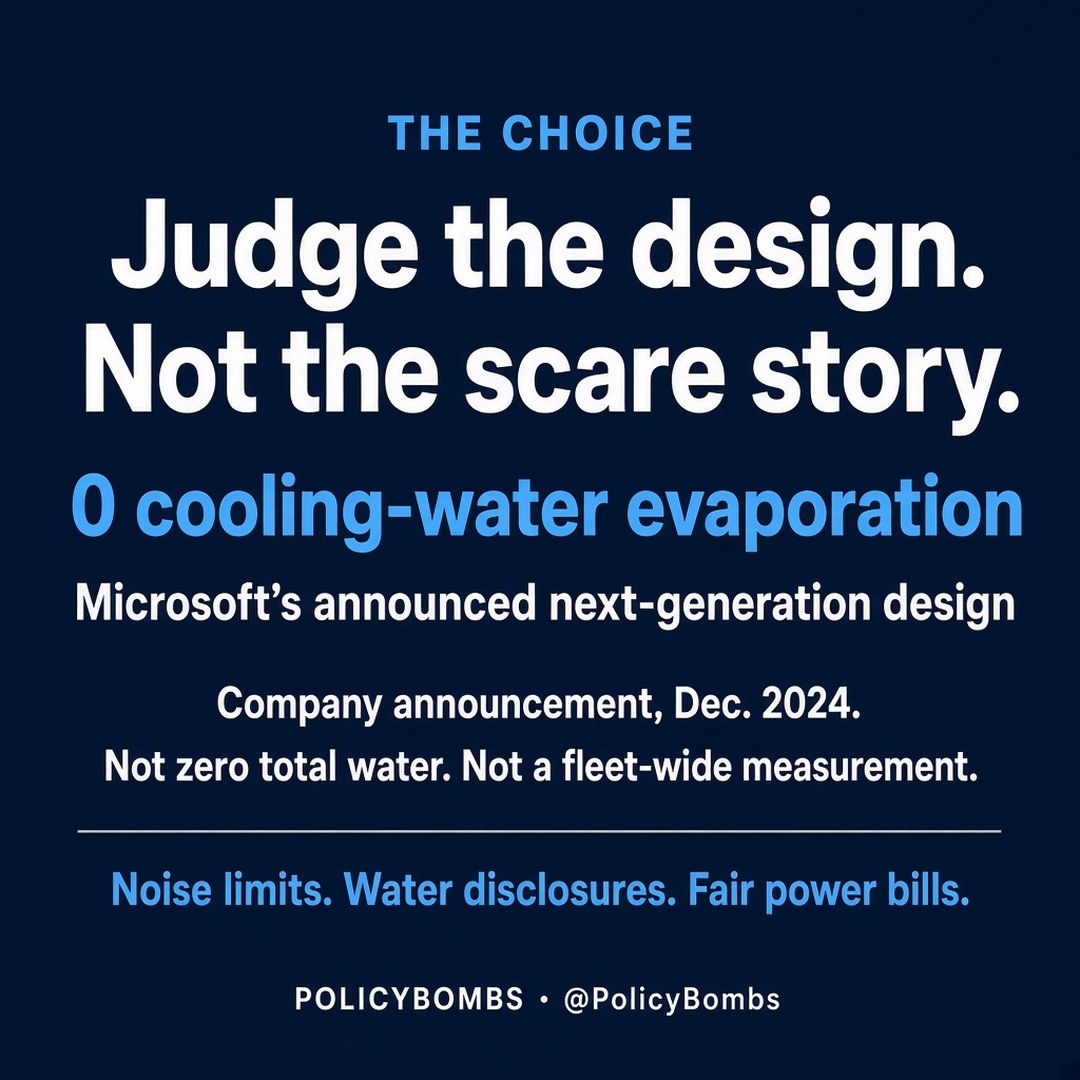
Judge the design, not the scare story. Permanent blanket bans on well-sited, compliant data centers are bad policy. Proportionate noise, water and utility-cost standards are good policy.
Microsoft's December 2024 next-generation design announcement claims zero cooling-water evaporation. That is not zero total water use, and it is not a fleet-wide measurement. Water demand still depends on cooling design, climate and source.
Noise is not inevitable or imaginary, and it is not automatically a violation. Virginia's legislative audit found most sites drew no complaints. Selected complaint-site readings were about 40 to 59 dBA of total ambient sound, around a refrigerator hum (40 dB, CDC) and in the same range as a dishwasher (45 to 65 dB, CDC), and below CDC's range for a normal talking voice at arm's length (65 to 80 dB). Loudoun County's all-hours residential property-line limit is 55 dBA. Complaints can exceed documented ordinance exceedances, especially a low-frequency hum that A-weighted meters understate. Conventional data-center complaints were documented years before the AI boom.
There is real foreign-influence evidence: OpenAI identified a likely China-origin operation amplifying U.S. data-center power-cost fears. It found no meaningful breakout beyond its own activity. That does not prove China funded local groups or caused November ballot outcomes.
Kevin O'Leary cited alleged funding receipts. His own June 25 clarification said he had no evidence the named Utah groups and people were funded by China or the CCP. Both facts belong in an honest account.
PRO: Build useful domestic compute with enforceable, design-specific standards and meaningful local participation.
CON / COST: Real nuisance, basin stress and stranded grid costs can justify denial or relocation when a project cannot meet proportionate rules.
SOCIETY: MIXED ballot package, BAD indiscriminate bans on compliant sites, GOOD targeted standards.
Community benefits belong in the same ledger. Loudoun County budgeted $794.8 million in FY2026 from data-center computer-equipment taxes, and the official real-property rate fell from $1.145 per $100 in 2016 to $0.805 in 2026. Virginia's 2024 JLARC study found facilities were paying their full cost of service under then-current rates. That is not a proven general claim that households already pay a data center's electricity price. Some companies have also contracted to add grid-connected generation, including Microsoft's planned 835 MW Crane restart.
Full analysis
Day 69 | Judge the design. Not the scare story.
Updated November 12, 2026, America/Los_Angeles (PST), building on the November 8, 2026 revision. Stable Day 69 and slug retained. This update adds ordinance-level noise comparisons, community tax and construction benefits, and a clearer distinction between tax breaks, grid-cost risk, and an unproven general household electricity-price subsidy.
Content as of November 12, 2026. Sources: primary documents, official audits, original posts and platform reports. Companion research files live in the PolicyBomb Research Drive folder.
Contents
- 10-Minute Lazy Voter Guide
- 1. What is the policy
- 2. Why it exists
- 3. Realized effects: noise, water, grid, foreign influence
- Politicians and decision-makers
- 4. Good or bad for society
- Key claims and evidence tags
- References and source links
- Gaps / unverified
10-Minute Lazy Voter Guide
Build useful domestic compute. Make the project prove its impacts. Permanent blanket bans on well-sited, compliant data centers are BAD policy on balance; proportionate noise, water and utility-cost standards are GOOD policy. The heterogeneous November ballot measures are MIXED because an advisory, a financial guarantee and a permanent ban do different things.
Two popular claims do not survive scrutiny. “Every AI center drains drinking water” ignores engineering differences. “Nobody complained before AI” ignores documented conventional-data-center complaints from years ago. Most Virginia sites generated no reported noise complaints, but some caused persistent problems. Selected complaint-site readings were about 40 to 59 dBA of total ambient sound, around a refrigerator hum (40 dB, CDC) and in the dishwasher range (45 to 65 dB, CDC), and below CDC's talking-voice range (65 to 80 dB). Loudoun's all-hours residential limit is 55 dBA. JLARC found the noise rarely violates ordinances; complaints can still exceed documented exceedances.
There is real evidence of attempted foreign interference: OpenAI documented a likely PRC-origin operation using fabricated American personas to amplify power-cost concerns. It found no meaningful breakout beyond that activity. This does not establish that China funded named Utah groups or caused the November results. O’Leary did cite alleged receipts; his own June 25 clarification also expressly says he has no evidence the named groups and individuals were China/CCP-funded.
Verdict: MIXED ballot package. BAD indiscriminate bans on compliant sites. GOOD targeted, enforceable standards. |
Figure | Meaning | Tag |
|---|---|---|
40 of 41 | Restriction-side outcomes among local contests on Nov. 3, 2026 (Ballotpedia Nov. 6 synthesis; not all bans) | Substantiated as compiler synthesis |
0 cooling-water evaporation | Microsoft Dec. 9, 2024 announced next-generation design; not zero total water; not fleet-wide measurement | Substantiated company design claim |
40-59 dBA | Selected Virginia complaint-site total ambient sound in JLARC Dec. 2024 audit, around a refrigerator hum (40 dB, CDC) and in the dishwasher range (45 to 65 dB, CDC); Loudoun's all-hours residential limit is 55 dBA | Substantiated with measurement limits |
55 dBA | Loudoun County all-hours residential receiving property-line sound limit; CDC lists a refrigerator hum at 40 dB and a dishwasher at 45 to 65 dB | Substantiated ordinance / technical-report comparison |
$794.8 million | Loudoun FY2026 adopted data-center computer-equipment tax revenue; official real-property rate $0.805 per $100 | Substantiated official budget figure |
192 TWh / 4.7% | LBNL June 2026 electricity update historical 2024 model estimate of U.S. data-center use | Substantiated model estimate |
No meaningful breakout | OpenAI June 2026 finding on the likely PRC-origin Data Center Bandwagon activity | Substantiated platform finding |
1. What is the policy
Day 69 examines municipal and county restrictions on data-center development considered on November 3, 2026, and the evidence for better alternatives. There is no single national ballot law.
Ballotpedia’s original November 6 synthesis reports restriction-side results in 40 of 41 local contests: 27 limiting/oppositional approvals and 13 defeats of favorable measures. Categories included full and partial bans, temporary pauses, zoning changes, nonbinding advisories, voter-approval requirements and a financial guarantee. That is not 40 blanket bans.
CNBC reports ten states and 21 Ohio measures. The underlying Ballotpedia table was blocked in this research run, so those geographic subtotals remain attributed reporting, not an independently reconciled primary count. Original local Harwood reporting gives 325 No and 105 Yes on proposed Article X (added qualified industrial review). The official county landing page labels returns unofficial; the underlying tally was not retrieved here.
Separately, Sen. Bernie Sanders’s S.4214 remains introduced/referred on the retrieved Congress.gov record, not enacted. Local ballots did not enact that nationwide proposal.
2. Why it exists
Stated reasons: Protect local water, power rates, farmland, property values and quality of life; stop being sold out to hyperscalers.
Underlying drivers: Industrial facilities can impose noise, construction, land-use and utility costs beyond their property lines. Secrecy about scale undermines trust. Domestic compute also supports everyday internet services and has strategic value. Absolute demand growth from AI density is real even when efficiency improves. Domestic organizing is documented. A likely PRC-origin covert influence effort targeting electricity-cost narratives is documented by OpenAI, with limited demonstrated reach. Developer, activist, utility and investor incentives all matter and should be disclosed rather than treated as proof of fraud.
3. Realized effects: noise, water, grid, foreign influence
Noise
The claim that nobody complained before AI is false. Original 2019 Chandler reporting documented years of conventional CyrusOne cooling complaints. JLARC records Virginia complaints from 2021 and 2022. Most Virginia sites did not generate problematic reports; a minority did. Selected complaint-site readings were about 40 to 59 dBA total ambient sound, not isolated facility emissions or a national sample. Low-frequency or tonal sound can annoy below a generic hearing-damage or dBA limit. Mitigation can work: Great Oak reporting describes roughly a ten-decibel retrofit reduction with remaining concerns.
Ordinance limits and familiar everyday sounds put those readings in context. Loudoun County caps sound at 55 dBA at a residential receiving property line, at all hours, and requires pre- and post-construction noise studies. Prince William and Fairfax residential limits are 60 dBA by day and 55 dBA at night. CDC's Listen Up noise meter lists a refrigerator hum at 40 dB, a running dishwasher at 45 to 65 dB, a normal talking voice at arm's length at 65 to 80 dB, and a lawn mower at 80 to 100 dB. The 40 to 59 dBA complaint-site readings, and Loudoun's 55 dBA limit, sit around a fridge hum and in the dishwasher range, and below CDC's talking-voice range. JLARC also concluded that data-center noise is not loud enough to damage hearing and is rarely loud enough to violate noise ordinances. Complaints can therefore exceed documented ordinance exceedances. That does not make the sound imaginary, and it does not make every facility a violation. Site-specific post-construction measurements remain the fair test.
Water
Withdrawal and consumption are different. A closed chip loop can still reject heat through an evaporating tower. Microsoft’s announced next-generation design claims zero cooling-water evaporation while still using administrative water and an initial fill; pilots were planned for 2026 and new sites from late 2027. JLARC estimated about 2.1 billion gallons used in Virginia in 2023, just over one-third reclaimed and under 0.5% of statewide withdrawals, with large building-level variation. Google disclosed almost 275 million gallons consumed at The Dalles in 2021. Dry/mechanical cooling can raise electricity demand. National modeled averages should not be assigned to one town or one prompt.
Grid and economics
JLARC found Virginia facilities were paying allocated service costs under then-current rates while warning growth could raise future system costs or strand infrastructure. Ohio’s 2025 dedicated tariff is a real middle path: minimum charges, collateral and exit obligations protecting other customers while allowing connections. LBNL’s June 2026 update estimates 192 TWh in 2024 (4.7% of U.S. electricity) and a 2030 reference case of 649 TWh. These are models, not meter totals. Crypto mining is excluded. JLARC’s 74,000 supported jobs include construction and multiplier effects, not permanent facility headcount.
Distinguish three cost claims that often get blended. Direct discounted electricity rates, with households paying the data center’s kWh price, are not proven as a general fact. Grid and capacity cost shifting is partly supported: PJM’s Independent Market Monitor associated $9.33 billion of 2025/2026 capacity-auction revenue with existing and forecast data-center load, a market-price spillover paid by all load in the region, including the data centers. Tax breaks are a separate, proven budget cost, not an electric-bill line. Lawrence Berkeley National Laboratory and Brattle found that from 2019 to 2024, states with the highest load growth generally saw inflation-adjusted retail rates decline as fixed costs were spread over more sales, with the caveat that the pattern may reverse where supply is tight, as in parts of PJM.
Community tax and construction benefits belong in the same ledger. Loudoun County’s FY2026 adopted budget lists $794,780,452 from data-center computer-equipment taxes. County Administrator Tim Hemstreet said data centers generate about 38% of general-fund revenue. The official real-property rate fell from $1.145 per $100 of assessed value in tax year 2016 to $0.805 in tax years 2025 and 2026, and the county says that revenue helped fund the cuts; individual bills still vary with assessments. Permanent jobs remain few relative to capital. Construction-phase hospitality lift is real but poorly measured nationwide. One local snapshot, Lauderdale County, Mississippi, citing Visit Meridian, reported hotel occupancy up 11.4% and hotel revenue up 19.5% while more than 1,050 workers were on site; that is not a controlled national study.
Some companies are also paying to add or restore generation. Microsoft’s 20-year PPA is set to restart 835 MW at Three Mile Island (Crane) for the PJM grid. Google is backing the 615 MW Duane Arnold restart, and NextEra says Iowa customers will not bear the costs of the power Google buys. Entergy says Meta will pay full cost of service for a large Louisiana gas buildout and claims about $2 billion in customer savings over 20 years; that figure is the utility’s estimate and additional plants still need commission approval. Behind-the-meter hookups can cut the other way: FERC rejected expanding Amazon’s Susquehanna co-location after commissioners warned about reliability and consumer costs. A good ballot alternative is a pay-your-own-way tariff plus required, grid-connected generation or interconnection funding, not a blanket ban on a compliant site.
Foreign influence and O’Leary
OpenAI’s original reports say it banned account clusters likely originating from China. The Data Center Bandwagon operators were likely part of a private Chinese technology company’s social-media team working for provincial-government clients. Exact impact limit: no evidence of meaningful breakout beyond its own activity. That does not establish Chinese funding of named Utah groups or causation of Day 69 ballots.
O’Leary publicly pointed to Form 990 research and BPI reports. The linked investigation website could not be retrieved in this run. His original June 25 clarification image states he has no evidence Alliance for a Better Utah, Elevate Strategies, Gabrielle Finlayson, Taylor Knuth or Josh Kanter are funded by China or the CCP. BPI’s Part II expressly does not assert that Singham funds PSL. Domestic organizing is real; association is not proof of foreign direction.
Politicians and decision-makers
Supports stronger restrictions / national pause: Sen. Bernie Sanders (I-VT), sponsor of S.4214 (introduced/referred, not enacted).
Supports buildout with guardrails: Sen. Mark Warner (D-VA), July 21, 2026 Congressional Record speech favoring domestic infrastructure with water/energy disclosure, setbacks and accountable tax benefits.
Local Harwood: Mayor Blake Hankey opposed Article X’s added process; resident organizer Michael Swartz supported more participation.
Rate design alternative: PUCO / AEP Ohio dedicated large-load tariff framework (2025) aims to protect other customers while allowing connections.
These are different policies and should not be flattened into a single pro/anti-data-center scorecard.
4. Good or bad for society
GOOD: transparent, technically grounded permitting with enforceable noise/water standards, secured incremental utility costs, meaningful local participation and predictable deadlines.
BAD: permanent blanket bans regardless of design, and unrestricted approvals regardless of measurable harm.
MIXED: the heterogeneous 2026 ballot measures themselves. A short, time-boxed planning pause can be justified to write missing standards; it should not become an indefinite veto.
Deny or relocate projects that cannot meet legitimate proportionate standards. Approve useful compliant projects without treating fear or guilt by association as engineering.
Key claims and evidence tags
Selected tags from the revised claims/evidence matrix. Full 34-claim matrix and source register are linked below.
- MISLEADING: Every AI center must consume huge quantities of drinking water.
- MISLEADING / CONTRADICTED: Nobody complained about conventional centers before AI.
- SUBSTANTIATED: COMPANY DESIGN CLAIM: Microsoft announced 0 cooling-water evaporation.
- SUBSTANTIATED AS PLATFORM FINDING: A likely PRC-origin covert operation targeted this debate.
- UNVERIFIED; EXPRESS EVIDENTIARY RETREAT: O’Leary proved named Utah groups were China-funded.
- MISLEADING: All 41 local measures were bans.
- SUBSTANTIATED POLICY EXAMPLE: Dedicated tariff can reduce stranded-cost shifting.
- SUBSTANTIATED: Loudoun FY2026 adopted $794,780,452 in data-center computer-equipment tax revenue; official real-property rate $0.805.
- NOT PROVEN AS A GENERAL FACT: Households already pay AI data centers' electricity prices.
- SUBSTANTIATED WITH LIMITS: Selected complaint-site ambient readings about 40 to 59 dBA; rarely ordinance violations; complaints can exceed documented exceedances.
References and source links
[1] Ballotpedia Nov. 6, 2026 synthesis. https://news.ballotpedia.org/2026/11/06/voters-favored-limiting-data-center-development-in-40-of-41-local-ballot-measures-on-nov-3/
[2] Virginia JLARC Report 598. https://jlarc.virginia.gov/pdfs/reports/Rpt598.pdf
[3] Microsoft Dec. 9, 2024 design announcement. https://www.microsoft.com/en-us/microsoft-cloud/blog/2024/12/09/sustainable-by-design-next-generation-datacenters-consume-zero-water-for-cooling/
[4] OpenAI PRC-linked influence operations report. https://openai.com/index/prc-linked-influence-operations-ai-debates/
[5] OpenAI Data Center Bandwagon case study. https://openai.com/index/disrupting-malicious-uses-of-ai-data-center-bandwagon/
[6] O'Leary original June 25 clarification. https://x.com/kevinolearytv/status/2070227278169059350
[7] LBNL / DOE 2025 Update (published June 2026). https://www.energy.gov/documents/united-states-data-center-energy-usage-report-2025-update
[8] PUCO data-center tariff order. https://puco.ohio.gov/news/puco-orders-aep-ohio-to-create-data-center-specific-tariff
[9] Congress.gov S.4214. https://www.congress.gov/bill/119th-congress/senate-bill/4214
[10] Warner Congressional Record July 21, 2026. https://www.congress.gov/congressional-record/volume-172/issue-119/senate-section/article/S4178-1
[11] Loudoun County tax revenues and budget. https://www.loudoun.gov/6409/Tax-Revenues-County-Budget
[12] Loudoun County noise and air-quality concerns, including the 55 dBA residential standard. https://www.loudoun.gov/6405/Noise-Air-Quality-Concerns
[13] CDC, Listen Up! Protect Your Hearing. https://www.cdc.gov/nceh/hearing_loss/infographic/
Drive research files (revised pack):
Summary DOCX: https://drive.google.com/file/d/1OwDeFrrmymp9AH2I6o1F4bL13tZ2OuI6/view
Full analysis DOCX: https://drive.google.com/file/d/1Aq4ahZfHxX7rVF5pFrbRR8CHrFyFgbRl/view
Claims/evidence matrix DOCX: https://drive.google.com/file/d/1dEetaDnBIvO0oEgAXTb6C8DeZXr5KgLk/view
Source register: https://drive.google.com/file/d/1vdbIrqIvQygv3f9c6TjOfi8_9W6SBb5W/view
Revised explainer image: https://drive.google.com/file/d/1Ptf3vifUu8DkhjKS9Czbn7ATC-kW2386/view
Gaps / unverified
Unavailable underlying linked 990 receipts and IP methodology; incomplete case-by-case BPI financial audit; certified official ballot reconciliation and geographic subtotals; project-specific acoustic/engineering/basin studies; actual completion of Microsoft’s announced rollout. No video was watched. Evidence of attempted influence does not establish its size, reach or electoral effect. No fabricated interview quotation is used.
PolicyBombs. Follow @PolicyBombs on X.