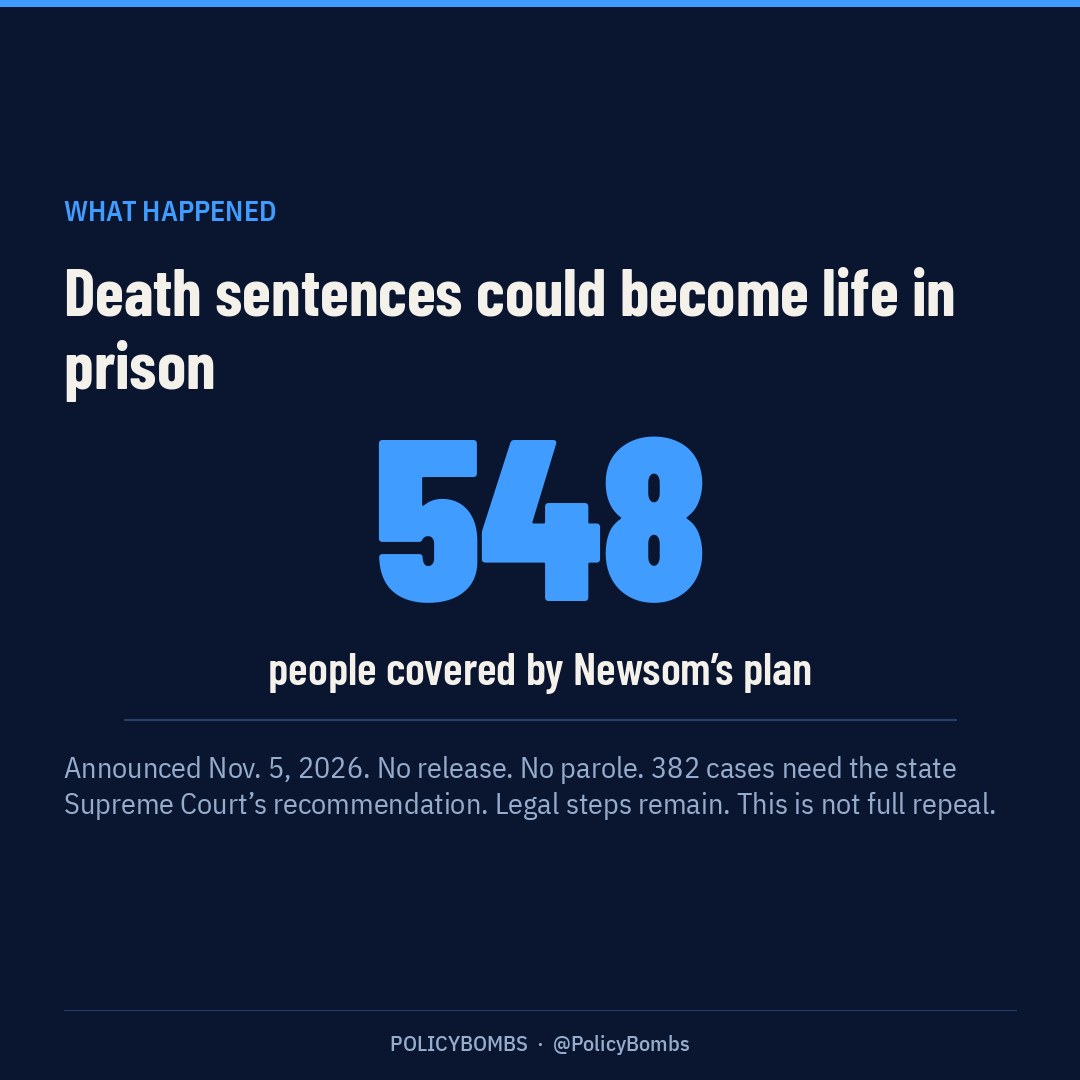
548 people. Newsom wants every current California death sentence changed to life without parole. Nobody gets a release date.
He announced the move Nov. 5, 2026. But this is not a finished "death row is empty" story: 382 cases need the California Supreme Court's recommendation, and the governor says legal steps still have to be completed before any commutation takes effect.
The case for it: keep confinement, remove the irreversible risk of executing the wrong person, and stop pretending a system with no execution since 2006 is working as advertised.
The case against it: juries imposed these sentences. Voters rejected repeal twice, Prop 34 in 2012 and Prop 62 in 2016, and in 2016 approved Prop 66, a measure meant to speed the process. Some victims' families see this as a broken promise, not mercy.
One catch nobody announced: under Prop 66 (Penal Code 2700.1), death-row inmates must work and hand over 70% of their wages for restitution. Life-without-parole inmates? 20% to 50% under Penal Code 2085.5. Lawmakers can fix that in one sentence.
And the clock: Newsom asked the court to act by Dec. 31, 2026. A new governor takes over Jan. 4, 2027.
Don't sell fake certainty. Deterrence is not settled. The old $150 million a year savings estimate was the Legislative Analyst's 2016 number for full repeal, not a score of this action. California can still seek new death sentences.
Verdict: GOOD on balance, with a serious process and democratic-legitimacy cost, plus one fixable flaw: the restitution rate. Keep the punishment severe without making an error irreversible. But honor the court process, support survivors and let voters confront the unfinished law.
Full analysis
Sources checked November 6, 2026; status revised November 9, 2026 (Pacific time).
Finding tags: Substantiated = supported by the cited source, with attribution and limits; Pending = proposed or awaiting legal/administrative completion; Cleared = a specific misleading claim is contradicted by the governing documents, not a declaration of innocence; Unverified = not established or conflicting in the material reviewed. Analytical judgments are identified as judgments, not findings of fact.
Executive finding
GOOD on balance as a punishment-policy choice, not a proven crime-control breakthrough. Life without parole preserves confinement while removing irreversible execution risk for the intended recipients. The biggest counterarguments are not imaginary: juries imposed these sentences, voters repeatedly rejected repeal, victims disagree, and a universal decision avoids individualized assessment. Constitutional authority and political legitimacy are related but different tests.
The event is an announced universal clemency decision and a legal process launched on November 5, 2026. It is not verified completion of all commutations. The governor's own implementation page says necessary legal steps must occur first. That distinction matters for every claim below. [1 to 7]
Update, November 9, 2026 (PST): status check and new findings
Status [Pending]. As of this check, no California Supreme Court recommendation on the 382-person request was found in the sources reviewed. The governor asked the court to act by the end of 2026 so he can act before his term ends. Governor-elect Xavier Becerra (D), who won on November 3, 2026, takes office January 4, 2027. Becerra has publicly committed to extending the 2019 execution moratorium, which halts executions without changing sentences; he has not been found endorsing this specific mass commutation. If the court has not acted before January 4, the governor's documents do not say what happens to the request. [2,5,6,25,28]
Court practice [Substantiated, secondary]. A Horvitz & Levy appellate analysis reports that during Newsom's two terms the court has not declined a single clemency recommendation, approving 117 requests, including 24 to commute life-without-parole sentences, under a deferential abuse-of-power standard. The same analysis notes this request is different: no individual applications and no individual review. A deferential history is not a prediction. [21]
A restitution side effect nobody announced [Substantiated statute reading; dollar effect Unverified]. Proposition 66 made condemned inmates work and requires CDCR to take 70 percent of their wages and trust deposits, or the balance owed, for restitution (Penal Code 2700.1). That rule applies to people "sentenced to death" and held under the death-sentence housing statutes. The general prisoner rule (Penal Code 2085.5) is a minimum of 20 percent and a maximum of 50 percent. Read plainly, converting a death sentence to life without parole moves a recipient from the 70 percent rule to the 20 to 50 percent rule and ends the Proposition 66 work mandate. The fact sheet says restitution orders survive, which is true; the collection rate is a separate question it does not address. No official figure for restitution collected from condemned inmates was found, so the dollar effect is Unverified. [3,26,27]
Count caveat [Unverified reconciliation]. CDCR's capital punishment pages say their list reflects records as of November 4, 2026 and "may exclude or include people whose sentencing or resentencing is pending." That is a plausible reason for the 548 versus 561 gap, not a confirmed one. [8,9]
Question 1. What is the policy?
The actual action and its legal status
Newsom announced that all current California death sentences should become life imprisonment without the possibility of parole. The official fact sheet identifies 548 people: 529 men and 19 women. His open letter states the ethical case for applying the same replacement sentence to everyone rather than distinguishing among crimes or offenders. [1,3,4] [Substantiated announcement; Pending implementation]
The signed letter to Chief Justice Patricia Guerrero and the associate justices requests a recommendation for 382 people convicted of more than one felony. It asks the court to act by year-end so the governor can act before his term ends. These are intentions and a requested timeline, not evidence that the court has approved them. [5,6] [Substantiated request; Pending outcome]
California Constitution article V, section 8(a), permits reprieves, pardons and commutations after sentence, subject to statutory application procedures. For a person twice convicted of a felony, it requires a Supreme Court recommendation with four judges concurring. This is a recommendation authorizing exercise of executive clemency, not an ordinary appellate reversal of guilt. The governor's explanatory statement describes the court's existing abuse-of-power review doctrine and argues that a categorical ethical reason satisfies it. That is his legal argument, not a new holding resolving this action. [6,7]
Subtracting the court-review cohort from the announced total gives 166 people outside that requirement. The arithmetic does not establish that their commutations have already issued. The clemency page says commutations will not go into effect until necessary legal steps are completed; it also promises notification to registered victims when they take effect. Until operative grants or a clear official completion notice are available, neither 166 completed nor 548 completed is a defensible verified count. [2,3,6]
What changes, and what does not
- Changes: the intended operative punishment for the current cohort becomes LWOP rather than execution. [3,6]
- Does not change: underlying convictions, other aspects of their sentences and restitution orders. These are not pardons, exonerations or findings of innocence. [3,6]
- Does not grant: parole eligibility or release. The explanatory statement specifies ineligibility for the cited Board commutation-review process because a recipient will already have received a commutation during the current incarceration. [3,6]
- Does not abolish: California's death-penalty statutes or future charging, jury sentencing and judicial review in eligible cases. Newsom explicitly acknowledges this boundary. [4]
- Does not reach: federal death sentences or another state's judgments. The legal authority being exercised belongs to California's governor over California sentences. A federal prosecution arising in California is not converted into a state case by geography. [6,7; jurisdictional analysis]
"No parole" describes the replacement sentence. It should not be turned into a legally absolute promise that a future court could never overturn a conviction, or that future constitutional clemency powers could never be exercised. Likewise, the specified regulatory exclusion is not a repeal of every judicial remedy. "This action releases people" is Cleared as a misleading description; "no conceivable later relief can ever occur" is Unverified and overbroad.
Before and after: the count problem
The best event-specific number is 548 intended recipients, from the governor's contemporaneous fact sheet and letter. The governor also publishes recipient rosters and a separate multiple-felony roster. [3,4,23,24]
There is a material official-data discrepancy: CDCR's transfer-program FAQ says 561 condemned people as of November 5, 2026. CDCR's general capital-punishment page separately notes its overall list reflects November 4 records and may exclude pending sentencing, not-yet-recorded judgments or people awaiting transfer. Those caveats demonstrate why a count needs a denominator and date; they do not establish the reason for the specific 561-versus-548 difference. We do not silently reconcile it or assume a typographical error. [8,9] [Unverified reconciliation]
Verified baseline for the announced action: 548. Verified completed after-count: not established by the sources reviewed. Intended endpoint for this identified cohort: no remaining death sentences if every proposed commutation is legally completed. That endpoint is conditional and does not rule out later death sentences in new cases. Reporting "California has zero death-row prisoners now" would confuse a target with a measured result.
Timeline and the policy distinctions that matter
January 17, 2006: the last California execution. Newsom did not create the entire execution hiatus. [3,19]
November 2012: voters rejected Proposition 34, which sought repeal. The certified summary reports 48% yes and 52% no. [11]
November 2016: voters rejected Proposition 62, another repeal proposal, 46.8% yes to 53.2% no, while approving Proposition 66, 51.1% yes to 48.9% no. The successful measure changed capital-case procedures and permitted condemned prisoners to be housed in other prisons. The failed repeal would have replaced death with LWOP and stopped future capital sentencing. [12 to 14]
March 13, 2019: Newsom imposed an execution moratorium in the form of reprieves, withdrew the lethal-injection protocol and closed San Quentin's execution chamber. The official announcement identified 737 then-condemned people and explicitly left their convictions and sentences intact. A pause in carrying out death is not the same legal act as replacing a death judgment. [8,10]
May 28, 2024: CDCR's FAQ says the East Block population had been transferred into general-population housing elsewhere, with specified psychiatric-inpatient exceptions; women's condemned housing had also been integrated. These preexisting physical changes must not be passed off as effects of the new commutations. [9]
November 5, 2026: announcement, open letter and court request launch the universal commutation process. November 6: Riverside DA Mike Hestrin tells KESQ that prosecutors are consulting about a challenge, without a decision on when or where to file. The reviewed report is evidence of a contemplated case, not a filed complaint or injunction. [1 to 6,20]
The immediate litigation questions
The governor's explanatory statement is unusually candid: he has not reviewed and will not review individual clemency applications for this action; he did not use individualized rehabilitation and risk assessments; and he has not provided Board of Parole Hearings recommendations. His rationale is that this is a universal initiative, not an application-driven release decision. [6]
Horvitz & Levy's contemporaneous legal analysis identifies the obvious contested issues: whether statutory application procedures constrain this form of action, whether parole-board investigation requirements apply, and what the court must examine before recommending clemency for the multiple-felony cohort. It reports the matter docketed as "Request re: Commutation of death sentences." We have the governor's actual submission, but not an independently retrieved current court docket/order establishing a disposition. [5,6,21]
The right reporting posture is Pending. The court could accept the governor's reasoning, impose procedural conditions, or find a legal defect. Prosecutors' anger does not itself prove illegality, just as broad constitutional language does not predetermine every procedural question. A policy argument against capital punishment cannot substitute for resolving statutory and constitutional process.
Question 2. Why does this policy exist?
The stated reasons
Newsom argues that state killing cannot be squared with human decency and a fallible legal system. In his letter, he says the system cannot be fairly applied and acknowledges the severe harm committed by the recipients. He says an attempt to exempt the "worst of the worst" would create different classes of victims, each of whom experiences the murder as the worst loss. He expressly accepts responsibility for causing some survivors further pain. [4]
This is a categorical ethical judgment. The explanatory statement confirms that individual rehabilitation was not the selection rule. It would therefore be misleading to describe the recipients collectively as newly found innocent, rehabilitated or safe to release. The defense of the policy is instead that even the guilty can be confined without the state killing them. [4,6]
The operational failure behind the moral argument
The administration's fact sheet reports 29 people awaiting appellate counsel and 376 people, involving 378 cases, awaiting appointment and/or funding of state habeas counsel. It says 220 have waited at least 15 years for habeas counsel, and 139 at least 20 years. These are official claims, but this analysis did not independently audit case files or counsel appointments. The overlapping groups must not be summed into a unique-person backlog. [3] [Substantiated as administration-reported]
The same fact sheet says only five people have been appointed counsel since Proposition 66 passed and gives an average wait of 29 years. Its scope is not clear enough to treat that wording as a comprehensive count of all capital counsel appointments across every category. It appears here only as an attributed claim, not as a universal performance metric. [3] [Unverified scope]
Proposition 66 was sold as a route toward faster resolution. LAO's analysis warned that costs and timing depended on lawyer availability, court practice and the complexity of cases. The Judicial Branch's implementation record confirms that rules and forms were changed, but adopting procedures does not prove that timely, adequately represented review was achieved. [14,22]
Political incentives, honestly separated from proof of motive
Newsom: a final-term, high-profile decision can cement an anti-death-penalty legacy and appeal to civil-rights and criminal-defense constituencies. NBC reports presidential ambitions as a possibility, not a declared candidacy in the material used here. Acting after an election and near the end of his term reduces some immediate electoral exposure while giving him a concrete national identity. Those are plausible strategic incentives, not proof that his long-stated moral opposition is fabricated. [4,5,19; analytical inference]
Prosecutors: elected DAs have incentives to defend jury verdicts, their offices' charging discretion and their relationship with victims and law-enforcement voters. They can sincerely regard a universal reversal as betrayal while also benefiting politically from opposition. Their institutional stake does not erase the substantive argument about individualized justice. [17,19,20; analytical inference]
Defense and abolition groups: NACDL has an explicit professional and ideological stake in avoiding executions and challenging unreliable convictions. Its moral language is advocacy. That does not make innocence risk fictional, but its claim about deterrence should be tested against independent evidence rather than repeated as scientific certainty. [15,16,18]
Voters and successor administrations: the contradiction between retained death-penalty law and executive nonuse encourages recurring symbolic conflict. Prosecutors can continue seeking death, while governors can suspend or commute it. Each side may obtain a political signal even while the system remains expensive and incoherent. That is an institutional incentive analysis, not a claim of a secret agreement.
Named politicians and interest groups
Supports this action: Gavin Newsom, Democratic governor, is the decision-maker. NACDL president C. Melissa "Missy" Owen and executive director Lisa M. Wayne publicly praise it. They are interest-group leaders, not elected politicians. [4,18]
Opposes this action: Todd Spitzer, Orange County DA, condemns it and promises continued capital charging when warranted. Jeannine M. Pacioni, Monterey County DA and CDAA president, argues it disrespects juries and victims. Mike Hestrin, Riverside County DA, calls it misuse of power and discusses legal options. Cynthia Zimmer, Kern County DA, is reported by KESQ to promise a challenge; that particular statement is secondhand in the report, not a separately fetched original release. CDAA and its CEO Greg Totten are organized institutional opponents. [17,19,20]
More nuanced: Nathan Hochman, Los Angeles County DA, acknowledges constitutional clemency power but says death-penalty law remains binding and his office will keep evaluating eligible cases. This should not be flattened into either an endorsement of the mass action or a denial that the governor has any clemency power. [19]
Related policy, not verified endorsement of this action: NBC identifies Xavier Becerra as the incoming governor. NACDL's statement says he committed to maintain the execution moratorium. Without a separately retrieved Becerra statement endorsing this particular commutation, we do not list him as a confirmed supporter of it. [18,19]
Victims' families: neither prosecutors nor abolition organizations should be treated as a census of survivor opinion. Newsom explicitly says survivors do not speak with one voice. CDAA says families lacked a meaningful advance opportunity to be heard; the governor documents outreach efforts and planned notifications. Those are competing assertions about process, not measured satisfaction rates. [4,6,17]
Question 3. What has it actually done?
Realized effects versus a new announcement
The immediately observable effects are a public executive decision, published recipient lists, a request for constitutional court review, and organized support and opposition. Legal conversion of all sentences, audited budget reductions, homicide changes and survivor outcomes have not been established by the reviewed evidence. [1 to 6,17 to 21]
If legally completed, commutation would remove execution as the punishment for the covered death judgments. That is a direct legal effect, not a causal claim about crime rates. It would leave the people confined, meaning the normal community-incapacitation function continues. It would not eliminate every possible prison-security risk, nor prove that confinement conditions and institutional violence are irrelevant.
Relative to keeping the moratorium, the immediate difference in actual executions is limited because executions were already paused. The important incremental benefit is durability for the current cohort: converting the sentence is stronger protection against a later resumption than retaining death judgments under a governor's pause. This is a legal-policy assessment conditional on valid completed grants, not a claim that a successor could freely revoke valid commutations. [4,6,7,10]
Deterrence: neither side gets a free scientific victory
The National Research Council's review found that the available studies could not determine whether capital punishment decreases, increases or has no effect on homicide compared with alternatives. The review highlighted failures to account for noncapital punishment, unsupported assumptions about potential offenders' perceptions, and fragile modeling. [15]
That finding does not establish that execution has zero deterrent effect. It also does not support a claim that this commutation will increase murder by any specified amount. The relevant comparison is execution policy versus LWOP under actual conditions, not punishment versus no punishment. California's long execution hiatus further complicates claims that the November 5 announcement immediately changes a credible execution threat for all potential offenders.
The evidence review dates from 2012. It is a serious methodological benchmark, not a claim to have exhaustively reviewed every later study. No new California-specific causal estimate is asserted here. Comparing homicide rates across states or around the 2019 moratorium without a credible design would confound enforcement, economic conditions and other policy changes. [Unverified: a quantified crime effect of this action]
Wrongful conviction: real risk, wrong shortcut
Gross and colleagues' 2014 PNAS study used national death-sentence data from 1973 to 2004, a cohort of 7,482 defendants, and survival analysis to estimate that at least 4.1% would be exonerated if all remained under death-row scrutiny indefinitely. The estimate is model-based and historical. It is not an observed current California innocence percentage and it is not the fraction of executions known to have been wrongful. [16]
The policy implication is that irreversible punishment operates in a system that can convict innocent people. The invalid shortcut is to multiply that percentage by the current cohort and announce a number of innocent Californians spared. This analysis makes no such calculation. Nor does the fact that errors exist establish that any named recipient is innocent. [Substantiated study estimate; Unverified cohort-specific innocence count]
There is an important unintended consequence on the other side of the ledger. The study finds that exoneration efforts decline when defendants leave death row for life imprisonment. Commutation can prevent wrongful execution while leaving an innocent person locked up and less likely to receive intensive legal attention. A sound implementation should preserve conviction review, evidence access and competent counsel rather than declaring the justice problem solved once death is removed. [16; recommendation]
Costs: what can actually be claimed
LAO's 2016 Proposition 62 analysis estimated around $150 million annually in net state and county savings from full repeal after several years, with uncertainty of tens of millions. It identified shorter capital trials, reduced legal challenges and lower death-row housing costs. It also discussed potential offsets, including effects on plea bargaining and ongoing challenges unrelated to death. [13]
That figure is not a cost estimate for Newsom's action. Full repeal would have stopped future capital prosecutions, while this action does not. A 2016 housing baseline also does not capture CDCR's later transfer program. The governor's new fact sheet explicitly says no major CDCR operational change is expected because physical death row was previously dismantled and classification still governs housing. [3,9,13]
Future savings may arise from narrowing death-sentence litigation, but guilt challenges, prison operations, medical care and restitution administration continue. Existing expenditure is not all avoidable expenditure; attorney and court resources may be reassigned rather than removed from a budget. Implementation and any litigation over the commutations also use resources. No booked saving, per-person annual saving, or cumulative dollar total for this specific action is verified. [Pending measurement]
Proposition 66's own 2016 analysis warned of uncertain ongoing court costs, potential near-term accelerated spending in the tens of millions annually and possible prison savings in the tens of millions. Those were forecasts for that measure, not receipts showing that it either succeeded or failed fiscally. [14]
Victims, restitution and finality
The governor says the action could end capital litigation but acknowledges that finality is not the same as emotional closure. That distinction is essential. Some survivors may experience relief from recurring execution litigation; others may experience the loss of an expected sentence as renewed harm. There is no measured representative survey of affected families in this analysis. [4,17]
Restitution orders remain. That is not a promise that collections, deductions or payments will be identical in practice; this analysis did not audit recipient finances or the interaction of every deduction rule after resentencing. The continuity of an order is substantiated; identical cash recovery is not. [3,6]
The administration says registered victims will receive notice and support; prosecutors say meaningful advance participation was lacking. Notification after a decision is not equivalent to consultation before it. Even where a survivor has no veto over clemency, how a government explains and communicates the decision can affect legitimacy. [2,6,17]
Equal protection and the arbitrary-line problem
Universal treatment removes one executive selection line among current death-sentenced recipients. Newsom's stated rationale is that every victim's loss matters, so clemency should not depend on which murder the executive regards as worst. [4,6]
It does not prove that past charging, representation and sentencing disparities have been eliminated. Nor does it prevent new death sentences after this cohort is selected. A future defendant could face death under unchanged law while an earlier one with a similar offense receives LWOP. That is a policy-coherence and fairness issue. It is not, without a controlling judicial ruling, a verified equal-protection violation.
The 2019 governor's statement cites racial disparities and wrongful-conviction history as reasons to stop executions. We identify those as administration arguments rather than treating a raw racial population share as a causal estimate of discrimination. The current commutation record does not contain an independently audited risk-adjusted analysis of every charging and sentencing decision. [10]
Question 4. Is this good or bad for society?
The strongest case for it
A civilized state should demand an unusually strong public justification before making punishment irreversible. LWOP retains severe punishment and confinement while preserving a possibility of correcting a wrongful conviction. In a jurisdiction that has not executed since 2006 and still reports major counsel backlogs, retaining the label of death has weak demonstrated operational value. Removing execution risk without releasing prisoners is a defensible net improvement. [3,6,15,16; evaluative judgment]
The conclusion does not require claiming that most recipients are innocent, that every execution has no deterrent effect, or that the decision instantly saves a specific sum. None of those claims is needed or established. It rests on severity with reversibility, continued incapacitation and the absence here of a demonstrated incremental public-safety benefit sufficient to outweigh the irreversible-error risk.
The strongest case against it
Retributive justice is not reducible to a budget spreadsheet. Some citizens believe certain murders deserve death even if it produces no additional measurable deterrence. Juries considered aggravation and mitigation, and voters declined repeal. A governor who substitutes one categorical judgment for all those decisions can exercise constitutional power while still imposing a real cost on democratic trust and individualized justice. [11,12,17]
For those survivors who regard the death sentence as a promise, the state has changed the bargain after years of participation in proceedings. Saying "nobody is being released" answers a public-safety fear, but not the entire moral objection. A fair account should confront the lost punishment, not pretend critics misunderstand parole.
The process also matters independently of the desired outcome. If the statutory application and review requirements constrain this categorical action, the executive must comply rather than assume the moral argument supplies missing legal authority. A good policy does not earn a procedural exemption merely by calling itself humane. [6,7,21]
Direct verdict
GOOD on balance: keep confinement, end irreversible execution risk for this cohort, and stop marketing a stalled punishment as a functioning system. But the court process, survivors and the voters' unfinished argument cannot be waved away.
This is not "good because Newsom did it," and not "bad because he benefits politically." Political incentives exist on both sides. The public test is what the policy does, whether the law authorizes its implementation, and whether the remaining harms are acknowledged and mitigated.
Compared with continuing a temporary moratorium, completed commutations improve durability for existing recipients but do not repair the system for future cases. Compared with full repeal, they leave a costly and inconsistent pipeline legally possible. Compared with rapid executions, they trade away retribution by death while reducing the risk of an uncorrectable error. The deterrence trade-off remains empirically uncertain in the evidence used here.
What a good policy would include
Each proposal below is tied to an official estimate where one exists. Where no current official or independent score exists, it is labeled Unverified rather than given a made-up number.
- Settle the law, not just the cohort: put repeal (or a reformed penalty) to the Legislature or voters. Commutation protects these 548 people but leaves the capital pipeline open for future cases. The only official fiscal score for ending the penalty is LAO's 2016 Proposition 62 analysis: net state and county savings of around $150 million a year within a few years, plus or minus tens of millions, from shorter murder trials, fewer capital appeals and prison housing. That estimate is ten years old and predates the 2024 end of segregated death-row housing, so a fresh LAO score is needed. Current dollar figure: Unverified. [13]
- Protect the restitution rate by statute. Amend Penal Code 2700.1 so anyone whose death sentence is commuted to life without parole stays under the 70 percent deduction and work requirement. Cost to the state: essentially none, because it moves money from inmate accounts to victims. Dollar benefit: Unverified (no official collection data found). [26,27]
- Redirect capital litigation money to accuracy and victims, and report it. LAO's 2016 baseline put state spending on legal challenges to death sentences at about $55 million a year. As cases leave capital status, require the Department of Finance to publish what actually stops (penalty-phase appeals, capital habeas counsel) and what continues (guilt-phase challenges), then dedicate a published share to post-conviction DNA and innocence review and to victim services. Savings attributable to this action: Unverified until reported. [3,13]
- Publish a completion ledger. Name-by-name status (court recommendation, certificate issued, CDCR sentence updated), and reconcile 548 against CDCR's 561. Cost: administrative, Unverified but small relative to the figures above. [2,8,9]
- Give survivors more than a notice. Direct contact, an explanation of what the sentence change means (no parole, no release), and access to CalVCB services. Cost: Unverified; no official estimate tied to this action exists. [3,6]
- If the alternative is to keep and speed the death penalty, price it honestly. LAO's 2016 Proposition 66 analysis projected near-term state court cost increases potentially in the tens of millions of dollars a year to accelerate appeals, with similar savings later, and possible prison savings in the tens of millions. Ten years later, the shortage of appointed habeas counsel the administration reports (376 people awaiting counsel and/or funding) shows that acceleration did not happen. Any "mend it" plan must fund counsel first. [3,14]
These are recommendations, not provisions already enacted by the announcement.
Finding register
Substantiated: November 5 announcement; intended LWOP replacement; 548-person action cohort as officially stated; 382-person court request; four-justice requirement; convictions and restitution retained; original moratorium and historical election results. Attribution does not make every administration assertion an independent audit. [1 to 14]
Pending: Supreme Court recommendation (none found as of Nov 9, 2026; requested by Dec 31, 2026; governor changes Jan 4, 2027) and any applicable legal procedures; operative grants; a verified post-action count; future litigation outcomes; actual savings; longer-run survivor and public-safety effects. [2,5,6,20,21]
Cleared: descriptions of this action as a prison release, a pardon, an exoneration or repeal of all future California death-penalty law contradict the official documents. This tag does not label any prisoner cleared of wrongdoing. [3,4,6]
Unverified: dollar effect of the restitution-rate change; reconciliation of CDCR's 561 with the announced 548; any statement that all commutations already took effect; a current after-count of zero; a causal homicide effect; an audited dollar saving; a current-cohort innocence headcount; universal victim support/opposition; every family's advance notice; any new final court holding on this proposal. [2,3,9,15 to 17,20,21]
Source limitation: AP's original article timed out during direct retrieval and is not a load-bearing citation here. A Los Angeles Times search result contained percentage wording inconsistent with 382 out of 548; we rely instead on the governor's primary explanatory statement. CourtListener's Briggs opinion page returned 403; this analysis does not rely on that blocked page for a legal holding. The current court disposition was not independently retrieved from a court docket. Official letters, fact sheet, rosters, statute and ballot documents were retrieved directly; scanned letter pages were read as images where text extraction was empty.
Sources
Sources 1 to 24 were retrieved November 6, 2026; sources 25 to 29 were added November 9, 2026 (Pacific time). Numbers are sourced to specific documents, historical estimates are dated, and calculations are identified.
- [1] Governor, announcement, Nov 5, 2026: https://www.gov.ca.gov/2026/11/05/governor-newsom-releases-letter-to-california-on-the-death-penalty/
- [2] Governor, clemency implementation/status page: https://www.gov.ca.gov/clemency/
- [3] Governor, California Commutations fact sheet, Nov 5, 2026: https://www.gov.ca.gov/wp-content/uploads/2026/11/11-5-26-External-Fact-Sheet-Clemency-Action.pdf
- [4] Governor, signed open letter, Nov 5, 2026 (scanned PDF read visually): https://www.gov.ca.gov/wp-content/uploads/2026/11/2026-11-5-26-GGN-Open-Letter-FINAL.pdf
- [5] Governor, request to California Supreme Court, Nov 5, 2026 (scanned PDF, first page read visually): https://www.gov.ca.gov/wp-content/uploads/2026/11/2026-11-5-26-GGN-Letter-to-Court-FINAL.pdf
- [6] Governor, explanatory statement, proposed death penalty clemency action: https://www.gov.ca.gov/wp-content/uploads/2026/11/2026-11-5-26-GGN-Explanatory-Statement-FINAL.pdf
- [7] California Constitution, article V, section 8: https://leginfo.legislature.ca.gov/faces/codes_displaySection.xhtml?lawCode=CONS§ionNum=SEC.%208.&article=V
- [8] CDCR, Capital Punishment, records note dated Nov 4, 2026: https://www.cdcr.ca.gov/capital-punishment/
- [9] CDCR, Condemned Inmate Transfer Program FAQ (contains conflicting population figure): https://www.cdcr.ca.gov/capital-punishment/condemned-inmate-transfer-program/
- [10] Governor, original execution moratorium announcement, March 13, 2019: https://www.gov.ca.gov/2019/03/13/governor-gavin-newsom-orders-a-halt-to-the-death-penalty-in-california/
- [11] Secretary of State, certified 2012 vote summary, Proposition 34: https://elections.cdn.sos.ca.gov/sov/2012-general/06-sov-summary.pdf
- [12] Secretary of State, certified 2016 vote summary, Propositions 62 and 66: https://elections.cdn.sos.ca.gov/sov/2016-general/sov/06-sov-summary.pdf
- [13] Legislative Analyst, Proposition 62 fiscal analysis, 2016: https://www.lao.ca.gov/BallotAnalysis/Proposition?number=62&year=2016
- [14] Legislative Analyst, Proposition 66 fiscal analysis, 2016: https://www.lao.ca.gov/BallotAnalysis/Proposition?number=66&year=2016
- [15] National Research Council / National Academies, deterrence evidence review, April 18, 2012: https://www.nationalacademies.org/news/current-research-not-sufficient-to-assess-deterrent-effect-of-the-death-penalty
- [16] Gross, O'Brien, Hu and Kennedy, PNAS, Rate of false conviction of criminal defendants who are sentenced to death, 2014: https://www.pnas.org/doi/10.1073/pnas.1306417111
- [17] California District Attorneys Association, opposition statement, Nov 5, 2026: https://www.cdaa.org/common/Uploaded%20files/Press%20Releases/CDAA%20Release%20Commutation%20to%20LWOP%2011052026.pdf
- [18] NACDL, support statement, Nov 5, 2026: https://www.nacdl.org/newsrelease/News-Release-~-California-Death-Sentences
- [19] NBC Los Angeles, Jonathan Lloyd, Nov 5, 2026, political and prosecutor responses: https://www.nbclosangeles.com/news/california-news/newsom-commute-death-sentences/3966504/
- [20] KESQ, Garrett Hottle, Nov 6, 2026, prosecutors considering court challenge: https://kesq.com/news/2026/11/06/newsom-mass-death-penalty-commutation/
- [21] Horvitz & Levy, At the Lectern, Nov 5, 2026, legal analysis and docket reporting: https://www.horvitzlevy.com/governor-asks-supreme-court-to-approve-a-blanket-commutation-of-382-death-sentences/
- [22] Judicial Branch, Proposition 66 Rules Working Group, implementation record: https://courts.ca.gov/advisory-body/proposition-66-rules-working-group
- [23] Governor, list of intended clemency recipients: https://www.gov.ca.gov/wp-content/uploads/2026/11/List-of-Intended-Clemency-Recipients.pdf
- [24] Governor, intended recipients twice convicted of a felony: https://www.gov.ca.gov/wp-content/uploads/2026/11/FOR-COURTS-2026-11-5-26-CA-List-of-Intended-Clemency-Recipients.pdf
- [25] California Today, Nov 2026, commutations not yet in effect; Dec 31 request; Jan 4, 2027 term change; Becerra moratorium statement (secondary, cross-checked against primary documents [2,5,6]): https://californiatoday.com/news/legal/newsom-death-sentence-commutations-california-supreme-court/
- [26] California Penal Code section 2700.1 (Proposition 66, 2016): condemned inmates must work; 70 percent restitution deduction: https://leginfo.legislature.ca.gov/faces/codes_displaySection.xhtml?lawCode=PEN§ionNum=2700.1
- [27] California Penal Code section 2085.5 (as amended by AB 1186, effective Jan 1, 2025): general prisoner restitution deduction, minimum 20 percent, maximum 50 percent: https://leginfo.legislature.ca.gov/faces/codes_displaySection.xhtml?lawCode=PEN§ionNum=2085.5
- [28] Associated Press, Sophie Austin, Nov 4, 2026, Becerra wins California governor's race: https://apnews.com/article/california-governor-election-becerra-hilton-newsom-aae9829ede7e3f0c5e4512d5732d4df3
- [29] Habeas Corpus Resource Center, Commutation of California Death Sentences (state agency explainer): https://www.hcrc.ca.gov/commutation.html
PolicyBombs · Policy #72. Follow @PolicyBombs on X.