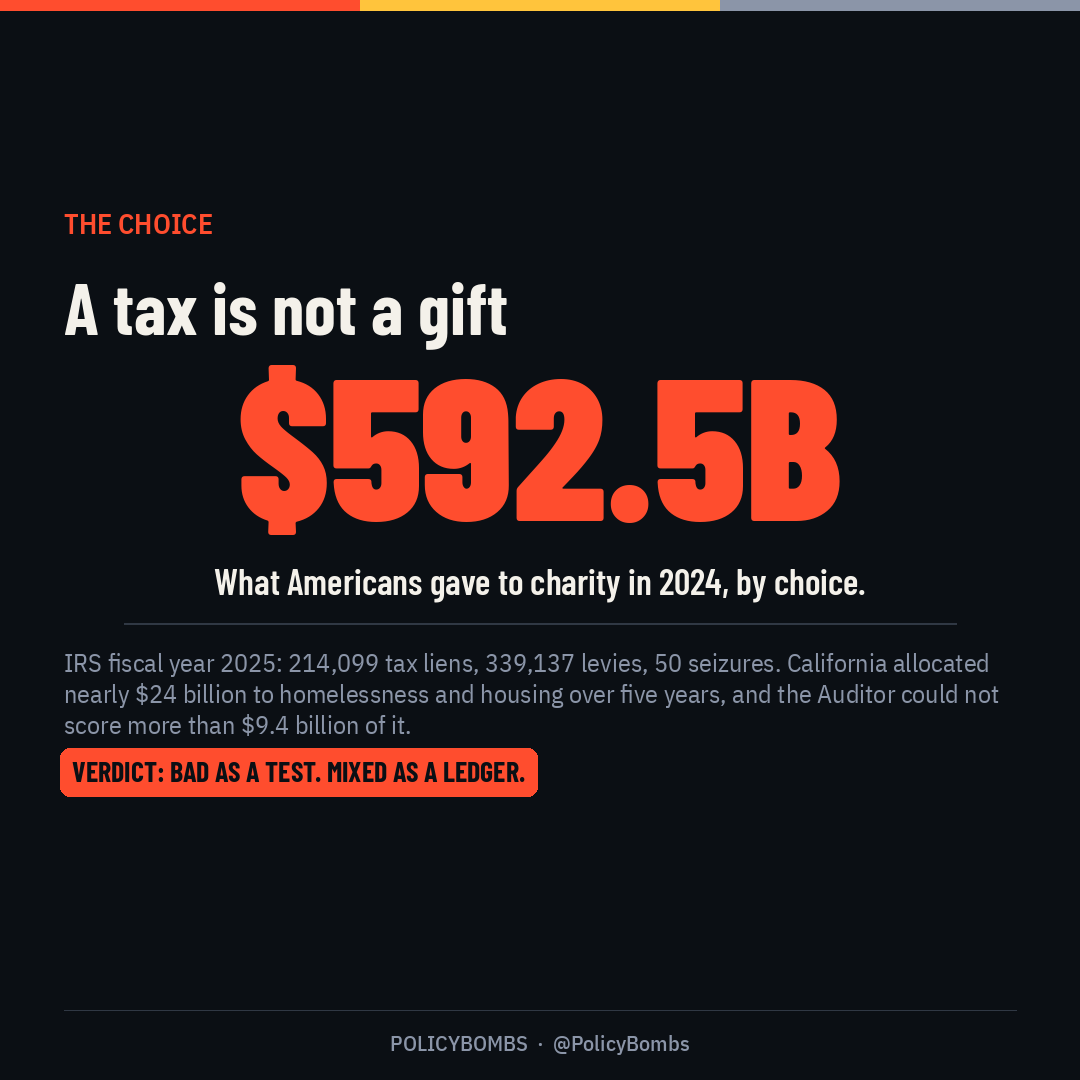
$592.5 billion. That’s what Americans gave to charity in 2024, by choice (Giving USA). Empathy is a virtue. A tax is not a gift.
The decision rule, not one bill: if a cause feels worthy, the law should take the money and spend it. Gad Saad defines “suicidal empathy” in Suicidal Empathy: Dying to Be Kind (Broadside Books, May 12, 2026). Feeling is not a result.
A donation is a gift. You can say no. A tax is a command. In fiscal year 2025 the IRS filed 214,099 federal tax liens, requested 339,137 levies on banks and paychecks, and conducted 50 seizures. It assessed 24.3 million “failure to pay” penalties on individual returns, totaling $12.1 billion. Legal-source tax-crime cases sent 315 people to prison. Ordinary late bills are usually collected civilly.
Some tax-funded programs work. A $1,000 increase in the Earned Income Tax Credit raised employment 7.3 points and cut poverty 9.4 points among single mothers with children (Hoynes and Patel, NBER, 2015). SNAP and Social Security also reduce measured poverty. That is the strongest honest case for a tax-funded transfer.
Some programs hurt the people they name. San Francisco’s 1994 rent-control expansion made covered buildings 8 points more likely to become condos and cut renters in treated buildings by 15 points (Diamond, McQuade, and Qian). California allocated nearly $24 billion to homelessness and housing over five years. In April 2024 the State Auditor could not score three programs that had received more than $9.4 billion since 2020. The 2023 HUD count was still 181,399, up 53 percent from 2013.
Verdict: BAD as a test of policy. MIXED as a ledger of programs. Measure the result. Prefer a gift where a public good is not at stake. Do not hide the force behind a feeling.
PRO: Public goods and free riders are real. Democracies do authorize taxes. The EITC has a documented record of raising work and cutting poverty. SNAP and Social Security also reduce measured poverty.
CON / COST: A tax is collected by force: 214,099 liens, 339,137 levies, and 50 seizures in fiscal year 2025, plus 315 legal-source tax-crime incarcerations (IRS). California allocated nearly $24 billion to homelessness and housing over five years and could not score more than $9.4 billion of it, while the 2023 HUD count was still 181,399, up 53 percent from 2013. San Francisco rent control shrank the rental supply it was supposed to protect.
SOCIETY: BAD as a test of policy. MIXED as a ledger of programs. Empathy is a virtue. It is a bad statute. Measure results. Prefer gifts where a public good is not at stake. Do not hide compulsion behind a feeling.
Full analysis
This analysis tests a decision rule, not a single statute. When a cause feels worthy, should the law take the money and spend it? The question is whether empathy, once written into a tax or a mandate, actually helps the less fortunate or society.
1. What is the policy
There is no Act of Congress titled “Suicidal Empathy.” The policy is a habit of government: sell a program as compassion, collect the money by law, and treat doubt about results as a failure of feeling.
Terms, defined. Empathy is the ability to understand and share another person’s feelings. Gad Saad, an evolutionary behavioral scientist at Concordia University, defines “suicidal empathy” in Suicidal Empathy: Dying to Be Kind (Broadside Books, an imprint of HarperCollins, May 12, 2026; ISBN 9780063446533). In his telling, empathy itself is an adaptive virtue. It becomes suicidal when it is dysregulated: hyperactive, aimed at the wrong people, fired in the wrong situations, or used as the only filter for decision-making, crowding out prudence, discernment, and justice. He has compared the misfire to obsessive-compulsive disorder, an adaptive threat-scan that, unmodulated, wrecks the person who has it. He developed that argument after The Parasitic Mind: How Infectious Ideas Are Killing Common Sense (Regnery, 2020), which was about ideological “idea pathogens” hijacking reason. This analysis does not attribute the term “suicidal empathy” to the 2020 book. In a May 2026 interview with the Jewish Journal, Saad said he coined the phrase more than ten years earlier. That is his account of earlier use. The published definition used here is the 2026 book.
The mechanism this analysis measures is force, not feeling. A donation after a flood is a gift. The giver can say no, and no lien follows. A tax-funded transfer is not a gift. Title 26 of the U.S. Code authorizes assessment, penalties, and interest. If the tax is assessed, demand is made, and it is not paid, a federal tax lien arises (26 U.S.C. 6321). The IRS may levy banks and wages (26 U.S.C. 6331) and, in a smaller set of cases, seize property. Willful failure to file a return, supply information, or pay tax is a misdemeanor that can carry up to one year in prison per count (26 U.S.C. 7203). Tax evasion, which requires an affirmative act of concealment, is a felony (26 U.S.C. 7201). Willfulness means a voluntary, intentional violation of a known legal duty. Inability to pay, or ordinary negligence, is not a crime. The honest line is this: most unpaid bills are collected civilly, through penalties, liens, levies, and occasional seizures. Jail is reserved for willful crimes. Both are force. Only the second is prison.
Jurisdiction and scope. The United States is the frame. California supplies some of the cleanest official outcome records, especially on homelessness spending. The program types used as tests are disaster aid, means-tested welfare, housing rules sold as protection for tenants, homelessness spending, and foreign aid. Each is a place where compassion is the stated reason for a law. A separate PolicyBomb takes up a different issue: taxes and fees sold for one purpose and then spent on another.
What this is not. This analysis does not argue that empathy is a vice, or that every public program is a failure, or that taxes used for genuine public goods (courts, defense, a functioning property-rights system) are indistinguishable from a transfer. It argues that “we meant well” is not a result, and that a compulsory transfer should be described as compulsion.
2. Why it exists
Stated reasons. Supporters say a decent society does not leave the hungry, the sick, the flooded, or the old to private luck. Justice Oliver Wendell Holmes Jr., dissenting in Compania General de Tabacos de Filipinas v. Collector of Internal Revenue, 275 U.S. 87, 100 (1927), wrote the sentence still used to close the argument: “Taxes are what we pay for civilized society.” Sen. Bernie Sanders (I-VT) has said health care is “a human right, not a privilege,” and has proposed to fund national provision by raising taxes on high earners and large firms. The New Deal and the Great Society were sold in the same language: social insurance, a floor under destitution, a public duty. After a natural disaster, the stated case is speed and scale that private giving may not match. After a recession, the stated case is automatic stabilizers.
The public-goods argument, stated fairly. Some goods are non-excludable. If the harbor is defended, the person who did not chip in still gets the defense. Voluntary giving then under-provides. That is the free-rider problem, and it is the strongest honest case for a tax. It is strongest for defense, courts, and a narrow set of infrastructure. It is weakest when the program is a transfer to a named group, because the benefit is excludable and the question is whether the payer consented and whether the transfer works.
Honest underlying drivers. Politicians get credit for announcing a compassionate program. The people who receive the money, or who administer it, notice. The people who pay are a diffuse tax base. Once a program exists, ending it looks hard-hearted, even if the program failed its own test. Empathy, in that setting, is not only a motive. It is a shield. Our inference, labeled as such: compassion-by-law persists in part because it is a low-cost way to display virtue with other people’s money, and because questioning the result can be smeared as a lack of feeling. That is an inference from incentives and from the pattern of weak outcome measurement documented below. It is not a memo, and it is not proof of any official’s private intent.
The older critique. Frederic Bastiat, in The Law (1850), defined legal plunder as the law taking from some persons what belongs to them and giving it to others to whom it does not belong. When that is the method, he argued, the state becomes “the great fiction by which everyone endeavors to live at the expense of everyone else” (Bastiat, “The State,” 1848). Robert Nozick, in Anarchy, State, and Utopia (1974), wrote that “taxation of earnings from labor is on a par with forced labor.” F.A. Hayek, in The Road to Serfdom (1944) and later work, warned that coercive redistribution, even when the end is humane, trains a society to accept more coercion and to replace the rule of law with official discretion. The point of citing them is not nostalgia. It is to name the thing being done. A tax is a command. If the command is justified, justify it on results and on consent, not on the warmth of the sponsor.
3. Realized effects
3A. The collection machinery is not a metaphor
The Internal Revenue Service Data Book, 2025 (Publication 55-B), covering fiscal year 2025 (October 1, 2024, through September 30, 2025), is the official count.
Civil collection, Table 4-1 (money amounts in thousands of dollars):
- Notices of federal tax lien filed: 196,996 in fiscal year 2024; 214,099 in fiscal year 2025.
- Notices of levy requested on third parties (banks and employers, by the Automated Collection System and Field Collection): 313,792 in 2024; 339,137 in 2025. The table does not include some automated levy programs, so this is not the full levy universe.
- Seizures conducted by Field Collection: 71 in 2024; 50 in 2025.
- Taxpayer delinquent accounts at year end: 14,901,508 in 2024, with a balance of assessed tax, penalties, and interest of $208.4 billion; 13,112,485 in 2025, with a balance of $211.5 billion.
- Offers in compromise accepted: 7,199 in 2024 ($163.4 million); 5,464 in 2025 ($98.1 million).
Civil penalties, Table 4-2, individual and estate and trust income taxes, fiscal year 2025:
- 46,748,796 penalties assessed, totaling $33.1 billion.
- Of those, 24,251,980 were “failure to pay” penalties, totaling $12.1 billion.
- The Data Book’s grand total of all civil penalties is much larger ($1.25 trillion assessed) because other categories, including employment-tax items, dominate. This analysis uses the individual, estate, and trust income-tax line, not the grand total, so the figure is not inflated by unlike categories.
Criminal cases, Table 3-10, fiscal year 2025:
- Investigations initiated: 2,792. Completed: 2,850. Referrals for prosecution: 2,043. Convictions: 1,611. Sentenced: 1,613. Incarcerated: 1,225 (75.9 percent of those sentenced).
- Those totals mix legal-source tax crimes with illegal-source financial crimes and narcotics-related financial crimes. The legal-source tax-crimes program, the category closest to willful tax offenses in legal industries and occupations, accounted for 968 investigations initiated, 421 convictions, 431 people sentenced, and 315 incarcerated.
What this does and does not prove. It proves that unpaid tax is not an honor system. Liens, levies, penalties, and a smaller number of seizures are routine. It does not prove that ordinary late payers go to prison. They generally do not. The prison counts above are criminal cases, and only a share of them are legal-source tax crimes. Anyone who says “refuse a compassionate tax and you go to jail” is overstating the typical path. Anyone who says “it is just like a donation” is understating the law.
3B. Americans already give, in large amounts, by choice
Giving USA 2025, the annual report on philanthropy for 2024, published by Giving USA Foundation and researched by the Indiana University Lilly Family School of Philanthropy, estimates that individuals, bequests, foundations, and corporations gave $592.50 billion to U.S. charities in 2024, up 6.3 percent in current dollars (3.3 percent after inflation). Individuals gave $392.45 billion; foundations $109.81 billion; bequests $45.84 billion; corporations $44.40 billion. Among recipient categories, religion received $146.54 billion and human services $91.15 billion. These are estimates, revised in later years as tax and economic data become final, which Giving USA discloses.
This does not prove that private giving can replace every public program. It does prove that “if we do not tax it, no one will give” is false as a blanket claim. The United States already runs a vast voluntary transfer system, by choice.
Disaster giving is a narrower slice. A widely circulated 2024 figure that less than 1 percent of tracked philanthropy goes to disasters was not independently confirmed from a primary table this analysis and is left no official figure was found here. Qualitative evidence of private speed, from church disaster teams and volunteer flotillas such as the Cajun Navy after major hurricanes, is real and repeatedly reported. Official counts of people rescued or dollars delivered by those volunteer groups were not found in a form that meets this analysis’s sourcing rule, and no such totals are used.
3C. Disaster aid: the government’s own overhead, and the limits of the comparison
GAO-15-65 (December 17, 2014) found that FEMA obligated $12.7 billion from the Disaster Relief Fund for its own administrative costs in fiscal years 2004 through 2013. That was 13 percent of $95.2 billion obligated from the fund for 650 major disasters in those years, about double the average administrative-cost share in fiscal years 1989 to 1998. GAO also counted $1.7 billion obligated to reimburse state and local grantees for administrative costs on Public Assistance grants in the same period. FEMA agreed with GAO’s recommendations to plan and track those costs. A current official administrative-cost share for the most recent decade was not retrieved this analysis and is Pending.
This is not a full horse-race between FEMA and private charity. FEMA writes large checks for public infrastructure and individual assistance that no volunteer flotilla can replace. Private groups often arrive faster on a local street, with less process, and with money that was given, not taken. A good comparison would be cost per dollar delivered and time to first help, program by program. That full side-by-side, official and current, is still thinner than it should be. What can be said on the record is that “the government must do it because it is more efficient” was not the story GAO told about FEMA’s own overhead in that decade, and that administrative costs as a share of disaster funding had risen, not fallen.
3D. Transfers can help. They can also trap.
The strongest evidence that a tax-funded transfer can help the people it targets is the Earned Income Tax Credit. Hoynes and Patel (NBER Working Paper 21340, 2015) used variation in EITC generosity across tax years and family sizes. They found that a policy-induced $1,000 increase in the EITC led to a 7.3 percentage point increase in employment and a 9.4 percentage point reduction in the share of single-mother families with after-tax and transfer income below the poverty line. The gains were concentrated between about 75 percent and 150 percent of poverty, with little effect at the very bottom (50 percent of poverty and below). The authors also argue that static poverty counts understate the credit’s effect because they miss the added earnings from more work. This is a wage subsidy for work, not a pure handout, which is part of why the employment result appears.
SNAP and Social Security, in Census Supplemental Poverty Measure research, are repeatedly among the transfers that move the most people over the poverty line. Those findings are the core of the social-insurance counterargument and are treated as such in Section 4.
The other side of the ledger is the benefit cliff: a small raise can cost more in lost benefits than it adds in pay, producing a very high effective marginal tax rate, in the extreme above 100 percent. The Congressional Budget Office and HHS/ASPE have documented this structure for years. Exact point estimates from those reports (for example a single official “average” rate) are not quoted here because the official PDFs could not be retrieved this analysis. The mechanism itself is not in doubt: when benefits phase out steeply, or fall off a cliff, the compassionate program can punish the next hour of work. That is an outcome test, not a motive test.
3E. When a well-meant rule hurts the people it names
Rent control, San Francisco. Rebecca Diamond, Tim McQuade, and Franklin Qian studied the 1994 expansion of San Francisco rent control (Diamond’s 2018 Brookings summary of the research, later published in the American Economic Review). Buildings brought under the rule were 8 percentage points more likely to convert to condominiums than control buildings. The number of renters living in treated buildings fell 15 percentage points, and the number of renters in rent-controlled units fell 25 percentage points, relative to 1994 levels, as landlords converted units or replaced buildings with new, often exempt, construction. New residents of that high-end housing had incomes at least 18 percent higher. In the short run, incumbent tenants were less likely to move. In the long run, the policy reduced rental supply and, in the authors’ judgment, contributed to gentrification: the opposite of the stated goal. A related Cambridge, Massachusetts, study, also summarized by Diamond, found that ending rent control raised property values by $2.0 billion from 1994 to 2004, only $300 million of it on formerly controlled units; most of the cost of the old rule had been borne by nearby, never-controlled owners.
Homelessness spending, California. The California State Auditor, Report 2023-102.1 (April 9, 2024), found that more than 180,000 Californians experienced homelessness in 2023 (the HUD point-in-time count cited in the report is 181,399), a 53 percent increase from 2013. Nine state agencies had spent billions over five years on at least 30 programs. The Legislative Analyst’s Office, as cited by the Auditor, found that the State allocated nearly $24 billion for homelessness and housing in fiscal years 2018-19 through 2022-23. Cal ICH had reported financial information for 2018-19 through 2020-21 and then did not keep it up. Of five programs reviewed, Homekey and the CalWORKs Housing Support Program appeared cost-effective. The Auditor could not assess the State Rental Assistance Program, the Encampment Resolution Funding program, or HHAP, which collectively had received more than $9.4 billion since 2020, because the State had not collected sufficient outcome data. A program sold as compassion that cannot say what it bought is not a proven kindness. It is an untested check.
Foreign aid. William Easterly (The White Man’s Burden) and Dambisa Moyo (Dead Aid) have argued that large, government-to-government aid streams can entrench bad governance, fail to produce growth, and leave the intended beneficiaries no better off. That critique is not a claim that every health intervention failed. Vaccine campaigns and programs such as PEPFAR have documented lives-saved results. The fair conclusion is mixed: some targeted, measurable aid works; “spend more because the cause is worthy” does not, by itself, produce development. No new global aid total is invented here.
Minimum wages. A large empirical literature is split. The Card and Krueger tradition finds small or no employment losses from modest increases. Many other studies, and the Congressional Budget Office’s scorekeeping of large federal increases, find job losses concentrated among the least experienced workers. The official CBO point estimates for a $15 or $17 federal wage were not independently retrieved from CBO PDFs this analysis and are left no official figure was found. What can be said without that number is the logic of the test: a wage floor is a compassionate-sounding mandate. If it prices some of the intended beneficiaries out of work, the feeling and the result have parted company.
4. Good or bad for society
Verdict: BAD as a test of policy. MIXED as a ledger of programs.
The decision rule fails. “We felt for them” is not evidence that the less fortunate were helped, or that society was. A tax is not a gift. The collection machinery (penalties, liens, levies, seizures, and, for willful crimes, prison) is documented in the IRS Data Book. Voluntary giving is already enormous. Where programs are measured, some work and some do not. A society that uses empathy as a substitute for measurement will keep programs that fail, because ending them feels cruel.
The ledger of programs is mixed, and this analysis will not pretend otherwise. The EITC has a strong, quasi-experimental record of raising employment and cutting poverty for single mothers with children. SNAP and Social Security reduce measured poverty. Homekey and CalWORKs Housing Support looked cost-effective in the California Auditor’s review. Targeted public-health aid has saved lives. Those results matter. They are arguments for specific, tested designs, usually ones that reward work, measure outcomes, or insure against shocks. They are not arguments for the decision rule that any compassionate-sounding statute justifies the force used to fund it.
Rent control shrank the rental supply it was supposed to protect. California spent nearly $24 billion on homelessness and housing over five years and, for more than $9.4 billion of it, could not tell the Auditor whether the programs worked, while the unsheltered and sheltered count remained above 180,000 and far above 2013. FEMA’s own administrative costs consumed 13 percent of Disaster Relief Fund obligations in the 2004 to 2013 window, double an earlier decade. That is not a theory of suicidal empathy. It is the official record.
Strongest counterarguments
1. Public goods and free riders. Some goods will be under-provided if contribution is voluntary. This is true. It justifies a tax for those goods. It does not justify every transfer, and it does not excuse failing to measure results. The right reply is to narrow the tax to the public good, not to treat every worthy cause as a public good.
2. Charity is uneven and can fade. Giving USA documents a huge voluntary sector, but donors have favorites, and disaster giving can spike and then drop. People with little donor appeal can be missed. That is a real gap. The reply is targeted, audited public insurance or a match for under-served cases, not a blank claim that only the state can care.
3. Social insurance works in the data. The EITC result is the hardest for a pure anti-transfer argument to dismiss. SNAP and Social Security also move poverty counts. A serious pack has to say so. The reply is design: prefer work-linked credits, smooth phaseouts so the next hour of work is not punished, publish outcomes, and sunset what cannot be shown to work. Do not confuse “this credit raised employment” with “every compassion statute is therefore justified.”
4. Democratic consent. Holmes’s line, and the standard civics reply, is that taxes are authorized by elected legislatures and can be changed at the next election. That is a real difference between a republic and a thief. It is also incomplete. A voter cannot easily withhold a single line-item. And consent, even when real, does not turn a failed program into a success.
5. Critics of Saad. Critics argue that “suicidal empathy” is a political slogan, not a validated clinical or experimental diagnosis, and that it is used to pathologize solidarity, immigration, and redistribution. Valerie Stivers, in UnHerd, has been quoted calling it “fake science.” Matthew d’Ancona has been quoted calling the rhetoric around the term “spectacularly divisive.” Those characterizations were not re-opened from the original columns this analysis; they are reported as attributed criticism, not as our finding. The reply, for this analysis, does not depend on adopting Saad as an authority in every domain. The test used here is older and simpler than his book: define the claim, measure the result, and do not hide force behind a feeling. If a program helps, say so. If it does not, the sponsor’s empathy is not a rebuttal.
What a good policy would include
-
Outcome tests, not intention tests. Every major transfer and mandate should publish cost, population served (by eligibility category), and outcomes against a pre-stated goal. The California Auditor’s recommendation that the Legislature mandate cost-and-outcome reporting on homelessness programs is the model. No current official score is invented for programs that lack one. [Where no official score exists, no official figure was found]
-
Prefer voluntary giving where a public good is not at stake. After a disaster, match private giving, cut the government’s own overhead, and measure time to first help. Do not pretend a tax is a donation.
-
Design transfers so they do not punish work. Smooth phaseouts. Prefer wage subsidies with a work test, in the EITC pattern, over cliffs. Publish effective marginal tax rates for typetaxpayer households.
-
Sunsets and independent audits. A compassion program that cannot show results in a fixed term ends or is redesigned. Industry- or advocate-funded evaluations should be labeled.
-
Tell the truth about force. Taxpayers are owed a plain description of penalties, liens, levies, and the criminal statutes. A government that is ashamed to describe its own collection tools should raise less, or make a better case.
Eligibility and who uses the programs
Federal law already separates groups. SNAP, federal Medicaid, and most means-tested benefits bar most noncitizens who are not qualified aliens; emergency Medicaid and some state-only programs are the exceptions. The EITC requires a Social Security number valid for work. FEMA individual assistance and charitable aid have different rules. This analysis does not lump citizens, lawful residents, and undocumented immigrants together. Where a state has used its own money to expand a benefit regardless of status, that is a separate, measurable choice (see Policy #92 on the immigration bargain). No new eligibility headcount is invented here.
Fiscal sustainability and integrity
The same budgets that sell compassion still have to add up. California allocated nearly $24 billion to homelessness and housing over five fiscal years and, for more than $9.4 billion of it, could not tell the Auditor whether the programs worked. FEMA’s administrative costs consumed 13 percent of Disaster Relief Fund obligations in the 2004 to 2013 window. A government that cannot say whether its largest compassion programs work is not in a position to treat empathy as a fiscal strategy. No fraud allegation is made without an audit finding; the Auditor’s homelessness report is about missing outcome data, not a prosecuted fraud case.
Politicians and public figures for and against
For tax-funded social provision as a duty of compassion, or for the programs this rule has been used to justify:
- Sen. Bernie Sanders (I-VT): “Health care is a human right, not a privilege.” He has introduced Medicare for All with Sen. Pramila Jayapal (D-WA) and Rep. Debbie Dingell (D-MI), to be funded by progressive taxes on high earners and large firms (Senate remarks and bill announcements).
- Justice Oliver Wendell Holmes Jr.: “Taxes are what we pay for civilized society” (Compania General de Tabacos, 275 U.S. at 100, dissent, 1927). Not an elected official, but the sentence most often used as the official moral case.
- President Franklin D. Roosevelt and President Lyndon B. Johnson: architects of Social Security and the Great Society, the template for compassion by statute.
- Gov. Gavin Newsom (D-CA) and the Legislature that enacted the recent budget acts: they signed the homelessness appropriations the Auditor later could not fully score. The stated purpose of those budgets is protection of vulnerable Californians.
Against treating a tax as a gift, or against using empathy as a substitute for results:
- The intellectual case: Bastiat, Nozick, Hayek, and Saad, as cited above. Saad is not a politician.
- President Javier Milei of Argentina has argued, in international speeches, that the state funds its promises by coercion and that shrinking that coercion is a moral, not only a fiscal, project (see also Policy #80).
- Sen. Rand Paul (R-KY) and other limited-government Republicans have repeatedly argued that compassion is not measured by the volume of other people’s money a statute directs, and have supported work requirements and spending caps on that ground. Democratic officeholders are, in the current record, the more frequent public defenders of expanding tax-funded social provision as a moral duty. That is a description of the coalition, not a claim that every Democrat favors every transfer, or that every Republican refuses one.
Gaps
- Official CBO point estimates of employment loss from a $15 or $17 federal minimum wage (PDFs not retrieved this analysis).
- A current FEMA administrative-cost share for disasters after 2013.
- People-rescued or dollars-delivered totals for volunteer disaster groups (Cajun Navy, specific church networks).
- The share of Giving USA totals that goes to disaster relief.
- Whether the exact phrase “suicidal empathy” appears in the text of The Parasitic Mind (2020). This analysis does not attribute the term to that book. Saad’s published treatment is the 2026 Broadside volume.
References
- Gad Saad, Suicidal Empathy: Dying to Be Kind (New York: Broadside Books, an imprint of HarperCollins, May 12, 2026), ISBN 9780063446533. https://www.amazon.com/Suicidal-Empathy-Dying-Be-Kind/dp/0063446537
- Gad Saad, The Parasitic Mind: How Infectious Ideas Are Killing Common Sense (Washington, DC: Regnery, 2020). Cited only as the prior book on idea pathogens, not as the source of the term “suicidal empathy.”
- Gad Saad, “Parasitic Ideas and Suicidal Empathy Are Killing the West,” When Free to Choose (Northwood), January 17, 2025. https://truenorthideas.org/parasitic-ideas-and-suicidal-empathy-are-killing-the-west/
- Alan Zeitlin, “The ‘Gadfather’ Makes an Offer He Hopes You Can’t Refuse,” Jewish Journal, May 6, 2026 (Saad’s account of earlier coining; book date May 12, 2026). https://jewishjournal.com/culture/arts/books/388547/the-gadfather-makes-an-offer-he-hopes-you-cant-refuse/
- Hillsdale College Podcast Network, “Suicidal Empathy and the West” (Saad on hyperactive, misfired empathy). https://podcast.hillsdale.edu/suicidal-empathy-and-the-west/
- Frederic Bastiat, The Law (1850); Bastiat, “The State” (1848).
- Robert Nozick, Anarchy, State, and Utopia (New York: Basic Books, 1974).
- F.A. Hayek, The Road to Serfdom (1944).
- Compania General de Tabacos de Filipinas v. Collector of Internal Revenue, 275 U.S. 87, 100 (1927) (Holmes, J., dissenting). https://www.law.cornell.edu/supremecourt/text/275/87
- 26 U.S.C. 6321, 6331, 7201, 7203. https://uscode.house.gov/view.xhtml?edition=prelim&num=0&req=granuleid:USC-prelim-title26-section7203
- Internal Revenue Service, Data Book, 2025, Publication 55-B, Tables 3-10, 4-1, and 4-2. https://www.irs.gov/pub/irs-pdf/p55b.pdf
- Giving USA Foundation and Indiana University Lilly Family School of Philanthropy, Giving USA 2025: The Annual Report on Philanthropy for the Year 2024. https://givingusa.org/giving-usa-2025-u-s-charitable-giving-grew-to-592-50-billion-in-2024-lifted-by-stock-market-gains/
- U.S. Government Accountability Office, Federal Emergency Management Agency: Opportunities Exist to Strengthen Oversight of Administrative Costs for Major Disasters, GAO-15-65, December 17, 2014. https://www.gao.gov/products/gao-15-65
- Hilary W. Hoynes and Ankur J. Patel, “Effective Policy for Reducing Inequality? The Earned Income Tax Credit and the Distribution of Income,” NBER Working Paper 21340, 2015. https://www.nber.org/papers/w21340
- Rebecca Diamond, “What does economic evidence tell us about the effects of rent control?” Brookings Institution, October 18, 2018 (summarizing Diamond, McQuade, and Qian). https://www.brookings.edu/articles/what-does-economic-evidence-tell-us-about-the-effects-of-rent-control/
- California State Auditor, Homelessness in California: The State Must Do More to Assess the Cost-Effectiveness of Its Homelessness Programs, Report 2023-102.1, April 9, 2024. https://www.auditor.ca.gov/wp-content/uploads/2024/04/2023-102.1-Report.pdf
- Sen. Bernie Sanders, prepared remarks and Medicare for All announcements. https://www.sanders.senate.gov/press-releases/prepared-remarks-chairman-sanders-opening-statement-at-hearing-on-medicare-for-all/
- William Easterly, The White Man’s Burden (2006); Dambisa Moyo, Dead Aid (2009).
- PolicyBombs #80 (Milei) and #92 (immigration bargain), for cross-reference only. Neither is a source for the figures in this analysis.
- A separate PolicyBomb, The head fake: sold for one cause, spent on another, takes up the distinct issue of dedicated taxes and fees later spent off purpose. It is not a source for the figures in this analysis.
PolicyBombs · Policy #95. Follow @PolicyBombs on X.