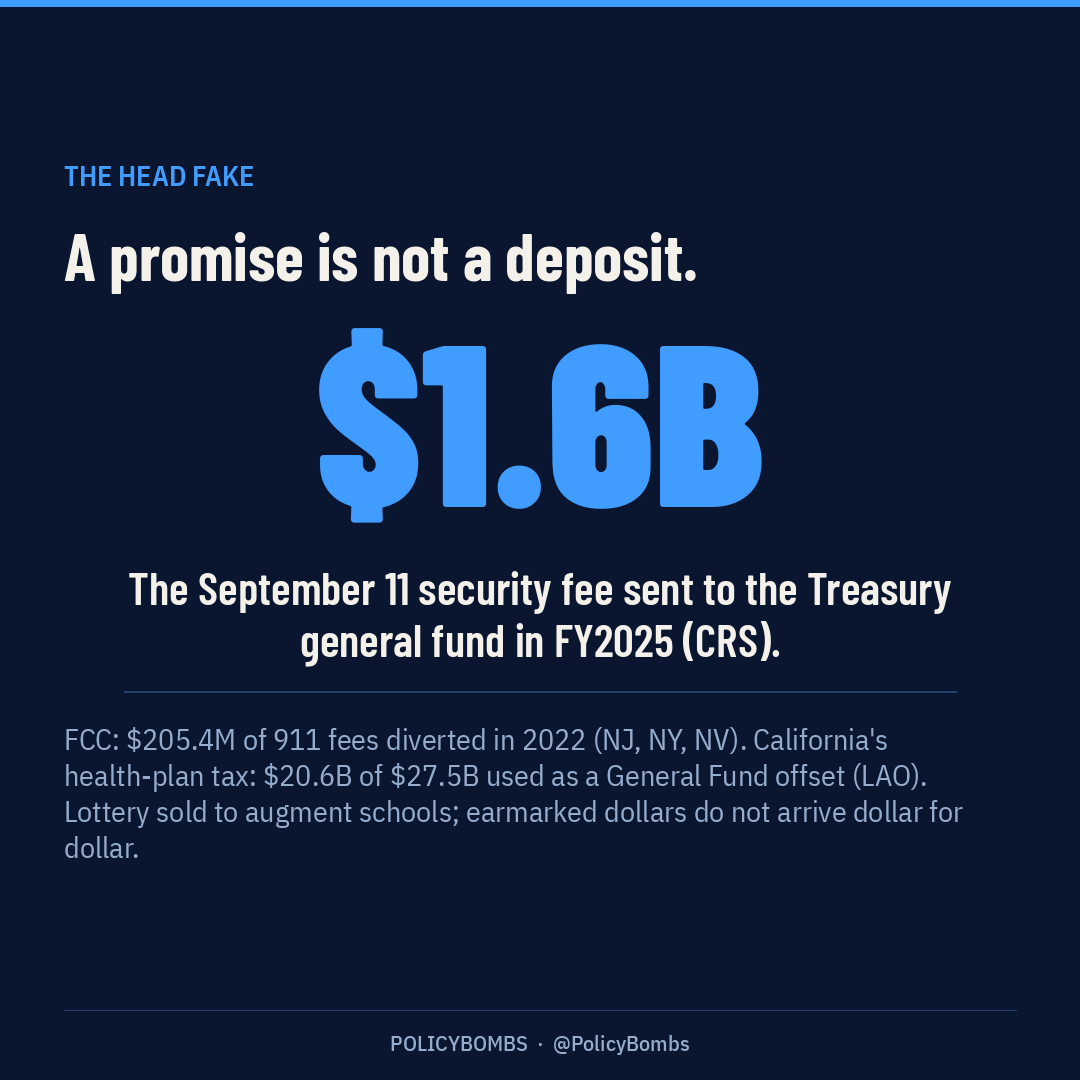
$1.6 billion. That’s the September 11 security fee sent to the Treasury general fund in fiscal year 2025 (CRS). All that glisters is not gold. A promise is not a deposit.
A tax named for the schools, for the roads, or for the call that is supposed to bring help, can glitter in the brochure and still spend like any other dollar in the treasury. What’s in a name? That which we call a 911 fee, a lottery for the kids, or a security charge after September 11, would by any other name still be a tax. The name is the pitch. The cash is the prize.
Lawmakers want a tax that sounds like a deposit. Budget offices want flexible cash. You wanted the thing you were billed for. Our inference, labeled as such: fungibility lets politicians pass a tax voters would reject for general spending, then spend it that way anyway. It is not a memo. It is the repeated official pattern.
The FCC found $205.4 million of 911 fees diverted in calendar year 2022, in New Jersey, New York, and Nevada (FCC). California was not on that list. California’s managed care organization tax, sold as supporting Medi-Cal, is used mostly as a budget plug: the Legislative Analyst’s Office (Report 5075) reports that the 2025-26 Budget Act plan uses $20.6 billion of $27.5 billion in net revenue through 2026-27 as a General Fund offset.
The California Lottery was sold in 1984 to augment, rather than substitute for, education. In fiscal year 2024-25 it declared $1.931 billion for the Education Fund, 20.6 percent of sales. Academic work finds that earmarked lottery dollars do not arrive dollar for dollar. Outstanding special-fund loans to California’s General Fund were $5.28 billion as of June 30, 2026 (Department of Finance).
Verdict: BAD. A dedicated promise treated as flexible cash is a broken contract with the payer, even when the paperwork is legal. Keep dedicated money dedicated, or tell the public the truth and raise a general tax. A promise is not a deposit.
PRO: Many California movements are loans with published interest and repayment dates, and some later uses are worthy on their own terms, including fire protection, transportation-bond debt, deficit reduction, and Medi-Cal itself. Legislatures have appropriation authority. Proposition 1 was a voter-approved rewrite, not a quiet sweep. SB 1’s parks slice is in the statute. Highway Trust Fund general-fund transfers are money into a dedicated fund, not out of it. Social Security special-issue securities are legal Treasury claims, not waste paper. The 1998 tobacco settlement legally compensated states for health costs, not for a CDC prevention floor.
CON / COST: The September 11 security fee sends $1.6 billion to the Treasury general fund in fiscal year 2025 (Bart Elias, CRS R48543). The FCC found $205.4 million of 911 fees diverted in calendar year 2022. California’s health-plan tax plan uses $20.6 billion of $27.5 billion as a General Fund offset (LAO Report 5075). The Lottery, pitched to augment education, does not arrive dollar for dollar. Bottle-bill deposits were owed $496.8 million at the end of 2009-10. Outstanding special-fund loans were $5.28 billion as of June 30, 2026.
SOCIETY: BAD. A fee sold for one cause and spent as flexible cash is a broken contract with the payer, even when the paperwork is legal. Those legal distinctions matter. They do not restore a 911 fee, a September 11 security fee, a recycling deposit, a truck fee, or a lottery ticket to the purpose that was sold to the public. Keep dedicated money dedicated, or tell the public the truth and raise a general tax.
Full analysis
Research cutoff: November 27, 2026 (America/Los_Angeles). This analysis tests a budget practice, not a single statute, and not the same question as PolicyBomb #95. #95 asks whether empathy, written into a tax, is a sound test of policy. This pack asks something narrower: when the public is told that a tax, a fee, a surcharge, a settlement, a bond, or a lottery will be spent on a named cause, is the money then spent on that cause, or is it swept, loaned, backfilled, supplanted, securitized, or left unspent?
Hook
All that glisters is not gold. A tax named for the schools, for the roads, for the call that is supposed to bring help, can glitter in the brochure and still spend like any other dollar in the treasury. What’s in a name? That which we call a 911 fee, a lottery for the kids, or a security charge after September 11, would by any other name still be a tax. The name is the pitch. The cash is the prize.
The crux
The fight is not over whether governments may tax, or even over whether a later use is worthy on its own terms. Fire protection is worthy. Paying down a deficit is a real task. Transportation-bond debt is still, in many years, a transportation bill. The fight is over a second promise. A dedicated tax is sold as a closed circuit: pay this and the named cause is funded. Once the cash exists, budget writers treat it as flexible money.
Who is for the later use, and what they gain. Legislatures and budget offices gain a tax that is easier to pass than a general levy, then a pot they can loan, backfill, or offset when the General Fund is short. Coalition groups that help sell the fee gain a win and a talking point, even when the net new spending is smaller than the pitch. Agencies with a hole to fill gain relief that does not require a new, honest tax. In California, Governor Gavin Newsom and the Legislature have signed special-fund loans and cap-and-trade plans that include high-speed rail funding and CalFire General Fund backfill. The 2011 Legislature, in AB 105, sent truck weight fees to transportation-bond debt after Proposition 22 limited a fuel-tax path. Congress, in the Bipartisan Budget Act of 2013 and later extensions, directed a slice of the September 11 security fee to the Treasury general fund. New Jersey, New York, and local governments in Nevada were named by the FCC for 911-fee diversion in calendar year 2022.
Who is against the later use, and what they gain. Voters, payers, and the named cause gain what they were billed for: a 911 system, a school dollar that is actually additional, a screening fee that screens, a recycling deposit that recycles. Officials and scorekeepers who tried to lock the bucket, or who published the diversion, include California voters in Proposition 22 (2010) and Proposition 69 (2018), which limited fuel-tax borrowing and sought to lock transportation taxes; then-Sen. Mark DeSaulnier (D), who authored SB 1418 (2014) to send weight fees back to highways (it did not become law); California voters in Proposition 35 (2024), who tried to lock a health-plan tax more tightly to Medi-Cal augmentations; Congress, which in the Great American Outdoors Act of 2020 made new Land and Water Conservation Fund collections permanent; and the FCC, which names 911 diverters and amounts each year.
The strongest case for the later use, stated fairly: many California movements are loans with published interest and repayment dates. Some later uses are worthy on their own terms. Legislatures have appropriation authority. A Budget Act loan can be legal. Some named cases are not silent raids: Proposition 1 was a voter-approved rewrite; SB 1’s parks slice is in the statute; Proposition 64’s 60/20/20 split held in the sources opened for the original pack and is not re-litigated here as a raid. An unspent fund, such as the Nuclear Waste Fund, still holds the cash. Highway Trust Fund transfers are general money going into a dedicated fund, not a raid of it. Social Security special-issue securities are legal Treasury claims, not waste paper. The 1998 tobacco settlement legally compensated states for health costs, not for a CDC prevention floor.
The case this pack tests: a dedicated pitch makes the tax easier to pass, then the cash is treated as flexible. Our inference, labeled as such: that is why the method persists. Fungibility lets politicians pass a tax voters would reject for general spending, reward coalition groups with a brochure, and dodge accountability when the named cause still comes up short. This is an inference from incentives and from the repeated official pattern documented below. It is not a memo, and it is not proof of any official’s private intent.
The record below is official. Counters are stated in the same sections, not buried. Figures are used only when an official or clearly labeled source was opened this run. Items without a confirmed dollar amount are marked Unverified or Pending and are kept off the live text.
1. What is the policy
There is no Act of Congress titled “The Head Fake.” The policy is a recurring method of public finance. A legislature or an agency sells a revenue stream as paying for a closed circuit: pay this 911 fee and 911 works; pay this security fee and screening is funded; buy this lottery ticket and the schools gain; pay this nuclear-waste fee and a repository is built; pay this bottle deposit and recycling is funded; pay this truck fee and the roads under the truck are funded. Later, in a budget act, a statute, or a quiet appropriation cap, the money is used for something else, or is not used for the promised thing at all.
Mechanisms, defined.
- A sweep takes dedicated cash for another use.
- A loan moves the cash, often with interest and a published repayment date. The dedicated program still cannot use the money while it is gone.
- A backfill uses dedicated money to free up General Fund cash, or uses general money to fill a dedicated hole.
- Supplantation replaces old general-purpose support with new dedicated money, so the new tax does not add what the public was told it would add. This is the quiet heart of the lottery story and of several California health taxes.
- Securitization sells a future dedicated stream for cash now, often spending today’s politics on tomorrow’s receipts.
- An unspent or unappropriated balance means the money was collected or credited and then left in the Treasury.
- A naming mismatch means the statute always split the money more broadly than the popular name.
- A voter-approved rewrite changes the split in public, on the ballot. That is not a silent raid, and this pack will not pretend otherwise.
Jurisdiction and scope. California, because the State Auditor, the Legislative Analyst’s Office, the Department of Finance, the State Treasurer’s office, and the Lottery’s audited statements publish loans, fees, and repayment schedules, and because recycling deposits, truck weight fees, the managed care organization tax, and the state lottery are living examples. Other states, where an official federal scorekeeper (the FCC) or a state transportation official chart exists. The federal government, where CRS, DOE, Treasury, SSA, and statute are clear. A 50-row inventory compiled for the original work is at https://docs.google.com/spreadsheets/d/1l56hBU2tx5cZUOIUJoUxrPVATBFhhD1UyqV_erBx6lc/edit.
What this is not. This pack does not argue that every dedicated tax is a fraud, or that every loan is a theft, or that money sitting in a trust fund has vanished. It does not treat a published statutory split as a later raid. It does not add the Highway Trust Fund’s general-fund transfers (money going into a dedicated fund) to a “raided” total. It does not treat Social Security special-issue securities as waste paper. It does not call the entire tobacco-settlement pot legally diverted from prevention. Those distinctions are the difference between a serious charge and a slogan.
2. Why it exists
Stated reasons. Budget offices describe special-fund loans as cash-management tools: the General Fund is short, a dedicated fund has a balance, the statute allows a loan, interest is estimated, and a repayment year is published. Transportation officials note that weight-fee money used for bond debt is still, in many years, paying for transportation projects, just older ones. Climate-auction managers can say high-speed rail and fire protection are climate-adjacent. Settlement lawyers can say the 1998 tobacco deal legally compensated states for health costs, not for a CDC prevention floor. Appropriators can say Congress has always had the power to decide when credited money is actually spent. Health departments can say a managed care tax that flows into Medi-Cal is still a health tax, even when it merely replaces General Fund support. Those defenses are real. They explain the paperwork. They do not restore the original pitch to the payer.
Our inference, labeled as such. Lawmakers prefer a named fee, a lottery, or a dedicated tax because it is easier to pass than a general tax. The payer is told the dollar is spoken for. Opposition is weaker when the brochure says “this pays for 911,” or “this pays for schools,” or “this pays for roads,” or “this pays for a waste dump.” Once the cash exists, budget writers want flexibility, especially when the General Fund or the deficit is tight. The earmark is a sales tool. The sweep, the loan, the backfill, the substitution, or the unspent balance is the later convenience. Fungibility is the hidden feature, not a bug. It lets a coalition pass a levy the public would reject if the pitch were “this will plug the general budget,” then spend as if that had been the pitch all along. This is an inference from incentives and from the repeated official pattern documented below. It is not a memo, and it is not proof of any official’s private intent.
The consent point. A tax already requires a justification. A dedicated tax adds a second promise: this particular dollar is for this particular cause. Breaking the second promise is a different wrong from collecting the tax in the first place. Democratic consent to a budget is not automatically consent to every later sweep of a fee that was sold as a closed circuit.
3. Realized effects
3A. The lottery sold for the schools
This is the head fake most people already suspect, and the official record bears the suspicion out, if not always with a single smoking-gun dollar.
State lotteries are sold as a painless tax for a beloved cause, usually public education. Alicia Hansen, writing for the Tax Foundation in October 2004, put the fiscal logic plainly: once the funds are transferred to state coffers, “they can be used in any way the legislature sees fit (even in states that ‘earmark’ lottery proceeds).” The majority of lottery states earmark profits for public education, she wrote, “but legislators are able to shuffle other funds so that lottery tax revenue supplants, rather than supplements, existing funds for education.” (Hansen, Tax Foundation Background Paper No. 46, October 1, 2004.)
Lucy Dadayan and Donald J. Boyd, in a January 2016 Rockefeller Institute of Government brief, described the same swap with budget-office clarity. “Despite earmarking, higher lottery revenue does not necessarily translate into increased state spending on dedicated purposes.” When lottery revenue is higher than expected, “states may be able to reduce nonlottery support for the dedicated program, freeing up funds for any purpose in the budget rather than increasing spending on the dedicated program.” (Dadayan and Boyd, “Powerball Fever: State Budget Bonanza? Or False Hopes?,” Rockefeller Institute of Government, January 2016.)
The academic literature, using state panel data, reaches a compatible finding and does not claim dollar-for-dollar addition. William N. Evans and Ping Zhang, in Education Finance and Policy (2007), rejected the hypothesis that education spending rises dollar for dollar with earmarked lottery profits. They found that 50 to 70 cents of an earmarked lottery dollar finds its way to local school districts, compared with about 30 cents in states that deposit lottery profits in the general fund. (Evans and Zhang, “The Impact of Earmarked Lottery Revenue on K-12 Educational Expenditures,” Education Finance and Policy 2, no. 1 [Winter 2007]: 40-73.) That is evidence of partial addition, and of substantial substitution. It is not a finding that the brochure’s promise was kept in full.
California is the local, audited case. Voters approved Proposition 37 in 1984, amending the California Constitution to authorize a statewide lottery. The Legislative Analyst’s Office, in an August 22, 1984, analysis for the Assembly Committee on Governmental Organization, stated the measure’s intent in words that could not be clearer: the funds made available for public education “are to be used to augment (rather than substitute for) funds already allocated for public education in California.” (Legislative Analyst’s Office, “Proposition 37: The California State Lottery Initiative,” August 22, 1984.)
What arrived, four decades later, is a large transfer and a smaller share. The California State Lottery’s audited Annual Comprehensive Financial Report for the fiscal year ended June 30, 2025, reports total operating revenues of $8,932,712,123 in fiscal year 2024-25, down 3.7 percent from $9,275,114,092 in fiscal year 2023-24. Allocation of sales to the Education Fund was $1,844,228,139, or 20.6 percent of operating revenues. Adding unclaimed prizes and related amounts, total funds declared for allocation to the Education Fund were $1,931,575,925. (California State Lottery, Annual Comprehensive Financial Report, Fiscal Year 2024-25.) The Legislative Analyst’s Office had already flagged the shrinking education share years earlier: while actual distributions to education increased, the percent of lottery sales revenue distributed to education fell from 34.7 percent in 2009-10 to 23.8 percent in 2017-18, as the prize share rose. (Legislative Analyst’s Office, “Overview of the California State Lottery,” August 21, 2019.)
This pack does not invent a California dollar figure for General Fund education aid withdrawn after the lottery began. That substitution amount is not published as a single official cumulative, and it is left Pending. The honest statement is this: the 1984 pitch was augmentation, not substitution. The economic literature says earmarked lottery dollars do not arrive dollar for dollar. The Lottery’s own audit shows a large education transfer and a 20.6 percent share of sales. A transfer into an education fund is not automatically a net new school dollar. That is the lottery head fake.
3B. Tobacco settlement money, sold as a public-health victory
In November 1998, 46 states, the District of Columbia, and five U.S. territories settled lawsuits against the major cigarette companies in the Master Settlement Agreement. The legal instrument compensated states for health costs associated with smoking, including Medicaid. It was not, in the contract, a mandate to spend a CDC-recommended amount on prevention. That distinction matters, and it will be repeated.
What the public heard, and what public-health groups still measure, is different. The Campaign for Tobacco-Free Kids, with the American Heart Association, the American Cancer Society Cancer Action Network, the American Lung Association, Americans for Nonsmokers’ Rights, and Truth Initiative, publishes an annual “Broken Promises to Our Children” report. For fiscal year 2026, that advocacy compilation, using a CDC benchmark, finds that states will collect $21.7 billion from tobacco settlement payments and tobacco taxes, and will spend $728.6 million on tobacco prevention and cessation programs, or 3.4 percent of that revenue, and less than a quarter (22 percent) of the $3.3 billion the CDC recommends for all states combined. Only Maine funds its program at the CDC-recommended level. Seventeen states are spending less than 10 percent of the CDC recommendation. (Campaign for Tobacco-Free Kids et al., “Broken Promises to Our Children,” FY2026, https://www.tobaccofreekids.org/state-report.) This pack treats those figures as a substantiated advocacy compilation against a CDC benchmark, not as a finding that the entire $21.7 billion was legally diverted from prevention.
States also monetized the future stream. Securitization sells tomorrow’s settlement payments for cash today. The California Debt and Investment Advisory Commission has described how California governments, like those in other settling states, issued bonds repaid from MSA payments, “backed by a stream of future payments to the public entity.” (California Debt and Investment Advisory Commission, “Issue Brief: Tobacco Securitization Bond Issuance in California,” CDIAC No. 08.04.) A complete official issuance total for the Golden State Tobacco Securitization Corporation, covering every refunding through the latest audited year, was not reconstructed as a single Treasurer figure this run and is left Pending. The mechanism is not in doubt: a public-health settlement became a financing tool for budgets now.
3C. 911 fees: the bill says emergency, the cash does not always
Phone bills carry a 911 or E911 surcharge sold as paying for emergency-call systems. The Federal Communications Commission’s Fifteenth Annual 911 Fee Report, covering calendar year 2022, found $205,401,927.93 diverted from $3,850,866,702.58 collected, about 5.33 percent. The named diverters were New Jersey, New York, and Nevada (local governments in Nevada). California was not on that diversion list. (Federal Communications Commission, Fifteenth Annual Report to Congress on State Collection and Distribution of 911 and Enhanced 911 Fees and Charges, December 29, 2023.) Under 47 U.S.C. 615a-1 and 47 C.F.R. Part 9, Subpart I, “diversion” means spending 911 fee revenue on anything other than the support and implementation of 911 services and the operational expenses of public-safety answering points.
A later, Seventeenth Annual Report, released February 13, 2026, and covering calendar year 2024, is listed by the FCC as the current report to Congress. Secondary accounts attribute to that report about $225.2 million diverted, again by Nevada, New Jersey, and New York. This revision attempted to open the official Seventeenth Annual Report PDF this run. The official file was not independently retrieved, so the later dollar amount is left Unverified and is not used as a live figure. The 2022 figure is official.
The concentration is the point. Most states did not divert. A few large ones did, year after year, while the fee still appeared on the bill as if it were a closed circuit for 911.
3D. The September 11 passenger security fee
Travelers have been told for two decades that a per-segment security fee pays for airport screening. The Aviation and Transportation Security Act, enacted after the attacks of September 11, 2001, created that fee to help pay for civil aviation security. After the Bipartisan Budget Act of 2013 (Public Law 113-67), and later extensions (including Public Laws 114-41 and 115-123), a specified slice of that fee is deposited in the Treasury general fund for deficit or debt reduction, not in TSA’s screening budget.
The Congressional Research Service records the statutory deposits as $1.6 billion in fiscal year 2025, $1.64 billion in 2026, and $1.68 billion in 2027. Remaining fees, after the general-fund deposit and a required $250 million deposit to the Aviation Security Capital Fund, offset TSA’s appropriation. (Bart Elias, coordinator, Transportation Security: Background and Issues for the 119th Congress, CRS Report R48543, May 23, 2025; 49 U.S.C. 44940.) The statute originally specified such general-fund amounts through fiscal year 2023. A 2014 TSA Federal Register rule implementing the 2013 Budget Act stated that the Act required stipulated amounts totaling $12.63 billion for fiscal years 2014 through 2023 to be deposited in the general fund. (Transportation Security Administration, “Adjustment of Passenger Civil Aviation Security Service Fee,” 79 Fed. Reg. 35463, June 20, 2014.) Those are statutory stipulated amounts, not an independently audited series of actual deposits, and this pack does not treat $12.63 billion as a verified cash total of dollars collected in every year of that window, including the pandemic collapse in air travel.
This is one of the cleanest head fakes in the federal record. The fee’s name is a national trauma. A slice of the cash is a deficit tool.
3E. California beverage container recycling deposits
Consumers pay a deposit so that cans and bottles come back, and so that recycling is funded. The California State Auditor has documented, more than once, that the Legislature used this fund as a bank for other parts of government. Report 2014-110, which this run re-opened, found that at the end of fiscal year 2009-10 the beverage program was owed $496.8 million by the General Fund and the Air Pollution Control Fund, equal to roughly 43 percent of that year’s program revenue. The General Fund began substantial repayments in 2010-11. By the end of 2013-14, about $82.3 million was still owed by the General Fund, and the Air Pollution Control Fund had repaid its loans. The Auditor warned that those repayments had “somewhat masked” the recycling program’s own weak finances. (California State Auditor, Report 2014-110.)
The habit did not end in 2014. The 2025-26 Governor’s Budget fund-condition statement for CalRecycle, cited in the original pack, shows a $100 million loan from the Beverage Container Recycling Fund to the General Fund under the Budget Act of 2023, and a $100 million loan repayment from the General Fund recorded in 2023-24 under Executive Order E 23/24-157. It also shows loans from the beverage fund to the California Circular Economy Fund to implement SB 54. A single official outstanding CRV-to-General-Fund balance for every year after 2013-14 was not reconstructed this run and is left Pending. The honest assessment is this: many of these loans were later repaid, including the 2023 loan, and interest can be part of the deal. A repaid loan is still a diversion in the year the recycling program cannot use its own cash. The public pays a deposit for recycling, not to fill a hole in the General Fund.
3F. California truck weight fees, after voters locked the gas tax
Weight fees are charged to heavy vehicles that use the roads. They historically flowed to the State Highway Account. The Legislative Analyst’s Office, in a January 24, 2017, transportation-funding handout re-opened this run, states that weight fees generate about $1 billion annually, and that since 2011 those fees have been used to offset a portion of debt service on transportation general-obligation bonds rather than remaining in the highway account. The 2016-17 budget used about $1 billion in weight fees for that offset. In years when weight-fee revenue exceeded eligible debt service, the rest was loaned to the General Fund; in the reverse years, those loans were to be repaid. (Legislative Analyst’s Office, “Overview of Transportation Funding,” January 24, 2017.) This pack does not invent a 15-year cumulative by multiplying that annual figure.
The origin of the shift matters. After the 2010 gas-tax swap, Proposition 22 (November 2010) limited the state’s ability to use fuel-tax revenues to pay certain bond debt and to borrow Highway Users Tax Account money. The Legislature’s response, in AB 105 (Chapter 6, Statutes of 2011), was to send vehicle weight fees to the Transportation Debt Service Fund to reimburse the General Fund. A 2014 Senate analysis of SB 1418 (DeSaulnier), which would have undone the diversion, described the same history: voters blocked one path, and lawmakers opened another. SB 1418 did not become the new rule. The fair counterpoint is that the bonds themselves often funded transportation projects, so this is not always money leaving transportation entirely. It is money that would have gone to current highway work being used instead to pay old transportation debt and to relieve the General Fund. The payers were still told, by the structure of the fee, that they were funding the roads under the trucks.
3G. California’s managed care organization tax: a health tax used as a budget plug
This is the current California giant, and it was too thin in the earlier draft.
For more than a decade, California has charged a tax on health plans, including Kaiser Permanente and Anthem Blue Cross, called the managed care organization (MCO) tax. In recent years it has been based on each plan’s monthly enrollment in Medi-Cal and in the commercial market. The Legislative Analyst’s Office explains the design: though each sector comprises around half of plans’ taxable enrollment, more than 99 percent of the MCO tax revenue comes from Medi-Cal enrollment, because the Medi-Cal tax rate is significantly higher (more than 150 times higher) than the commercial rate. Gross collections exceed $12 billion a year, but less than $8 billion in net revenue is available to the state, because Medi-Cal covers plans’ cost of paying the tax on Medi-Cal enrollment, with federal matching funds in the usual way. (Legislative Analyst’s Office, “The 2025-26 Budget: MCO Tax and Proposition 35,” Report 4992.)
The tax is deposited into special-fund accounts and spent on Medi-Cal. That sentence can be used as a defense, and it is literally true. The LAO is just as plain about what the design has actually done: “historically the state has used funds to pay for existing service levels in Medi-Cal. Using funds in this way meant that the state needed less money from the General Fund to pay for Medi-Cal services, freeing up General Fund support for other budget priorities.” That is supplantation with a health-care label.
In November 2024, California voters approved Proposition 35, which made the tax permanent and created new rules on how to spend the funds, with a larger claim for provider-rate augmentations. The 2025-26 Budget Act began implementing those rules. Even after that voter lock, the official multiyear plan still uses most of the money as a General Fund offset. The Legislative Analyst’s Office, in “The 2025-26 California Spending Plan: Health” (Report 5075, October 16, 2025), reports the 2025-26 Budget Act plan as follows (in billions of dollars):
| 2023-24 | 2024-25 | 2025-26 | 2026-27 | Totals | |
|---|---|---|---|---|---|
| Net revenue | 5.1 | 9.2 | 7.0 | 6.3 | 27.5 |
| General Fund offset | 5.1 | 8.5 | 4.2 | 2.8 | 20.6 |
| Augmentations used as a budget solution | 0 | 0 | 1.3 | 0.3 | 1.6 |
| Other augmentations | 0 | 0.7 | 1.5 | 3.2 | 5.4 |
Of $27.5 billion in net MCO-tax revenue through 2026-27, $20.6 billion is a General Fund offset, and another $1.6 billion of “augmentations” is scored as a budget solution. In 2025-26 alone, net revenue is $7.0 billion, the General Fund offset is $4.2 billion, and $1.3 billion of augmentations is used as a budget solution. The LAO further notes that the largest activity in the Proposition 35 augmentation plan is underlying growth in managed care costs, which the General Fund would otherwise have covered, and which the spending plan therefore also scores as a budget solution. A $145 million slice of the 2024-25 “General Fund offset” line was used to help cover Proposition 56 costs.
The fair counterpoint is that Medi-Cal is a health program, federal match makes the tax a high-yield fiscal device, and Proposition 35 did shift more money toward listed augmentations than the prior plan. None of that turns a General Fund offset into new health spending. A tax sold as supporting Medi-Cal can do so by replacing money the state was already going to spend. That is the head fake at full California scale.
3H. Proposition 56: a tobacco tax dedicated to Medi-Cal, then used two ways
California voters approved Proposition 56 in 2016, raising state taxes on tobacco products and dedicating most revenues to Medi-Cal on an ongoing basis, “to ensure timely access to quality care.” The Legislative Analyst’s Office, in a May 30, 2019, Budget Conference Committee handout re-opened this run, stated that Proposition 56 “currently provides about $1 billion annually to Medi-Cal,” and that the money had been used for two main purposes: augmenting the program, such as by increasing provider payments, and “offsetting General Fund spending on underlying cost growth in Medi-Cal.” (Legislative Analyst’s Office, “Proposition 56 Spending,” May 30, 2019.) A cumulative official General Fund-offset total across all years since 2017-18 was not reconstructed this run and is left Unverified. The mechanism is official: a tobacco tax sold for Medi-Cal access has been used, in part, as a General Fund substitute.
3I. Cap-and-trade dollars and CalFire backfill
Auction proceeds from California’s cap-and-trade (now cap-and-invest) program are sold to the public as climate funding. The Legislative Analyst’s Office, in an August 12, 2026, handout on the Greenhouse Gas Reduction Fund, using Department of Finance July 2026 revenue estimates, describes the 2026-27 expenditure plan under the SB 840 framework (Chapter 121, Statutes of 2025, Limon). Department of Finance estimated $2.731 billion in 2026-27 auction proceeds, down from $3.4 billion at the May Revision. The plan includes $1.000 billion for the High-Speed Rail Authority and, in total, $1.25 billion as a CalFire General Fund backfill ($750 million in Tier 2 plus $500 million in additional backfill), plus $92 million as a State Responsibility Area fee backfill. (Legislative Analyst’s Office, “GGRF Updates and Key Issues for Legislative Consideration,” August 12, 2026.)
High-speed rail is a climate-adjacent capital project. CalFire is fire protection. Both can be defended on the merits. Neither is what a voter is usually told a carbon auction is for when the pitch is “pay this so we cut emissions.” Using climate dollars to backfill the General Fund for firefighters is a budget choice. It should be named as a choice, not as proof that the original cause was funded.
3J. The special-fund loan book
Special-fund loans to the General Fund, budget-wide, are not hidden. They are reported to the Legislature under Government Code section 16320. The Department of Finance’s July 22, 2026, letter, signed for Director Joe Stephenshaw by Chief Deputy Director Erika Li, and re-opened this run, puts outstanding budgetary loans at $5,281,764,000, or $5.28 billion, as of June 30, 2026, at the 2026 Budget Act, plus $638,155,000, or $638.2 million, in estimated interest when the loans are fully paid, for a total outstanding amount of $5,919,919,000, or $5.92 billion. (California Department of Finance, report pursuant to Government Code section 16320, July 22, 2026.) The list is a tour of dedicated promises used as a bank: the AIDS Drug Assistance Program Rebate Fund ($500 million, due 2028-29), the Health Care Affordability Reserve Fund ($309 million), Underground Storage Tank Cleanup Fund loans, licensing and certification funds, childhood lead-poisoning funds, and a $755.6 million “various funds” line from the 2025 Budget Act with no repayment date yet assigned.
The official counterpoint, which is true as far as it goes, is that these are loans, not gifts, that interest is estimated, and that repayment dates are published. A raid that is later repaid is still a raid in the year the dedicated fund cannot use its own cash. These are snapshots of a loan book, not totals to be added across years.
3K. Proposition 63, rewritten in public by Proposition 1
In 2004, California voters approved Proposition 63, the Mental Health Services Act, a tax on incomes over $1 million a year, required to be used for mental health services. The tax typically raises between $2 billion and $3.5 billion each year. Under the original act, at least 95 percent of the money went to counties, with the rest to the state. (Legislative Analyst’s Office, official ballot analysis of Proposition 1, March 5, 2024 election.)
Proposition 1, approved by voters in March 2024, did not change the tax. It changed the split and the allowed uses, and it authorized $6.38 billion in bonds for treatment facilities and housing, with estimated General Fund repayment costs of about $310 million annually for 30 years. The state’s share of the millionaire’s tax rose from 5 percent to 10 percent. The Legislative Analyst estimated a shift of roughly $140 million annually of existing mental-health tax revenue from counties to the state, an amount that would be higher or lower depending on collections. Counties would be required to spend more of their remaining share on housing and personalized support, leaving less Mental Health Services Act money for other mental health services. (Legislative Analyst’s Office, Proposition 1 ballot analysis, March 2024.)
This is not a silent raid. Voters rewrote the dedicated tax in public. This pack will not pretend otherwise. It is still a lesson in the head fake’s life cycle: a tax sold in 2004 for county mental health services was, twenty years later, partly redirected, on the ballot, toward a different mix of housing, workforce, and state-run uses. A public rewrite is more honest than a quiet sweep. It is also proof that a dedicated promise can be revised when the original coalition is no longer the one writing the brochure.
3L. SB 1 and the gas tax: what held, and what came before
The Road Repair and Accountability Act of 2017 (SB 1) raised gasoline and diesel taxes and vehicle fees and was sold as a roads-and-transit package. The California State Auditor, Report 2023-124, Table 1, April 2024, re-opened this run, reports an estimated average of $5.247 billion a year in SB 1 revenue. Of that, $1.900 billion (36.2 percent) is for state highway maintenance and rehabilitation, and $1.500 billion (28.6 percent) is for the Local Streets and Roads Program. Combined with other state and local road and corridor programs, a large majority still goes to highways and local streets. Transit operations and capital improvement receive $750 million (14.3 percent). Parks, off-highway vehicle, boating, and agricultural programs receive $80 million a year, or 1.5 percent. (California State Auditor, Report 2023-124, Table 1, April 2024; figures are the California Transportation Commission’s yearly average of expected revenues over the first ten years of SB 1, and actual amounts may vary.)
The parks slice is in the statute. This pack will not treat a published 1.5 percent statutory allocation as a later raid of a roads tax. The earlier history is the better warning. Fuel taxes had been borrowed and swapped often enough that voters passed Proposition 22 in 2010 to limit those practices, and later sought further transportation-tax protections, including Proposition 69 in 2018. After one door closed, weight fees became the path, as section 3F shows. A tax that mostly still goes to roads can sit beside a related fee that does not. That is how the method adapts.
3M. Texas State Highway Fund: the road fund that still pays other agencies
Texas offers a clean, current, official chart, not a historical rumor. The Texas Department of Transportation’s “Distribution of Total State Highway Fund Receipts,” for the fiscal year ended August 31, 2024, reports total State Highway Fund receipts of $16.890 billion and total disbursements of $19.185 billion. Of those disbursements, $560.9 million, or 3 percent, went to “Other Agency Expenditures/Transfers”: $434.3 million in other agency expenditures and $126.6 million in transfers to other agencies. (Texas Department of Transportation, FY2024 State Highway Fund receipts and disbursement chart.) This pack does not invent a pre-2015 cumulative. It does not need to. In fiscal year 2024, a dedicated highway fund still sent more than half a billion dollars to other agencies. The share is small. The mechanism is not imaginary.
3N. The Nuclear Waste Fund: paid in, repository not open
Ratepayers on nuclear-generated electricity paid a fee so the federal government would take the spent fuel and build a permanent repository. The Department of Energy’s FY2025 Nuclear Waste Fund Annual Financial Report Summary, opened this run, states a current balance of $51.435 billion (fund balance with Treasury and investments and related interest, net, plus unexpended or undisbursed appropriations). Cumulative income through fiscal year 2025 is $62.942 billion. Cumulative expenditures are $11.513 billion, including $7.530 billion for first-repository costs (Yucca Mountain and other first-repository activities). (U.S. Department of Energy, Nuclear Waste Fund Annual Financial Report Summary, FY2025.) Yucca Mountain is not an operating repository. The cash remains in the fund. This is not a sweep. It is a broken delivery: the fee was collected, the project was not finished, and tens of billions sit in the Treasury while the waste sits at the plants.
3O. The Land and Water Conservation Fund, until Congress locked new money
The Land and Water Conservation Fund was created in 1965 to finance outdoor recreation, including federal land acquisition and state matching grants, credited mainly from offshore oil and gas receipts. For decades, Congress credited the money and then appropriated only part of it. The Congressional Research Service, in Land and Water Conservation Fund: Overview, Funding History, and Issues, RL33531, updated June 19, 2019, and re-opened this run, reports that from fiscal year 1965 through fiscal year 2019 about $40.9 billion was credited to the fund and $18.9 billion was appropriated, leaving an unappropriated balance of approximately $22.0 billion. (Carol Hardy Vincent, CRS Report RL33531, June 19, 2019.) The Great American Outdoors Act of 2020 later made $900 million a year in new funding permanent. An unappropriated balance is not a vanished dollar. It is a credited dollar that was not spent on the cause used to justify the credit. That, too, is a head fake, and Congress eventually narrowed it for new collections.
3P. Social Security: the official unified-budget mechanism, not a vanished fund
Social Security is the largest dedicated revenue stream in American life, and it is the case most often oversold as a “raid.” This pack will not oversell it.
The 2025 Annual Report of the Board of Trustees of the Federal Old-Age and Survivors Insurance and Federal Disability Insurance Trust Funds, Table II.B1, reports combined OASDI reserves of $2,721.5 billion at the end of calendar year 2024, down $67.0 billion on the year, with $2,538.3 billion in the OASI Trust Fund and $183.2 billion in the DI Trust Fund. Benefit payments were 99.1 percent of cost. (Board of Trustees, 2025 OASDI Trustees Report, Section II.B, Table II.B1, https://www.ssa.gov/oact/TR/2025/II_B_cyoper.html.)
By law, trust-fund income is invested in special-issue Treasury securities, available only to the trust funds, redeemable at face value, and backed by the full faith and credit of the United States. The Social Security Administration’s own Trust Fund FAQs, opened this run, state the unified-budget fact without euphemism: “Tax income is deposited on a daily basis and is invested in ‘special-issue’ securities. The cash exchanged for the securities goes into the general fund of the Treasury and is indistinguishable from other cash in the general fund.” The same FAQ rejects the claim that the securities are “worthless IOUs.” The government has always repaid Social Security, with interest. The Social Security Act limits trust-fund expenditures to benefits and administrative costs. (Social Security Administration, “Trust Fund FAQs,” https://www.ssa.gov/OACT/ProgData/fundFAQ.html.)
The honest head-fake point is narrower than the slogan. Surplus payroll taxes were not stored as a pile of cash in a lockbox. They financed other government spending and were replaced with legal claims on future taxpayers. Those claims are real. They are also a promise that a later Congress and a later set of taxpayers must keep, at a time when combined reserves are already falling. Calling the securities worthless is false. Calling the system a hermetically sealed lockbox is also false. SSA has said as much, in official English.
3Q. The Highway Trust Fund: a bailout, not a raid, with a wider purpose than the 1956 pitch
The federal gasoline tax was sold, from the Interstate era forward, as a user fee for highways. The honest complication is the opposite of a classic raid. Motor-fuel taxes have not covered authorized highway and transit spending, so Congress has transferred general-fund money into the Highway Trust Fund, repeatedly, since 2008.
The Congressional Research Service, in Funding and Financing Highways and Public Transportation Under the Infrastructure Investment and Jobs Act, R47573, Table 2, re-opened this run, reports general-fund transfers totaling $271.527 billion ($211.385 billion to the Highway Account and $60.142 billion to the Mass Transit Account), plus $3.700 billion from the Leaking Underground Storage Tank Trust Fund, for total transfers of $275.227 billion. The single largest transfer is $118 billion under the Infrastructure Investment and Jobs Act (Public Law 117-58). (William J. Mallett, CRS Report R47573, updated April 14, 2026.) Those transfers kept checks from bouncing. They are not a raid of the trust fund. This pack will not add them to a “diverted” total.
Two related points still belong in the story. First, the 1956 pitch was highways; later statutes dedicated a share of fuel taxes to mass transit, which is a broader purpose than the original brochure, even when it is written into law. Second, a user-fee fund that cannot pay its bills, and that lives on general-fund infusions, is a warning about dedicated taxes that are not set to cover the promise. A short fund can be as misleading as a raided one. It is a different failure, and it should be named as a different failure.
3R. Negative findings, stated for credibility
Not every popular example is a silent raid, and this pack will say so.
- Proposition 64’s cannabis-tax split, in the sources opened for the original pack, held as a published 60/20/20 allocation. It is not treated here as a later diversion.
- SB 1 still sends the large majority of its estimated average revenue to state highways and local roads. The $80 million (1.5 percent) parks, off-highway, boating, and agriculture slice is statutory. (California State Auditor, Report 2023-124, Table 1.)
- Proposition 1 was a voter-approved rewrite of Proposition 63, not a quiet sweep. (Legislative Analyst’s Office, March 2024 ballot analysis.)
- California was not an FCC 911-fee diverter in calendar year 2022. (FCC, Fifteenth Annual 911 Fee Report.)
- Highway Trust Fund general-fund transfers are money into a dedicated fund, not out of it. (CRS R47573.)
- Social Security special-issue securities are legal Treasury securities, not waste paper. (SSA, Trust Fund FAQs; 2025 Trustees Report.)
- The Nuclear Waste Fund balance is still in the fund. (DOE, FY2025 NWF summary.)
- The Land and Water Conservation Fund’s new collections were later made permanent by the Great American Outdoors Act of 2020.
- Measure ULA, San Francisco Proposition C, and Regional Measure 3 are not documented in this revision as classic off-purpose sweeps with official diversion dollars, and are not used as live examples.
3S. Related, and easy to confuse, but not the same
A dedicated fund can fail in more than one way. A raid, a loan, a substitution, an unspent balance, and a short fund that needs a bailout are different mechanisms. The Crime Victims Fund’s obligation cap (a CHIMP, or change in mandatory programs) is a real appropriations mechanism that can leave collections unspent for victims’ programs and produce budget-score savings. A current official dollar amount for the cap in fiscal years 2025 and 2026 was not independently confirmed from a CRS or appropriations PDF opened this run and is left Unverified. The Harbor Maintenance Trust Fund has a long official history of collections running ahead of spending; a current Treasury Combined Statement balance was not cleanly extracted this run and is left Unverified. Neither mechanism is used here as a live dollar lead.
3T. How to talk about the totals, without double counting
This pack will not add every figure in this report into one “head fake grand total.” The cases overlap in time, use different mechanisms, and sometimes point in opposite directions (a raid versus a bailout). The 2026 California special-fund loan book is a snapshot, not a flow. The MCO-tax General Fund offset, the Proposition 56 offset, and Medi-Cal spending more generally can describe related dollars in the same budget and must not be stacked as if they were separate piles of cash. Tobacco-settlement collections and tobacco-tax collections are combined in the Campaign for Tobacco-Free Kids $21.7 billion figure; that figure is not a legal diversion total. Lottery education transfers are not net new school spending. Where this pack uses a number, it uses it inside its own case.
3U. Counters, stated plainly
- Many California movements are loans with published interest and repayment dates. Some, including a $100 million 2023 bottle-bill loan, have been recorded as repaid.
- Some later uses are worthy on their own terms (fire protection, transportation-bond debt, deficit reduction, Medi-Cal itself).
- Legislatures have appropriation authority. A Budget Act loan can be legal. Legality is not the same as keeping the original promise to the payer.
- Some named cases are voter-approved rewrites or statutory splits that were always broader than the slogan.
- The tobacco settlement legally compensated states for health costs. The prevention shortfall is a political and public-health promise, plus a CDC benchmark, not a uniform legal mandate.
- The Nuclear Waste Fund balance is still in the fund. The Land and Water Conservation Fund’s new collections were later made permanent. Highway Trust Fund transfers kept checks from bouncing. Social Security special issues are legal Treasury securities.
4. Good or bad for society
Verdict: BAD.
A fee sold for one cause and spent as flexible cash is a broken contract with the payer, even when the paperwork is legal. A free people can be asked to pay a general tax, and can be told the truth about a deficit. What they should not be asked to do is pay a 911 fee, a September 11 security fee, a nuclear-waste fee, a bottle deposit, a truck fee, or a lottery ticket on the promise that the dollar is spoken for, and then watch that dollar used to plug a general hole, replace money that would have been spent anyway, pay old debt, or sit in the Treasury while the promised project is not built.
The collection is easier because the pitch is specific. The later use is easier because the cash is already in hand. Our inference, again: that is why the method persists. Fungibility is the feature. The brochure is the bait.
The legal ledger has mixed entries, and this pack will not flatten them. Loans can be repaid with interest. Voters can rewrite a dedicated tax in public, as they did with Proposition 1. A statute can always have allocated a slice to parks, as SB 1 did. A settlement can legally be compensation for health costs rather than a prevention mandate. An unspent fund can still hold the cash. Social Security’s special issues are real claims. Those distinctions are required by the evidence. They do not restore the original promise, and they do not make the September 11 fee’s general-fund deposit, or the FCC’s $205.4 million in diverted 911 fees, or $20.6 billion in MCO-tax General Fund offsets, into something other than a broken or diluted pitch.
Keep dedicated money dedicated, or tell the public the truth and raise a general tax. A promise is not a deposit.
Strongest counterarguments
First, legality and cash management: if the statute allows a loan, and interest and a repayment date are published, calling it a “raid” overstates the charge. Answer: the charge is not that every movement is theft. The charge is that the payer was sold a closed circuit and did not get one in the year the cash was gone.
Second, worthy later uses: firefighters, Medi-Cal, deficit reduction, and old transportation bonds are not scandals merely because the original brochure was narrower. Answer: a worthy use can still be funded by an honest tax. The head fake is the method of sale, not a finding that fire protection is worthless.
Third, addition versus labeling: some earmarked dollars do add something (Evans and Zhang’s 50 to 70 cents; Proposition 35’s listed augmentations; SB 1’s road share). Answer: partial addition is not the pitch. The pitch was the cause. Fifty to seventy cents on the dollar is a grade, not a defense of the brochure.
Fourth, lockboxes sometimes work: the Great American Outdoors Act, Proposition 22, Proposition 69, and Proposition 35 are attempts to make the promise stick. Answer: those attempts are evidence for the diagnosis. People do not pass lockbox measures if the closed circuit was already being honored.
What a good policy would include
A serious dedicated-revenue rule would do at least the following, with official estimates attached where they exist and Unverified labels where they do not.
1. Tell the truth in the name and in the ballot label. If a slice of a September 11 security fee will go to the Treasury general fund, say so on the fee itself. If a lottery may substitute for General Fund school aid, say so in the brochure.
2. Publish a substitution account. For every earmarked tax, the budget office should show the general-fund (or equivalent) baseline before and after the earmark, so the public can see net addition, not just the transfer into a named fund. No official California lottery-substitution cumulative was found this run (Pending).
3. Ban, or publicly vote, sweeps and loans of emergency and consumer deposits. A 911 fee, a bottle deposit, and a victim-compensation assessment are the worst funds to treat as a bank.
4. If a loan is unavoidable, make repayment senior, short, and automatic, with published interest, and with the dedicated program made whole in the same fiscal year if possible.
5. Constitutional or statutory lockboxes where the public was sold a closed circuit, with a recorded vote to unlock, as voters attempted with Proposition 22, Proposition 69, and Proposition 35, and as Congress did for new Land and Water Conservation Fund collections in 2020.
6. An annual auditor scorecard of dedicated funds: pledged purpose, collections, uses, loans outstanding, and net addition versus the prior baseline. California already publishes Government Code section 16320 loan letters. That model should be the floor, not the exception, and it should include substitution, not only loans.
7. Do not securitize a public-health settlement to spend tomorrow’s receipts on today’s general budget without a public accounting of what was sold and what remains for the named harm.
This pack does not invent savings or revenue estimates for those rules. Where a score does not exist, the item is Unverified as to fiscal effect and is still recommended as a governance rule.
Eligibility and who uses the programs
The head fake is a method of public finance, not a benefits program with an eligibility test. The payers are the people charged the fee, the tax, the surcharge, the deposit, or the lottery ticket: drivers and truckers, air travelers, phone subscribers, ratepayers, tobacco buyers, health-plan enrollees (with costs that can be passed through), and lottery players. Lottery play is well established in the fiscal literature as a regressive implicit tax (Hansen, Tax Foundation, 2004). This pack does not invent a payer-by-citizenship table, because these instruments are not administered on that basis. Where a dedicated stream later funds a benefits program (Medi-Cal, mental health, schools), eligibility follows that program’s rules, which are outside this pack’s charge except as context for the MCO tax and Proposition 56 offsets.
Fiscal sustainability and integrity
Dedicated promises that are quietly made flexible hide the true size of the general budget problem. California’s 2026 Budget Act still carries $5.28 billion in outstanding special-fund loans, plus estimated interest, while using $4.2 billion of 2025-26 MCO-tax net revenue as a General Fund offset (Department of Finance, July 22, 2026; Legislative Analyst’s Office, Report 5075). Federally, a September 11 security fee that deposits $1.6 billion a year in the general fund (CRS R48543) and a Highway Trust Fund that has required $271.527 billion in general-fund transfers (CRS R47573) are two faces of the same honesty problem: either the dedicated fee is too useful as general cash, or it is too small for the promise. Social Security’s combined reserves fell by $67.0 billion in 2024, to $2,721.5 billion (2025 Trustees Report). The special-issue securities are real claims. They are also future tax or borrowing pressure. A government that sells closed circuits while running open-ended general deficits is using trust as a financing tool.
Politicians and public figures for and against
Enacted or administered the later use, or the flexible design: Gov. Gavin Newsom and the California Legislature (special-fund loans; cap-and-trade / SB 840 expenditure plans that include high-speed rail and CalFire General Fund backfill; administration of the MCO tax and Proposition 35 spending plan). The 2011 Legislature and AB 105 (weight-fee path after Proposition 22). Congress in the Bipartisan Budget Act of 2013 (Public Law 113-67) and later extensions (Public Laws 114-41 and 115-123), for the September 11 fee’s general-fund deposit. New Jersey, New York, and local governments in Nevada, named by the FCC for 911-fee diversion in calendar year 2022. State legislatures and governors, across decades, who treated lottery profits and tobacco-settlement payments as fungible budget cash.
Tried to lock the bucket, or published the diversion: California voters in Proposition 22 (2010), Proposition 69 (2018), and Proposition 35 (2024). Then-Sen. Mark DeSaulnier (D), SB 1418 (2014), which did not become law. Congress in the Great American Outdoors Act of 2020. The FCC, which is required by 47 U.S.C. 615a-1 to report 911-fee diversion annually. The California State Auditor, the Legislative Analyst’s Office, the Department of Finance (Government Code section 16320 letters), the Texas Department of Transportation (highway-fund charts), CRS, DOE, and SSA, whose official accounts make the method visible.
Gaps and Unverified items
- FCC Seventeenth Annual 911 Fee Report (calendar year 2024) diversion dollars: the report exists (released February 13, 2026), but the official PDF was not independently opened this run. Live text uses the Fifteenth Annual Report (calendar year 2022) figures only.
- An independently audited, year-by-year total of actual September 11 fee deposits to the Treasury general fund, as distinct from statutory stipulated amounts (including the $12.63 billion stipulated for fiscal years 2014-2023 in the 2014 TSA rule).
- A complete official Golden State Tobacco Securitization Corporation issuance and refunding total through the latest audited year.
- A complete CRV outstanding-loan series after 2013-14.
- A cumulative official Proposition 56 General Fund-offset total.
- An official California (or other state) dollar total for General Fund education aid withdrawn after a lottery earmark (the substitution amount).
- Current official Crime Victims Fund obligation-cap / CHIMP dollars.
- A cleanly extracted current Harbor Maintenance Trust Fund Treasury Combined Statement balance.
- An official pre-2015 Texas State Highway Fund non-highway cumulative. (Fiscal year 2024’s $560.9 million is official and is used instead.)
References
- Alicia Hansen, Lotteries and State Fiscal Policy, Tax Foundation Background Paper No. 46 (October 1, 2004), https://taxfoundation.org/research/all/state/lotteries-and-state-fiscal-policy/.
- Lucy Dadayan and Donald J. Boyd, “Powerball Fever: State Budget Bonanza? Or False Hopes?,” Rockefeller Institute of Government, January 2016, https://rockinst.org/wp-content/uploads/2018/02/2016-01-By_Numbers_Brief_No3.pdf.
- William N. Evans and Ping Zhang, “The Impact of Earmarked Lottery Revenue on K-12 Educational Expenditures,” Education Finance and Policy 2, no. 1 (Winter 2007): 40-73, https://doi.org/10.1162/edfp.2007.2.1.40.
- Legislative Analyst’s Office, “Proposition 37: The California State Lottery Initiative,” analysis for the Assembly Committee on Governmental Organization, August 22, 1984, https://lao.ca.gov/reports/1984/proposition_37_the_california_state_lottery_initiative.pdf.
- Legislative Analyst’s Office, “Overview of the California State Lottery,” August 21, 2019, https://lao.ca.gov/handouts/crimjust/2019/State-Lottery-Overview-082119.pdf.
- California State Lottery, Annual Comprehensive Financial Report, Fiscal Year 2024-25, https://static.www.calottery.com/-/media/project/calottery/pws/pdfs/financial-reports-etc/acfr-fy-2024-25-audited-ada.pdf.
- Campaign for Tobacco-Free Kids, American Heart Association, American Cancer Society Cancer Action Network, American Lung Association, Americans for Nonsmokers’ Rights, and Truth Initiative, “Broken Promises to Our Children,” fiscal year 2026, https://www.tobaccofreekids.org/state-report.
- California Debt and Investment Advisory Commission, “Issue Brief: Tobacco Securitization Bond Issuance in California,” CDIAC No. 08.04, https://www.treasurer.ca.gov/sites/default/files/2025-10/tobacco_0.pdf.
- Federal Communications Commission, Fifteenth Annual Report to Congress on State Collection and Distribution of 911 and Enhanced 911 Fees and Charges, December 29, 2023; FCC 911 Fee Reports page (including the Seventeenth Annual Report, February 13, 2026, listed but not independently opened this run), https://www.fcc.gov/general/911-fee-reports.
- Bart Elias, coordinator, Transportation Security: Background and Issues for the 119th Congress, Congressional Research Service, R48543, May 23, 2025, https://www.congress.gov/crs-product/R48543.
- 49 U.S.C. 44940; Bipartisan Budget Act of 2013, Public Law 113-67.
- Transportation Security Administration, “Adjustment of Passenger Civil Aviation Security Service Fee,” 79 Fed. Reg. 35463 (June 20, 2014), https://www.federalregister.gov/documents/2014/06/20/2014-14488/adjustment-of-passenger-civil-aviation-security-service-fee.
- California State Auditor, Report 2014-110, https://information.auditor.ca.gov/pdfs/reports/2014-110.pdf.
- Legislative Analyst’s Office, “Overview of Transportation Funding,” January 24, 2017, https://lao.ca.gov/handouts/Transportation/2017/Overview-of-Transportation-Funding-012417.pdf.
- Legislative Analyst’s Office, “The 2025-26 Budget: MCO Tax and Proposition 35,” Report 4992, https://www.lao.ca.gov/Publications/Report/4992.
- Legislative Analyst’s Office, “The 2025-26 California Spending Plan: Health,” Report 5075, October 16, 2025, https://www.lao.ca.gov/Publications/Report/5075.
- Legislative Analyst’s Office, “Proposition 56 Spending,” May 30, 2019, https://lao.ca.gov/handouts/Conf_Comm/2019/Proposition-56-Spending-053019.pdf.
- Legislative Analyst’s Office, “GGRF Updates and Key Issues for Legislative Consideration,” August 12, 2026, https://www.lao.ca.gov/handouts/resources/2026/GGRF-Updates-and-Key-Issues-for-Leg-Consideration.pdf.
- California Department of Finance, report pursuant to Government Code section 16320, July 22, 2026 (Joe Stephenshaw, Director, by Erika Li, Chief Deputy Director), https://dof.ca.gov/media/docs/budget/budget-reports-and-analyses/GC-16320-Letter.pdf.
- Legislative Analyst’s Office, official ballot analysis of Proposition 1 (March 5, 2024), https://lao.ca.gov/BallotAnalysis/Proposition?number=1&year=2024.
- California State Auditor, Report 2023-124, Table 1, April 2024, https://www.auditor.ca.gov/wp-content/uploads/2024/04/2023-124-Table-1.pdf.
- Texas Department of Transportation, “Distribution of Total State Highway Fund Receipts,” fiscal year ended August 31, 2024, https://www.txdot.gov/content/dam/docs/division/fin/coin-charts/fy24-distribution-shf-receipts-disbursement.pdf.
- U.S. Department of Energy, Nuclear Waste Fund Annual Financial Report Summary, FY2025, https://www.energy.gov/documents/fy-2025-nwf-annual-financial-report-summary.
- Carol Hardy Vincent, Land and Water Conservation Fund: Overview, Funding History, and Issues, Congressional Research Service, RL33531, updated June 19, 2019, https://www.congress.gov/crs-product/RL33531.
- Board of Trustees, Federal Old-Age and Survivors Insurance and Federal Disability Insurance Trust Funds, 2025 Annual Report, Section II.B, Table II.B1, https://www.ssa.gov/oact/TR/2025/II_B_cyoper.html.
- Social Security Administration, “Trust Fund FAQs,” https://www.ssa.gov/OACT/ProgData/fundFAQ.html.
- William J. Mallett, Funding and Financing Highways and Public Transportation Under the Infrastructure Investment and Jobs Act, Congressional Research Service, R47573, updated April 14, 2026, Table 2, https://www.congress.gov/crs-product/R47573.
- PolicyBombs #95, Suicidal empathy: compassion by law, for the separate issue of compassion imposed by tax. It is not a source for the figures in this pack.
PolicyBombs · Policy #96. Follow @PolicyBombs on X.