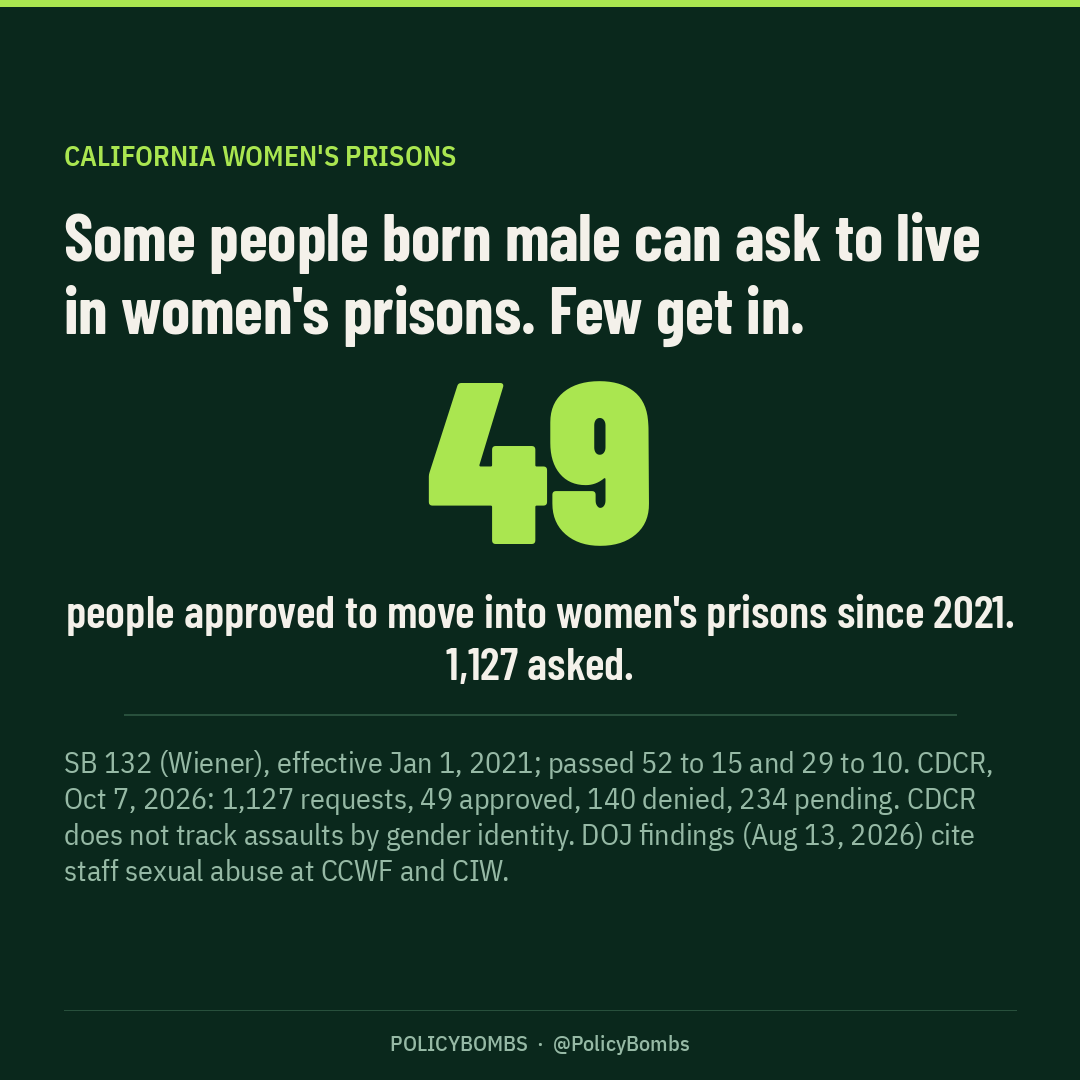
49. That’s how many people California has approved to move from men’s prisons into women’s prisons under its 2021 trans housing law. 1,127 asked. 234 are still waiting.
The law is SB 132, by Sen. Scott Wiener. You self-identify as transgender, non-binary or intersex. No surgery. No hormones. A warden’s committee reviews it. It can say no for security reasons, but it can’t say no because of your anatomy.
To be fair to CDCR: it says no a lot. About 3 out of 4 decided requests get denied. The 36 approved people still in prison are about 1% of the 3,585 women in custody.
Now the number that matters most. How many assaults on women by transferred inmates? CDCR’s answer, in writing: its systems “do not track assaults by gender identity.”
So when the state says this is safe, it can’t show you.
What we do know: one of the first transfers, a three-strikes inmate, was charged with two counts of forcible rape over an alleged Jan. 30, 2024 attack at the Central California Women’s Facility. The case is pending. A status recheck on November 11, 2026 (PST) found no verdict.
The other side has a real point too. In the federal inmate survey, 39.9% of transgender prisoners reported sexual victimization. Men’s prisons are dangerous for them.
And the abuse the feds actually documented? Staff. An Aug. 13, 2026 DOJ report found a pattern of staff sexual abuse at CCWF and CIW: 375+ allegations in two and a half years, 320 lawsuits.
A 2025 Republican bill to create separate secure housing died in committee, 1 to 4.
Verdict: MIXED, leaning BAD. The goal is legit. The safeguards and the data aren’t. Count the assaults, bar sex offenders, and fix the staff abuse first.
PRO: Addresses documented danger: 39.9% of transgender state and federal prisoners reported sexual victimization (BJS NIS 2011 to 2012), 33.2% by another inmate. CDCR approved only 49 of 1,127 requests (about 26% of 189 decided); 3 moved back involuntarily. Approved people still in custody (36) are about 1.0% of 3,585 women in custody.
CON / COST: Self-identification; no surgery or hormones required; denials cannot be based on anatomy. CDCR does not track assaults by gender identity. Pending forcible rape charges against an early SB 132 transfer (alleged Jan 30, 2024, CCWF). 234 requests pending (about 6.5% of the women’s population). Ninth Circuit appeal and DOJ civil-rights investigation (Mar 26, 2026) pending.
SOCIETY: MIXED, leaning BAD as implemented: legitimate goal, narrow approvals, but no incident data and no bright-line exclusions; the biggest documented abuse problem in these prisons is staff (DOJ, Aug 13, 2026).
Full analysis
Content checked November 9, 2026 (PST). A status recheck of the Carroll case on November 11, 2026 (PST) found no verdict; the charges remain allegations. This is a separate PolicyBomb from Day 22 (Inmate Gender Transitions).
Finding tags: Substantiated = supported by the cited source; Pending = not final; Cleared = a specific claim is contradicted by the evidence.
Executive finding
MIXED, leaning BAD as implemented. SB 132 addresses a real, documented danger to transgender prisoners in men’s prisons. CDCR has applied it narrowly: 49 approvals out of 1,127 requests since 2021, with 36 approved people still in custody, about 1% of the women’s prison population. But the law relies on self-identification, prohibits denials based on anatomy, and the state does not track assaults by the gender identity of the aggressor, so it cannot show that women are safe. One SB 132 transfer faces pending rape charges. The best-documented sexual-abuse problem in California’s women’s prisons, per a federal findings report, is staff abuse. [1,2,5,9]
Question 1. What is the policy?
Provisions
- Statute: SB 132 (Wiener), the Transgender Respect, Agency and Dignity Act, effective January 1, 2021. It added Penal Code sections on asking incoming prisoners their gender identity and pronouns, and on housing and search preferences. [2,6]
- Who qualifies: anyone in CDCR custody who self-identifies as transgender, non-binary or intersex. CDCR “does not determine an incarcerated person’s gender identity.” No surgery and no hormone therapy is required. [2]
- Process: a multi-disciplinary Institution Classification Committee chaired by a warden reviews the person’s file, criminal history, in-custody behavior, medical and mental health information and PREA screening. [2]
- Denials: allowed for “management or security concerns,” but CDCR “must give serious consideration” to the person’s own perception of safety, and a denial cannot be based on “anatomy, physical characteristics, and sexual orientation.” [2]
- Federal constraint: PREA standards (28 CFR 115.42(g)) bar placing LGBTI prisoners in dedicated facilities, units or wings solely on the basis of that identification. CDCR cites this as why it does not run a separate transgender facility. [2]
- Searches: people who ask may be searched by staff of the gender they identify with. [2]
Status and legislative record
| Date | Event | Vote | Source |
|---|---|---|---|
| Aug 30, 2020 | Assembly floor passage | 52 to 15, 12 not voting | [3] |
| Aug 31, 2020 | Senate concurrence | 29 to 10, 1 not voting | [3] |
| 2020 | Signed by Gov. Gavin Newsom | [8] | |
| Jan 1, 2021 | Effective | [2] | |
| Apr 29, 2025 | SB 311 (Grove) separate secure housing bill fails in Senate Public Safety | 1 to 4 | [12] |
| Mar 23, 2026 | Federal judge dismisses women inmates’ amended challenge (standing) | [6] | |
| Mar 26, 2026 | DOJ opens investigation of CCWF and CIW under “single-sex prisons initiative” | [8] | |
| Aug 13, 2026 | DOJ findings report on staff sexual abuse at CCWF and CIW | [9] | |
| Oct 2026 | WoLF appeal briefed at the Ninth Circuit | [7] |
Question 2. Why does this policy exist?
Stated reasons
Sen. Wiener: “Transgender people in prison, particularly trans women, are at severe risk of assault and sexual victimization because they’re automatically housed by their birth-assigned sex.” CDCR adds that state law prohibits gender-identity discrimination and that housing by identity “when safe to do so, increases safety.” [2,5]
The evidence behind the stated reason
The Bureau of Justice Statistics’ National Inmate Survey (2011 to 2012) found 39.9% of transgender state and federal prisoners reported sexual victimization in the prior 12 months, 33.2% by another inmate. That survey is national and old; no California-specific victimization rate for transgender prisoners was found. [Substantiated as a national figure] [11]
Underlying drivers
- Civil rights framing and litigation risk. California’s anti-discrimination law covers gender identity, and the alternative the federal PREA rules discourage (dedicated units) is legally constrained. [2]
- Advocacy coalition. The ACLU of Southern California, Lambda Legal and the Transgender Law Center intervened to defend the law. [5]
- Political alignment. The final votes were largely party-line, with Democratic supermajorities. No evidence of financial capture or corruption was found; this is a values dispute. [3]
Question 3. What has it actually done?
Official counts (CDCR, as of Oct 7, 2026)
| Category | Total since 2021 | Still incarcerated |
|---|---|---|
| Requests to female institutions | 1,127 | 849 |
| Approved | 49 | 36 |
| Denied | 140 | 128 |
| Changed mind during review | 147 | 118 |
| Pending review | 234 | 234 |
| Did not reach review (parole, withdrawal, death) | 567 | 343 |
| Transferred back voluntarily | 10 | 10 |
| Transferred back involuntarily | 3 | 3 |
| Requests to male institutions (approved) | 90 (8) | 58 (6) |
Source: [1]. CDCR notes categories are not mutually exclusive. Total people identifying as transgender, non-binary or intersex in the incarcerated population: 2,640. [1]
PolicyBombs arithmetic: 49 approvals out of 189 decided requests is about 26%. The 36 approved people still in custody equal about 1.0% of the 3,585 women in custody on Nov 4, 2026; the 234 pending equal about 6.5%. [1,4]
What the data cannot tell you
CDCR states plainly: “CDCR’s reporting mechanisms do not track assaults by gender identity.” PREA data are tracked by institution, not by gender identity. CDCR’s 2024 PREA annual report gives statewide totals only. Statewide substantiated incarcerated-on-incarcerated nonconsensual sexual acts were 5 in 2021, 3 in 2022, 9 in 2023 and 14 in 2024, with 87 investigations still open for 2024. These numbers cover all prisons, men and women, and cannot be attributed to SB 132. [2,10]
Documented case
Tremaine Carroll, one of the first SB 132 transfers to the Central California Women’s Facility (2021), was charged in Madera County with two counts of forcible rape and one of dissuading a witness over an alleged January 30, 2024 attack, and was moved to Kern Valley State Prison, a men’s prison. Carroll was serving a three-strikes sentence of 25 years to life. No verdict was found as of a November 11, 2026 (PST) recheck. [Pending; charges are allegations] [5]
Testing the claims
- “About 50 men housed there, hundreds more on a wait list” (WoLF legal director Lauren Bone). [Substantiated, roughly] 49 approvals since 2021, 36 still incarcerated; 234 pending. [1,5]
- “Placement is not automatic” (CDCR). [Substantiated] Most requests have not been approved. [1]
- “Housing by identity, when safe, increases safety” (CDCR). CDCR publishes no before-and-after victimization data for transfers or for the women they join, so this claim cannot be tested with official numbers. [2,10]
- DOJ’s “many dozen such men housed in women’s prisons” (Dhillon). [Substantiated, roughly] Consistent with 36 currently incarcerated approvals. DOJ’s transgender-housing investigation has no published findings. [Pending] [1,8]
The larger, documented abuse problem
DOJ’s August 13, 2026 findings report on CCWF and CIW found reasonable cause to believe CDCR subjects women prisoners to unconstitutional conditions through a pattern of staff sexual abuse from 2000 through 2024. CDCR’s own records show more than 375 allegations of staff sexual misconduct at the two prisons between 2023 and June 2025, and 320 private lawsuits. The investigation was noticed September 4, 2024 and predates the March 2026 transgender-housing inquiry. The findings report does not address SB 132. [Substantiated] [8,9]
Unintended consequences
- Incentive to claim an identity. Women II Women’s founder alleges Carroll showed no prior identification until after SB 132 passed; CDCR’s process cannot verify identity by design. The claim is an allegation, not a finding. [2,5]
- Women’s privacy. Search-by-identity rules and shared housing are contested by the Chandler plaintiffs; the district court dismissed for lack of standing, not on the merits of every claim, and left room for more specific claims. [6]
- Litigation and federal exposure. California now faces a Ninth Circuit appeal and a federal civil-rights investigation. [7,8]
Question 4. Is it good or bad for society?
The strongest case for it
Transgender women in men’s prisons face extreme sexual-victimization rates. A narrow, screened transfer path, used for 49 people in nearly six years, reduces that risk for a few while CDCR denies most requests. [1,11]
The strongest case against it
The people bearing the risk, incarcerated women, have no voice in each decision. The law removes the simplest screen (anatomy), relies on self-identification, and the state refuses to count assaults by the aggressor’s gender identity. A pending rape prosecution and the federal investigation show the concern is not hypothetical. [2,5,8]
Direct verdict
MIXED, leaning BAD as implemented. The goal is legitimate and CDCR’s screening is tighter than the rhetoric on either side. The failure is accountability: without incident data, hard exclusion rules for sex offenders and a faster, transparent process, the state is asking women prisoners to trust it in facilities where the federal government has already found it failed to protect them from its own staff.
Fiscal and integrity notes
No official cost estimate of SB 132 implementation was found. The DOJ findings show the costlier liability is staff abuse (320 private lawsuits). No fraud or financial anomaly is implicated. Immigration-status eligibility does not apply to this policy. [9]
Named politicians and parties
| Person | Party | Position | Evidence |
|---|---|---|---|
| Sen. Scott Wiener | D | Author, for | SB 132; voted no on SB 311 [3,12] |
| Gov. Gavin Newsom | D | Signed SB 132 | [8] |
| Sen. Shannon Grove | R | Against; author of SB 311 | Voted no on SB 132 (2020) [3,12] |
| Sen. Brian Dahle | R | Against; SB 311 coauthor | [3,12] |
| Sen. Kelly Seyarto | R | Voted yes on SB 311 | [12] |
| Sens. Jesse Arreguín, Lena Gonzalez, Sasha Renée Pérez | D | Voted no on SB 311 | [12] |
| Asm. Tyler Diep | R | Voted yes on SB 132 | [3] |
| Asm. Rudy Salas | D | Voted no on SB 132 | [3] |
| Asst. Atty. Gen. Harmeet Dhillon (Trump DOJ) | R administration | Opened investigation | [8] |
What a good policy would include
- Publish incident data by gender identity and transfer status of both the alleged aggressor and victim, per institution, quarterly. CDCR already publishes monthly SB 132 counts and annual PREA data, so this is an administrative change. No official cost was found. [1,2,10]
- Bright-line exclusions: no transfer to a women’s prison for anyone with a sex-offense conviction, sexual violence in custody, or a PREA “high risk of abusiveness” screen, unless a documented individual exception is approved at headquarters. CDCR does not publish offense types for people who ask to transfer, so the number who would be barred is not known. [1,2]
- Separate secure housing options inside women’s prisons for transferred people who are not cleared for general population, as SB 311 proposed, designed around the PREA bar on facilities dedicated solely by identity. SB 311 died without a published fiscal score. [2,12]
- A voice for affected women: notice and a written-objection path for women in the receiving housing unit, reviewed by the committee. No official cost was found.
- Fix the staff-abuse crisis DOJ documented: cameras, confidential reporting, independent investigations and staff accountability. DOJ’s report lists minimum corrective measures without a price. [9]
- Clear the 234-request backlog with written reasons and publish approval criteria. [1]
Gaps
- No assault data by gender identity exist (CDCR). [2]
- No outcome yet in the Carroll prosecution; no findings yet from DOJ’s March 2026 investigation; Ninth Circuit appeal pending. [5,7,8]
- The Moss Group 2023 assessment was not reviewed in detail. [13]
- BJS transgender victimization data are national and from 2011 to 2012. [11]
Sources (numbered; checked November 9, 2026 PST)
[1] CDCR Office of Research, Senate Bill 132 report as of October 7, 2026 (published Oct 8, 2026): 2,640 people identifying as transgender, non-binary or intersex; 1,127 requests to female institutions since Jan 1, 2021 (849 still incarcerated); 49 approved (36 still incarcerated); 140 denied; 147 changed their minds; 234 pending; 567 did not reach committee review; 10 voluntary and 3 involuntary transfers back; 90 requests to male institutions, 8 approved. https://www.cdcr.ca.gov/research/wp-content/uploads/sites/174/2026/10/STA472-102026-M.pdf
[2] CDCR, PREA: SB 132 frequently asked questions (classification committee process; denials for “management or security concerns”; denials cannot be based on anatomy; no surgery or hormones required; self-identification; “CDCR’s reporting mechanisms do not track assaults by gender identity”; PREA bar on dedicated transgender facilities, 28 CFR 115.42(g)). https://www.cdcr.ca.gov/prea/sb-132/
[3] California Legislature, SB 132 (2019 to 2020, Wiener) bill votes: Assembly floor Aug 30, 2020, 52 to 15 (12 not voting); Senate concurrence Aug 31, 2020, 29 to 10. https://leginfo.legislature.ca.gov/faces/billVotesClient.xhtml?bill_id=201920200SB132
[4] CDCR, Weekly total population report as of Nov 4, 2026: 3,585 women in custody; CCWF 2,141; CIW 1,112. https://www.cdcr.ca.gov/research/wp-content/uploads/sites/174/2026/11/Tpop1d261104.pdf
[5] Fox News Digital: charges against Tremaine Carroll (two counts of forcible rape and one of dissuading a witness, Madera County, alleged Jan 30, 2024 incident at CCWF); transfer to Kern Valley State Prison; WoLF and Women II Women statements; Sen. Scott Wiener statement. Secondary source; charges are allegations. https://www.foxnews.com/us/third-strike-trans-rape-suspect-prompts-rebellion-against-ca-law-after-attack-womens-prison
[6] Volokh Conspiracy (Reason), Mar 23, 2026, excerpting Judge Jennifer Thurston (E.D. Cal.) dismissing the women inmates’ amended complaint in Chandler v. Macomber on standing grounds. https://reason.com/volokh/2026/03/23/court-rejects-women-inmates-objections-to-california-law-related-to-housing-of-transgender-nonbinary-or-intersex-inmates/
[7] Women’s Liberation Front, Chandler v. Macomber Ninth Circuit appeal: state and intervenor answering briefs filed (advocacy source; used for case status only). https://womensliberationfront.org/news/the-state-and-the-men-respond-to-wolfs-appeal-in-chandler-v-macomber
[8] Los Angeles Times, Mar 26, 2026: U.S. DOJ Civil Rights Division (Assistant Attorney General Harmeet Dhillon) opens investigation of CCWF and CIW under a “single-sex prisons initiative.” https://www.latimes.com/california/story/2026-03-26/doj-investigation-california-men-womens-prisons
[9] U.S. Department of Justice, Civil Rights Division and U.S. Attorneys (E.D. and C.D. Cal.), Investigation of CCWF and CIW, findings report, Aug 13, 2026: pattern of staff sexual abuse 2000 to 2024; more than 375 allegations of staff sexual misconduct between 2023 and June 2025; 320 private lawsuits. Investigation noticed Sept 4, 2024. https://www.justice.gov/crt/media/1457771/dl
[10] CDCR, 2024 PREA Annual Report: statewide substantiated incarcerated-on-incarcerated nonconsensual sexual acts 7 (2019), 8 (2020), 5 (2021), 3 (2022), 9 (2023), 14 (2024); ongoing investigations rose to 87 in 2024; statewide, not by institution or gender identity. https://www.cdcr.ca.gov/prea/wp-content/uploads/sites/186/2025/10/PREA-Annual-Report-2024.pdf
[11] Bureau of Justice Statistics, Sexual victimization among transgender adult inmates, National Inmate Survey 2007 to 2012, supplemental tables: 39.9% of transgender state and federal prisoners reported sexual victimization in 2011 to 2012; 33.2% inmate-on-inmate. https://bjs.ojp.gov/content/pub/pdf/svpjri1112_st.pdf
[12] California Legislature, SB 311 (2025 to 2026, Grove; coauthor Dahle): bill status (died) and votes: failed in Senate Public Safety Apr 29, 2025, 1 to 4 (Aye: Seyarto; No: Arreguín, Gonzalez, Pérez, Wiener; not voting: Caballero). https://leginfo.legislature.ca.gov/faces/billStatusClient.xhtml?bill_id=202520260SB311 https://leginfo.legislature.ca.gov/faces/billVotesClient.xhtml?bill_id=202520260SB311
[13] CDCR, The Moss Group, Final SB 132 assessment report (2023), linked from CDCR’s SB 132 page (not reviewed in detail here). https://www.cdcr.ca.gov/prea/wp-content/uploads/sites/186/2023/03/Final-SB132-CDCR-Assessment-Report_ADA.pdf
PolicyBombs · Policy #86. Follow @PolicyBombs on X.